
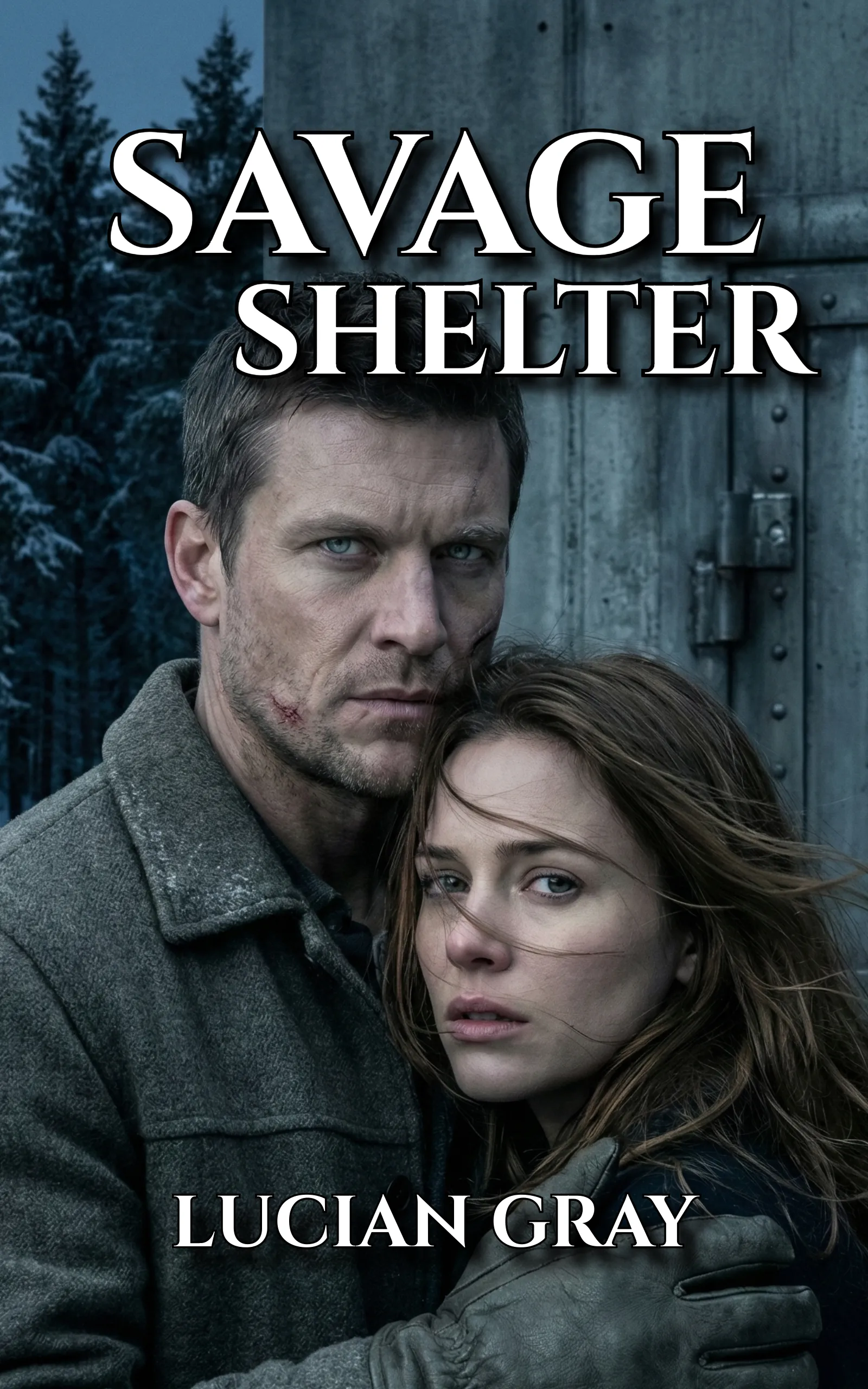
Savage Shelter
A Post-Apocalyptic Dark Romance
The Fallout Chronicles Book 1 • by Lucian Gray
📖 Free with Kindle Unlimited
Pairing: MF
Heat: 🌶️🌶️🌶️🌶️🌶️ Inferno
Tropes: Age Gap, Forced Proximity, Grumpy/Sunshine, Domestic Discipline, Captive Romance
Safe means submissive. Survival means surrender.
Wren Callahan didn’t expect the world to end while she was procrastinating on her thesis. But when the grid goes down and the screaming starts, she has only one hope: the isolated mountain cabin her grandmother used to whisper about.
She expects an abandoned shelter. She finds a fortress—and the man who built it.
Jude Morrow is a ghost. A terrifying, scarred survivalist who has spent twelve years preparing for the collapse. He doesn’t want company. He doesn’t want complications. But when Wren shows up on his doorstep, half-frozen and desperate, he makes her a deal:
My roof. My rules. My consequences.
Jude will keep her alive. He will feed her, clothe her, and protect her from the chaos outside. But inside his bunker, there is no democracy. There is only his order, his discipline, and his absolute control.
Wren thought she was fighting for survival. But as the weeks pass and the heat rises in the underground dark, she realizes she’s fighting a much more dangerous battle—she’s falling for her captor. And he has no intention of ever letting her go.
You’ll love this if you enjoy:
✓ Post-apocalyptic survival romance
✓ Forced proximity in a bunker
✓ Age gap (45/24) with a protective alpha
✓ Domestic discipline and D/s dynamics
✓ “Touch her and die” protector
✓ Grumpy/sunshine with praise kink
✓ Morally gray hero who earns his redemption
⚠️ Content Note: This is a dark romance with captive dynamics, domestic discipline, and explicit content. The hero does morally questionable things. Reader discretion advised.
Savage Shelter features a survival prepper, a woman with no options, and the dangerous line between protection and possession. Guaranteed HEA.
Read Chapter One Free
The orchid was dying.
Wren pressed her thumb against the soil—bone dry, despite the watering she’d done three days ago. The roots were probably rotted through, waterlogged from months of her anxiety-driven overcare before she’d finally backed off. Now she’d backed off too much. Story of her life: overcorrect, then overcorrect the overcorrection, never quite finding the balance that came naturally to everyone else.
She moved the pot closer to the window, adjusting the angle of the leaves toward the fading evening light. Outside, the Oregon mountains rose in the distance, their peaks already dusted with early October snow. Somewhere up there, in a cabin she’d only seen twice in her life, lived the man her grandmother used to call “that Morrow fellow.”
Keeps to himself, Gran had said, but he’s solid. Military, I think. Built that place to survive the end of the world.
Wren had been sixteen the last time she’d seen him—a massive silhouette loading supplies into a truck, not even glancing in their direction as Gran waved from the car. He’d looked like something carved from the mountain itself. Wren had felt a strange flutter in her chest that she’d quickly buried under teenage mortification.
That was eight years ago. She hadn’t thought about him in ages.
Her phone buzzed on the desk, and she abandoned the orchid to check the message.
Sage: You’re spiraling again. I can feel it from Montana.
Wren smiled despite herself. Her sister had always been able to read her from any distance. It was annoying as hell.
Wren: I’m not spiraling. I’m procrastinating. There’s a difference.
Sage: Your thesis is due in three weeks.
Wren: Which is why I’m checking on my plants instead of writing about nitrogen fixation in degraded agricultural soil. Very logical procrastination.
Sage: Wren.
Wren: Sage.
Sage: Just breathe. You’ve got this. Call me tomorrow?
Wren: Yes mom
Sage: Brat. Love you.
Wren: Love you t
The screen went black.
Wren stared at it, waiting for the display to come back. She pressed the power button. Nothing. The phone was fully charged—she’d plugged it in an hour ago.
The lamp on her desk flickered once, twice, and died.
The hum of the refrigerator in the kitchen cut off mid-cycle, leaving a silence so sudden it felt like pressure against her eardrums. Wren stood frozen, phone in hand, as the streetlights outside her window blinked out one by one, a cascade of darkness rolling down the block like a wave.
Within thirty seconds, the entire town went black.
Power outage, she told herself. Happens all the time in autumn. A tree hit a line somewhere.
But her phone was dead too. And through the window, she could see her neighbors emerging onto their porches, holding up their own dark phones, their faces pale smudges in the moonlight.
Wren lit a candle and told herself the power would be back by morning.
It wasn’t.
The first day was confusion.
Nobody’s phone worked. Nobody’s car would start. The woman three doors down had a vintage Volkswagen from the seventies that still turned over, and she drove toward town to get answers, promising to report back.
She never came back.
The second day was denial.
Wren walked to campus and found it deserted, the buildings locked, the emergency lights that should have been running on backup generators dark and silent. She walked to the grocery store and found the doors propped open, employees standing around looking shell-shocked. The registers didn’t work. The freezers were already sweating.
Take what you can carry, a manager was saying. Just take it. It’s going to spoil anyway.
Wren took bread, peanut butter, canned soup, bottled water. She felt like a thief even as she stepped over the spilled milk and broken glass on her way out.
The third day was when people started to understand.
An EMP, someone said. A cyberattack. Both. Neither. Wren heard a dozen theories from a dozen neighbors, everyone gathered on the street because there was nowhere else to go, nothing else to do. The old man at the end of the block had a battery-powered radio that still worked, and he reported fragments of news: infrastructure collapse… cascading failures… please remain calm…
The broadcast cut out halfway through. It didn’t come back.
By the end of the first week, the water stopped running.
Wren filled her bathtub, her pots, her empty bottles with the last trickle from the tap. It wasn’t enough. It was never going to be enough.
By the end of the second week, the sickness came.
It moved through the town like a scythe. Wren heard it through her walls—the coughing, the retching, the crying. Mrs. Patterson next door stopped answering when Wren knocked. The smell started three days later.
Wren stopped knocking.
She stopped leaving her apartment except to collect rainwater from the buckets she’d placed on the fire escape. She stopped talking to anyone. She stopped doing anything except existing, rationing her dwindling food, counting her bottles of water, listening to the world outside her window collapse into something unrecognizable.
She heard screaming on the fourth week. Gunshots on the fifth.
By the sixth week, the only sounds outside were dogs—feral now, running in packs, no longer anyone’s pets. And sometimes, late at night, the sound of footsteps. Voices. People who had survived but become something else. Something that moved through the empty houses taking what they wanted.
Wren pushed her bookshelf against the door. She slept with a kitchen knife under her pillow, though she had no idea how to use it.
She ran out of food on day forty-three.
On day forty-seven, Wren started walking.
The rain had been falling for hours—a cold, relentless autumn rain that soaked through her jacket in minutes. She didn’t care. She couldn’t stay in the apartment anymore. There was nothing left there except stale air and the smell of her own fear.
She carried her backpack—the same one she’d used for hiking with Sage two summers ago, back when hiking was something people did for fun. Inside it: one change of clothes, her grandmother’s pocket knife, a journal she couldn’t remember why she’d brought, and a single bottle of water she’d been rationing for three days.
Her boots squelched against the cracked asphalt as she climbed the mountain road. Every step sent pain shooting through her calves. She’d been sedentary for six weeks, surviving on scraps, and her body had forgotten how to do anything except exist in a small, dark space.
But she remembered the way. Some part of her had never forgotten.
That Morrow man, Gran had said. If you ever need help…
Wren had never needed help before. She’d been aggressively, stubbornly self-sufficient her entire life—working through college, refusing loans from her parents, insisting she could handle her own anxiety without medication, thank you very much. She’d built her whole identity around not needing anyone.
Funny how fast identity crumbled when you hadn’t eaten in four days.
The road narrowed as she climbed, pavement giving way to gravel, then to muddy dirt. The trees pressed close, dripping and dark. Wren’s breath came in ragged gasps. Her vision kept going fuzzy at the edges—dehydration, probably, or the low-grade fever she’d been ignoring for days.
She almost missed the driveway.
It was barely visible, overgrown with brush that looked deliberately unkempt. If she hadn’t been looking for it, she would have walked right past. She turned up the narrow track, her heart pounding so hard she could feel it in her throat.
The cabin appeared through the trees like a mirage.
It looked abandoned. Paint peeling, windows dark, front porch sagging under the weight of dead leaves and neglect. Wren’s stomach dropped. She’d come all this way for nothing. He was gone, or dead, or had never been the kind of man who could help her in the first place.
Then she noticed the details.
The windows weren’t just dark—they were reinforced, the glass thick and multi-paned in a way that didn’t match the rustic exterior. The door was solid steel painted to look like weathered wood. And there, tucked under the eaves where it would be invisible unless you were looking for it, the tiny gleam of a camera lens.
Someone was watching.
Someone was home.
Wren climbed the porch steps on shaking legs. Her hand trembled as she raised it to knock.
The door swung open before her knuckles touched the steel.
He filled the doorway.
Wren had remembered him as large, but memory hadn’t done justice to the reality. He was at least six-three, shoulders broad enough to block the light from inside, built like a man who had spent his life preparing for physical catastrophe. His hair was dark and silver-threaked, cropped short. A thick beard covered the lower half of his face, well-maintained despite the circumstances. His eyes were pale grey, almost colorless, and they were fixed on her with an intensity that made her want to take a step back.
He held a rifle in his hands with the casual ease of someone who had held one every day for years.
“Wren Callahan.”
It wasn’t a question. His voice was low, rough, a sound like boots on gravel.
“You—” She swallowed. Her throat was so dry. “You know who I am?”
“You look like your grandmother.”
He didn’t lower the rifle. He didn’t step back to let her in. He just stood there, blocking the entrance, rain dripping from the eaves behind her as she shivered on his porch.
“Please,” she said. The word came out cracked and desperate and nothing like the strong, capable woman she’d always believed herself to be. “I don’t have anywhere else to go. I don’t have food, or water, or—” Her voice broke. She pressed her palm against her mouth, forcing herself to hold it together. “I’ll do anything. Whatever you need. I can clean, I can cook, I can learn—I’ll follow your rules, whatever they are. Just please. Please don’t send me back down there.”
He studied her for a long, horrible moment. She watched his eyes move across her face, down her body, taking in her soaked clothes, her shaking hands, the hollows of her cheeks that hadn’t been there two months ago.
“You come in,” he said finally, “you don’t leave until I say. Could be weeks. Could be months. Could be longer.”
“I understand.”
“Do you?” He stepped closer, and she caught his scent: pine resin, gun oil, something clean like cold water. “My roof. My rules. My schedule, my resources, my final word on everything. You do what I say, when I say it, no arguments. You try to leave without permission, you don’t come back. You fight me on something critical, there are consequences. I’m not running a democracy down there. You understand what that means?”
Wren’s heart was beating so hard she was sure he could hear it. Some part of her—the part that had gotten a 4.0, that had argued with professors, that had bristled at every suggestion she couldn’t handle things on her own—wanted to turn around and take her chances with the feral dogs and the raiders and the slow starvation waiting at the bottom of the mountain.
But that part was very quiet now.
And there was another part, one she’d never let herself acknowledge, that heard his words and felt something loosen in her chest. My rules. My final word. Consequences.
No more decisions. No more trying to figure out what to do. No more lying awake at night paralyzed by the weight of keeping herself alive.
Someone else would handle it. Someone who knew how.
“Yes,” she whispered. “I understand.”
He held her gaze for one more second. Then he stepped aside and gestured with the rifle toward the dark hallway behind him.
“Inside. Now.”
Wren walked through the door.
Behind her, she heard the locks engage—one, two, three, four separate mechanisms sliding into place, sealing her in.
She didn’t look back.
More Dark Romance
Love survival scenarios and morally gray heroes? Explore more dark romance.
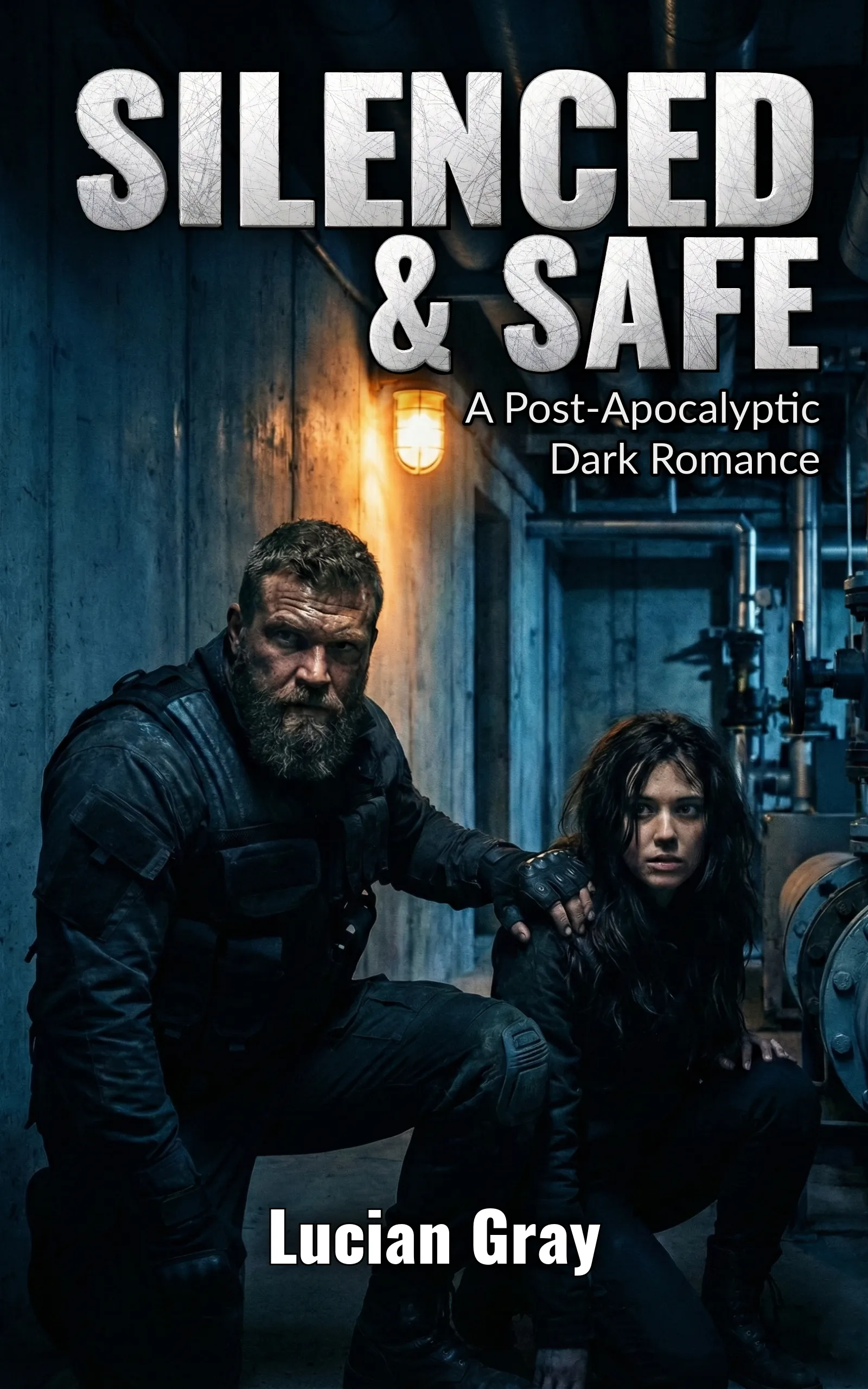
Silenced & Safe
Post-Apocalyptic • Captive
🌶️🌶️🌶️

Strictly Forbidden
Dad’s Best Friend • Age Gap
🌶️🌶️🌶️🌶️

Strings of Ash
Crime Thriller • Mafia
🌶️🌶️🌶️
Frequently Asked Questions
How dark is Savage Shelter?
This is a dark romance with captive dynamics and domestic discipline. Wren enters a situation where she trades her autonomy for safety, and Jude enforces strict rules with physical consequences. The hero is morally gray—he does some things that are genuinely wrong, and the book doesn’t excuse them. If you need clear enthusiastic consent from page one, this may not be for you.
What’s the age gap?
Jude is 45 and Wren is 24—a 21-year age gap. This is explicitly addressed in the text and is part of the power dynamic that drives the story.
Is there domestic discipline (spanking)?
Yes, multiple scenes. This is a core element of the D/s dynamic between Jude and Wren. The discipline evolves as their relationship does—from punitive to something more consensual and negotiated by the end.
Is this a kidnapping romance?
It’s “captive by circumstance” rather than traditional kidnapping. Wren chooses to enter Jude’s bunker because the alternative is death, but once inside, she can’t leave without his permission. The power dynamics are complex and evolve significantly over the course of the book.
Is there a happily ever after?
Always. Every Fractal Enigma book ends with a guaranteed HEA. Wren and Jude earn their ending through genuine growth, honest communication, and earned forgiveness.
Never Miss a Release
Get new release alerts, exclusive bonus content, and reader-only giveaways.