
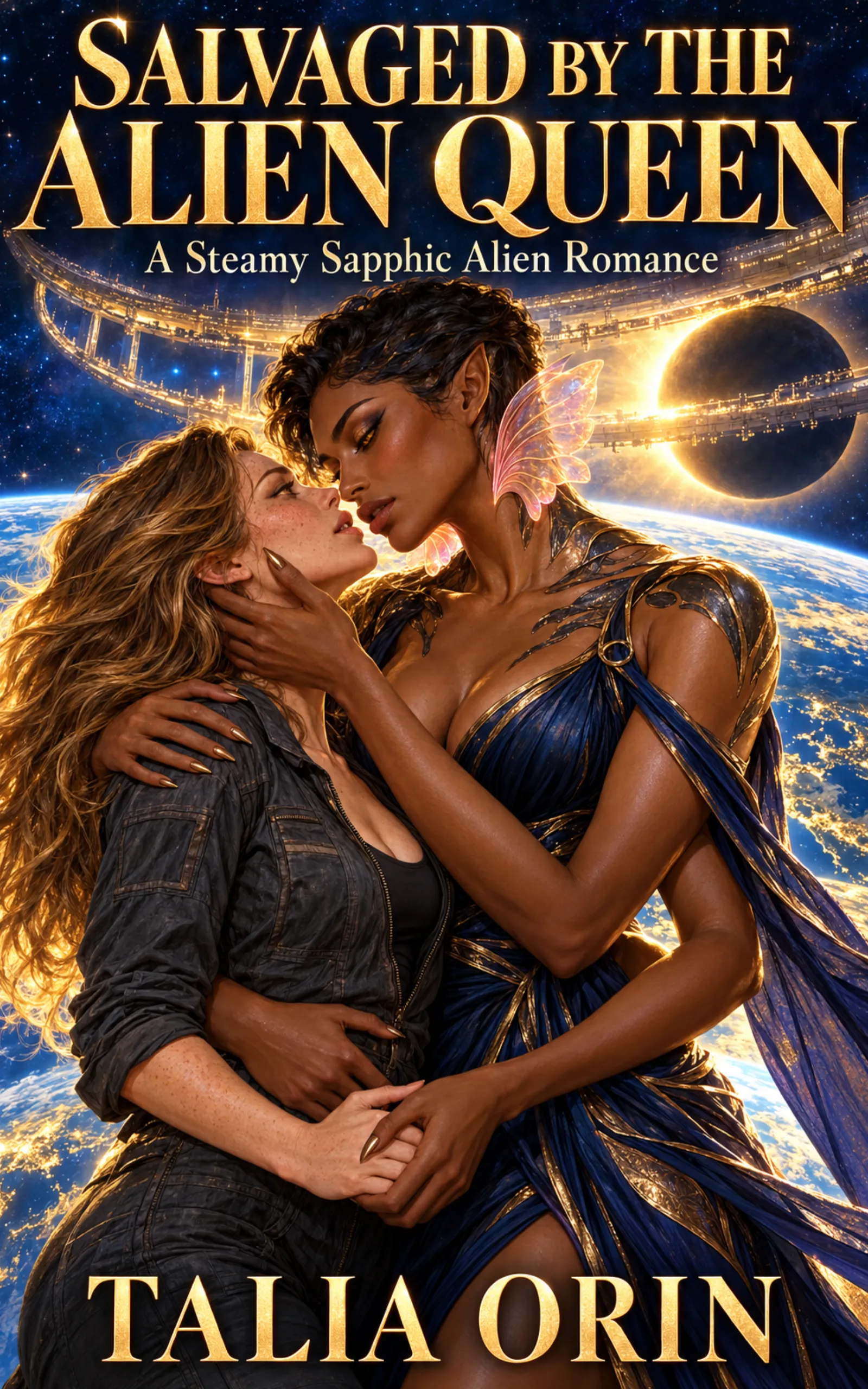
Salvaged by the Alien Queen
A Steamy Sapphic Sci-Fi Alien Romance
by Talia Orin
Shop the ebook · Shop the audiobook
Available at all major retailers
Pairing: FF (Sapphic)
Heat: 🌶️🌶️🌶️🌶️🌶️ Inferno
Tropes: Alien Romance, Royal Romance, Size Difference, Four Arms, Strangers to Lovers, Forced Proximity, Competence Kink, Praise Kink, Touch Starved, Hurt/Comfort, Protector Romance, Rescue Romance, Opposites Attract, Secret Relationship, Professional Boundaries, Found Family, Space Station, Standalone
She came to strip the station for parts. The queen came out to get her.
June Mercer has one job: certify the royal habitat Avarra abandoned, strip its dock fittings for scrap, and collect the bonus that clears the debt about to cost her the only home she has, her battered salvage tug, Magpie.
Then her docking tunnel tears, her suit starts venting, and the airlock in front of her opens by hand.
The figure inside is a towering, armored, four-armed alien queen. And Avarra isn’t empty. Eight thousand people are still aboard, breathing air that runs out in eighteen days.
Queen Ilyra has been holding her failing station together with her own four hands, one sleepless night at a time. She doesn’t need a mouthy human with a creditor’s patch on her shoulder. She definitely doesn’t need to feel June’s heartbeat every time she walks into a room. Her fans can hear it. Every beat.
But someone is sabotaging Avarra. Someone wants it dead on paper by Day 14. And the woman sent to take the station apart might be the only one who can keep it breathing, if the queen will let anyone carry the weight with her.
Salvaged by the Alien Queen is a high-heat sapphic sci-fi romance with a profane, brilliant salvage engineer, a starved and stubborn alien queen, a station full of found family, a lot of very explicit on-page spice (four hands, a hum you can feel in your teeth, and fans that are very sensitive), and a guaranteed HEA. Standalone.
You’ll love this book if you enjoy:
✅ A salvage tech who swears at machines in three languages and fixes them in forty seconds
✅ A towering alien queen who holds a coolant valve shut with her bare hands for nineteen days because nobody else will
✅ Four arms. All of them used. Constantly.
✅ Fans along her throat that read June’s heartbeat from across the room, and the night June finally gets permission to touch them
✅ “Visit or work?”
✅ A contract with June’s no written into it, a workbench, “all four, flat on the bench,” and a queen who has never once been called good
✅ A sabotage mystery, a corrupt Minister, a creditor in very nice shoes, and an arbitration panel that does not care how you feel
✅ A nine-year-old with a clipboard, a cook who won’t let you pay, a furious tiny doctor, and a whole station that learns to ask for help
✅ 🌶️🌶️🌶️🌶️🌶️ heat, HEA guaranteed
⚠️ Content Warning: This novel contains explicit sexual content (graphic FF scenes between a human and a four-armed alien woman, including fingering, oral sex, edging, tribbing, wrists held during sex, praise, and a sex scene during a video call), workplace and industrial hazards (decompression, a suit breach, severe heat exposure, a coolant burn, a near-fatal blast in a confined crawlway), a bleeding wound that will not clot, deliberate sabotage endangering children, low-oxygen and high-CO2 illness including in children, debt coercion and blackmail, themes of deportation, detention camps and families separated, the death of a mentor by fire in backstory, grief, and strong language. Intended for readers 18+.
📖 Read Chapter One Free
Not sure yet? Read all of Chapter One right here.
Chapter One: June
“Easy, sweetheart. Nobody’s asking you to be pretty. Just be on time.”
Magpie answered the way she answered everything, with a long metallic groan that rolled through her frame from nose to engines and settled somewhere in June’s back teeth. The attitude thrusters coughed. The approach display flickered, decided to live, and painted the habitat in thin green lines across the cracked glass.
Avarra.
From four hundred kilometers out it looked like somebody had driven a spear through a wedding ring and then wandered off. The ring turned, slow and stately, catching the interchange beacon’s light along its outer hull. The spear—the central service spine—hung motionless through the middle, studded with dock arms and radiator panels and the black stumps of things that had been torn off or folded away. Two of the big radiator wings at the far end were the wrong color, a dull bruised gray where they should have shone.
“Look at her,” June said. “Royal habitat. Gold leaf on the dock arms, probably. Marble toilets.” She leaned forward and squinted. “Nobody home.”
Nobody was supposed to be home. That was the whole point. The writ on her second screen said so in three languages and under a seal she didn’t recognize, and the writ had been very clear about its feelings.
AVARRA ROYAL HABITAT. STATUS: EVACUATED. DESIGNATION: DERELICT ASSET UNDER CREDITOR REVIEW. CONTRACTOR WILL CONDUCT STRUCTURAL ASSESSMENT, FILE CERTIFICATE OF IRREPARABILITY, AND RECOVER DESIGNATED DOCK FITTINGS PER SCHEDULE C.
Below that, in a smaller font, sat the line June had read so many times in the last week that she could see it on the backs of her eyelids:
COMPLETION BONUS: 220,000 CR. PAYABLE ON FILING.
Two hundred and twenty thousand. Her loan balance with Merrow Asset Recovery stood at two hundred and six thousand, four hundred and eleven credits, and the interest was a living animal that fed on the first of every month.
Fourteen thousand left over. She could replace Magpie’s port thruster bell. She could buy coffee that hadn’t been reconstituted by someone who hated her. She could stop waking up at three in the morning doing math in the dark.
Or she could screw this up, and Merrow would take the ship. Her ship. The only address June Mercer had ever had that nobody could evict her from—right up until she’d signed a predatory equipment loan in a dockside office at Kessler Point because the alternative had been not eating.
“We’re not screwing this up,” she told Magpie. “Right? We’re professionals. We go in, poke a dead station, sign a form, and pull its pretty fittings out like teeth.”
Magpie’s coolant pump made a noise like a dying goose.
“That’s the spirit.”
The long-range scanner chimed as she crossed the two-hundred-kilometer mark. June glanced at it. Then she glanced again.
Heat. Little scattered blooms of it across the ring’s south quadrant, a speckled orange rash. Clustered, too, in a way that made the back of her neck prickle.
She tapped the display. The blooms shivered and held.
“Residual,” she decided. “Thermal mass. Station that size holds heat for months. Reactor’s idling in safe mode.” She tapped it again anyway, harder, as if she could knock the orange loose. “Beacon’s been running a loop since we hit range, too. Somebody left the lights on when they bailed. Rich people. They never turn anything off.”
The beacon was still going, in fact—a low, rhythmic transmission on the emergency band, a voice recording in a language her bargain translator rendered as [VEYR — DIALECT UNRECOGNIZED — UPDATE REQUIRED]. It repeated every forty seconds. The voice was a woman’s, low and even, and there was something in the cadence June didn’t like. It didn’t sound like a recording made by people who were leaving. It sounded like a recording made by someone who was very, very tired.
She turned it down.
Then she turned it off, because she was going to be alone on a derelict for nine days and she didn’t need a ghost.
Merrow’s docking schedule had assigned her to the spine’s far end, Collar Twelve—an emergency transfer collar, decades obsolete, the kind they’d built back when airlocks still came with hand cranks. Every modern berth was flagged SECURED — CREDITOR SEAL, which meant Merrow didn’t want some contractor scratching the expensive arms she was supposed to be pulling off for them. Fine. June had docked on worse. She’d docked on a freighter that was actively on fire.
She brought Magpie in slow, matched the spine’s nonexistent spin, and kissed the old collar with the tug’s nose at less than a centimeter a second. The clamps went in with a sound like a door slamming three rooms away.
“Contact,” June said, and let out the breath she’d been rationing. “See? Professional.”
The collar was too old to hard-seal with her lock. That was in the schedule notes too: contractor will deploy flexible transfer tunnel and manually open station hatch. So she unstrapped, kicked off toward the back of the cockpit, and climbed into her suit.
It was a good suit. It was not a new suit. Very little June owned was new; she preferred things that had already proven they could survive. The left gauntlet’s wrist seal had been replaced twice. The helmet had a scratch at eye level she’d stopped seeing years ago. She dogged it down, ran the checks, and watched the green lights come up one by one like reluctant witnesses.
“If I die,” she told the empty cabin, “I want it on record that I was right about the coffee filters.”
She ran the tunnel out. It snaked from Magpie’s belly lock across three meters of nothing and cupped the station collar like a mouth, inflating with a soft rustle she felt through her boots. Pressure equalized. Green. She cycled the inner hatch, stepped into the tube, and let Magpie seal behind her.
The tunnel was pale and ribbed and faintly translucent. Through it she could see the station hatch ahead, a thick circle of dull metal with a recessed manual crank. Beyond the walls of the tube: stars. Below her boots: the long dark body of the spine dropping away into shadow.
She pushed off and drifted toward the hatch.
Halfway there, the collar screamed.
Not metaphorically. The sound came through the tunnel wall and her suit and her bones—a long, rising shriek of metal grinding metal—and the whole tube jumped. June slammed shoulder-first into the ribbing. Her helmet rang. Through the scratched visor she watched the far end buckle where it met the collar, the seal ring peeling back like a lip.
“No,” she said. “No, no, no. That’s a good seal. I checked that seal—”
The tunnel went soft around her. Not all at once. A slow, horrible sag, like a lung emptying. Her suit’s outside-pressure readout started counting down in red.
She twisted toward Magpie’s hatch.
The indicator above it was red too. While she watched, the inner safety bolts shot home with a heavy chunk she felt in her molars.
Interlock. The tunnel was losing pressure, so Magpie had done exactly what June had programmed her to do years ago, when she’d been younger and dumber and very proud of her own safety logic: sealed the ship to protect the ship. That hatch wasn’t opening until the tunnel repressurized.
The tunnel was not going to repressurize.
“Oh,” June said. “Oh, you idiot. I made you do that. I literally coded that.”
She got to the hatch anyway and punched the override. Nothing. Again. The panel flashed TUNNEL INTEGRITY FAULT — LOCK HELD in friendly blue letters.
Fine. Fine. She had a suit. Suits were for this. She’d hang in the tube and call—call who? Merrow’s nearest tug was six days out. Avarra was empty. Kessler Point traffic control was two light-minutes away and one hundred percent unwilling to care.
The collar shrieked again. The tunnel lurched, and something on its torn edge—some jagged rib of old metal—came swinging inward and caught her left forearm.
She felt it as a tug. A snag. Nothing, really.
Then her suit started screaming.
SUIT BREACH. LEFT WRIST SEAL. INTERNAL PRESSURE DROPPING.
June looked down. The wrist seal—the twice-replaced, really-should-have-been-three-times-replaced wrist seal—was venting a thin bright plume of freezing air into the dark. It sparkled. It was honestly very pretty.
“Shit,” she whispered.
The suit’s calm, female, deeply unhelpful voice informed her that at the current loss rate she had approximately four minutes of breathable atmosphere.
She clamped her right glove over the wrist. The plume narrowed but didn’t stop; you couldn’t hold a seal with a glove, the geometry was all wrong. Her patch kit was in the thigh pocket. She went for it one-handed, and the tunnel bucked and spun her, and the kit slipped out of her fingers and tumbled lazily away down the sagging tube toward the station hatch, end over end over end.
“Okay,” June said. Her voice sounded very far away inside her helmet. “Okay. That’s fine. Great development. Love that for me.”
Three minutes forty.
She kicked after the kit. The tunnel was mostly vacuum now, flaccid and twisting; it wrapped around her legs like wet laundry. The station end had torn halfway free of the collar, and through the gap she could see raw stars. If it tore the rest of the way, the tunnel would whip loose, and so would she, and she would become a very small piece of debris with a very pretty plume coming out of its wrist, falling forever past the royal habitat of Avarra.
Three minutes ten.
She caught the kit. Her left fingers were going numb—cold leaking in with the vacuum—and she couldn’t get the tab open with one hand. She tried with her teeth before remembering she was wearing a helmet.
A laugh came out of her. A bad one. High and wet.
“Mom,” she said, to nobody, “I’m sorry I said salvage was safer than the refinery.”
Something hit the station hatch from the other side.
June froze.
It came again. A deep, ringing thoom she felt through the floor of the tunnel, through her palms where they pressed the old metal. Then a grinding, shuddering vibration, slow and rhythmic, like a giant clearing its throat.
The crank on the hatch face was turning.
By itself. No—not by itself. From the inside. Somebody on the other side of a door on a dead station was spinning a hand crank that hadn’t been touched in thirty years, and they were spinning it fast.
“Hello?” June said stupidly, as if they could hear her. “Hi? I’m—hi?”
The hatch cracked. A thin ring of light appeared around its rim, then the faintest puff of nothing—whoever was on the other side had already evacuated their own lock before opening it, smart, so smart—and the hatch swung inward.
A shape filled the circle.
Big. That was the first thing. Huge, the top of the helmet nearly brushing the rim, shoulders so broad they didn’t look human—and they weren’t human, because the suit had four arms.
Four. June counted, through the haze of cold and panic and her own idiot laughter. Two at the shoulders, thick and powerful. Two lower, at the ribs, slimmer, moving with a quick and precise kind of grace. The suit was deep bronze and battered, and there was a crest on the chest plate, something gold, a ring with a spear driven through it. A voice came over the emergency band in heavily accented Standard, low and level and absolutely calm.
“Open, confirmed. I have her.”
The upper arms reached out.
One hooked the hatch rim, braced, and locked. The other caught June around the waist and simply took her. Plucked her out of the collapsing tunnel the way June would pick up a dropped wrench—no strain, no hesitation—and hauled her through the hatch and against that broad armored chest. The lower arms were already moving. One closed over her venting wrist and clamped down hard. The other snatched the drifting patch kit out of the air without looking, thumbed the tab open, and pulled the sealant strip free in a single motion.
“Hold still,” the voice said.
June hadn’t planned on doing anything else. She hung in the circle of those arms with her heart trying to climb out through her mouth and watched a stranger’s lower hand wrap sealant around her wrist in three tight, neat turns. Press it. Smooth it. The alarm in her helmet stuttered, wailed once more out of pure spite, and went quiet.
SUIT BREACH SEALED. INTERNAL PRESSURE STABILIZING.
Behind them, the hatch boomed shut. The stranger hadn’t even turned around. One upper arm had swung it closed while the other held June still, and now that hand was on the inner crank, spinning it, the whole lock vibrating with the force.
June became aware of several things at once.
She was inside an airlock. A real one, narrow and ribbed and dim, lit by a single red emergency strip. She was alive. Her suit was holding. Her left hand was all pins and needles and her face was wet with tears she had no memory of crying.
And she was being held.
Not supported. Not steadied. Held. The upper left arm was wrapped around her waist, locking her back against a chest that felt like the side of a ship. The lower left hand still rested over her patched wrist, warm through two layers of gauntlet, the thumb pressing the sealant as if it didn’t quite trust it yet. A third hand—lower right—lay spread flat between her shoulder blades, keeping her from tumbling in the low gravity. It wasn’t doing anything. It was just there. Steady. As if whoever this was had decided June would not be floating away, and that was the end of the discussion.
Nobody had ever held June like that. Not once. Not in thirty-four years.
“Pressure in ninety seconds,” the voice said, close to her helmet. “Are you injured anywhere else?”
“I—” June swallowed. “No. Wrist. Just the wrist. Thank you. Holy shit. Thank you. Who—”
“Breathe. Do not talk.”
“Okay. Sorry. I talk when I’m—”
“I know.” Was that amusement? Hard to tell over the comm. “Breathe anyway.”
She breathed. The repressurization hiss filled the lock, a rising, comforting roar, and she felt the walls of her suit ease as outside pressure climbed to meet them. The red strip shaded orange, then amber, then a soft clean white.
Through her scratched visor she could see the stranger’s helmet over her shoulder. The faceplate was tinted, but this close she could make out shapes behind it. Bronze skin. A strong jaw. Something pale and folded along the sides of the neck, like the closed wings of a moth.
The lock chimed. Green.
“You may remove your helmet,” the stranger said, and then, before June could fumble for the latches with her dead hand, one of those lower hands did it for her. Click. Click. Twist. The helmet came away, and the station’s air hit June’s face—cool and dry, smelling of metal and old greenery and something she couldn’t name, faintly like sun-warmed stone and citrus peel.
She gulped it like water.
The stranger let her go. Slowly, June noticed—one arm at a time, as if checking that she could stand. June could, barely. The gravity out here at the spine end was a joke, maybe a fifth of standard, and her knees had apparently filed for divorce. She grabbed a handhold and turned around.
The stranger was taking off her own helmet.
Her, June’s brain supplied before her eyes had caught up, and then her eyes caught up and her brain shut off entirely.
She was tall. Not just tall—six-two, six-three, and built like she’d been designed to carry things. Her skin was deep bronze, warm and smooth across high cheekbones, and over her shoulders and along her collarbones, where the suit’s neck ring opened, June could see plates. Actual armor plates, darker than her skin, a bronze-black like old coins, fitted to her body like they’d grown there, because they had. Her hair was black and cropped close to her skull. Her face was long and severe and devastating, with a mouth that looked like it had forgotten how to smile but might remember if someone gave it a good enough reason.
And her eyes were gold. Not hazel, not amber. Gold. Molten. As June stared, a second lid, thin and clear as glass, slid sideways across them and back. A blink, but not a human one.
Along both sides of her neck, the pale folded things began to open. Slowly. Delicately. They were fans—thin, ribbed, translucent membranes the soft gray of a winter morning, unfurling from a firmer collar of tissue at the base of her throat. They lifted, spread a few centimeters, and trembled in the still air of the lock.
They were angled toward June.
June felt them like a hand on her skin, which was insane, because nothing was touching her. They were just—pointed at her. Listening.
“Hi,” June said. It came out a croak.
The alien woman looked at her. Up and down, unhurried, gold eyes taking inventory. The fans quivered once and settled.
“You are human,” she observed.
“Last time I checked.” June wiped her face with the back of her good glove and was horrified to find it soaked. “Sorry. That’s—that’s suit sweat. Very common. Occupational hazard.”
“Of course.”
“You have four arms.”
“Yes.”
“That’s—cool. That was very useful. Back there. All of the arms.” Shut up, June. “Really great arms.”
The woman’s mouth did something. A tiny shift at one corner, there and gone. June would think about that later, at length, in the dark.
Out of the helmet, up close, she looked exhausted. It was in the dull grayish cast under her eyes and in the way her upper shoulders sat—braced, the way June’s shoulders sat at the end of a forty-hour salvage shift once she’d stopped being able to feel her own body. There was a smear of something dark on her lower plating. Grease, probably. One of her lower hands had a faint tremor in it, and she seemed to notice June noticing; she closed it into a fist, and the tremor stopped.
“You came in on the old collar,” the woman said. “Why?”
“It’s where I was assigned.” June jerked her chin back toward the hatch, toward the tunnel and Magpie and the whole disaster. “My ship’s on the other side. She locked herself—long story. I set her up that way. I’m an idiot. Is she—can you see if she’s okay? The collar was tearing.”
“The collar is old. It tears.” The woman tapped something at her wrist. A small display bloomed across her forearm plating, all curling script June couldn’t read. “Your ship is clamped. Her hull is intact. The collar is not. Your vessel will not be going anywhere for some time.”
Relief hit June so hard her knees went again. She hung on to the handhold and laughed—a real one this time, ragged at the edges.
“Okay,” she said. “Okay. She’s okay. Good girl.” She looked up. “Sorry. Not you. The ship.”
“I assumed.”
“How did you even—” June waved helplessly at the hatch. “How did you know? How were you here? This station’s empty. It’s on the registry as evacuated. I’ve got a writ that says—”
She stopped.
The woman was looking at her very steadily now, and something in that look had gone cool and flat as a closed door.
“You’re supposed to be empty,” June finished, quieter.
The fans along the woman’s throat folded halfway back. Not all the way. Just enough.
“So I’ve been told,” she said.
The silence stretched. Somewhere deep in the station a pump thudded, irregular, like a heart with a skip in it. June listened to it and felt the hairs on her arms lift inside her suit. Residual heat, she’d told Magpie. Thermal mass. Rich people never turn anything off.
“The beacon,” June said slowly. “On the emergency band. That was you.”
“That was me.” The woman’s voice didn’t change, but one of her upper hands flexed on the rail beside her. “I have been broadcasting for thirty-eight days. I am told no one listens to the emergency bands near this interchange anymore.”
“My translator didn’t have the dialect,” June said, and heard exactly how pathetic it sounded. “I turned it off. I thought it was a ghost.”
Something moved behind all that gold. Not anger, exactly. Something older and more tired than anger.
“Many people have thought that,” she said.
June opened her mouth. Shut it. There was nothing to say to that. She’d been in the business long enough to know what derelict meant on a registry, and what it did to the people still aboard a station when the paperwork decided they weren’t—but that happened on shitty mining platforms and company towns. The kind of places June had grown up in. Not royal habitats. Not places with gold on the dock arms.
“I’m June,” she said instead, because her mother had raised her to give her name to people who saved her life. “June Mercer. Mercer Recovery. It’s—it’s just me. And the ship.” She held out her good hand, then hesitated, because she had no idea whether four-armed aliens shook hands or whether she was about to commit some grave diplomatic atrocity.
The woman looked at the hand.
Then one of her lower hands came up and closed around it.
It was warm through the glove—warmer than June expected, broad and firm, and even through the layers she could feel something textured in the palm, a fine ridged grip that caught and held. The hand stayed exactly as long as was polite. Then a beat longer.
The fans along her throat lifted again. Quivered. June had the absurd feeling she was being read, somehow, like a pressure gauge, and that whatever the needle said, it was embarrassing.
“Ilyra,” the woman said.
“Just Ilyra?”
That tiny shift at the corner of her mouth again. “For now.”
She let go. June’s hand felt strange and empty without it, which was a stupid thing to feel about a stranger’s hand. She was in shock. That was all. Shock and adrenaline and almost dying and the fact that she’d just been carried through an airlock against a chest like the hull of a cathedral by a towering alien woman with molten eyes and a voice like a big engine idling warm—and none of that was a reason to feel anything at all. Certainly not the low, slow, deeply inappropriate heat curling somewhere south of her suit’s belly seal.
Fantastic, June. You nearly died, and your first reaction is thirst. Very healthy. Dana would be so proud.
“Okay,” June said. “Ilyra. Thank you. Seriously. I owe you my life. I don’t really have a way to pay that back, but I’ll fix whatever you need fixed. I’m good with collars. Old systems. Hand cranks.” She tried a smile. “Obviously not great with collars, given the last ten minutes, but—”
“You came on a writ,” Ilyra said.
June’s smile died.
Ilyra wasn’t looking at her face anymore. She was looking at June’s left shoulder. At the patch sewn onto the suit’s outer layer, where every contractor had to wear the sigil of whoever was paying them: a stylized black hook over a bar of white, and beneath it, in clean block letters, MERROW ASSET RECOVERY — AUTHORIZED SALVAGE.
“That’s—yeah.” June’s hand drifted up to cover it, which was useless and stupid and made her feel about twelve years old. “It’s a contract. It’s just a job. I’m doing an assessment, that’s all, that’s—”
“An assessment,” Ilyra repeated. “Of what?”
“The station. Structural. For the creditor review.” June could hear her own voice speeding up. “Look, I didn’t know anyone was here. The registry says evacuated. Merrow said evacuated. My writ says—”
“Tell me what your writ says.”
June swallowed. The alien woman’s voice hadn’t gotten louder. If anything, it had gotten softer, the way June’s mother used to go quiet right before she found out what June had done.
“It says I file a certificate,” June said. “That the station’s irreparable. And then I strip the dock fittings. For resale.”
The fans along Ilyra’s neck folded flat. All the way, this time, pressed against her throat like something closing its eyes.
She didn’t say anything. She turned to the inner hatch—modern, thank God, with a touchpad—and laid one upper hand flat against the panel. The lock hummed. The seals let go with a soft pneumatic sigh, and the door slid open.
June had braced for a dead corridor. Cold, dark, emergency strips on the floor, dust drifting in the air.
The corridor beyond Lock Twelve was lit.
Dimly—half the panels were dark and the rest were turned down low—but lit. It was warm, too, a real warmth that rolled over June’s face and smelled of bodies and cooking and machine oil. Cots lined the walls. Folding ones, mismatched, shoved end to end, some heaped with blankets, some with bags and bundles. A string of paper cutouts—little ring shapes, a kid’s craft project—had been taped along a conduit overhead.
And there were children.
A lot of them. Seven or eight right at the front, crammed into the corridor’s mouth like they’d been waiting there a long time and nobody had told them to leave. A human girl of maybe nine, missing two front teeth, a massive wrench clutched in both hands. A pair of Veyr kids—small and bronze, the plates on their shoulders still pale and soft-looking, four skinny arms apiece—holding hands with two of them and clinging to a rail with the other two. A tiny boy of some species June didn’t recognize, with dark blue skin and enormous black eyes, sucking his thumb.
They were all staring at June.
No. Not at June. At her shoulder.
The girl with the wrench took one step forward. She looked at the Merrow patch, then up at June’s face, then at Ilyra. Her expression was the very specific expression of a child who has heard adults whispering about something for a very long time and has just watched it walk through a door.
“Majesty,” she said. “Is that her? Is she the one who’s going to take the station apart?”
Majesty.
June looked at the crest on the bronze chest plate. The ring. The spear. The shape of the station she’d stared at for four hundred kilometers, thinking nobody home.
Nobody answered the girl.
June stood there in her ruined suit with her patched wrist and her helmet dangling from one hand, and for the first time in her whole loud, joking, keep-talking-until-it’s-okay life, she couldn’t think of a single thing to say.
Beside her, Ilyra looked down at the patch one more time. When she spoke, it wasn’t to the children. It was to June—low, almost gentle, which was so much worse than angry.
“You’ve come,” the queen of Avarra said, “to take my home apart.”
Want to keep reading? The full novel is available now.
🔥 Want an EXCLUSIVE Bonus Chapter?
Item Fourteen — A scene TOO HOT for the bookstore
Just after the epilogue, June finally gets the queen of Avarra off her station for two weeks. Magpie is parked over a ringed blue planet, the new bunk is big enough for two, and item fourteen on June’s list says Do absolutely nothing. Ilyra has no idea how. June is going to teach her. No gravity. Four hands. And for the first time, June’s mouth on her fans.
More from Talia Orin
Browse all Talia Orin books.

Salvaged by the Alien Queen
She came to strip the station for parts. The queen came out to get her.
Never Miss a Release
Get new release alerts, exclusive bonus content, and reader-only giveaways.