
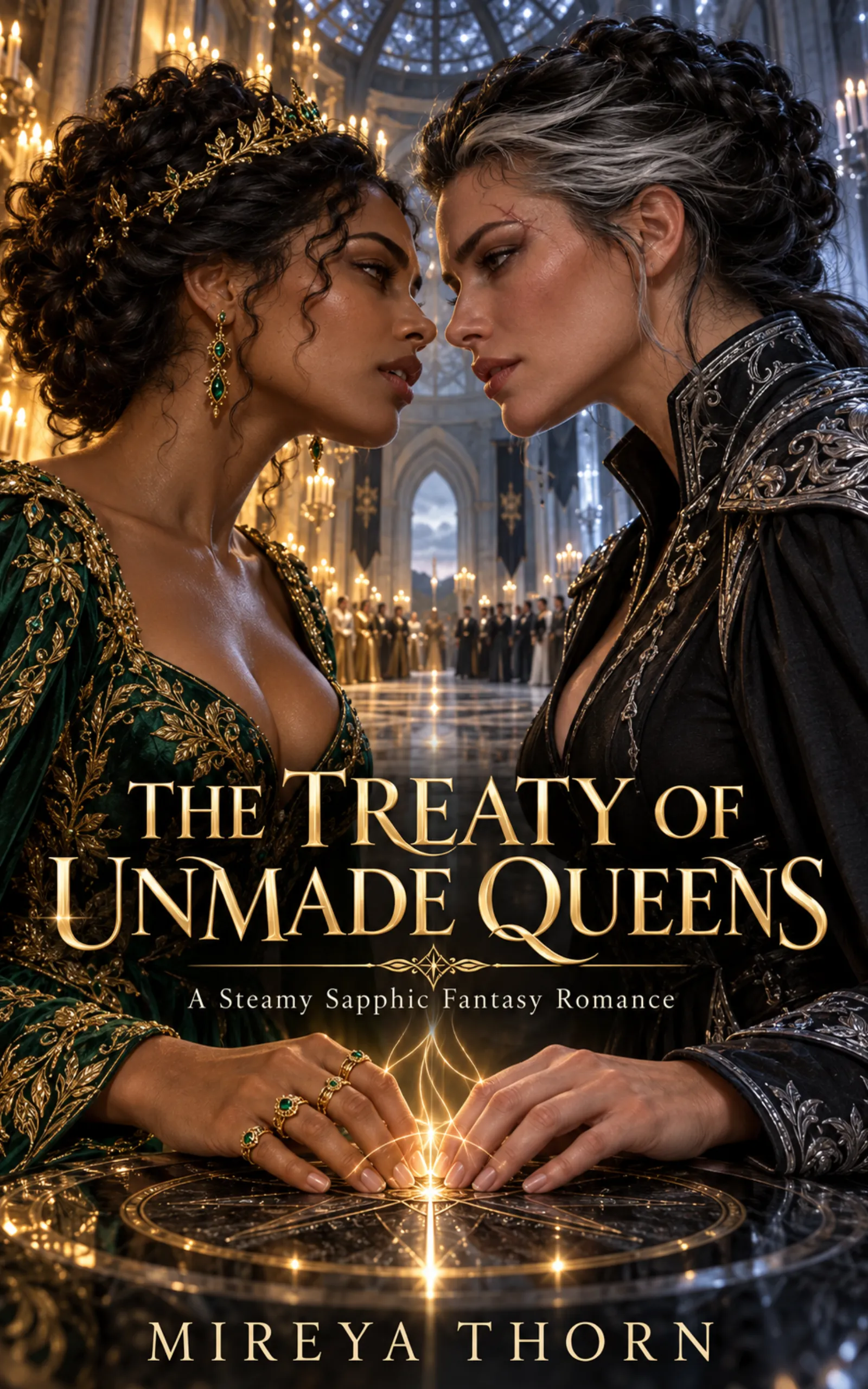
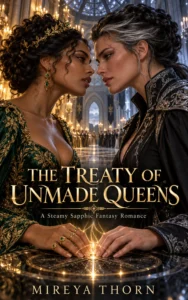
The Treaty of Unmade Queens
A Steamy Sapphic Enemies-to-Lovers Romantasy
by Mireya Thorn
Shop the ebook · Shop the audiobook
Available at all major retailers
Pairing: FF (Sapphic)
Heat: 🌶️🌶️🌶️🌶️🌶️ Inferno
Series: The Unmade Crowns, Book 1
Tropes: Enemies to Lovers, Marriage of Convenience, Rival Queens, Magical Bond (Shared Sensation), Forced Proximity, Royal Romance, Contract with Rules, Hurt/Comfort, Touch Starved, Competence Kink, Control/Surrender, Strap-On, Voyeurism, Dirty Talk, Scar Worship, Mutual Pining, Secrets & Betrayal, Grovel, Political Intrigue, Grief Recovery, Series (Book 1, complete HEA)
We married to save the treaty. Then the seal let me feel everything she feels.
Ilyra Vey, queen of Avarra, knows the name of every person she has ever failed. Six years ago she dropped a bridge on an army and a hundred and forty refugees. She reads their names in chapel every year until her voice gives out.
Sabine Daur, queen of Ordel, led that army. Her brother died on that bridge. She has spent six years calling Ilyra a murderer, and she has never once said what she did on that road herself.
Now the forty-year-old treaty that holds their kingdoms apart is failing. Roads fold under the grass with carts still on them. Rivers run backward. Whole villages vanish from the map. The only door into the treaty’s heart opens for a joint royal household, which means the two women who hate each other most in the world have to get married. Fast.
Ilyra writes the contract herself: separate rooms, a connecting door locked from both sides, a kiss at the wedding of no more than two seconds, and clause twelve in letters an inch high. No presumption of consummation.
The kiss lasts five seconds. And when their hands meet on the wedding seal, the treaty binds them the only way it knows how. As one body. Every heartbeat, every ache, every touch, felt by both. That first night, through two locks and a stone wall, Sabine feels Ilyra slip into her bath. Then she feels her hand.
Iron cuffs can muffle the Bind. Nothing can muffle what’s under the treaty: a city sealed inside a mountain, a third party erased from every history, a Chancellor with forty years of secrets, a marshal with four companies a day’s ride away, and a sealed letter Ilyra sends to her Assembly without telling the one woman who can feel her lie.
The Treaty of Unmade Queens is a high-heat sapphic romantasy about two rival queens in a political marriage with very strict rules, a magical bond that makes every scene of very explicit on-page spice felt twice (bath voyeurism, a mill in the rain, a buried city, a harness, and a love that has to survive losing the magic), a real betrayal and a real grovel, and a guaranteed HEA. 88,000 words. The Unmade Crowns, Book 1, with a complete romance and a happily ever after.
You’ll love this book if you enjoy:
✅ Rival queens who wrote a 31-page marriage contract and broke clause twelve in the first week
✅ A wedding kiss contracted at two seconds that lasts five, and they both counted
✅ A magical bond that lets them feel everything the other feels, and iron cuffs that only come off by your own hand
✅ A bath, a locked door, and a queen who knows exactly whose touch she just felt, and doesn’t stop
✅ “Tell me yes or tell me stop.”
✅ A late-night tea ritual in a corridor exactly halfway between two doors
✅ “Solution, argument, or company?”
✅ A soldier queen who has never once asked to be the one it’s done to, until she hands over a harness and asks
✅ A buried city, a dead steward’s seal, and a surveyor who refuses to let either queen be sorry at her
✅ A betrayal you can feel coming through the Bind, and a public confession with no rings on
✅ Losing the magic, and finding out they have to ask now, out loud, every time
✅ 🌶️🌶️🌶️🌶️🌶️ heat, HEA guaranteed
⚠️ Content Warning: This novel contains explicit sexual content (graphic FF scenes including mutual masturbation through a magical bond, voyeurism, oral sex, fingering, tribbing, face-sitting, a strap-on, praise and dirty talk, and light restraint), war backstory including the deliberate destruction of a bridge with civilian deaths and the death of a sibling, on-page deaths including a named soldier, an arson attack, a buried city and the historical forced displacement of a people, political betrayal, lying by omission between the leads, a mother’s death (backstory), injury and chronic pain, fear of the dark and a panic episode, and strong language. Intended for readers 18+.
📖 Read Chapter One Free
Not sure yet? Read all of Chapter One right here.
Chapter One: Ilyra
The stone said Ennet was two miles east, and there was no such place.
Ilyra Vey had read the royal survey of the Whiteglass March three times on the ride north from Belisar. She had read it by lamplight in a coaching inn that smelled of tallow and wet dog, and again in the saddle by the first grey of dawn, and she knew every name on the eastern sheet the way she knew the names of her ministers’ children. Lowmere, the crossing village behind her. The bridge. The river Sere. On the far bank, a strip of Ordeli grazing, a contour line, and the frontier road climbing toward Karsen.
No Ennet.
The marker didn’t care what the survey said. It stood waist-high at the edge of the bridge road, older than the paving around it, its letters cut deep and furred with lichen. ENNET — 2. An arrow beneath, pointing straight at the river.
“Majesty.” Captain Mera Tal arrived at her elbow the way weather arrived, without announcement. “The engineers would like you off the road.”
“The engineers would like a great many things.” Ilyra crouched, heedless of her riding skirts, and brushed lichen from the arrow with her thumb. Her rings caught on the stone. “Who set this?”
“Couldn’t tell you. Somebody who could spell.”
“It isn’t on the survey.”
“Then the survey’s wrong.” Mera said it the way she said most things, as if the world had disappointed her early and she’d decided not to hold it against anyone. “It’s been wrong about four things since we crossed the canal. Majesty. The road.”
Ilyra stood. Lowmere was waking around them, or trying to. Forty-odd roofs of grey slate, a tannery whose stink rolled downhill with the mist, a market square already half-full of carts loaded with whatever people valued most — bedding, a grandfather clock, a goat with an expression of profound betrayal. The reeve had sent word to Belisar six days ago: the road is shortening. The Assembly had called it a clerical error. Ilyra had called for her horse.
“That’s my gran’s house.”
The girl was perhaps eight, sitting on a pile of sacks by the marker with her chin in her fists. Brown braids, one shoe, and the solemn certainty of a child who has been disbelieved by every adult she’s met that morning and has decided to try one more.
“Where?” Ilyra asked.
The girl pointed past the arrow, past the bridge, at the eastern bank. “Ennet. By the ferry steps. She keeps hens.”
“There’s no ferry on the Sere, sweetheart.”
“Not now.” Withering. “She says there was.”
“Nell.” A woman descended on the sacks, red-cheeked, and hauled the girl up by one arm. She saw the gold at Ilyra’s throat and the Avarran crest on Mera’s breastplate and went white. “Majesty — forgive her. My mother-in-law tells stories. There’s no Ennet. There’s never been an Ennet.”
“Of course,” Ilyra said gently, and smiled, and watched them go, and filed the name away in the part of her mind where she kept things that didn’t fit.
Then the ground tore.
It didn’t sound like an earthquake. Ilyra had felt two of those as a girl, and they had sounded like the world clearing its throat. This was finer and worse — a long ripping hiss from somewhere under her boots, like silk drawn slowly across a blade. The mule hitched to a cart on the bridge approach threw up its head and screamed.
Forty yards ahead, the road creased.
Not cracked. Creased. The paving lifted along a line as straight as a ruler, rose into a ridge, and folded over on itself like the page of a book being turned by a careful hand. The cart was on the wrong side of the fold. A man on the bench, a woman beside him with a crate of jars in her lap — Ilyra saw the woman’s face turn toward her, saw her mouth open — and then the land laid itself down over them, gently, and lay flat.
Grass. Sunlight on dew. The road ran on toward the bridge, and it was shorter by exactly the length of one cart, one mule, and two people.
The mule’s scream stopped in the middle.
For one second Ilyra was not a queen. She was a body standing in a road with its heart trying to climb out of its mouth, and the silence where the scream had been was the loudest thing she’d ever heard.
Then she was a queen again, because someone had to be.
“Mera. Nobody on the bridge road. Nobody.”
“Already —”
“Dorran!” The reeve was a big man with flour on his sleeves, frozen by the well. Ilyra made her voice carry the way her mother had taught her, low and absolute. “Everyone west. Not the market road, the canal towpath, it’s on bedrock. Tell the tanner to leave the hides. Tell the Forran sisters to leave the clock. Anything that can’t be carried in two hands stays.”
“Majesty, the east landing —”
“I see it.”
She did. The bridge was five spans of honey-colored stone, built forty years ago when the treaty was new and both crowns had wanted something handsome to look at. On the far side, the Ordeli bank held a scatter of houses — the east landing, the survey called it, as if it had no name of its own — and people were pouring out of them toward the bridge, because the bridge was the way home, the way west, the way anywhere.
And under the third span, the river was flowing the wrong way.
Ilyra watched the brown water curl back on itself and climb the pier, and her stomach dropped. “Engineer Dace.”
Corwin Dace was already beside her, grey-bearded and chalk-dusted, staring at the river the way men stare at a dog they’ve just seen speak. “That pier’s going to shear, Majesty. The ground under it’s moving. I don’t know where it’s moving to.”
“How long?”
“An hour. Ten minutes. I don’t — I’ve never seen land do this.”
“Then you’re about to be the expert. Barges off the canal, all of them. Timber, rope, every block and tackle in the village. I want the third pier braced from the water.”
“From our side? The current’s —”
“From whichever side keeps it standing.”
Dace ran. Ilyra didn’t. She walked the market square with Mera a pace behind, because running queens started stampedes, and she said names as she went. Hanna, take your father’s other arm. Joss, the goat can walk, put it down. Widow Teague, I know, I know, I’ll send a cart for the loom tomorrow, I swear it on my mother. People moved when their names were said. They always had. It was the oldest trick she knew and the only one that had never failed her.
She counted as they passed onto the towpath. Thirty. Fifty. Eighty-one. The reeve’s roll said a hundred and twelve.
The cart was two. She didn’t know their names. She would find out.
There were people on the bridge. A dozen, then twenty, running west across the honey stone with children on their hips. And the middle span was beginning, very quietly, to sag.
The horns came first.
Ordeli horns had a sound you didn’t forget once you’d heard it across a battlefield — flat, brass-throated, two notes falling like a door slamming twice. Ilyra had heard them last at the Red Ford, six years ago, through smoke. Her body remembered before her mind did. Her hand went to her hip, where she hadn’t worn a sword since her coronation.
On the eastern ridge, cavalry crested against the dawn. Black pennants. Grey horses. Perhaps sixty riders, coming down the frontier road at a pace no sensible officer would allow on wet stone.
“Well,” said Mera, very flat. “Fuck.”
“Hold the archers.”
“I didn’t bring archers. You told me not to bring archers. You said, and I’m quoting, ‘it’s a relief visit, Mera, not a provocation.'”
“Then hold whatever you brought.”
The rider at the front wore no helmet. Ilyra would have known her anyway. Some people were recognizable by their shape against the sky, and Sabine Daur had the kind of shape that made other people step back without knowing why — tall in the saddle, broad through the shoulders, all that iron and black leather sitting on her like she’d been born in it. Dark hair pulled back hard. Even at three hundred yards, the silver at her temples caught the light.
Six years. Six years of letters through intermediaries, of ambassadors who swallowed their words, of portraits in other people’s halls that made her look older and crueler than she was. Ilyra had imagined this moment so many times she’d worn grooves in it. In every version, she was ready.
She was not ready.
Sabine didn’t stop at the east landing. She didn’t send a herald. She didn’t so much as glance at the Avarran crests on the western bank. She put her heels to a grey warhorse the size of a hay cart and rode straight onto the failing bridge.
“She’s going to kill herself,” Dace breathed.
“No,” Ilyra said. “She isn’t.”
She didn’t know how she knew. She knew.
Sabine went across the first span at a canter and the second at a trot, and her riders came behind her in pairs, and on the sagging middle span she reined in hard among the people who had frozen there — a grandmother with a cane, a boy with a lamb in his arms, a man who had simply sat down and put his hands over his head. Ilyra watched Sabine lean from the saddle and haul the grandmother up in front of her like a sack of oats. Watched her shout something, and the riders behind her break into pairs again, each one scooping up a body and wheeling back east.
Back east. Into Ordel.
“She’s taking them,” Mera said.
“She’s taking them off the span.” Ilyra’s voice came out steadier than she felt. “The east side’s nearer from the middle. It’s the right call.”
She hated that it was the right call. She hated more that she’d have made the same one, slower.
The middle span groaned. A crack ran across the parapet like a vein opening. Sabine’s horse reared, and for one stupid, lurching heartbeat Ilyra’s whole body went tight — and then Sabine had it down, had it turned, had the boy with the lamb tucked against her hip with one arm, and was riding east with the stone breaking behind her hooves.
Ilyra let out her breath.
“Majesty.” Dace. “The barges.”
“The third pier. Go.”
“They’ll be working under Ordeli —”
“They’ll be working under a bridge with Avarran citizens on it. Go.”
The canal barges came down the slipway one after another, flat-bottomed and ugly, poled by men who had never in their lives taken a boat into a river flowing uphill. Dace’s engineers stood in the bows with timber and rope. Ilyra walked down to the waterline herself, because a queen standing on the bank meant something to the men in the boats, even if all it meant was that she’d be the first one drowned if the pier went.
On the eastern bank, Sabine had dismounted.
She was shouting orders at her riders in Ordeli — short words, hard consonants — and the riders were stripping off their cloaks and hauling ropes down to the water. One of them hurled a coiled line across the gap between the eastern pier and the nearest Avarran barge. Dace caught it. Looked at it. Looked at Ilyra on the bank.
Ilyra nodded.
He lashed it to the bracing timber, and on the far bank six Ordeli soldiers leaned their weight into the line, and the timber swung into place against the pier with a crack that Ilyra felt in her teeth.
Nobody said a word across the water. Nobody needed to. An Avarran engineer would point at a joint; an Ordeli soldier would haul. A rope would fall short; someone on the other side would wade waist-deep into the wrong-flowing current and catch it. Ilyra found herself calling to Dace, and Dace signaling the barge, and the barge signaling the bank, and on the bank, every time, Sabine Daur was already moving to the place the next problem would be.
Then a timber kicked.
It came loose from its lashing with a sound like a whip and swept across the second barge at knee height, and the youngest of Dace’s engineers — Hollis, nineteen, freckled, terrified of his own mother — went over the side and into the backward current without a sound.
Ilyra was moving before she’d decided to. Mera caught her by the belt.
“Majesty.“
“Let go of me —”
“You can’t swim in a skirt and you can’t swim at all, and I am not explaining to the Assembly how you drowned for a boy who —”
Across the water, Sabine went in.
No hesitation. No boots off. She simply stepped off the eastern bank into the wrong-way river and was gone to the shoulders, then to the neck, and the current that should have carried her downstream carried her up, toward the pier, toward the brown churn where Hollis’s head had broken the surface once and gone under. Ilyra watched a black-haired head and a broad arm cut through it. Watched the arm hook under the boy’s chin. Watched Sabine haul him back against the current that was trying to fold the whole river in half, kicking, swearing in Ordeli loud enough to carry, until her soldiers waded in and dragged them both onto the mud.
Hollis coughed up half the Sere. Sabine knelt over him and thumped his back with the flat of her hand until he stopped.
Then she stood, streaming water, and looked across the river.
Straight at Ilyra. Not at the crests, not at the engineers. At her.
She lifted one hand, palm out. Yours. Alive.
Ilyra’s throat closed. She didn’t trust it to carry anything across that much water, so she lifted her own hand in answer, rings flashing, and held it there until Sabine turned away.
“Well,” Mera said, releasing her belt. “That’s inconvenient.”
“Which part?”
“All of it, Majesty. Every single part.”
She worked in her shirtsleeves. She’d thrown off her breastplate somewhere, and the white linen went transparent with river water by the second hour, and Ilyra was a grown woman of thirty-two and a reigning sovereign and she was not going to stand on a riverbank during a catastrophe staring at the shape of her enemy’s back.
She stared at it.
Broad. Muscle moving under wet linen when Sabine set her shoulder to a timber and shoved. The long line of her thigh in black breeches, braced against the bank. Her hands — big, square, raw at the knuckles — taking rope from a soldier half her age and showing him how to wrap it. Ilyra had imagined, more than once in six years and always at night, those hands around her throat.
Not like this. Not wet and patient and careful.
Heat crawled up the back of her neck, and she hated that too.
By the time the sun cleared the eastern ridge, the third pier was braced and the bridge was empty. The middle span hadn’t fallen. It sagged like an old horse’s back, cracked and impassable, but it held. Lowmere was on the towpath. The east landing was on the Ordeli road. Ilyra’s engineers were soaked and shaking and grinning at each other the way men grin when they have done something impossible and are only now realizing how close they came to dying of it.
And Sabine Daur was walking across the riverbed toward her.
The Sere had dropped while they worked, sucked away somewhere downstream by whatever was eating the land, and the gap between the eastern pier and the western bank was nothing now but a stretch of shining mud with a channel running through it ankle-deep. Sabine waded the channel without looking down. Mera’s hand drifted to her sword.
“Don’t,” Ilyra murmured.
“I’m not doing anything. I’m adjusting.”
“Adjust less.”
They met on the mud bank under the western pier, in the shadow of the bridge, ten feet apart.
Up close, Sabine was bigger than Ilyra remembered and older than the portraits — not cruelly, but in the way of a woman who had spent six years squinting into frontier wind. Lines at the corners of her eyes. A scar through her left eyebrow Ilyra didn’t recognize. Mud to the thigh. Her shirt was plastered to her chest, and Ilyra kept her eyes on Sabine’s face through an act of will she would later count among the great diplomatic achievements of her reign.
“Queen Ilyra.” The voice was the same. Low, a little rough, no music in it at all.
“Queen Sabine.” Ilyra inclined her head precisely as far as protocol required and not one hair further. “Thank you for my citizens.”
“They’re mine now. They’re on my side of the river.”
“There’s a sheep on your side of the river. I’ll want that back too.”
Something moved at the corner of Sabine’s mouth and was suppressed. “Your engineers did this.”
“I beg your pardon?”
“The canal.” Sabine jerked her chin west, toward the cut of the new irrigation channel glinting beyond Lowmere. “Two years ago you redirected the Sere’s spring overflow into your orchards. Water goes somewhere. It went here.”
“Water does not make roads fold, Majesty. Your frontier road, on the other hand — the one your engineers rammed through the Greyhollow ridge last autumn without so much as a courtesy letter to Halden —”
“It’s a road.”
“It’s a road built on treaty ground.”
“Everything here is built on treaty ground.” Sabine’s eyes went past her to the marker on the bluff, then back. Grey eyes. Ilyra had forgotten they were grey. “You’d know about that. You’d know about destroying crossings.”
There it was.
It sat between them on the mud like a third person. The Red Ford. The bridge Ilyra had ordered dropped. The young Ordeli captain on it, twenty-two, who’d had his sister’s jaw and his sister’s eyes. The hundred and forty people whose names Ilyra had read aloud every year in the chapel at Belisar until her voice gave out.
She didn’t flinch. She had spent seven years learning not to flinch.
“I’d know,” she said. “And you’d know about sending cavalry onto a crossing full of civilians. Seems we both have experience. How fortunate. We can compare notes.”
Sabine’s jaw went tight. For a moment Ilyra thought she’d overplayed it — thought the woman might simply turn and wade back across the river and let the March eat itself out of spite.
Instead Sabine shifted her weight, and Ilyra saw it.
The left knee. Sabine had been standing square, the way soldiers stood, and now she eased off the left leg by a fraction — so slightly that anyone who hadn’t been staring at her body for two hours would have missed it. A wince that never reached her face. Old injury. Cold water.
Ilyra filed it in the same place she’d filed Ennet.
“Halden,” she said. “Pel Aven’s summoned both delegations. You’ll have had the letter.”
“I had it. Four pages. Pel Aven used the word systemic eleven times.”
“You counted.”
“I had a long ride.” Sabine looked at the sagging span above them, the cracked parapet, the river crawling back toward its proper course as if embarrassed. “Pel thinks it’s the treaty.”
“Pel thinks everything is the treaty. Pel thinks the weather is the treaty.”
“And you?”
Ilyra hesitated, which she never did. A cart and two people and a mule, gone under grass like a page turned. A marker pointing at a village no map remembered. “I think,” she said carefully, “that whatever did this doesn’t care whose engineers are to blame. Which is very inconvenient for both of us.”
“For you. I was enjoying blaming you.”
“Keep enjoying it. Do it at Halden. We can blame each other in a room with chairs.”
“Chairs,” Sabine said, as if Ilyra had suggested they do it in ball gowns. “Fine.”
She turned to go. Ilyra let her get two steps.
“The child on the bridge. The boy with the lamb.”
Sabine stopped.
“His name is Pim Arrowsmith. His mother’s on the towpath. She’ll want him back.”
A long pause. Sabine looked at her over one shoulder, and her expression was something Ilyra couldn’t read — not hostile, exactly. Startled. As if she’d been handed a weapon she didn’t know the shape of.
“You know his name.”
“I know all their names,” Ilyra said. “It’s the only thing I’m good for.”
That was more than she’d meant to say. She closed her mouth on it.
Sabine opened hers — and the ground under them hissed.
The same sound. Silk on a blade. The mud bank shivered beneath Ilyra’s boots and slid, a whole sheet of it moving toward the pier as smoothly as a tablecloth yanked from a table. Her feet went out from under her. The river channel was suddenly much nearer and much faster, and the pier’s foundation stones loomed up gray and slick and sharp, and she had time to think, absurdly, Mera’s going to be furious —
A hand closed around her upper arm like a shackle.
Sabine hauled. Not gently. Ilyra came up off the sliding mud and slammed into her, chest to chest, and Sabine took the weight without staggering, one arm locked around her back, the other hand still clamped on her arm hard enough to bruise. Behind Ilyra, the mud poured into the channel with a wet sucking roar and was gone. Where she’d been standing, there was bare stone.
Neither of them moved.
Ilyra could feel Sabine’s heart. Not hear — feel, through two layers of wet linen and a corset, hammering against her own ribs, fast and hard and not remotely as calm as the woman’s face. Sabine smelled of horse and river and iron. Her breath was on Ilyra’s temple. Her thumb, on Ilyra’s arm, had stopped digging in and was simply resting there, warm, as if it had forgotten what it was supposed to be doing.
Six years of hating this woman. Ilyra had built a whole reign on the shape of that hatred, and it turned out the shape had a body, and the body was holding her up.
“You’re welcome,” Sabine said, very low.
“I didn’t say thank you.”
“I noticed.”
Ilyra stepped back. Sabine let her go at once — no lingering, no last squeeze, just open hands, gone. Ilyra’s arm throbbed where her fingers had been. It would bruise. She found she wanted to see the marks.
Up on the bluff, the girl Nell was standing by the marker again, her mother’s hand on her shoulder, both of them staring across the river at a stretch of grassland where, according to every map in the kingdom, there had never been anything at all.
Ilyra looked at Sabine. Sabine was looking at the marker too.
“Halden,” Sabine said.
“Halden.”
She waded back across the river without looking back, and Ilyra stood on the bare stone where she’d nearly died and touched her own arm, and told herself the heat under her skin was only the sun.
Want to keep reading? The full novel is available now.
🔥 Want an EXCLUSIVE Bonus Chapter?
Clause Four — A scene TOO HOT for the bookstore
Seven weeks after Esren, the Bind is gone and the old iron cuffs are only metal. Ilyra can’t feel a single thing Sabine feels anymore, so she drafts a new clause: Sabine, tied to her headboard with the dead cuffs and a silk cord, has to tell her. Every touch. Out loud. Sabine’s point of view. Begging, narration, the harness, and the only signature either of them needs.
More from Mireya Thorn
Browse all Mireya Thorn books.

The Queen’s Borrowed Face
She lent her face for one night. Getting it back means taking her shirt off.
The Dragon’s Night Physician
She came to diagnose a queen. She stayed to make her beg.
The House That Ate Its Brides
Seven brides went into Morven House. None came out. She’s the eighth.
The Museum of Unfinished Worlds
She stole a priceless artifact, broke my heart, and vanished. Now she needs me to help her do it again.
The Treaty of Unmade Queens
The Unmade Crowns
We married to save the treaty. Then the seal let me feel everything she feels.
Never Miss a Release
Get new release alerts, exclusive bonus content, and reader-only giveaways.