

Going Down With Him
An MM Age-Gap Bisexual Awakening Romance
by Jace Wilder
Available at all major retailers
Pairing: MM
Heat: 🌶️🌶️🌶️🌶️🌶️ Inferno
Length: ~74,000 words
Series: Standalone
Tropes: Age Gap (12 Years), Bisexual Awakening at 44, Coworkers to Lovers, Forced Proximity (Stuck Elevator), First Time With a Man, Touch-Starved Hero, Grumpy/Sunshine, Blue Collar, Praise Kink, Hold-Me-Down Surrender, Switch Heat, Secret Relationship, Coming Out Later in Life, Hotel Room 708, Grand Gesture, Found Family, Dual POV, HEA
Two hours in the dark between seven and eight. That’s all it took.
Eight weeks. Four elevators. One 1926 hotel with a gala it cannot miss. And a partner he never asked for.
Russell Grant has spent twenty-two years keeping other people’s elevators running and his own life on autopilot. Divorced, forty-four, careful to a fault, he eats frozen dinners standing at the counter and keeps the good towels on the top shelf for guests who never come. He hasn’t been touched on purpose in four years. He’s stopped noticing.
Then Keystone Lift pairs him with Nico Flores for the overhaul of the Ashby Grand. Nico is thirty-two, sharp-mouthed, openly gay, and the best troubleshooter in the branch. He reads Russell’s project plan for ninety seconds and tells him it’s wrong. He’s right. He’s right about a lot of things, including the way Russell keeps looking at the gears and marigolds inked down his forearm.
When a storm knocks out the city’s power and traps them in Car One between the seventh and eighth floors, two hours in the dark is all it takes for Russell to find out what he’s been not looking at his whole life.
Nico has one rule: he will never be anybody’s secret again. Russell swears he won’t hide him. But a promotion Russell has wanted for a decade is suddenly on the table, the crew is starting to talk, and Nico is keeping a secret of his own in a folder marked BANK. The hardest thing a careful man can do is stop being careful, out loud, in front of everyone.
Going Down With Him is a steamy, standalone MM age-gap romance with a bisexual awakening at forty-four, workplace forced proximity, a touch-starved hero who learns he’s allowed to be wanted, plenty of explicit scenes, no cheating, and a guaranteed HEA. Dual POV.
You’ll love this book if you enjoy:
✅ A big, silver-templed 44-year-old elevator mechanic and the 32-year-old troubleshooter who calls him “Russ”
✅ Two hours stuck in a gold-and-walnut 1927 elevator during a citywide blackout
✅ “Ask me.” / “Can I kiss you.”
✅ A grease-pencil coffee order that says more than a love letter
✅ A first-time-with-a-man hero who asks to bottom, cries after, and then asks to stay
✅ A hotel room numbered 708, a tall wavy-glass window, and “Let them look”
✅ “Hold me down” and “There’s my good boy” running both directions
✅ The good towels finally coming off the top shelf
✅ A grand gesture at a 400-guest gala, and a boyfriend who stands up and says it back
✅ Age gap, workplace romance, coming out, no cheating, 🌶️🌶️🌶️🌶️🌶️ heat, HEA guaranteed
⚠️ Content Warning: This novel contains explicit sexual content (graphic MM scenes, including oral sex, first-time anal for a 44-year-old bisexual man, light restraint and hold-me-down play, exhibitionism at a hotel window, praise, and dirty talk), a 12-year age gap between consenting adults, a workplace relationship, coming out later in life, divorce aftermath, references to a parent’s death, a past relationship with a closeted married man, a public outing-adjacent lie and a brief third-act separation, alcohol, and strong language. No cheating, no sexual violence, no dub-con. Intended for readers 18+.
📖 Read Chapter One Free
Not sure yet? Read all of Chapter One right here.
Chapter One: Russell
Denise Harlow handed me a clipboard and a partner in the same breath, and only one of them came with instructions.
“Eight weeks,” she said. “Four cars. Three passenger, one service. New controllers, new machines, new everything except what the guests can see. The guests can see brass, so the brass stays.” She tapped the clipboard against my chest like she was knighting me. “Gala’s November twenty-first. That date does not move. I’ve been told so by people who own yachts.”
“I thought I was getting a crew.”
“You’re getting Flores.”
The lobby of the Ashby Grand smelled like plaster dust and old money. Somebody had thrown drop cloths over everything that could be sat on, so the place looked like a ballroom full of ghosts waiting for the music to start. Fourteen floors of 1926 above us, scaffolding in the stairwell, a chandelier in a sling. Across the marble, the four elevator doors stood in a row, their bronze frames scrubbed so clean they looked wet.
“Flores,” I said.
“Nico Flores. Eleven years with us. Best troubleshooter in the branch and the single greatest pain in my ass, and I say that with love, because I’m told I’m supposed to say things with love now. HR sent a webinar.” Denise’s reading glasses were pushed up into gray hair that had stopped being blond around the second Bush administration. She’d been my regional manager for nine years and had never once wasted a sentence on me. “He’s sharp. You’re thorough. Together you might be one competent adult.”
“I’ve worked alone on bigger jobs.”
“You have. And you’ve been passed over for field supervisor twice because you don’t let anyone near your jobs.” She held my eyes long enough for that to land. “This is me helping you, Russell. Try to look grateful.”
I tried. She sighed.
“He’s in Car One,” she said. “Go meet him before he takes it apart without you.”
Car One was the showpiece. The hotel people had put it on every brochure they’d printed for the reopening: a brass gate behind the outer doors, scissor-folded and polished to gold, walnut panels inside, a ceiling painted with clouds by some guy who’d died in 1931. Above the doors on every floor, a half-moon dial with a brass arrow sweeping from L to 14. Under all of it, Keystone was gutting the guts. New controller in the machine room, new machine, new door operators. The cars had gone in the spring of 1927, a year after the hotel opened its doors, and the trick of the job was making a ninety-nine-year-old car run like it came off the line this morning without anyone being able to tell it had been touched.
The outer doors stood open. The gate was folded back. And sitting on the floor of the car with his back against the walnut and a laptop on his knees was a man who looked up at me like he’d been waiting for the punchline and I was it.
“Going down?” he said.
I didn’t laugh. I didn’t do anything. I stood there with my clipboard and my coffee and looked at him.
He was smaller than I expected for the amount of trouble Denise had promised. Five-nine, maybe, but built solid, the kind of compact strength that comes from carrying your own tools up stairs because the elevator you’re fixing is the one that’s broken. Black hair cut short on the sides, longer on top and pushed back. A beard trimmed so sharp along the jaw it looked drafted. A small dark mole on the left side of his jaw, just where the beard stopped. His Keystone shirt was rolled to the elbows, and the whole left forearm was inked — gears, meshed and turning, and through the gears, flowers. Marigolds, I thought. Orange and gold, wound through the teeth like they’d grown there.
He watched me not laugh, and something in his face changed. Pleased, like I’d gotten a question right.
“Tough room,” he said, and closed the laptop. “Nico.”
“Russell Grant.”
“I know. You’re the guy.” He stood in one easy motion. “Every time something gets weird at a site, somebody says, ‘Call Grant.’ I’ve been in this branch eleven years and I have never once been in the same building as you. I was starting to think you were a myth. Like a lake monster. People claiming they saw you once in the fog at a Hilton.”
“I’ve been around.”
“Not around me.” He held out his hand.
I shook it. His grip was dry and hard, callused across the top of the palm. He didn’t do the thing some guys do, the squeeze to see who’d flinch. He just held on a half second longer than the shake needed and let go.
“Denise said you’re a pain in her ass,” I said.
“Denise loves me. Denise says I’m a pain in her ass the way other women say ‘sweetheart.'” He tipped his head at the car. “You want the tour? I’ve been in here since six. The gate’s original, the panels are original, the floor dial’s original and it’s a goddamn crime what somebody did to the arrow in like 1970. Look.” He pointed up at the indicator above the doors. The brass arrow had a bad weld on it, a fat gray bead where it had been snapped and repaired by someone who’d had a deadline and no pride. “Somebody broke it and fixed it with a fucking glue gun, basically. It drives me crazy.”
“It’s not in scope.”
“Nothing beautiful is ever in scope, Russell.”
He said my name like he was testing the fit of it. I looked away from him and up at the arrow. He was right. It was ugly.
“Machine room,” I said.
“Machine room,” he agreed, and grinned like I’d asked him to dance.
The machine room for the passenger cars sat on the roof, a brick box above the fourteenth floor that had been built back when men in hats and suspenders thought electricity was a temporary fad. We took the stairs. Fourteen flights. Nico talked the whole way up and wasn’t out of breath at the top, which I noted, and which annoyed me, because I was.
Inside, the old equipment hulked under work lights: the original machines, massive and black, the relay controllers that had been retired in the eighties, the replacement controllers from the eighties that were now being retired themselves. Everything smelled like hot dust and gear oil. Our new equipment sat crated along the far wall, waiting.
I spread the project plan on the workbench and flattened it with my forearms. Eight weeks broken into colored bars. Demo, install, wiring, testing, inspection. I’d been through it twice on Sunday night at my kitchen counter with a beer.
Nico came and stood next to me. Not close. Close enough that I could smell him over the gear oil — soap, coffee, something warm underneath, like cedar.
He read the plan for maybe ninety seconds. Then he put his finger on week two.
“This is wrong,” he said.
I didn’t look at him. “Which part.”
“The generator tie-in.” He tapped the bar. “Electrical contractor’s scheduled to bring Car One onto the emergency generator week two. Fine. But we don’t swap Car One’s controller until week three.” He slid his finger to the right. “So the electricians are going to land their emergency power feed on a controller that’s coming out of the building seven days later. Which means either they wire it twice, and bill the hotel twice, and the hotel screams at Denise, and Denise screams at us. Or they wire it once to the old one and we spend week three ripping it back out and trying to figure out what they did.”
“They’ll have drawings.”
“They’ll have drawings of a controller that’s going in a dumpster.”
I felt the back of my neck go hot. It’s a thing that happens. Twenty-two years, and the fastest way to get under my skin is still a younger guy telling me my plan is wrong inside of two minutes of reading it, before I’ve finished my coffee, in a tone like he’s pointing out I’ve got toilet paper on my boot.
“Plan’s been reviewed,” I said.
“By who?”
“By me.”
“Okay.” He didn’t back off and he didn’t push. He just stood there, hand flat on week two, waiting.
I pulled the electrical drawings out of the tube. Unrolled them. Weighted the corners with a wrench, a level, my coffee, and his laptop, which he let me take without comment. I traced the emergency feed from the generator room in the subbasement up the riser to the machine room. Then I found the termination point. Then I found the sheet that told me what it was terminating on.
The old controller. He was right.
I checked the schedule again, in case the electrical sub had a revision I hadn’t seen. They didn’t. I checked the date on the drawing. Current. I checked it a third time for no reason except that I didn’t want to look up.
Then I looked up.
“You’re right,” I said. “We swap the order. Car One controller goes in week two. Generator tie-in moves to week three. I’ll call the electrical sub this afternoon.”
Something went across his face, fast, and was gone. If I’d blinked I’d have missed it. Surprise, I think. Not that he was right — he’d known that before he opened his mouth. Surprise that I’d said it. Just said it, flat out, without making him fight for it.
“Huh,” he said.
“What.”
“Nothing. Most guys need a minute.”
“I took a minute.”
“You took forty seconds and checked it three times.” The corner of his mouth went up. “I counted.”
“Then you know I’m sure.”
“Yeah,” he said, quieter, and looked at me in a way that I didn’t have a file for. “Yeah, I know.”
I rolled up the drawings. My hands needed something to do. “It means Car One’s off emergency power one week longer than it should be. Week two, if the grid goes, that car stops where it stops.”
“In September?” He snorted. “When’s the last time Bellhaven lost the grid?”
“Two years ago. Ice storm.”
“It’s not icing in September, Russell.”
“Things happen.”
“Things happen,” he repeated, like he was filing that away about me. He handed me a pen off the bench so I could mark up the plan, and when I took it our fingers touched. Barely. The kind of contact you don’t register.
I registered it.
We worked the rest of the day like two strangers carrying a couch up a staircase — careful, a lot of grunting, a lot of “wait, wait, your end.” By three o’clock we’d stopped saying “wait.” By four, I’d figured out his rhythm: he worked fast and talked faster, and his talking wasn’t noise. He narrated. He told you what he was seeing as he saw it, and half the time he’d fixed the thing before he finished the sentence.
My way is slower. I look. I look again. I make the decision once and then I don’t have to make it twice.
Around four-thirty we were in the car with the ceiling panel down, checking the old wiring to the car-top station, and his phone buzzed in his back pocket. He pulled it out, read it, laughed out loud.
“Your wife?” I said, because it was something to say.
“God, no.” He turned the screen toward me, which I hadn’t asked for. A dating app. A gray profile square, a message underneath. “This guy wants to know if I’m ‘into older men.’ With quotation marks. Like it’s a controlled substance.”
I looked at the phone a beat too long. Then I looked at the wiring. “Are you?”
I don’t know why I asked. It came out the way a bolt comes off a stripped thread — no resistance, and then it’s in your hand and you can’t put it back.
Nico didn’t answer right away. When I made myself glance at him, he was watching me with his head tilted.
“Depends on the man,” he said. “Why? You have an opinion?”
“No.”
“Most straight guys have an opinion.”
“I don’t have an opinion.”
“Huh.” He typed something with his thumb, fast, and put the phone away without showing me. “That’s twice today you’ve surprised me.”
“You surprise easy.”
“I really don’t.” He reached up past me to get at the car-top connector, and for one second his arm was across my line of sight, all that ink, the gears and the flowers, the muscle in his forearm shifting under it as he twisted the plug loose. He smelled like cedar again. “You like it?”
“What?”
“The tattoo. You’ve been looking at it since the lobby.”
I hadn’t known I was doing it. I felt the heat come up my neck again, slower this time. “It’s good work.”
“My grandfather was a machinist. Forty years in a tool-and-die shop in Monterrey, then thirty more here. Marigolds are for Día de los Muertos. You put them out so the dead can find their way home.” He turned his arm over, showing me the underside, where a single gear sat alone with one small flower through its center. “That one’s him. The rest is just me being dramatic.”
“It suits you.”
“Being dramatic?”
“The gears.”
He went quiet. Then he laughed, short and low, like I’d caught him off guard and he didn’t hate it.
“Okay, Russell Grant,” he said. “Okay.”
At five-thirty Denise came up to the lobby with the hotel’s general manager, a woman named Victoria Hale who wore heels on a construction site and didn’t slip once. She shook my hand, then Nico’s, then explained to us in a voice like a velvet-wrapped crowbar that the Ashby Grand had sold four hundred tickets to its reopening gala at a price I didn’t want to think about, and that the first thing four hundred people would do when they walked through the front doors was get into Car One.
“Which means,” she said, “that it works.”
“It’ll work,” I said.
She looked at me. She looked at Nico. “Denise tells me you two are her best.”
“Denise is a liar,” Nico said pleasantly. “But in this case she’s not.”
Victoria Hale smiled with exactly half her mouth and left. Denise lingered long enough to murmur to me, “Told you,” and then she was gone too.
Nico packed his laptop. I wound up my extension cords, the long way, over-under, so they wouldn’t kink. When I looked up, he was watching my hands.
“What,” I said.
“Nobody does that anymore. The over-under.”
“Somebody should.”
“Yeah,” he said, and slung his bag over his shoulder. “Somebody should.”
He paused at the door, the late light coming through the lobby’s tall windows and cutting him in half, gold and shadow.
“See you tomorrow, Russ.”
Nobody calls me Russ. My sister, sometimes, when she wants something. Helen, at the beginning, and then not, and then never again.
“Russell,” I said.
He grinned with his whole face. “Sure thing, Russ.”
My townhouse is on Fairmount, end unit, two stories and a basement, vinyl siding the color of weak coffee. I bought it after the divorce because it was close to the depot and had a garage big enough for the truck and the tools, and because the realtor said, “This would be great for someone starting over,” and I didn’t have the energy to argue.
Four years later, I still hadn’t started anything.
I let myself in at seven-ten. Dropped my keys in the bowl by the door. The house was the temperature I’d left it, which was the temperature it always was. I stood in the kitchen and ate a frozen lasagna out of its plastic tray, leaning against the counter, because the dining table was on the other side of the room and walking over there and sitting down felt like a production. There were four chairs at that table. I’d never sat in any of them. Helen had picked it out for the old house and I’d taken it because she’d said, “You keep it, you’ll need a table,” and I’d thought she was right. A man needs a table.
I rinsed the tray and put it in the recycling. Rinsed the fork, dried it, put it back in the drawer. Wiped the counter. The whole thing took four minutes. Then there was nothing left to do in the kitchen, so I went upstairs to shower.
The hall closet at the top of the stairs has two shelves. The bottom shelf is my towels — gray, thin, a little rough, bought in a three-pack at the hardware store. The top shelf is the good towels. White, thick, Egyptian cotton, a wedding present from Helen’s aunt. Six bath, six hand, six washcloths, still folded in the shape they came out of the package in. They’re for guests.
I’d never had a guest.
I took a gray one off the bottom shelf, like always.
Under the shower I stood with my palms flat on the tile and let the water hit the back of my neck. My shoulders were tight from the stairs. My knees ached the way they’d started aching about two years ago, a dull complaint on the way down that I’d decided to ignore until it went away or got worse. Forty-four. Not old. Not young either. Somewhere in the middle, where nobody’s looking at you, so you stop looking at yourself.
When was the last time somebody touched me?
The question came in sideways, the way they do in the shower. I tried to answer it honestly. The dental hygienist, in July. Her gloved fingers on my jaw, telling me to open wider. The barber, three weeks ago, his hand on the back of my head, tipping it forward to get the neckline. Paul clapping me on the shoulder at the depot. My mother’s hug at Easter, quick and hard, like she was checking I was still solid.
And on purpose? Not because it was somebody’s job, or a greeting, or a goodbye?
I stood there long enough that the hot water started to fade, and I still didn’t have an answer that was less than four years old.
Helen, then. Near the end. One night when neither of us could sleep and she’d put her hand flat on my back between the shoulder blades and left it there, not moving, for maybe a minute. And I’d lain perfectly still and waited for her to say something, and she’d waited for me to say something, and neither of us had. And then she took her hand back, and in the morning she was making coffee like it hadn’t happened. Three months later she told me she was leaving.
I turned off the water and stood dripping in the cold for a while.
Then — I don’t know why — I thought about Nico Flores’s hand flat on the project plan. Week two. Long fingers, the knuckles scarred white in two places, a black smudge of grease along the side of his thumb. The way he’d held it there and waited for me. Not pushing. Not moving.
I thought about his hands on the brass gate this morning when he’d folded it back for me, the way he’d done it — not yanking it like most guys would but easing it, his palm along the crossbars, feeling for the place where it wanted to catch. Like it was something that would respond if you were patient with it.
I thought about the half second too long when he’d held on after we shook.
I toweled off fast and hard with the gray towel, rough enough to sting.
Good tech, I told myself. That was all. I was impressed by a good tech. God knew I’d worked with enough bad ones. When you spend twenty-two years watching men force things that should be eased, you notice when somebody doesn’t. That’s all it was. Professional respect. Something I’d tell Denise at his review: Flores has good hands.
I stood there in the steamed-up bathroom with the towel around my waist and heard how that sounded.
I went to bed.
I lay on my back on the right side of a queen bed I’d bought new so I wouldn’t have to sleep in the old one, and the left side was flat and cool and had never once had anybody on it. I looked at the ceiling. I listened to the furnace kick on and off.
Depends on the man. Why? You have an opinion?
No.
Most straight guys have an opinion.
I’d said I didn’t. That had been true. I didn’t have an opinion about men who liked men, or men who liked older men, or what Nico Flores did on his phone with his quick thumb on his own time. It wasn’t my business. I’d never been a guy who cared about that. Paul was always going on about one thing or another and I’d always just let it go by.
But I’d asked. Are you? I’d asked him, and when he’d answered I’d had to look at the wiring, because there was something in my chest I didn’t want on my face.
I turned on my side, away from the empty half of the bed.
Six-thirty would come early. I closed my eyes and put myself in the machine room and walked through tomorrow the way I always did: call the electrical sub first thing, get the revised sequence in writing, pull the old controller on Car One, tag every wire before it comes off. Methodical. One step and then the next one. I’d done it a thousand times. I could do it asleep.
Instead I saw his forearm across my line of sight. The gears turning under the skin as he twisted the plug. The single small flower through the single gear on the soft underside of his wrist, where his pulse would be.
My phone lit up on the nightstand.
I reached for it. A text from Paul Benson, eighteen years of friendship and approximately four thousand bad jokes, most of them at my expense.
Heard they stuck you with Flores. Watch yourself, he bites.
I read it twice. My thumb hovered over the keyboard. I could have sent the laughing face. I could have said noted. I could have said nothing, which was what I usually said to Paul at ten-forty on a Monday night.
I typed Good, and sent it, and lay there in the dark staring at the word on the screen with no idea what the hell I’d meant by it.
Want to find out what happens between seven and eight? Get the full novel at your favorite retailer.
🔥 Want an EXCLUSIVE Bonus Chapter?
Do Not Disturb — A scene TOO HOT for the bookstore
The wedding night. Room 708. Paul’s toast is over, Victoria hung the sign on the door herself, and Russell still has the key to Car One in his pocket. Nico has his tie, a promise, and nothing between them anymore.
More from Jace Wilder
Browse all Jace Wilder books.

One Time Only (He Lied)
He said it was one time. He lied.

Your Side of My Bed
Four weeks, in pen. One thin wall. Eleven years of pretending.
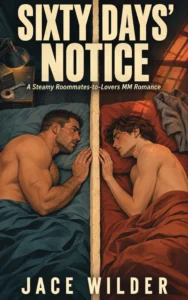
Sixty Days’ Notice
Four years. One wall. Zero idea.

Back of House
He bought my family's ovens and turned them off. Now he wants me.

Under New Management
The founder retired. The successor stopped waiting.

Room for the Best Man
Two best men. One bathroom. A couch night he swore he forgot.
Never Miss a Release
Get new release alerts, exclusive bonus content, and reader-only giveaways.