
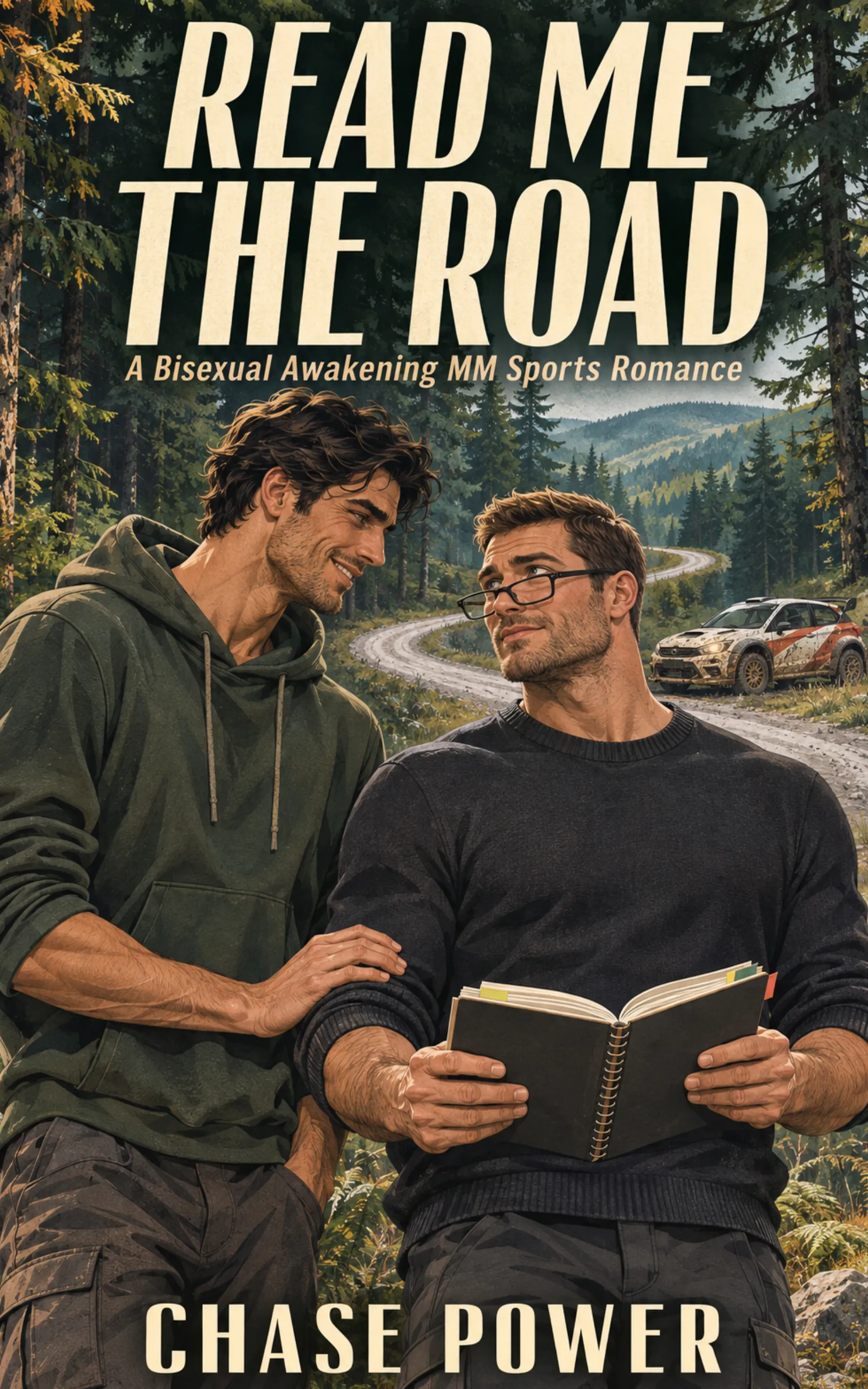
Read Me the Road
MM Rally Sports Romance
by Chase Power
Available at all major retailers
Pairing: MM
Heat: 🌶️🌶️🌶️🌶️🌶️ Inferno
Tropes: Grumpy/Sunshine, Driver/Co-Driver, Forced Proximity, Twin Room, Bisexual Awakening, First Time With a Man, Workplace Romance, Secret Relationship, Voice Kink, Praise Kink, Competence Kink, Instruction Kink, Dirty Talk, Switch, Jealous Ex, Coming Out, Found Family, Motorsport Romance
One voice in his helmet. One rule: never sleep with your driver.
He’s the fastest driver in the series. He’s never once listened to the man beside him.
Tomas Varga can make a rally car do things that make engineers go pink. He’s also crashed out of three of his last six rallies, lost his co-driver, sunk his savings into one funded season, and earned a reputation as a very expensive highlight reel. His team boss has one condition for keeping him on the road: he sits beside Owen Price.
Owen Price is precise, dry, utterly unimpressed, and done being any driver’s babysitter. The last man he sat beside blamed him on camera for a crash that wasn’t his fault, and kept him a secret for three years. Owen has one rule left: never sleep with your driver.
Then Owen’s voice is inside Tomas’s helmet, calling the road half a beat before he needs it, and Tomas, who has only ever dated women, can’t stop hearing that voice in the dark.
One shared twin room. One kiss Owen shouldn’t return. One season where every stage is an audition and every night is harder to walk away from.
But going fast together was never the hard part. Hearing each other when it matters is.
You’ll love this book if you enjoy:
✅ A cocky, funny driver’s bisexual awakening, and a grumpy Welsh co-driver who swore off drivers
✅ A voice kink that starts over the intercom and ends up in bed: easy, hold it, now
✅ Forced proximity in rally hotels, one twin room, and eleven inches between the beds
✅ Explicit, inferno-hot MM scenes with real switching, praise, and dirty talk
✅ Gravel, forests, mud, champagne, and a pace-note system you’ll know by heart
✅ A hero who learns to say stop, a hero who learns to say what he needs, and a guaranteed HEA
⚠️ Content Warning: This novel contains explicit sexual content (graphic MM scenes including solo masturbation, handjobs, oral sex, fingering, anal sex, rimming, edging, praise, voice play and dirty talk), strong language, a rally crash in which both men walk away, a near brake failure, references to a past closeted relationship and public blame, financial pressure, and coming out to family. Intended for readers 18+.
📖 Read Chapter One Free
Not sure yet? Read the full first chapter right here.
Chapter One: Tomas
Graham from Accounts Payable had stopped screaming at the second corner, and Tomas Varga took it personally.
“Still with me, Graham?”
Nothing from the passenger seat but breathing. Big, wet, reverent breathing, the kind a man did in church or just before he was sick.
Tomas glanced across. Graham’s knuckles were white on the grab handle, his borrowed helmet sat crooked over a face the color of skimmed milk, and his mouth hung open in a perfect O that could have been terror or rapture. In Tomas’s experience, the corporate ones were usually both.
“Right,” Tomas said. “Let’s fix that.”
He let the little school car run wide out of the left-hander, stood on the throttle down the short straight between the larches, and flicked it in for the hairpin a fraction early. Weight forward. Lift. The rear went light and loose and lovely, swung out across the gravel in a long, lazy arc, and he caught it with a quarter-turn of lock and held it there—sideways, spitting stones, the whole forest wheeling past the windscreen like a carousel—until the road straightened and he gave the car its nose back.
Graham screamed.
It was a glorious scream. High and joyful and a little bit Wiltshire. It went on for most of the straight and turned into laughter at the end, and by the time Tomas rolled into the finish area at a sedate twenty miles an hour, Graham was pounding the dashboard with his fist and shouting, “Again! Christ! Can we do it again?”
“That’s your three laps, mate.”
“I’ll pay. I’ll pay for another.”
“You’ll have to fight Brenda for it.” Tomas nodded at the queue by the timing hut, where five more people in matching fleeces stood holding hot chocolate and expressions of polite doubt. Brenda, from Marketing, had asked him twice whether the cars had airbags. “Corporate package. Everybody gets three laps and a certificate.”
“A certificate,” Graham repeated, as though Tomas had said a kidney.
Tomas undid his belts, dragged his helmet off, and shoved a hand through dark hair that badly needed cutting. March bit his ears at once. Hollin Forest Rally School smelled the way it always did—pine resin, wet gravel, and the bacon rolls Gary sold out of a van at criminal prices. Tomas loved it here. He also loved getting paid in cash at the end of the day, which was the bit he tried not to think about.
One hundred and sixty quid for eight hours of making strangers scream. Twelve more days like this and he’d have the deposit on a set of tyres. Thirty-odd more and he’d have half a gearbox.
He’d done that maths so many times it had stopped being maths and become a sort of weather.
Graham clambered out, staggered, caught himself on the roof. “You should be doing this properly, you know. Proper rallies. On the telly.”
“Yeah,” said Tomas. “I should.”
He said it lightly. He was good at lightly. The trick was to smile with your whole face so nobody noticed you weren’t smiling with anything behind it.
His phone buzzed in the pocket of his jacket. Then buzzed again, which meant voicemail.
He fished it out while Gary waved Brenda forward. One missed call. Helen Calder.
His stomach did something complicated.
He walked a few steps from the queue, turned his back to the wind, and pressed play.
“Tomas, it’s Helen.” Brisk, flat, every consonant ironed. Helen Calder didn’t leave voicemails so much as file them. “I need you at the unit by four. Today. Not tomorrow, not ‘after I finish up,’ not ‘I’m on my way’ when you’re still sitting at the forest school. Four.” A pause, and a breath that might have been a sigh if Helen had been the sort of person who sighed. “Bring your excuses, by all means. I’d like to watch you leave them in the car park.”
The message ended.
Tomas looked at the phone. Then at the clock on the timing hut. Twelve forty. Five more clients. Forty minutes up the A6 to Ashby Fold if the lorries were kind.
He turned around with the full-wattage grin already in place. “Brenda! Good news. How do you feel about going sideways?”
Calder Motorsport lived in a converted industrial unit between a carpet warehouse and a gym called IRON TEMPLE. Calder’s shutter was always up. Light spilled out of it at all hours, along with the whine of air tools, Radio 2, and swearing in at least three regional accents.
He parked his van at three fifty-eight, which was a personal best.
Inside, the main bay smelled of hot metal, brake cleaner, and coffee that had been stewing since dawn. Two customer cars sat up on lifts with their wheels off. Down at the far end, under a gray dust sheet, crouched the car that was supposed to be his.
He stopped walking without deciding to.
Even covered, she looked fast—wide arches, the sheet pulled tight over the rear wing so the whole shape seemed to be holding its breath. Four-wheel drive, five-speed sequential, a 1.6 turbo that sounded at full chat like God clearing His throat. Last season she’d worn his number on her doors for six rounds.
He’d brought her home on a trailer three times.
“Don’t,” said a voice behind him. “You’ll drool on the floor, and I’ve just mopped.”
Beth Morgan leaned in the kitchen doorway, eating toast. Five-foot-four in steel toecaps, forearms like a docker’s, a black ponytail she’d once threatened to cut off and strangle a man with. Calder’s lead mechanic for six years. She had rebuilt that car’s rear suspension twice and never, so far as Tomas knew, forgiven him for either.
“Afternoon, Beth.”
“Is it?” She took a bite. Chewed. “She’s upstairs. Been upstairs since two. She’s had three coffees and moved the stapler twice. I’d go up, if I were you.”
“Do you know what it’s about?”
“Yes.”
He waited.
Beth chewed.
“Are you going to tell me?”
“No,” said Beth pleasantly. “But I’m going to stand right here till you come back down, because I wouldn’t miss it for the world.”
Helen’s meeting room was up a flight of open steel stairs: a long table, a whiteboard nobody had wiped since 2019, and a window overlooking the bay so Helen could see everything that happened in her building. Which she did.
She was standing at that window when he came in.
“Sit down, Tomas.”
He sat. She didn’t.
Helen Calder was forty-six, tall, gray at the temples and entirely unbothered by it, in a navy jumper with the Calder logo stitched small on the chest. She’d driven herself once—not fast enough, she always said, but decent, and decent had taught her to count.
She put a folder on the table in front of him and didn’t open it.
“Brindle have renewed,” she said.
Something unclenched in his chest so fast he nearly laughed. “Brilliant. Helen, that’s brilliant, I told you they would, I told you Martin loves the—”
“Conditionally.”
“Right.”
“One season. Six rounds. If you don’t finish at least four of them, Martin Brindle is going to put his money into a junior karting program in Chesterfield and a very nice new canteen for his workforce, and frankly, Tomas, I wouldn’t blame him.” She pulled out the chair opposite and sat. “He showed me his figures. Do you know what last season cost him per kilometre of competitive running?”
“Guessing it’s a lot.”
“It’s a lot because you didn’t do many kilometres.” She laced her fingers together. “Three retirements in your last six. You have the fastest stage times in the series and a car that’s spent more time on a trailer than a show pony.”
“That’s not fair.”
“It’s arithmetic. Fairness isn’t really its department.” Helen’s voice didn’t rise. It never did. “I want you to understand where we are. I’m building this season out of Brindle, Hartley’s for the smaller decals, your own contribution, and whatever I can squeeze out of the lease. It works. Just. But it only works once.”
He looked at the folder. His name on the tab in Ruth’s neat capitals. VARGA – SEASON PACKAGE.
“Ben’s gone,” Helen said.
“I know Ben’s gone.”
“I know you know. I’m saying it out loud because I don’t think you have.” She tilted her head. “He’s signed with the Stewart crew. Full season.”
Tomas had seen the post. He’d typed congrats mate, they’re lucky to have you, deleted it, and left a thumbs-up, which was cowardly. He’d known it was cowardly.
Three seasons, Ben had sat beside him. Patient, funny, slightly deaf in his left ear from a childhood infection. And somewhere in the last year Ben had stopped arguing with him in the car. Just stopped. Read the notes, kept the time card, nodded when Tomas said it was the notes. Then after the final round he’d sat across from Tomas in a Wetherspoons in Inverness and said, very kindly, I don’t want to do another year of this, Tom, and Tomas had said of what, and Ben had looked at him for a long time and not answered.
Tomas knew of what. He was fast, not stupid.
“So I’ll find someone,” he said. “There’s that lad from the Welsh championship, the one who did Junior with—”
“I’ve found someone.”
He stopped.
Helen opened the folder at last. On top of the budget lay a single sheet with a photo clipped to the corner—a headshot from the series launch, a man in a plain navy shirt looking at the camera like it had asked him something stupid.
“Owen Price,” Helen said.
Tomas knew the name. Everyone in British gravel knew the name. Eleven seasons, a national title in the class below, then three years beside Callum Hale—podiums, then that crash at Kielder, then a quiet patch where Owen Price sat beside nobody and people said things in service parks Tomas had never bothered listening to.
What Tomas mostly knew was the reputation. Precise. Cold. Doesn’t suffer fools. A marshal at Hafren had once described him as a sat nav with a law degree.
“He’s good,” Tomas said slowly.
“He’s very good.”
“He’s also—” Tomas hunted for a diplomatic word, didn’t find one, went with the honest one. “He’s a bit of a prick, isn’t he?”
“I wouldn’t know,” said Helen. “I’ve only worked with him.”
“When?”
“Two years, before Hale.” She tapped the photo. “Best co-driver we ever had in this building. I’ve been trying to get him back for a fortnight. He’s free, he’s interested, and he’s the condition.”
“The what?”
“The condition. Martin’s and mine. You get the funded season if you sit beside Owen Price. Not someone you’ve found on a forum because you like his banter. Him.”
It hit him somewhere low and sour. He felt his face doing something—he could never stop his face doing things—and he reached for the grin to put over the top of it and couldn’t find it.
“So I’m getting a babysitter.”
“You’re getting a co-driver.”
“One you picked because he’ll keep me in line.”
“One I picked because he’ll keep you on the road,” said Helen, “which is a different thing, and I’m disappointed you can’t tell the difference.” She leaned forward. “Listen to me. Nobody in this building doubts you’re fast. Rafi has graphs of you that make him go a bit pink. But speed without judgment isn’t a career, Tomas. It’s a bill. And I’m the one who keeps paying it.”
He looked down at the photo. Owen Price looked back, unimpressed.
“Does he know?” Tomas said. “That this is a rescue mission?”
“He knows the job.”
“And he wants it.”
Helen considered that. “He wants to see it,” she said. “He’s downstairs.”
Tomas’s head snapped up. “Now?“
“He arrived at half three. Unlike some.” She got up, pushed the door open with one hand, and called down the stairwell in a voice that cut clean through the air tools. “Owen. When you’ve a minute.”
He heard him before he saw him.
Footsteps on the steel stairs—unhurried, even, a man who’d never once in his life taken a flight two at a time to make an entrance. Then a voice answering something Beth must have said at the bottom, too low for the words. Only the shape of it.
It was a good voice. That was the first annoying thing.
Not deep, exactly. Not a radio voice. Just level. Every word set down the way you’d put a full glass on a table, no clatter, no hurry. Something Welsh running underneath, the vowels rounding off at the ends of sentences. It was the kind of voice that sounded like it had already decided whether it liked you.
Owen Price came through the door, and Tomas got to his feet without meaning to, like a schoolboy.
He was shorter than the photo suggested—an inch or so under Tomas—but solid with it, broad through the chest and shoulders, built for sitting strapped into a steel cage all day and climbing out at the end without a limp. Brown hair cut short and neat. Three days’ stubble along a square jaw. A gray sweater with the sleeves shoved up his forearms, dark jeans, boots that had seen real mud. He was reading a sheaf of paper as he came in, wearing plain black reading glasses—and the instant he looked up and saw Tomas watching him, he took them off.
Fast. Folded them one-handed and slid them into his back pocket in a single irritated movement, as if he’d been caught at something.
Then he looked at Tomas properly.
His eyes were a strange color. Blue, gone gray at the edges, like the sea off a Welsh beach in October. They went over Tomas once, top to bottom and back—not rude, not lingering, just taking inventory. Tomas had the sudden, mad sense of being read like a page of notes. Graded. Filed.
“Tomas Varga,” Helen said. “Owen Price.”
Owen held out a hand. Tomas took it.
Dry palm. A firm grip—not a crusher, not a dead fish, exactly as much pressure as the job required. A ridge of callus along the side of the index finger where a pencil would sit. Tomas noticed it, then noticed that he’d noticed, and let go a fraction too fast.
“Hiya,” Owen said.
That was all. Hiya. Two syllables in that level, placed voice, and Tomas found he disliked it intensely. He disliked how calm it was. He disliked that he could still hear it after it stopped, hanging in the air like the hum after a bell. Most of all he disliked the way it had made the back of his neck go warm, which was obviously just embarrassment at being caught standing to attention.
“Alright,” Tomas said, and turned the grin up as high as it went. “Heard a lot about you.”
“Have you.” Not a question.
“All good.”
Owen’s mouth moved. Not a smile. The place a smile would go, if he’d had the slightest interest in deploying one. “I doubt that.”
“Sit down, both of you,” said Helen. “I’m not refereeing this standing up.”
They sat. Owen took the chair directly opposite Tomas, laid his papers on the table, squared them against the edge with two fingers, and folded his hands on top. Still hands. Square, blunt-fingered, a thin white scar across one knuckle. He didn’t fidget. Tomas had fidgeted his whole life, and he’d never been so aware of it as now, across from a man who could apparently switch himself off at the wall.
Tomas’s knee started going under the table. He made it stop.
“I’ve watched your onboards,” Owen said. “Last season. All six rounds.”
“Yeah? Like what you saw?”
“Some of it.” Owen turned over the top sheet. It was covered, every inch, in small sharp pencil handwriting. Timestamps. Stage numbers. Arrows. “SS3 at Hafren was lovely. You were two-point-one quicker than anyone through the top section and didn’t put a wheel wrong.”
The warmth that went through Tomas at that was entirely out of proportion. “Cheers.”
“SS4 at Hafren, you went off.”
The warmth went somewhere else.
“I’d like you to explain your last three retirements,” Owen said. Calm. Even. The tone of a man asking for directions to the station. “Redesdale, Wildmoor, Glen Corran. In order. Without using the word unlucky.”
From the doorway came a small, delighted crunch.
Tomas didn’t need to look. Beth had followed Owen up the stairs and was leaning against the frame with her toast, chewing with the satisfaction of a woman who’d paid for the good seats.
“Go on, then,” Beth said through a mouthful. “I’ve been waiting for this since about August.”
“Thank you, Beth,” said Helen, without heat.
“Pleasure.”
Tomas looked back at Owen. Owen looked back at him. A pencil had appeared in his hand from nowhere, held loose between two fingers, not tapping. Just waiting.
“Fine,” Tomas said. “Redesdale. SS5. The road changed. We’d recce’d it dry, it rained overnight, and the grip at the bottom of that valley—”
“The grip was fine for the car in front of you.”
“The car in front of me was going slower.”
“Yes,” said Owen.
Tomas opened his mouth and found nothing in it.
“That’s the first sentence,” Owen said. “The road changed. The road always changes. It’s gravel, that’s what it’s for. What did you do?”
“I—” He sat back. Folded his arms. “We’d lost eight seconds to a puncture on the stage before. I was trying to claw it back. Over the crest into the left—Ben called a four, and honestly it was more of a three and a half, it was right on the edge of—”
“Ben called four minus,” said Owen. “I’ve listened to it three times. Four minus tightens, keep in. You didn’t keep in.”
The room went very quiet. Even the air tools downstairs seemed to have dropped a register.
Heat climbed Tomas’s neck. He knew exactly what his face was doing and couldn’t stop it. “So you want me to say I cocked it up.”
“I want you to say what happened.”
“I just—”
“You told me what the road did,” Owen said, not unkindly, which somehow made it worse. “I’m asking about the driver.”
Tomas made himself breathe. Made himself look away from those sea-gray eyes, down at an old coffee ring in the laminate.
“I went in too fast,” he said. “I didn’t keep in. And I put it in the bank.”
“Thank you,” said Owen. Something in his voice shifted—half a tone, the faintest give, like a hand easing off a rope. It shouldn’t have meant anything. It went through Tomas like current through a wire anyway. “Wildmoor.”
“Wildmoor was a driveshaft.”
“Why did the driveshaft break?”
“Because driveshafts break, mate, it’s a mechanical—”
“No they don’t,” said Beth from the door, with total serenity. “Not mine.”
“It landed heavy off the jump on SS2,” Tomas said, louder. “The jump was bigger than in recce, the approach had been cut up by the—” He heard himself. The road again. The road, the grip, the jump, the weather. He shut his mouth.
Owen waited. He didn’t fill the silence. He just let it sit there on the table between them, the way a co-driver leaves a gap before the next call, and Tomas understood with a flash of real resentment that the man was very, very good at this.
“I took it flat,” Tomas said finally. “Ben called jump, caution, don’t go. And I went. Because I wanted to see if she’d—” He stopped.
“If she’d what?”
“Doesn’t matter.”
“It does to me.”
Tomas looked up. Owen’s face was perfectly still, but his eyes weren’t. They were sharp and intent and—interested. Properly interested, the way nobody in a debrief had looked at him in a very long time. Not as if he were a problem. As if he were a puzzle worth the trouble.
It made his stomach flip in a way he didn’t care for at all.
“If she’d take it,” he said. “Flat. I’d thought about it all through recce. I reckoned she would.”
“And she didn’t.”
“She did, actually. The landing didn’t.”
Something crossed Owen’s face. If Tomas hadn’t known better, he’d have sworn it was amusement.
“And Glen Corran?” Owen said.
That was the one Tomas didn’t want to talk about. That was the one that still woke him up at night.
Final round. Leading the class after day one, which nobody had expected—Ben murmuring steady, steady all morning like a prayer. Then SS8, a fast left-hander lined with old cut stumps, and Ben had said don’t cut. Tomas had heard him. Clear as anything. And he’d cut anyway, by maybe a foot, because a foot was a tenth and a tenth was the class.
The front-right had hit a stump and come clean off the hub. It had rolled away down the hill on its own while the car sat there on three wheels and a brake disc. The clip had made the series highlights. Someone online had set it to Benny Hill.
“I cut,” Tomas said quietly. “He said don’t cut. I cut.”
He didn’t look at Beth. He felt her stop chewing.
For a long moment nobody spoke.
Then Owen picked up his pencil and made a small mark on the page. Tomas couldn’t see what. A tick. A cross. A note in the margin reading hopeless. It was the most humiliating thing that had happened to him all year, and the year had included Benny Hill.
“Right,” said Owen.
That was all. He squared his papers again and pushed his chair back an inch.
“That’s it?” said Tomas.
“For now.”
“You make me sit here confessing like a teenager in the headmaster’s bloody office—”
“You said unlucky in four separate post-event interviews last season,” said Owen. “I counted.”
“You counted.”
“I’m a co-driver,” Owen said. “Counting is the job.”
Beth made a noise in the doorway that might have been a cough and was definitely not a cough.
Tomas sat back and stared at him. At the sheer, maddening calm of him. He wanted, quite badly, to make that face do something. Crack. Laugh. Snap at him. Anything at all that wasn’t that patient, measuring look.
He’d always been able to make people do something. Outside a car, it was the one thing he was reliably good at.
“Go on, then,” Tomas said. “Your turn. Helen says you’re free. Why’s a man with your reputation sitting around free in March?”
A flicker. It came and went so fast he’d have missed it if he hadn’t been staring—a tightening at the hinge of Owen’s jaw, the briefest drop of his eyes. Then gone. Smoothed over. Filed.
“I’m selective,” said Owen.
“Selective.”
“I’ve had offers. I’ve turned them down.”
“Why?”
“Because I wasn’t interested in being somebody’s—” A tiny pause, a word picked up and then put back down unused. “I wasn’t interested.”
“And you’re interested in this.”
“I’m interested in finding out whether I’m interested.” Owen glanced at Helen. “That was the agreement.”
“That was the agreement,” Helen said. She’d sat through all of it with her hands folded, watching them both the way she watched telemetry. “Test day’s a week Saturday. The private loop at Clocaenog. Rafi has the car for the full day, and I’ve budgeted for one set of new tyres and as many runs as the engine will take before I have to sell a kidney.” She looked at Tomas. “Owen will build the notes with you. He’ll read for you. Then he’ll decide.”
“He’ll decide,” Tomas repeated.
“He’ll decide,” said Owen. “I’d like you to get a chance to decide as well. But yes.”
It was absurd. Tomas was the driver. Tomas had the fastest stage times in the series. And a man who’d spent ten minutes taking him apart with a pencil was going to watch him drive for a day and then—what? Send him home with a certificate?
He thought of the trailer. Three times.
He thought of the folder with his name on the tab, and Martin Brindle’s lovely new canteen.
“Fine,” Tomas said. “Test day. I’ll show you.”
“I hope so,” said Owen.
He stood, gathered his papers, and tucked the pencil into the front pocket of his jeans. Tomas’s eyes followed the movement there without any instruction from Tomas whatsoever, then came hastily back up to a safe altitude.
Owen held out his hand again.
Tomas took it. Same dry palm. Same pencil callus. Same exact pressure. Except this time Owen held on a beat longer and looked at him directly, and in the close quiet of the room his voice dropped—just for the two of them, level and unhurried and Welsh around the edges.
“I’m not here to babysit you, Tomas,” he said. “I’m not here to fix you either. If that’s what you were hoping.”
His thumb shifted, barely, against the back of Tomas’s hand. Probably nothing. Probably just letting go. Tomas felt it all the way up his arm.
“I wasn’t hoping anything,” Tomas said. His voice came out rougher than he’d meant it to.
“Good.” The shadow of that not-smile. “Then we’ve got something in common.”
He let go.
He was nearly at the door before Tomas found words again. “So you’ve signed, then? With Helen? It’s done?”
Owen stopped beside Beth, who had finished her toast and was licking butter off her thumb in a state of something close to religious contentment.
He looked back over his shoulder. The light from the window caught the gray in his eyes.
“I haven’t signed,” said Owen Price. “I’ll decide after the test.”
Want to keep reading? Get Read Me the Road at all major retailers.
🔥 Want an EXCLUSIVE Bonus Chapter?
Two Passes — A scene TOO HOT for retailers. The week before Christmas, Owen comes home from Banbury to a finished green kitchen and a road book in Tomas’s handwriting. For once, Owen is the one in the passenger seat. Told from Owen’s side.
More from Chase Power
Browse all Chase Power books.
Read Me the Road
One voice in his helmet. One rule: never sleep with your driver.

Clean Hit
He hit me clean. Then they made him my roommate.

The Man Under Center
He's the quarterback who can't stop getting sacked. I'm the center who's done taking the blame.

The Other Goalie
He was supposed to be one night. Now he wants my net.
Off the Ice
He can't touch him for six weeks. Nobody said he couldn't tell him what to do.
Home Field Advantage
The only man who can put him back together is the one he left behind.
Never Miss a Release
Get new release alerts, exclusive bonus content, and reader-only giveaways.