
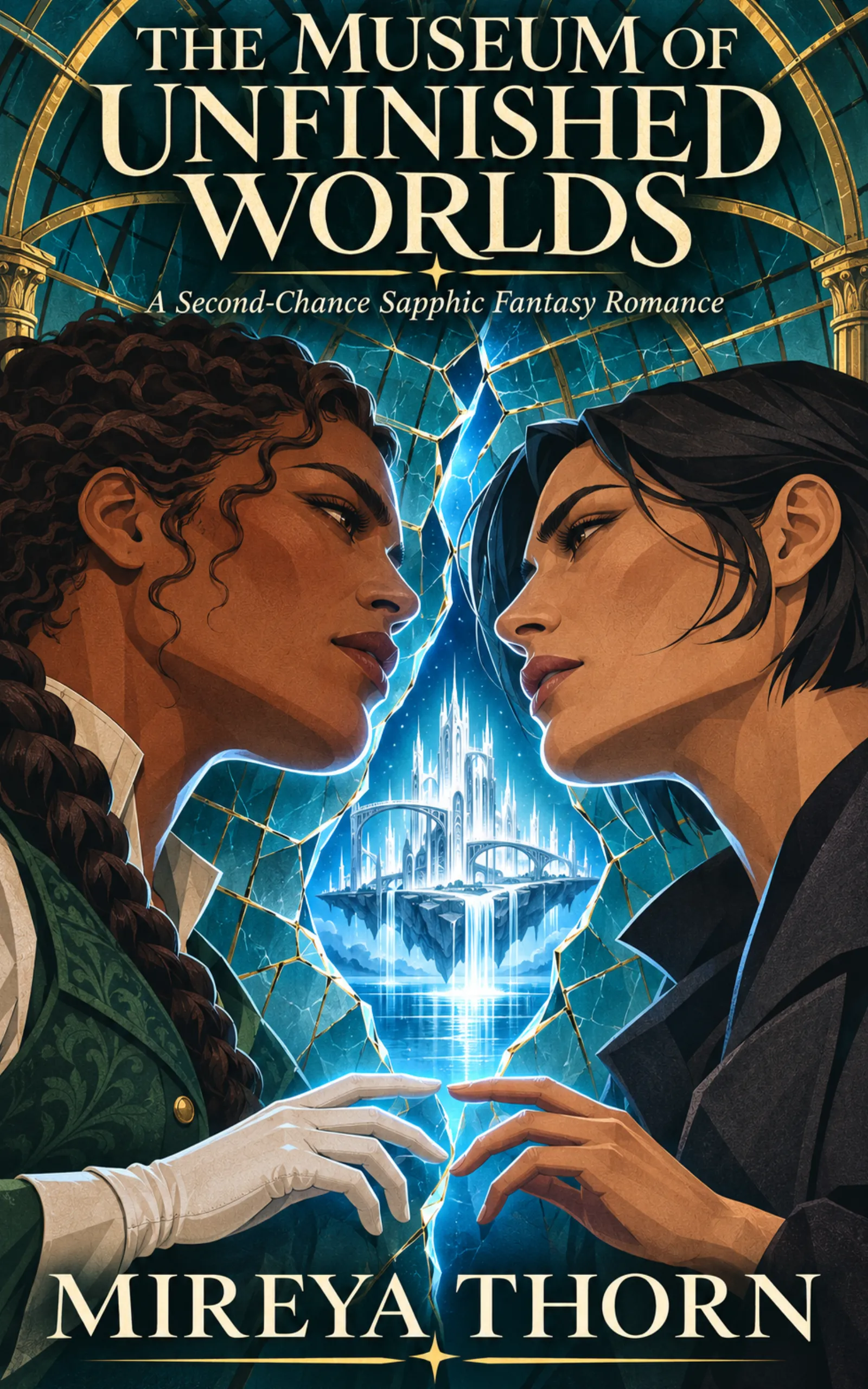
The Museum of Unfinished Worlds
A Sapphic Second-Chance Heist Romantasy
by Mireya Thorn
Shop the ebook · Shop the audiobook
Available at all major retailers
Pairing: FF (Sapphic)
Heat: 🌶️🌶️🌶️🌶️🌶️ Inferno
Tropes: Second Chance, Exes Reunited, Ex-Lovers Heist, Thief × Conservator, Portal Fantasy, Forbidden Romance, Angry Reunion Sex, Mentor Betrayal, Competence Kink, Control/Surrender, Glove Play, Edging, Scar Worship, Hurt/Comfort, Love Letters, Mutual Pining, Found Family, Strap-On, Workplace Romance
She stole a priceless artifact, broke my heart, and vanished. Now she needs me to help her do it again.
Dr. Lenya Dorr has spent twelve years preserving the enchanted worlds of the Museum of Unfinished Worlds: glass-domed landscapes everyone in Bellastrand knows are beautiful illusions, peopled by echoes.
Then a cracked exhibit answers her back.
The worlds behind the glass aren’t illusions. They’re inhabited. And in thirteen days the museum will auction their bridges, their heat and their only doors home to private collectors, piece by piece, with Lenya’s own signature on the paperwork that made it possible.
The only thief good enough to break into the museum’s sealed heart is Solenne Kade: the woman who shared Lenya’s bed for eighteen months, then robbed her gallery and vanished on a morning she promised to be back by six.
Solenne had her reasons. Twenty-three of them. That doesn’t mean Lenya forgives her. It doesn’t mean she’s stopped wanting her, either. Lenya has rules now, chalked on a board in a haulage yard. Rule one: tell me before you decide. Rule seven, said out loud: if we fuck, it doesn’t mean I forgive you.
Two stolen keys. Two living worlds. One auction, one director who calls it stewardship, and nineteen minutes to run his transfer backward. And an ex who still knows exactly how to take her apart.
The Museum of Unfinished Worlds is a high-heat, standalone sapphic romantasy with a slow-burn heist, a fast-burn reunion, dual POV, explicit open-door scenes, no cheating between the leads and an HEA guaranteed. Explicit content. 18+.
You’ll love this book if you enjoy:
✅ A meticulous museum conservator in white cotton gloves and the thief who robbed her gallery and broke her heart
✅ An angry kiss against a pantry door in chapter two, and a woman who stops one breath short on purpose
✅ Seven rules on a chalkboard, and the night rule seven gets tested
✅ Living worlds behind glass: a city of mirror bridges and a volcanic town whose roads ring underfoot
✅ Fourteen unsent letters, a flat paid for every month for years, and a travel case that is always packed
✅ A charming villain who calls it stewardship, and a heist run in nineteen minutes on auction day
✅ Glove play, edging, a bath in a sea-green cistern, and a hand-blown amber glass toy
✅ Second chances that have to be earned, no cheating between the leads, 🌶️🌶️🌶️🌶️🌶️ heat and an HEA guaranteed
⚠️ Content Warning: This novel contains extremely explicit sexual content (graphic FF scenes throughout, including oral, fingering, gloved play, edging and orgasm denial, a strap-on with a hand-blown glass toy, scissoring, bath and shower sex, a hand on the throat and dirty talk), strong language, and some alcohol. Also includes a manipulative mentor and institutional betrayal, a population deliberately starved of supplies, imprisonment and sleep deprivation (off page), burns, bruised ribs, a past injury to a hand, rooftop peril and a heist-day crisis. Past partners during the separation are backstory only. No cheating between the leads. Intended for readers 18+.
📖 Read Chapter One Free
Not sure yet? Read all of Chapter One right here.
Chapter One: Lenya
At eleven o’clock at night, the Museum of Unfinished Worlds belonged to Lenya Dorr and the dead.
That was what the night guards called the east wing. The dead galleries. Eleven domes under brass collars, each one holding a landscape nobody had ever finished making: a frozen sea with no far shore, a city of staircases that climbed into nothing, a forest of glass trees that had been dark since before Lenya was born. Failed experiments in worldmaking, the placards said. Beautiful mistakes, preserved for the public good. Twelve years of walking past them in the dark and she had stopped hearing the joke.
The Vesper Gallery was not dead. Neither, strictly, was the Cindervale vessel in the last bay, which ran warm and which the guards gave a wide berth—but Cindervale only glowed. Vesperglass was the problem, and the reason she still took the night rotation nobody else wanted.
She set her conservation cart beside the vessel, opened the flat tin case she kept in her waistcoat pocket, and took out a fresh pair of white cotton gloves. The ritual never changed. Left hand first, tug at the wrist, smooth each finger down to the web. Right hand. Flex. The cotton smelled faintly of the lavender the laundry used, and under that, of the brass polish that lived in the grain of everything in this building, including her.
Then she looked at Vesperglass, because she always did, and because twelve years had not made it ordinary.
The vessel sat on a plinth of black stone at the center of the gallery: a shallow basin of hammered silver the size of a dining table, under a dome of hand-blown glass so clear it only showed itself where the gaslight caught the curve. A brass collar ringed the base, engraved with the museum’s eight-pointed star. And inside the dome, small and far away, as if seen from the top of a very high hill, a city hung over a lake of light.
Mirror bridges. Dozens of them, strung between slender towers like silver thread between pins, catching a sun that did not exist and flinging it from span to span in long bright pulses. Below them, the lake moved like mercury. It was dawn in there; it was nearly always dawn in the curated view. The pulses ran in sequences. The placard on the wall called them decorative cycling, and said that the faint figures one sometimes glimpsed crossing the bridges were residual impressions of the original makers’ test subjects—echoes, in the technical sense.
Lenya had written part of that placard. She had been twenty-nine and very proud of the phrase in the technical sense.
“Hello, my darling,” she told the city, because no one was there to hear her be ridiculous. “Let’s see about that lens.”
The projection housing ran around the inside of the collar: a ring of twelve crystal lenses, each ground to a particular curve, each one taking a slice of whatever lay beyond the glass and folding it into the pretty, distant, manageable view the public paid to see. The eastern lens had been drifting for a week. Not much. A hair’s width of blur along the left edge of the picture, a slight doubling of the tallest tower. Nobody but Lenya would have noticed. Nobody but Lenya would have stayed until midnight to fix it.
She settled the loupe over her right eye, drew the reading slate from the cart, and laid two gloved fingertips against the collar.
Her discipline did not look like much from the outside. That had been a disappointment to her mother, who had hoped for sparks. What Lenya did was listen. Every made thing carried stress the way a body carried tension—along its seams, in the places it had been forced, at the joints where one material met another and neither quite agreed. Lay a trained hand against it and the stress spoke in a language that was half pressure and half light, and if you were patient and precise and did not lie to yourself about what you were feeling, you could coax it into a better shape. Not a new one. Never a new one. You could only help a thing be more fully what it already was.
The eastern lens was unhappy. She felt it through the cotton, through the brass, a high thin note like a wet finger on the rim of a glass. Too much pressure from the inside. That was odd. Projection lenses were passive. Nothing should be pushing on them at all.
She frowned, adjusted the loupe, and leaned closer.
The basin went white.
Not bright. White, the way a page is white, as if every bridge in the city had turned to face her at once and thrown back all its light in a single breath. The dome rang—a pure, singing tone that went through her teeth and into the hinges of her jaw. Then the eastern lens cracked, with a sound exactly like ice giving way on a pond in March, and the gallery’s alarm began its polite, insistent chime.
Lenya did not step back. Later she would wonder about that. The protocol was clear: in the event of an uncontrolled surge, withdraw, isolate, summon the duty officer. She had taught the protocol to three junior conservators. She knew it the way she knew her own address.
She stayed where she was, hand flat on the brass, because something was coming through the crack.
Light, first. A thread of it, silver-blue, spilling from the fracture and lying across the black stone of the plinth like a dropped ribbon. And then, riding the light the way a voice rides breath, a woman spoke.
“You repaired the bridge.“
The voice was low, rough at the edges, and very close, as if the speaker were standing at Lenya’s shoulder with her mouth an inch from her ear.
“They’re selling the part that holds it up.“
The alarm chimed. The thread of light trembled and steadied.
Lenya’s heart was going hard enough that she could feel it in the fingertips she had pressed to the collar. Residual impressions. Echoes, in the technical sense. She had heard echoes before, in twelve years—everyone on the conservation staff had. Fragments of speech in no language anyone could place, half a laugh, a name. The museum’s explanation was elegant and well documented: during the vessels’ manufacture, test subjects had been recorded into the projection matrix, and surges sometimes shook those recordings loose. A stored echo repeated. Always. Identically. That was what made it an echo.
She lifted the reading slate with a hand that was not quite steady and turned its face to the ribbon of light. The slate drank the waveform and painted it across its glass in fine bright lines.
“Repeat,” Lenya said. Her voice came out level. Good. “Please repeat the message.”
A pause. Then, with unmistakable irritation:
“I said they’re selling it. The Bearing. Are you deaf out there, or only careful?“
The lines on the slate did not match. Not a single peak. Different words, different length, different shape. The waveform of a person choosing what to say.
Lenya stared at it.
Live. Not a recording. Not an echo. Someone on the other side of that glass, right now, in a city she had spent twelve years calling a beautiful mistake, had heard her ask a question and had answered it with contempt.
“Who is this?” she whispered.
“Eresa Venn.” The name was given like a challenge. “You fixed my bridge three years ago, conservator. You used too much silver.“
The floor seemed to tip a little under Lenya’s boots.
Three years ago. The Great Span—the long central bridge in the view, the one the placard called the principal ornamental arc. A stress fracture had opened along its eastern support, visible even through the projection, and she had spent four nights rebuilding the optical alignment through the vessel’s interface, one careful pass at a time. She had used a silver-heavy bonding formula because the original material had resisted everything else. She had worried, afterward, that it was more than the structure needed. She had written that worry down exactly once, in a private notebook that lived in the locked drawer of her desk upstairs.
Nobody knew about the silver. Nobody could.
“How do you—”
“Because I walk on it every morning. Listen to me. The sliver won’t hold long. Lot nine. Look at lot nine. They catalogued it as a sculpture, and it isn’t, and you made it easy to take, and you have thirteen days—“
The thread of light flickered, thinned, and went out like a snuffed wick.
“Wait—” Lenya pressed her palm harder to the collar, as if she could hold the door open by force. “Eresa. Eresa Venn. Are you still there? What sliver? What do you mean, take—”
Nothing. The note in the brass had dropped to a dull, bruised hum. She pushed into it anyway, the way she would push into a stubborn seam, gentle and then less gentle, reaching for any thread of that silver-blue light, and found only the ordinary architecture of the housing and the raw new edges of the crack. Whatever had come through had come through a gap, and the gap was closed.
She took her hand away. Her glove had left a faint damp print on the polished brass. She wiped it with her sleeve, an old reflex, before she realized she was trembling.
The city in the dome was dawn-colored and distant again. Bridges flashed in their pretty sequences. A tiny figure crossed the Great Span and was gone.
I walk on it every morning.
The alarm went on chiming.
Lenya realized she was holding her breath, and let it out, and pulled in another that tasted like hot metal.
Footsteps in the corridor. Several sets, one of them unhurried and expensive.
She moved before she decided to. She tilted the reading slate, thumbed the clear-plate, and watched Eresa Venn’s waveform vanish from the glass. Then she bent over the cracked lens as if she had been studying it the whole time.
Director Halvere Sorn arrived the way he arrived everywhere, as though the room had been waiting for him and he was too well mannered to say so.
He was in evening clothes—he had come from a donor dinner, she saw, from the small gold pin of the Astronomers’ Guild still in his lapel—and his silver hair was brushed back from a face that had been handsome at thirty and had spent the decades since becoming distinguished instead. Two night guards trailed him, both young, both visibly relieved to find nothing on fire.
“Dr. Dorr.” His voice was warm. It always was, with her. “Tell me the vessel is intact.”
“The vessel is intact.” She straightened, and kept her gloved hands loosely folded in front of her waistcoat so he would not see them shake. “The eastern projection lens is not. Hairline through the full depth. It’ll need replacing.”
“Ah.” He came to stand beside her and looked down into the dome, and for a moment—Lenya would remember this—his face went soft and private, like a man looking at a sleeping lover. Then it was the director’s face again. “A surge, the guards said.”
“A surge.”
“The core’s been temperamental all month. Every vessel in the building is being calibrated for the transfer, and it shows.” He sighed. “Anything else? Any… noise?”
There was the moment. It went past her like a carriage, close enough to feel the wind of it.
“An echo cascade,” Lenya heard herself say. “Fragmentary. Nothing intelligible.”
Sorn nodded slowly. He did not look at her. He looked at the city.
“If anything in this building were going to crack at midnight,” he said, “I would want it to be in front of you. You know that.” He laid a hand on her shoulder, briefly, approving. She felt the weight of it settle into her like warm water. Twelve years of that hand. She had been grateful for it once, in the worst year of her life, when the museum could have shown her the door and had instead given her the night rotation and a raise and said, We know whose fault this was, Lenya, and it wasn’t yours.
“I’m sealing the Vesper Gallery,” he said. “Effective now, until the auction. Thirteen days. I won’t have it embarrassing us in front of the buyers with a cracked eye.”
“I can have the lens replaced in two.”
“I’m sure you can. Seal it anyway.” He smiled at her. “Log it as a malfunction, please, before you go home. And do go home. You look like you’ve been staring into the sun.”
“Director.” She wet her lips. “I put my objection to the auction in writing.”
“Three times. Beautifully argued, every one. The board read them all.” His smile didn’t change. “And the board decided the museum would prefer to survive. You lost that argument with more grace than most people win them, Lenya. Don’t spoil it now.”
He touched two fingers to his brow in a gesture that was almost a salute and went out, and the guards went after him, and the alarm finally stopped.
The silence afterward was enormous.
Lenya stood in it for a long time. Then she took out the reading slate, opened a malfunction log, and wrote, in her small square hand, Projection surge. Eastern lens fractured. Echo cascade, fragmentary, unintelligible. She signed it. She dated it.
It was the first false thing she had put into the record in twelve years, and her signature on it looked exactly the same as all the true ones.
Lot nine.
They catalogued it as a sculpture, and it isn’t, and you made it easy to take.
She bent and lifted the cracked lens free of its seat. It came away cleanly into her gloved palm, a curved disc of crystal no bigger than a biscuit, the fracture running through it like a frozen river. The light that had carried Eresa Venn’s voice still lived in the break, very faintly—she could feel it humming against the cotton, a residue that would fade in a day or two. Evidence, of a kind. She should log it. She should bag it, label it, and send it down to the Closed Catalogue with the night porter.
She slipped it into the inside pocket of her waistcoat instead, against her ribs.
Then, because she was thorough, because she could not have stopped herself if she’d tried, she settled the loupe back over her eye and bent to inspect the empty seat where the lens had been.
The brass of the housing was old and soft and dark with a century of polish. The seat was a shallow ring, and along its inner seam, where nobody would ever look unless they were replacing that precise lens on that precise night, someone had scratched a tiny bird.
A sparrow. Four strokes and a dot. Wings mid-beat.
The metal in the scratch was bright. No tarnish. No oxidation at all.
Days old. Maybe less.
Lenya did not move. Somewhere far away in the building a clock struck the half hour, and she heard every one of its gears.
She knew that sparrow. She had watched it drawn in the steam on her bathroom mirror with one fingertip, idly, while the person drawing it stood naked and dripping and talking about breakfast. She had found it pressed into the butter once, as a joke. She had seen it, exactly once, scratched into the inside of the brass cradle that had held the Vesperglass prism—the morning after the prism was gone, when the investigators had pulled her into a room and shown her a photograph of it and asked, very gently, whether she recognized the mark.
She had said yes. She had said whose it was.
It took nothing at all for the rest to come. That was the humiliating part. Four years of not thinking about it, of building a life with no gaps in it where anything could leak through, and one bird the size of her smallest fingernail undid the whole wall.
Solenne’s hands. That was what came first, always. Not her face—her hands. Long, olive-brown, rough on the palms from rope and stone, the left ring finger crooked from a break she had never properly explained. Hands that were never quite still. Hands that had unbuttoned Lenya’s waistcoat one button at a time, with enormous patience, standing behind her at the kitchen counter, while the coffee went cold in its pot and Solenne’s mouth moved along the side of her throat and said, You’ve got somewhere to be. I know. I’ll be quick. She had not been quick. She had slid one of those hands down the front of Lenya’s skirt and taken her apart against the counter with three slow fingers, the crooked one curling just so, until Lenya had come gripping the edge of the sink with both fists and swearing at the window. She had been forty minutes late to work. Solenne had kissed the back of her neck at the door and said, Worth it, and Lenya had laughed all the way up the hill.
And then the last morning. Coffee. The good blue cups. Solenne already dressed, which was unusual, in the charcoal coat. A kiss pressed to Lenya’s bare shoulder, warm, unhurried, the most ordinary kiss in the world.
Back by six.
Lenya had made dinner. She had made it for two and kept it warm and then not warm, and at midnight she had put it in the cold box with a cloth over it, and at three she had sat on the floor of the hall with her back against the door, and in the morning the museum had sent a porter to fetch her, because the Vesperglass prism was missing from its cradle and there was a sparrow scratched into the brass.
She found that she had pressed her gloved hand flat over the pocket where the lens lay, as if something in there might try to get out.
The protocol was clear here, too. Report it. Report the mark, the date of the scratch, the person it belonged to. She had done it once. She had sat across a table from two investigators and a museum solicitor for nine hours and given them everything—dates, habits, the names of cafés, the location of the spare key—because she had believed, with the whole furious strength of her humiliation, that she had been used. That eighteen months had been a long con with a beautiful woman at the center of it, and Lenya had been the lock.
She could do it again. Walk to the duty office, wake the night officer, say the name.
You repaired the bridge. They’re selling the part that holds it up.
Lenya closed the loupe, put it in its case, and covered the empty lens seat with a square of conservation linen so the sparrow didn’t show.
She sealed the gallery as the director had asked. She signed the log. She went home.
Bellastrand at two in the morning was a city of slopes and lamplight, its streets folding down the hill from the old imperial observatory like the pleats of a skirt. The museum’s great copper dome sat above everything, green and enormous against the stars, and the clock in its tower told the hour to anyone who looked up. Lenya didn’t look up. She walked the long way, down the Stair of Saints and across the tram lines and into the old glassworkers’ quarter, where the houses leaned together over narrow lanes and every second doorway still had a kiln-mark painted above it for luck.
Her flat was on the third floor of a narrow brick house on Glassmakers’ Row. She had lived there for nine years. For eighteen months of those years, she had not lived there alone.
She climbed the stairs slowly. The lens sat against her ribs like a second heartbeat. The whole walk home she had been thinking—clearly, in the precise and orderly way she thought about cracks in old glass—and none of it had arrived anywhere. A live voice inside a vessel. A woman who knew about the silver. A sparrow, days old. Lot nine. Thirteen days.
She had changed the locks after Solenne left. Three of them. A deadbolt, a mortise, and a heavy brass chain that the locksmith had described as the sort they put on bank doors, miss, in a tone that suggested he thought she was overreacting. She had paid him extra. For the first year she had checked them every night before bed, twice, standing in her nightdress in the dark hall with her hand on the cold brass, and she had hated herself a little more every time she did it.
She fitted the first key. Turned the second. Slid the chain free.
The flat smelled of tea.
Lenya stopped in the doorway with her hand still on the chain.
Bergamot. Black tea, steeped too long, the way she liked it, the way she’d always liked it, strong enough to stand a spoon in. The smell came warm and fresh from the kitchen at the end of the short hall, which was dark. She had not left anything on the stove. She had not made tea this morning at all; she had been late.
The hall was dark too. The street lamp outside the kitchen window threw a long pale lozenge of light across the kitchen floor and up over the edge of the little table, and in that light she could see her own blue cup—one of the good blue cups, which she had not used since, which she had kept at the very back of the highest cupboard where she would not have to look at them—sitting on its saucer, with a thin thread of steam rising off it.
Beside it, laid neatly on the saucer’s rim, a teaspoon. Two sugars, then. No milk. She knew without tasting. Whoever had made that tea had made it exactly right.
Someone was sitting in the chair on the far side of the table, in the dark beyond the lamplight.
Lenya did not scream. She was distantly proud of that. She shut the door behind her very quietly and stood with her back against it, and her right hand went—of its own accord, without asking her—to the inside pocket of her waistcoat, where the cracked lens was. As if a disc of broken crystal were a weapon. As if she could throw it.
The figure in the chair shifted. The light from the street caught a sliver of it as it leaned forward: the edge of a jaw, a sharp dark line of hair cut just there, at the angle of it. A long charcoal coat. A hand resting on the table beside the blue cup—long fingers, olive skin, the left ring finger crooked.
The hand didn’t move toward her. It just lay there in the light, open, where she could see it.
On the floor beside the chair, half in shadow, sat a small leather travel case with brass corners, its strap already buckled. Lenya knew that case. It had lived by the door of this flat for eighteen months, always packed, always ready, and she had teased about it once—are you planning to run off in the night?—and Solenne had laughed and kissed her and said, Only ever toward you.
It had gone with her, that last morning. Lenya had noticed its absence on the third day and sat down on the hall floor again.
Four years, three locks, and nine hours in a room with a solicitor.
Lenya’s mouth had gone dry. Her pulse was so loud it seemed impossible that the other woman couldn’t hear it from across the kitchen. She was aware of everything at once—the cold door at her back, the cotton of her gloves gone damp at the palms, the tea steaming, the stupid, unforgivable, entirely physical lurch low in her belly at the sight of that hand.
“Get out of my house,” she said.
It came out a whisper.
The figure in the chair tilted its head. When she spoke, her voice was exactly the same—low, amused at the edges, warm in the middle, a voice like a hand on the back of the neck—and it went through Lenya like the surge had gone through the dome.
“You changed the locks,” said Solenne Kade. “Badly.”
Want to keep reading? The full novel is available now.
🔥 Want an EXCLUSIVE Bonus Chapter?
The Gloves in the Drawer — A scene TOO HOT for the bookstore
Five months after the auction, the curtains go up in the Lantern Quarter flat. Solenne takes a pair of grey-white cotton gloves out of the writing desk drawer and asks Lenya to do what she did in Fen’s office, all of it. And this time, to finish.
More from Mireya Thorn
Browse all Mireya Thorn books.

The Queen’s Borrowed Face
She lent her face for one night. Getting it back means taking her shirt off.

The Dragon’s Night Physician
She came to diagnose a queen. She stayed to make her beg.

The House That Ate Its Brides
Seven brides went into Morven House. None came out. She’s the eighth.

The Museum of Unfinished Worlds
She stole a priceless artifact, broke my heart, and vanished. Now she needs me to help her do it again.

The Treaty of Unmade Queens
The Unmade Crowns
We married to save the treaty. Then the seal let me feel everything she feels.
Never Miss a Release
Get new release alerts, exclusive bonus content, and reader-only giveaways.