
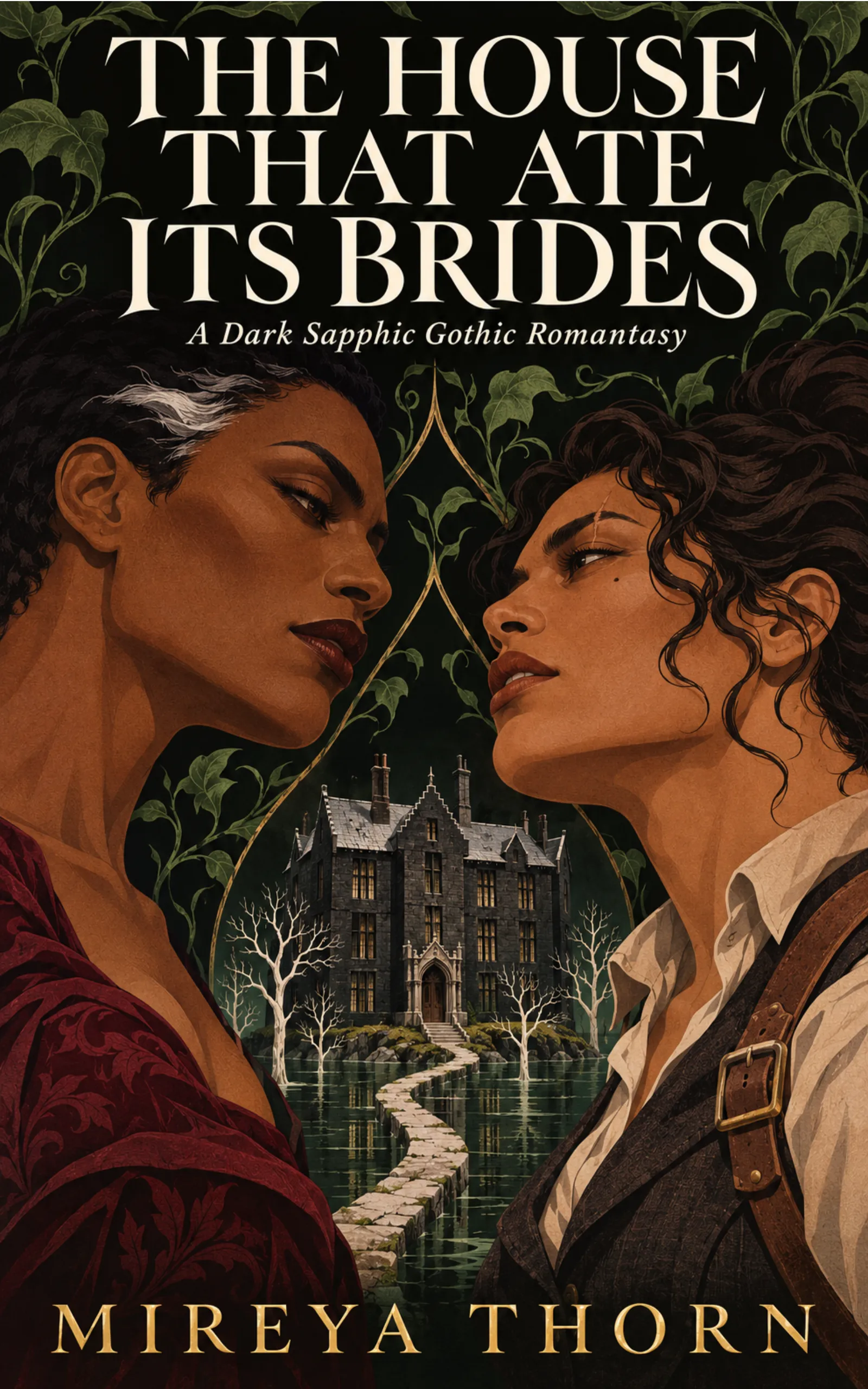
The House That Ate Its Brides
A Sapphic Gothic Romantasy
by Mireya Thorn
Shop the ebook · Shop the audiobook
Available at all major retailers
Pairing: FF (Sapphic)
Heat: 🌶️🌶️🌶️🌶️🌶️ Inferno
Tropes: Forced Proximity, Haunted House, Gothic Romance, Age Gap, One Bed, Widow Heroine, Ice Queen, Competence Kink, Touch Starved, Hurt/Comfort, Who Hurt You, Magical Bond, Captive Romance, Found Family, Grief Recovery, Light Bondage, Strap-On, Body Worship, Dirty Talk, Mutual Pining
Seven brides went into Morven House. None came out. She’s the eighth.
Lenora Quist fixes houses that bite. She’s broke, she’s good, and she takes the jobs nobody else will touch. Morven House pays triple.
The first thing she sees inside is its mistress halfway up a ladder, taking a sledgehammer to her own bedroom wall.
Asha Morven has been trapped on this headland for eight years. The house keeps her warm, keeps her fed, and won’t let her cross the causeway. Every mistress of Morven goes into the walls eventually. The trustees just hired her replacement. And Lenora signed the contract with her own blood.
Twenty-one nights until the solstice Settlement. A house that locks them in together and leaves one bed. A woman who hasn’t been touched in eight years and a woman who has never once let anyone take care of her. Behind the wallpaper, someone is knocking.
The house wants a bride. It’s about to learn it can’t have either of them.
The House That Ate Its Brides is a high-heat, standalone sapphic gothic romantasy with dual POV, explicit open-door scenes, a sentient house that sets every trap but can’t touch desire, no cheating and an HEA guaranteed. Explicit content. 18+.
You’ll love this book if you enjoy:
✅ A broke, blunt restorer who reads walls like books and a widowed mistress who takes a sledgehammer to her own bedroom
✅ A living gothic house that moves bathrooms, locks doors, builds a bridal suite overnight and leaves exactly one bed
✅ A blood-signed contract with a missing page, and twenty-one nights until the solstice
✅ Women knocking from inside the walls, a kitchen nobody knows exists, and a ledger that proves the house is bankrupt
✅ An ice queen who has never once said please in bed, and a woman who ties a scaffold hitch only she can undo
✅ A mirror that speaks in a dead wife’s voice, and a heroine who answers it with watch, then
✅ A saddler-made strap-on laid out on a satin cushion by a house that thinks it’s helping
✅ Two women who each try to sacrifice themselves for the other and get called a pair of idiots for it, 🌶️🌶️🌶️🌶️🌶️ heat and an HEA guaranteed
⚠️ Content Warning: This novel contains extremely explicit sexual content (graphic FF scenes throughout, including oral, fingering, tribbing, a mirror scene, face-sitting, consensual light bondage with silk ribbons, edging, a strap-on worn by both heroines, 69 and dirty talk) and strong language. Also includes coercive magical binding and contracts signed under deception, captivity and confinement by a sentient house, memory loss, body horror (people absorbed into walls), the past death of a spouse and grief, financial coercion and debt, physical injury (cracked rib, hypothermia, exhaustion), two off-page deaths in the past, and the on-page death of the villain. No cheating. Intended for readers 18+.
📖 Read Chapter One Free
Not sure yet? Read all of Chapter One right here.
Chapter One: Lenora
The mule stopped dead in the middle of the causeway, and Lenora Quist realized, with the flat clarity of a woman who had already done the sums, that she was about to drown for triple pay.
“Come on,” she said. “Come on, you stubborn bastard. Nobody’s asking you to like it.”
Behind her, the estuary was coming home. It slid in over the mudflats in long gray tongues, filling the ruts her wheels had cut, licking at the edges of the stones. An hour ago the causeway had been a road. Now it was a suggestion: a pale spine of cobbles a quarter mile long, running from the coast road out to the headland, with water on both sides and water creeping up the middle.
The mule flicked an ear at the tide and declined.
Lenora climbed down. Cold water closed over her boots, and she swore loudly and in some detail while she got hold of the bridle. Her tool harness clanked against her ribs. Her whole career rattled in the cart bed behind her: two crates of binding lime, the long case with her levels and plumb lines, the surveying chalk, the satchel of old drawings she couldn’t afford to replace, and the carpetbag holding every piece of clothing she owned that didn’t have a hole in it.
“Walk,” she told the mule, and walked herself, leaning into the bridle until her shoulder burned. After a long, insulted moment, it came.
She didn’t let herself look at the house until she’d dragged them both past the halfway marker. Then she did, because a restorer who didn’t look at a building before she went inside it deserved whatever the building did to her.
Morven House stood on its headland like something set down on purpose. Black stone, three stories, a slate roof gone silver with salt, chimneys in a crooked row. The windows caught the last of the afternoon and gave none of it back. Below the house the land fell away into the estuary, and in the drowning shallows a double row of trees marched out toward the sea. An old avenue, she guessed, planted back when the ground there was ground. The trees were dead and white as bone, every branch stripped bare, and the water was climbing their trunks.
In an hour the causeway would be gone, the avenue would be drowned to the knees, and the house would sit above all that flat gray water as if it floated.
The people at the inn in Greyhaven had told her that last night, the way locals tell you a story so they can watch your face. At high tide she floats. Bride ship, my gran used to call her. Then the innkeeper’s wife had asked, far too casually, whether Lenora was married. When she’d said no, the woman had looked relieved, then ashamed of being relieved, and hurried off to fetch more bread.
Lenora had not slept especially well.
The tide was at the wheel hubs when the cart rolled off the last stone and onto the gravel of the headland. She looked back. The water had already closed over the spot where she’d stood arguing with the mule. A smooth sheet of pewter ran all the way to the coast road. She’d have to wait for the morning tide to leave, and that was fine, because she wasn’t leaving. She was going to work.
Triple fee. Half up front. Enough to clear the worst of her notes, the ones that had changed hands twice this year and now belonged to some firm in the capital whose name she’d never heard. Enough to rent a workshop with her own name over the door. Enough, maybe, to stop dreaming about the sound a wall makes in the half second before it comes down on people.
The front door opened before she could knock.
“Miss Quist.” The man on the step was tall, gray at the temples in a way that looked deliberate, and wearing a coat that had cost more than her cart. He came down with both hands out, as if she were a favorite cousin. “Corven Hale. We corresponded. You made the tide. I confess I was worried. Come in, come in, you’re soaked to the knee. Tessa will see to your animal.”
A broad, weathered woman in steward’s gray had appeared at his shoulder. She took the bridle without a word and gave Lenora a single look that went from boots to harness to face. Then she led the mule off around the side of the house. The look hadn’t been unfriendly. It had been the look of someone counting.
Inside, the hall was warm.
Not fire-warm. There was a fire, a big one, in a hearth carved with oak leaves, but the warmth didn’t come from it. It came from everywhere: the flagstones, the walls, the dark paneled ceiling, even and gentle as bathwater. Her wet feet stopped aching. The cold she’d hauled across the causeway lifted off her shoulders like a coat being taken by a servant.
She hated it immediately.
“Wonderful, isn’t it?” Corven said. “The old estates were built to keep their people comfortable, and Morven does it better than any house in Darsen. Sit, please.” He steered her to a table by the fire, where papers waited in a neat stack beside a teapot that steamed as if it had been poured that second. “I won’t keep you long. You’ll want your rooms, and your first look at the work, but I’m afraid the trustees are particular about formalities. The commission must be sealed before you lift a tool. If the house were to object to a stranger’s hands—”
“It wouldn’t be the first,” Lenora said.
“No. I read about your Vellmouth job.” He smiled. He had a good smile, kind lines and all, the smile of a man who gave money to orphanages and made sure people heard about it. “Eleven workers pulled out of a collapsing ward vault against your director’s explicit orders. I admired that very much. I’m sorry your firm didn’t.”
She didn’t answer. He didn’t seem to need her to.
She read the commission. She read it twice. It was long and dull and blessedly ordinary: a structural survey of the south and west wings, stabilization of folded spaces, repair of damaged registers, all at a rate that made her stomach clench every time she saw the figure. Board and lodging for the duration. Completion by the winter solstice, twenty-one days off.
Clause fourteen referred to Appendix C, Terms of Provisional Custody.
Appendix C was not there.
“The appendix,” she said.
“Ah.” Corven spread his hands. “Trustee boilerplate. It lives in the estate archive, and the archive is a disgrace, which is half the reason we need you. It’s standard custody language for any restorer working on site. While your seal is active, the house treats you as household, so it won’t fight you. I’ll have it copied out tomorrow. You have my word.”
She looked at the figure again.
She thought of her mother’s hands, and the knuckles that wouldn’t straighten anymore. She thought of the letters from the note holders, politer every month, which was how you knew they were getting ready to stop being polite.
“Tomorrow,” she said.
“First thing.”
She signed. Then she took the steel lancet from its loop on her harness, because she’d never trusted anyone else’s, pricked the pad of her thumb, and pressed it to the restoration seal.
The seal was brass, the size of a coin, set into a plate of black wood. She had sealed a hundred of them. You gave the brass a drop of blood, the building tasted you, and for the length of the job it knew your hands. It was nothing. A handshake.
This one drank.
She felt it pull. Not a sting but a draw, long and steady, as if something had fitted its mouth to the cut and was in no hurry at all. The brass warmed under her thumb. A thread of heat ran up her wrist and into her forearm, up past the old lime burns, toward her elbow, and kept going. Then it let go.
She lifted her hand and looked at the seal. It was spotless. Not a smear.
“There we are,” Corven said, sliding the papers into a leather folder before she could look at them again. “Welcome to Morven House, Miss Quist. One more thing. The mistress is unwell. Has been for some years, poor woman. She keeps to the east wing, and she’s—” a delicate pause “—not always herself. It would be best not to trouble her. Anything you need, bring to me or to Tessa.”
“Understood,” Lenora said, and closed her fist around her thumb, where it went on throbbing like a second pulse.
Her rooms were fine. Better than fine: a canopied bed, a bath through a connecting door, a fire already burning, her carpetbag already on the luggage stand, though she hadn’t seen anyone carry it up. She didn’t stay. She cinched her harness, took her chalk and her tape and the long brass rod she used for sounding walls, and went to look at the south wing while there was still enough daylight to check her numbers.
You measured a building twice. Once from outside, with your feet and a tape. Once from inside, with your eyes shut.
She did the outside first, pacing the south front along the gravel with the wind off the estuary slapping her coat against her legs. The tide was all the way in now, the white avenue drowned to its branches. Sixty-two paces from the corner buttress to the conservatory glass. She chalked the number on the stone and went back in.
The south corridor ran the length of the wing on the ground floor: doors on the left, tall windows on the right looking out over the water. The wallpaper was green and old, a climbing pattern of thin dark stems twining up from the wainscot and curling into leaves near the ceiling. Someone had chosen it with love once. The sun had bleached it in long pale stripes.
Lenora ran her tape along it. Then she paced it, because tape could lie if you let it sag.
Sixty-eight.
She stood at the far end and looked back the way she’d come. Six paces. The inside of the wing was six paces longer than the outside.
That wasn’t alarming by itself. Half the old estates in Darsen were folded somewhere: a pantry that held more than it should, a stair that took one turn too many. Folding was a craft. You took space from where nobody wanted it and put it where they did. The trouble was never the fold. The trouble was what the fold was anchored to, and what it was eating to stay open.
She went to the corner where the corridor met the end wall and put her back into the angle, the way her mother had taught her when she was nine. Her shoulder blades should have touched both walls at once. The left one touched. The right one met a finger’s width of air. She tried the opposite corner. The same, mirrored.
Nothing in Morven House was square.
All right, she thought. Let’s have a proper look at you.
She closed her eyes, breathed out, and opened them the other way.
Seam-sight wasn’t seeing, exactly. Her instructors had called it perception of structural enchantment. Her mother had called it looking at the bones. Lenora had always thought of it as taking off a pair of spectacles, except that what blurred was the world and what came sharp was everything holding it together. The corridor went soft and gray. The walls turned to rumor. And in them, under them, the seams lit up.
Every building had seams. Ordinary ones were dull brown threads where enchantment met mortar, where a ward joined a lintel, where a hearth spell tied into a flue. Old houses had more of them, knotted and patched and layered like a much-darned stocking.
Morven House was lit like a city at night.
Seams ran everywhere. Up the walls, along the joists, through the window frames, crossing and recrossing in dense bright lattices. And they pulsed. Not fast. Slow and steady, like something breathing in its sleep. Every line in the corridor bent the same way, gentle as grass in a current, toward the end wall at her back and straight through it, east.
East of this corridor there was nothing but the conservatory and the old kitchen court. She’d paced both from outside.
She turned to the wall itself, and the wallpaper swam into focus, and the stems were writing.
Almost. The thin dark vines twisted up the paper in loops and long descenders, and in seam-sight the loops were too regular, the pressure too even, the way a pen presses when it’s forming letters. She leaned closer. That was an a. That was the tail of a y. That curve and downstroke might have been an M, if she let it. She chased the word and it slid away every time she reached for it, like a name she’d known all her life and couldn’t quite say.
The vertigo hit all at once.
The floor tipped. The corridor split in two, one set of windows sliding apart from the other, two long green walls peeling away from each other, her own hand on the paper becoming two hands. She squeezed her eyes shut, palms flat to the wall, and breathed through her nose until the world stopped skating.
“Too long,” she muttered. “You idiot. Too long.”
That was the price. Every restorer paid it in some coin; Lenora paid in her eyes and her balance. Push the sight too hard and edges doubled, distances stopped meaning anything, and if you kept pushing, one day they didn’t come back. She’d known a man in the trade who couldn’t pour a glass of water without missing the glass. He’d held a ward vault up with his sight for six minutes, once, and four people had walked out who otherwise wouldn’t have, and he’d never threaded a needle again.
She opened her eyes. One corridor. One row of windows. Good.
Down the hall, a bell rang.
A small bell. A servant’s bell, the kind that hangs on a spring board in a kitchen with a name painted under it. It rang twice, crisp and bright, and stopped.
Lenora went to look, because she was who she was.
It came from the third door on the left. She knocked. Nothing. The handle turned easily onto a small sitting room, shuttered, the furniture under dust sheets, the grate cold. A bell-pull hung beside the mantel, a long strip of faded green tapestry ending in a brass handle.
It was swinging.
Slowly, a little farther each way, as if a hand had just let go of it.
There was no one in the room. There was no other door. The dust on the floorboards held no prints but the ones she’d just made in the doorway.
She stood very still and listened. The house breathed around her, warm and quiet. Far off, water slapped the foot of the headland. And from much closer, from inside the walls or under the floor, came a sound she couldn’t place at first: a soft, patient scrape, like someone sweeping a stone floor with a stiff broom, a long way down.
“The room is prepared,” said the dark glass of the window behind her, in a woman’s voice, pleasant and tired.
Lenora didn’t spin around. She turned slowly, with her sounding rod in her fist, and looked at the window. It was only a window, full of dusk and black water and her own reflection: a short, square-built woman in a tool harness, curls escaping their pins, mouth set hard.
“Not for me it isn’t,” she told it.
The bell-pull stopped swinging.
She backed out, shut the door, and started up the corridor toward the hall with her heart going at a hard, steady trot. And the corridor got longer.
She felt it happen. Every step she took toward the front of the house, the hall door at the far end, with its brass knob and the glow of the fire beyond, stayed exactly the same distance away. Not by much. A pace or two. Just enough. The boards kept on being boards under her boots, the windows kept sliding past, and she walked and walked and arrived nowhere.
She stopped. Thought about it. Then she turned around, to face east, toward the conservatory and whatever all those seams were bending toward, and took one step.
She was at the end wall. Easy as breathing.
“Oh, I see,” she said quietly. “You don’t mind me going in. It’s going out you don’t care for.”
The house said nothing. It didn’t need to.
She faced the hall again and made herself think it plainly: upstairs. My room. My bag. A bath. Not out. Not away. And this time, because she wasn’t leaving, the corridor let her through.
When she stepped into the hall, something white was snowing down the main stair.
Plaster dust. It sifted through the lamplight in a fine, slow fall, settling on the banister and the carpet runner. From somewhere above, in the east wing, came a sound she knew better than her own heartbeat. A sledge going into a wall. Thud. A pause. Thud. The grunt of someone putting her back into it.
It would be best not to trouble her.
Lenora took the stairs two at a time.
The east corridor was dark except for a slice of light from a doorway halfway along. The door wasn’t shut. It stood ajar, a hand’s width, deliberately, though Lenora couldn’t have said how she knew it was deliberate. The thudding came from inside, and so did the dust, rolling out low across the floor. She pushed the door open with two fingers.
It was a bedroom. A big one, once beautiful, with a bed hung in dark red and a tall window over the water. The fourth wall had been half murdered. Paper hung off it in long torn strips. Plaster lay across the floor in drifts, chunks of it the size of bread loaves, and through the ruin the lath showed in raw, broken ribs. A stepladder leaned against it.
On the stepladder was a woman in a nightgown, swinging a sledgehammer.
She was tall. Lenora could tell even with her up on the fourth rung. Long everywhere: long arms, long back, long dark legs running bare from the hem of the nightgown into a pair of scuffed leather climbing boots laced to the shin. Her hair was cropped close to her skull, black, with a streak of silver at one temple that caught the lamp. There was plaster in it. There was plaster on her shoulders and forearms, on her cheekbones, caught in the sweat at her throat. The nightgown was thin white cotton, old, darned at the hem. One strap had slipped off her shoulder, and she either hadn’t noticed or didn’t care.
She set her feet on the rung, wound back, and drove the hammer into the wall with her whole body. The swing came up from her boots through her hips and back and shoulders, the wet cotton pulling tight across her breasts and the long curve of her waist as she turned. The head of the sledge punched through lath into dark.
Lenora’s mouth went dry.
It was a stupid, physical, deeply unwelcome thing, and she felt it all the way down. A hot pull low in her belly. A sudden awareness of her own pulse in places that had no business having opinions while she was on the clock. She’d been told the mistress was an invalid. She’d pictured shawls. Smelling salts. Not this. Not a woman with sweat running down the groove of her spine through soaked cotton, with arms like she split her own firewood and a backswing like she enjoyed it.
Fuck, Lenora thought, with real feeling. Not now.
“If you keep hitting it there,” she said, “you’re going to take out the flue.”
The woman stopped mid-swing.
She turned on the ladder, unhurried, the sledge hanging from one hand, and looked down. Her face was all angles: high cheekbones, a narrow straight nose, a wide mouth pressed flat. Her eyes were very dark and very steady, and they went over Lenora once, boots and harness and the chalk on her sleeve, the way you’d read a contract you suspected of hiding something.
“There is no flue,” she said. Her voice was low and exact, educated somewhere expensive by someone who had since stopped caring who knew it. “There was a flue this morning. It’s moved.”
“Flues don’t move.”
“No,” the woman agreed. “They don’t.”
She came down the ladder without hurrying that either. At the bottom she propped the sledge against the bedpost like an umbrella and stood there in her ruined nightgown and her boots. She was taller than Lenora by most of a head. She didn’t pull the strap back up.
Up close, she was older than she’d seemed from the doorway. Late thirties, perhaps. And she was not well. There was a gray cast under the deep brown of her skin and a faint blue at the edges of her lips. When she lifted a hand to wipe dust from her eyes, the hand shook, a fine, fast tremor in the fingers. She saw Lenora notice and put it behind her back.
“You’ll be the restorer,” she said.
“Lenora Quist.”
“Asha Morven.” No hand offered. “You’re welcome to the house, Miss Quist. I’d keep your fingers out of the walls.”
“That’s—” Lenora looked past her at the wreckage. Seam-sight flickered at the edge of her vision, unasked for. She was still raw from the corridor, and the wall bloomed at her in bright, angry lines. Scar tissue. Repair on top of repair, new plaster grown over old like bark over an axe wound, every seam knotted and reknotted. Some of the knots were days old. Some were hours. “That wall’s been rebuilt. A lot. Recently.”
“Every night,” Asha said.
“By who?”
Asha looked at her for a long moment. Then her gaze dropped to Lenora’s right hand.
Lenora followed it. Her thumb. She’d forgotten. A small dark crust of blood sat on the pad of it, and the skin around the puncture had gone faintly, wrongly pale, like skin left too long in water.
Something happened to Asha Morven’s face. It barely moved. Lenora would learn that it almost never moved much. But it closed, the way a shutter comes down over a shop window.
“When,” Asha said. It wasn’t a question.
“An hour ago. Downstairs. Standard restoration seal.” Lenora heard herself turning defensive and couldn’t stop it. “I’ve done a hundred of them.”
“Did it drink?”
The back of Lenora’s neck went cold.
“Yes,” she said.
Asha shut her eyes. When she opened them they were furious, and not, Lenora thought, at her. “Did you read the contract?”
“Every word.”
“Every word they gave you.” Asha took one step closer. She smelled of plaster dust and sweat and plain soap, and Lenora had to make herself stand still. “You’ve signed something you weren’t allowed to read, Miss Quist. There was an appendix?”
“To follow.”
“Of course it was.” One laugh, with nothing funny in it anywhere. “Of course it was to follow. Clause fourteen?”
“How do you—”
“Because I’ve read it,” Asha said. “Because it’s the same paper they’ve been trying to put in front of every woman who’s crossed that causeway for eight years, and you’re the first one who was desperate enough to—” She stopped. Pressed her shaking hand flat against her breastbone, as if holding something in place. When she spoke again, her voice was perfectly level. “I apologize. That was unjust. You couldn’t have known. Nobody in this house ever tells anyone anything. That’s how it works.”
“Then tell me,” Lenora said.
Asha looked at her. For one second Lenora thought she might. Something moved behind that closed face, quick as a fish under ice.
Then she reached past Lenora, close enough that her bare arm brushed Lenora’s shoulder. It was cold. Cold as stone at midnight, cold all the way through. She pushed the door wide, all the way open, and held it there.
“Leave tonight,” she said.
“I’m halfway through a survey—”
“Leave tonight. Don’t unpack. Don’t eat anything they bring you. Go down to the stable, find your animal, get back across that causeway, and when the trustees write to you, burn the letters.” The dark eyes held hers. “Please.”
The please went in somewhere under Lenora’s ribs and lodged there.
She opened her mouth to argue. And then, because some part of her was always measuring, she looked past Asha’s shoulder at the tall window.
The evening was gone. The glass was black, and in it hung the lamp and the ruined room and two women standing far too close together. Beyond their reflection there was only water, flat and dark and endless, all the way to the faint lights of the coast road. The white trees were under it. The causeway was under it.
The tide was in.
Want to keep reading? The full novel is available now.
🔥 Want an EXCLUSIVE Bonus Chapter?
The Iron Lock — A scene TOO HOT for the bookstore
One year after the longest night, a parcel arrives from a saddler in Vellmouth addressed to Mrs. A. Quist. Inside: a harness cut to Asha’s measurements. Tonight she wants the ivory ribbon round her wrists in a bow she can pull, and for the first time ever, she wants Lenora to turn the lock.
More from Mireya Thorn
Browse all Mireya Thorn books.

The Queen’s Borrowed Face
She lent her face for one night. Getting it back means taking her shirt off.

The Dragon’s Night Physician
She came to diagnose a queen. She stayed to make her beg.

The House That Ate Its Brides
Seven brides went into Morven House. None came out. She’s the eighth.

The Museum of Unfinished Worlds
She stole a priceless artifact, broke my heart, and vanished. Now she needs me to help her do it again.

The Treaty of Unmade Queens
The Unmade Crowns
We married to save the treaty. Then the seal let me feel everything she feels.
Never Miss a Release
Get new release alerts, exclusive bonus content, and reader-only giveaways.