
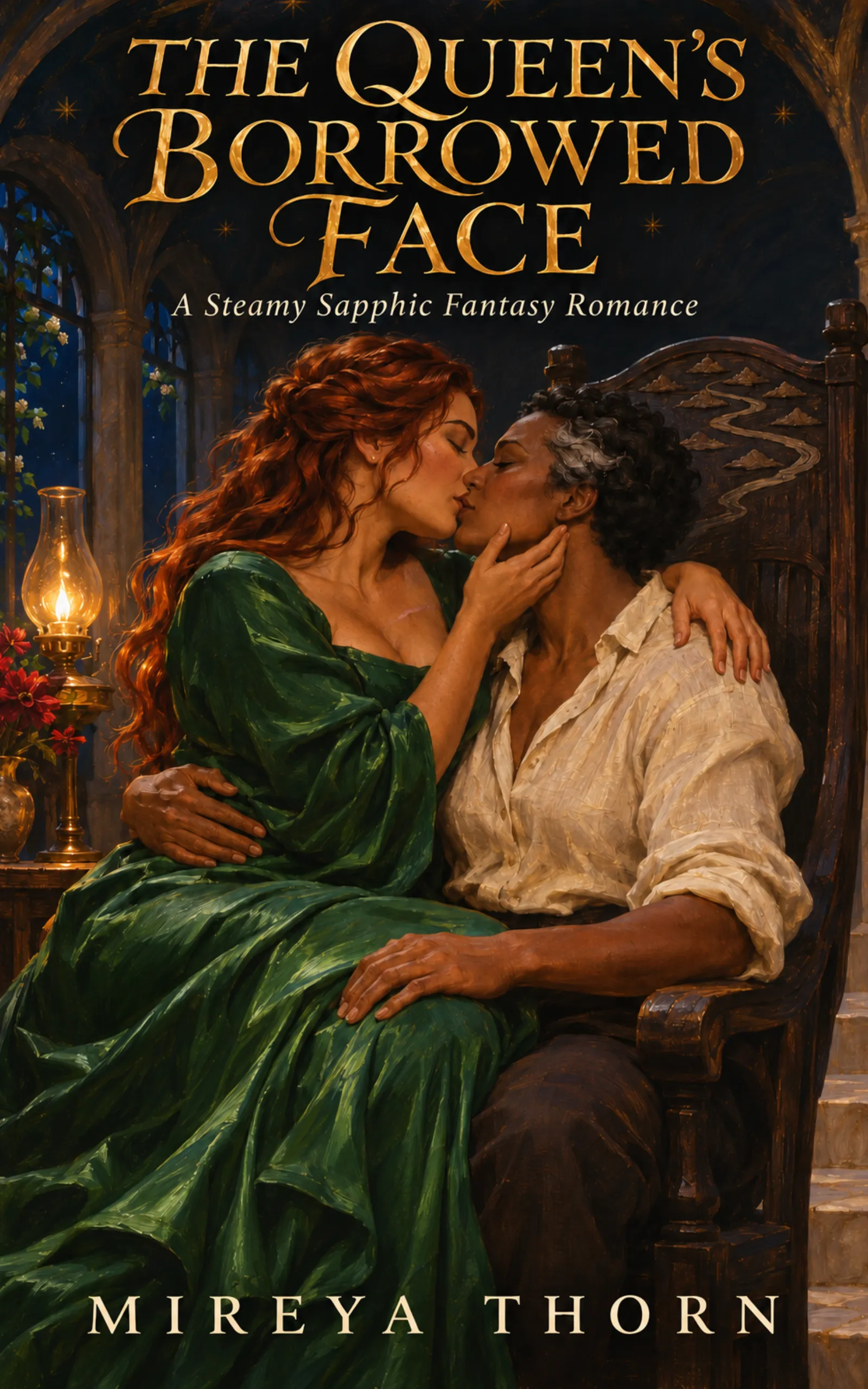
The Queen’s Borrowed Face
A Sapphic Court-Intrigue Romantasy
by Mireya Thorn
Shop the ebook · Shop the audiobook
Available at all major retailers
Pairing: FF (Sapphic)
Heat: 🌶️🌶️🌶️🌶️🌶️ Inferno
Tropes: Hidden Identity, Secret Royal, Royal × Commoner, Suspicion to Lovers, Forced Proximity, One Bed, Body Double, Masquerade, Court Intrigue, Instruction Kink, Power Exchange, Safe Word, Light Bondage, Mirror Play, Strap-On, Scar Worship, Grovel by Action, Touch Her and Die
She lent her face for one night. Getting it back means taking her shirt off.
Queen Maelin Sore lent her face to an actress for one night of festival theater. By midnight, assassins had put her guard in the river, and the actress was sitting on her throne.
Wearing a stranger’s borrowed face and unable to speak her own name, Maelin slips back into her own palace as a laundress. Only one person has noticed that the queen is wrong: Damaris Holt, a blunt, broad-shouldered tribunal investigator who doesn’t bow, doesn’t flatter, and makes every witness say exactly what they mean.
Maelin tells her the truth with a knife at her throat. Damaris makes her prove it, with her shirt off.
What starts behind a locked door becomes the most dangerous fourteen days of their lives: a manufactured war, a terrified double, a treasurer with a vessel built to steal the queen’s memories, and a desire that turns a woman who gives orders all day into one who begs to be told.
But Maelin’s crown has secrets Damaris’s integrity can’t bury, and the clock on the borrowed face is running out.
The Queen’s Borrowed Face is a scorching, standalone sapphic court-intrigue romantasy with hidden identity, dual POV, explicit open-door scenes, no cheating between the leads and an HEA guaranteed. Explicit content. 18+.
You’ll love this book if you enjoy:
✅ A queen hiding in her own palace as a laundress, and the one investigator who notices her hands
✅ Prove it. Take off your shirt. Suspicion to lovers, at knifepoint
✅ Two rooms above a chandler’s shop, one bed, and a creaking stair she learns to skip
✅ A queen who gives orders all day and begs to be told exactly what to do at night
✅ A masked ball, a laundry-chute escape, secret messages stitched into hems, and a body double who refuses her cue
✅ A wardrobe, a mirror she can’t bear to look into, a glass strap-on, a silk sash and a safeword
✅ Grovel by action: a twenty-page confession she never meant anyone to read
✅ Hidden identity, royal × commoner, touch her and die, no cheating between the leads, 🌶️🌶️🌶️🌶️🌶️ heat and an HEA guaranteed
⚠️ Content Warning: This novel contains extremely explicit sexual content (graphic FF scenes throughout, including oral, fingering, mirror play, face-sitting, scissoring, a glass strap-on, wrist-pinning, restraint with a silk sash, edging and a safeword), and strong language. Also includes the on-page murder of a bodyguard and two boatmen, an assassination attempt, knife violence including a serious arm wound, a woman struck by a guard, abduction and imprisonment, coercion of a theater company through debt and threats, a plot to steal a person's memories, political corruption and a manufactured war, an execution (off page, epilogue) and the death of a parent (past). No cheating between the leads. Intended for readers 18+.
📖 Read Chapter One Free
Not sure yet? Read all of Chapter One right here.
Chapter One: Maelin
The woman on the stage had Maelin’s mouth, and she was using it better than Maelin ever had.
From the wings of the Festival Theater, half-hidden behind a counterweight rope as thick as her wrist, Queen Maelin Sore watched herself lift a crown from a velvet cushion and hold it up to ten thousand people on the river.
The river stage had been built out over the water for the Festival of Borrowed Faces, a great lacquered platform on pilings, lit from beneath by floating lanterns so that the whole thing seemed to hover. The audience filled the stepped banks and crowded onto barges lashed hull to hull across the channel, a sprawl of masks and painted cheeks and upturned faces gilded by lamplight. Every one of them was looking at the queen.
None of them was looking at Maelin.
“Look at her hands,” she murmured.
“I am looking at her hands, Majesty.” Pellan Rusk stood at her elbow, sixty-two years old and twitching like a man thirty years younger with three times the debts. The facewright had not stopped fiddling with the brass lens on his watch chain since the curtain went up. “That’s what I’ve been looking at for nine days of rehearsal. She reaches with her right.”
On stage, Vessa Ardent set the crown on her own head with her right hand. The gesture was slow and terrible and lovely, and the crowd made a sound like surf.
Maelin’s face did it. Maelin’s gray-green eyes went wide and wet in the lantern-light, Maelin’s lips parted, and Maelin’s voice — low, dark-edged, the contralto her tutors had spent years training into something calm enough to read treaties in — rolled out across the water:
“I did not ask the river for this. The river asked me.”
It was the founding speech of Queen Asra, a speech every child in Ostel learned, and Maelin had delivered it herself at her coronation nine years ago. She had been competent. She had been dignified.
Vessa made it sound like a woman confessing to a lover.
Something warm and unsettled moved low in Maelin’s belly, and she didn’t care for it. There was no word for the feeling of watching your own throat swallow when you hadn’t swallowed. Of seeing the precise curve of your lower lip bitten, and knowing, from the inside, exactly how that bite would feel, and not feeling it.
“She’s better at me than I am,” Maelin said.
“She’s an actress, Majesty. You’re a queen. She has the easier part.” Pellan lowered his lens and lowered his voice. “Fourteen days. I’ll say it again because no one has listened to me yet. The lease will not settle for less. Whatever happens tonight, that face stays on her for fourteen days, unless the both of you stand in a room with the instrument, the prism, and me.”
“I know, Master Rusk.”
“And the clause—”
“The name clause.” She smiled at him, the gracious one, the smile that ended conversations. “While she holds my likeness, I can’t speak my own registered name aloud. It keeps two women from swearing to the same identity during a performance. I signed it. I read it first, which I’m told is unusual for monarchs.”
He didn’t smile back. “And her collar.”
On stage, Vessa wore the coronation gown of Queen Asra, crimson and gold, with a high standing collar of black lace that climbed nearly to the jaw. A beautiful choice. A necessary one. The lease took the face, the hair, the voice. Below the jaw, Vessa was herself — smaller in the shoulder, narrower at the waist, and unmarked.
Maelin’s fingers found the place under her own bodice without meaning to. A small raised seam of old scar tissue below her left collarbone. A knife, when she was nineteen and a princess and foolish enough to walk a garden without her guard. The whole kingdom knew the story. Half the kingdom had seen the scar at one ceremony or another.
Nobody would see the absence of it on Vessa, so long as the lace stayed up.
“She keeps the collar for fourteen days,” Maelin said. “She keeps to the Rose Apartments, she eats my pastry chef into an early grave, and on the fifteenth morning we stand in your little room and you give me back my nose.”
“Majesty.” Pellan glanced over his shoulder, toward the backstage passage, where the noise of stagehands and dressers rose and fell. “It isn’t the fifteenth morning that worries me. It’s tonight. The crossing.”
“Lord Vale arranged the crossing.”
“I know he did.”
“Four men. A covered skiff. The water gate.” She kept her voice light because his wasn’t. “Discretion, Pellan. If the queen leaves this theater under a column of halberds, ten thousand people will wonder why the queen is in two places at once.”
“Every person who matters knows exactly where you are, Majesty. That’s my worry. Everyone who matters knows where the queen isn’t.”
She opened her mouth to answer, and the music swelled and the crowd roared, and Vessa came down to the lip of the stage for her bow.
For one instant, through the glare of the footlamps, Vessa’s eyes found her in the wings.
They were Maelin’s eyes. They should have been the easiest thing in the world to read. But there was something in them — wide and fixed and white at the edges — that Maelin had never seen in a mirror.
Stage fright, she thought. Ten thousand people. Even Vessa Ardent could be frightened.
Then Vessa turned and swept her crimson train toward the far wings, and Lord Treasurer Adren Vale came through the backstage passage with his gloves already on.
“Majesty.” He bowed precisely as deep as a treasurer should. He was a handsome man still, at fifty-five — silver at the temples, a voice like good brandy, a habit of finishing other people’s arguments for them. “A triumph. The skiff is waiting. Captain Varrick has your route.”
“Thank you, Adren.”
“Tomorrow’s audience is at ten. I’ll have the brief sent up.” He offered his arm. “The city will talk of nothing else for a month.”
Maelin took the arm. Behind her, Pellan Rusk said nothing at all, and she would remember that silence later, the way you remember the one stair you didn’t see in the dark.
She would remember something else, too, going down the backstage steps toward the water: the strange, greedy little wish that had been growing in her for weeks, ever since she had first agreed to this. That she might, just once, walk out among those ten thousand people with her face hidden. Buy a skewer of honeyed river eel from a stall. Be jostled. Be ignored.
Be looked at by someone who didn’t know what she was, and see what they saw.
There were not many people in Selcourt who told her the truth to her face. She could have counted them on one hand, and one of them was a tribunal investigator she’d spoken to exactly twice, two years ago. Damaris Holt. A broad-shouldered woman with a silver streak in her black curls, who had stood up in open hearing and said, “With respect, Majesty, the figure was eleven thousand. You said twelve.” The whole chamber had gone still. Maelin had felt her cheeks burn.
She’d caught the woman in the corridor afterward and said, quietly, so no one else could hear: “Thank you for not letting me be wrong in public.”
Damaris Holt had not bowed. She had looked at the queen for a long, considering moment, as if deciding something, and then nodded once and walked away.
Maelin had thought about that look for a week.
She thought about it now, absurdly, stepping down into the covered skiff, and then she put it away, because she was queen, and queens did not daydream on stairs.
The skiff was black-lacquered and narrow, a curtained cabin amidships with a bench just wide enough for one. Two oarsmen. Ser Tam Orrow, gray-bearded, who had guarded her for six years and still told terrible jokes about the Treasury. One more guard she didn’t recognize — young, freckled, very quiet.
“New?” she asked Tam, low, as he handed her in.
“Varrick’s man. Captain said we were short.” Tam grimaced. “Captain’s always short. Mind your head, Majesty — the curtain rod’s a traitor.”
They pushed off. The theater’s roar fell away behind them, flattened by the water into a long, soft surf. Selcourt slid past in lanterns and fog. The city was built on eleven islands and stitched together with bridges, and during the Festival every bridge was painted fresh and strung with paper lights, so that the skiff passed beneath arch after arch of blue and gold and crimson, the oars dipping quiet, the bells of the temples sounding the half hour.
Maelin leaned her head against the cabin’s lacquered wall and let herself, for the length of three bridges, be tired.
Fourteen days in the palace with no face to wear in public. Pellan had suggested it as a joke, the first time — Majesty will have to hide in her own bedchamber, like a scandal — and she’d laughed and realized it was exactly what she wanted. Fourteen days of papers and quiet. Fourteen days of no one watching her mouth for the next decree.
She was thinking of that, of a bath and a book and the audit files she hadn’t had time to read, when the oarsman in the bow said, “Ser Tam—”
And then he didn’t say anything else, because he had a crossbow bolt through his throat.
It happened without music. That was what she’d remember. In the plays there was always a drum to tell you. Here there was only a wet, ugly sound and the oarsman toppling sideways with his hands at his neck, and the skiff lurching, and Tam’s voice, completely calm: “Down.”
She went down. Something hammered into the lacquered wall above her head and quivered there.
A barge had nosed out of the mouth of the Coopers’ Canal, low and unlit, its crew in festival masks — black half-faces, white beaks, the cheap kind sold on every bridge tonight, so that they looked like a flock of carrion birds come up out of the river. The second oarsman stood to swing his oar and took two bolts in the chest. The young freckled guard drew his sword.
And then he turned, quite deliberately, toward the cabin.
Toward her.
Tam hit him. Maelin saw it through a gap in the curtain — Tam’s gauntleted fist driving into the young man’s face, the young man’s sword skidding across the deck. The barge slammed into the skiff’s flank with a shriek of lacquer, and the birds came over the rail.
There were five of them. One was enormous, broad as a door, and when his mask slipped in the struggle she saw a pale scar splitting his upper lip and a jaw like a ship’s keel. He moved without hurry. He moved like a man who had already been paid.
“The cabin,” he said. Bored. “Quick.”
Tam was between them and her. Tam was fifty-one years old, and he killed the first bird before it got its blade up, and the second, and then the big man put a long knife into Tam’s side, low, under the ribs, and twisted it, and Tam made a sound that Maelin would hear for the rest of her life.
He didn’t fall. He came backward through the curtain, bleeding, and dropped to his knees in front of her, and he pressed something small and hard into her left palm.
“Festival token,” he said. His breath was wet. “Security issue. Crack it and think of nothing.”
“Tam—”
“Go in the water.” His hand closed over hers and squeezed. “And for the love of every god on the river, Maelin, don’t come up where they can see you.“
He had never called her by her name. Not once in six years.
Then he turned around, on his knees, and went back through the curtain toward the big man with nothing in his hands at all.
Maelin went over the side.
The river took her like a fist. The cold was immediate and total, a slap that went straight through silk and skin and into her lungs, and the weight of her gown dragged her down at once — skirts filling, sleeves filling, the whole beautiful expensive thing turning to lead. She kicked. She clawed at laces she couldn’t see. Above her the hull was a long black shadow against lantern-light, and something heavy hit the water beside her and sank, and she did not look at what it was.
She tore the outer gown loose. It slid away into the dark like a drowning woman. In her shift and her bodice she kicked upward under the hull, along it, past it, and came up gasping in the shadow of the Painted Bridge’s nearest piling, her cheek against slime-slick wood, her hand still clenched so tightly around Tam’s token that its edges had bitten her palm.
Voices above. Lanterns swinging.
“—not in the cabin.”
“Then she’s in the river.”
“Then look in the fucking river.”
Light swept the water. It slid across the piling an arm’s length from her face. Maelin pressed herself into the dark between the posts, among the trash and the weed and the dead festival paper, and opened her hand.
The token was a disk of red wax the size of a coin, stamped with the theater’s mask emblem and a seal she’d seen on security warrants. The festival guard issued them to plainclothes officers, she remembered vaguely — a cheap licensed likeness from the archive, so a watchman could vanish into a crowd and become nobody in the space of a breath. Crack it and think of nothing.
She put it between her teeth and bit down.
It tasted of honey and iron. For a heartbeat nothing happened at all.
Then her face caught fire.
It was not pain, exactly. It was worse than pain — the sensation of a hand of hot wax pressed flat over her features and then peeled, slowly, from brow to chin, taking her with it. Her nose shifted. Her cheekbones sank and widened. Her scalp prickled and pulled, and the long heavy weight of her hair, which had been pinned up for the theater, simply wasn’t there anymore; she felt the cold water against the back of her neck for the first time in her adult life. Her jaw ached as if she’d been struck. Her throat closed, and opened, and when she gasped, the gasp came out wrong — lower, rougher, a stranger’s breath in her own chest.
She clung to the piling, shaking, and waited for it to stop.
“There.” A lantern swung toward her. “Something in the pilings.”
“It’s a woman.”
Maelin looked up into the light.
The bird-masked man on the bridge railing looked down at her, at whatever face was looking up at him, and grunted. “Not her. Some drunk. Leave it.”
“Varrick’ll want the body.”
“Then he can swim for it. Doesn’t matter if she floats.” A laugh, careless. “She’s already home, isn’t she? Waving at everybody.”
The lantern swung away.
Maelin stayed in the dark until her teeth were knocking so hard she was afraid they’d hear. Until the boots overhead had gone, and the barge had slipped back into the Coopers’ Canal, and the only sound left on the water was the faint, cheerful roar of the festival drifting downriver from the theater, where ten thousand people were still applauding the queen.
Varrick’ll want the body.
She climbed out on the canal stair on her hands and knees.
There was a watchman at the top. Of course there was; it was festival night, and the watch was out on every bridge to keep drunks from drowning. He was young and round-faced and holding a lantern on a pole, and he started back when she rose up out of the river in a soaked shift and a ruined bodice.
“Gods, mistress. You fall in?”
“I need—” Her voice was a stranger’s. Low, husky, smoke and gravel. She stopped and made herself go on. “I need you to take me to the palace. The Water Gate. Now.”
“The palace.” He looked her up and down with the frank pity people reserved for festival casualties. “Course you do.”
“Listen to me.” She caught his wrist. “My name is—”
Her throat closed.
It wasn’t fear. It was a physical thing, a hand around her windpipe, gentle and absolute. She tried again, and the name sat on her tongue like a stone, and she could not push it past her teeth. Maelin. She could think it. She could see it written in her own looping left hand on a thousand warrants. She could not say it.
While she holds your likeness, Majesty, you cannot speak your registered name.
She had laughed when Pellan read her that clause. She’d said, What a relief.
“I’m the queen,” she said instead. The words came out fine; there was no clause against those. “I’m the queen of Ostel, and someone has just tried to kill me, and my guard is dead in a skiff below the Painted Bridge.”
The watchman’s face did something complicated, and then settled, kindly, into a grin.
“And I’m the moon, mistress,” he said. “Lovely costume, though. Very good. Who’re you supposed to be — the drowned queen? From the ballad?” He patted her hand where it clutched his wrist and unhooked it, quite gently. “Get yourself home and dry. Stay off the bridges. Lots of drink about tonight.”
He walked away whistling.
She stood on the Painted Bridge in a stranger’s face and dripped.
The festival went on around her as if nothing had happened, because for the festival nothing had. Revelers pushed past in feathered masks and borrowed crowns. A child on her father’s shoulders waved a paper queen on a stick. Somebody had set up a stall selling hand mirrors, little round ones framed in tin and painted with stars, so that people could admire their festival faces, and the vendor was calling, See yourself, see yourself, a copper to see yourself.
Maelin walked to the stall because her feet took her there.
The woman in the mirror was perhaps forty-five. Plain. Weathered, as if she’d worked outside for years; a scatter of freckles over a broad nose; brown eyes; a wide, thin mouth with lines bracketing it. Her hair was dark and cropped close to the skull, a soldier’s crop, a laundress’s crop. A face you’d pass on the street and never think of again.
Maelin lifted her hand to push her hair back from her forehead — the gesture she’d made ten thousand times, sweeping auburn waves off her brow — and her fingers found nothing. Stubble. Cold scalp.
The face in the mirror frowned at her. It was not her frown.
“Lovely,” the vendor said. “Very authentic. Copper, mistress?”
She had no copper. She had nothing. She had a soaked shift and a ruined bodice and, pinned inside the bodice where Tam must have slipped it while handing her into the skiff — the curtain rod’s a traitor, Majesty — a small enamel badge stamped FESTIVAL SECURITY — SERVICE DOORS. She hadn’t felt him do it.
She put the mirror down and turned away from the stall, and the drums began.
Down the river, the royal barge was coming.
She’d ordered it built three years ago for state processions: forty oars, gilded prow, a canopy of crimson silk, lanterns hung along every rail so that it moved through the dark like a constellation. The crowds on the bridges went wild as it came. People leaned out over the railings; people threw flowers. On the barge’s raised deck, beneath the canopy, stood a woman in a crimson coronation gown with a high black lace collar, and on her head was a crown, and she was waving.
Maelin’s hand. Maelin’s face. Maelin’s soft, practiced, gracious smile.
At her elbow, close, his gloved hand resting at the small of her back as if he had every right in the world to put it there, stood Lord Treasurer Adren Vale.
The barge passed beneath the Painted Bridge. For a few seconds Maelin was directly above it, close enough to drop a flower into the queen’s hair. Close enough to see that the waving hand was the right one. Close enough to see the queen’s eyes, under all that gracious smiling, moving — not across the crowd, but through it. Searching. Wide and fixed and white at the edges, exactly the way they had been in the wings.
Not stage fright.
Terror.
And then the barge was through, and gone downstream toward the Water Gate of the Palace of Tides, trailing its lanterns and its drums and its flowers floating on the black water.
Maelin gripped the bridge rail with both hands and made herself think.
The route. Who had known the route? Not the city. Not the court. The crossing had been planned for discretion; the plan had been on one sheet of paper. She had seen it. She could see it now. Five people had known which skiff, which bridge, which canal, which hour.
Herself.
Pellan Rusk, who had begged her not to go.
Ser Tam Orrow, who was lying in the bottom of a skiff in the Coopers’ Canal with a knife twisted under his ribs.
Captain Joss Varrick of the Treasury Guard, who had drawn up the route and assigned a quiet young freckled man to make up the numbers — and whose name a killer had dropped on the bridge as casually as a coin.
And Lord Treasurer Adren Vale, who had arranged it all, and who was at this moment escorting her face home with his hand on its back.
If she walked to the Water Gate tonight, the man who opened it would answer to Varrick. If she walked into the palace by any public door, she would walk in wearing this face, unable to say her own name, and the woman in her bedchamber would be wearing hers. Someone would be called to settle it. Someone would decide which of them was mad.
She had a fairly good idea who that someone would be.
The drums faded. The crowds on the bridge broke apart, laughing, drifting toward the wine stalls and the dancing on the next island. The child with the paper queen had fallen asleep on her father’s shoulders, the little crown dangling from her fist.
Maelin looked down at the badge pinned inside her bodice. SERVICE DOORS.
She had lived in the Palace of Tides for thirty-six years. She knew every public stair, every ceremonial gallery, every balcony from which a sovereign could be seen. She had been told, once, that there were service passages behind most of them. She had never once used one. She had never once wondered where they went.
She was going to find out.
Far downriver, the royal barge swung in under the arch of the Water Gate, its lanterns shrinking to a single smear of gold. On its deck, a small figure in crimson lifted its arm one last time to the cheering banks.
The queen waved.
Maelin, soaked and nameless on the Painted Bridge, watched herself go home without her.
Want to keep reading? The full novel is available now.
🔥 Want an EXCLUSIVE Bonus Chapter?
By the Front Door — A scene TOO HOT for the bookstore
The night after the bells, Damaris climbs the queen’s own stair in her boots and her terrible coat, with a box from the bottom of her sea trunk. Maelin wants it in her own bed, in her own face, with her own name finally hers to say.
More from Mireya Thorn
Browse all Mireya Thorn books.

The Queen’s Borrowed Face
She lent her face for one night. Getting it back means taking her shirt off.

The Dragon’s Night Physician
She came to diagnose a queen. She stayed to make her beg.
The House That Ate Its Brides
Seven brides went into Morven House. None came out. She’s the eighth.

The Museum of Unfinished Worlds
She stole a priceless artifact, broke my heart, and vanished. Now she needs me to help her do it again.
The Treaty of Unmade Queens
The Unmade Crowns
We married to save the treaty. Then the seal let me feel everything she feels.
Never Miss a Release
Get new release alerts, exclusive bonus content, and reader-only giveaways.