
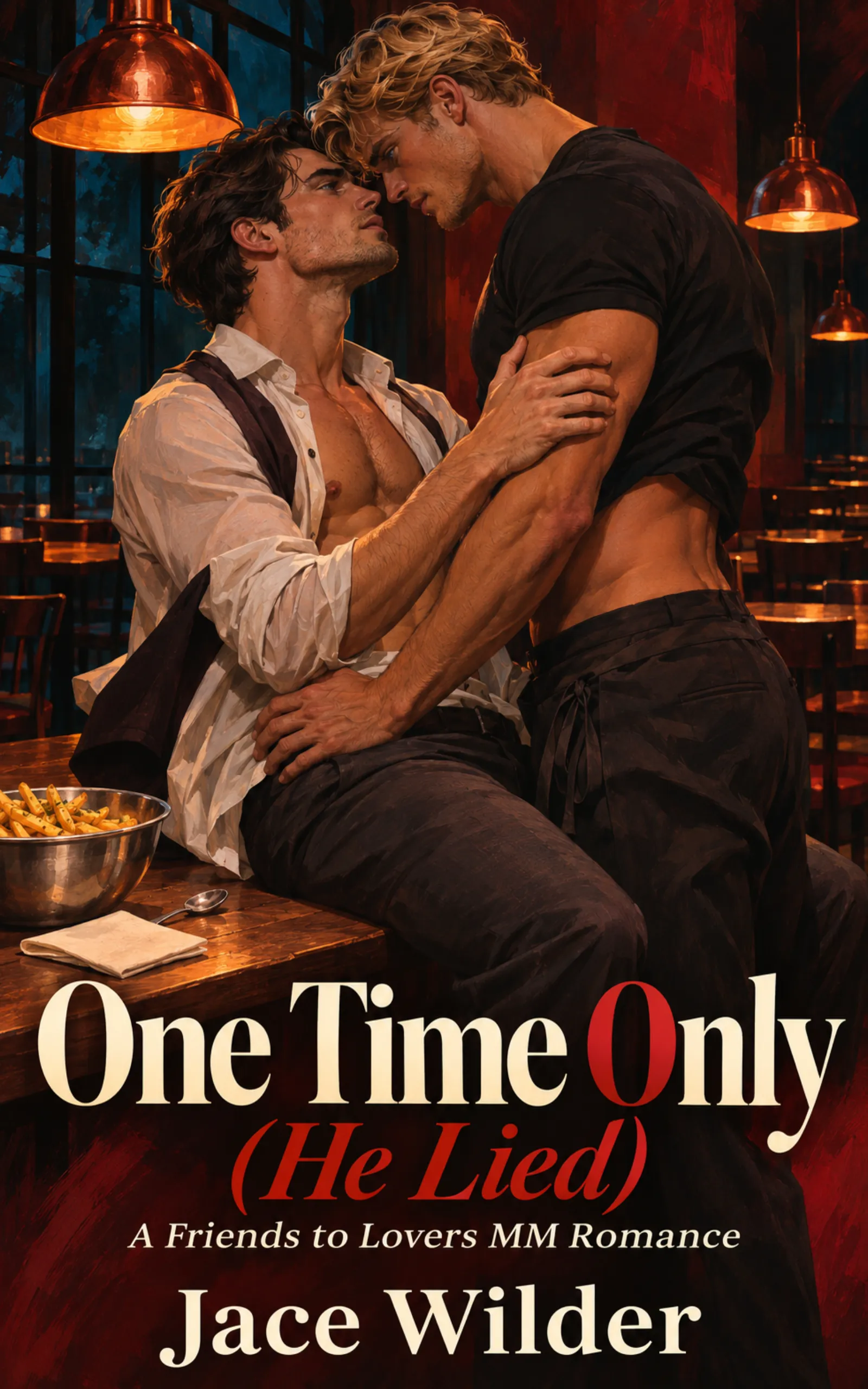
One Time Only (He Lied)
MM Friends-to-Lovers Workplace Romance
by Jace Wilder
Available at all major retailers
Pairing: MM
Heat: 🌶️🌶️🌶️🌶️🌶️ Inferno
Tropes: Friends to Lovers, Coworkers to Lovers, Curious Straight Guy, First Time With a Man, Bisexual Awakening, Secret Workplace Affair, Rules on a Napkin, “Just One Time”, Five Years of Pining, He Falls First, Chef & Restaurant Romance, Coming Out to Family, Found Family, Scar Worship, Switch/Flip-Flop, Grand Gesture, Proposal, HEA
He said it was one time. He lied.
Five years. That’s how long Dalton Eckert has run the front of house at Salt & Cedar, and how long he’s kept his feelings for the saucier at the next station filed away where they can’t hurt anybody.
Nolan Tisdale is straight. Nolan is a ranch kid from outside Lubbock with forearms that should be illegal and a girlfriend who just walked out with a parting shot he can’t shake. And at one in the morning, over a plate of cold fries, Nolan asks Dalton something no straight friend should ever ask.
One time. Just to know. It changes nothing.
Dalton has a rule. He made it at twenty-four, the week the man who’d kept him as a secret mailed him a wedding invitation and a thank-you note. Never be anyone’s experiment. Never again.
He says yes anyway.
There are terms, written on a restaurant napkin. One time. Nobody in the kitchen finds out. It changes nothing. Either of them can walk.
One time becomes “just to be sure.” “Just to be sure” becomes the walk-in cooler, the prep counter after close, and a kitchen full of people who can smell smoke. And when Nolan’s ex comes back offering him the easy way out, Dalton does what his rule always told him to: he gets out first.
What he doesn’t know: Nolan’s one time was never one time. He’d been drafting that question since April. And he’s about to cook the most important meal of his life to prove it.
One Time Only (He Lied) is a high-heat, standalone MM friends-to-lovers workplace romance with a curious-straight-guy first time, a restaurant family that can’t keep a secret, and a guaranteed HEA.
You’ll love this book if you enjoy:
✅ A gay GM with a rule against being anyone’s experiment, and the “straight” saucier who asks him for exactly that over cold fries at 1 a.m.
✅ Four terms on a Salt & Cedar napkin, and two men breaking them one technicality at a time
✅ Every first with a man on the page: a dry-storage kiss, a fourth-floor apartment off Congress, a prep counter after close, and a walk-in at 4:40 on a Tuesday (🌶️🌶️🌶️🌶️🌶️)
✅ A secret that six drafts in a Notes app have been keeping since April
✅ A kitchen family with a five-year betting pool, a chef who says “Mm,” and a dishwasher who knows everything
✅ A ranch-kid coming out on his father’s porch, a seven-course apology served by candlelight, and a guaranteed HEA
⚠️ Content Warning: This novel contains explicit sexual content (graphic MM scenes including oral sex, rimming, fingering, anal sex with condoms, switching, sex in a restaurant walk-in, on a prep counter and on a staff table, solo masturbation, dirty talk and praise), strong language, a curious-straight first time and bisexual awakening, coming out to family, references to a parent’s death and grief, a past relationship in which a character was kept as a secret, a breakup and separation during which one character kisses another man before stopping it, and workplace sex with professional risk. No cheating. Intended for readers 18+.
📖 Read Chapter One Free
Not sure yet? Read the full first chapter right here.
Chapter One: Dalton
At eight-forty on a Saturday night, Salt & Cedar sounds like a freight train that has decided, on principle, not to stop.
I love it. I would never say so in front of the servers, who need to believe I suffer alongside them, but I love it—the full book, the bar three deep, the slam and hiss that rolls out of the kitchen every time the doors swing. Ninety-two covers on the reservation sheet and a walk-in six-top I’d already found room for, because conjuring a table that doesn’t exist is the closest thing I have to a superpower.
“Dalton.” Fern caught my elbow at the host stand, a tray balanced flat on one palm, her ponytail losing the war. “Twelve wants to know if the duck can come without the cherries.”
“The duck can come without the cherries.”
“Fourteen wants to know if the duck can come without the duck.”
“Fourteen gets the cauliflower and a glass of whatever Perry thinks will make them happy, on the house, and nobody says the word duck at fourteen again tonight.”
“You’re a saint.”
“I’m a general manager. It’s like a saint, with worse hours.”
She was gone before I finished, which was correct. I straightened the menus, smiled at a couple who had been married long enough to stop talking to each other and were deciding whether to start again, and pushed through the kitchen doors to check on the line.
Heat hit me like a hand to the chest. It always does. Ten years old this September, and the kitchen at Salt & Cedar still runs hotter than any room has a right to: six burners roaring, the wood grill throwing orange light up the white tile, the dish pit steaming in the back corner where Gus Whitlow had been feeding the machine since before most of the line could legally drink.
Dom Baptiste stood at the pass like a lighthouse—tall, unbothered, reading glasses pushed into her grey-streaked hair, tickets clipped above her in a row she read the way other people read scripture.
“Ordering, two duck, one cauliflower, one strip mid-rare. Fire twelve. Where is my sauce for nine?”
“Walking,” came the answer from the sauté station.
It came quieter than it should have.
I’d noticed on Tuesday. By Thursday I’d started keeping track, the way I keep track of a server who’s suddenly too cheerful or a regular who orders the second bottle before the first is gone. Nolan Tisdale had been off all week. Not bad—Nolan has never in five years been bad at anything that happens on a stove—but precise in a way that looked like effort. Quiet in a way that looked like weather. He hadn’t sung once. On a normal Saturday you can’t get through a push without him murdering a George Strait chorus over the hood fans, Hector Ruiz harmonizing badly at the grill beside him, Dom pretending she can’t hear it while she taps the beat on the pass with her pen.
Tonight the hood fans were the only music.
He was plating nine as I watched. Beurre blanc, pale gold and glossy, drawn across the plate in a single stroke of the spoon. He tasted from a second spoon first—he always tastes—tilting it into his mouth, letting it sit on his tongue, frowning at nothing. His lower lip shone with butter for a moment before he caught it with his teeth.
I looked at the tickets.
Here is the thing nobody tells you about working beside someone for five years: you learn their body like a floor plan. I could have told you, blindfolded, that Nolan would shove his sleeves up past the elbow during the second turn because the chef coat made his wrists itch. That his forearms—thick, sun-browned, a ranch kid’s forearms, the kind of forearms a server once described in the walk-in as a public safety concern—would be slick with sweat by nine. That there would be a pale crescent of scar on the inside of his left wrist, just below the heel of his hand, and that if you asked him where it came from, you’d get a different answer than the last person who asked. A fryer in Lubbock. A bet in culinary school. A sous chef in Dallas with a temper and a hotel pan. I’d heard all three. I’d believed none of them.
I knew all of this the way I knew the sightlines in the dining room. Professionally.
Five years ago, the week Dom hired him, I’d watched him break down a case of chickens with his tongue between his teeth and felt something tilt hard in my chest, and I’d done what I always do with things that tilt. I’d picked it up, looked at it, and filed it.
Nolan Tisdale. Colleague. Excellent.
The file had held for five years. It was a very good file.
“GM’s in my kitchen,” Dom said without looking at me. “Is somebody dying?”
“Fourteen almost had a duck-related incident. It’s handled.”
“Good. Then stop standing there looking decorative and get me two more runners. Fern’s carrying like she’s in a circus.”
“She’s carrying like she’s on salary. I’ll pull Rafi off the bar.”
“Mm.” Which from Dom is a commendation.
I was halfway back to the doors when the spoon appeared.
It’s a ritual. I don’t remember when it started—sometime in his first year, during a slow Tuesday, when he’d been fighting a red wine reduction that wouldn’t behave. He’d held out a spoon over the pass and said, Tell me what’s wrong with it, and I’d said, Nothing, and he’d said, Liar, and grinned at me like I’d given him a gift. Every Saturday since, somewhere in the middle of the rush, a spoon comes my way across the stainless steel. Whatever he’s proudest of that night. Whatever he’s worried about.
Tonight it was the beurre blanc. He held it out without a word.
I took it. Tasted. Shallot and white wine, a breath of lemon, enough butter to make a cardiologist file a complaint. The texture was perfect—that point where a sauce stops being liquid and starts being a decision.
“Nothing,” I said. “It’s perfect.”
I waited for liar.
Nolan looked at me. Blue eyes, a little bloodshot from the heat. Hair the color of a wheat field somebody forgot to harvest, sticking up in the back where he’d dragged a hand through it. He looked at me for a beat too long, and then he took the spoon back, nodded once like I’d told him the time, and turned back to his station.
No liar.
I stood there holding nothing.
“Dalton,” Dom said mildly. “Runners.”
“Runners,” I agreed, and went.
We close the kitchen at eleven on Saturdays. The last table leaves somewhere around twelve-fifteen, if I’m charming, and twelve-forty if I’m not. Tonight I was very charming. By one in the morning the dining room was dark except for the bar lights and the pendant lamps over the long staff table in the back, and the whole crew of Salt & Cedar was sitting down to eat for the first time since four in the afternoon.
Family meal. Every restaurant does it. Ours does it at the end instead of the beginning, because Dom says she refuses to feed people and then watch them work, she wants to feed people and watch them rest. It was her first rule when she opened, and it outlasted three sous chefs, one ice storm, and a pandemic. There is always something from the line—tonight, the last of the short rib braise, falling apart over grits—and there are always fries. Gus makes them. Nobody else is allowed to make them. They come out in a steel bowl the size of a hubcap, salted with a heavy, loving hand, and they are the closest thing this kitchen has to a church.
I took my usual seat at the end, where I could see the whole table and the dining room door. Perry Lang dropped into the chair beside me with two glasses and a bottle of something from the reserve he was not technically allowed to open.
“Perry.”
“It’s corked,” he said serenely, pouring.
“It’s not corked.”
“It’s emotionally corked. It’s been waiting for someone to love it since 2015. I’m performing a mercy.” He slid a glass to me. Perry is forty-four, silver at the temples, built like a retired dancer, and married for fifteen years to a high school chemistry teacher named Ray who thinks wine is “fine.” It’s the great tragedy of Perry’s life and he will discuss it at length with anyone. “Drink. You were very gracious to fourteen.”
“Fourteen was a delight.”
“Fourteen sent back a glass of my Sancerre because it tasted too much like wine.“
“And you didn’t kill them. Look at us, growing.”
Across the table, Hector was building a fry tower with the focus of a structural engineer. Fern sat beside him with her shoes off and her feet up on the next chair, counting tips into stacks. Gus sat at the far end with his reading glasses and a crossword, where he has sat for ten years, filling in squares in pen.
Nolan sat directly across from me.
He always does. Five years, and I couldn’t tell you whether I started taking that chair because he sat across from it or the other way around. He’d changed out of his chef coat into a grey T-shirt that had seen better decades, and his hair was still damp at the temples. He wasn’t eating. He was holding a fry between two fingers and looking at it like it had asked him a hard question.
“So,” Perry said, to me, in the voice he uses when he’s about to ruin my evening. “I saw Kyle’s Instagram.”
“Congratulations. You have a phone.”
“He’s in Marfa. With a man. They’re standing in front of that fake Prada store looking very—” He searched for the word. “Contented.”
“Good for Kyle.”
“You mean that.”
“I do.” I did. Kyle and I had lasted two years and ended a year ago, without a single raised voice, which I used to think was a sign we were good at love and have since come to understand was a sign we were bad at wanting things. Kyle was kind and handsome and a very competent architect, and being with him had felt like a well-run hotel—clean sheets, good water pressure, nobody who’d ever look for you if you didn’t come down to breakfast. “I hope he’s happy. I hope it’s a warm man. Kyle runs cold.”
“Kyle ran fine,” Perry said. “That was your word. Fine. You said it about him the way people talk about a used Corolla.”
“Corollas are excellent cars.”
“Dalton needs a man,” Hector announced, not looking up from his tower.
“Dalton needs a hobby,” Fern said.
“Dalton needs both of you to finish eating so he can lock up,” I said. “Dalton has opinions about overtime.”
“There’s a new bartender at Rosie’s,” Perry went on, unmoved. “Thirty, gorgeous, does a thing with mezcal that should be illegal. Very sweet. Very curious.”
I took a sip of the emotionally corked wine. “Curious is a no.”
“Curious about what?” Hector asked.
“Curious,” Perry said, in a stage whisper, “about whether he likes men. He’s never tried. He told Ray at a party he’s always wondered. And our Dalton doesn’t do wonderers.” He turned his glass by the stem and gave me a look over it, half fond and half exhausted. “Dalton has a policy.”
“It’s not a policy,” I said. “It’s a rule.”
“Oh, my mistake.”
Across the table, Nolan had gone still.
I noticed, because I notice everything, and then I made myself stop noticing. The table moved on—Fern wanted to know who’d drunk the last Topo Chico from the bar fridge, Hector wanted to know why it was always him who got blamed, Gus said, “Because it was you,” without lifting his eyes from the crossword—and I sat with the rule in my mouth like a bad tooth.
It’s not complicated. I don’t talk about it, but it isn’t complicated.
When I was twenty-four I lived with a man named Brett Lowry in a two-bedroom off Riverside, and for eleven months we used one of the bedrooms and kept the other made up for his parents. He’d never been with a man before. He told me that the first night, his hands shaking, and I thought it was the sweetest thing anyone had ever trusted me with. He told me he’d never felt this way. He told me he just needed time. He told me, a hundred times, in the dark, that it wasn’t me he was hiding, it was him.
Then he moved out over a long weekend while I was visiting my sister, and three months later I got a wedding invitation in the mail. Heavy cream cardstock. Her name above his in raised gold script. Tucked inside the reply card, folded in thirds, there was a thank-you note in his handwriting.
Thank you for helping me figure some things out. You’ll always mean a lot to me.
I kept that note for a year, in a drawer, like a splinter you can’t stop pressing on. Then one night I burned it in the kitchen sink and ran the tap until the ash went down the drain, and I made a rule.
Never again be anybody’s experiment.
Not the man they try. Not the question they need answered. Not the chapter they skip when they tell the story at their kids’ graduation. I was out at nineteen and I have never been confused about who I am or what I want, and I decided at twenty-four that I would never again hand the most breakable thing I own to a man who was still deciding whether he wanted it.
It’s been eight years. The rule has an excellent record.
“Anyway,” Perry said, “I’ll tell the bartender you’re tragically celibate.”
“Tell him I’m monogamous with my job.”
“I’ll tell him you’re married to a binder full of seating charts.”
“Accurate.”
I glanced across the table. Nolan was looking at me.
Not the way people look at you when you’ve said something, the polite scan that slides off your face and onto the next thing. He was looking at me like the spoon. Like he was waiting for me to say a word I hadn’t said yet.
Then he ate the fry, finally, and looked away.
By one-forty they’d started peeling off. Fern first, shoes in her hand. Hector second, after he’d stolen three fries off Gus’s plate and received a look that would have stripped varnish. Gus folded his crossword and put his pen in his shirt pocket and said goodnight to the room, the way he does, like he’s blessing it. Perry stood, finished his glass, and paused behind my chair.
“Ray says hello,” he said. “Ray says come to dinner Sunday. Ray says if you bring a man he’ll make the good tamales, and if you don’t he’ll make the sad ones.”
“I love the sad ones.”
“I know you do.” He squeezed my shoulder, once, and his eyes slid over the top of my head toward the other side of the table, where Nolan was still sitting. Something passed across Perry’s face, too quick to read. “Lock up, Mr. Eckert.”
“Always do.”
The front door swung shut behind him and the dining room settled into that particular after-hours hush, the bar lights humming, the ice machine dropping a fresh load behind the bar like distant applause. In the kitchen the dish machine had stopped. Somewhere a refrigerator compressor clicked on.
Nolan was still there.
He’d pulled the fry bowl toward himself and was methodically eating the cold ones at the bottom—the limp, salty dregs that everybody else leaves. It’s a thing he does. He claims the cold ones taste more like potato, which is nonsense, and I’ve told him so, and he does it anyway.
“You don’t have to stay,” I said. “I’ve got the back door.”
“I know.”
He didn’t move.
I got up and went behind the bar, because if I was going to be sitting in a dark restaurant with Nolan Tisdale at two in the morning I needed something to do with my hands. I pulled two Shiner Bocks from the cooler, popped them on the edge of the bar, and brought them back to the table. Then, because I’m a professional and I couldn’t help it, I took a bar towel and a wine glass Perry had abandoned and started polishing it.
Nolan watched me do it. The corner of his mouth went up, barely. “You’re doing the thing.”
“What thing.”
“The glass thing. You polish when you’re thinking.”
“I polish when there are glasses.”
“That glass is clean, Dalton.”
I looked at it. It was. I set it down.
He turned the beer bottle in a slow circle on the table, leaving a wet ring, and then another one, overlapping the first. The pendant light above us caught the side of his face—stubble coming in coppery along his jaw, a small cut on his knuckle from the mandoline, a pale line of sweat salt drying at his collar. He was a big man in a small chair, shoulders curved forward, forearms on the table, the scar on his wrist turned up toward the light.
“You were off tonight,” I said.
“Was I.” Not a question.
“You were off all week. You didn’t sing. Hector had to do ‘Amarillo by Morning’ alone on Wednesday, and nobody deserves that, least of all Hector.”
That got a laugh out of him, short and surprised. Then it was gone, and he said, to the beer bottle, “Whitney said something. When she left.”
I set my towel down.
Whitney Carver. Pediatric nurse, thirty, kind eyes, laughed at the right places, came to the Christmas party two years running and brought homemade pralines and asked Gus about his grandkids by name. They’d been together two years. She’d left in February. Nolan had come to work the next day, done a double without a word, and when Hector asked if he was okay he’d said, She was right, and nothing else, and none of us had pushed, because in a kitchen you learn which doors to knock on and which ones to slide a plate under.
“That was four months ago,” I said carefully.
“Yeah.”
“You never said what happened.”
“Nothing happened. That’s sort of what happened.” He rubbed his thumb along the scar on his wrist. “We were good. I thought we were good. I was nice to her. I remembered her schedule and I learned to make that Vietnamese soup she liked and I never once forgot to text when I got off a double. I thought that was it. I thought that was—you know. The job.”
“Love isn’t a job.”
“Everything’s a job if you do it right.” He said it with complete sincerity, the way he says everything, and I felt something in my chest go soft and stupid. “Anyway. She sat me down on the couch, and she’d clearly thought about it. She had it written out, I think. She’s a nurse. She does a lot of discharge instructions.”
I bit the inside of my cheek.
“She said—” He stopped. Took a breath. When he said it, he said it carefully, like he was carrying something full to the brim across a crowded room. “She said, You’re wonderful. And it’s like loving somebody through a screen door. I think that door’s closed for a reason, and I’m not what’s behind it.“
The ice machine dropped another load. Neither of us moved.
I have been a general manager for eight years and a gay man for thirty-two, and I have heard every kind of breakup line there is, and I knew—the way you know a wine is going to be good before you taste it, just from the color in the glass—exactly what that sentence meant. I knew what she’d seen. I knew what she was trying to tell him, gently, with love, from her side of the mesh.
And I knew it was not my business. Not my door. Not my question.
“That’s a hell of a line,” I said.
“Right?” He laughed, but it came out wrong. “I’ve thought about it every day since. Every single day, Dalton. I’ll be reducing a stock and I’ll think about it. I’ll be in the shower. I’ll be at the HEB in the cereal aisle, and I’ll just—stop. Standing there like an idiot with a box of Cheerios, thinking about a goddamn screen door.”
“You’ve never told anyone that.”
“Told you.”
He said it like it was obvious. Like I was the place you put things.
I’ve been that, for a lot of people. It’s what I’m good at—the staff bring me their landlord problems and their custody schedules and their I think I’m drinking too much, and I fix what I can and hold what I can’t. I’m the calm in the storm. I’m the man who finds the table. Nobody ever asks what I do with all of it afterward.
Nolan was looking at me again. Straight on, steady, his jaw set like a man about to lift something heavy.
“You were a good boyfriend,” I said. “For what it’s worth. She was lucky.”
“I was a polite boyfriend.” He glanced down. Then up. “That’s not the same thing. I didn’t know that until she said it.”
The pendant light buzzed faintly overhead. Outside, a car went by on Cesar Chavez with its windows down and its bass up, and the sound rolled across the dark dining room and was gone. Nolan put the beer down. He put both hands flat on the table, on either side of the cold fries, like he was steadying himself on a pass during a rush.
I picked up the clean glass again. I didn’t mean to. My hands just went.
He watched me do it.
“Dalton,” he said.
There is a voice people use right before they ask you for something they’re afraid you won’t give. I know it the way a bartender knows the sound of a glass about to tip—a half second before it happens, when you can still reach out and catch it. Nolan had never used that voice with me. Not once in five years. He’d asked me for shift swaps and rides to the airport and help moving a couch up three flights of stairs, and every time, he’d asked the way he does everything—plainly, like the answer was obviously yes, like he’d already bought the beer to thank me.
This was not that voice.
I set the glass down very carefully, because my hand had gone strange.
He took a breath. I watched it fill his chest under the old grey T-shirt. I watched him wet his lips. And I had the sudden, absurd feeling that he’d practiced this—that whatever came next, he’d already said it to himself in a dark room somewhere, more than once.
“Can I ask you something?” Nolan said. “And you can say no. You can say no, and we never talk about it again.”
Want to keep reading? Get One Time Only (He Lied) now — available at all major retailers.
🔥 Want an EXCLUSIVE Bonus Chapter?
Serves: Two — A scene TOO HOT for retailers. The wedding night. One in the morning, two spoons, a cold fry on the shelf by the window, and Dalton waiting in the kitchen in the charcoal waistcoat Nolan has been fantasizing about since September. A promise from the walk-in finally kept, a nightstand drawer with only one thing in it, and nothing between them for the first time. Told from Nolan’s side.
More from Jace Wilder
Browse all Jace Wilder books.

One Time Only (He Lied)
He said it was one time. He lied.

Your Side of My Bed
Four weeks, in pen. One thin wall. Eleven years of pretending.

Sixty Days’ Notice
Four years. One wall. Zero idea.

Back of House
He bought my family's ovens and turned them off. Now he wants me.

Under New Management
The founder retired. The successor stopped waiting.

Room for the Best Man
Two best men. One bathroom. A couch night he swore he forgot.
Never Miss a Release
Get new release alerts, exclusive bonus content, and reader-only giveaways.