
🔥 The Proposal 🔥
An Exclusive Bonus Chapter from The CEO’s Wife
Thank You for Reading! 💜
You made it to the bonus content — which means you’ve survived the gala, the dressing room, the desk, Marcus’s bed, the parking garage, the wire, the fight, and a woman who stood in a penthouse hallway and said Take your hand off me.
This scene takes place six months after the epilogue. Rowan and Vivienne have been in Barcelona for nearly a year. Detective the cat still ignores Rowan. The cilantro has died a fifth time. And Rowan has been carrying a ring in the pocket of her linen suit for eleven days.
The ring was in the left pocket of her linen suit.
It had been there for eleven days. Eleven days of walking to work with a two-carat cushion-cut sapphire pressing against her thigh, eleven days of sitting in board meetings and reviewing financial models and conducting herself with the precise, unflappable professionalism that Meridia’s investors had come to expect from their COO, while a ring that cost more than her first year’s rent in the West Village sat in her pocket like a grenade with the pin half-pulled.
The sapphire was blue. Not diamond—Vivienne had spent twelve years wearing a diamond, and Rowan would sooner swallow glass than put another diamond on her finger. The sapphire was the blue of Vivienne’s eyes. The blue of the Mediterranean from the terrace on a clear morning. The blue of the dress Vivienne had been wearing the night Rowan decided to stop being careful and start being brave.
She’d bought it from a jeweler in El Born—a tiny shop on a narrow street where a woman named Laia had listened to Rowan describe what she wanted and had produced, three days later, a ring so beautiful that Rowan had held it in the shop and felt her eyes burn and said Yes, that’s her, that’s exactly her, and Laia had smiled the smile of a woman who made rings for a living and still, after thirty years, found the love part moving.
Eleven days. Every morning Rowan put on the suit and transferred the ring from the nightstand drawer to the left pocket and went to work and came home and transferred the ring back to the drawer and lay in bed beside the woman she was going to propose to and did not propose.
It wasn’t fear. Rowan had spent the last two years dismantling every cage fear had built around her life—the armor, the control, the strategic management of every emotion and every relationship and every moment of vulnerability. She was not afraid of asking Vivienne to marry her. She was not afraid of the answer.
She was afraid of the question being less than perfect.
Because Vivienne Ashford deserved perfect. Not Marcus’s version of perfect—the engineered, controlled, performative perfection of a man who treated his marriage like a quarterly report. Real perfect. The kind that was messy and specific and so completely theirs that Vivienne would know, without doubt, that the question came from the woman who had knelt behind her in a dressing room and fixed a zipper and spent the next year and a half proving, day by day, that love was not a cage.
Today was the day. Rowan had decided. Today—a Thursday in April, unremarkable, ordinary, the kind of day that would become remarkable and extraordinary only in retrospect, only when they told the story later and people asked when and Vivienne said a Thursday, in April, on the terrace, while I was painting.
Rowan left work at four. She walked home through the Gothic Quarter. She stopped at the market—flowers. Not roses. Roses were Marcus’s move. Rowan bought wildflowers. A loose, chaotic, magnificent handful of whatever the vendor had—lavender and sunflowers and something purple she didn’t know the name of and a spray of tiny white blooms that looked like stars.
She climbed the stairs. She opened the door. The apartment smelled like turpentine and coffee. Detective was on the couch, asleep. Vivienne was on the terrace, painting the cathedral again, barefoot, paint-stained jeans, hair in a clip.
“You’re home early,” Vivienne said without turning around.
“I brought flowers.”
“What kind?”
“The chaotic kind.”
Vivienne turned and her face softened. “They’re perfect. Put them in the blue vase.”
Rowan put the flowers in the vase and stood on the terrace and felt the ring in her pocket and thought: Now.
“Vivienne. Come here.”
Vivienne set down her brush and crossed the terrace—three steps, bare feet on warm stone. “You have paint on your nose,” Rowan said.
“I always have paint on my nose.”
“I know. It’s my favorite thing about you.”
Rowan reached into her pocket. “I have been carrying this for eleven days. I’ve sat through eleven days of board meetings with this in my pocket, and I’ve come home eleven times and not asked the question because I was trying to find the perfect moment.”
“And then today, I was sitting in a meeting about payment processing infrastructure—genuinely the least romantic context imaginable—and I thought: The perfect moment is any moment she’s in. I have been waiting for a moment that’s been here the whole time.”
She opened her hand. The sapphire caught the Barcelona light and fractured it—blue, deeper blue, the blue of eyes and oceans.
“It’s not a diamond. You spent twelve years wearing a diamond, and I would rather die than replicate any part of that life. It’s a sapphire. It’s the color of your eyes. It’s the color of the dress you were wearing the night I fixed your zipper and my hands were shaking because I was meeting the person I was going to love for the rest of my life.”
“I love you. I love you because you’re brave and kind and you grow cilantro that keeps dying and you paint cathedrals and you left a penthouse with a canvas bag and walked into my apartment and chose me.”
She was crying. Tears—the real kind, the body’s way of saying this matters too much for words so here is water instead.
“Marry me, Vivienne. Not because I need a ring on your finger to know you’re mine. Marry me because I want to stand in front of people and say it out loud. Because you taught me that the bravest thing a person can do is say the true thing, even when the true thing makes you cry in the middle of a proposal on a terrace with paint on your fiancée’s nose.”
“You said fiancée.”
“I’m being optimistic.”
Vivienne took Rowan’s face in her paint-stained hands. “Yes,” she said. “Yes, I will marry you. Yes, on this terrace, with paint on my nose and our terrible cilantro and our judgmental cat. Yes. A thousand times. Every time. Yes.”
Rowan put the ring on Vivienne’s finger. The sapphire sat on the hand that had worn Marcus’s diamond for twelve years—small, precise, changing everything.
“It’s the color of your eyes in the morning,” Vivienne said. “I’ve been trying to paint that color for six months and I can’t get it right. And now it’s on my hand.”
Rowan kissed her. The kiss was salt and paint and the irreplaceable taste of joy.
The kiss deepened. “Inside,” Vivienne murmured. “The painting can wait. The cathedral’s been standing since the fourteenth century.”
They fell onto the bed. The light came through the window in long golden bars that striped their bodies as they undressed each other—slowly, because they’d learned that slowness was not the opposite of desire but its amplifier.
Rowan kissed the collarbone. The throat. The spot behind Vivienne’s ear. “You said yes,” she murmured against Vivienne’s skin.
“I’m going to marry you,” Vivienne said, working the buttons of Rowan’s shirt. “And I’m going to tell every person who asks about this ring the story of a woman who fixed my zipper and changed my life.”
“I contain multitudes,” she said, pushing the shirt off Rowan’s shoulders. “Now stop talking and celebrate with me.”
Rowan celebrated with her mouth and her hands and the murmured narration that had been her technique since the beginning—whispered words against skin, praise that was not performance but prayer. Beautiful. Against her sternum. Brave. Against the curve of her breast. Mine. Against her stomach, where a smudge of cadmium yellow marked the spot where she’d wiped her brush that afternoon.
She moved lower. Vivienne’s jeans came off. The underwear followed. And Vivienne was bare on the bed, in the golden light, with a sapphire ring on her left hand that caught the sun and fractured it into a constellation of blue-white points that danced across the ceiling.
“The ring is making patterns on the ceiling,” Vivienne said breathlessly.
“The ring is doing what light does. I’m doing what I do.”
“And what’s that?”
“Worshipping you.”
Rowan put her mouth on Vivienne and worshipped her with the same meticulous, strategically devastating attention that had documented a four-billion-dollar fraud and planned a revolution and proposed on a terrace with wildflowers and a sapphire. Every touch a prayer. Every response a revelation. Every sound Vivienne made—the gasps, the moans, her name spoken in that breathless register—evidence of a miracle she hadn’t earned but intended to deserve.
Vivienne’s hand found Rowan’s head. The left hand. The hand with the ring. She threaded her fingers into Rowan’s hair and the cool metal of the sapphire pressed against her scalp—the ring she’d bought and carried and proposed with, now pressing against her head while she loved the woman who wore it—and the intimacy of it, the circularity, was so complete it made her chest ache.
She took her time. An hour. The luxury of an April evening with nowhere to be and the entire life stretching ahead of them like La Rambla at sunset.
Vivienne came twice before she pulled Rowan up and reversed them. “My turn.” She pushed Rowan onto her back. Straddled her. “My fiancée,” she said, testing the word.
“I love you. I’m going to love you forever. I’m going to love you so long and so thoroughly that when we’re eighty and sitting on this terrace with a cat named Detective the Third—”
“We’re not having three cats named Detective.”
She touched Rowan the way Barcelona light touched the city—slowly, warmly, illuminating everything. She moved between Rowan’s legs with the confidence of mastery, using her hands and her mouth and the devastating voice that had gone from silence to song since she’d left the penthouse.
Rowan let go. Completely. The orgasm moved through her like a tide—not a wave but a rising, a filling, the sustained pleasure of a body that was safe and loved and known. She came with Vivienne’s name on her lips and Vivienne’s ring hand on her chest, over her heart, the sapphire pressing against her sternum like a seal. Here. This heart. This person. Yours.
After. They lay on the wrecked bed in the violet-blue of a Barcelona evening. Vivienne held her left hand up and turned the sapphire slowly in the dying light.
“I’m never taking it off.”
“You’ll get cadmium yellow in the setting.”
“Then it’ll be the most me ring in the history of rings.”
“Thank you,” Vivienne said. “For everything. For the coffee. For the zipper. For seeing me when I was invisible. For loving me when I was frozen.”
“You weren’t broken. You were caged. There’s a difference.”
“You opened the cage.”
“You walked out. I just held the door.”
“I want to get married on this terrace.”
“This terrace is eight by ten feet.”
“You, me, Gloria, Delphine, and Detective. That’s everyone who matters.”
“Gloria will want to bring the oxtail.”
“It’s not a wedding without oxtail.”
“And Detective—”
“Detective will ignore the ceremony, knock over a wine glass, and sleep on my train.”
“You want whatever you want. That’s the whole point.”
“I want you,” Vivienne said. “In a linen suit. On this terrace. In April. With your mother’s oxtail and Delphine’s flowers and a cat who doesn’t care. That’s all I’ve ever wanted.”
“Then that’s what you’ll have.”
The evening settled. The sapphire glinted in the last light. Rowan held the woman who had said yes and thought about a dressing room, a zipper, a pair of blue eyes. Everything had changed. Everything was still changing.
And it was, all of it—the ring, the terrace, the paint, the cat, the oxtail, the linen suit, the wildflowers in the blue vase, the woman in her arms who had been a stranger and then a secret and then a lover and then a partner and was now her fiancée—
Perfect.
Not Marcus’s perfect. Not engineered or controlled or performed.
Just perfect. The real kind. The messy, paint-stained, cilantro-killing, cathedral-painting, wildflower-buying, sapphire-wearing, forever kind.
Perfect.
Loved The CEO’s Wife?
Get new release alerts, exclusive bonus content, and reader-only giveaways from Isla Wilde.
More from Isla Wilde

The Honeymoon Wasn’t Cancelled
A Why Choose FMF Vacation Romance
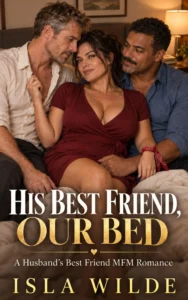
His Best Friend, Our Bed
My husband wants to watch. His best friend has wanted me for fifteen years.

Our Girlfriend’s House Rules
Two wives. One rule: never the same woman. Then they rent the guest suite to her.

Vacation Girlfriend, Double Trouble
Two best friends. One fake vacation girlfriend. Seven days that change everything.

Unprecedented Access
A Steamy MMF Hockey Romance

Room for Three
Two roommates. One new girl. Zero chance of staying just friends.