
After Hours
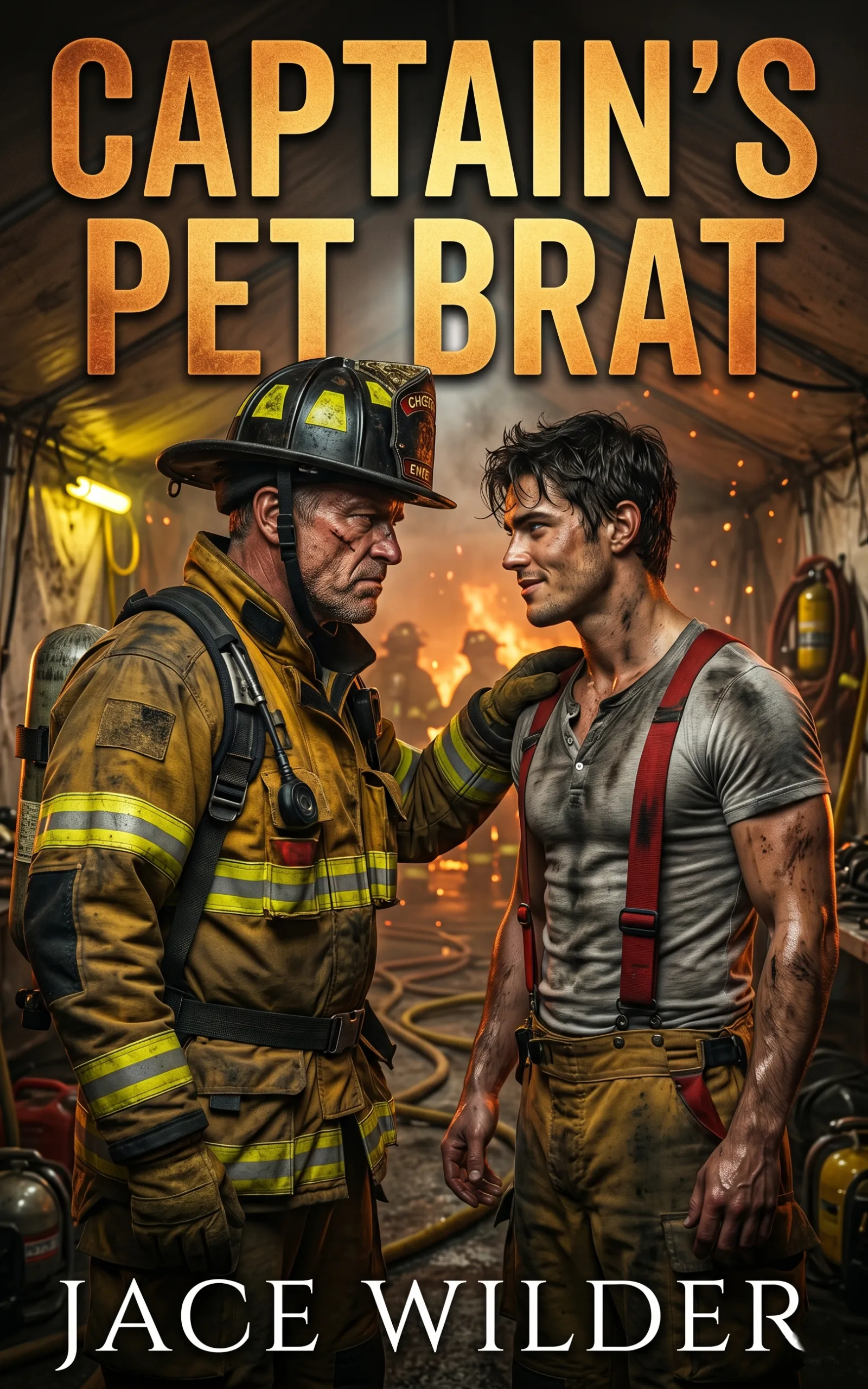
A bonus chapter from Captain’s Pet Brat by Jace Wilder
Set between Chapter Five and Chapter Six. The night before Laurel Pine. Station 19 empty except for the captain in his office and the lieutenant who can’t sleep.
Too hot for Amazon. For you.
— Jace
DAX
The bunkroom ceiling at 0213 had seven water stains that I had been counting for three hours.
Four on the east side. Two clustered near the south vent. One above my rack that was shaped, if you squinted, like the state of Wyoming. I had counted them eight times since 2304, which was when Reyes had come up from the kitchen and had gotten into the rack by the window without saying a word to me, and which was when I had gone from maybe I will sleep tonight to I am not going to sleep tonight.
His breathing four feet away was the wrong rhythm.
He was not asleep either.
He had been pretending to breathe regularly for two hours and fourteen minutes, and I had been pretending to sleep for the same two hours and fourteen minutes, and Cortez in the rack across the room was snoring like a freight train with a blown exhaust pipe, and Finn was breathing the small soft breaths of a kid who had taken a sleeping pill his mother had told him about, and the rest of the house was quiet in the way a firehouse gets quiet in the dead middle of a night that has not yet had a call.
I had kissed him nine hours ago in his office bathroom.
I had changed his burn dressing seven hours ago on the toilet lid.
He had told Kade Thorne no six hours ago with my knee against the inside of his thigh.
We had eaten dinner with Mel and Bear and Finn and the Redline Six seniors at a briefing in the mess tent five hours ago, and we had walked back to the station through the California dark two hours ago, and he had told me at 2147 in the apparatus bay — quietly, with his hand on Juno’s head and his eyes on the concrete floor — Rivera. Not tonight. We have Laurel Pine in the morning. Go to sleep.
I had said copy, Cap.
I had meant it.
I had not slept.
He had not slept either.
At 0217 his rack creaked.
I did not move. I kept my breathing even. I watched the water stain shaped like Wyoming. I heard the soft sound of his bare feet on the tile. I heard him cross the bunkroom. I heard him stop at the door.
I heard him not turn around.
I heard him open the door — slow, carefully, so it would not creak — and I heard him go out.
I counted to sixty.
Cortez snored.
Finn breathed.
Reyes’s rack across the room was empty.
I got up.
I went out after him.
REYES
I had not meant to leave the bunkroom.
I had meant to lie in my rack and stare at the ceiling and not think about the fact that in six and a half hours we were rolling eighty miles north to a base camp that a district chief I had misread for three years had engineered, and in six and a half hours I was going to be sitting in the passenger seat of a loaner engine from Station 23 with a Colt 1911 in a lockbox under my feet and a twenty-eight-year-old lieutenant in the jump seat behind me, and the only thing keeping me from thinking about any of that was Rivera’s breathing four feet from my head, which was also what was keeping me awake.
I had meant to sleep.
I had failed.
At 0217 I had gotten up. I had gone down to my office. I had not turned the light on. I had sat at my desk in the dark with one hand flat on the wood and the other on the back of Juno’s head — she had followed me down, because of course she had — and I had stared at the empty space on the bookshelf where the fostered-dog photos used to live, and I had breathed.
The house was quiet.
The door of my office was open to the hallway. The hallway light was a dim orange from the emergency fixture at the mezzanine. The apparatus bay three rooms over was black except for the red exit sign over the bay door and the slow green blink of the engine’s standby indicator.
I had been sitting for about three minutes when I heard bare feet on the tile.
I did not move.
The footsteps stopped at my door.
Rivera said, quiet: “Cap.”
I said, quiet back: “Rivera.”
He said, “Can I come in.”
I said, “Yeah.”
He came in.
He closed the door behind him.
DAX
He had not turned the light on.
I did not turn the light on.
The room was dark except for the orange spill from the hallway coming under the door and the red LED on his desk phone. He was in his gray T-shirt and pajama pants. No shoes. The fresh dressing on his shoulder was a pale shape under the cotton of the shirt where I had wrapped it at 1017 that morning. His hair was sticking up on one side. His hands were flat on the desk in front of him. He had Juno at his foot, asleep, her head on his slipper.
He did not stand up when I came in.
He watched me from the desk.
I said, “Cap.”
He said, “Rivera. You were not asleep.”
I said, “No, Cap. You were not either.”
He said, “No.”
I said, “Cap.”
He said, “Yeah.”
I said, “We do not have to do anything. I just — I cannot lie in that rack and stare at the ceiling for another four hours. I needed to be in the same room as you. That’s it. I will go back up if you want me to.”
He looked at me.
He looked at me for maybe six seconds.
Then he said, “Close the blinds.”
There were no blinds. The office had an interior window to the hall and a small exterior window behind the desk that faced the side alley and had a pull-down shade that I had seen him use precisely never. I went to the exterior window. I pulled the shade down. I walked to the interior window. I dropped the roller blinds that he had probably not dropped in six years.
I crossed the office.
I stood in front of his desk.
My heart was doing a thing.
He said, “Come around.”
I came around.
I stopped next to his chair. He looked up at me. I could see him clearly now that my eyes had adjusted — gray eyes dark in the dark, jaw rough from the hour, chest rising and falling a little faster than he wanted me to see.
I said, “Cap.”
He said, “Rivera. Kneel.”
My whole body went warm.
I knelt.
The floor was carpet, thin commercial-grade, and it was not comfortable, and I did not care. I knelt between his knees on the carpet of his office with my hands on his thighs and my forehead level with his chest and I looked up at him.
He said, “You were not going to sleep.”
I said, “No, Cap.”
He said, “I told you not tonight.”
I said, “Yes, Cap.”
He said, “You came down here anyway.”
I said, “Yes, Cap.”
He said, “Why.”
I said, “Because I could hear you not sleeping, Cap.”
He did not speak for a second.
Then he put his hand on the top of my head.
He said, “Good boy.”
I closed my eyes.
I made a sound that I was grateful for the closed door about, because it was the sound of a man who had been under-slept and over-wound for three days and who had just been told, quietly, by a captain who had been holding the line for seven years, that he was doing something right.
Reyes said, “Rivera. Look at me.”
I looked up.
He said, “Do you want this.”
I said, “Yes, Cap.”
He said, “You know we cannot fuck in this office.”
I said, “Copy, Cap. I know. I was not going to ask for that.”
He said, “What were you going to ask for.”
I said, “Cap.”
He said, “Rivera.”
I said, “I was going to ask if I could put my mouth on you.”
He did not speak for a second.
Then he said, quiet, “Yeah, Rivera.”
He said, “Yes.”
He said, “Good boy.“
I reached up.
I unbuckled his belt.
REYES
I want to tell you something about my office.
My office had not had a closed door during business hours in six years. The closed door was, in my own head, a thing that I did with my grief and with my privacy, and a thing that I did not do at work. I had run a station with an open door for a decade. I had told my crew, every new probie, at orientation: if my door is closed, it is closed for a reason, and the reason is almost never good news — so if you see it closed, knock.
I had closed the door on Rivera three times in nine days.
The first time had been for the Thorne meeting.
The second had been for his field-dressing of my shoulder.
The third time was right now, at 0224 on the Thursday night before Laurel Pine, with my lieutenant on his knees between my thighs in the dark undoing my belt.
I was not going to count it as business hours.
I was going to count it as the exception that God had given me.
He got my belt open.
He got my pajama pants down to my thighs.
He got my boxers down after them.
He looked up at me with my cock in his hand — already hard, I had been hard since the word kneel had left my mouth, possibly since I had heard his bare feet on the tile in the hall — and he said, quiet:
“Cap.”
I said, “Yeah.”
He said, “I have been thinking about this for four days.”
I said, “Copy, Rivera.”
He said, “Since the decon tent.”
I said, “Copy.”
He said, “I wanted to do it in the tent. I wanted to go down on you in the tent. I did not ask. I wanted to wait. I have been — I have been thinking about it every night since.”
I said, “Rivera.“
He said, “I am going to do it now.”
I said, “Yes.“
He took me in his mouth.
He took me slow. Tip first, one long sink down to the root, all the way, his hands flat on my thighs and his hair falling into his eyes and the dark at the back of his throat when he pushed all the way down to my pelvis and held me there — his tongue flat along the underside of me, the pressure of him swallowing around me — and I put my hand in his hair and I did not push, I did not pull, I just held on.
He hummed.
The vibration went through my whole lower body like a struck bell.
I said, “Jesus. Christ. Rivera.“
He laughed.
He laughed around me, mouth full, a small warm rumble, and it was the most filthy and the most tender thing I had felt in years, and I had to put my other hand flat on the desk to keep from making a sound that would have been, in a fire station at 0224, a bad idea.
He pulled off.
Slow. Slower than slow. He let every inch of me drag across his tongue on the way out, tongue curled around the underside, lips tight. He got to the tip. He did a tight slow swirl that made my hips come off the chair.
He said, “Cap.”
He said it against the head of my cock, his mouth an inch away, his breath on the slick skin, his hazel eyes up at my face in the orange spill under the door.
I said, “Rivera.“
He said, “You have to be quiet.”
I said, “Copy.“
He said, “Finn’s upstairs.”
I said, “Copy, Rivera, I know.”
He said, “You cannot come in here. I am not going to have you walk into an apparatus bay at 0500 with come on the inside of your pajama pants, Chief. I am taking you back up to the bunkroom after this and you are sleeping, and the reason you are going to sleep is because I am going to do this for you now and then you are going to have emptied out, and your body is going to do the thing bodies do, and you are going to sleep. Yes?”
I said, “Yes, Rivera.”
He said, “Where.”
I said, “What.“
He said, “Where do you want to finish, Cap.”
I said, “Your mouth.“
He said, “Good boy.”
He took me back down.
DAX
I want to tell you exactly how I got him off.
I am going to tell you because I took notes in my head at the time and because I intend to do it again on a porch swing in May of next year, and I want the record to be accurate.
I took him down to the root.
I held him there for five seconds.
I hummed.
He made a small sound in his throat that he did not mean to make.
I pulled off to the tip slow. I did a tight swirl. I took him down halfway. I worked the middle third of him with a tight suck — lips tight, tongue flat, a steady fast rhythm — while my hand on his base did the part my mouth was not reaching. I kept my other hand flat on his thigh, thumb on the tendon at his inner groin, because I had learned at the cabin that thumb pressure right there lit him up, and we had not actually been to the cabin yet because this was day five of the Beast Fire, but I had figured it out in the decon tent and I had been filing it, and I was cashing the file in now.
He put his hand in my hair.
Not pulling.
Gripping.
I worked him for maybe two minutes like that.
Full down to the root, hum, pull to the tip, swirl, halfway down, suck, hand working the base on the down-stroke, thumb on the tendon, nose occasionally in the coarse dark hair at his pelvis. He was leaking — I could taste it, the salt, the thick — and he was making tiny broken breaths above me that he was not letting turn into sounds. His thigh was shaking under my palm. His other hand was fisted in the edge of his desk so hard I could see the tendons.
I pulled off.
He said, “Rivera—“
I said, “Cap. Look at me.”
He looked down.
His face in the dim orange light was a face I have never seen on him before and have seen on him about forty times since. Mouth open. Cheeks flushed. Eyes blown. A man undone at three a.m. in a room he had closed the door on for the first time in six years.
I said, “I love you.”
He said, “Rivera—“
I said, “I have not said it. I have been about to say it for three days. I am saying it now because we are going to Laurel Pine in six hours and I do not want the first time I say it to be in a base-camp tent with my back against a canvas pole. I am saying it here. On my knees. In your office. At 0226 on the Thursday before we roll north. I love you, Reyes Harlan. That is the thing I came down here to say. The rest of this was — the rest of this is because I love you. Not instead of. Because of.”
He did not speak for a second.
Then he said, voice cracking: “Rivera.“
I said, “Cap.”
He said, “Dax.“
I said, “Yeah.”
He said, “I — I love you.”
I said, “Copy, Cap.”
He said, “I am going to come if you put your mouth back on me.”
I said, “Copy, Cap. That’s the idea.”
He said, “Rivera.“
I said, “Yes, Cap.“
I put my mouth back on him.
He came in about ninety seconds.
I took him through it. Every pulse. All the way down. I kept my hand on his thigh, thumb on the tendon, and my other hand at his base, and I swallowed around him through the whole thing, and he did not make a sound because he had his whole fist pressed against his own mouth, biting down on his knuckle hard enough that he had a mark for three days that I was going to kiss on Friday night in a tent at Laurel Pine after he had told me about Paradise.
I pulled off slow.
I wiped my mouth with the back of my wrist.
I sat back on my heels on the carpet between his knees.
I looked up at him.
He was crying.
Quietly. Silent. Tears at the corners of his eyes. Not sobbing. Just — wet. The way a man cries when he has been holding something too long and it has gotten out of him sideways. His hand was still in my hair. His other hand was flat on the desk, white-knuckled. His thigh was still shaking under my palm.
I said, “Cap.”
He said, “Dax.“
I said, “Come here.”
He slid off the chair onto the floor with me. His pajama pants tangled at his ankles, boxers too, a ridiculous logistical problem we ignored. He wrapped both arms around my shoulders and he pulled me into his chest and he put his face in my hair, and he held on.
He held on for about two minutes.
I held him back.
At 0231 he said, into my hair, “Rivera.”
I said, “Cap.”
He said, “You did not let me touch you.”
I said, “Cap. Not tonight.”
He said, “Rivera.”
I said, “Tonight was yours. It had to be. You have been carrying Thorne for six months and a CO device for sixteen hours and a burn on your shoulder for thirty and a file on a dead chief for a decade, and you have been the one in every room who was holding it. I wanted to be on my knees for you tonight. I did not want to be fucked. I wanted to do this. This was what I wanted. Yes?”
He said, “Copy, Rivera.”
He said, “I love you.”
I said, “I love you.”
He said, “I am forty-eight years old, and I am sitting on the carpet of my own office at 0232 with my pants around my ankles and the man I love holding me, and I am going to tell you something.”
I said, “Yeah.”
He said, “This is the best night of my life.”
I said, “Cap.“
He said, “So far.”
He said, “So far, Rivera.”
I laughed into his neck.
He laughed into my hair.
We stayed on the carpet for another minute, and then I got up, and I pulled his pants up for him, and I fastened his belt, and I sat him back in his chair, and I went into his office bathroom and I wet a washcloth with warm water, and I came back, and I cleaned his face for him — the tears, the sweat at the temples, the corner of his jaw where the heel of his hand had pressed — and he let me do it.
When I was done I kissed him once, soft, closed-mouthed.
He kissed me back the same way.
He said, “Rivera.”
I said, “Yeah.”
He said, “Take me to bed.”
I said, “Copy, Cap.”
REYES
We went back up to the bunkroom at 0247.
Cortez snored.
Finn breathed.
Juno followed us — she had stayed asleep in the office through the whole thing, which was either a testament to her discretion or evidence that she was seven and a half and slept like a brick once the lights were out — and she jumped up onto Rivera’s rack and lay down at the foot of it, because I had apparently been demoted one rack in her rotation during the previous four minutes.
I got into my rack.
Rivera got into his.
I lay on my back.
I closed my eyes.
My body — he had been right about this, he had been right in the way Army officers get right about the things bodies do — had emptied. The coil that had been holding me up for forty-eight hours had slipped. I could feel the weight of the burn on my shoulder for the first time as tired, not as pain to manage. I could feel the sheet under my back as a sheet. I could feel my breathing as breathing.
I was going to sleep.
I had not known I was going to sleep until that second.
Across the room, Rivera said, very quiet, “Cap.”
I said, “Rivera.”
He said, “I love you.”
I said, “I love you.”
He said, “Sleep.”
I said, “Copy.”
I slept.
I slept for two and a half hours, which was not a lot, but which was real sleep, which was dreamless, and which put me on Engine 23’s loaner rig at 0517 with a cleaner head than I had gone to bed with.
At 0514 Rivera’s alarm went off.
Mine went off at 0515.
We met at the top of the stairs in our boxers.
He looked at me.
He smiled — small, sleepy, a corner of his mouth.
He said, “Morning, Cap.”
I said, “Morning, Rivera.”
He said, “You sleep?”
I said, “Yeah.”
He said, “Good.”
I said, “You?”
He said, “Yeah.”
He said, “Best sleep I’ve had in a year.”
I said, “Rivera.“
He said, “Cap.”
I said, “Come here.”
He came there.
I kissed him at the top of the stairs with Cortez’s snoring still faint from down the hall and the dawn blue coming in through the bunkroom window at the end of the hallway and the smell of coffee from Mel in the kitchen downstairs and Juno somewhere between our feet, and he kissed me back, and I pulled back and I put my forehead on his forehead for a second, and I said:
“Rivera.”
He said, “Cap.”
I said, “Laurel Pine.”
He said, “Laurel Pine.”
I said, “Ready?”
He said, “Ready.”
I said, “Let’s go.”
We went.
That was the night. That was the bonus one. That was the one I did not put in the book because it lived in between — between Chapter Five and Chapter Six, between a burn dressing and a tent confession, between not yet and yes, between a closed door at 0224 and a kiss at the top of the stairs at 0515, between the life I had been living for seven years and the life that started when he came down the hall in his bare feet and asked me if he could come in.
I said yes.
I am still saying yes.
I will be saying yes for the rest of my life.
— for the people who bought the book and came looking for more.
thank you for reading.
— Jace
🔥 Hope you enjoyed that
If you haven’t read the full novel yet, Ghost and Blaze’s whole story is waiting for you.
Never Miss a Release
Get new release alerts, exclusive bonus content, and reader-only giveaways.