
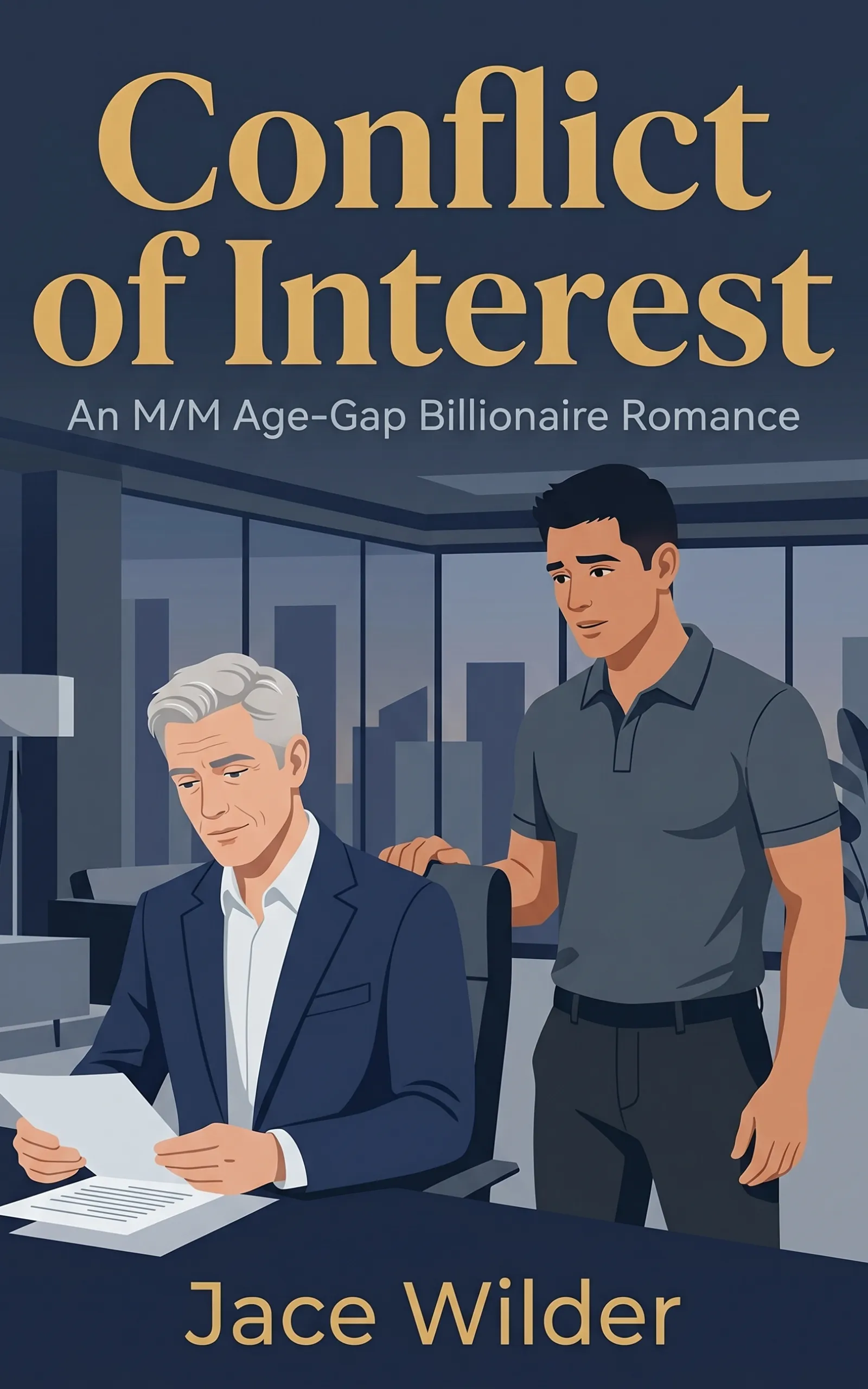
Conflict of Interest
MM Age-Gap Romance
by Jace Wilder
See available purchase options
Pairing: MM (Gay Romance)
Heat: 🌶️🌶️🌶️🌶️🌶️ Inferno
Tropes: Age Gap (24 yrs), Forced Proximity, Boss/Employee Inversion, Widower, Praise Kink, Grumpy/Sunshine, Hurt/Comfort, Touch Starved
Six weeks to close the deal of his life. Six weeks to keep his hands off the man his board hired to save it.
Adrian Cross has spent seven years being a brand instead of a man.
Since his husband died, he’s poured everything into Crosshatch Capital — fourteen billion under management, a corner office, a wedding ring he never took off, and a bed that hasn’t had anyone in it but him.
Then his board hands him an ultimatum: six weeks of executive recovery, or he loses the lead on the biggest deal of his career.
Six weeks with Nolan Vale.
Twenty-eight. Former Olympic-track. Founder of the most exclusive performance firm in New York. Hired help with a rate sheet, a client list, and exactly zero interest in being intimidated by an older man’s restraint.
Nolan was supposed to fix Adrian’s sleep. Not his hands. Not his hunger. Not the parts of him that have been in storage for seven years.
Six weeks to close the deal. Six weeks to keep his hands off the man his board hired to save his life. Six weeks to decide whether being alive again is worth what it’ll cost him.
You’ll love this book if you enjoy:
✅ Grumpy widower CEO × cocky younger trainer who refuses to be temporary
✅ Age-gap romance where the older man is the one being unraveled
✅ “Praise kink” written like it actually means something
✅ Forced proximity, ticking-clock tension, and a workplace ethics line that gets crossed beautifully
✅ Slow-burn first half, scorching second half (🌶️🌶️🌶️🌶️🌶️ — explicit, graphic, emotional)
✅ Grief recovery handled with care — no replacement of the dead husband, no easy answers
✅ A grovel scene set in the kitchen where it all broke, in front of the people who matter
✅ HEA guaranteed
⚠️ Content Warning: This novel contains explicit sexual content (graphic MM scenes, on-page), strong language, on-page panic attack, grief and loss of a spouse to cancer (off-page, past), and depictions of touch deprivation and emotional shutdown. Themes of professional ethics and consent within an unequal-power dynamic are central. No infidelity. No CNC. HEA guaranteed. Intended for readers 18+.
📖 Read Chapter One Free
Not sure yet? Read the full first chapter right here.
Chapter One: Day One
There was a particular humiliation in coming back to consciousness with four members of your board staring down at you, and Adrian Cross was discovering it in real time.
The carpet under his cheek was Italian wool. Daniel had picked it out when they’d renovated the offices nine years ago, dye-matched to a shade he had called, with a straight face, expensive grief. Adrian had laughed at the time. He was now making intimate acquaintance with the texture and finding the joke a great deal less funny.
“He’s coming back.”
Felix’s voice, very close. Felix Tran was crouched beside him, two fingers at his pulse, calm in the way Felix was always calm, which was the kind of calm a person had to work for. The other voices were further off. Someone had gotten water. Someone had loosened his tie — Adrian could feel the gap at his throat — and that more than anything was what brought him fully back, because the idea of someone undoing his clothing in his own boardroom was unbearable.
He sat up.
“Adrian.” Marin’s voice this time, sharper. Marin Hollis was not a person who got hysterical, and the closest she got to it now was a single click of her tongue. “Lie back down.”
“I’m fine.”
“You are on the floor.”
“I’m leaving the floor.”
“Adrian.”
He got up. His legs took him. That was a relief, because he wasn’t entirely sure they were going to. He braced one hand against the slate of the conference table and waited until the gray at the edges of his vision unfurled and let go. He fixed his tie. He buttoned his jacket. He looked at the four people in the room with him and let the silence stretch until it became a fact instead of a question.
“Continue,” he said. “Where were we.”
Marin closed her folder.
“We were,” she said, “at the part where you stop killing yourself for this fund.”
Forty minutes later, in the smaller conference room next to his office — what Daniel used to call the quiet room, on the basis that it was the only room in the building where Adrian was occasionally willing to shut up — Marin laid out his options.
There were two.
“Option one,” she said, sliding a single sheet of paper across the table to him. “You take six weeks. We bring in Apex Performance. Daily sessions. Sleep audit, nutrition audit, full nervous system reset. You do the work, you close Halden, you keep your name on the deal.”
“And option two.”
“Option two.” She did not slide him a second piece of paper. “I pull you from Halden. Felix takes lead. You take a sabbatical, sit on the beach, read a book, possibly remember what color your daughter’s eyes are. We tell the press it’s a sabbatical. The Street will not believe us. Your stock takes a hit. You come back when I think you can come back. Or you don’t.”
“Marin.”
“Don’t Marin me, Adrian. You hit the floor. You hit it hard. Felix had to crack your tie open to make sure you were breathing.”
“My EKG is clean.”
“Yes. Because if it weren’t clean we’d be having this conversation in a hospital. I’m not interested in waiting for it to be unclean.”
He looked at the paper. Apex Performance, LLC. A name he half-recognized, the way he half-recognized most of the wellness industry — pet projects of the rich, polished bullshit, men who put crystals on people’s stomachs and charged forty thousand dollars a month. He looked at the name on the paper a second time. Lead consultant: N. Vale. Beneath that, a CV in compressed font, every line of which was annoying.
“He’s twelve,” Adrian said.
“He’s twenty-eight.”
“As I said.”
“He’s also,” Marin said pleasantly, “already in a car on his way to your apartment, so unless you’d like him to do an intake on the doorman, I would suggest you go home.”
Adrian set the paper down very carefully, which was his version of throwing something across the room.
“You did this without asking me.”
“You were unconscious.”
“For thirty seconds.”
“Long enough.”
He looked at Felix. Felix, at the other end of the table, did not return his look. Felix, who had stood beside him through twenty-one years of acquisitions, divorces, deaths, and elevator small talk, was suddenly fascinated by the cap of his pen.
“Coward,” Adrian said, mildly.
“Yes,” Felix said. “Go home, Adrian.”
The car took him uptown. He didn’t speak to the driver. He watched the city slide past him in late-October light — that particular angled gold New York gave you for about three weeks a year, the kind of light that made even the ugly buildings look like they had been lit deliberately — and he did the breathing exercise he had taught himself in the months after Daniel had died, when it had not been clear that he was going to be able to keep going to work, or come home from work, or get out of bed in any of the rooms he and Daniel had picked out together. In for four, hold for seven, out for eight. He had read about it in a magazine. He had never told anyone he did it.
By the time the car reached his building, he was, by any measurement that mattered, fine.
Mariana had let herself out. She had left tea on the counter — green, in the cast-iron pot Daniel had bought in Kyoto on their tenth anniversary — and a covered plate of something he wasn’t going to eat. He could hear the soft hum of the building’s HVAC, and beyond that nothing. Tribeca, thirty-eight floors up, double glazing all the way around. The penthouse was as quiet as a held breath.
He set his briefcase down. He did not change out of his suit. He had been told that someone was coming, and he was going to receive that someone in a tie.
The intercom buzzed.
“Mr. Vale to see you, sir.”
“Send him up.”
The elevator opened directly into the foyer, which Daniel had thought was the height of vulgarity until he had used it for the first time and decided, immediately, that vulgarity was underrated. Adrian heard the chime. He heard the doors part. He heard a single set of footsteps, unhurried, on the marble.
He turned.
The first thing Adrian thought was: He’s not what they sent me.
The second thing was that he had no business having a first thought, because he had not given the man two full seconds.
Nolan Vale was 5’11”, lean in the way runners were lean, which was to say built like a length of cable rather than a slab of stone. Dark jeans. A fitted gray henley with the top two buttons undone, neckline soft from washing. A worn navy hoodie unzipped over it. White sneakers, clean. A vintage gold-cased watch on his left wrist that didn’t match the rest of him and looked, for that reason, like the most personal thing he was wearing. He was carrying a slim leather portfolio under one arm. His hair was dark and a little long on top and slightly damp at the temples, as if he had walked the last block from the car. His face was — and this was the part Adrian was annoyed by — extremely good. Not pretty. Sharp. Wide-set brown eyes with a green-gold thing happening at the edges. A mouth that sat naturally a degree off neutral, a quarter-smile that wasn’t a smile, that you could not have removed from him with a court order.
He was twenty-eight years old, and he had walked into Adrian’s apartment with the relaxed, considering posture of a man who had been in nicer places and was not in a hurry to be impressed.
“Adrian,” he said, before Adrian had said anything.
“Mr. Vale.”
“Nolan, please.”
“Nolan.”
He came across the foyer and offered his hand. The grip was dry and brief and exactly as firm as it should have been. He did not pump it. He did not linger. He was clearly a person who had worked out, somewhere along the line, that nothing about a handshake had to be performed if you were comfortable in your own body, and he was. The release came at exactly the right moment, and Adrian was annoyed that he had noticed.
“Thanks for the time,” Nolan said.
“I wasn’t given a choice.”
The quarter-smile became, briefly, a half. “I know. I appreciate it anyway.”
He didn’t apologize for it. Adrian had been ready for the apology — for the careful little speech about respecting his time, about understanding that this was delicate, that he was grateful for the opportunity, all the practiced syntax of consultants and yes-men. Nolan, instead, said I appreciate it anyway like a fact, with eye contact, and waited.
Adrian gestured toward the kitchen.
“This way.”
He led him down the long hallway into the open of the apartment. Floor-to-ceiling windows on three sides. The river to the west, lower Manhattan to the south, the Brooklyn Bridge tucked in at the corner like a thumbprint. Mid-century low-slung furniture in oxbloods and bone, a piano nobody played anymore, a long blackened-steel kitchen island with three leather stools. He took the stool farthest from the door because it was his stool. Nolan, after the briefest pause, took the one across from him rather than beside him, which Adrian also noticed.
“Tea?” Adrian said. “It’s fresh.”
“I’m okay. Water’s fine.”
He poured the man a glass of water and slid it across, and watched, despite himself, the way Nolan’s hand closed around it. Long fingers. Square nails. A faint white scar across the back of the right thumb. The hand of someone who used his hands.
Nolan opened the portfolio. A tablet. A leather-cased fountain pen. A small Moleskine that had clearly seen miles. He clicked the tablet awake, scrolled briefly, and then put it screen-down on the marble and folded his arms on the counter and looked at Adrian.
“I have what they sent me,” he said. “Bloodwork, the cardiac workup from this morning, your medication list, the six-month sleep tracker your assistant set up that I’m guessing you didn’t know existed.”
“I knew it existed.”
“Then you knew the data was bad.”
“It runs in three-hour cycles.”
“When you sleep at all.”
Adrian set his cup down with more care than was warranted. “Mr. Vale.”
“Nolan.”
“Nolan. I’d rather not begin our acquaintance with you telling me what I do and don’t know about my own body.”
Nolan considered this. He didn’t bristle. He didn’t flinch. He picked up the fountain pen and uncapped it and laid the cap precisely on the marble parallel to the barrel and said, with exactly the same calm he’d had in the foyer:
“Okay. Then tell me about your sleep.”
“I get six. Six and a half.”
“Hm.”
That was all. Hm. He wrote nothing. He was looking at Adrian the way you might look at a dog that had just told you, very confidently, that it had not eaten the sandwich. He waited. He didn’t fill the silence. Adrian had been on the receiving end of a great many tactical silences over the course of his career and had deployed at least as many, and he could tell, with a flush of professional appreciation that was its own irritation, that this one had been chosen.
“Three to four,” he said, eventually. “Some nights none.”
Nolan wrote that down.
“Thank you,” he said, mildly.
“I don’t see why it should be —“
“Because if you lie to me about your sleep, we’ll waste each other’s time. And I cost a lot of money, and your time is the only thing on the table that matters more than mine. So.” He clicked his pen open again. “Let’s not lie to each other, Adrian. It would be inefficient.”
Adrian held his gaze for a long second.
It was not, he thought distantly, the gaze of a twenty-eight-year-old. Or rather — it was, exactly. That was the problem. It was the gaze of a twenty-eight-year-old who knew precisely how old he was and had decided that the older man across the kitchen island was not, on balance, going to use it against him.
“All right,” Adrian said. “Ask your questions.”
The questions were, in their way, worse than the boardroom.
Marin’s people had given Nolan the medical workup, the bloods, the medication list — a handful of things, statins, a beta-blocker he took occasionally for travel, the Ambien he didn’t take but kept by his bed in case he ever became the kind of person who took Ambien — but Nolan asked his own questions anyway, in his own order, and the order, Adrian came to understand somewhere around the fifteenth one, was the point.
Sleep, first. They had done sleep.
Then food. Then alcohol. Then water. Then the last time he’d been outside for more than twenty minutes that wasn’t between a car and a building. (He had to think.) The last time he had eaten a meal sitting down. (He had to think.) The last time he had eaten a meal sitting down with another human being who was not a colleague. (He stopped thinking.) The last time he had exercised in a way that wasn’t punishment. The last time he had allowed himself to be sore and not worked through it. The last time he had taken a sick day. The last time he had taken any day. Whether he carried his phone into the bathroom in the morning. (Yes.) Whether he carried it into the shower. (Once or twice.) Whether his bedroom had blackout curtains. (Yes.) Whether his bedroom had a television. (No.) Whether he masturbated. (Excuse me.) Whether he masturbated, Nolan repeated, calmly. It was a circulatory and nervous-system question. He could decline to answer if he preferred.
“Occasionally,” Adrian said.
Nolan wrote it down.
“And sex,” Nolan said, in the same tone, not looking up.
“Pardon.”
“Are you sexually active, with a partner.”
“No.”
“Recently?”
“No.”
“How recently.”
A pause.
“Define recently.”
Nolan looked up.
This, Adrian understood, was the moment. He had been bracing for it without quite knowing he was bracing. The man across his kitchen island, whose forearms on the marble were corded in a way Adrian was choosing not to evaluate, whose mouth had not yet formed the question Adrian was sitting here pretending he didn’t know was coming, was about to ask him about Daniel; and Adrian had a script for that, a clean, frictionless script, my husband died seven years ago, thank you for asking, next question — and he could feel, with the same animal clarity he had when a deal was about to turn, that the script was not going to survive contact with this man.
But Nolan, Nolan didn’t ask about Daniel.
“Have you had sex in the last twelve months,” he said.
“No.”
“In the last five years.”
“No.”
“In the last seven.”
A breath.
“No.”
Nolan capped his pen.
He didn’t write anything. He looked at Adrian for a long, mild beat. Not pity. Not surprise. Something more like a registered fact, slotted into a larger pattern, the way a doctor might note a blood pressure that had not been a surprise, exactly, but mattered.
“Okay,” he said.
That was it. Okay. He uncapped the pen again and moved on. When did you last take a vacation. Did you work the entire time. When did you last cry. When did you last laugh until you couldn’t catch your breath. When did somebody touch you, Adrian, that wasn’t a handshake or a haircut.
Adrian answered some of them. He did not answer others. Nolan did not press. He moved on every time, in the same steady rhythm, the pen scratching softly on the Moleskine page, and the longer it went on, the more Adrian had the disorienting, near-unbearable sense that he was being seen — not in any swooning, romantic way, nothing so embarrassing as that — but in the way a piece of equipment was seen by a man who had been hired to fix it and who was, very calmly, finding all the broken parts.
He was aware, halfway through, that he had been looking at Nolan’s mouth.
He was aware, two-thirds of the way through, that he had been doing it for some time.
The mouth was not doing anything. The mouth was speaking, occasionally, and then closing, and then the man’s eyes were on Adrian again, and the slight crookedness of the upper lip — a small thing, a very small thing, the kind of thing you could not have mentioned out loud without revealing how long you had been looking at it — kept catching him at the edge of his attention every time the man asked another question. Adrian was a person, by training and by long, ground-in habit, who did not look at men. Who had not looked at a man, with anything more than the abstract acknowledgment that some men were attractive, since he was forty-five and his husband had been alive and the world had been a different world.
He looked at Nolan Vale’s mouth. He looked at it for the time it took Nolan to ask him whether he ever woke up at three a.m. with his heart pounding for no reason he could identify. He looked at it through his own answer, which was yes. He looked at it for a second past that, and then he looked away, and his face was warm under his collar, and he was furious.
He stood up.
“I think,” he said, “we have what we need.”
Nolan did not look thrown. He capped his pen. He closed the Moleskine. He wrote nothing down about the standing.
“Sure,” he said. “We’ve got plenty to start.”
He slid a single sheet of paper across the marble — a printed schedule, neat, sans-serif — and stood, also, and zipped his hoodie halfway up.
“Six a.m. tomorrow,” he said. “Your gym. No coffee yet.”
“Excuse me.”
“Your gym. Through the door off your bedroom. Six a.m. Wear what you’d wear to move in. Don’t eat. Don’t drink coffee. Water is fine. We’ll do an assessment, talk through the schedule. It’ll take ninety minutes. After that you can have all the coffee you want.”
“I drink coffee,” Adrian said, “at five-thirty.”
“Not tomorrow.”
“I have a call at seven-fifteen.”
“Then we’ll start at five-forty-five.”
Adrian opened his mouth. Closed it.
Nolan was already gathering his portfolio, sliding the tablet inside, tucking the pen back into its leather sleeve. He moved without hurry. Adrian had the uncharitable thought, watching him, that the man would not be hurried by an earthquake, and also the more uncharitable thought that he was watching him.
He turned away. He walked Nolan to the foyer.
At the elevator Nolan paused, hand on the call button. He turned back.
“It gets less awful, by the way.”
“What does.”
“This. The first week is the worst part. You’ll hate me for about six days. You’ll start to hate yourself for hating me around day eight. Then you’ll sleep through a whole night for the first time in probably a year, and you’ll forgive me a little. By week three you’ll be telling me things you’ve never said out loud.”
He said all of that pleasantly, as if reading off a card.
“That sounds appalling,” Adrian said.
“It is, a little.”
The elevator doors opened. Nolan stepped in. He turned, hand on the doorframe, that quarter-smile back at the corner of his mouth.
“Get some sleep, Adrian.”
“Good evening, Mr. Vale.”
“Nolan.”
“Good evening, Nolan.”
The doors closed.
The hallway was very quiet. Adrian could hear, somewhere deep in the building, the elevator descending. He could hear his own pulse. He could hear, with the strange clarity that came at the end of a long day, the soft hum of the refrigerator three rooms away.
He did not move for a moment.
Then he turned and walked back to the kitchen.
The schedule lay where Nolan had left it on the marble.
Adrian picked it up. He read it standing, jacket still on, because he had not, in his own apartment, in his own kitchen, taken off his jacket. The schedule was simple. Daily training, six a.m., his gym, ninety minutes. Mobility, strength, cardiovascular, in rotating priority. A nutrition window — first food no earlier than nine, last food no later than eight. A sleep protocol: bedroom screens off by nine-thirty, lights low by ten, asleep by eleven. Asleep, the schedule noted dryly, in italics, not in bed working. There was a hydration target and a sodium target and a note about caffeine cutoff at one p.m. There was a small block at the end of each day labeled recovery, fifteen minutes, contents unspecified.
At the bottom of the page, in his own handwriting — Nolan’s handwriting, then; the handwriting of a man who used a fountain pen at twenty-eight — was a single line.
Anything you want changed, we’ll change. Anything you want skipped, we won’t.
— N.V.
Adrian set the schedule down.
He stood for a long moment with his hands flat on the marble.
Then he looked at his hands.
The wedding ring on his right hand was brushed platinum, simple, with a single line of script engraved on the inside that nobody but him would ever read. He had not taken it off in seven years. He had not, in any meaningful sense, thought about it in seven years; it was not so much a piece of jewelry as a piece of his hand, a thing that was simply true about him, like the small scar on his sternum or the way his left shoulder came up when he was tired. He turned it once around his finger with the pad of his thumb. He had been doing that, he realized, while Nolan had been sitting across from him asking him questions. He had been doing it without noticing he was doing it.
He turned it again, slower.
He thought, unwillingly, of Daniel — Daniel, who would have walked in from the foyer fifteen minutes after Nolan had left, taken one look at Adrian standing at the kitchen island with that piece of paper in his hand, taken one look at the half-drunk water glass with the ring of condensation on the marble and the second leather stool pulled out at an angle, and he would have grinned. The grin Adrian could still summon at will. The grin that had only ever meant one thing, which was uh-oh.
He thought, with a small clean stab of loyalty so old it had calcified into reflex, no.
He thought, with the next breath, Daniel would have liked him.
He sat down on the leather stool — the one across from his own, the one Nolan had used — and he put his elbows on the marble and he pressed the heels of his hands against his eyes and he sat like that for a long time, and he did not cry, because he didn’t, anymore, and he didn’t move, because there was nowhere in particular to go, and eventually he lowered his hands and looked, again, at the ring on his finger.
“Six a.m.,” he said aloud to the empty apartment.
The empty apartment said nothing back.
He folded the schedule in half. He took it down the hallway with him, and into his bedroom, and laid it on his nightstand on top of the unread Economist and the bottle of Ambien he didn’t take. He undressed methodically. Jacket on the valet stand. Tie back on its hanger. Shirt to the laundry chute. Trousers folded over the bench at the foot of the bed.
He did not, as he sometimes did, get back into a button-down to sit and read. He sat on the edge of the bed in his undershirt and his briefs and looked at the floor.
It had been seven years and four months and eleven days since anyone had looked at him the way Nolan Vale had looked at him across the kitchen island.
It hadn’t been, he understood, the way Daniel had looked at him.
Daniel had looked at him like he was the answer.
This man — twenty-eight, in white sneakers, with a gold watch and a fountain pen and a quarter-smile he hadn’t asked anyone’s permission for — had looked at him like he was a question.
Adrian Cross had not been a question, to anyone, in a very long time.
He turned out the light at ten.
He lay in the dark with his eyes open until almost one.
He slept, when he slept, badly.
At five forty-five, in Lululemon shorts he had bought online because he had been told, by a man twenty-four years his junior, that he could not have his coffee, he opened the door from his bedroom into his home gym.
Nolan Vale was already there.
Want to keep reading? The full novel is available now.
🔥 Want an EXCLUSIVE Bonus Chapter?
The Wedding — Three months later. The lawn at Hudson. The lavender in bloom. The morning Adrian decides about the ring — alone, in front of his own mirror, on his own. The man who plants six terracotta pots before noon and sees, when he looks up, exactly what his husband has done. Then a wedding-night scene that takes two hours and seventeen minutes and earns every minute of it.
More from Jace Wilder

Still Here, Still Yours
He promised to call. Twenty-three years later, he's standing on my ball field.

Hands Full
One good hand. One thin wall. His best friend's little brother on the other side of it.

The Year We Stopped Pretending
They’ve been best friends for twenty-five years. It took one bed to ruin everything.

Two’s Company, Three’s Coming
A Steamy MMM Roommates-to-Lovers Romance

Spare Key After Midnight
The key was for emergencies. Wanting the man upstairs wasn't supposed to count.

His First Man at Forty
Bluebird Lanes
He asked the brewery owner to be his first. The answer was three dates — and nothing comes off until the third.
Never Miss a Release
Get new release alerts, exclusive bonus content, and reader-only giveaways.