
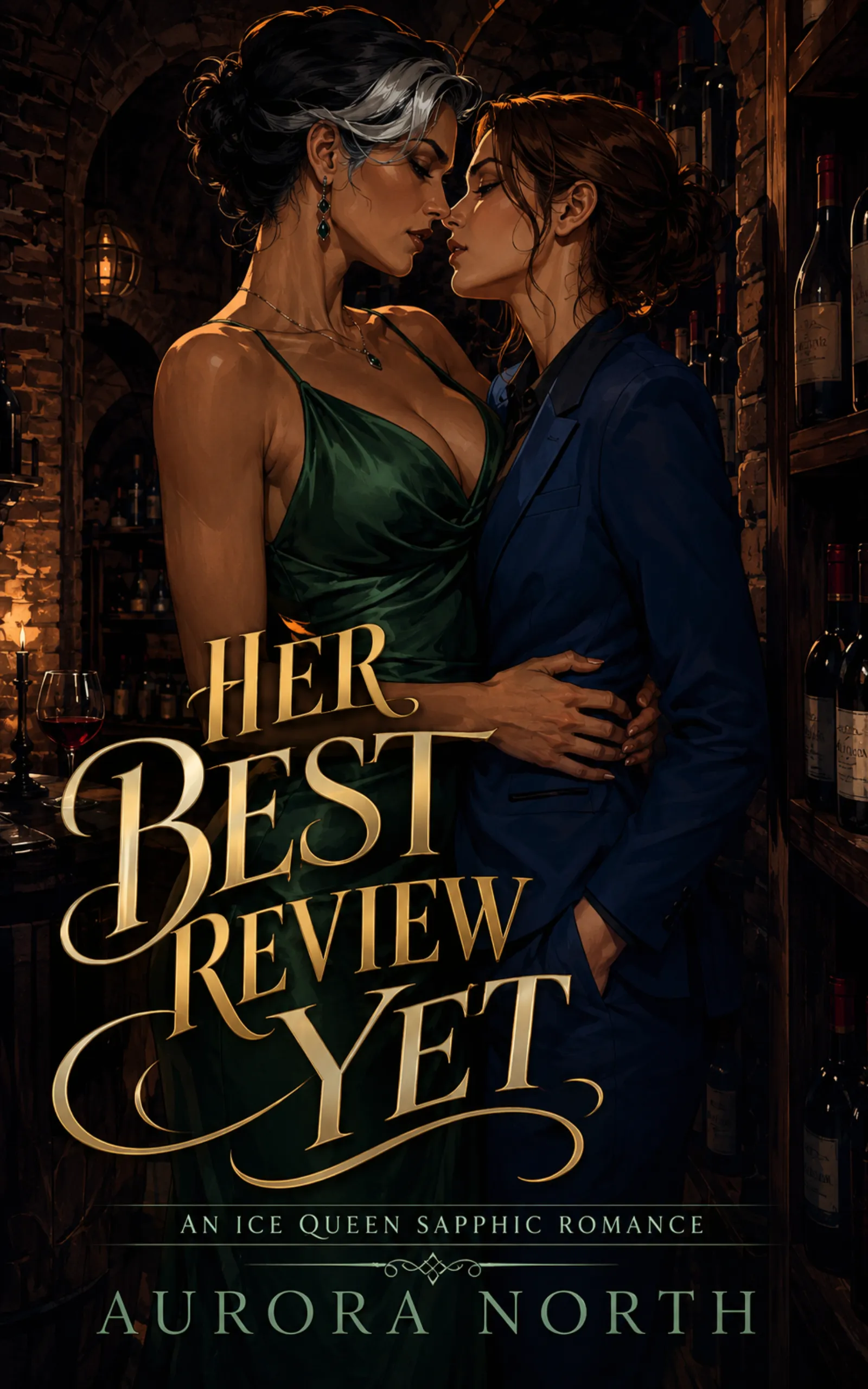
Bonus Chapter: The Review She Never Published
A free bonus epilogue for Her Best Review Yet — by Aurora North
This bonus chapter takes place after the epilogue of Her Best Review Yet. Spoilers ahead — read the book first! Intended for readers 18+.
They got married at the restaurant, obviously.
There had been a brief, doomed period in which other venues were discussed — Vivienne had a list, annotated, scored out of ten, because of course she did — and then one Sunday Maya had simply asked, “Where did we happen?” and the list went into a drawer and never came out again. Calder & Vine, closed for one private Saturday in June. Sixty chairs, every one of them full of family, which was the same word as staff, which had been the point all along.
Dez cooked the wedding dinner and cried into the duck. Priya ran the floor so flawlessly that Maya only tried to refill someone’s water twice, and was stopped both times by her own assistant general manager physically removing the bottle from her hands with the words “you are the bride, you absolute disaster.” Elliot Marsh came down from Maine and gave a toast about second restaurants and second chances that ruined every adult in the room. Gordon’s wife caught the bouquet and Gordon looked genuinely alarmed. Tom Okafor told the story of the day his best critic walked into his office and set her whole career on his desk like a printout, and raised his glass and said, “To the only correction I ever ran on the front page,” and Vivienne, in white, with the silver streak loose the way Maya loved it, did not cry, and fooled exactly no one, again.
By midnight they were alone.
The fairy lights stayed on. The staff had reset the room before they left as a final gift — every table dressed, every wick trimmed, the floor swept gleaming — so that the two of them stood in a restaurant that looked ready for a service that would never be called, candles burning down at table twelve, the whole gold room holding its breath for an audience of two.
“Mrs. Calder-Shaw,” Vivienne said, from the bar, pouring two glasses of the second-cheapest tempranillo, because some traditions were load-bearing.
“Mrs. Calder-Shaw,” Maya agreed, taking hers, and the words did something to both of them that the champagne hadn’t managed all day.
They drank in the doorway light of their own beginning, shoulder to shoulder against the zinc, veils of the day settling. And then Vivienne set down her glass with a small deliberate click — the click Maya had learned three years ago meant the agenda has arrived — and reached into the inside pocket of her white jacket, and produced an envelope. Heavy cream stock. Fountain-pen black. Sealed.
“One more,” she said. “The last one, in this format. I’ve been writing it for three years — a line or two at a time, nights you were asleep. It was meant to be vows, and then I wrote the vows and they were for the room, and this —” she turned the envelope once in her fingers, the closest her hands ever came to nervous — “this was never for the room. It’s the review I never published. The full edition. No rationing, no scores, no word count. I want you to read it tonight, here, where the file was opened. And then, Mrs. Calder-Shaw —” the dark eyes came up, banked heat fully unbanked, the voice dropping into the register that lived at the base of Maya’s spine — “I intend to spend the rest of the night demonstrating the findings. At length. In detail. Out loud.”
Maya read it at table twelve, by candlelight, in her wedding dress, with her wife’s hand resting at the back of her neck — and what was in those four pages stayed between the two of them and the room that had witnessed all of it, except for the last line, which Maya would carry to the end of her life: You asked me once what loses the point. Nothing ever did. You were the ten the whole time — I was just learning to be the kind of woman who could afford to say it.
She looked up with wet eyes. “Vivienne—”
“No commentary from the subject,” Vivienne murmured, taking the pages from her hands and setting them aside with the wine, stepping in close, tipping Maya’s chin up the precise degree she wanted — three years and the gesture still rewired her completely. “The review is filed. We’re past words now. This is the demonstration portion of the evening.”
“Here?” Maya managed, pulse already gone to Friday-night tempo. “We have a perfectly good hotel suite—”
“We have a perfectly good restaurant,” said Vivienne Shaw-Calder, unhurried, exact, already finding the zipper of the wedding dress like a woman who had studied the schematics, “where I have conducted every assessment that ever mattered to me. The hotel is for tomorrow. Tonight is for the permanent collection.” Her mouth found the curve of Maya’s neck, and against it, low, she issued the last instruction of the evening, the one that had started everything and would never stop: “Now hold still, Mrs. Calder-Shaw, and let me show you exactly how good you are.”
The candles at table twelve burned all the way down. The fairy lights stayed on till morning. And what the gold room witnessed that night was thorough, and unhurried, and conducted — as all the best reviews are — entirely out loud: every promise from three years of midnight texts kept at once, every score retired, every word spent freely by a woman who had finally learned what her words were for. Somewhere in the smallest hours, wrapped together in the corner banquette under a tablecloth and a wedding jacket, Maya asked the ceiling, breathless and laughing, what the night would have scored, in the old currency.
Vivienne considered it with full professional gravity, her lips against her wife’s hair, her hand finding the pulse at Maya’s wrist — the first thing she’d ever touched, still running, still hers.
“Insufficient data,” she said. “Ask me again in fifty years.”
***
The End — for now. Thank you for reading Maya & Vivienne’s story.
Never Miss a Release
Get new release alerts, exclusive bonus content, and reader-only giveaways.