
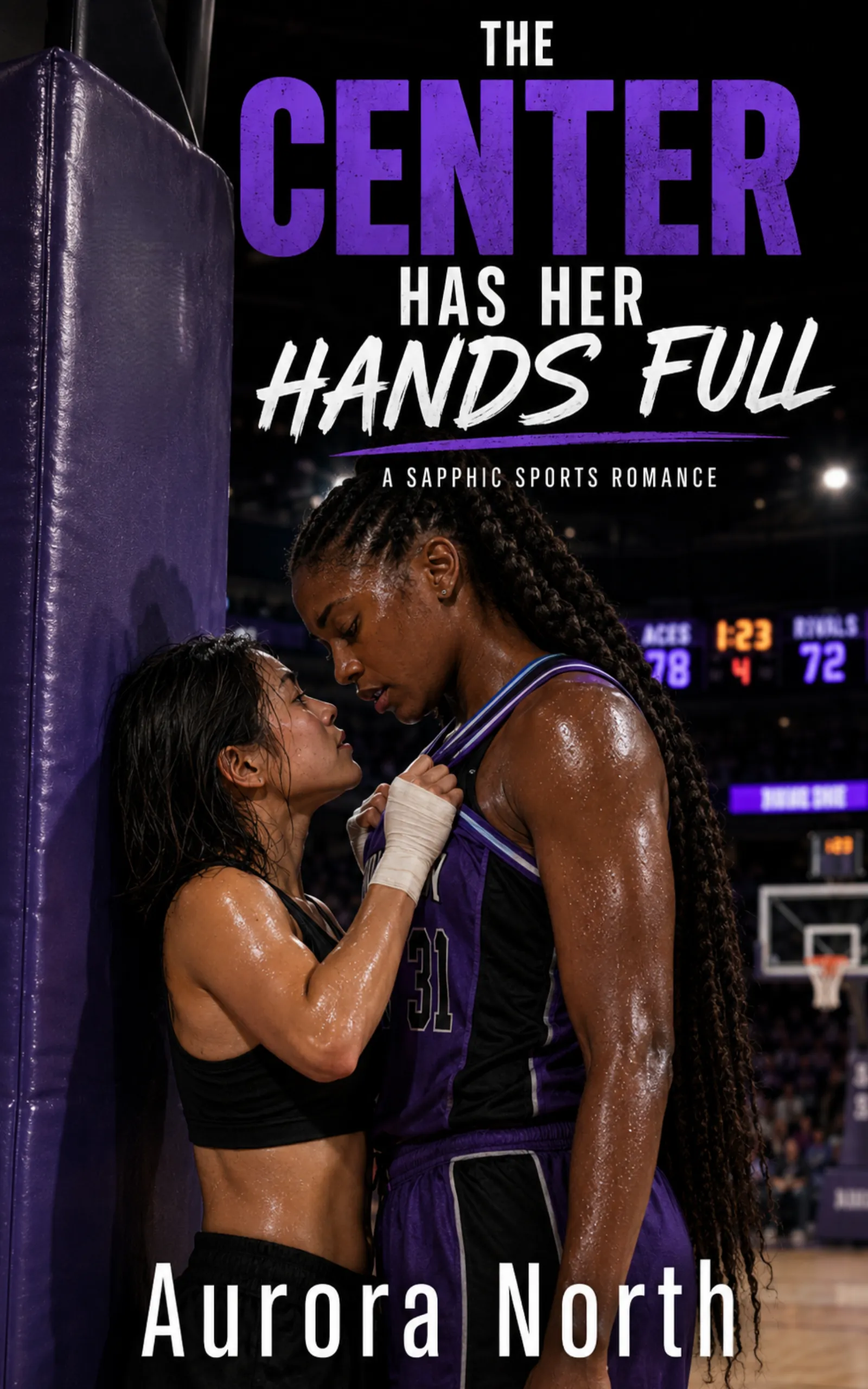
Overtime — All-Star Weekend
The Center Has Her Hands Full — Bonus Chapter
by Aurora North
⚠️ Set at All-Star Weekend, eight months after the epilogue. Amara POV. Read the novel first for maximum impact. Explicit FF content, 18+.
The jersey didn’t fit. That was the first thing.
The All-Star jersey was custom — violet and silver, the league’s showcase colors, my name across the shoulders in block letters, the number twelve stitched with the particular care reserved for events where the uniforms were souvenirs and the game was secondary to the spectacle. It fit the way all my jerseys fit: correctly, because the equipment managers had learned in my rookie year that six-five and two hundred pounds required its own pattern, and the pattern had been filed and reproduced with the precision of a woman who would notice if the shoulder seam was off by a quarter inch.
It fit perfectly. And I stood in the locker room at All-Star Weekend and looked at it hanging in my stall — my name, my number, the showcase — and felt the compression in my chest that would never fully retire.
Some things lived in the body. The anxiety was one. The ritual was another.
I pulled out my phone.
Amara: Tell me what you saw in practice.
The reply came in eleven seconds.
Dani: Your post footwork is the best in the league. Your midrange pull-up is shooting 46%, which remains obscene. And from up here in the suite you look approximately nine feet tall, which is doing things to me that are inappropriate for a coaching-program guest to experience in public seating.
I smiled. Set the phone down. Pulled the jersey on.
The compression eased.
She was in the suite.
Not on the bench. Not on the floor. Not in the film room or the training room or any of the places Dani Park had occupied for fifteen professional seasons. She was sitting in a leather chair behind glass, watching the court from an altitude she’d never voluntarily chosen, wearing a charcoal blazer and the silver streak and the expression of a woman who was learning to watch basketball from a position that didn’t include a clipboard.
She was fine.
I hadn’t been sure she would be. The transition — from player to coaching-program participant, from the court to the chair, from running the offense to studying it — was a geography Dani had been navigating for eight months with the tactical precision she applied to everything. Some days the navigation was smooth. Some days the ankle ached and the chair felt like a sentence and the distance between the glass and the hardwood was the exact width of a career she wasn’t finished grieving.
But tonight she was fine. I could tell from the suite, sixty feet below, because I knew her body the way I knew a defensive rotation — by the posture, the jaw, the placement of her hands. Relaxed. Present. Watching the warm-ups with the analytical attention of a woman who was building a new relationship with the game instead of mourning the old one.
She was fine because her person was on the floor. She’d said that once, in the dark, in our bed — I used to be afraid of what I’d be without the game. Turns out I just needed to know where you were. — and I’d filed it in the same place I filed everything she said when her composure was down: permanently, with reverence, in a room I’d built specifically for the things Dani Park whispered when she thought being soft was safe.
I played the game. Twenty-two minutes, fourteen points, seven rebounds, an alley-oop finish that made the showcase crowd stand and the broadcasting team use the word dominant in a context I’d finally made peace with. I played well. I played like a woman who was exactly where she belonged, in a body she’d stopped apologizing for, on a court she’d learned to occupy at full volume.
After, in the handshake line, I looked up at the suite. She was standing at the glass. Watching. Not with the coaching assessment or the scouting-report analysis. With the private expression. The one the glass couldn’t hide and the distance couldn’t diminish.
The one that said: I see you. All of you. And the view from up here is the best I’ve ever had.
The hotel room was a suite. All-Star Weekend comped the accommodations, and the accommodations did not mess around — a king bed that could’ve held three of me, a sitting area with furniture designed for human beings of normal proportions, and a bathroom with a shower that I could stand in at full height without hunching.
Dani arrived twenty minutes after I did. She’d changed out of the blazer into jeans and the soft gray T-shirt I’d been systematically stealing for two years, and she carried a garment bag over one arm that she set on the chair with the deliberate placement of a woman who’d brought something specific and was waiting for the right moment.
“Good game,” she said.
“I know.”
“Fourteen points in twenty-two minutes against the best players in the league.”
“I know.”
“The alley-oop in the third quarter was—”
“Dani.”
“—the most athletic finish I’ve seen from a center this season, and I’ve been watching centers for sixteen years, and I’m including myself in the watching because I’m thorough.”
I crossed the room. Stood in front of her. The angle — eleven inches, always eleven inches — was the same in every hotel room and every apartment and every space we’d ever occupied. The geometry that the world saw as a novelty and we understood as the architecture of a life.
“What’s in the bag?” I asked.
She unzipped it. Held up two jerseys.
The first was hers. Not the All-Star jersey, not a current-season jersey — an old one. Faded violet, the fabric soft from a decade of washes, the number seven printed in cracked white lettering. Her rookie-year jersey. The one she’d kept in a drawer since her second season because the fabric was too worn to wear and too important to throw away.
The second was mine. Tonight’s All-Star jersey, the one I’d hung in my stall four hours ago, the one with my name across the shoulders. She’d taken it from the locker room. How she’d gotten into the locker room was a question I chose not to examine because the answer was probably Dani Park walked in like she owned it and no one had the structural integrity to stop her.
“Put this on,” she said, and handed me the rookie jersey.
I held it up. Size small. Fifteen years old. Designed for a five-seven point guard at the beginning of a career that would span a decade and a half and end not with a final game but with a woman choosing to rebuild.
“This is a doll shirt,” I said.
“Put it on.”
I pulled it over my head. The fabric stopped approximately four inches above my navel. The sleeves — such as they were — ended at my deltoids. The number seven stretched across my chest with the particular distortion of a garment being asked to cover a body three sizes beyond its engineering.
I looked down at myself. Dani’s name. Dani’s number. On my body. The visual absurdity of a six-five woman wearing a five-seven woman’s jersey from fifteen years ago, the fabric straining at every seam, should have been comedy.
It was not comedy.
It was the most intimate thing she’d ever given me.
Dani pulled my All-Star jersey over her head. It fell to her thighs. The shoulders drooped past her arms. The fabric pooled around her like a tent, and my name — COLE — hung across her shoulder blades in letters large enough to be read from the stands.
She looked up at me. Drowning in my jersey. Five-seven in a garment built for six-five. And the expression on her face was not dry or controlled or tactically composed. It was open and soft and carrying the specific weight of a woman wearing her partner’s name across her back and understanding what it meant.
“Come here,” she said.
We fell onto the bed in a tangle of oversized fabric and undersized fabric and the particular laughter that accompanied two women whose wardrobes were physiologically incompatible trying to undress each other through jerseys that wouldn’t cooperate.
“Your jersey is actively hostile,” she said, trying to pull hers — mine — over her head and getting lost in the armhole. “I’m trapped. This is how I die. Under the COLE banner.”
“There are worse ways to go.”
“Name one.”
“Dying without hearing what I’m about to say to you.”
She stopped fighting the jersey. Looked at me from inside the neck hole, her face framed by fabric, the silver streak escaping sideways.
“I’m listening.”
“Get the jersey off first.”
She wrestled free. I pulled the rookie jersey over my head — which required both hands and a degree of spinal flexibility I would be feeling tomorrow — and we lay on the bed in underwear and nothing else, my body taking up two-thirds of the king mattress and hers fitting against mine the way she always fit: precisely, like a clause in a sentence I was still writing.
I kissed her. Slowly. The taste of her mouth was the taste of every night and every morning for the past year — spearmint and warmth and the particular flavor of a woman who’d spent fifteen years controlling everything and had learned, in the twelfth month of loving me, to let one thing be uncontrolled.
My hands found her breasts. Small, perfect, sensitive in the specific way I’d mapped over a hundred nights — the left responding to pressure, the right to the flat of my tongue, both to the sound of my voice when I told her what I saw. I kissed down her throat. Her collarbone. Drew her nipple into my mouth and felt her hand find my braids with the grip that meant more, don’t stop, I’m already further along than I’m going to admit.
“Tell me what you want,” I said, against her skin. The rule. Both directions. Always.
“I want your hands.” Her voice was wrecked already. The composure never lasted long anymore — she’d stopped treating it as a necessity and started treating it as a door she could close or open, and with me the door stayed open. “And I want you to talk. Tell me what you saw tonight. On the court. What you felt.”
“Is this a film session or sex?”
“Both. You know what both does to me.”
I did know. Both was the frequency she couldn’t resist — the convergence of basketball and intimacy, the place where the game and the body met, where praise arrived wearing two uniforms and she couldn’t tell which one was making her wet.
I slid my hand between her legs. Found her soaked — the evidence of the jersey swap, the visual of my name on her back, the hour of anticipation between the suite and this bed. She gasped when I touched her, her hips lifting into my palm, and I circled slowly while I spoke.
“I felt the court tonight,” I said, my fingers moving in the rhythm she needed — steady, patient, building. “The way I feel it when everything’s right. The reads coming early. The body doing what I ask without negotiating. The crowd noise turning into white sound and the game slowing down until I can see every option before it develops.”
“More.” Her hips were moving against my hand. Her eyes were closed. Her mouth was open.
“The alley-oop — I didn’t think. I saw the lane and I went and the ball was there because the point guard who threw it read the floor the same way I did. Different point guard. Same language.” I pressed two fingers inside her and she clenched around me instantly. “Your language. The one you taught me. Court vision isn’t a skill — it’s a vocabulary, and you gave me mine.”
“Amara — right there—”
“And when I finished the play, when the crowd stood, I looked up at the suite.” I curled forward. Found the spot. Held. “And you were standing at the glass. And the look on your face was the same look you had the first time you said good read in an empty gym. Except this time you were sixty feet away and wearing a blazer and the look still landed in the same place.”
Her hand tightened in my braids. Her thighs were shaking. I increased the pressure — my thumb on her clit, my fingers curled inside, the dual rhythm she’d taught me in a hotel room in Phoenix a lifetime ago. I’d perfected it since. I’d perfected it the way she’d perfected the pocket pass — through repetition, attention, and the willingness to study one person until the study became devotion.
“You looked at me through that glass and I felt it in my feet,” I said. “In my hands. In the part of my chest where the anxiety lives. And the feeling wasn’t praise or pride or any of the words we’ve been using. The feeling was—”
“Say it.”
“Home.” I pressed deep. She came apart — hard, sudden, a gasp that broke into my name and then a moan that broke into nothing, her body arching against my hand, her grip in my braids pulling tight enough to sting, and I held her through it the way she’d taught me: present, patient, without letting go until the last wave passed and her breathing told me she was back.
She lay against me afterward. The king bed holding both of us easily, the luxury of space we’d never had in her old apartment, where the queen mattress and the eleven-inch height difference had required creative geometry. Her head on my chest. Her hand on my stomach. The slow, aimless patterns she drew when her composure was rebuilding and her fingers were doing the talking her mouth hadn’t recovered for.
“I used to think the game was the only thing that would ever have my whole heart,” she said. Quietly. Into my skin. In the register she used for truths she’d only recently learned to say while I was awake. “Fifteen years. Three cities. One marriage. And the court was always the thing I organized everything around. The non-negotiable. The part I never let anyone touch.”
“And now?”
“Now the court is a place I love. But it’s not the only place.” Her fingers paused. Resumed. “My heart just needed a bigger arena.”
I kissed the top of her head. The silver streak was wider than it had been a year ago. She wore it without comment now — not a mark of age but a feature of the landscape. The landscape I’d been studying for a year and intended to study for considerably longer.
“Next year,” I said. Sleepy. The post-game exhaustion and the post-orgasm warmth converging into something gravitational. “Get you a ring.”
“Championship?”
“Sure.” I tightened my arm around her. Pressed my mouth to the silver streak. “That one too.”
She went still. Not the frozen stillness of a woman who’d heard something she wasn’t ready for. The held stillness of a woman who’d heard exactly what she was ready for and was letting it settle into the architecture of her body, where it would live beside the coaching certification and the ankle rehabilitation and the morning tape ritual and every other component of the life she was building — not around basketball, not around me, but around both of us, together, with room.
“Amara Cole.”
“Mm.”
“If you just proposed to me in an All-Star hotel room while I’m wearing your jersey and your hand is still between my legs, I need you to know that I’m going to say yes and then I’m going to need approximately forty-five minutes before I can discuss logistics.”
“I didn’t propose. I made a forecast.”
“A forecast.”
“Based on available data.”
“The data being?”
“That I’m in love with you and I want to tape your ring finger every morning for the rest of my life and I’d like the tape to be covering something that costs more than athletic adhesive.”
The silence lasted four seconds. In Dani-time, four seconds was a geological event.
“Forty-five minutes,” she said. “Then logistics.”
“Deal.”
She kissed my collarbone. I held her. The hotel room hummed around us — the air conditioning, the ambient noise of a building full of the best basketball players in the world sleeping off a showcase game, the distant, muffled sound of a city that never learned to be quiet.
On the chair, two jerseys. One too small for me. One too big for her. Both worn. Both kept. Both carrying a name that belonged to someone else and fit, somehow, better than anything designed for the body that wore it.
Equal possession.
The center had her hands full.
And the hands were exactly where they belonged.
← Back to The Center Has Her Hands Full
Never Miss a Release
Get new release alerts, exclusive bonus content, and reader-only giveaways.