
🔥 The Glove Box 🔥
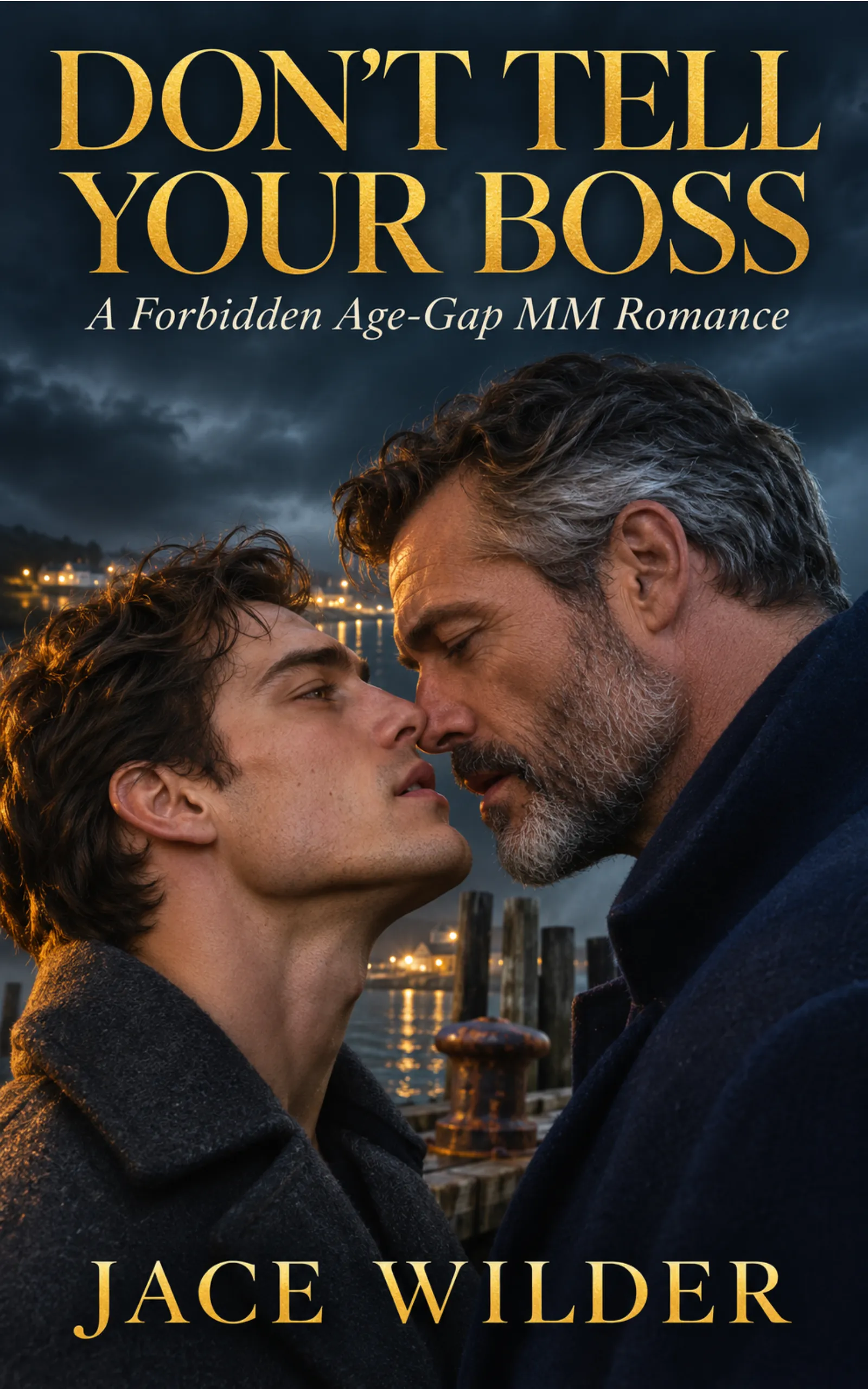
An Exclusive Bonus Chapter from Don’t Tell Your Boss by Jace Wilder
⚠️ Spoiler Warning: This bonus chapter is the overlook Adam refuses to talk about in Chapter Eleven: the drive home from the cottage at Kettle Point, the morning after he said “I love you” and Martin didn’t say it back. It contains spoilers and very explicit sexual content (18+), and it runs hotter than the book. Read the novel first for the full experience.
Martin’s side of the overlook: an empty gravel lot above the sea, a Volvo with a very roomy front seat, a dead phone in the glove box, and three words he says every way except out loud. Explicit content — 18+.
The Glove Box
He’d been quiet for forty minutes, and I’d been rehearsing for all forty of them.
Three words. I’d had them in my mouth since dawn on Abel’s floor, since he’d said them first and gone white as a sheet, and I’d kissed him instead of answering because I was a coward who’d built an entire marriage out of not being a burden. Now they sat behind my teeth while the coast road unspooled south in long gray curves, and every time I opened my mouth to say them, something else came out. Are you warm enough. Do you want the radio. There’s coffee in the thermos if you want it.
He didn’t want the coffee. He sat in my passenger seat in his heavy cream sweater with his knees pulled up and his temple against the window, watching the sea, and his hand had been on my thigh when we left Kettle Point and wasn’t anymore. I noticed exactly when it went. Mile marker sixty-one. He’d lifted it to push his hair back and put it in his own lap after, and it had stayed there, and I’d felt the lack of it like a draft.
I said it to a barista once. He’d made it into a joke. He was good at that. He made everything that hurt him into something small and tidy that nobody else would have to carry.
I knew that move. I’d invented it.
“Pull over,” he said.
I looked at him. He was still looking at the sea. A brown sign went by on the right: SCENIC OVERLOOK ¼ MILE.
“Are you all right? Are you going to be sick?”
“Martin.” He turned his head. His eyes were very clear and very dark, and there was something in his face I hadn’t seen since the coat room. “Pull over.”
I pulled over.
The overlook was a crescent of gravel cut into the cliff, with a wooden guardrail, one picnic table nobody had sat at since Labor Day, and a sign about cormorants. Nobody else. It was a Sunday at the end of October and the season was over; the whole coast had gone quiet and gold and empty. Below the rail the land fell away a hundred feet to black rock and white water, and beyond that there was nothing but sea to the edge of the world, flat and shining under a low sun that had already started down.
I parked nose-first at the rail and turned off the engine. The silence came in all at once. The tick of the cooling engine. The sea, far down, breathing.
Adam unbuckled his seat belt. Then he reached across and unbuckled mine.
“Adam—”
“I’ve been sitting over there for forty minutes,” he said, “being polite.”
“You don’t have to be polite.”
“I know.” He put his hand flat on my chest, over my coat, over my heart, and left it there, and I knew he could feel what it was doing. “So I’m going to stop. I’m going to stop being careful with you, and you’re going to stop being careful with me, and you’re going to push your seat all the way back.”
I looked at him for one long second.
Then I reached down beside the seat and found the lever and shoved, and the whole seat slid back on its rails with a clunk until my knees cleared the wheel by a foot. I found the other lever. The seatback dropped, not all the way, just enough.
He was already climbing over the console.
He was not graceful about it. A Volvo wagon has many virtues, and a smooth path from the passenger seat to the driver’s lap is not one of them. He put a knee on the parking brake and a hand on my shoulder and swung his other leg over, and his back hit the steering wheel, and the horn went off—one long, outraged honk that echoed off the cliff and sent a gull screaming up from the rail.
We both froze. Then he started to laugh, helplessly, his forehead dropping onto my shoulder.
“Oh my God,” he said into my coat. “We announced it. We announced it to the cormorants.”
“There’s nobody here.”
“There’s a sign, Martin. About the cormorants. They’re protected.”
I put my hands on his hips and pulled him forward, off the wheel, onto me, until he was straddling my lap with his knees jammed against the door on one side and the console on the other and his whole weight settled across my thighs. The laughing stopped. He was hard. I could feel it through two layers of denim, pressed right against my stomach, and his breath went short.
“Better,” he said, much more quietly.
He kissed me.
Not the way he’d kissed me that morning by the stove, slow and sweet and frightened of itself. This was the other Adam. The one who’d said Don’t you dare apologize in the dark among two hundred coats. He took my face in both hands and kissed me hard and open-mouthed, his tongue in my mouth, his teeth catching my lower lip and pulling, and he ground down into my lap in one long, deliberate roll that made the seat creak on its rails.
I said his name. It came out wrecked.
“Coat,” he said against my mouth. “Off.”
Getting a man my size out of a wool coat in the driver’s seat of a car is an engineering problem. He solved it the way he solved everything, which was by refusing to accept that it couldn’t be done. He got one sleeve, then the other, and shoved the whole thing into the footwell of the passenger side, and then his hands were under my sweater, flat on my belly, spreading over the softness there and gripping, and I stopped caring about engineering.
“I love this,” he said, his palms moving up over my ribs, my chest, the hair there. “Do you know that? I love—” He stopped himself. I felt him do it. His whole body hitched on the word like a foot catching on a stair, and his face, an inch from mine, flushed and closed.
He’d said it to me once and I’d let it fall on the floor. Now he couldn’t even say it about my stomach.
I took his face in my hands. I held it there. I looked at him the way I’d wanted to look at him at dawn, when I’d been too slow and too afraid, and I didn’t say it—God help me, I still didn’t say it, it was still caught somewhere under my sternum like a swallowed stone—but I didn’t look away either.
“Say whatever you want to me,” I said. “Anything. Anytime. I’m not going anywhere.”
Something moved in his eyes. He leaned in and bit my jaw, not gently.
“Then I want you inside me,” he said. “Here. Now. With the sea right there.”
“Glove box,” I said.
He went still on my lap. “What?”
“In the glove box.” I could feel my face going hot. “I packed it this morning. When I loaded the car.”
He stared at me. Then, slowly, he twisted around on my thighs, braced one hand on the dash, and reached across to the passenger side and thumbed the latch.
The glove box dropped open.
The registration. The owner’s manual. The tire gauge I’d never once used. His phone, black and dead, lying face-down on top of all of it exactly where I’d put it at the gas station in Breakwater two days ago. And tucked right beside it, where I’d wedged it at seven that morning while he was still in the outdoor shower, the bottle of lube from Abel’s floor.
He looked at it for a long moment.
To get to the bottle he had to move the phone. I watched him realize it. His hand went into the glove box and his fingers touched the phone, and stopped there, resting on it, and I watched every one of the forty-one messages I knew would be waiting go across his face.
Then he picked up the phone, set it on top of the owner’s manual, took the lube, and shut the glove box on it with a firm little click.
“It can stay in there,” he said.
He turned back to me, bottle in hand, and his face had changed again. Softer. Something almost like wonder in it.
“You packed lube next to my phone,” he said slowly. “On purpose. So the only way to get one was to touch the other.”
I hadn’t thought of it like that. I’d thought of it as the only compartment in the car with a latch. But he was looking at me like I’d done something clever and tender and deliberate, and I wasn’t going to correct him.
“I’m an optimist,” I said.
He laughed, low, and kissed me again.
Jeans in a car seat are their own campaign. He had to kneel up, his head bent under the roof liner, while I got his belt open and his fly down and dragged denim and boxers together down over the curve of his ass. He kicked one leg free and left the jeans tangled around his other ankle, and then he was in my lap again, bare from the waist down, in his big cream sweater with the sleeves pushed up, and the low gold light through the windshield lay across his thighs and his hard, flushed cock where it stood up against the wool.
I had to stop and look. I couldn’t help it.
“Martin,” he said, half a warning.
“Give me a second.”
“You’ve had two days.”
“It wasn’t enough.” I ran my palms up the outsides of his thighs, under the hem of the sweater, over his hips. “It’s never going to be enough.”
He went pink. All the way up his throat. And then he reached down and opened my trousers himself, quick and impatient, and got his hand around my cock and pulled me out into the cold air of the car, and I stopped being able to make speeches.
He slicked me with the lube, both hands, slow, his thumb dragging over the head until I swore. Then he poured more into his palm and handed me the bottle and said, “You,” and leaned forward onto my chest with his face in my neck and his ass tipped up, and waited.
I slid two fingers into him.
He was still soft and open from the morning, from Abel’s floor, from all of it. He took them easily and moaned into my neck, a long shaky sound I felt in my collarbone, and pushed back on them.
“You’re still—” I said.
“I know what I still am. You did it.” He turned his face and bit my earlobe. “Three times since Friday. I can feel you every time I sit down. I’ve been feeling you for a hundred and twenty miles of coast road.”
I curled my fingers inside him and he made a noise that fogged a patch of the driver’s window.
“Now,” he said. “Please. I don’t want to wait.”
He sat up. He took me in his fist and held me steady and lowered himself, and the roof of the car was too low for him to rise very far, so he didn’t rise at all. He just sank. Straight down, slow and relentless, his thighs shaking, until I was buried in him to the root and he was sitting in my lap with nowhere left to go, full, his mouth open, both hands braced flat on my chest.
Neither of us moved.
Through the windshield behind his head, the sea went on forever. The sun had dropped another inch toward it and laid a long, hammered road of gold across the water, straight to us. I could hear the waves breaking a hundred feet down. I could hear him breathing. I could feel his heart, I swear, through everything—through his body and mine, the tight hot clench of him around me pulsing in time with it.
I love you, I thought. So loudly I was half afraid he’d hear it.
He started to move.
There wasn’t room to ride me the way he had at dawn, rising and falling. So he rocked. Short, deep, grinding strokes, hips rolling, his knees digging into the seat on either side of me, his weight pressing down and down and down until I couldn’t tell where the pressure stopped and I started. The old seat creaked on its rails with every roll. The car rocked gently on its springs. Somewhere in the back, a thermos tipped over and rolled across the cargo floor and hit the wheel well with a hollow clang, and neither of us so much as blinked.
I got my hands under his sweater and held his waist, and then his back, and then I pushed the sweater up and up until he lifted his arms and I dragged it off over his head and threw it after my coat. Then he was naked in my lap, gold in the late light, sweat starting at his temples, his chest heaving, and I put my mouth on him. His throat. His collarbone. His nipple, sucking hard, and he cried out and clenched around me so tightly I saw sparks.
“Martin—God—”
“I’ve got you.” I couldn’t think of anything else. My vocabulary had gone somewhere and not come back. “I’ve got you, sweetheart, I’ve got you.”
The windows were fogging. All of them. The sea outside went soft and blurred and the gold light came through the steam in long diffuse bars, and it was like being inside a lantern. Adam slapped one hand against the driver’s window to brace himself and it left a perfect print in the fog, fingers splayed, and then dragged slowly down the glass as he rocked.
“Turn me around,” he gasped.
I didn’t understand. Then I did.
He lifted off me, all the way, with a sound like it hurt him to do it, and turned on my lap—elbow in my ribs, knee on the console, a curse when he hit his head on the visor—until his back was against my chest and his feet were planted in the footwell either side of mine and he was facing the windshield. Facing the sea. He reached between his own legs and found me and guided me back in, and sank down again, and this time we both groaned out loud at the same moment.
He leaned forward. Put both hands flat on the dashboard. Wiped a long streak through the fog on the inside of the windshield with his forearm, so he could see out.
“There,” he breathed. “There it is.”
The sea. Gold on black, all the way to the end.
Then he started to fuck himself on me, braced on my dashboard, his back arched and his head hanging, and I held his hips and watched the long muscles of his back move and thought I had never seen anything so beautiful in fifty-one years.
He couldn’t see my face like this. That was the thing. He was looking at the sea.
So I leaned forward, and put my mouth against his spine, between his shoulder blades, where the skin was damp and hot and salt-tasting—and I said it.
Not out loud. I didn’t have the nerve. I shaped it into his skin with my lips, no breath behind it at all. I love you. Once at the top of his spine. I love you. Once lower, over the knobs of his back, while he gasped and rocked and swore at the sea. I love you. Once at the small of his back, my forehead pressed there, my hands spanning his hips, holding on.
He shivered all the way up. I don’t think he knew why.
“Touch me,” he said. “Martin. Please. I’m so close—”
I wrapped my hand around his cock. He was soaking, slick and hard as iron, and he bucked into my fist and back onto my cock and then forward again, caught between the two, and his breath broke into a string of sounds that weren’t words. I thrust up into him as hard as the seat would let me. The whole car rocked. The fog ran in long drips down the windshield. His hand slipped off the dashboard and slapped back down, and his fingers hooked over the edge of the glove box door.
“Martin—”
“Go on,” I said into his back. “Go on. Let me have it.”
He came with his forehead pressed to the dashboard and his hand white-knuckled on the glove box and my name tearing out of him so loud it bounced off the glass. He clenched around me in long, brutal waves, his whole body jerking in my arms, and spilled over my fist and the dash and the glove box door in hot, thick pulses, and I felt every one of them go through him into me.
I lasted three more strokes.
I came with my face buried between his shoulder blades and both arms locked around his chest, pulling him down onto me as hard as I could, emptying into him so deep and so long my vision went white and my legs shook against the pedals. I made a sound I’d never made in my life. I didn’t care. There was nobody for a mile in any direction but the cormorants, and they could file a complaint.
He slumped back against my chest. I let him. I wrapped both arms around him and held him there in my lap, still inside him, while we both shook.
The windows were completely white now. The sun came through them in a diffuse gold glow, and the car smelled like sex and sweat and wool and the sea, and his heart was slamming under my forearm, and his head was tipped back on my shoulder with his eyes closed and his mouth open, panting at the roof.
“Oh my God,” he said eventually, to the roof.
“Mm.”
He lifted his head an inch and looked at the dashboard. At the glove box door. He started to laugh, weak and wrecked and delighted.
“I came on your glove box.”
“I noticed.”
“I came on the glove box, Martin. With my phone in it.” He was laughing so hard now that he clenched around me and we both hissed. “That’s the closest it’s been to me in two days. That’s the most attention it’s had all weekend.”
I found my handkerchief in my trouser pocket—I always carried one; he’d teased me about it—and cleaned the dash as best I could, and the glove box door, and then my hand, and then, very gently, him. He let me. He lay back against my chest with his eyes closed and let me take care of him, and didn’t make a single joke about it, and I thought that might be the most trust anyone had ever shown me.
When I finally eased out of him he made a small, unhappy sound and turned in my lap and curled against my chest, sideways, his knees drawn up, his head under my chin. Naked except for the jeans still tangled around one ankle. I reached into the back seat for the wool blanket from Abel’s and pulled it over him.
We stayed like that until the fog on the glass started to clear and the sun touched the water.
“Martin,” he said, very quietly, into my sweater.
“Yes.”
A long pause. I felt him gather himself to say something. I felt him decide not to.
“Nothing,” he said. “This was good. That’s all.”
That’s never all, I thought. Ben had taught him that. He’d taught it to me.
I put my mouth against his hair, and I almost said it. I had it all the way to my lips. And then he yawned, enormously, against my chest, and murmured something about the cormorants, and I thought, Not like this. Not as a reply. Not when he’s half asleep and can’t see your face. He said it with his eyes open. He deserves it with his eyes open.
So I held him instead.
He fell asleep twenty minutes later, back in his own seat, dressed again, with the blanket over his knees and his temple against the cool window and—this time—his hand on my thigh. It stayed there all the way through Breakwater. It stayed there past the turn for the city. It slid off once, when we went over the river, and he made a small sound in his sleep and felt around for me until he found me again.
The sun was gone. The coast road was dark. The lights of Port Mercer were coming up ahead of us across the water, and the man I loved was asleep in my passenger seat with his hand on my leg and his phone still dark in the glove box, two feet from his knees, behind a door with a faint, drying streak across it that I was never, ever going to clean properly.
I said it then. Out loud. To the windshield, to the road, to the headlights, very quietly.
“I love you.”
He didn’t stir.
That was all right. It wasn’t for him yet. It was practice. It was me finding out, for the first time in my life, that I could say a thing I wanted out loud and the car wouldn’t go off the road.
Next time, I promised myself, I’d say it where he could see me.
Next time I’d say it with the lights on.
← Back to Don’t Tell Your Boss
Join the Jace Wilder Reader List
New releases, bonus chapters too hot for retail, and exclusive content from Jace Wilder.
Related Books



The Bookshop After Hours — Ebook
Ames Willow
He sells romance for a living. He hasn’t had any in three years.
More from Jace Wilder



My Boss Says Good Boy — Paperback
He can manage a billion-dollar acquisition. He cannot manage two quiet words from his boss.