
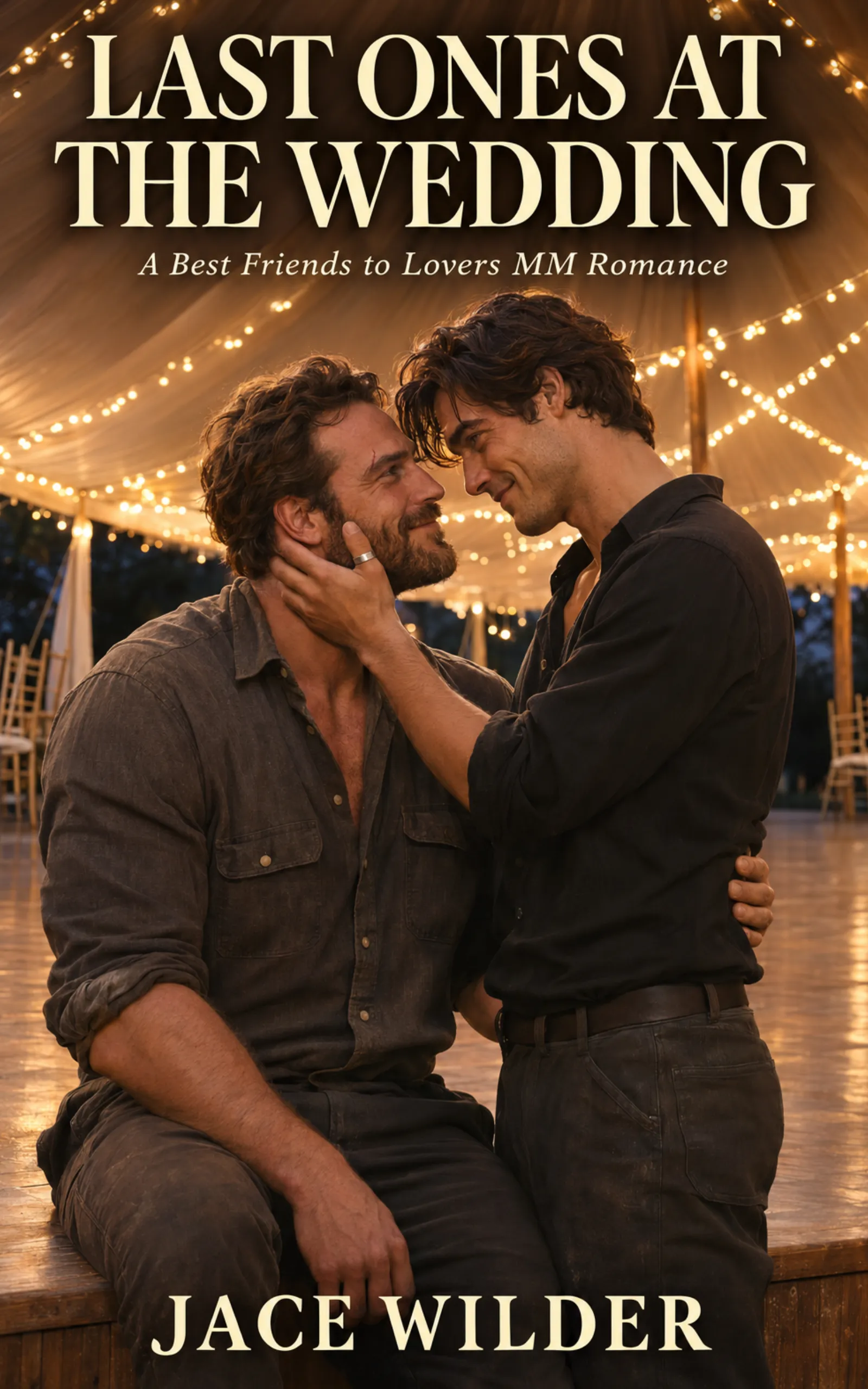
Last Ones at the Wedding
MM Best Friends to Lovers Bisexual Awakening Romance
by Jace Wilder
Available at all major retailers
Pairing: MM
Heat: 🌶️🌶️🌶️🌶️🌶️ Inferno
Tropes: Best Friends to Lovers, Bisexual Awakening, Mutual Pining, First Time, Switch Dynamic, Blue Collar, Small Town, Wedding Romance, Found Family, Dirty Talk, Praise Kink, Size Difference
Everybody else goes home with somebody. They stay behind to take it all apart.
Trevor Mills lights weddings. Adam Fischer builds the tents. For nine years they’ve been the last two men standing at every reception in the Hudson Valley: striking the frame at three in the morning, splitting hash browns at Dot’s Diner, then going home to separate houses.
Trevor has been in love with him for five of those years. Adam has no idea.
Then a retiring rental king offers them his whole business, and Adam writes MILLS & FISCHER across a diner napkin in red Sharpie before Trevor has even sat down. The same week, the biggest arena tour on the East Coast wants Trevor behind its lighting desk. For the first time in nine years, Trevor doesn’t say yes.
And for the first time in nine years, Adam watches another man kiss his best friend, and finds out he wanted it to be him.
A loading dock under sodium light. A first date in a shirt one size too small. A tent full of four thousand stars at 2:40 a.m. Adam has never touched a man. He did his homework. There was a diagram.
But Trevor has spent five years building his whole life around Adam’s, and the one thing he finally wants for himself might be the thing that costs him the man he’s built it for.
You’ll love this book if you enjoy:
✅ Best friends to lovers with nine years of history behind every look
✅ A big, steady, stubborn bisexual awakening hero who does his homework
✅ Five years of secret pining, then everything at once
✅ First times, switching, dirty talk and filthy praise (🌶️🌶️🌶️🌶️🌶️)
✅ Found family: a crew lead who cries in service tents, a sister who sees everything, a 71-year-old tent king
✅ HEA guaranteed
⚠️ Content Warning: This novel contains explicit sexual content (graphic MM scenes including oral, rimming, first-time anal, bareback sex after testing, phone sex and semi-public sex), strong language, discussion of STI testing, references to a parent’s job loss and childhood instability, past breakups, and relationship conflict. Intended for readers 18+.
📖 Read Chapter One Free
Not sure yet? Read the full first chapter right here.
Chapter One: Trevor
There are two kinds of men at the end of a wedding: the ones who go home with somebody, and the ones who stay behind to take the whole thing apart.
I’d been the second kind for eleven years. For nine of them, I’d been doing it next to Adam Fischer.
At 2:06 on the first Sunday morning in September, four hours after the last toast of Saturday’s wedding, Harrow Hill Estate looked like a party that had been shot and left to bleed out slowly. The guests were gone. The bride had been carried to a Range Rover by her brand-new husband, laughing, a shoe in each hand. Somebody’s aunt had cried on me about the uplights. And out on the south lawn, where the couple had made their sparkler exit, sixty dead wire sticks were still poked into the grass like a burned-down birthday cake, a few of them threading thin smoke up into the dark.
I’d lit the whole night. Warm 2700K on the tent ceiling, amber washes up the oaks, pin spots on the cake so the sugar flowers looked grown instead of made. Now I was on my knees in wet grass coiling forty feet of DMX cable over-under, over-under, the way an old stagehand named Lou had taught me when I was twenty-four and stupid enough to drop a fixture on my own elbow.
Over-under. Don’t look up.
“Mills.” Adam’s voice came from inside the tent, low and rough at the edges the way it got after midnight. “You alive?”
“Define alive.”
“Breathing. Bitching.”
“Then yes.”
“Good. Need you to kill the house circuit on the east side before Darren pulls the leg. He’s not in the mood to get lit up.”
“Darren’s never in the mood for anything.”
“Darren’s got three daughters,” Adam said. “He’s not allowed to have moods.”
I laughed and stood and walked my cable to the Ghost — my van, a white Ford Transit with a hundred and ninety thousand miles on it and a ghost-shaped dent in the back door that I’d decided was a mascot instead of a problem. Tossed the coil in a road case. Went to the east panel. Killed the circuit. The string lights along the sidewall faded out as the dimmer bled down, and for a second the whole tent looked like what it really was: a sixty-by-one-twenty frame of aluminum and white vinyl with nobody left inside.
That was the part nobody saw. Three hundred people had stood in that tent tonight and thought it was magic. It wasn’t magic. It was two guys who’d been up since five.
“Clear east!” I called.
“Clear east,” Adam called back, and then the crew went to work on the frame, and I went to work on not watching him.
Here’s the thing about not watching Adam Fischer: I was very good at it. I’d had five years of practice. I could pull a truss, strike a dance-floor wash, and wrap a hundred and twenty feet of Edison string while maintaining a perfectly professional peripheral awareness of where he was and what he was doing, without once looking directly at him like a man who wanted to climb him.
Mostly.
Tonight the problem was the sidewall. Vinyl sidewall comes off a frame tent in twenty-foot panels, and wet, it’s heavy as hell. It had rained at six — a ten-minute cloudburst that sent the whole bridal party shrieking under the tent — and every panel was slick and sagging. Adam’s crew was short a guy. So Adam was hauling them himself, which meant that at 2:20 a.m., in the yellow spill of the work lights, he reached back over his shoulder with one hand, grabbed a fistful of his soaked gray T-shirt, and pulled it off over his head.
I looked at the dimmer pack in my hands with the intensity of a man defusing a bomb.
It didn’t help. I’d already seen it. You couldn’t not see it. Adam was six-two and built like the thing he did for a living — not gym-cut, nothing pretty about it, just heavy, thick slabs of muscle stacked on a frame that had been hauling steel and canvas since he was twenty-two. Broad chest with dark hair across it, a line of it running down the middle of a stomach that wasn’t a six-pack so much as a wall. Work pants riding low and dark with rain. Shoulders like he could carry a car. A farmer’s tan that stopped dead at the biceps, because Adam Fischer did not own a single shirt without sleeves and wouldn’t have known what to do with one if it was handed to him.
He tossed the shirt onto a stack of chair dollies, bent, got both hands under the bottom edge of a sidewall panel, and the muscles in his back moved like something tectonic.
I was a professional. I ran my thumb over the dimmer’s channel display. I read it twice. I could not have told you a single number on it.
Five years. You’d think a man would build up an immunity, the way your hands stop feeling the cold after a while. You’d be wrong. It got worse, because now I knew things. I knew the faded line through his left eyebrow came from falling off his grandmother’s porch at nine. I knew he hummed Springsteen when he was concentrating and had no idea he was doing it. I knew he had a mole low on his right hip, an inch above where his boxers sat, because one August at a lake wedding in Copake he’d changed out of soaked work pants behind his truck and I’d been standing exactly where I shouldn’t have been.
I’d seen the mole. I’d seen the rest of him, too, for about a second and a half — heavy and thick against his thigh, so much more than I’d let myself imagine — and I’d walked straight into a tent stake on my way back to the van.
I’d been carrying that second and a half around in my head for three years like a stolen coin. On bad nights, alone, I took it out and used it, and afterward I lay in the dark and felt like a thief.
I’d never touched him there. I’d never touched him anywhere that counted.
That was the rule. Not anybody else’s rule — mine. Separate trucks. Separate houses. Separate businesses that happened to book the same weddings. He’d climbed the stairs to my apartment a hundred times and never once had a key. At the end of the night, I went home alone. Every time. No exceptions.
“Trev.” He was right next to me. Shirtless, breathing hard, sweat shining down the column of his throat. He held out a hand without looking. “Coffee. I’m dying.”
I picked up the thermos off my road case and put it in his palm. His, not mine — black, no sugar, brewed at 4:45 that morning in the cracked Mr. Coffee at his yard. Mine was the one with the oat milk, which he made fun of every single time and had also, at some point in the last two years, started keeping in his fridge without ever saying a word about it.
He unscrewed the lid and drank, and his throat worked, and I studied the grass.
“How’s the knee?” I said.
“Fine.”
“It’s not fine.”
“It’s fine.”
“You’ve been babying it since the first dance. You did the thing on the bar steps where you lead with your left foot.”
He lowered the thermos and gave me a look. Hazel eyes, gone dark in the work light. Wrecked brown hair falling into them. “You’re watching my feet now?”
“I’m watching everything. That’s my whole job. I get paid to look at stuff.”
“You get paid to make stuff pretty.”
“Same thing.” I pointed at his knee with the dimmer. “Ice it when you get home. Don’t do that thing where you say you’ll ice it and then you pass out on top of the covers with your boots still on.”
He laughed, low and surprised. “How do you know I do that?”
Because you’ve done it on my couch twice and on the floor of my van once, and I didn’t sleep either time. “You’re thirty-seven and you live alone. Everybody does that.”
“You live alone.”
“I’m thirty-five and extremely disciplined.”
“You ate a sleeve of Ritz crackers for dinner at the Delaney wedding.”
“That was a dinner of discipline. I only ate one sleeve.”
He was grinning now, the real one, the one that started on the left side of his mouth and took its time getting to the right. He handed the thermos back — I didn’t need it; I took it anyway — wiped his mouth with the back of his wrist, and said, “Dot’s opens at five. We could sit in the lot till it does. You’re buying.”
There it was.
Dot’s Diner on Route 9 in Millbrook Falls opened at five a.m. for the setup crews and the farm guys and the cops coming off night shift. Adam got a Western omelet and black coffee. I got hash browns extra crispy and an oat-milk latte that cost two dollars extra and tasted like a wet cardboard box, and then I stole his toast, and then we sat in the booth by the window and watched the sun come up gray over the Sunoco and talked about nothing, and it was one of my favorite places on the planet.
That was exactly the problem.
You say yes to the diner once and it’s a nice thing. You say yes every time and it’s a habit. And with him, a habit was a door I’d trained myself to keep shut, because on the other side of it was a version of me who drove home from Dot’s at six-thirty with his hands shaking on the wheel — because Adam had laughed at something with his whole body and leaned his shoulder into mine in the booth and then said See you Thursday, man, and gone home to sleep on top of his covers.
So I had a rule inside the rule. Every few times, I said no. Not because I didn’t want to go. Because I wanted to too much.
“Can’t,” I said. “I loaded the Ghost wrong. I’ve got to restack at the unit.”
“I’ll help you restack.”
“Then it’ll be six and you’ll be asleep on my road cases.”
“I’ve slept on worse.”
“You’ve slept on me,” I said, too lightly, and he laughed again, and I hated how easy it was to say it like a joke.
The generator. That was what I meant, and he probably didn’t remember it the way I did. Five years ago, January, a winter wedding at a stone barn up near Germantown. Fourteen degrees. My generator died forty minutes before the first dance, and I’d stood in the snow with a dead Honda and two hundred guests and a mother of the bride who looked ready to have me killed, and I’d called the only person I ever called when things went bad.
Adam had been two hours away. He’d made it in an hour fifty, in a snowstorm, with a spare 7,500-watt generator strapped under a tarp in his truck bed, and we’d had light back before the cake cutting. After, at three in the morning, he’d climbed into the passenger seat of my van to thaw out while we waited for the plows, and he’d fallen asleep with his head on my shoulder.
I didn’t move for two hours. My arm was numb by the twenty-minute mark. I didn’t move.
That was the night. I knew it the way you know you’ve broken a bone — not right away, just a dull, certain wrongness that turns into something you can’t stand on.
“Next time,” Adam said now, and knocked his knuckles once against my arm, and went back to his sidewall.
“Next time,” I agreed, and picked up the next cable. Over-under. Over-under. Didn’t look up.
By 3:40 the frame was down to bare legs and the vinyl was rolled on the flatbed. The last caterer’s van pulled out at 3:52. Darren left at four with a two-finger salute and a muttered prayer to his own mattress.
And then it was just the two of us, the way it always was.
Last ones out. Every wedding, every time. It had turned into a running joke with the vendors — Nina Patel, the planner who booked half our jobs, called us the Night Shift — but it wasn’t a joke to me. It was the only part of the night when Adam was all mine. Nobody else to watch him, and nobody to watch me watching.
I started the Ghost to let her warm up — she was old, she needed a minute — and sat in the driver’s seat with the door hanging open and the heater blowing on my wet boots, and took out my phone.
I’d read the email eleven times since Thursday. I read it a twelfth.
Trevor — Ben Alvarez passed along your reel. The canopy work and the barn installs are genuinely lovely; there’s a way you handle warm practicals in big volumes that we’d love to see at arena scale. We have an Associate Lighting Designer / Programmer slot open for the East Coast leg — rehearsals mid-February, run through mid-March, roughly five weeks. We’d like you to apply. Portal link below. — Maya Okafor, Production Design, Northern Lights
Northern Lights. The tour with the moving-light rig that two trade mags had written up in the spring. Barclays. The Garden. Twenty thousand seats a night and a lighting desk the size of my van.
I’d wanted that since I was twenty-two. Since before Adam, if I was being honest — since a night in the cheap seats at a concert in Albany when I’d watched a rig of three hundred lights do something to twelve thousand people that I’d never seen anything do, and I’d thought, That. I want to make that.
Then I got into weddings because weddings paid rent, and I got good, and somewhere in there I met a stubborn tent guy who thought lighting was decoration until I walked him around a dark barn and showed him what it was. After that, I stopped looking at tour postings. I told myself it was because wedding work was steady. Because I liked my life. Because arena work was for guys in their twenties who could live out of a bus.
I knew the real reason. I’d just never said it out loud.
Ben had sent my reel without asking. When I’d called Thursday to yell at him, he’d said, You’ve been building that man’s weddings for nine years, Trev. Build something for yourself for once, and then he’d hung up on me — which was very unlike Ben, a sweet audio nerd who wore cardigans to load-ins.
Five weeks. February to March. Every weekend Adam and I had ever spent apart, put end to end, probably didn’t add up to five weeks.
I hadn’t told him.
I didn’t know why. Yes, I did.
My left hand found the silver ring on my right thumb and turned it, around and around. Old habit. Stupid one. I’d bought the ring for eleven dollars at a flea market in Hudson when I was twenty-six, and it turned my skin green for a year, and I kept wearing it anyway. I was loyal like that to things that were bad for me.
A shadow fell across the open door.
“You look like somebody died,” Adam said.
I locked the screen so fast I nearly dropped the phone. He’d pulled a clean flannel out of his truck — red and black, unbuttoned, hanging loose over his belt — and he was leaning on the top of my door with both forearms, which put his whole bare chest about a foot from my face.
“Nobody died. I’m tired.”
“You’re always tired. That’s not your tired face.” He tilted his head. “That’s your thinking face.”
“I don’t have a thinking face.”
“You’ve got a thinking face, a lying face, and the face you make when a groom asks if you can make the lights pop.”
“That last one’s just my face.”
He grinned and didn’t move. The work light behind him threw his shadow long across my legs. He smelled like rain and wet canvas and sweat, and under that the cedar body wash he bought in a green bottle at the CVS, and I’d never once told him I could pick it out across an entire tent.
“Don’t go to the unit,” he said.
“Adam —”
“I’m not asking about the diner.” He rubbed the back of his neck — the thing he did when he’d been sitting on something too long — and my stomach went tight. “I want to show you something. It’s on the way. Sort of. Rhinecliff.”
“Rhinecliff isn’t on the way to anything.”
“It’s on the way to Rhinecliff.”
“It’s four in the morning.”
“It’s four-ten,” he said. “He said he’d be there at seven. We’ve got time to get coffee somewhere that isn’t Dot’s, and you can eat another sleeve of Ritz crackers, and you can yell at me the whole drive.” He paused. “Please.”
Adam Fischer did not say please. Adam Fischer said you in? and yeah and let’s go. In nine years I could count the times he’d said please to me on one hand, and every one of them had been about something that mattered.
I should’ve said no.
I’d said yes to that man for nine years. Yes to the snowstorm and yes to the Copake lake and yes to a two-day pole tent in Saugerties during a tropical storm when I should’ve been at my sister’s thirtieth. I said yes because saying yes to Adam felt like the closest I’d ever get to anything else.
“Who’s he?” I said.
His whole face lit up. Not from the work light. From him.
“Glen Mercer,” he said. “Follow me.”
Mercer Event Rentals was a sheet-metal warehouse the size of a high school gym on a gravel lot off River Road, a quarter mile from the Rhinecliff train station. I’d driven past it a hundred times. Glen Mercer had been renting tents and chairs and dance floors to half the Hudson Valley since before I was born; a hand-painted sign over the bay doors read MERCER — SINCE 1985 in a red that had faded to the color of a skinned knee.
At 7:04 a.m., with the river gone silver behind us and the sun just clearing the hills on the Ulster side, Glen let us in through the side door.
He was seventy-one, small and sun-creased, in a Carhartt vest and a Mets cap so old the logo had become more of an idea. He shook my hand like a vise and said, “The lighting kid,” like he’d heard of me, which I didn’t know what to do with. Then he shook Adam’s hand and held on a long time and said, “Fischer,” the way you’d say the name of a horse you’d bet on and won.
Then he walked us through it.
The warehouse smelled like forty years of dust and diesel and mildew and canvas. Under the fluorescents — god-awful light, a green-gray 4100K that made everybody look like they had the flu — racks went all the way to the roof. Rolled tent tops in their bags, tagged and dated in black marker. Pallets of white folding chairs, towers of wood chiavaris. Dance floor panels. Staging. Four generators lined up along the back wall like retired boxers. Two box trucks backed into the bays with MERCER on their sides.
“Six tents,” Glen said. “Three frames, three pole tents. One of the poles is the big eighty-by-two-hundred I did the Vanderbilt thing with in ’04. Twelve hundred chairs. Four gennies. Two trucks. And the book.” He tapped his temple. “Forty years of people who call me before they call anybody.”
“Glen,” Adam said. “Tell him the rest.”
Glen looked at me. His eyes were very blue and very tired.
“My wife wants to see Portugal before she dies,” he said, “and she’s decided she might die soon just to make a point. My kids don’t want this. One’s a dentist and one’s in Denver.” He shrugged. “So I’m selling. Whole package. Lease has six years left on it. Spring’s already booked — thirty-one weddings, February through June. You buy, you get the calendar. The clients, the deposits, all of it.”
“How much?” I said, because somebody had to.
“Three-forty.”
My mouth went dry. Three hundred and forty thousand dollars. More than everything I owned, twice over.
“I wanted Fischer to have first shot,” Glen went on, like he hadn’t just said a number that big out loud. “He’s the only one of you young guys who ever brought my tents back the way he found ’em. I’m not selling to some outfit from Jersey that’s gonna spray-paint over my name.”
“Nobody’s painting over your name,” Adam said.
He wasn’t looking at Glen when he said it. He was looking at me.
I’d known Adam Fischer for nine years, and I’d seen him in every kind of light there was. Tent light, work light, orange parking-lot sodium, the blue of a phone screen in a dark van. I’d seen him happy. I’d seen him proud, wiped out, drunk at Darren’s fortieth, gutted the week Julia moved out. But I had never seen him look the way he looked right then — standing in that ugly green wash with dust drifting down around him like snow.
He looked lit from the inside.
“Trev,” he said. “Think about it. Glen’s inventory, plus my frames, plus your rig. Tents and lighting, one roof, one call. Couples book us as a package. We stop splitting jobs with every jackass in four counties. We stop chasing deposits. We’ve got a real warehouse instead of my gravel lot and your storage unit.” He took a step toward me. “Fifty-fifty. Mills and Fischer.”
“Fischer and Mills,” Glen said. “Alphabetical.”
“Mills and Fischer,” Adam said, without taking his eyes off me. “Sounds better. He’s the one who makes it look good.”
My throat closed.
“We’ve been doing this together for nine years anyway,” he said, lower. “Every weekend. Every wedding. We just never had our names on the same thing. I want to build something, Trev. Something that’s ours. Something that stays up.”
He meant it. That was the worst part. He meant every word, and he had no idea what he was asking. He didn’t know I’d been building my calendar around his for five years. He didn’t know every yes I’d ever given him had a hook in it that went all the way down. He didn’t know that what he was offering — both our names on a sign, every weekend for the rest of our lives, last ones out until we were seventy-one in dusty Mets caps — was the closest thing to everything I’d ever wanted, and the one thing guaranteed to kill me slow.
Because it would still just be business. He’d still go home to his house, and I’d go home to mine. And one day he’d meet some woman at a wedding, some nice bridesmaid who laughed at his jokes, and he’d bring her by the warehouse with our names on it. And I’d have to light their fucking wedding.
“Adam,” I said.
“Don’t think about the money yet. Glen’ll do terms. Right, Glen?”
“I’ll do terms,” Glen said, “if you two quit staring at each other like a pair of heifers at a gate and let me get to church.”
Adam laughed, and didn’t look away. He came one more step, close enough that I had to tip my head back an inch, and put his hand on my shoulder — big and warm, his thumb settling into the hollow above my collarbone like it had always lived there — and squeezed.
“Say yes,” he said.
I’d said yes to Adam Fischer for nine straight years. It was the easiest word I knew. My mouth was already shaping it. I could feel it behind my teeth, warm and familiar — the word that kept him close and kept me safe and had been quietly costing me a little more every year.
I opened my mouth.
And in my back pocket, my phone buzzed.
Once. Short. An email.
I didn’t have to look. I knew who it was from the same way I knew Adam’s knee hurt — not from any evidence, just from the shape of the thing. Maya Okafor. Northern Lights. Just following up, Trevor — we’d love to see your application.
Adam’s hand was still on my shoulder. His face was still lit up like the inside of a tent at midnight.
And for the first time in nine years, the word that came up my throat wasn’t yes.
Want to keep reading? Get Last Ones at the Wedding at all major retailers.
🔥 Want an EXCLUSIVE Bonus Chapter?
Window Seat — A scene TOO HOT for retailers. Week three of the tour. Adam’s first flight alone, an empty arena at two in the morning, four hundred lights swinging gold for an audience of one. Then eighteen floors over Atlanta, a wall of glass, and the real reason nobody talks about Atlanta in front of Darren.
More from Jace Wilder
Browse all Jace Wilder books.

One Time Only (He Lied)
He said it was one time. He lied.

Your Side of My Bed
Four weeks, in pen. One thin wall. Eleven years of pretending.
Sixty Days’ Notice
Four years. One wall. Zero idea.

Back of House
He bought my family's ovens and turned them off. Now he wants me.

Under New Management
The founder retired. The successor stopped waiting.
Room for the Best Man
Two best men. One bathroom. A couch night he swore he forgot.
Never Miss a Release
Get new release alerts, exclusive bonus content, and reader-only giveaways.