
The Margins — Bonus Chapter
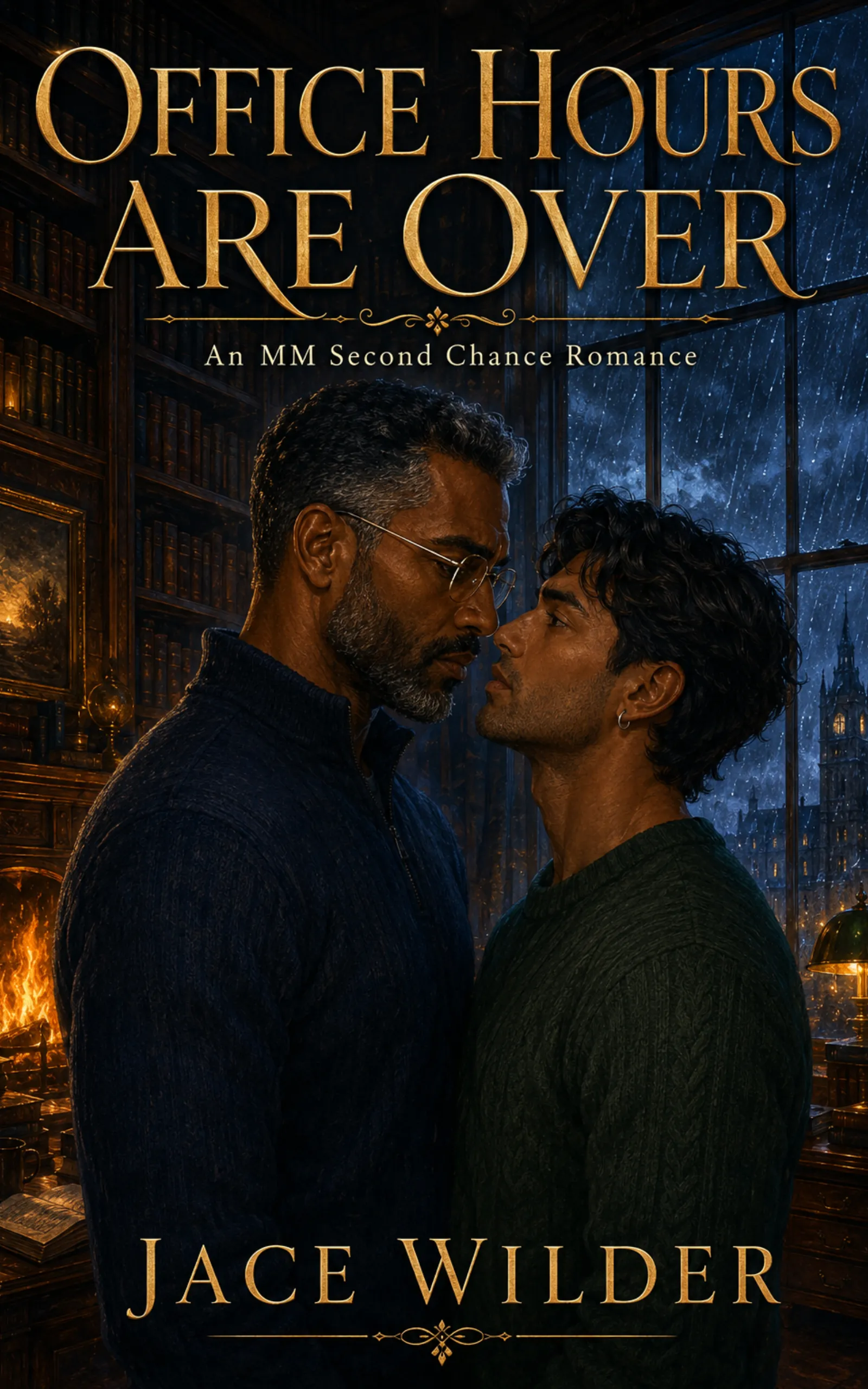
Office Hours Are Over by Jace Wilder
This bonus chapter takes place approximately one year after the epilogue of Office Hours Are Over. Contains graphic explicit content. Spoilers ahead.
I find the box on a Saturday afternoon in December while Gideon is at a lecture in Harvard Square.
It’s in the back of his study closet, behind the rowing equipment he hasn’t used in a decade and beneath a garment bag containing a suit jacket I’ve never seen him wear. The box is cardboard, unmarked, sealed with packing tape that has gone brittle with age. I’m looking for the extra wrapping paper he swore was in here somewhere, because his sister’s birthday gift needs wrapping and Gideon is the kind of man who owns wrapping paper in three coordinated colors.
I don’t find wrapping paper.
I find a stack of student manuscripts from his advanced prose seminar. The one I took. The one that changed my life.
They’re in a manila folder, organized chronologically, each one annotated in his dark red ink. Marcus Webb’s short story about a Moroccan restaurant. Priya Nair’s poem cycle about monsoon season. David Aoki’s experimental piece about his grandfather’s internment camp letters.
And mine.
Six manuscripts. Every piece of fiction I submitted during his seminar. Annotated, covered in that red ink that I used to dream about. The handwriting small and precise and relentless.
But these aren’t the notes that were leaked. The notes that Basil stole were the official workshop copies — the ones filed in the department archive, the ones Gideon knew would be accessible to future researchers. Those notes were rigorous and professional and carefully calibrated to survive institutional scrutiny.
These are the private copies.
The ones he kept.
The ones with a second layer of marginalia — written in pencil, lighter, smaller, in the spaces between the red ink comments. A parallel commentary that the official notes don’t contain. The things Gideon thought but did not include in the version he knew would be archived.
I sit cross-legged on the closet floor with the manuscripts spread around me and I read the pencil notes and my heart climbs into my throat and stays there.
On my first submission — a short story about a young painter who falls in love with his art dealer — the red ink says: The desire in this passage is too precisely rendered to be entirely imagined. The author has felt this. The question is whether the fiction will have the courage to be as honest as the feeling behind it.
The pencil note, squeezed into the margin beside it, says: His courage exceeds mine.
On my second submission — a piece about a swimmer and his coach — the red ink gives a thorough analysis of the underwater imagery and the way the narrator uses breath-holding as a metaphor for concealment.
The pencil note says: He sat three feet from my desk today and read this passage aloud and I had to grip the edge of my chair. The breath-holding metaphor is not only the narrator’s.
On my third submission — two men meeting at a museum, one older, one younger — the red ink delivers a structural critique of the pacing and a note about the dialogue rhythm.
The pencil note in the margin says: He wrote the older man’s hands with the specificity of someone who has been watching real hands. I recognize the observation. I recognize which hands.
On my fourth submission, the red ink is three pages of detailed notes. The pencil marginalia becomes more frequent here, more urgent, the handwriting slightly less controlled.
One pencil note reads: Office hours today. He wore a brown corduroy jacket and argued with me about Forster for twenty-five minutes and I wanted to pull him across my desk by the lapels and I did not and the not-doing was the most disciplined act of my professional career.
I stop breathing when I read that one. I read it three times. The brown corduroy jacket. He remembered the jacket. He remembered the specific jacket I was wearing during a specific argument about E. M. Forster, and he wrote it down in pencil in the margin of my fiction, and he kept it in a box for seven years.
On my fifth submission — the one where the narrator describes being watched by a man who refuses to acknowledge the watching — the red ink says: The narrator’s frustration is the strongest element. Consider whether the unnamed observer’s silence functions as cruelty or as discipline. The distinction matters to the story’s ethics.
The pencil note says: The distinction matters to mine. I read this story in bed at midnight and I could not finish it without stopping twice. Not because the prose was difficult. Because the prose was easy, and the ease made me imagine things I have no right to imagine, and the imagining did not stop when I put the manuscript down.
My face is hot. My hands are shaking. The pencil note is a confession — not of the wanting, which I already knew about, but of the when. He read my fiction at midnight. In bed. And he imagined things. And the imagining didn’t stop.
I have spent seven years wondering what Gideon Parish thought about when he was alone. I have the answer now, and the answer is written in pencil in the margins of my undergraduate fiction, and the answer is me.
On my final submission — the last piece I ever turned in to him, the one I wrote knowing I was graduating, knowing I might never sit in his office again — the red ink gives three pages of detailed notes. Structure, voice, ambition, the places where the prose reaches past its ability and the places where the reaching is the point.
The pencil note at the bottom of the last page, in handwriting that is less steady than the rest, says: This is the best student work I have received in twenty years of teaching. I cannot tell him. I cannot tell anyone. The sentence I want to write in this margin would end my career and it would be worth it and the fact that it would be worth it is the reason I must not write it.
And then, in even smaller script, barely legible:
I will miss him.
I sit on the closet floor and I hold the manuscript and I press my hand to my mouth and I do not cry because the tears aren’t sadness. They’re the specific, overwhelming, full-body response to being loved in a language you didn’t know existed.
He kept them. For seven years. In a box in the back of his closet. The things he couldn’t say and couldn’t throw away. The margins of his own restraint.
I hear the front door open. His keys on the hall table. His footsteps — the particular stride I’d know in the dark, the slight unevenness from the shoulder that affects his gait when he’s tired.
“Noel? I couldn’t find wrapping paper at the—”
He appears in the study doorway. He sees the open closet. The box. The manuscripts spread across the floor. The pencil notes visible in the lamplight.
His face changes. Not the controlled shift of a man managing his expression. The uncontrolled shift of a man whose most private writing has just been discovered by the person it was written about. The color drains from his face and then returns, darker, and his hand grips the doorframe and his mouth opens and nothing comes out.
“Those are—”
“Private. I know. I wasn’t looking for them.” I hold up the last manuscript. The one with the pencil note at the bottom. “Read this to me.”
“Noel—”
“Read it. The pencil note. The one you wrote seven years ago and kept in a box in your closet because you couldn’t say it and you couldn’t destroy it. Read it to me. In your voice. Right now.”
He stands in the doorway. His coat is still on. His scarf is half-unwound. His glasses are fogging slightly from the temperature change between the December cold and the heated study. He looks at me — sitting on his closet floor surrounded by the evidence of seven years of hidden devotion — and I see the moment he decides. The moment the last piece of armor he’s been carrying falls away.
He takes off his coat. Hangs it on the door hook. Unwraps his scarf. Removes his glasses, folds them, puts them in his breast pocket — our ritual, the disarming, the stripping of the barrier. He crosses the room and sits down on the floor across from me, his long legs folded awkwardly in the small space, his back against the closet wall, his knees nearly touching mine.
He picks up the manuscript. He finds the pencil note.
He reads it aloud.
“This is the best student work I have received in twenty years of teaching.” His voice is quiet. The real one. Number four — the one beneath all the others, the one I claimed in a cottage in Rhode Island and have refused to relinquish since. “I cannot tell him. I cannot tell anyone. The sentence I want to write in this margin would end my career and it would be worth it and the fact that it would be worth it is the reason I must not write it.”
His voice catches on the next line. The three words he wrote in tiny script at the bottom of a student manuscript seven years ago, alone in his office, after the last class of my last semester, knowing he would let me walk out of his life without ever saying this.
“I will miss him.”
The silence holds everything. Seven years. Two confessions. A lighthouse. A storm. A glass library. A scandal. A book launch where I called him my partner in front of the entire New York literary establishment. And this: a box in a closet, a pencil note, the three simplest words a man who weaponizes language has ever committed to paper.
“What sentence?” I ask.
“What?”
“The note says: the sentence I want to write in this margin would end my career. What was the sentence? The one you couldn’t write. What would it have said?”
He looks at me. His eyes are dark amber and unshielded and full of something that has been aging in the dark for seven years like wine or grief or love or all three at once.
“I wanted to write: I am in love with you and I have no right to be and the no-right-to-be is not stronger than the love.”
I close the distance between us.
On the closet floor. With manuscripts scattered around us and seven years of marginalia pooling in the lamplight and his coat on the door and his glasses in his pocket and his scarf draped over the chair and his mouth — God, his mouth, which said I will miss him in a voice I will carry into every future I write — his mouth opening under mine as I kiss him with everything I have.
The kiss is not gentle. It is the kiss of a man who has just read the private archives of his own worship and who needs the worshipper to know that the worship was received and returned and that every pencil note, every hidden confession, every midnight reading of student fiction in a bed where the professor lay awake imagining things he had no right to imagine — all of it was heard. All of it was worth the keeping.
He pulls me into his lap. My knees on either side of his hips, my hands in his hair, his hands gripping my waist with the urgency of a man who has just been excavated. I’ve uncovered his archive. His private collection. The document trail of a love he filed away and never discarded, and the discovery has stripped the last layer of composure from both of us.
“The study,” I say against his mouth. “The desk. Now.”
We barely make it out of the closet. We knock two manuscripts off the shelf. His elbow catches the garment bag. I trip over the rowing equipment he hasn’t used in a decade, which is poetic justice for keeping it. We stumble into the study proper — the book-lined room where he writes his essays and I write my novels and where the desk has survived multiple encounters and the fountain pens have learned to roll to safety when the surface begins to shake.
I push him against the desk. His hips hit the edge. He sits on it without resistance — a controlled descent that communicates complete surrender of navigational authority.
“I want you to annotate me,” I tell him.
“That is not a coherent sentence.”
“I want you to do to my body what you did to my manuscripts. The red ink version — the formal assessment, the controlled observations, the professional register. And then the pencil version — the things you really thought, the confessions you hid between the lines. I want both. Everything you wrote down and everything you didn’t. Right here. On this desk. With the margins watching.”
His breathing fractures. I watch the composure leave his body the way weather leaves a coast — in stages, in visible increments, the controlled surface giving way to what’s been building underneath.
He reaches for my shirt. Pulls it over my head. His hands settle on my bare chest and he looks at me with the focused intensity of a man preparing to deliver a close reading.
“Red ink first,” he says, and his voice is the workshop voice — measured, analytical, the precision instrument of a man who has spent twenty-five years delivering literary assessments that students either feared or craved. “The structure of your body has improved significantly since the original submission.” His mouth finds my collarbone. “The shoulders demonstrate greater authority.” Teeth graze the ridge of muscle. “The abdominal composition is—” His tongue traces a line down the center of my chest, across the plane of my stomach, circles my navel. I grip the edge of the desk behind him. “—tighter. More disciplined. The overall presentation is exceptional and the author demonstrates a confident command of physical material that was absent in earlier drafts.”
“That’s the red ink version,” I gasp. His tongue is still on my stomach. His hands are at my belt. “Now the pencil.”
His voice drops. The architecture dissolves. What remains is raw and low and sounds like it’s being dragged from the same place where those pencil notes were born — the midnight place, the alone place, the place where Gideon Parish stopped being a professor and became a man who wanted things he couldn’t have.
“I want to put my mouth on every inch of you.” He pulls my belt free. The buckle clinks against the desk leg. “I have wanted this specific body since you were twenty-two years old and sat in my office in a brown corduroy jacket arguing about Forster, and I am no longer apologizing for the wanting.” My jeans open. His hand slides inside. Wraps around me through the thin cotton of my briefs. I make a sound that is not language. “Your skin in this light makes me forget every sentence I have ever constructed. Your cock in my hand makes me forget my own name. I am a man with four published books and a twenty-year vocabulary and you reduce me to monosyllables.”
“Prove it,” I manage.
He pushes my jeans and briefs down in one motion. Drops to his knees on the hardwood floor of his study. The sight of him — Gideon Parish, on his knees, in his book-lined room, surrounded by his fountain pens and his first editions and the complete works of every queer theorist who ever tried to explain desire in academic prose — is the single most erotic image of my life, and I include in that assessment every scene I’ve ever written.
He takes me in his mouth. Not slowly — not with the measured approach of the storm night or the literary pacing of the read-aloud. He takes me deep and immediate, like a man who has been composing a sentence for seven years and has finally found the word he was looking for. His mouth is wet and hot and devastating and his hands grip my hips and his throat opens and the sound I make when he swallows around me echoes off the bookshelves.
“Gideon—fuck—”
He pulls back just enough to speak. His mouth is red and wet and his voice is destroyed and he looks up at me with those amber eyes and says: “Pencil note, page twelve of your fourth submission: If he makes that sound in my office one more time I will not be responsible for what my discipline fails to prevent.”
“You wrote—”
“I wrote it. At midnight. After you spent an hour in my office arguing about unreliable narrators and making small sounds of frustration every time I disagreed with you. The sounds were—” He runs his tongue along the underside of my cock, base to tip, and my knees nearly give. “—identical to the sounds you make now. I recognized them the first time we were together. I had been hearing them in my memory for five years.”
He takes me in again. Deeper. His hand wraps around the base where his mouth can’t reach and the rhythm he sets is relentless and specific and devastatingly good. My hand finds his hair — the silver threads catching the desk lamp light — and I hold on. Not directing. Holding. The way you hold something precious and alive.
The praise kink fires in both directions simultaneously. He is praising me with his mouth and I am praising him with sounds and the sounds are the text he’s reading and the reading generates more praise and the loop accelerates. My hips stutter forward. His grip tightens. His throat works.
“I’m going to come if you don’t—”
He pulls off. Looks up at me. His mouth is obscene. His eyes are blazing.
“Not yet,” he says. “I haven’t finished the annotation.”
He stands. I pull his shirt open — buttons, no patience for ceremony, one hits the bookshelf behind him. His chest is broad and warm and I put my mouth on it, on the silver hair in the center, on the place over his heart where I can feel the beat slamming against my lips. I undo his trousers. Push them down. He steps out of them and we are both naked now in his study, surrounded by his books and his pens and seven years of hidden marginalia and the particular December light that comes through Cambridge windows like a quiet admission.
“I want you inside me,” I say. “Right here. On this desk. With the margins watching.”
He reaches for the drawer — yes, we keep supplies in his study desk now, because this is our life, this is what we built from the wreckage of a scandal and the architecture of seven years of restraint — and he prepares me with the steady, precise hands that wrote those pencil notes. The same fingers. The same attention. The same care that he brought to annotating my prose, brought now to preparing my body.
I brace my hands on the desk behind me and lean back and let him work. One finger, slicked and careful. Then two, stretching, his other hand on my hip to steady me. His eyes on my face, reading me the way he reads everything — for the text beneath the text, for the reaction I’m trying to control and the one I can’t.
“There,” I breathe when his fingers find the angle. “Right there. Don’t stop.”
“Red ink version: the subject responds most strongly to sustained pressure at—”
“Pencil version, Gideon. Give me the pencil.”
“You are the most beautiful thing I have ever touched and the sounds you make when my fingers are inside you are better than any sentence in any language I speak.”
I pull him forward by the hips. He lines up. Pushes in.
The feeling is home. Every time. Not the sharp, annihilating pleasure of our first time on the cottage bed, or the desperate urgency of Cambridge after the scandal, or the playful warmth of the epilogue’s punctuation game. Just home. The thorough, unremarkable miracle of being filled by someone whose body your body knows like a language you dream in. The stretch and the fullness and the deep, interior ache of accommodation that transforms, breath by breath, into pleasure so complete it feels less like sensation and more like arrival.
He moves. Slow at first. The desk creaks beneath us. A fountain pen rolls off the edge — the Montblanc, his favorite, and he doesn’t even glance at it, which tells me more about his state of mind than any pencil note ever could. His hands are on my hips, guiding the angle, and his mouth is at my ear, and the narration returns.
Both versions. Simultaneously. Layered on top of each other like palimpsest, the formal and the private, the red ink and the pencil:
“The response to sustained physical attention is—” He thrusts deeper. I wrap my legs around his waist. “—extraordinary. The subject demonstrates a capacity for—” His voice cracks. The red ink bleeds into pencil. “Noel. You feel. God, you feel like—”
“Like what?” I tighten around him. His hips stutter.
“Like the sentence I couldn’t write. The one that would have ended my career. You feel like the truth I couldn’t afford. You feel like every midnight I spent reading your prose in bed and imagining exactly this and knowing I would never have it and having it now is—” He drives deep. I arch off the desk. His voice fractures completely. “—is better than I imagined. It was always better. You were always better. The real you, the specific you, the you who hums when he writes and leaves cabinet doors open and calls Die Hard a Christmas movie—”
“It is a Christmas movie—”
“—that man. This man. You. Are the best thing I have ever—”
He loses the sentence. His rhythm accelerates. His hand finds my cock — hard, leaking, straining against my stomach — and he strokes me in time with his thrusts and the synchronization creates a feedback loop that overwhelms every system I have. His hand and his cock and his voice all operating on the same frequency, all saying the same thing in different languages: you, you, you.
I grip the desk edge with one hand and his shoulder with the other and the orgasm builds like a sentence reaching its final clause — the subject established, the verb in motion, the object approaching with inevitable grammatical force. His thumb drags across the head of my cock and his hips snap forward and he says my name — just my name, nothing else, no praise, no analysis, just Noel said the way you say a word that means everything —
I come. The orgasm rips through me in a wave that starts where he’s buried inside me and expands outward, through my hips, my chest, my arms, my hands gripping the desk and his shoulder, my mouth open on a sound that is his name and not his name and a noise that belongs to no language except the one we’ve invented between us. I come in his hand and against my stomach and the clench of my body around him pulls him over the edge with me.
He comes inside me with a groan that I feel in his ribs, pressed against mine, a vibration that travels between our bodies like a shared sentence. His hips stutter, still, shudder. His forehead drops to my shoulder. His mouth is open against my skin and the sound he makes is relief — the bone-deep, structural relief of a man who has been carrying a box of secret marginalia in a closet for seven years and has finally been read.
We lie on the desk. Breathing. The December light coming through the windows, pale and quiet. A fountain pen on the floor. Manuscripts scattered across the room. His body over mine, heavy and warm and trembling with the aftershocks.
“I’m keeping the manuscripts,” I say.
“They’re my property.”
“They’re my prose. You wrote in my margins. Joint custody.”
“That is not how intellectual property law works.”
“Sue me.” I press my mouth against his chest. Feel his heartbeat slowing under my lips. “Gideon.”
“Yes.”
“The sentence you couldn’t write. The one about love and no right and the no-right not being stronger.”
“Yes.”
“Write it now. In the margin. In red ink. Make it permanent.”
He is quiet for a moment. Then he reaches across the desk — stretching, his body still tangled with mine, his cock still softening inside me — and picks up the fountain pen from the floor. The Montblanc. He uncaps it with one hand. He pulls the final manuscript from the scattered pile. Finds the bottom of the last page, where the pencil note lives in its tiny, careful script.
And beneath it, in his dark red ink, in the handwriting I fell in love with before I fell in love with the man, he writes:
I am in love with you. I have every right to be.
He caps the pen. Sets it down. Looks at me with eyes that are amber and clear and unguarded and entirely, permanently mine.
I pull his face to mine and I kiss the ink on his fingers and I think: this is the margin. This is the space between what was written and what was meant, between what was kept and what was given, between the red ink and the pencil. And we are finally, finally living in it.
The manuscripts will go on the shelf. Not in the closet — on the shelf, beside his published essays and my published novels, in the study where we write and argue and make love on a desk that has learned to creak with resignation rather than protest.
The pencil notes will stay. The red ink will stay. And the new line — the permanent one, the one that says I have every right — will be the last annotation either of us ever needs.
Office hours are over.
The margins are ours.
← Back to Office Hours Are Over
Never Miss a Release
Get new release alerts, exclusive bonus content, and reader-only giveaways.