
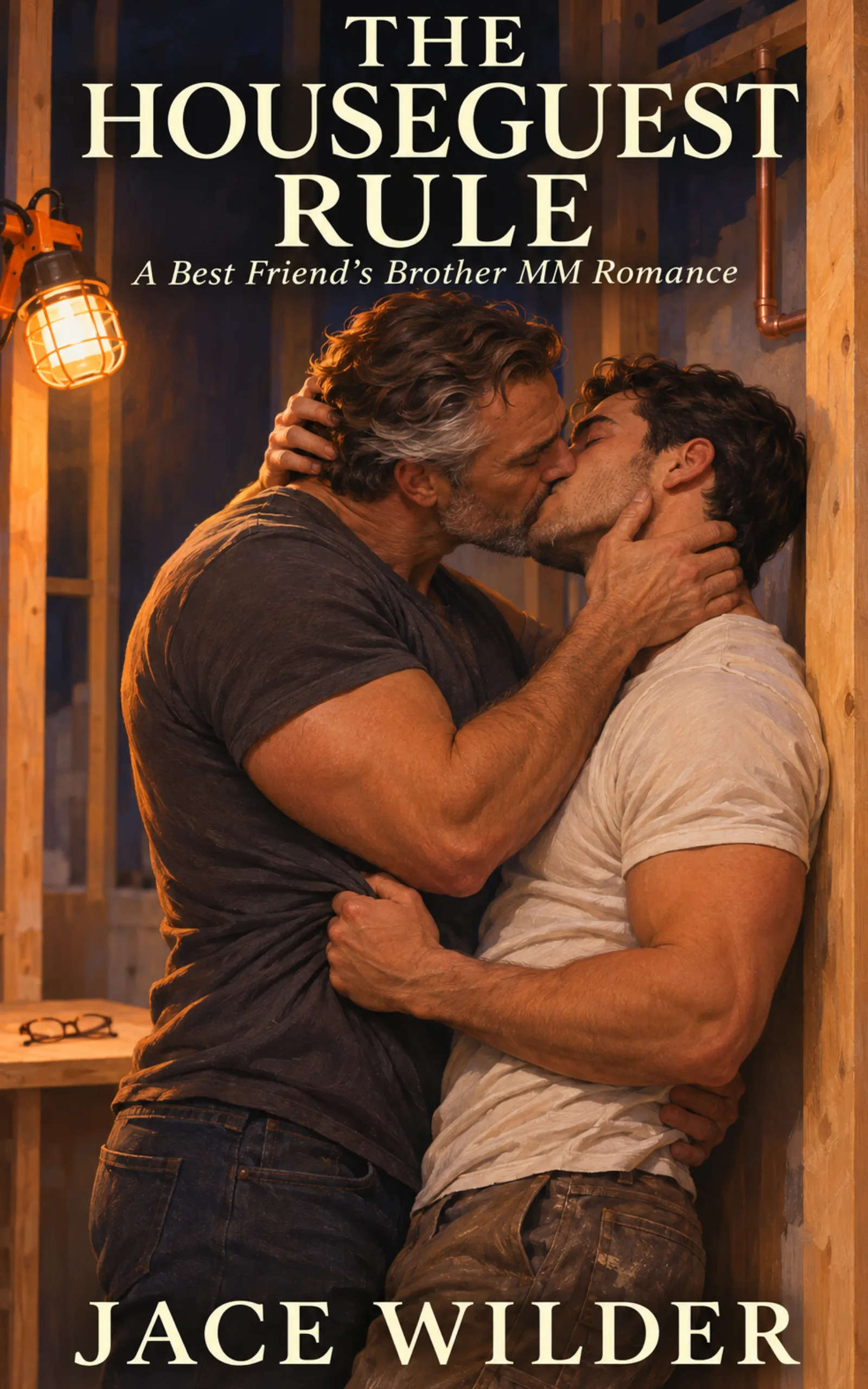
The Houseguest Rule
MM Age-Gap Best Friend’s Brother Romance
by Jace Wilder
Available at all major retailers
Pairing: MM
Heat: 🌶️🌶️🌶️🌶️🌶️ Inferno
Tropes: Best Friend’s Brother, Age Gap (19 Years), Forced Proximity, Houseguest/Landlord, Forbidden Romance, Secret Relationship, Silver Fox, Homeowner/Contractor, Blue Collar, Thin Walls, Competence Kink, Praise Kink, Light Bondage, Dirty Talk, Found Family
Nothing happens under this roof while you’re my guest.
Rule one of staying in your best friend’s brother’s spare room: don’t touch him.
Joe Mason is twenty-nine, running the biggest contract of his life, and six weeks short of an apartment he’s already paid for. His best friend’s solution? Move in with Callum’s older brother.
David Turner is forty-eight, divorced, glasses, gray at the temples, an insurance adjuster who can take a liar apart with one and a half questions. He’s selling a house too big for one man, and he has exactly one rule for his houseguest: nothing happens under this roof while you’re my guest. Joe has to be free to say no and still have somewhere to sleep.
Joe has no intention of saying no.
The walls are thin. The kitchen is torn down to the studs. Joe is rebuilding it with his bare hands, shirtless, on weekends, and every night the man who has never once lost control loses it a little more.
But David has been keeping something from Joe. Something that started before the first kiss. And when it comes out, at the worst possible moment, in front of everyone, it’ll prove the one thing Joe swore no one would ever do to him again: that the man he’s falling for was watching him all along.
You’ll love this book if you enjoy:
✅ A best friend’s older brother with a nineteen-year age gap and a rule he was always going to break
✅ Thin walls, a shared headboard, and a morning-after confession over the newspaper
✅ A blue-collar hero who builds the kitchen of his lover’s dreams, one shirtless weekend at a time
✅ A silver-fox adjuster who asks first, every single time, and praises filthy (🌶️🌶️🌶️🌶️🌶️)
✅ Light bondage with a silk tie, a pantry quickie twelve minutes before the realtor arrives, and a brand-new quartz island christened
✅ A grovel that actually means it, and a found family worth staying for
✅ HEA guaranteed
⚠️ Content Warning: This novel contains explicit sexual content (graphic MM scenes including mutual masturbation through a shared wall, oral, rimming, anal sex, edging, light bondage with a tie, praise and dirty talk, and semi-public sex), strong language, a nineteen-year age gap between consenting adults, references to a past business collapse, financial hardship and a depressive episode, a breach of trust within a family, and relationship conflict. Intended for readers 18+.
📖 Read Chapter One Free
Not sure yet? Read the full first chapter right here.
Chapter One: Joe
The guy from Halvorsen Property Management had a mustache like a push broom and the bedside manner of a parking ticket.
“Six weeks,” he said. “Give or take.”
“Give or take what?”
He frowned at his monitor like it had let him down personally. “The outgoing tenant is exercising a holdover clause. Once he’s out, there’s water damage behind the bathroom vanity. Mold remediation. New drywall. We can’t hand over a unit with—”
“Mold. Sure.” Under the desk, where he couldn’t see it, I tapped two fingers against my thigh. One, two. One, two. “Here’s my problem, Dennis. My current lease ends Friday. This Friday. Three-days-from-now Friday. The woman moving into my old place already texted me a picture of her cat. The cat has a name. It’s Admiral.”
“I’m sorry to hear that.”
“You’re sorry to hear about Admiral?”
Dennis did not laugh. Nobody at Halvorsen had laughed since the Clinton administration.
“Your deposit is secured,” he said. “The unit is yours. It’s simply not ready.”
“So you’ve got my twenty-four hundred bucks, and I’ve got a picture of a bathroom I can’t use.”
He slid a printed notice across the desk. Anticipated Handover: Six (6) Weeks. Somebody had paid for the parentheses.
I folded it into quarters and put it in my back pocket, because the other option was eating it.
The Foundry Market had been a steel foundry for ninety years and a pigeon hotel for twenty, and in nine weeks it was supposed to be the best food hall in Eastbridge. Brick walls, iron trusses, nine vendor stalls, and every one of them needed a commercial kitchen.
My company was installing all nine.
Mason Kitchen Works. Me, my van, and the guys I trusted enough to call. Seven years of hoods, walk-ins, and gas runs. This was the first job where my name sat at the top of the paperwork instead of somewhere in the middle. If I nailed it, I was a lead contractor. If I blew it, I was a guy with a van.
I walked in at ten, and Sean Ellis looked up from a junction box with the face of a man who’d been waiting to say something.
“You look like shit,” he said.
“I always look like this.”
“You usually look like shit with a little more optimism.” He peeled off his gloves. Sean was thirty-four, built like a refrigerator somebody had taught to wire things, and the best electrician I’d ever worked with. “Apartment?”
“Six weeks.”
“Ouch.”
“Give or take.”
“Double ouch. Where are you sleeping?”
“You can have my couch.”
“Your couch is a futon from 2011, and your kid gets up at five forty to watch cartoons at a volume that violates the Geneva Conventions.”
“She’d love you. She’d sit on your face.”
“That’s the problem, Sean.”
Stall four was going to be a Korean barbecue place. Right now it was a concrete box, and the floor drain was exactly where the old plans put it—eighteen inches from where the new plans moved the sink.
I crouched, measured, measured again. “Who poured this?”
“Delgado’s crew, Tuesday.”
“Off rev three.” I stood up and pulled up the drawings on my phone. “Rev four moved the sink. We’ll be cutting this floor.”
Sean swore softly and with genuine artistry.
“I’ll call Farah,” I said. “Design change after pour. It’s not on us.”
“She’s going to say it’s on us.”
That was the job. Nine kitchens, four hundred moving parts, and every part had a person attached who wanted it to be somebody else’s fault. I liked it. Kitchens were honest. They worked or they didn’t.
People were a lot harder to measure.
My phone buzzed. Callum.
Heard about the apt. Copper Pin, 7. Not optional.
I hadn’t told him. I’d told my sister Natalie last night, and Natalie had told Callum’s girlfriend, Nina, because Eastbridge was a city of three hundred thousand people and a phone tree of four.
Then I’m drinking, I typed.
Callum Turner had been my best friend since we were eighteen and assigned as lab partners in a community college chemistry class we both failed with real commitment. Eleven years later he managed a sporting goods store and still thought he was the responsible one.
He was waiting in our booth at the Copper Pin with two beers and a face.
“Don’t,” I said, sliding in.
“I haven’t said anything.”
“You’re making the face.”
“This is my face.” He pushed a beer across the table. He was lanky where I was solid, auburn where I was dark, and he had the Turner habit of leaning forward when he was about to manage you. “Six weeks?”
“Give or take.”
“Where are you staying?”
“Thinking about the extended stay off Route 9. Ninety-five a night.”
“That’s four grand.”
“Three ninety-nine. They have a waffle machine.”
“Joe.”
“I’ve got money, Cal.”
He looked at me. It was quick, it was kind, and I hated it. The look said I know you do while meaning last time you said that, you were three months behind on everything and not answering your phone.
Five years ago. A general contractor named Russ Pell folded his company owing me fourteen thousand dollars, and for three months I stopped answering anybody. Callum lent me three thousand to keep my van and my rent. I paid him back in eleven months, every dollar, with a case of good bourbon on top.
He remembered the part where he lent it to me.
“You can’t stay with us,” he said, like I’d asked. “The couch is a love seat. You’d sleep in a question mark.”
“I didn’t ask.”
“I know. So I asked Dave.”
I put the beer down. “You asked David?”
“He’s got four bedrooms and nobody in any of them. He’s selling in a couple months anyway.” He shrugged, very pleased with himself. “He said yes before I finished the sentence.”
David Turner. Callum’s older brother. Eighteen years older than Callum—the first Turner son, followed by a long nap, followed by Callum as a surprise encore. I’d met David at Callum’s place when I was twenty-one, and maybe a dozen times since—birthdays, a Fourth of July, one extremely long Thanksgiving. He brought good wine, asked one precise question about your work, and left by nine-thirty.
In my head, for years, he’d been filed under Callum’s Dad-Brother.
The last time I’d seen him was Callum’s thirtieth. Navy sweater, glasses, gray at the temples. I’d caught myself watching his hands while he talked, which was weird and stupid, so I’d gone out to the fire escape until the weirdness went away.
“I’m not crashing on your brother for six weeks,” I said.
“You’re not crashing. He’s rattling around that place by himself since the divorce. You’ll be good for him.”
“You’re running the biggest job of your life. Every dollar you spend on a waffle machine is payroll if Foundry pays late. Everybody pays late.”
He was right. That was the infuriating thing about Callum. Under all the managing, he was usually right about the math.
I tapped my thigh. One, two. “I pay him.”
“He won’t take it.”
“Then I’m not going.”
Callum grinned and lifted his beer. “Saturday. He said noon. He said, and I quote, ‘Tell him to bring his tools, the garage is empty and I’m tired of looking at it.'”
I clinked his glass because there wasn’t anything else to do.
David Turner’s house sat at the end of a curved street in Hollins Park. A gray colonial, white shutters, a red door, a deep front porch with a swing nobody had sat on in years. It was the kind of house that got bought by a couple who planned to fill it.
I parked the van in the driveway, killed the engine, and sat there for a second with my hands on the wheel.
Six weeks. You’re a guest. Be a good one. Don’t make it weird.
The red door opened before I got to it.
“You found it,” David said.
He was taller than I remembered. Six-two at least, wide through the shoulders, a heavy chest under a charcoal sweater with the sleeves pushed to his elbows. Old jeans. Bare feet, which for some reason knocked me sideways a little—like I’d assumed he came out of the factory in loafers. His hair was brown going silver at the sides, and he had reading glasses pushed up on his head, and his eyes were a cool clear gray that took me in from boots to face in one unhurried pass.
It was an insurance adjuster’s look. I’d find that out later. It catalogued everything and gave nothing away.
“Thanks for this,” I said.
“Thank Callum.” The corner of his mouth moved. “He described you as ‘basically housebroken.'”
“That’s a lie. I chew furniture.”
“I’ll hide the good chairs.” He stepped back to let me in. “Come on. I’ll show you around.”
The house was half packed and half lived in. Boxes labeled in neat block capitals—BOOKS, STUDY. KITCHEN, SPARE. SIMON, DO NOT OPEN—lined the front hall. The living room had a big leather couch, a good rug, and a wall of built-in shelves already mostly emptied. It smelled like coffee and cedar.
“Guest room,” he said upstairs, pushing open a door. “Own bathroom. The mattress is better than mine, which I resent.”
Queen bed, dresser, empty closet. On the wall above the headboard hung a framed print of a sailboat that had clearly been chosen by someone who didn’t love sailboats.
“My room’s through that wall,” he said, nodding to the right. “I’m quiet. If I’m not, tell me.”
“I snore,” I said.
“I’ve been warned.” He looked at me for a second longer than the sentence needed. “Bathroom’s there. Garage is through the kitchen. Let’s do the kitchen last. I want to see your face.”
That should’ve tipped me off.
The kitchen was a crime scene.
Honey-oak cabinets with cathedral arches. Laminate counters the color of a Band-Aid. Almond appliances, a four-burner electric coil stove, a fluorescent light box in the ceiling, and wallpaper—wallpaper—with a border of tiny ducks wearing scarves.
I stood in the doorway and didn’t say anything for a long time.
“There it is,” David said, with real satisfaction.
“Nineteen ninety-eight,” he said. “The previous owners were very proud.”
“They should be in prison.” I walked in and opened a cabinet. The hinge groaned like it had something to confess. “The ducks are wearing scarves, David.”
“I’m aware of the ducks.”
“Why are the ducks wearing scarves?”
“Simon liked them.” He leaned in the doorway with his arms crossed, and the sweater pulled across his chest when he did it. “My ex-husband. He said they were jaunty. I said if we stripped the wallpaper, we’d have to do the whole kitchen, and if we did the whole kitchen, we’d have to agree on a kitchen, and we didn’t agree on anything after year six. So the ducks stayed.”
“And then the marriage left.”
“And then the marriage left,” he agreed, dry as paper. “The ducks remain. My realtor wants to burn the room down. I’ve been told it’ll cost me thirty thousand on the asking price.”
“It’ll cost you more than that. Anybody who walks in here is going to see forty grand of work and knock off sixty.” I ran a thumb along the counter’s peeling edge. “You could just paint the cabinets, swap the hardware, get a—”
I stopped, because he was smiling at me.
Not his public smile, the polite one he’d used at Thanksgiving. This one started in his eyes and made it about halfway down his face before he caught it.
“What?” I said.
“Nothing. You just looked very happy for a second.”
“I’m a kitchen guy. This is like showing a dentist a horse with no teeth.”
“That’s a terrible metaphor.”
He laughed. It was a short, low sound, surprised out of him, and it went straight down my spine and sat at the base of it, warm.
No, I told the base of my spine. Absolutely not. Callum’s brother. Dad-Brother. Duck-Kitchen Man.
“Come on,” he said. “Let’s get your van emptied before it rains.”
It didn’t rain. It was the first week of September, eighty-one degrees and sticky, and by the time we’d moved two tool chests, my compressor, three totes, and a box labeled JOE’S SHIT, DO NOT JUDGE into the house and the garage, my T-shirt was soaked through.
So was David’s sweater, which he’d finally pulled off over his head in the garage without breaking stride.
He had on a plain white undershirt beneath it. I want to be clear about that, for the record. A completely normal, forty-eight-year-old-man undershirt. Thin cotton. Damp. Sticking to the heavy slope of his chest and the thick curve of his shoulders and the soft place at his waist where he wasn’t built like a gym guy—he was built like a guy who’d been big his whole life and had stopped apologizing for it. Gray in the stubble along his jaw.
I picked up the compressor wrong and nearly took off my own shin.
“You all right?”
“Great,” I said. “Love this compressor.”
He took the other end without asking and we carried it to the back wall together, and he smelled like sweat and cedar and laundry soap, and I thought about Russ Pell’s lawyer, and IRS penalties, and the drain in stall four, until my body calmed the hell down.
At five o’clock, he put a yellow legal pad on the kitchen table.
I looked at it. I looked at him. He sat down across from me with a pen and two cold beers and slid one over.
“You’re kidding,” I said.
“It’s just a few things to agree on. So nobody has to guess.”
“Do I need a notary? My lawyer is an electrician named Sean.”
“Drink your beer, Joe.”
I drank my beer. He uncapped the pen.
He’d already written headers. Neat, square capitals. DATES. COSTS. TOOLS. KITCHEN & LAUNDRY. GUESTS. PRIVACY. IF IT’S LATE AGAIN.
“Oh my God,” I said, and started laughing. “You made categories.“
“I spend all day reading claims from people who didn’t write things down.” He didn’t look embarrassed. He looked like a man who’d been laughed at by better. “Dates. Callum said six weeks.”
“Six weeks, give or take.”
“Give or take what?”
“That’s what I asked.” I fished the folded notice out of my pocket and smoothed it on the table. He picked it up, put his glasses on, and read it the way I imagined he read everything—once quickly, once slowly, eyes stopping exactly where a person might lie.
“Holdover clause and mold,” he said. “That’s six weeks if everyone’s honest and eight if they’re not.”
“Halvorsen’s not honest.”
“Then I’ll pencil eight.” He wrote 6 (8?) in the margin, then looked up over the rims. “Costs.”
“I’m paying you.”
“No, you’re not.”
“Then I’m leaving.” I said it lightly, but I meant it, and I let him see that I meant it. “I’m not a charity case, David. I’m a grown man with a business. I know Callum probably told you some story—”
“Callum told me your apartment was late.” He set the pen down very precisely, parallel to the legal pad. “That’s all he told me.”
It was the first time I saw him do that, set something down before he said something careful. I didn’t know yet that it was a tell.
“Okay,” I said. “Then you know I’m good for it.”
“I don’t need the money.”
“I didn’t ask if you needed it. I’m going to use your water, your power, your washing machine, and probably your coffee, because I’m not an animal. A hundred and fifty a week.”
“Fifty.”
“One-fifty.”
“Seventy-five.”
“Are we haggling? You’re haggling down?”
“I’m an adjuster,” he said. “I don’t like inflated claims.”
I leaned back and crossed my arms. “One-fifty, or I’m calling the Route 9 Suites and asking about their waffle machine.”
He looked at me for a long moment. Then he wrote 150/wk on the pad and underlined it once.
“Thank you,” I said.
“You’re very stubborn.”
“I’ve been told.”
That got the half smile again. He moved down the list. Tools in the garage—fine, and I could use his workbench. Kitchen—mine to use, anytime, though he warned me the stove took nine minutes to boil water and had once set a dish towel on fire out of spite. Laundry—Sundays were his, the rest of the week was mine. Guests—
“I won’t bring anybody back,” I said.
“You’re an adult. I’d just want a heads-up.”
“Same goes.”
His pen paused. “I don’t really have people over.”
“Still. Same goes.”
“Noted.” He wrote both ways beside GUESTS. Then PRIVACY. “That door locks. You’ll have your own key to the house. I won’t go in your room unless it’s on fire, and even then I’ll knock.”
He slid a key across the table. It was on a ring with a little brass tag stamped with a number seven.
“Why seven?”
“It came with the house. There’s a drawer full of them. I’ve never known what one through six were for.”
I turned it over in my fingers. It was warm from his pocket.
“And the last one,” he said. “If it’s late again. If Halvorsen runs past eight weeks, or something goes sideways—”
“Then I’ll figure something out.”
“Then we talk,” he said. “That’s all. We talk about it. Nobody disappears into a motel at midnight to avoid an awkward conversation.”
I stared at him. “Did Callum say something?”
“About what?”
About me disappearing. About the three months nobody could reach me. About the version of me that people still told stories about at parties when they thought I was out of earshot.
But his face was perfectly blank and perfectly patient, and I’d been wrong before about people knowing things.
“Nothing,” I said. “Yeah. Okay. We talk.”
He wrote it down. Then he flipped the pad around and slid it across to me with the pen on top.
“Sign it,” he said.
“You want me to sign it?”
“I want you to feel like you can hold me to it.” He took off his glasses and folded them, and without them his face looked younger and more tired and a lot less guarded. “That goes both ways too. If something here isn’t working for you—anything—tell me. I’d much rather know than guess.”
There was something under the way he said it. Something old and worn smooth, like he’d been guessing about things in this house for a long time.
I signed it. Joseph D. Mason. Then, under that, I drew a small duck in a scarf.
He looked at the duck for a long moment.
“That’s legally binding now,” he said gravely.
“I’d expect nothing less.”
I cooked that night, because I’d seen inside his fridge and it contained eggs, two lemons, mustard, half a bottle of white wine, and a container of something that had once been soup and now had ambitions.
I made chicken thighs with lemon and garlic and a pan sauce with his wine, and rice. The stove took nine minutes to boil water, just like he’d said. I fought it the whole time and won.
He sat at the table with his laptop open and didn’t work. Every time I turned around, he was looking at something near me—the pan, the cutting board, my hands.
“You do this professionally,” he said finally.
“I install kitchens professionally. I cook to stay alive. Big difference.”
“It doesn’t smell like a big difference.”
I put a plate in front of him. He ate the first bite and closed his eyes for a second, and I had to turn back to the stove and stare at an almond-colored burner very hard.
We talked. That was the surprising thing. He asked about Foundry Market and actually listened—asked the one question that mattered, which was who’d signed off on the rev four drawings and whether the change order was written before or after the pour. I told him about the floor drain. He told me about a restaurant owner who’d blamed a kitchen fire on lightning on a cloudless day.
“What gave him away?” I asked.
“The lightning, mainly.”
I laughed so hard I had to put my fork down.
He told me about the house. He’d bought out Simon’s half four years ago. He was listing it in October and wanted something small by the river, somewhere he wouldn’t have to mow.
“Why’d you wait four years?”
He thought about it, which I was starting to realize he did with everything. “Because selling it means it’s actually over. Living in it just means I haven’t finished cleaning up.”
He said it lightly. It didn’t land lightly.
“For what it’s worth,” I said, “the ducks are definitely over.”
“Thank you, Joe.”
“No problem, Dave.”
He winced. “Only Callum calls me Dave.”
“Only Callum calls me Joe-Joe. When he’s drunk. Never tell anyone.”
“Your secret’s safe with me,” he said, and I don’t know why, but something in the room shifted when he said it. A small, quiet click, like a key turning in a lock you didn’t know you’d been standing in front of.
We did the dishes. He washed. I dried. Our elbows bumped twice. The second time, neither of us moved for half a second longer than we needed to.
At ten he said goodnight and went upstairs, and I sat on the back deck with a beer and the cicadas and texted Callum.
Your brother made me sign a contract.
LOL yeah he does that. You good?
I’m good.
Good. Be nice to him. He’s had a rough few years.
I looked up at the house. One light was still on upstairs, behind the wall I’d be sleeping against.
I’m always nice, I typed.
I don’t sleep well the first night anywhere. I lay under the sad sailboat and listened to the house settle. At one in the morning I gave up, pulled on a T-shirt over my boxers, and went downstairs for water.
The kitchen light was off. The light over the stove was on.
David was standing at the counter in the dark.
He wore gray sweatpants and nothing else. They sat low on his hips, low enough that I could see the line of dark hair that ran down from his navel and disappeared under the waistband. His reading glasses were on, and there was a file folder open on the counter beside a short glass with an inch of something amber in it. The stove light caught the gray in his hair and the wide, heavy plane of his chest, the hair across it, the soft swell of his stomach, the thick muscle of his upper arms. He was absolutely, completely still, the way men are when they think nobody’s watching.
I should’ve coughed. Said something. Gone back upstairs.
I stood in the doorway and looked.
He turned a page. Picked up the glass. Drank. His throat moved.
My dick, which had been minding its own business for the entirety of a very long day, sat up and paid attention.
“Can’t sleep?” he said, without turning around.
I nearly jumped out of my skin. “Jesus. How long did you know I was there?”
“Third stair creaks.” Now he turned. The glasses caught the light. His eyes went to my face, then down—T-shirt, boxers, bare legs, bare feet—and back up. Not fast. Not slow, either. “New place?”
“New place,” I agreed. My voice came out lower than I meant it to. “You?”
“A warehouse fire. Somebody is lying to me, and I don’t know who yet.” He nodded at the glass. “Bourbon. Do you want one?”
No. Say no. Get your water, go upstairs, lock your door.
“Sure,” I said.
He got down a second glass without asking how I took it and poured two fingers, neat, and held it out. I crossed the kitchen to take it. Our fingers touched on the glass—his were warm and blunt and broad across the knuckles, and his thumb grazed the side of my hand, and it was nothing. It was a guy handing another guy a drink.
It went through me like current through a bad ground.
“Thanks,” I said.
“You’re welcome.”
We stood a few feet apart in the stove light. The ducks watched us from the wall in their little scarves.
“Do you always work this late?” I asked.
“Lately.” He took the glasses off and pinched the bridge of his nose. “It’s quieter at night. Nobody asks me anything.”
“I’m asking you something.”
“You are.” He looked at me. Without the glasses his eyes were darker, and there were faint lines at the corners of them, and it was very hard to remember he was Callum’s brother. “I don’t mind it from you.”
There it was again. That click.
I drank the rest of the bourbon in one swallow because my mouth had gone dry. “I should let you work.”
“You should probably sleep.”
“Yeah.”
Neither of us moved.
Then I did, because I’m not an idiot. I set the glass down on the Band-Aid-colored counter, filled a water glass from the tap, and said, “Night, David,” without looking at him.
“Goodnight, Joe.”
I felt his eyes on my back all the way to the stairs. The third one creaked under my foot. I swear to God I heard him exhale.
Upstairs, I shut the door and leaned against it, holding the water I’d forgotten to drink.
I was hard. Not a little hard. So hard my boxers were tented like a circus, and my pulse was going in my cock, and my skin felt two sizes too small, all because a forty-eight-year-old insurance adjuster with gray in his hair had handed me a glass of bourbon and said he didn’t mind my questions.
I set the water down on the dresser.
I did not touch myself.
I lay on top of the covers in the dark and stared at the ceiling and tapped my fingers against my thigh, one, two, one, two, and listed every reason this was the worst idea I’d ever had.
He was Callum’s brother.
Nineteen years older than me. He’d been in college when I was in diapers.
He was my landlord, kind of. My host. I’d signed a legal pad. There was a duck.
He probably hadn’t looked at me twice in eight years.
He had looked at me twice tonight. Down and back up. In the doorway and over the glass.
My cock throbbed against my stomach like it had heard that.
Through the wall, the stairs creaked. Footsteps in the hall, slow and heavy. A door opened and shut, the other side of the headboard.
Then I heard the bedsprings take his weight—close, so close, a foot of drywall and two-by-four away—and the long low sound of a man settling into the dark.
I turned my face into the pillow and thought, very clearly: He’s Callum’s brother.
It didn’t help.
It didn’t help at all.
Want to keep reading? Get The Houseguest Rule at all major retailers.
🔥 Want an EXCLUSIVE Bonus Chapter?
Without Asking — A scene TOO HOT for retailers. Nine months later, David uses the key to Joe’s apartment for the first time, wearing the navy tie with the white dots. This time Joe ties the knot. Told from David’s side.
More from Jace Wilder
Browse all Jace Wilder books.

One Time Only (He Lied)
He said it was one time. He lied.

Your Side of My Bed
Four weeks, in pen. One thin wall. Eleven years of pretending.
Sixty Days’ Notice
Four years. One wall. Zero idea.

Back of House
He bought my family's ovens and turned them off. Now he wants me.

Under New Management
The founder retired. The successor stopped waiting.

Room for the Best Man
Two best men. One bathroom. A couch night he swore he forgot.
Never Miss a Release
Get new release alerts, exclusive bonus content, and reader-only giveaways.