
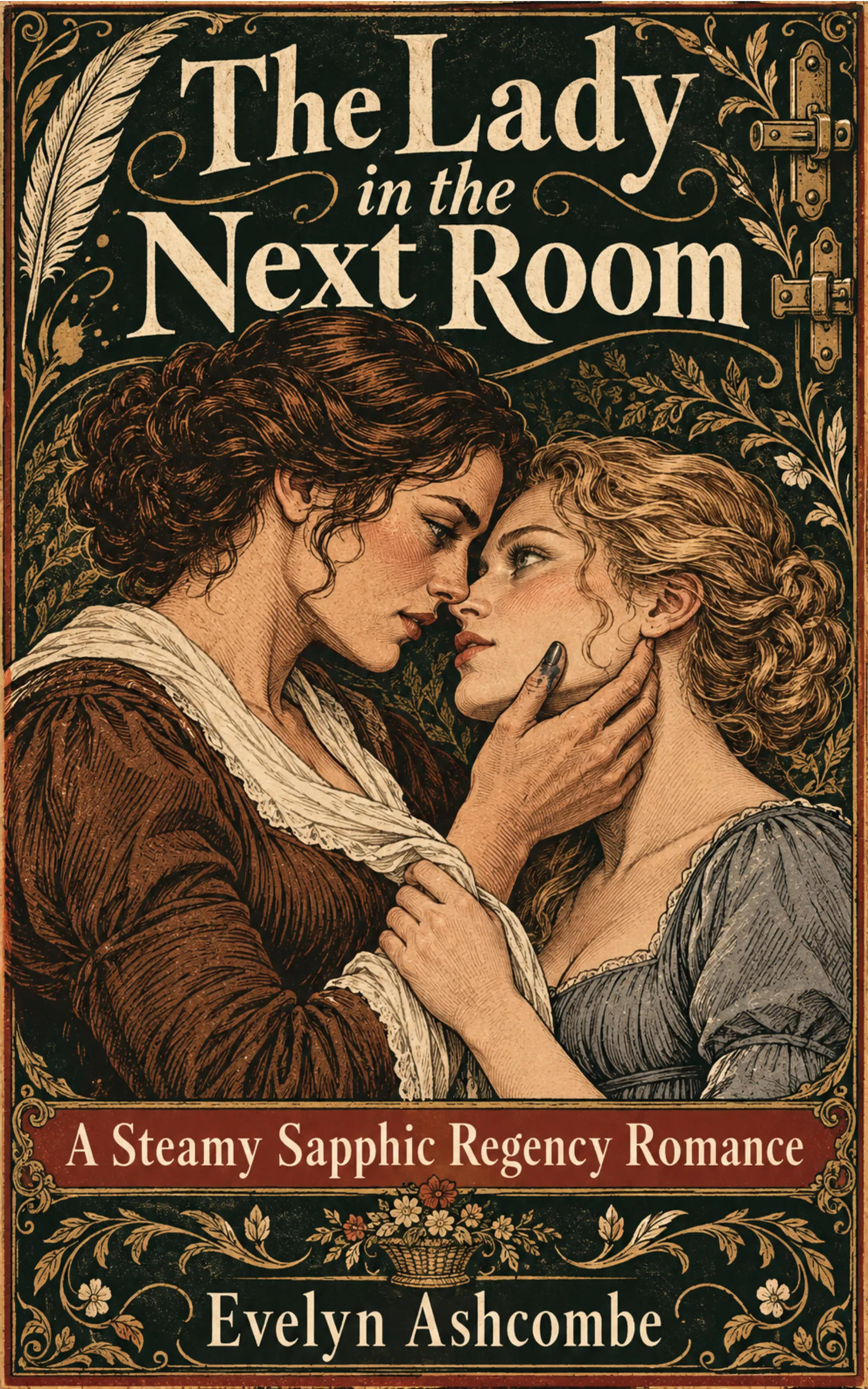
🔥 The Window Seat 🔥
An Exclusive Bonus Chapter from The Lady in the Next Room by Evelyn Ashcombe
⚠️ Spoiler Warning: This bonus chapter takes place in Bath on the fourteenth of March, 1820, Arabella’s thirtieth birthday, after Chapter Twenty-Two and before the Epilogue. It contains spoilers for the whole of The Lady in the Next Room and very explicit sexual content (18+), and it runs hotter than the book. Read the novel first for the full experience.
Arabella’s side of a frosty birthday night in Quiet Street: the window-seat leaf with the line she never got back, a curtain that moves, a hand that finds her ankle in the dark and stops to ask, a watchman on his rounds below, and a French article tied on with stay-laces. Explicit content — 18+.
The Window Seat
She was thirty years old at eleven o’clock on the morning of the fourteenth of March, eighteen hundred and twenty, in a bank in Milsom Street, and by four o’clock she had decided what she wanted for her birthday.
“A present,” she said at dinner.
Frances looked up from the mutton. “You have had a present. You have had two thousand pounds.”
“That was Papa’s. And the four per cents’. And a little bit Mr. Price’s.” Arabella cut a potato exactly in half, which was a thing she had learned at this table and would never now unlearn. “I should like one from you.”
“The gloves are upstairs.”
“I know about the gloves. I found them on Tuesday in your hatbox. They are very beautiful and I shall cry when you give them to me. I want something else as well.”
Miss Pike, at the foot of the table, laid down her fork.
“Miss Crewe and I,” she said to the cruet, “are going to the Upper Rooms tonight. A quartet. Mozart. Miss Crewe has opinions about the second violin which she means to deliver to him personally at the interval.” She took up her fork again. “It will be very late. The second violin will wish to defend himself.”
“Thank you, Judith,” said Frances.
“I have done nothing whatever,” said Miss Pike. “Many happy returns, Miss Wren. Thirty is a great relief. One stops being asked when one means to settle.”
Mrs. Hale went at six with Betsy and a slice of birthday seed cake wrapped in a napkin for the cooper’s apprentice. Miss Pike and Miss Crewe went at half past seven in a chair apiece, Miss Crewe humming the second violin’s part in the manner of a woman sharpening a knife. The street door shut. Frances turned her key in it, and then, a moment later and from habit, Arabella turned hers, and they stood in the hall and laughed at each other for locking one door twice.
“Well,” said Frances. “Ask.”
Arabella took a folded leaf out of her bodice.
She had carried it all day. It was in her own round hand on Mrs. Finch’s trade paper, one of the twenty she had written out from memory on a straw cot over Milsom Street with every carriage in Bath going by under the window. Halfway down it there was a gap, a blank line ruled off at either end, with a small mark in the margin in pencil. She had looked at that gap a hundred times in fifteen months. She had never once asked Frances what went in it.
She held it out.
Frances knew it before she took it. Arabella watched her know it: the color starting at the collar, the inked fingers going still on the paper.
“The window seat.”
“The window seat. I want it done. Not read. Done.” Arabella’s own voice surprised her by being perfectly steady. “There is a window seat in the sitting room that nobody uses because there is a draught in the sash. It has a curtain that draws across it. I am going to go up and sit in it and draw the curtain, and you are going to come up in a little while and do what the page says. Except for one thing.”
“Which thing?”
“Nobody on that page asks. You said so yourself, in bed, the first week. Every one of them is taken by surprise.” Arabella stepped closer and put two fingers on the leaf, on the gap. “I want the curtain to move, and the hand to come round it, and find my ankle in the dark. And then I want it to stop and wait for me to say yes. That’s my present. That, and the gloves.”
Frances looked at her for a long moment in the light of the hall lamp. Then she folded the leaf once, very precisely, along its old crease.
“Go up,” she said, in the voice she kept for the butcher. “I shall give you a quarter of an hour. Take your stockings off.”
The sitting room was dark but for the fire, banked low. The window seat ran the width of the front window over Quiet Street, a long hard ledge with two flat cushions in faded red, and the curtain was old green damask that had been good once and hung to the floor. Arabella drew it. It shut her into a narrow cold place between the heavy cloth and the glass, with the street below her and the sky above it, a long slot of lamplight and frost.
She took her stockings off, as she had been told, and her garters, and pushed them under the cushion. She sat sideways on the seat with her back against the shutter and her knees drawn up under her gray wool and her bare feet on the cushion, and waited.
The draught came in at the sash and found her ankles at once.
Below, Quiet Street was empty but for one lamp, and the watchman’s lantern going slowly up toward George Street. Across the way a candle was lit in an upper window. A carriage went by at the far end, toward the Rooms, its wheels loud on the frozen stones. She could see her own breath on the glass. She could hear her own heart. A quarter of an hour was a very long time when one had been told to take one’s stockings off.
She heard the sitting-room door.
She heard it close, quite softly. She heard the key turn in it, which Frances had done once in four years and now did every time, as a sort of signature. Then nothing. No step. A long silence, in which the fire ticked behind the curtain and the watchman called the half hour a street away.
Then Frances began to read.
She read in her own room voice, low and dry and exact, from somewhere quite near on the other side of the damask, and the words came through the old cloth as if the curtain itself were saying them.
“She had taken the window seat, because the curtain could be drawn across it, and because no one ever looked for her there.”
Arabella shut her eyes.
“It was not to be expected, therefore, that the curtain should move.”
Nothing moved. Arabella sat with her hands flat on the cold cushion and her breath short and her whole skin listening, as it had listened to a pen through a wall on the first night of her life in this house.
“It moved,” said Frances.
The damask stirred at the foot of the seat. A narrow gap of firelight opened at the floor, the width of a hand, and a hand came round it: bare, warm, the first two fingers black to the second joint. It felt along the cushion, slowly, in the dark, as if it did not know what it would find. It touched her heel. It closed, gently, round her bare ankle.
Arabella made a sound she had not planned to make.
“And a hand came round it,” Frances said, behind the curtain, a little less steadily, “and found her ankle in the dark.”
The hand stayed where it was. It did not pull. The thumb moved once, over the knob of the bone, and stopped.
“The page goes on,” said Frances. “It says that the hand drew her down along the cushions by it. It says that she did not cry out. It does not say that anyone asked her.” A pause. “I am asking. Shall I go on?”
It was the carriage leaf. It was the line written into the margin in a different ink, fifteen months ago, by a woman who had never once said it out loud. Arabella heard it come through the damask and felt it go all the way down her to the ankle in that warm hand.
“Yes,” she said. “Yes. Go on.”
The hand drew her down.
It did it slowly, by the ankle, exactly as the page said, so that she slid down along the cushions from sitting to lying with her shoulders against the shutter and her head on the hard ledge and her gray skirts riding up her shins. Then the curtain parted properly, and Frances came through it on her knees onto the end of the seat and let the damask fall closed again behind her, and they were both inside the narrow cold slot of window, with the frost and the lamp and Quiet Street beyond the glass.
Frances was in her shift and her wrapper and nothing else. Her hair was down. She had the leaf still in her other hand, folded, and she put it on the sill, very carefully, beside Arabella’s head.
“I have it by heart,” she said. “I don’t need to read the rest. I wrote it in eighteen hundred and twelve in a bed with a husband asleep in it, and I have never once in my life done a single thing it describes.”
“Then do it now.”
“She did not cry out,” said Frances, and pushed the gray wool up over Arabella’s knees, slowly, with both hands, “because the house was full of people.”
“The house is empty.”
“Yes.” Frances bent her head and kissed the inside of one bare knee. “So you may.”
She did not hurry. She had never hurried at this, not since the first gray morning in the blue bed with Mrs. Hale’s key in the area door. She kissed up the inside of one thigh and down the other. She breathed on Arabella through the dark curls without touching, until Arabella’s hips came up off the cushion on their own and the old seat creaked under them. She laid one hand flat on Arabella’s belly over the bunched wool, and held her down, and said nothing at all, and the saying nothing was worse than any word.
“Frances—”
“And a mouth,” said Frances, against her, very low, quoting, “where no mouth had ever been.”
Then her tongue.
It was the flat of it first, the whole length of Arabella from the bottom to the top, slow as ink running down a page, and Arabella’s head went back against the shutter with a knock. Then again. Then the tip of it, finding the small hard place and circling it, and stopping, and circling the other way, while the hand on her belly held her still. Arabella got one hand in that loose brown hair and the other flat against the freezing glass above her head, and the cold of the window and the heat of that mouth met somewhere in the middle of her and made her gasp aloud.
She did not need to be quiet. She remembered that halfway through a breath and let the rest of the breath out as a sound, low and open, and heard it come back off the glass at her.
Below in Quiet Street the watchman’s lantern came back down from George Street.
He walked slowly, as watchmen do. He went under their window. Arabella saw the top of his hat and the light on the frosted railings and the swing of the lantern on its pole, and she lay with her bare legs spread on a window seat a dozen feet above his head with a woman’s mouth on her cunt, and the knowledge went through her like a struck match.
“He can’t see,” Frances said against her, without lifting her head. “The room is dark. The lamp is on him, not on us. All he can see is a black window.” Her tongue moved again, slow. “But you can see him. Can’t you?”
“Yes.”
“Then watch him go up the street,” said Frances, “and come on my mouth before he gets to the corner.”
Arabella made a noise she had never heard come out of herself, and Frances closed her lips round the small hard place and drew on it, and slid two fingers up into her, and curled them.
The watchman went up Quiet Street. Arabella watched him go with her eyes wide open and her hand flat on the glass and her hips grinding up against Frances’s face, and he was at the lamp, and he was past it, and he was at the corner with his lantern swinging, and she came. It went through her so hard that her heel kicked the shutter. It went on, clench after clench round those two inked fingers, while the lantern turned the corner into George Street and was gone and she was crying out to the empty street below, not words, only sound, the way the page said she had not.
Frances stayed with her mouth soft and still on her until the last of it, and then a little after, until Arabella pulled her up by the hair.
“That,” Arabella said, when she could, “was not on the page.”
“No.” Frances’s mouth was wet. Her eyes in the lamplight off the street were black. “The page had no watchman. I have taken liberties with my own text.”
“You have taken liberties with the night watch.”
“He will never know. He will go home and tell his wife the frost was bad on Quiet Street.” Frances lay down along the cushion beside her, on her side, in the narrow space between Arabella and the glass, and they were pressed together the whole length, breathing clouds onto the window. Frances’s hand was resting on Arabella’s thigh. It was shaking very slightly. Arabella put her own over it.
“You’re trembling.”
“I have wanted to do that for eight years,” said Frances, “and I did not know it until you gave me the page this evening. I wrote a woman being found. I did not write the one who finds her. I did not know that she would be shaking.”
Arabella turned her head and kissed her, and tasted herself, and did not care.
“There’s a line missing,” she said against Frances’s mouth. “In the middle. I never got it back. Do you remember what it was?”
Frances was quiet for a moment.
“Yes,” she said. “Every word.”
“Don’t tell me.”
Frances drew back an inch and looked at her.
“I’ve had fifteen months of not knowing what goes in it,” Arabella said. “I’ve lain in bed and filled it in a hundred ways. I like the gap. It’s the only line in that whole drawer that nobody wrote for the women. It’s where we went tonight.” She put her fingers on Frances’s lips. “Leave it empty. I’ll know.”
Frances kissed the fingers, one by one, and said nothing at all, which was a yes.
“Now mine,” said Arabella.
“You’ve had yours. That was yours. The gloves are yours.”
“That was your present to me. This is mine to myself.” She sat up on the cushion with her skirts round her waist and her hair coming down and reached under the seat cushion, past her own stockings, and drew out a parcel the size of a small loaf, in brown paper, tied with tape.
Frances stared at it.
“When did you put that there?”
“At five. While you were seeing Mrs. Hale out. You see a great many people out, my love, and I am very quick on stairs.” Arabella untied the tape. Inside the paper, on its bed of tissue, lay the French article in kid, middle size, which Mrs. Finch had sold her at trade price in the November of eighteen eighteen with the most eloquent eyebrow in Somerset. And beside it, coiled, two long stay-laces, the good linen ones, with the metal tags.
“I have never worn it,” said Arabella. “You wore it, in the workroom, on Thomas’s table, on the night we burned the leaf. I have used it on you with my hand. I have never once tied it on and had you with it.” She looked up. “I am thirty years old today and I have two thousand pounds of my own and I should like to tie it on myself, in this window, and have you on your knees on this seat with your hands on that glass, the way the lady at the wall had hers. Except that you will be able to turn round. And you will be asked.”
Frances did not say anything for a moment. Her face had done the thing it did in the alcove the first time Arabella had read her own page back to her: come open all the way, every page of it, faster than she could get a hand to the cover.
“That,” she said, unsteadily, “is a chapter.”
“It’s a novel. Three volumes. Yes or no, Frances.”
“Yes.”
She did it herself. She had watched it done once and done it once for Frances in the workroom, retying it twice, laughing so much she could barely see. She did not laugh now. She stood up off the seat inside the curtain, in the cold, and stepped out of her gray wool and petticoat and let them fall, and her stays after them, and her shift, and stood in nothing in the frost-light from the street. Then she set the kid against herself and wound the stay-laces round her hips, twice, and drew them, and knotted them at the back, flat and hard, without looking, the way she did the household book on Saturdays.
It sat against her, heavy and strange, the base of it pressed flush to the place that was still swollen and wet from Frances’s mouth. She moved her hips once, experimentally, and the pressure went through her like a bell.
“Oh,” she said.
Frances was watching from the cushion. She had pushed the wrapper off her shoulders and sat in her shift with her knees together and her hands in her lap, and her eyes went down Arabella’s body in the dark, slowly, to the thing standing out from her, absurd and dark and gleaming, and stayed there.
“You look like a figurehead,” Frances said hoarsely. “You look like something that would be carved on the front of a ship.”
“I feel ridiculous.”
“You look magnificent.” Frances drew a breath. “Tell me what to do. I want to be told.”
So Arabella told her.
“Take off your shift.” Frances took it off. “Kneel up on the seat. Facing the window.” Frances knelt up on the faded cushions, facing the glass, with her back to Arabella and the curtain. “Put your hands on it. Flat. Both of them.” Frances put her two hands flat on the freezing pane, one each side of the sash bar, and gasped at the cold of it. “Now spread your knees.”
Frances spread her knees on the cushion.
Arabella stood behind her and looked.
The long pale back. The brown hair down it to the waist. The small round hips, and between them, in the light that came up off Quiet Street, everything: dark curls, wet and parted, the lips of her flushed and shining. Frances was soaked. She had got that way with her mouth on Arabella and nobody touching her at all, and Arabella saw it and felt her own knees go weak.
She knelt up on the seat behind her. The kid nudged the back of Frances’s thigh, and Frances jumped, and then pushed back against it.
“Ask me,” Frances said, to the glass.
“May I?”
“Yes. God. Yes.”
Arabella reached between them and took hold of it and set it to her, and pushed.
It went in slowly. She made it go slowly. She watched it go: the blunt end of it parting Frances, opening her, an inch and then a breath, and Frances’s two hands sliding on the frosted glass and her head dropping forward between her arms and a long broken sound coming out of her that fogged the pane in front of her mouth. Arabella held her by the hips and kept pressing, steady, until there was nothing left to give and the stay-laces were flush against Frances’s skin and the base of the thing was ground hard against Arabella herself, and both of them stopped, and breathed.
“Tell me,” Arabella said. “You always tell me. Tell me what it’s like.”
“It is—” Frances’s voice shook. “It is full. You are all the way in me. I can feel the knot of the laces when you breathe. I can feel you behind me, all the length of you, and I can see the street, and the glass is so cold under my hands, and I am so hot I could—” She broke off. “Move. Please. I want to know what it is like when you move.”
Arabella moved.
She drew back nearly all the way and pushed in again, slow and deep, and Frances’s whole back arched under her hands. Again. And at the bottom of every stroke the base of it ground against her where she was swollen, so that every time she gave it to Frances she felt it herself, a hard sweet pressure going straight through her. She had not known. She had watched Frances’s face in the workroom and not understood until now, with her own hips doing it, how giving and having could be one movement.
“Oh,” she said. “Oh, Frances, it presses on me—every time—”
“I know. I know. Don’t stop. Harder.”
She gave it to her harder. The old window seat began to creak in time. Frances’s hands slid on the glass and found the sash bar and gripped it, and her breath went out on every stroke in a little cloud that spread across the pane and faded and came again, and her hair swung forward in a curtain of its own. Arabella held her hips and drove into her and watched the street over her shoulder: the one lamp, the frost, the candle still burning in the upper window across the way, where somebody was sitting up late with no idea at all.
“Talk,” Arabella said. “You always talk. Don’t stop now.”
And Frances talked. Of course she did. It came out of her in the low fast voice of the pen at two in the morning, broken across every stroke: You are so deep. You are fucking me in my own front window. I can see the watchman’s footprints in the frost. I can see a candle across the way. I am on my knees in my sitting room with my hands on the glass and a woman behind me with a cock tied on with my own stay-laces, and I am going to come, I am going to come on it, I am going to come so hard I shall have to have the sash reglazed—
Arabella laughed aloud, helplessly, with her hips still going, and leaned forward over that long back and reached round under her and found the small hard place, slick as oil, and circled it.
“Say it in the butcher’s voice,” she said into Frances’s ear. “Ask me for it in the voice you use for the butcher.”
Frances made a sound that was half a sob and half a laugh. Then her voice changed. It went cool and level and perfectly composed, the voice of a woman disputing a hundredweight of coals across an area railing.
“Fuck me harder, Miss Wren,” said Frances Bellamy, “and do not stop until I tell you.”
Arabella fucked her harder.
She did not stop. She drove into her with the window seat knocking against the shutter and her fingers circling in front, fast now, exact, and she felt it start in Frances before Frances knew: a tightening, a flutter, the long back going rigid under her. Then Frances came apart with her forehead pressed against the frozen glass and both hands spread on it, crying out into the pane, clenching round the kid so hard that Arabella felt it pull against the stay-laces and the base of it ground into her, once, twice, and that took her too. It went through her from where the laces were knotted to the soles of her bare feet, and she came standing on her knees, holding Frances’s hips, her own voice going up with Frances’s into the cold slot of window between the curtain and the glass, the two of them shaking and gasping and holding on.
When it was over Arabella could not have said how long they knelt there. Frances’s forehead was still against the pane. Arabella’s cheek was on Frances’s back. The fire had gone low behind the curtain. The candle across the street had gone out.
Very slowly, very carefully, she drew out. Frances made a small sound at the loss of it, and laughed at herself for making it, and turned round on the cushion and pulled Arabella down onto it with her, and they lay in a heap on the faded red seat with the kid still tied crookedly round Arabella’s hips and the green damask hanging down behind them like the end of an act.
“Happy birthday,” said Frances, into her hair.
“Thank you. I liked my present very much.”
“Which one?”
“All of them.” Arabella lifted her head and looked past Frances at the window.
There were two handprints on the inside of the glass.
They were very clear. Two spread hands, fingers wide, a little above the height of a kneeling woman, printed in fog on the frost and already beginning, at the edges, to freeze.
“Proofs,” said Arabella, and began to laugh.
Frances turned her head and looked, and went scarlet to the hairline, and laughed too, until the window seat creaked under them and they had to hold each other on.
Miss Pike and Miss Crewe came home at a quarter to midnight. The second violin had defended himself; Miss Crewe was still humming. They heard the two chairs set down in the street, and the knock, and Frances went down in her wrapper with her hair in a plait to let them in, and nobody said anything about the hour, and the house went up to bed.
At breakfast Miss Pike buttered her toast with great care.
“There appear to be two hands on the inside of the sitting-room window,” she said, to the toast. “A little above the height of a kneeling woman. In the frost.”
Arabella became absorbed in the marmalade. Frances poured the tea.
“I have told Betsy to leave them,” said Miss Pike. “They will be gone by noon. It is to be a very fine day.” She took a bite of toast. “Many happy returns, Miss Wren. I trust the draught in the sash did not trouble you.”
“Not in the least,” said Arabella. “I found it very bracing.”
“So I gathered,” said Miss Pike, “from the second floor.”
← Back to The Lady in the Next Room
Join the Evelyn Ashcombe Reader List
New releases, bonus chapters too hot for retail, and exclusive content from Evelyn Ashcombe.