
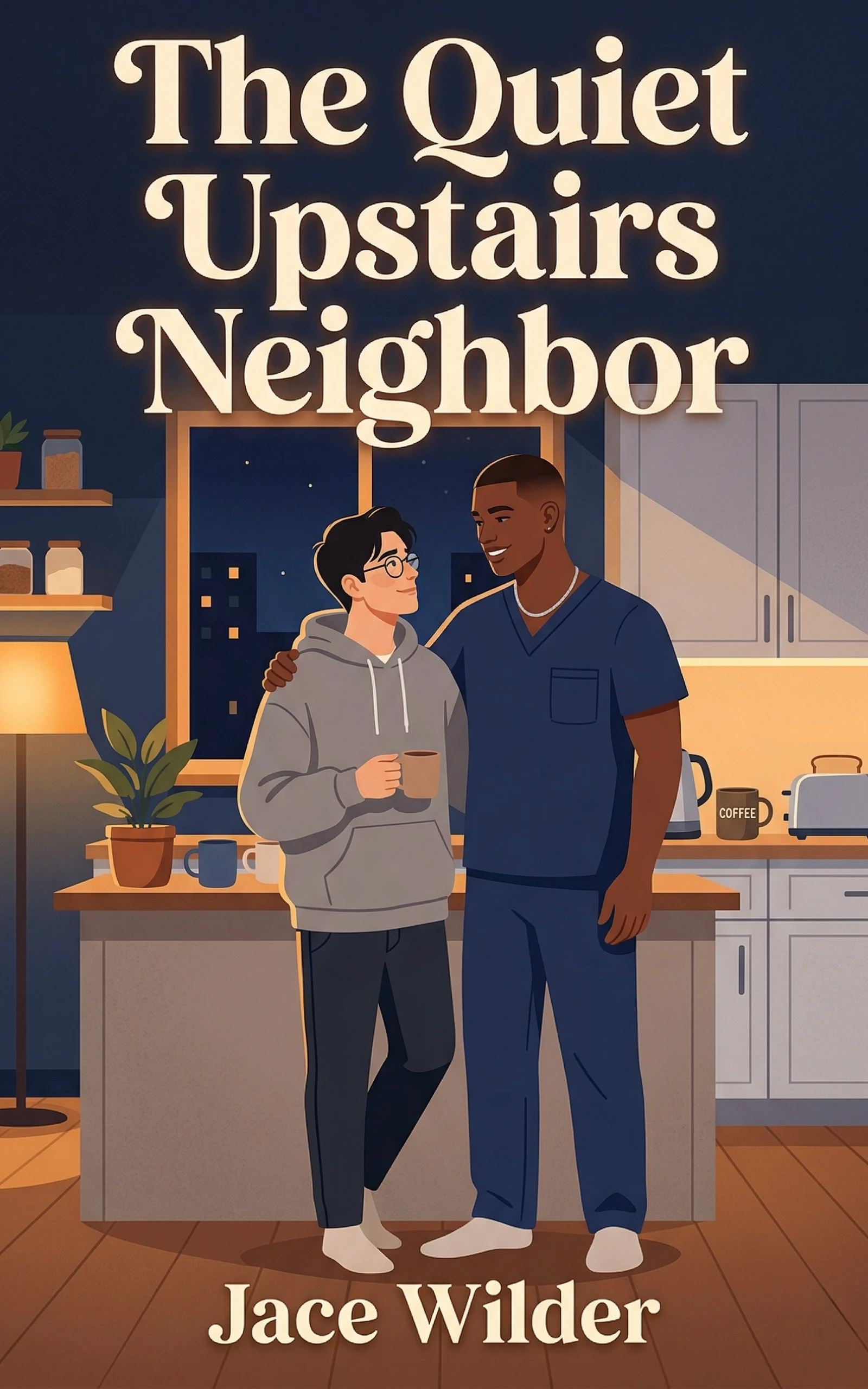
🔥 Bonus Chapter: What Happened on the Roof the Second Time
The Quiet Upstairs Neighbor — Exclusive Bonus
by Jace Wilder
⚠️ This scene takes place after the epilogue. Contains explicit MM sexual content. Intended for readers 18+ only.
What Happened on the Roof the Second Time
Nolan
The Bartlett was empty.
Not completely—three of the twelve units were still occupied, holdouts whose leases hadn’t expired before the renovation. But the hallways were dark, the mailboxes stripped of names, and the buzzing overhead light that had been Elliot’s personal nemesis for fourteen months had finally, mercifully, died. The building felt like a body after the spirit had left—structurally intact, technically standing, but hollow in a way you felt in your bones.
They’d come back to say goodbye. Elliot’s idea—not sentimental in the way he described it, which was “architectural closure,” a phrase so Elliot that Nolan had kissed him mid-sentence and agreed to anything.
It was January. Two weeks since the move. The new apartment was already theirs—the bookshelves full, the plants repositioned, the clawfoot tub christened with a bath so long Elliot’s fingers had wrinkled past recognition and he’d emerged looking, in his words, “like a raisin with opinions.” But the Bartlett still held their lease for another month, and Elliot had wanted to come back. Walk the hallways. Stand in the apartments. Touch the walls that had transmitted every footstep and every whisper and every sound that had carried them from strangers to this.
They’d started in 1B. Elliot’s apartment—empty now, stripped to bare walls and hardwood and the crack in the ceiling that ran from the light fixture to the corner. Elliot had stood in the center of the living room, looking up at it, and Nolan had watched him trace the line with his eyes the way he’d traced it a thousand nights, lying in bed, unable to sleep.
“The crack,” Elliot said.
“The crack.”
“The flaw in the architecture that let everything through.”
Then 2B. Nolan’s apartment—equally bare, the oatmeal rug rolled and donated, the windowsill empty where the plants had been. The spot on the floor where Nolan had paced—twelve feet, window to hallway—was visible as a faint wear pattern in the hardwood, a ghost of movement, the physical record of two years of walking off the night.
“The roof,” Nolan said.
Elliot looked at him. In the dark hallway, without his glasses—contacts again, chosen for tonight the way they’d been chosen for the first rooftop visit—his eyes were huge and blue and bright with something that Nolan recognized because he’d been seeing it for months. Want. Not the urgent, crisis-driven want of their early encounters. The slow, deliberate, I-choose-this-fully want of a man who had found the one place in the world his body trusted and was standing in it.
“The roof,” Elliot agreed.
They climbed. Fourth floor, fire escape, ladder—the sequence familiar, the metal cold under their hands, the January air sharper than December, the kind of cold that announced itself like a blade and stayed. The roof was unchanged—tar and gravel, the low wall, the city spread below in its winter configuration of bare trees and orange streetlights and the distant, glittering skyline.
Nolan had brought the blanket. The same one—the wool thing from the first time, packed with the moving boxes, retained for exactly this purpose. He spread it on the gravel. Stood at the roof’s edge, looking out.
“The last time we were up here,” Elliot said, standing beside him, “you asked me to move in with you and then got on your knees.”
“I have a pattern.”
“You have a very effective pattern.”
“Is that a request?”
Elliot turned to face him. The city behind him, the stars above—fewer tonight, the clouds rolling in from the west, the sky darker—and his face in the mixed light of streetlamp and starlight, all angles and shadow and the specific, devastating openness that he wore only here, only with Nolan, only in the dark.
“It’s an observation,” Elliot said. “The request is different.”
“What’s the request?”
“I want you to fuck me on this roof.”
The sentence—delivered in Elliot’s quiet, precise, translator’s voice, each word chosen and placed with the care of someone constructing a sentence in a second language—hit Nolan in the sternum. Not because it was unexpected. Because it was Elliot. Because the man who three months ago couldn’t say boyfriend without flinching had just said fuck me on this roof with the composed authority of someone ordering at a restaurant, and the distance between those two versions of Elliot Hart was the distance Nolan had crossed with him, night by night, and the crossing had been the most important journey of his life.
“Here,” Nolan said. Not a question.
“Here. On the building where we met. Under the sky we looked at the first time. On the blanket that’s been to every version of us. Here.”
“It’s January. It’s below freezing.”
“Then you’ll have to keep me warm.”
Nolan kissed him. Hard—not the soft, greeting kisses of their domestic life, the quick pecks in the kitchen, the forehead touches in bed. This was the other kind. The storm kind. The mouth-open, tongue-first, hands-in-hair kind that tasted like the beginning—like bourbon and thunderclaps and the moment on the couch when Elliot had closed the last inch and everything that came before became everything that came after.
Elliot’s hands were on his belt before the kiss broke. Fast—the fingers that typed a hundred words a minute finding buckle and zipper with the same percussive efficiency, the movements practiced now, the neural pathway from wanting Nolan to undressing Nolan so well-established that the intermediary steps were automatic.
“Slow down,” Nolan said against his mouth.
“No.” Elliot pulled the belt free. Unbuttoned. Unzipped. “We’ve been slow. We’ve been slow and careful and deliberate for three months and it’s been extraordinary and I love it and tonight I don’t want slow. Tonight I want you fast and hard on a rooftop in January and I want to feel it tomorrow and the day after and every time I look at this building from the street I want to remember what you felt like inside me on the last night we could call it ours.”
Nolan’s self-control—the famous clinical steadiness, the composure that held through twelve-hour shifts and dying patients and the accumulated crises of a career spent managing other people’s emergencies—dissolved. Not cracked. Not eroded. Dissolved, like salt in hot water, completely and instantly, replaced by the raw, unmanaged, animal want that Elliot’s voice and Elliot’s words and Elliot’s hands on his open jeans had unleashed.
He turned Elliot around. Both hands on his hips, spinning him, pressing him face-first against the low wall that edged the roof. The city spread below—four stories of air between them and the street, the vertigo and the exposure and the sheer, reckless openness of what they were about to do adding a voltage to the contact that indoor sex couldn’t replicate.
Elliot braced his hands on the wall. Looked over his shoulder. His face was flushed—the cold and the arousal combining to produce a color that ran from his cheeks to his neck to the strip of chest visible where his jacket had been pulled open. His eyes were dark, his lips parted, his breathing already ragged.
“The supplies—” Elliot started.
“Jacket pocket.” Nolan had come prepared. The same forethought he applied to shift prep—supplies staged, contingencies planned, the logistics handled in advance so that the execution could be seamless. Condom. Lube. The small, practical tools of safe sex, carried to a rooftop in January because he’d known, when Elliot said architectural closure, exactly what the closure would involve.
He pulled Elliot’s jeans down. Not all the way—to mid-thigh, the denim bunching, the cold air hitting bare skin and making Elliot hiss. His boxers followed. Elliot’s ass—pale in the starlight, the muscle taut with cold and anticipation—was exposed to the January night and to Nolan’s hands, which found it immediately, palms spreading, gripping, the possessive hold that Elliot had told him never to apologize for.
“You’re sure about—”
“If you ask me if I’m sure one more time I’m going to throw you off this roof.” Elliot pressed back against his hands. The motion was explicit—hips canting, spine curving, the body’s unmistakable demand for contact. “I said fast and hard, Nolan. I meant it. Stop being a nurse and start being the man who fucks me like the world is ending.”
Nolan’s hand came down on his ass. Not hard—a slap, firm, the sound sharp in the cold air, the sting immediate. Elliot gasped—a sharp, bright sound of surprise and pleasure and the specific, electric shock of being hit in a context that made the hitting an act of intimacy rather than aggression.
“That,” Elliot breathed, “is new.”
“Good new or—”
“Do it again.”
Nolan did it again. Harder—the crack of palm on skin ricocheting off the building’s stairwell housing and out into the January night, and Elliot moaned, loud, unfiltered, the sound carrying in the open air with nothing to absorb it. No walls. No ceilings. No neighbors. Just the sky and the city and the two of them and the sound of Elliot Hart being undone on a rooftop.
The prep was fast. Nolan’s fingers—slicked, warm from the packet he’d been holding in his fist—found Elliot and pressed inside with an efficiency that was closer to urgency than the methodical care of their indoor encounters. One finger, then two, stretching with purpose, and Elliot pushed back onto his hand with the demanding, impatient rhythm of a man who didn’t want to be eased into anything.
“Enough,” Elliot said after two minutes. Maybe less. “I’m ready. I’ve been ready since you spread the blanket. Get inside me.”
Nolan rolled the condom on. His hands were shaking—not from cold, not from nerves, from the sheer, compressed intensity of wanting something this much and being this close to having it. He slicked himself. Positioned. One hand on Elliot’s hip, one on the small of his back, and he pushed in.
Fast. Not rough—controlled, the thrust deep and sure—but fast, the single continuous stroke that buried him completely in one motion. The heat was devastating—after the January cold, the sudden, total, encompassing heat of Elliot’s body around him was a sensory overload that made Nolan’s vision white at the edges and his hand slam flat against the wall beside Elliot’s for support.
Elliot screamed. Not a moan—a scream, the sound they usually contained within apartments and showers and beds, released now into the open air, the rooftop, the January sky. The sound rose and dissipated and was gone, carried east by the wind toward the skyline and the sleeping city, and no one heard it except the stars.
“Move,” Elliot gasped. His hands on the wall, his back arched, his body gripping Nolan with a tightness that was borderline unbearable. “Don’t—don’t be gentle—I don’t want gentle tonight—”
Nolan moved. Fast and hard, as requested—as demanded—each thrust driving Elliot against the wall, the slap of skin on skin joining the sharp bite of January air and the distant hum of the city below. The pace was relentless—not the sustainable, marathon rhythm of their usual encounters but something shorter, more intense, a sprint rather than a distance, the specific urgency of two people saying goodbye to a building with their bodies.
Elliot was loud. Louder than he’d ever been indoors—the absence of walls, of neighbors, of the architectural constraints that had defined their sex life since the first night, liberating something in him that the apartments had always muted. He moaned without restraint. Cried out on the deep strokes. Swore—in English, in French, the languages bleeding together the way they did when his control was gone—and the sounds rose into the open air and were swallowed by the sky.
“Là—plus fort—oh fuck—Nolan—right there—don’t stop—ne t’arrête pas—“
The French. The language underneath the language, the one that surfaced when English couldn’t hold what he was feeling. Nolan didn’t understand the words and understood everything—the tone, the pitch, the desperate, fractured music of a body overwhelmed—and he responded in the only language he was fluent in: his hands, his hips, the angle adjusted by instinct, the spot found and hit and hit again until Elliot’s legs shook and his screams became sobs and the wall under his hands was the only thing keeping him vertical.
Nolan reached around. Found Elliot’s cock—hard, leaking, desperate for contact—and stroked. Fast, tight, the rhythm matched to his thrusts, the dual stimulation a coordinated assault that left no gap, no respite, no moment of reduced intensity for Elliot’s body to recover.
“Come for me,” Nolan said. Into his ear, lips against the shell, breath hot against the cold skin. “On this roof. In the open. Where no one can see and no one can hear and it’s just us and the building that made us. Come for me, Elliot.”
“I’m—oh God—I’m—”
“You’re so good. So fucking beautiful. The most beautiful thing on this roof, in this city, in any language I know or don’t know. Come.”
Elliot came. The orgasm ripped through him—his whole body seizing, his cock pulsing in Nolan’s hand, the release hot against the cold wall, against the January air, against the gravel below. The sound he made was beyond language—pre-verbal, primal, a sound that belonged to the body rather than the mind, and it carried across the rooftop and over the city and out into the night like a signal, like a beacon, like the last sound made in a place before the people who made it moved on.
Nolan followed. The clench of Elliot’s body around him—the rhythmic, post-orgasmic contractions that were the physical echo of Elliot’s release—pulled him over the edge with the irresistible, gravitational force of a body that knew him, that held him, that was designed at a molecular level to take everything he gave. He came deep, buried, his forehead against Elliot’s shoulder blade, his hands gripping hips that would bruise and he no longer pretended to be sorry about the bruising because Elliot pressed his fingers to the marks the next day and shivered and the shivering was its own answer.
They stood there. Connected. Breathing. The cold air on their exposed skin, the steam of their breath rising, the city below them and the sky above them and the building—the Bartlett, the thin-walled, creaky-floored, architecturally imperfect building that had brought them together—holding them one last time.
Nolan pulled out. Carefully—always carefully, even when the preceding event was the opposite of careful—and dealt with the condom and rearranged clothing with the practiced efficiency of a man who had learned, over the course of a relationship conducted primarily in spaces not designed for sex, to handle the logistics of aftermath in suboptimal conditions.
Elliot turned around. Leaned against the wall. His jeans were still around his thighs, his hair a disaster, his face flushed and his eyes bright and his mouth curved in the smile that Nolan had been collecting since the first tea night—the real one, the unedited one, the one that used his whole face.
“That was architectural closure,” Elliot said.
“That was structural demolition.”
“Same thing. You can’t close something without taking it apart.”
They sat on the blanket. Same as last time—same configuration, Elliot tucked against Nolan’s side, the city below, the sky above. The cold was immediate and comprehensive but neither of them moved. Some moments demanded discomfort. Some moments earned it.
“Thank you,” Elliot said. “For coming back here. For the blanket. For—” He gestured at the wall, the gravel, the general region of what had just transpired. “The comprehensive farewell.”
“We can come back anytime. The lease runs another month.”
“We won’t come back. This was the goodbye. You know that.”
Nolan did know that. The visit had the quality of a final reading—the last pass through a text before submitting, the translator’s closing review, the moment when you set the work down and accept that it’s done. The Bartlett was done. The apartments were done. The staircase, the hallway, the thin walls and the creaky floors and the crack in the ceiling of 1B—all of it done, the story told, the translation complete.
“Je t’aime,” Elliot said. Into the cold. Into the dark. Into the sky above the building where he’d hit a ceiling with a broom and changed both their lives.
“Je t’aime,” Nolan said back. His pronunciation was still terrible. Elliot still loved it.
They sat on the roof until the cold won. Then they climbed down—fire escape, ladder, hallway window—for the last time. Down the stairs, past 4B and 4A and 3A (silent, the Italian couple long gone) and 2B (their apartment, former, the door locked, the drawer empty) and 1B (his apartment, former, the crack in the ceiling invisible behind a closed door).
Out the front door. Into the January night. The building behind them, the city ahead.
They walked home. Three blocks to the car. Twelve blocks to the new apartment. The clawfoot tub. The bookshelves. The marshmallow couch in the corner. The pothos trailing from its new windowsill, the snake plant standing upright, the Rilke mug in the cabinet beside the chamomile.
Home.
Nolan held Elliot’s hand the entire way. The grip was warm. The night was cold. The building they’d left was already becoming memory—already translating itself from present to past, from lived experience to story, from the specific, physical reality of thin walls and footsteps and 2 a.m. tea into the language that Elliot would use when he told it.
And he would tell it. In his book. In the essays about the space between languages. In the words he was learning to write in his own voice, in his own name, in the language that was not French and not English but something between—something liminal, something that existed only in the gap between two people who had found each other in the dark and decided, against all evidence and experience, to stay.
The Bartlett’s lights went dark behind them.
They didn’t look back.
Thanks for reading Nolan and Elliot’s story. If you loved it, please leave a review — it means the world.
Never Miss a Release
Get new release alerts, exclusive bonus content, and reader-only giveaways.