
🔥 Article Nine 🔥
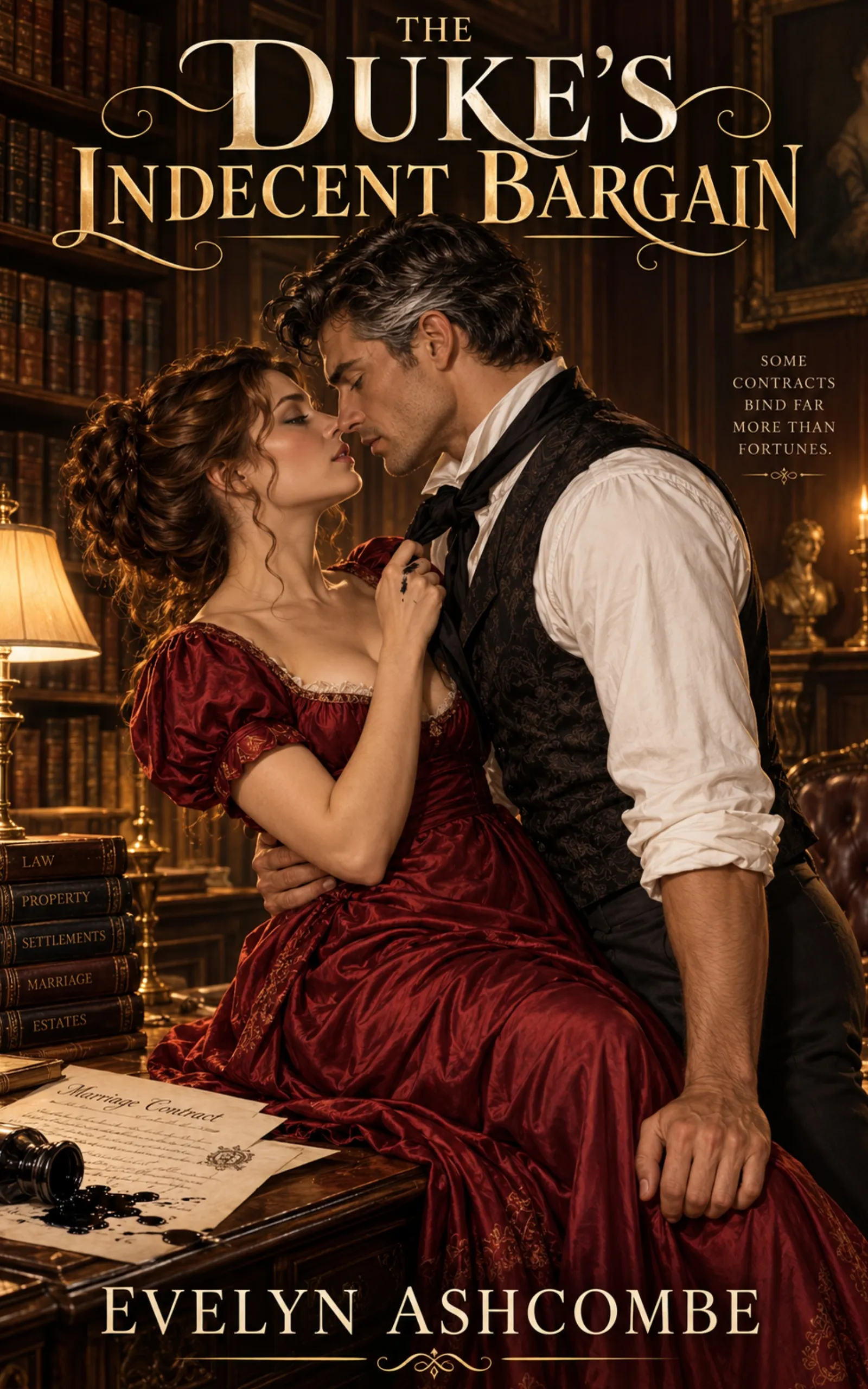
An Exclusive Bonus Chapter from The Duke’s Indecent Bargain by Evelyn Ashcombe
⚠️ Spoiler Warning: This bonus chapter takes place on Christmas night 1817, three months after Michaelmas and the end of Chapter Twenty, and before the Epilogue. It contains spoilers for the whole of The Duke’s Indecent Bargain and very explicit sexual content (18+), and it runs hotter than the book. Read the novel first for the full experience.
Adrian’s side of the first quarter day under the ninth article: a half-sheet in her hand, a pair of steel spectacles, snow at the windows, and a duke who has to say what he wants, in plain words and in full. Explicit content — 18+.
Article Nine
Christmas was a quarter day.
Adrian had known it all his life as the day on which money came in at one door of the estate office and went out by the other, faster. This year it had come in at the rent table from eight until noon, through a snow that began at breakfast and did not stop. More of it had come in than in any December since he was four-and-twenty. His wife had sat in Price’s chair with her spectacles on and receipted every shilling in her own hand, and Nell Tarrant had sat on a stool at her elbow and entered it again in a copybook, in pencil, with her tongue between her teeth, because the Duchess had said that a sum entered twice by two people was a sum one could sleep upon.
He had slept upon worse. He had not, until this year, slept upon anything at all.
By eleven at night the house had gone quiet in the particular way of a house that has eaten a goose. His mother had retired at ten with a glass of negus and the remark that the bird had been tolerable, which from her was a sonnet. Cecily had gone up humming. The servants’ hall had stopped singing. Outside, the snow had filled the long gallery’s windows to the second pane and lay along the sills like wool.
The white door stood open. It had stood open since Michaelmas; there was no lock on it now to stand any other way.
He went through in his shirt and breeches, as he had gone through most nights since September, and found his wife at her writing table under the new green hangings, which had gone up in Advent and which she had paid for herself, to the last brass ring, in spite of everything he could say. She had her spectacles on and her hair in its night plait and a dressing gown of dark blue wool belted at the waist. There was a half-sheet of paper in front of her. She had folded it once, and was holding it down with her inked finger as if it might get away.
“You have not given me a present,” she said.
“I gave you a horse.”
“You gave me the loan of a horse, with lessons. That is an article. It is in the margin. I have checked.” She held up the half-sheet between two fingers. “This is mine to you. You may read it standing, but I should sit, if I were you.”
He did not sit. He unfolded it by the fire.
It was in her hand: square, black and very small, the hand of a woman who had been taught to get a great deal onto a page because paper cost money.
Ninth. Upon every quarter day, from the hour the rents are entered until the last candle is out, the Duke shall say what he wants, in plain words and in full; and the Duchess shall give him every part of it that she is willing to give. He is not to say “if you would like.” He is not to ask what she wants instead. He is not, for the whole of the time, to be useful. A no is sufficient upon either side, as before. — Clara Vale.
He read it twice. The second time, his ears had gone hot.
“This is not an article,” said Adrian. “It is an ambush.”
“It is both. I learned my drafting from a duke.” She took off her spectacles, folded them, and looked up at him without them, which was always worse. “You told me in Russell Square what you wanted. You told me four things, and I gave you every one of them, and since then you have asked me what I want every single night for thirteen weeks. You are very good at it. You are a great deal too good at it. You have made it a place to stand behind.” She tipped her head toward the snow. “The rents are entered. Nell has them in pencil. The candles are lit. Go on.”
“I should like—”
“No. Should like is a tense for footmen.”
He stood on her hearth rug with the paper in his hand and found that his mouth had gone perfectly dry. It was absurd. He had stood up in a ballroom in front of two hundred people and told them his mother’s diamonds were glass. He had sat across a table from Renshaw and said no to a man who could ruin him. He could not, it appeared, tell his own wife in her own bedroom what he wanted, because nobody had ever required it of him, and the words were not where he had left them.
She saw it. She did not help him. That was the article, and she had drafted it to hold.
“Begin small,” Clara said, quite gently. “Begin with your coat.”
He let out a breath that was very nearly a laugh.
“I want you to undress me,” said Adrian. “Slowly. I want you to look at me while you do it. And I want you to tell me what you see.”
Her face changed. It was the look she had when a column came out true on the first casting.
“There,” she said. “That was not so very dreadful.”
“It was the worst thing I have done since Lombard Street.”
“Then it will be easier on Lady Day.” She rose, and came to him, and took the paper out of his hand and set it on the mantel under the clock, square to the edge, where he could see it. “Stand still.”
She began at the top, as he had once begun with her.
He wore no coat. She undid the collar of his shirt, one button, and then she stood back and looked at his throat as if it were a thing she was considering buying. Then she put her mouth to it. Only her mouth; her hands stayed at her sides. She kissed the hollow at the base of it, and the place under his jaw, and the edge of his ear, and said into it, conversationally, “Your pulse is going like a mill race. Item.”
“Clara.”
“You asked me to tell you what I see. I am telling you.”
She drew the shirt out of his breeches with both hands, as she had on their wedding night, and lifted it, and he bent his head and let her take it off over him. She dropped it on the floor. Then she did what he had done to her in forty candles and called an inventory.
“Two shoulders,” said his wife. “Broad. You carry them as if there were eleven buckets on them still, though I have personally seen the last bucket taken down to the dairy. Grey at the temples, which is premature and which I like. A great deal of dark hair on the chest, which I like more.” Her palm went flat over it, over his heart, and stayed there. “A scar across the ribs, eleven inches, from a gate you ought not to have tried at nineteen.” Her inked finger traced it, end to end, and he shut his eyes. “Do not shut them. You asked me to look. You are to watch me do it.”
He opened them.
She went down onto her knees on the rug in front of him and undid his shoes, which no one had done for him since he was breeched, and drew off his stockings, and set them neatly side by side. Then she knelt up and put her hands to the fall of his breeches and did not open it. She looked up at him.
“Tell me.”
“Open it.”
“In full, Adrian.”
His voice came out of him low and rough and not at all like a duke’s. “Open my breeches and take my cock out, and look at it. I want you to see what you do to me by sitting at a writing table in a woollen gown. I have been hard since you said ambush.”
She opened them. She drew breeches and drawers down together over his hips and thighs, and he stepped out of them, and his cock came up thick and dark and wet at the tip against his belly, an inch from her face. He stood naked before the fire in a room hung with green silk that she had bought, while his wife knelt fully clothed at his feet and examined him.
He had never in his life been looked at like this. Not by a woman who was not deciding his price.
“Item,” Clara said softly. She did not touch him. “One cock, of the first quality. Hard. Leaking already, which I take as a compliment to the gown.” She leaned in and breathed on it, warm, and watched it jerk. “It is a great deal handsomer than its owner believes. Its owner believes nothing about himself that is not written in red ink. I am going to change that.”
“Put your mouth on it.”
It came out of him before he had weighed it, and she smiled up at him like a woman who has been paid early.
“Say the rest.”
He made himself. “I want your mouth on me. I want my hand in your hair while you do it. And I want—” His throat closed. He forced it open. “Put your spectacles back on.”
She went quite still. Then her eyes filled with a light he had last seen in a counting room in Russell Square, in May, when she had knelt on bare boards and asked him what he wanted, and he had asked for her mouth, and the steel spectacles, and had thought afterwards that he had asked for too much.
“You asked for that once before.”
“I have wanted it every day since. I have wanted it at breakfast. I have wanted it in church.”
“In church?”
“In the second lesson. You were finding the place for my mother.”
She laughed, low in her throat, and took the spectacles out of her pocket, and unfolded them, and hooked them over her ears. Then she looked up at him through them, grave and steady and owlish, a merchant’s daughter on her knees, with the fire making two small bright coins of the lenses.
He put his hand in her hair. The plait was heavy and warm. He wound it once round his fist, not to pull, only to hold, and she leaned into it.
“Now,” he said.
She took him into her mouth.
She did it slowly, as she did everything that mattered: the head of him first, between her lips, and her tongue moving flat and wet beneath it, and her eyes on his face over the steel rims the whole time. Then more. She took him deep and drew back, and took him deeper, and the sound that came out of him was not a sound he had ever made in front of anybody. Her hands came up and took hold of his thighs. Her nails pressed. She hollowed her cheeks and drew on him, hard and steady, and let him slide out to the tip and lapped at it, and took him back.
“Christ. Clara. Look at you.” He could not stop his mouth. He did not try; the article forbade him to be useful, and it said nothing whatever against being honest. “Your mouth on my cock and your spectacles on. You look as if you are checking my sums. You look as if you have found an error and mean to have it out of me. God, you are—there. Like that. Do not stop.”
She did not stop. She hummed round him, which she had never done, and the vibration of it went up his spine and into the backs of his eyes. He held her plait in his fist and watched himself disappear between her lips, wet and shining in the firelight, and watched her watch him while he did it. The lenses had begun to fog. She did not trouble to wipe them.
“I want to tell you what it does to me,” he said, unsteadily. “May I?”
She drew off him with a soft wet sound, and looked up. Her mouth was red. “It is your quarter day. You may tell me anything.”
“It makes me feel owned.” It came out bare. “Not as the house owns me. Not as the debt did. As if I had been entered somewhere, in a good hand, by somebody who meant to keep the book.” He swallowed. “I have wanted that all my life and never had a word for it.”
Clara looked at him for a long moment. Then she took him back into her mouth, deep, all the way, so that he felt the back of her throat, and held him there, with her eyes on his, until his knees very nearly went.
He knew the edge when he came to it. He had been coming to it since the second lesson. He tightened his hand in her hair, and she felt the warning, and slowed, and let him slide out of her, and sat back on her heels with her hands on her thighs and her breath coming short.
“That is not all you want,” she said. “I can see that it is not. You have the face you had in the carriage.”
He looked down at her. He was shaking, faintly, all over, like a horse at the end of a hard gallop.
“I want you to tell me what you want me for,” said Adrian.
The fire spat. Snow ticked at the casement.
“In the carriage,” he went on, because he had begun and the article said in full, “on the Kensington road, I told you what I wanted you for. I had it by heart. I have been carrying it about for five months, and you have never once told me the same, and I have never once asked. I am asking. Not what I am good for. I know that list; I have heard it from bankers. I want to know what you want me for, when I am not paying anything, and not mending anything, and not standing between you and a single thing.” He heard his own voice crack, and let it. “That is the whole of it. That is the thing I want most, and I have wanted it since the terrace, and I did not know it until I read your paper.”
His wife took off her spectacles.
She folded them, and put them on the mantel, on top of the ninth article. Then she stood up and undid the belt of the blue dressing gown, and let it fall.
There was nothing under it.
“Then lie down,” said Clara Vale. “On my bed, on your back. And hold still for once in your life, and listen.”
He lay down on the green silk. She climbed onto the bed after him, and straddled his hips, and sat back on his thighs, naked and lamplit and enormous with intent, with her plait over one shoulder and her lovely heavy breasts rising and falling and the soft round of her belly catching the firelight. She took his cock in her inked hand. She did not put him in her. She held him against her, against the wet heat of her, and moved, slow, so that he slid along the whole slick length of her cunt and back, and he arched off the silk with a groan.
“I want you,” said his wife, “for your laugh.”
She rocked once more. He felt her shiver.
“You have only had it since May. I was there when it came. It came out of you in my bed, over a slice of toast, and you looked as if you had heard a burglar in your own house, and I have been working ever since to make you hear it again. I keep a count. Do you know the count?”
“No.”
“Two hundred and eleven.” She rose on her knees, and set him to her, and sank down onto him, all the way, slowly, until he was buried in her to the root and she was seated on him entirely, and they both cried out. “Item. I want you for that.”
“Clara—”
“Hold still. I am not finished.” Her hands spread flat on his chest. She did not move her hips; she only clenched around him, deliberately, and watched what it did to his face. “I want you for the way you sit down to breakfast now. As if it were a thing a person might be allowed. I want you for your hands when they are doing nothing at all. I want you for how you said I am afraid in Russell Square without once turning that ring. I want you for the south wood you mean to plant, which neither of us will live to see grown, and which you mean to plant anyway.” She lifted, and came down, slow, and her breath broke on it. “I want you for that. Do you hear me? For planting what you will never see.”
He could not answer her. He had his hands on her hips, and they were shaking.
“I want you for your mouth on me, for an hour, when I have not asked for an hour.” She began to ride him, long and slow, the way he liked it and had never said. “I want you for your cock, which fills me so full I cannot think of figures. I want you for the sounds you make when I take you in my mouth. I want you for the sound you are making now.” It was a sound he could not help. “I want you when you have nothing in your hands. That was your one term, and I granted it, and I have never told you what it was like to keep. It is the best thing I own. It is better than the Funds.”
“Clara. I cannot—if you say any more—”
“Then I shall say it faster.”
She did. She leaned forward with her hands on either side of his head and rode him hard, her breasts swinging above his face, her plait come loose and falling round them both like a curtain, and she said it into his mouth between strokes, item after item, plain and filthy and unhurried, the way she read out a ledger to a lawyer. That she wanted the weight of him. That she wanted the grey in his hair to go white on her pillow. That she wanted him to put his thumb on her, there, now, this instant, and not be clever about it. He put his thumb on her. She sobbed and ground down on it.
“I want you for this.” Her voice had gone to pieces. “For making me come on your cock with the snow at the window and your mother asleep at the end of the passage. I want you for being mine, Adrian, mine, entered and receipted, and I would not sell you back for the whole of Lower Wychcombe and the mill thrown in—”
She came. She came down on him and clamped round him in long hard waves, with her mouth open against his and her whole body shuddering, crying his name into him, and he held her hips and held on and did not let himself follow her. Not yet. There was one thing more on his list, and the article said in full.
When she had stopped shaking he rolled her under him.
He did it gently. He kept himself inside her. He brought her down onto her back on the green silk and came over her on his forearms, his whole weight on her the way she had asked for it once on a marble floor, and she wound her legs round his waist and looked up at him, dazed and wet-eyed and laughing a little at nothing.
“There is more,” she said. “I can see it in your face.”
“Two things.”
“Then say them.”
“I want you to let me pay for the hangings.”
“No,” said Clara, instantly, and began to laugh in earnest.
He laughed too; it shook out of him, helplessly, buried in her, and she felt it and gasped. Two hundred and twelve. He could see her count it. He did not ask again. The article said a no was sufficient, and he had found that he liked very much to be told one by her, in that voice, while she was laughing.
“And the other?”
He put his forehead to hers.
“I want you to say my name,” he said, “while I come in you. Not Wychcombe. Not Your Grace. I have been called by my house for eleven years. I want to be called by my name, by you, when I cannot help anything.”
Her arms went round his neck.
“Then move,” his wife said, very low. “And I will.”
He moved. He drew almost out of her and drove back in, deep and slow and then not slow, and she met him every time with her heels in the small of his back. The old bed shook. The hangings she had paid for swayed on their brass rings. He did not hide his face, and she did not let him; she held his jaw in her inked hand and kept her eyes on his and said it, at every stroke, quietly at first and then not quietly at all. Adrian. Adrian. Adrian. He felt her begin to tighten again under him, and could not believe it, and could not stop. He got his hand between them. She broke a second time with his name in her mouth, and it went through him like a blade through wet paper, and he followed her over at last, with a sound torn out of him that he would not have owned to in daylight, spending in her in long helpless pulses while she held his face and said his name, and said it, and went on saying it after he had nothing left.
For a long time neither of them spoke.
The fire had sunk. Somewhere at the end of the passage his mother coughed once in her sleep, and they both froze like children, and then Clara put her face in his shoulder and shook with silent laughter until the bed creaked.
“Is that all?” she said at last, muffled. “In full?”
He lay on his back with her across his chest and considered it honestly. The article required honesty. It required it more than anything he had ever signed.
“No,” said Adrian. “One more. It is not indecent.”
“I am disappointed. Go on.”
“I want to sleep in my own bed tonight. With you in it.”
She lifted her head and looked at him.
His room was through the white door: one rug, a plain mahogany bed narrower than hers by half, and a soldier’s grey blanket. She had seen it, and been in it. She had never yet been asked to it, in plain words, by its owner, for nothing but to sleep.
“It is a disgraceful bed,” said his wife.
“It is mine. You would be in it by invitation.”
She was quiet a moment. Then she got up, naked, and fetched the ninth article off the mantel, and her spectacles, and the blue dressing gown, and held out her hand to him.
They went through the open door together. The bed was too narrow for two by any honest measure; she said so, and lay down on top of him to settle the question, with her cheek on his chest and the soldier’s blanket over them both and her cold feet on his shins. The snow had stopped. Through the bare window the moon had come out over the park and laid itself white and flat across the floor, and across the folded half-sheet on the chair by the bed, where she had put it to be safe.
“Paid in full?” Clara murmured, already three parts asleep.
He thought of the rent table. Of Nell’s pencil, and a sum entered twice by two people, which one could sleep upon.
“On account,” said Adrian. “There are three more quarter days in the year.”
“Lady Day.” A yawn, warm against his skin. “I shall draft something for Lady Day.”
“What?”
But she was asleep, with her inked hand spread on his heart, and he did not wake her to ask. He lay in his own narrow bed with his wife on top of him and her ninth article on the chair, and looked at the moon on the floor, and found that for the first quarter day of his life he had not counted anything at all.
← Back to The Duke’s Indecent Bargain
Join the Evelyn Ashcombe Reader List
New releases, bonus chapters too hot for retail, and exclusive content from Evelyn Ashcombe.