
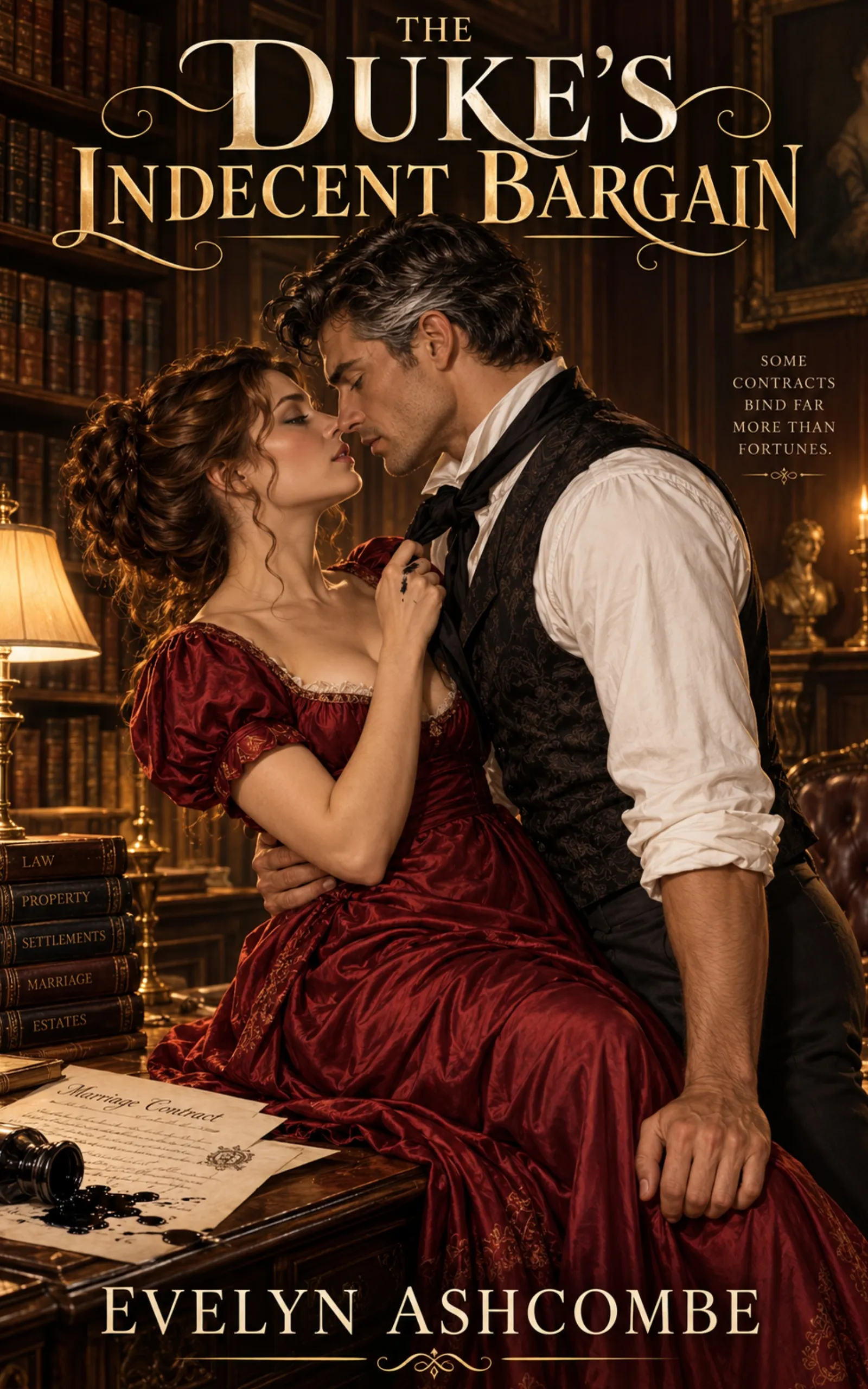
The Duke’s Indecent Bargain
A Regency Historical Romance
by Evelyn Ashcombe
Shop the ebook · Shop the audiobook · Shop the paperback
Available at all major retailers
Pairing: MF
Heat: 🌶️🌶️🌶️🌶️🌶️ Inferno
Series: Standalone
Tropes: Marriage of Convenience, Duke Romance, Merchant’s Daughter, Class Difference, Wealth Gap, Written Terms, Curvy Heroine, Experienced Heroine, Competence Kink, Dirty Talk, Body Worship, Light Bondage, Touch-Starved Hero, He Falls First, Only Soft for Her, Grovel
He named his price on a terrace. She answered with six articles and a lawyer.
London, 1817. Clara Whitmore has kept the books of Whitmore & Company since she was fifteen. Her father left her a hundred and ten thousand pounds and an ink stain that will not wash out. Her uncle means to marry her to his son by midsummer. And she has spent the Season beside a painted pillar in Lady Harcourt’s ballroom, positioned like a fire screen.
Then Adrian Vale, ninth Duke of Wychcombe, walks out onto the terrace and does what no gentleman in London has done. He tells her exactly what he costs.
Sixty thousand pounds. A house of a hundred and four rooms, twenty-two of them shut. Eleven buckets in the long gallery. A sister who must not be sold, and a mother who says trade the way other women say damp.
Clara’s answer: Friday. Noon. Bring a lawyer.
She writes six articles across eleven feet of mahogany: the sum, and not a penny more. Her fortune in her own trust. The books as kept, not as summarised. No apology for where she comes from. And a seventh that no lawyer will ever see. Her bed is her own. He comes into it by invitation. And when invited, he is expected to exert himself.
The Duke of Wychcombe exerts himself magnificently. On a library table. Over a rent ledger, in spilled ink. In a carriage on the Kensington road. Within weeks the marriage of convenience is the most inconvenient thing that has ever happened to either of them.
But one line on the schedule he signed says renewal in hand, and it is not. There is a twenty-two-thousand-pound bond, a viscount with a grudge on the far side of the hedge, and a duke who would rather lose everything he owns than ask his wife for help.
She could forgive him the debt.
What she cannot forgive is never being asked.
The Duke’s Indecent Bargain is a standalone Regency historical romance with a marriage of convenience, a merchant’s daughter who reads a balance sheet the way other women read a love letter, a duke who has never once slept beside anyone, explicit on-page heat, no cheating, and a guaranteed HEA. Dual POV. Approx. 73,000 words.
You’ll love this book if you enjoy:
✅ A merchant’s daughter who negotiates her own marriage with her solicitor in the room and her spectacles on
✅ A buttoned-up duke who has never once slept beside anyone, and finds out what he has been missing
✅ Article Seven: her bed is hers, he comes by invitation, and when invited he is expected to exert himself
✅ “Is that sufficiently plain?” Consent asked for, and given, in plain words, every time
✅ A curvy heroine who will not apologise for her body, her past, or her origins
✅ A desk, a rent ledger and a spilled inkwell: “I have signed for you.”
✅ A school in a dairy lodge, a girl named Nell who keeps the tally, and eleven buckets in the long gallery
✅ A hero who hides one debt too many, and a grovel paid in full, in public and in private
✅ Marriage of convenience to real love, 🌶️🌶️🌶️🌶️🌶️ heat, no cheating, HEA guaranteed
⚠️ Content Warning: This novel contains explicit sexual content (graphic MF scenes, including oral sex, manual sex, rough sex over a desk, sex in a moving carriage, outdoor sex, sex before a mirror, light bondage with the heroine tying the hero, and dirty talk; all on-page sex is consensual, with “no” honoured on the page), a heroine with a past sexual relationship and a former lover who tried to control her (off-page), period attitudes toward class, trade and women, a hero who conceals a family debt from his wife, a late father’s debts and the memory of bailiffs, a mother’s past gambling debt, the threat of foreclosure on a village, a marital separation, alcohol, strong language, and a possible pregnancy in the epilogue. No sexual violence, no dub-con, no cheating. Intended for readers 18+.
📖 Read Chapter One Free
Not sure yet? Read all of Chapter One right here.
Chapter One: Clara
The pillar was Siena marble, or had been painted to pass for it. Clara Whitmore had stood beside it for forty minutes, which was long enough to be certain about the paint.
She did not hold it against the pillar. Half of Lady Harcourt’s ballroom was pretending to be something dearer than it was. The gilding was Dutch metal. The footmen were hired by the evening and matched for their calves. And the hostess herself had greeted Clara with a smile so thin one could have read a bill through it.
“Miss Whitmore. One of the timber Whitmores,” she had informed the nearest clutch of turbans, in the tone of a woman identifying a species of beetle. “So good of you to come. You will be comfortable here, I think. Out of the crush.”
Out of the crush. Out of the candlelight, out of the path of any gentleman seeking a partner, and within four feet of a draught. Clara had been positioned like a fire screen.
She knew why she had been asked at all. Lord Harcourt owed Whitmore & Company for the roof over this very room, eleven hundred pounds of Baltic deal, four years outstanding, and his wife had evidently decided an invitation came cheaper than a remittance. It was not a bad calculation. Clara would have respected it more if anyone had brought her a glass of something.
So she did what she had always done when left with nothing to do. She took inventory.
Four hundred wax candles at the least, and not one of them tallow; someone was still extending the Harcourts credit. Two hundred guests. Six gentlemen who might interrupt whomever they pleased, and one elderly countess who outranked the lot of them and knew it. Any number of young ladies obliged to wait until they were spoken to, who filled the wait by laughing at nothing with their mouths closed. And on the far side of the painted marble, near enough that she might have touched his coat-tail, her uncle.
“By midsummer,” Richard Whitmore was saying, in the comfortable voice he kept for other people’s money. “I shall have the papers drawn. She’ll come round.”
Clara had been about to step out and ask him to find her some lemonade. She stayed where she was.
“You are very sure of her.” That dry little cough belonged to her uncle’s partner, who had stood at her father’s elbow for twenty years and never once addressed a remark to Clara that did not concern the weather.
“I am sure of the arithmetic. She is eight-and-twenty. She has had her year of black and her two months of this.” A pause, in which he presumably indicated the ballroom, the Season, and the entire hopeless enterprise of Lady Harcourt’s pillar. “And what has it fetched her? Not one caller. She is a sensible girl. Put a sensible proposition to her in a sensible way, and she has never in her life refused it.”
“And the capital?”
“Stays in the house, where Josiah would have wished it. Your boy gets a wife who can read a bill of lading, which is more than he can. You get her hundred and ten thousand working where you may keep an eye on it. And I,” said her uncle, with real feeling, “get some peace.”
“She has a great many opinions, Whitmore.”
“She has opinions because she has nothing else to occupy her. Give her a nursery. It only wants managing.”
They moved off toward the card room. Clara heard the cough twice more before the orchestra swallowed it.
She found she was looking very steadily at a vein in the false marble. Someone had painted it with real care, a fine grey thread wandering down through the gold, and at the bottom, where the artist had supposed nobody would ever look, he had simply stopped.
Your boy. The boy in question was three-and-twenty, had damp hands, and had once explained to her the principle of compound interest. Incorrectly.
It was not the first time she had been valued. Her father had done it lovingly, and Thomas Hale had done it in bed, and neither had troubled to consult her as to the figure. What turned her cold now was not the insult. It was how reasonable it sounded. Richard was no villain. He was a man tidying a ledger, and she was the entry that would not balance.
She has never in her life refused a sensible proposition.
No. She had not. That was very probably the trouble.
Clara smoothed her gloves, left the pillar to its own devices, and went to find the lemonade herself.
She had gone a dozen steps along the wall when the crowd ahead of her did something odd. It thinned. Nobody parted, exactly. People simply discovered reasons to be standing elsewhere, the way water finds its way round a stone.
The stone was a man in black.
He was tall, and he held himself with the kind of stillness that costs something. Dark hair, greying at the temples a good ten years before its time. A plain coat, plainer than any other in the room, cut by someone who had not needed to prove anything with it. He was not handsome after the fashion of the portrait gentlemen simpering by the punch. His face was too tired for that. Every line in it ran downward, and he looked at Lady Harcourt’s ballroom the way she imagined a ship’s master looked at weather.
Clara, who had spent the better part of an hour pricing everything in sight, found she could not put a figure on him at all.
“Wychcombe,” breathed a matron at her elbow, to no one. “And he has brought the sister.”
So that was the Duke of Wychcombe. She knew the name as one knows the name of a bank one does not deal with.
The sister was a slim girl of two- or three-and-twenty in white muslin, with her brother’s dark hair and an expression of bright, dangerous patience. The cause of the patience stood directly before her: a gentleman of forty or so, sleek as a seal, bowing over her hand for a moment longer than the hand had agreed to.
“Renshaw,” the matron added, with relish. “They say he holds half the paper in Hampshire. I should not care to owe him a shilling.”
“I was only remarking to Lady Cecily, Duke, that a lady’s portion is very like a harvest.” Lord Renshaw had the sort of voice that carried by design. “One hears such fine things of the field. And then one so wants to know what was actually got in.”
It took Clara a moment to credit that he had said it. In a ballroom. To a girl’s face, about a girl’s dowry, the spring after every estate in the south had watched its corn rot where it stood.
Lady Cecily’s chin came up. She drew breath.
“Renshaw.” The duke did not raise his voice. He lowered it, and the half-dozen people pretending not to listen leaned in like wheat. “You will have observed that the field is not for sale.”
“My dear fellow, I merely—”
“And that you are standing in it.”
He did not wait to see it land. He looked through Lord Renshaw to some point on the far wall, as though the man had in that instant ceased to be made of anything, and offered his sister his arm. “Cecily. I am told there are ices. They are reported to be the only thing in this house not passing itself off as something else.”
A cut, then. A real one, delivered in under thirty words and not one of them ungentlemanly. Renshaw was left completing his bow to a pair of retreating shoulders. Somebody tittered. His smile stayed precisely where it was, and above it his eyes went flat and patient: the eyes of a man adding an item to an account.
Clara noted that. She had seen that look across a counting-house table, on men who meant to be paid.
Then the duke and his sister passed within a yard of her, and she noted something else.
His right hand was behind his back. From the front he was all composure; one would have sworn nothing had touched him. But behind him, where only a woman abandoned against a wall could see, the hand opened and closed. Opened and closed. Slowly, the long fingers spreading and then curling in upon themselves, the way a man works his grip after setting down something he has carried a great deal too far.
A heavy gold signet caught the light each time.
“You might have let me answer him,” Lady Cecily was murmuring. “I had something prepared about his waistcoat.”
“I know you had. That is why.”
“It was extremely good, Adrian.”
“I’ve no doubt. Keep it by you. He will give you another occasion.”
And they were gone into the supper room, and the crowd closed over the place where they had been, and Clara stood with her pulse doing something it had no business to do over a stranger’s hand.
She was not a girl. She knew what that small, low pull was, precisely where in her body it sat and precisely what it was asking for, and she had long since given up being shocked at herself for having it. What surprised her was the occasion. Not his shoulders, though they repaid a second look. Not the voice, though it had gone through her like a warmed blade. It was the hand. All that power to make a room rearrange itself, and behind it, in private, the strain of holding the thing up.
I know what that costs, she thought. I have the receipts.
She forgot about the lemonade.
The ladies’ retiring room was upstairs, overheated, and occupied by a single yawning maid, who fell upon Clara’s perfectly sound hem with the gratitude of a woman who had had nothing to pin since ten o’clock. Clara let her. She had come up for somewhere to think.
Behind the dressing screen at the far end, two voices were being indiscreet in the particular carrying whisper of ladies who have had the champagne.
“Mortgaged to the weathervane, my dear. To the weathervane. My brother had it at White’s.”
“Wychcombe? But the house, the pictures—”
“Entailed, the house. He cannot sell so much as a doorknob. And everything else pledged twice over by the old duke, who never met a debt he did not think he could outface. They say the son has until Michaelmas.”
“Until Michaelmas for what?”
“To find sixty thousand pounds, or a wife who has them. And you saw him. Ten seasons I have watched that man walk through a ballroom, and he has never once smiled at a girl in it.”
“For strawberry leaves on my carriage door, I believe I could contrive to live without the smiling.”
“So could I. But could your papa contrive the sixty thousand? No. It will have to be Trade. Some great bouncing cit’s daughter with a fortune in tallow—”
“Oh, don’t—”
“—and only picture the Dowager’s face, being handed in to dinner behind her!”
They dissolved. Silk rustled; a scent bottle chinked. They came round the screen still laughing, two pretty women in their thirties, and their eyes passed over Clara and the kneeling maid exactly as eyes pass over a pair of chairs.
The door shut on them.
“There, miss,” said the maid, sitting back on her heels. “Nobody would ever know.”
“No,” Clara agreed. “One never would.” She put a shilling into the girl’s hand, which was sixpence more than was customary and bought her the first unfeigned smile of the evening, and stood a moment before the glass.
A woman of twenty-eight looked back at her. Brown hair, dressed more plainly than fashion liked. Hazel eyes that were, she had been told, too direct. A figure that no quantity of high-waisted muslin would ever render sylphlike, and that Thomas had been very glad of in the dark and faintly apologetic about by daylight. Rose silk at fourteen shillings the yard, because she had seen no reason to be parked beside a pillar in anything cheaper.
Great bouncing cit’s daughter. Well. Not tallow.
Sixty thousand pounds.
She did the sum as she did every sum, twice and from both ends. A hundred and ten thousand, wholly her own since the will was proved. By midsummer, if Richard had his way, it would be the firm’s again, and she would be a wife who could read a bill of lading to a husband who could not, with a nursery to absorb her opinions. Against that: a man who needed rather more than half of it, urgently, by a date. A man who could not sell a doorknob but could make a viscount vanish with two sentences. A man who had declined, before two hundred people, to let his sister be priced.
That last weighed more than it ought. She let it.
There was no question of love. She was not such a fool as to go shopping for that at a ball. But she had bought and sold enough to know that the soundest bargains were struck between two parties who each wanted the thing badly and could each afford to say so. If she was to be disposed of this year in any case, she would at least conduct the sale herself.
And if some small, low, thoroughly unbusinesslike part of her wished to learn what those hands did when they were not clenched behind his back, that need not be entered in the ledger.
She went downstairs.
He was not at the ices. Lady Cecily was, holding court among three young men with the air of a cat among slow mice; the duke had delivered her and gone. Clara looked for the coldest corner of the room, on the theory that he would have sought it, and saw the long window at the end standing a hand’s breadth open.
Nobody saw her go through it. That was the single advantage of having been made invisible. It was thorough.
The terrace ran the width of the house above a garden she could smell but not see: wet earth, clipped box, and the coal smoke that was London’s only real season. After the ballroom the April air met her bare arms like a palm. One lantern burned by the steps. Beyond its reach a tall shape in black stood at the balustrade with his back to her and both hands flat upon the stone, head down, like a man resting his whole weight on the one thing he trusted to bear it.
She let her slipper scrape.
He did not turn. “If Lady Harcourt has sent you to retrieve me for the supper dance, you may tell her I have been taken ill. Something lingering.”
“Lady Harcourt would not send me to retrieve her shawl. I do not believe she thinks I can be trusted with wool.”
That brought him round.
It was another matter altogether, being looked at by him instead of looking. She was accustomed to the glance gentlemen gave her: bosom, gown, price of gown, away. The Duke of Wychcombe began with her face and remained there, with a grave, unhurried attention, as though she were a document he had been asked to sign and he meant to read every clause of it first. His eyes were grey. By lantern light they were very nearly colourless, and they missed nothing.
Heat ran down her spine and settled, quite distinctly, between her hips.
“We have not been introduced,” he said.
“No. I stood forty minutes beside a pillar waiting for somebody to see to it, and I have been forced to conclude that the pillar is not well connected.” She did not curtsey. It seemed late for that. “Clara Whitmore.”
“Whitmore.” She watched him place it. “Timber.”
“Baltic deal, Memel oak, and masts when the Navy recollects to pay for them. You say it a good deal more civilly than our hostess.”
“I say it as a man with three acres of roof.” It came out dry as paper, and so quickly that she almost failed to notice the Duke of Wychcombe had made a joke at his own expense. Then the shutters closed again. “Miss Whitmore. You are alone on an unlit terrace with a gentleman. If you have come out here to be compromised, I regret that I must disappoint you. I cannot afford it.”
“I came out for air and arithmetic. And I have never cared for a bargain the other party had to be trapped into. They resent it afterwards, and it shows in the quality of the goods.”
Something stirred at the corner of his mouth and was put down like a mutiny.
“You managed Lord Renshaw very neatly,” she said. “He will dine out on it for a month and come off a little worse at each telling.”
“You were watching.”
“I was beside a pillar, Your Grace. One sees a great deal from a pillar. I saw your hand, for instance.”
Stillness. Not the ballroom stillness. Something with an edge on it.
“Behind your back, as you walked away. You have a way of working it.” She showed him, opening and closing her own gloved fingers in the dark between them. “Like a man who has carried a thing a long way and been told he may not set it down.”
For the space of three breaths he said nothing whatever. Then he came away from the balustrade.
He did it on purpose, she thought. Two strides, slow, using every inch of his height, until he stood near enough that she must tip up her chin and he could look down the length of that ducal nose. It was meant to send her back a step. Men had been backing her away from tables with it all her life.
Clara stayed where she was.
It put him very close indeed. Close enough to learn that he smelled of starch and cold air and, faintly, of horse, as if he had ridden that morning hard enough that soap had not entirely won. Close enough to see the pulse going above his cravat, a good deal quicker than his face admitted. Close enough that if she filled her lungs to the bottom, the rose silk would brush his waistcoat.
She filled her lungs.
His gaze dropped. To her mouth, and lower, one swift, helpless stroke down the front of her and back again. Then his jaw set, hard, like a man who has just caught his own hand in somebody else’s pocket.
Oh, thought Clara, on a hot bright throb of satisfaction that had nothing at all to do with arithmetic. So it is not only me.
“You are remarkably free with your observations, madam.” His voice had gone lower. She felt it in the soles of her feet, and in several places a good deal less respectable.
“I have had to be free with something. I was given nothing else to do all evening.”
“And what else have you observed? I assume there is more. I assume it comes from the retiring room. It generally does.”
“That you are mortgaged to the weathervane.” She kept her eyes on his. “That the house is entailed and all the rest is pledged. That you have until Michaelmas. That you have not smiled at a girl in ten seasons, though one lady felt she could support the want of it, for strawberry leaves.”
“And you, Miss Whitmore?” Very soft. “Could you support it?”
“I have not been smiled at in earnest for some years, Your Grace. I find I do very well without. It is being lied to pleasantly that I have given up. I never could make the expense answer.”
He studied her for a long moment. Whatever he had expected to find on Lady Harcourt’s terrace, a fortune-hunter, a flirt, some chit dispatched by her mama, she watched him take up each one, weigh it, and put it by, until he arrived at nothing he owned a name for. It did not appear to comfort him. A muscle moved in his cheek. Behind his back, she would have staked her whole hundred and ten thousand on it, that hand had begun to work again.
“What is it you want?”
She could not remember when anyone had last asked her. It went through her harder than his nearness had, and for half a breath she could not have answered him to save her life.
Then the counting room came to her rescue, as it always did.
“My uncle is in the card room at this moment disposing of me to his partner’s son, with the firm’s capital thrown in to sweeten me. He expects the matter settled by midsummer.” She was pleased to hear how level it came out. “I intend to be disposed of before then. On my own terms, by my own hand, to a man who will know to the shilling what he is getting and what he is not.”
“And you tell this to me because?”
“Because of three things I have seen tonight. You have a date to meet, so you will not waste my time. You cannot afford a scandal, on your own evidence, so you will deal straight. And you would not stand by to hear your sister priced in a ballroom.” She paused. “I should like to do business with a man who knows a person from a portion.”
The grey eyes narrowed. He had gone as still as he had been in the ballroom in the instant before he spoke to Renshaw, and it occurred to her, rather late and with a thrill she declined to examine, that she might be about to be cut dead by a duke.
She found she preferred it to the pillar.
“I am told you require sixty thousand pounds, Your Grace. I have them. Shall we discuss what they cost?”
Want to keep reading? The full novel is available now.
🔥 Want an EXCLUSIVE Bonus Chapter?
Article Nine — A scene TOO HOT for the bookstore
Christmas is a quarter day, and Clara has drafted one more article as his present: on every quarter day the Duke must say exactly what he wants, in plain words and in full, and be given it. Snow at the windows, her spectacles on, and a man who has never asked for anything learning to ask for everything. Adrian’s side, all of it.
More from Evelyn Ashcombe
Browse all Evelyn Ashcombe books.
The Lady in the Next Room
A widow with a locked drawer. A runaway with a borrowed name. And a door with two bolts between them.

Her Ladyship’s American Wife
A countess with a leaking house. An American heiress who pays for everything. And the one thing that cannot be bought.

The Duke’s Indecent Bargain
He named his price on a terrace. She answered with six articles and a lawyer.

An Heiress for the Wicked Duke
She doesn't sign for goods unseen. He hasn't let anyone see him in seven years.
Never Miss a Release
Get new release alerts, exclusive bonus content, and reader-only giveaways.