
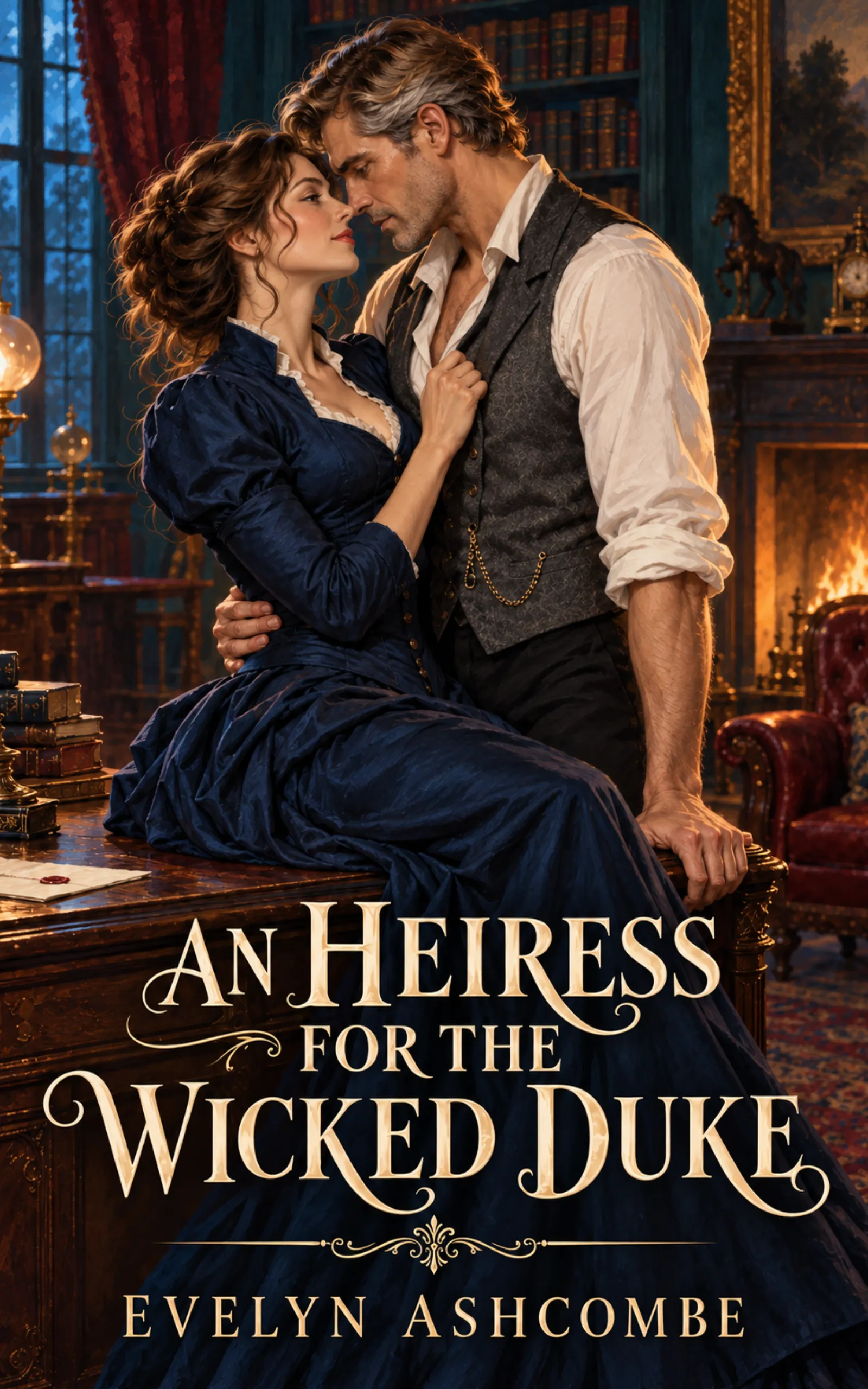
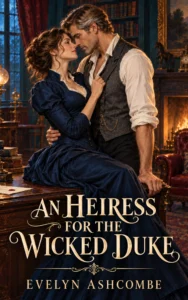
An Heiress for the Wicked Duke
A Gilded Age Historical Romance
by Evelyn Ashcombe
Shop the ebook · Shop the audiobook · Shop the paperback
Available at all major retailers
Pairing: MF
Heat: 🌶️🌶️🌶️🌶️🌶️ Inferno
Series: Standalone
Tropes: Marriage of Convenience, American Heiress, Disgraced Duke, Class Difference, Wealth Gap, Opposites Attract, Written Terms, He Falls First, First Time, Sexual Awakening, Photographer Heroine, Competence Kink, Dirty Talk, Praise and Asking Plainly, Public Grovel
She doesn’t sign for goods unseen. He hasn’t let anyone see him in seven years.
London, 1888. Vivian Hartwell is an American railroad heiress with a million-dollar dowry, a mother determined to buy her a coronet, and fingertips stained brown from developing her own photographs. Every gentleman in London has priced her. Not one has asked what she points the camera at.
Then the Duke of Ravenswick does.
Alistair Rowan is the most notorious man in England: the duke who ruined a girl and refused to marry her. His abbey leaks in eleven places. His name has kept his sister off every dance card in London for seven years. And on the night they meet he tells Vivian the truth: he needs her money, and wanting her is going to be damnably inconvenient for them both.
So she writes the terms herself. Two hundred thousand pounds, once. A room of her own with the bolt on the inside. No entitlement to her bed. And one clause no lawyer will ever see: either of us may ask for anything; neither of us may assume.
In the dark, the marriage of convenience works beautifully. He makes her ask for everything in plain words, and gives her every single thing she asks for. In daylight, London begins politely improving her, one inch at a time, and the price of letting the wicked duke back into society starts to look a great deal like his wife.
He can give her a title, a roof, and every pleasure she has the nerve to name.
The one thing she needs is for him to stand up in a room full of people and let her be exactly who she is.
An Heiress for the Wicked Duke is a standalone Gilded Age historical romance with a marriage of convenience, an American heiress who will not be sanded down, a disgraced duke keeping a secret that isn’t his to tell, a darkroom built to her hip height, explicit on-page heat, no cheating, and a guaranteed HEA. Dual POV.
You’ll love this book if you enjoy:
✅ An American heiress who negotiates her own marriage settlement in pencil, at midnight, in her stockings
✅ A disgraced duke who has kept a secret for seven years because it belongs to someone else
✅ “Plainly, Vivian.” Consent asked for in words, every time, and it is the hottest thing in the book
✅ A darkroom with a ruby lamp and a bolt that only locks from the inside
✅ Forty buttons, a wedding night, and “Wait. Stop.” honored to the letter
✅ A heroine with a camera who sees the man behind the mask, and a hero who finally lets her
✅ Leaking roofs, a mother who means well, and a grovel paid in a room full of people
✅ “It is hers to approve.”
✅ Marriage of convenience to real love, 🌶️🌶️🌶️🌶️🌶️ heat, no cheating, HEA guaranteed
⚠️ Content Warning: This novel contains explicit sexual content (graphic MF scenes, including a heroine’s first time, oral sex, manual sex, rough sex with dirty talk and degrading language requested by the heroine, hair pulling, consensual nude photography, sex against a door and a window, and masturbation; all on-page sex is consensual and negotiated, with a safe word honored on the page), period attitudes toward women, class and Americans, a controlling mother and social coercion, a family’s public shaming of the hero, a past off-page story of a young woman pressured toward a marriage by her father and a pregnancy outside marriage, a marital separation, mild injury from a past riding accident, alcohol, and strong language. No sexual violence, no dub-con, no cheating. Intended for readers 18+.
📖 Read Chapter One Free
Not sure yet? Read all of Chapter One right here.
Chapter One: Vivian
Her mother walked her down the length of Lady Selwyn’s ballroom the way a groom walks a filly past the rail at Saratoga: slowly, on a short rein, with a turn at the far end so the gentlemen could judge the other side.
Vivian Hartwell had been trotted out in three countries. She knew the gait.
“Chin,” Caroline murmured, smiling at a marchioness. “And do stop looking at people as though you were pricing them.”
“I thought that was the purpose of the evening.”
“The purpose of the evening is for them to price you, darling. Try to seem unaware of it.”
It was the tenth of May, the Season three weeks old, and every hothouse in Surrey had been emptied to fill one room in Belgrave Square. Lilies banked the walls and sweated. So did the footmen. Beneath six hundred candles the daughters of England revolved in white tulle like so many meringues, and Vivian revolved among them in oyster satin at four times the cost, because Caroline had decided that an American girl must be either invisible or perfect and had never once considered invisible.
Vivian would have chosen red. She was not, this year, doing the choosing.
Their hostess had received them at the head of the stairs with both hands and nothing whatever to say. Beatrice, Lady Selwyn, was forty-six and exquisite, and had the gift of sounding warm without committing herself to a noun. So glad. Such a pleasure. We must see a great deal of you. Vivian had come away feeling thoroughly welcomed and unable to recall a single word.
Since then she had been shown to an earl who owned a large part of Shropshire and spoke only of its drainage. She had been shown to a marquess of sixty, who examined her shoulders like a man checking a roof for missing slates. She had been shown to Viscount Pelham, who was thirty, solvent, and kind about the eyes, and who had asked whether she found London very different from New York and then explained to her, in some detail, that she did.
Not one of them had asked a question whose answer might prove inconvenient. Did she ride. Was the crossing rough. Did she not think the English spring delightful. Nobody asked what she read or what she did with her mornings, because a girl who answered might turn out to have mornings, and then where would the settlement be?
Her fingers itched inside their kid. That was no figure of speech. Under half a yard of French glove her fingertips were stained the brown of weak tea, the mark of pyrogallic acid and four years of developing her own photographic plates, and no quantity of lemon juice had ever shifted it. Caroline called it the condition. The gloves stayed on.
Vivian did not hate her for it. That was the difficulty. Caroline Hartwell had been worth millions for twenty years and had never once been worth a card to Mrs. Astor’s ball, and she had crossed the Atlantic with forty trunks and one daughter to buy the single thing New York refused to sell her. A coronet in the family would answer every unreturned call on Fifth Avenue. It only required Vivian to stand inside it.
“Mrs. Hartwell.”
A black fan descended between them like a toll gate. Behind it stood the Dowager Countess of Thurlow, who was eighty, upholstered in jet, and had been pointed out to Vivian on three separate occasions as a woman whose good opinion could not be bought. Caroline had taken this as a quotation of price.
“Lady Thurlow. May I present my daughter?”
“So this is the girl.” The old eyes went over Vivian from hem to hairpins. “Pretty. They usually are. I suppose in America you can afford to drown the plain ones.”
“Only the ones who can’t swim, ma’am,” Vivian said.
Caroline’s fingers closed on her elbow. The dowager’s mouth twitched, whether in amusement or dyspepsia it was impossible to say, and she drew breath to continue.
And the room changed.
It was nothing so crude as a silence. The orchestra sawed on; the meringues kept turning. But the talk dipped, all at once, like a gas flame when the house next door turns up its own, and then came back half a tone too bright. Shoulders angled. Fans rose. Vivian followed the one direction in which nobody was looking, and found the head of the stairs.
A man stood there, handing an elderly lady in grey silk up the last step.
He was tall and built lean, in evening black that fitted him the way good tailoring fits a man who has stopped paying the tailor: perfectly, and a season out of date. Dark blond hair, which the candles turned to old gilt. A face of the long, severe English kind that ought to have been cold and was saved from it by the mouth. He settled the old lady’s hand on the arm of a waiting friend, straightened, and looked over Lady Selwyn’s ballroom with no expression whatever.
It was the strangest thing Vivian had seen in a London room. Three hundred people were refusing to look at a man and could look at nothing else.
“Well,” said Lady Thurlow, with relish. “Beatrice Selwyn is a saint. I have always said so.”
“Who is he?” Vivian asked, though she had read enough newspapers to guess.
“That, child, is the Duke of Ravenswick.” The fan tapped her wrist, once, for attention. “You will be told that he is handsome, and you have eyes. You will be told he is a duke, and so he is, God forgive whoever keeps the list. What you must understand is that seven years ago he was engaged to a sweet girl of excellent family, compromised her beyond repair, and then declined to marry her. She has not been seen in London since. This is her own aunt’s house. He comes into it at Margaret Rowan’s elbow because Margaret cannot manage stairs and has nobody else, and he hasn’t the decency to wait in the carriage.”
“Shocking,” Caroline said faintly, storing every word.
Vivian said nothing. She was listening to an echo.
Compromised her beyond repair, and then declined to marry her. Mrs. Paget had said it over the teacups on Tuesday. The same words, in the same order, with the same small pause before declined, as if for the congregation to catch up.
Vivian had spent four years watching people through ground glass, and she knew one thing about them for certain. People who had seen a thing happen told it differently every time. People who had been handed a thing recited it.
“And the young lady, ma’am? What does she say of it?”
“Say?” The dowager seemed to find the notion novel. “Her father spoke for her, very properly. A girl in that position does not give interviews.”
“And the Duke? Seven years is a long while to be wicked. I only wondered if there were particulars.”
The fan stilled. “He has let his roof fall in, I’m told. There’s no money. No English father will give him a daughter, so he must look”—the old gaze travelled over the oyster satin, the pearls, the whole glittering fact of her—“further afield. He needs an American fortune, Miss Hartwell. I should imagine he has been reading the shipping news with great attention.”
“Then I’m obliged to you for the warning,” Vivian said.
“I should keep her close, Mrs. Hartwell.”
“I intend to,” said Caroline.
Across forty feet of parquet, the Duke of Ravenswick turned his head.
He could not have heard. He looked anyway, straight through a gap in the dancers to where she stood with her mother’s hand on her arm, and he did none of the things men did when they looked at her. He did not smile. He did not let his eyes drop to count the pearls. He looked at her face, steadily, like a man who fully expected her to look back, and in two Seasons nobody had ever done that.
Vivian looked back.
The heat of it arrived a second late, like brandy, low down and spreading. He had done nothing but look. She thought, quite distinctly, oh, and then, more distinctly still, so that is what they are all so frightened of.
Something moved at the corner of that severe mouth. Then he inclined his head, a quarter of an inch, turned, and walked out through a side door as if the room had already bored him.
“Mama,” she said. “I’ve put my heel through a flounce.”
The ladies’ retiring room was to the left of the landing. Vivian went right.
A door, a passage, another door, and then the noise fell away behind her as if she had dropped it. She was in a long gallery, panelled and dim, with a lamp burning at either end and a carpet that swallowed her steps. Dead Selwyns lined the walls in their gilt frames. It was a great deal cooler than the ballroom and it smelled of beeswax instead of lilies, and for the first time since six o’clock she could get a breath to the bottom of her stays.
She wrenched at her left glove. Three buttons at the wrist, and the slit gaped; she worked her hand out through it and let the empty kid fingers hang, and spread her own, bare, in the cool air. It was a ridiculous relief. It felt like taking off her face.
“He was not, if it’s any comfort, nearly so tall.”
Vivian did not shriek. She was rather proud of that afterwards.
He stood at the far end, where the lamp was, with his hands clasped behind him and his head tipped back to study a full-length cavalier in armour. He had not turned round.
“A foot shorter, and no chin to speak of,” the Duke of Ravenswick went on, in a voice as dry as good sherry. “I’ve seen the armour. It would fit a jockey. But the painter was paid by the square foot, so he added several, and here the fellow stands two hundred years later, the tallest liar in Belgravia.”
She ought to have left. A girl found alone in a gallery with any man was a risk. With this one she was a headline.
She walked toward the lamp.
“You make a study of him?”
“Whenever I’m in the house. I find it steadying to see how long a lie will hang if it’s handsomely framed.” Now he turned, and gave her his whole attention, and it was like stepping off a crowded platform into the path of the express. Grey eyes. Up close, the stillness she had taken for arrogance looked like something else: a man who had learned that movement drew fire. “A portrait is a treaty between a sitter’s vanity and a painter’s rent, Miss Hartwell. I don’t suppose you have ever met an honest one.”
“We haven’t been introduced.”
“No. Nobody will do it, which has its advantages. I may say what I like to you, and you may deny having heard it.” He bowed, so correctly that it tipped over into mockery of the form. “Ravenswick. I’d have known you without the newspapers. You are the only woman in that room who looked at me as though I were a question.”
“What do the others take you for?”
“An answer. Wicked. It’s a serviceable word; it saves people the labour of particulars.”
It was very nearly what she had said to Lady Thurlow ten minutes ago. Hearing her own thought handed back in a baritone did something unsteadying to her knees.
“Your Grace—”
“Duke, if you must call me something. ‘Your Grace’ is for tradesmen, and I owe most of them money.”
She laughed. It escaped before she could dress it, the real one, the one Caroline said showed too many teeth. His eyes went to her mouth and stayed there a moment too long for manners.
“You are remarkably direct for a duke,” she said.
“I have found that evasions become expensive, and I’ve had to give up expensive habits. So. Directly.” His hands stayed behind his back, as if he did not trust them loose. “I am thirty-five. I have an abbey in Wiltshire with forty bedrooms and weather in a good many of them. I have an income that falls every Michaelmas and a name no man in England will let his daughter take. And I am standing in a house where I’m loathed, on a Thursday, for one reason, which is that the Morning Post said you would be here.”
Her heart gave one hard knock against the whalebone.
“You’re shopping,” she said.
“I’m shopping.” Not a flicker of shame. “So are you, I think. Or you are being shopped, which is a good deal less agreeable. I thought one of us had better say so before the orchestra drowned it.”
“And what do you offer, Duke? Since we’re being tradesmen.”
“Nothing I’d dress up for you. My estate requires money. My reputation requires a miracle. I advise you to consider them separately.” He said it the way another man would read out the terms of a lease. “Your fortune can mend the first. It will do nothing whatever for the second, and anyone who tells you otherwise has something to sell.”
“Everyone in this house has something to sell me.”
“Yes. I’m the only one who has left the price ticket on.”
Nobody talked to her like this. They talked at her, or around her, or to the space six inches above her head where the dollars hung. She felt the way she did under the focusing cloth when a blurred shape on the glass came suddenly, exactly sharp.
So she tested him.
“Do you know why your income falls every Michaelmas?”
“Wheat.”
“American wheat. Grown on land that cost a dollar an acre and carried to the Atlantic at a rate no Wiltshire farmer can live against.” She lifted her chin, and for once it was not her mother’s instruction. “Would you care to know who carries it?”
“The Hartwell & Western Railroad,” said the Duke of Ravenswick. “Twenty-three hundred miles of track. Your father broke the grain pool in ’eighty-three and cut the through rate by a third; I’m told men in Chicago still spit when they say his name. I read his freight tables in March, Miss Hartwell. I read them before I asked a single question about you.”
She stared at him.
“Then you know what I am.”
“The refund?” That corner of his mouth again. “It had crossed my mind. I found it a good deal funnier than a man in my position ought.”
“You’re the first Englishman I’ve met who knows what my father does. The rest seem to think dollars grow on a kind of bush.”
“The rest have never been obliged to learn what was killing them.”
Far off, through two doors, the orchestra slid into a waltz. Neither of them moved. He was looking at her again in that steady, unhurried way, and she became aware of her own body by inches, as one does in a hot bath: the damp at the back of her neck, the drag of satin over her hips, the press of the busk between her breasts with each breath she was taking too quickly.
Then his gaze dropped, and she remembered her hand.
It hung at her side, bare to the wrist, the empty glove fingers dangling. In the lamplight the stains were as plain as tobacco. Every nerve her mother had trained said hide it.
She held it where it was.
He looked for a long moment. He did not recoil, and he did not do the other thing, the worse thing, which was to smile.
“That isn’t ink,” he said.
“Pyrogallic acid. I make photographs. I develop my own plates, and it marks the skin.” She waited for how charming. Men always said how charming, as one says it of a child’s drawing.
“Photographs of what?”
“I beg your pardon?”
“You must point the thing at something. What?”
Nobody had asked. Not in New York, not in Paris, not in three weeks of London. She found she had to clear her throat.
“Railway porters. Men mending a roof. People in the second after they’ve stopped arranging their faces.”
“God help me, then,” said the duke quietly. “I have been arranging mine for seven years.”
“I noticed.”
“Did you? Most people only notice that it’s a good one.”
“It is a good one,” Vivian said. “It simply isn’t yours.”
Something went through him at that, quick, and was mastered. In the silence she heard a door open somewhere along the passage, and a voice she would have known through a foot of oak, asking a footman a question.
“That will be your mother,” he said. “You’ll never manage those buttons one-handed, and I would rather you weren’t found undone in my company. They would say I did it.” He brought his hands from behind his back at last. They were bare; his gloves were crushed in his left fist. “May I?”
It was a question. He waited for the answer.
Vivian worked her fingers back into the kid and held out her wrist.
He did not take her hand. He steadied the edge of the glove with two fingers and set his thumb to the first pearl button, and in the gap of the slit, where the kid did not yet meet, the pad of that thumb lay against the inside of her wrist. Skin to skin. Directly on the pulse.
It was nothing. It was an inch of her.
He pressed the button home. Slowly. He was not looking at what he did; he was looking at her face, reading it as he had read her father’s freight tables, and whatever he found there turned his eyes a darker grey.
At nineteen Vivian had read a physician’s treatise on the married state, under the bedclothes, by a stolen candle, and had considered herself thoroughly informed as to what men and women did. No page of it had mentioned that a man’s thumb on the wrist could be felt, quite distinctly, between the thighs.
“There is one thing more you should have from me,” he said. His voice had dropped. “Since I’ve resolved not to lie to you. It’s the only economy I have left.”
“Go on.”
The second button. His thumb slid a half inch higher to reach it, dragging over the thin skin, and her breath caught where he could hear it.
“I came here tonight for the money. I have stayed in this gallery a quarter of an hour for a reason that has nothing to do with it.” The third. He fastened her in as carefully as a man closing a door on something he means to come back for. “And that, Miss Hartwell, is going to be damnably inconvenient for us both.”
He let her go.
She wanted, with a clarity that shocked her, to undo all three and make him begin again.
“I have been warned against you twice in four days,” she said, not quite steadily. “In the same sentence. Word for word.”
“Which sentence? I keep a collection.”
“‘Compromised her beyond repair, and then declined to marry her.’”
It was like watching a shutter drop. Not guilt; she knew what guilt did to a face. This was a door closing, quietly, on a room with someone else in it.
“Yes,” he said. “That is the authorised text.”
“Is it true?”
“It is accurate in the way that portrait is accurate. There was a man, and he did stand there.” He drew on his own gloves, finger by finger. “The rest is not mine to hand you in a corridor between waltzes. Ask me somewhere I can answer you properly, and I will tell you all that’s mine to tell.”
“And the part that isn’t?”
“I’ll tell you that it isn’t. Which is more than you will get from anyone else in this house.”
“Vivian.”
Caroline Hartwell stood in the gallery doorway with a footman’s lamp behind her and a smile on her face that could have etched glass. She took in the distance between her daughter and the most unsuitable man in England, found it defensible by perhaps eighteen inches, and advanced.
“The flounce is mended, Mama.”
“So I see.” The smile turned on him and cooled a further ten degrees. “The Duke of Ravenswick, I believe. We have not been introduced.”
“No, madam. Your daughter and I have been not being introduced for some time. It has gone remarkably well.”
“How fortunate. Vivian, Lord Pelham is waiting for his waltz.”
“Lord Pelham may ask himself whether I enjoy it, and tell himself that I do.” Vivian did not move. Her wrist still burned in three places, small and exact, like the marks of a brand. “Mama, the Duke has asked us down to Wiltshire.”
He had done no such thing.
There was the briefest pause, in which she watched a clever man decide how far to trust her. Then he said, without a tremor, “Saturday week, Mrs. Hartwell, if you are not engaged. It’s two and a half hours from Paddington. I’ll have you met at the station.”
“You are very quick, Duke.”
“I have had to become so, madam. The slow have all been sold up.”
“We could not possibly. We are promised to the Duchess of—”
“We are promised, every night until August, to be looked over by gentlemen who own houses.” Vivian heard her own voice come out level and was astonished at it. “I should like, for once, to look over a house. Before anyone discusses anything. Before one solicitor writes to another, or you tell me what colour I’m to be married in. I will see Ravenswick.”
“A young lady does not inspect a gentleman’s property like a bailiff.”
“Father never bought a mile of track he hadn’t walked.”
That landed. It was the one argument Caroline had never found an answer to, because it was the one that had paid for the oyster satin.
“Your father,” she said, very low, “is not here to be quoted.”
“No. He is in New York, signing whatever you cable him. I am the one who would have to live in it.”
The duke was watching Vivian, not her mother. All the dryness had gone out of his face. What was left looked very like alarm, and under the alarm, something hungrier.
“Which parts would you care to see, Miss Hartwell?” he asked. “My aunt will wish to know which rooms to fill with flowers.”
Vivian flexed her newly buttoned hand, and smiled with all her teeth.
“All of it. Including whatever you’ve been told to hide.”
Want to keep reading? The full novel is available now.
🔥 Want an EXCLUSIVE Bonus Chapter?
The Fourth Plate — A scene TOO HOT for the bookstore
The morning he finally sits for her camera, naked, she asks him for nothing more. Then he asks for something back: to put his own head under the black cloth and take her. A north window, a slate bench, eight seconds of holding still, and the one photograph of the Duchess of Ravenswick that nobody in England will ever see. Alistair’s side, all of it.
More from Evelyn Ashcombe
Browse all Evelyn Ashcombe books.
The Lady in the Next Room
A widow with a locked drawer. A runaway with a borrowed name. And a door with two bolts between them.
Her Ladyship’s American Wife
A countess with a leaking house. An American heiress who pays for everything. And the one thing that cannot be bought.
The Duke’s Indecent Bargain
He named his price on a terrace. She answered with six articles and a lawyer.
An Heiress for the Wicked Duke
She doesn't sign for goods unseen. He hasn't let anyone see him in seven years.
Never Miss a Release
Get new release alerts, exclusive bonus content, and reader-only giveaways.