

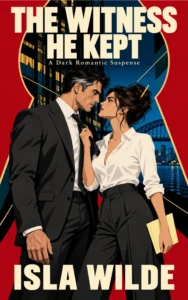
The Witness He Kept
A Steamy Dark Protector Romance
by Isla Wilde
Shop the ebook · Shop the audiobook
Available at all major retailers
Pairing: MF
Heat: 🌶️🌶️🌶️🌶️🌶️ Inferno
Tropes: Protector Romance, Morally Grey Hero, Fixer × Witness, Forced Proximity, Safehouse, He Falls First, Touch Her and Die, Praise Kink, Light Bondage, Control/Surrender, Scar Worship, Hurt/Comfort, Found Family, Romantic Suspense, Standalone
He was hired to erase her. He kept her instead.
Sloane Mercer is a forensic accountant who doesn’t round anything off. Six days into an audit of Halcyon Industrial, she finds twelve identical payments of $275,000 — one for every worker who died in the Ashgrove fire — and a controller whose initials simply stopped. She reports all of it. By eleven that night her credentials are dead, her accounts are frozen, and she’s being framed for stealing $312,000.
By midnight, a man is coming up her stairs to make her disappear.
Dorian Cade has spent fourteen years making bad weeks not happen for the people who can afford him. He built Sloane’s frame himself. He wrote her file. He has watched her through her own smoke detector for twelve nights, and on the thirteenth he turned the cameras off and couldn’t explain why. When the order comes down to close her permanently, he walks into her apartment, breaks the contractor’s wrist, and takes her out the service stairs instead.
Now she’s hiding in his safehouse with the one man who knows every secret she has — and none of the ones he’s keeping. She wants her life back. He wants her alive. And the closer the firm that made him gets, the harder it is to tell which of them is the bigger danger to her.
The Witness He Kept is a high-heat dark protector romantic suspense with a forensic accountant who audits everything, a fixer with a tie he never loosens, a boatyard full of misfits, a buried corporate cover-up, consent negotiated line by line, a lot of on-page spice, and a guaranteed HEA. Standalone.
You’ll love this book if you enjoy:
✅ A heroine who keeps a dated list of every question he won’t answer
✅ A morally grey fixer who built the frame he’s now dying to break
✅ “Need, or prefer?” — consent as a running negotiation
✅ His tie, her clove hitch, and a brass rail on a dead boat
✅ Kitchen tables by lantern light, a sail loft, a shower stall and an iron bedframe
✅ A safehouse in a dead boatyard run by a woman who hates him
✅ The full, itemized truth, and a grovel that costs him everything
✅ 🌶️🌶️🌶️🌶️🌶️ heat, HEA guaranteed
⚠️ Content Warning: This novel contains explicit sexual content (graphic MF scenes, including oral sex, light bondage and restraint, praise and dirty talk, and negotiated power exchange), covert surveillance of the heroine by the hero before the story begins, a frame-up and financial ruin, kidnapping attempts, gun violence and gunshot wounds, physical fights, forced sedation of a captive character, references to workplace deaths in an industrial fire, a past death in custody presented as suicide, grief, and strong language. Intended for readers 18+.
📖 Read Chapter One Free
Not sure yet? Read all of Chapter One right here.
Chapter One
At eleven on a Thursday night, the nineteenth floor of Corwin Hale Advisory belonged to me, a cleaning cart, and four vendors who did not exist.
I’d been circling them for six days. Tidewater Fuel & Supply. Brightline Facilities Group. Corvane Logistics. North Quay Consulting. Four tax IDs, four remittance addresses, all of them billing Halcyon Industrial for something the general ledger called vendor remediation. The phrase meant nothing, which is usually the point of a phrase like that.
Taken one at a time, none of them would have slowed me down. Halcyon ran chemical storage sites up and down the coast, and a company like that bleeds money to fuel suppliers and consultants all year long. It was the amounts that had kept me at my desk past the cleaners.
I pulled the pencil out of my hair, let the knot fall down my neck, and wrote the figure on a legal pad. Some things I need to see in my own handwriting before I’ll believe them.
$275,000.
Then I wrote it eleven more times.
Twelve payments, identical to the dollar. Three to each vendor, released over six weeks. The first one had cleared eleven days after Halcyon’s Ashgrove site burned through the night and killed twelve people.
Everyone in Port Sable remembered Ashgrove. You could see the smoke from the ferry. The evening news had run the names of the dead in a list, and it had taken the anchor a long time to get through them. Halcyon called it an equipment failure, and fourteen months later that was still the official word.
I sat very still. There’s a moment, when you find the thing you were looking for, when part of you would pay good money to un-find it.
I’m not sentimental about numbers. But no fuel contract in the world divides evenly by the dead.
I knew what I was looking at. I’d audited settlements before. Real ones run through insurers and law firms and leave a paper trail a mile wide, because the whole purpose of a settlement is being able to prove you paid it. These had gone out through a fuel supplier and a logistics company, in identical round sums, to be passed along to someone else. That isn’t how you compensate twelve families. It’s how you buy twelve silences and keep the receipt out of your own drawer.
Twelve times two seventy-five came to three point three million. The remediation account had paid out four point one. So I went hunting for the other eight hundred thousand and had it in under ten minutes, which told me whoever buried it had been short on either time or patience.
Four payments. Two hundred thousand apiece, one per vendor, all inside a single week, seven weeks ago.
I checked that week against the control log, mostly out of habit. Any Halcyon disbursement over fifty thousand needed the controller’s sign-off, and I’d been reading his initials for a month: J.P., small and backward-slanting, on every page going back nine years. Jonah Pell. I’d never met him. I knew he rounded nothing and dated everything, and I’d liked him for it.
That week, the initials stopped.
There was no resignation memo and no handover note. Jonah Pell approved a payroll run on a Tuesday, and on Wednesday the sign-offs belonged to an “acting controller” whose login had been created that same morning. As far as the books were concerned, a man with nine years of perfect paper had simply ended.
“Okay,” I said to the empty floor. My voice came out thinner than I liked. “Okay.”
I wrote it up the way I write everything: what I’d found, how I’d found it, what I couldn’t prove yet. Two pages, no adjectives. I addressed it to Margaret Osei, the one partner at Corwin Hale who had never asked me to make a finding friendlier.
Before I sent it I did what I did at the end of every working night and pushed a copy of the file to my own encrypted archive. That was against policy. I’d have written up a junior for it. I had also lost three weeks of work to a server migration in my second year, and I don’t lose things twice.
I hit send and reached for my coffee.
The reply beat the cup to my mouth.
Delivery has failed to these recipients: [email protected]. The address was rejected.
Internal addresses don’t get rejected. I’d emailed her at four that afternoon about a parking validation.
I sent it again and watched it bounce again. I picked up the desk phone, dialed her cell, and got her voicemail, which at that hour proved nothing at all.
When I looked back at my monitor, the ledger had grayed out behind a small, courteous box.
Your session has expired. Please sign in.
I signed in.
This account has been disabled. Contact your administrator.
I typed the password again, one key at a time, in case my hands had done something without consulting me. Same box.
My phone buzzed in my bag. Then it buzzed again.
The first alert was from my bank. For your protection, access to your accounts has been temporarily restricted. I opened the app. Checking and savings sat there in pale gray type, the balances replaced by a single word. Unavailable.
The second was an email to my personal address from Human Resources, sent at 11:14 p.m. The subject line was Notice of Administrative Suspension.
Effective immediately, you are suspended pending an inquiry into the disappearance of $312,000 from client escrow accounts under your reconciliation authority. Do not access firm systems. Do not contact clients or colleagues. A representative will be in touch tonight to arrange your cooperation.
I read the figure three times.
Nine days earlier, a man from the firm’s outside counsel had phoned me at home about a “discrepancy” in some escrow reconciliations with my initials on them. He’d been lovely about it. These things happen, he’d said, and it could all be corrected quietly, with nothing on my record. I’d told him I didn’t want it quiet. I’d told him to audit all of it, including me. When nobody called back, I’d assumed someone had found the typo.
Nobody had been looking for a typo. You don’t arrive at three hundred and twelve thousand dollars by accident. Somebody had sat down and built that number entry by entry, the same way I would have built it, and then they’d waited until tonight to hang it on me.
I had watched this done to a person once before. I was eleven and the person was my father, and the only difference was that he’d at least been guilty of something.
A representative will be in touch tonight.
I thought about calling Theo and didn’t. It was a school night, my little brother had seventh-grade science to teach at seven-forty, and nothing was wrong yet that I could put a name to.
I tore the top sheets off the legal pad, folded them into my bag, and left the coffee where it was. The motion-sensor lights went out behind me one bank at a time as I walked to the elevator. I’d always found that soothing. That night it felt like being erased from the back forward.
At the lobby turnstile my badge flashed red. The night guard, a retired bus driver named Emmett who had once shown me forty photographs of his granddaughter’s quinceañera, came around the desk without quite looking at me.
“They called down, Ms. Mercer. I’m supposed to hold on to that.”
I unclipped the badge and put it in his hand. He let me out through the side gate and told me he was sorry, and I believed him.
I walked home, because I had eleven dollars in my wallet and a debit card that had just become a piece of plastic. Twelve minutes, four flights, and my key in the deadbolt.
It turned without any resistance.
I lock that bolt every time I leave. I check it with my palm on the way out, a habit I’ve had since college. So I stood on the landing holding a key that had nothing to open, and a sensible woman would have gone back down the stairs.
What I actually thought was that it was my door, and I’d had enough taken from me in the last forty minutes.
The kitchen light was on. A man stood at my counter with his back to the stove, squaring up my mail into a neat stack.
The living room lamp was on too, and I never leave it on. My laptop sat squared to the edge of the table. I’d left it at an angle.
He was in his forties and soft around the middle, in a gray quarter-zip with reading glasses pushed up into thinning hair. He had the kind of face you’d ask to hold your place in line. Next to my bowl of clementines lay a bundle of black zip ties, sorted by length.
“Sloane! Hi. There you are.” He sounded delighted, as if I were a table he’d been waiting on. “First off, I’m so sorry about letting myself in. I know that’s alarming. I did knock.”
“Who are you?”
“I’m with the inquiry team. You’ll have seen the email.” He set my electric bill on top of the stack and patted it. “I put your milk back in the fridge, by the way. You’d left it out this morning.”
So he had been here a while. He’d had time to look around.
“What we’d love to do,” he went on, “is get your side of things on the record tonight, while it’s all fresh. We’ve got a car downstairs. An hour, maybe two, and you’re back in your own bed.”
“Tonight. At midnight.”
“It really does go better for people when they’re proactive.”
“And if I’d rather come in tomorrow, with a lawyer?”
“Oh, I wouldn’t recommend waiting. Things have a way of looking worse by morning.”
“Is that a forecast or a threat?”
“It’s just experience.” He beamed at me.
“Which firm are you with?”
“The partners have brought in a third party, to keep everything independent.”
“And the third party picks locks.”
That got a small, pained smile, the kind you’d give a customer being difficult about a return. I looked at the zip ties. He watched me look at them and made no move to cover them up.
“What are those for?”
“Those are only in case somebody gets upset.”
“Then let’s be accurate.” My pulse was going hard enough to blur the edges of the room, and my voice came out level anyway. It does that. “An interview doesn’t need restraints. You aren’t here to ask me anything. You’re here to move me.”
“I’m here to make this easy.”
“For whom?”
He sighed, and came around the counter.
He was much faster than he looked. I got one step toward the door before his hand closed on my right wrist and turned it, a practiced rotation that drove a white bolt up my arm and put me on my toes. My keys hit the floor. I threw an elbow back and connected with something that felt like a sofa cushion, and it made no difference to either of us.
“Okay. Okay, we’re okay.” The same warm voice, right beside my ear, while he walked me forward and bent me over my own counter. Cold laminate against my cheek. A clementine rolled off the edge and bounced. “Deep breath for me, Sloane. You’re doing great.”
Plastic bit into my wrist, and I heard the ratchet start to close.
I never heard my front door open. I heard it shut, one soft click, and I felt the man behind me go rigid.
“You’re not supposed to be—” he said.
That was as far as he got.
It took three movements. I counted them, because counting is what I do when there’s nothing else I can do.
On the first, the hand on my wrist stopped being a hand on my wrist, and there was a wet crack I felt more than heard. On the second, something bright came up out of the gray quarter-zip, quick and low, and a man in a dark suit stepped into it instead of away. On the third, the pleasant man’s forehead met the edge of my counter. He folded down among the mail and the clementines and stayed there.
A short blade skittered across the tile and stopped against the baseboard.
I pushed myself upright. The zip tie hung off my wrist, half closed, and my hand had begun to shake in a way I resented.
The man standing in my kitchen wasn’t even breathing hard.
He was tall and built on long lines, in a charcoal suit that had been cut for him. Dark hair, going silver at the temples. A tie still knotted up against his throat, at midnight, after that. His eyes were gray. When they came to me they didn’t travel the way a man’s eyes usually do. They stopped on my face and stayed there, patient, as though he had been looking at it for a long time already.
He glanced once at the smoke detector over my stove, for no reason I could see. Then he picked the blade up off the floor, took my wrist in his other hand, and cut the tie loose with one flick.
His fingers were warm. He turned my arm toward the light and looked at the red welt rising over the bone, and a muscle moved in his jaw. He held on a second longer than the job required. I let him, which I would have to think about later.
“Sloane Mercer.” It wasn’t a question. His voice was low and unhurried, with no accent I could place. “You have ninety seconds. Bring nothing with a battery.”
“Is he dead?”
“No.”
“Who—”
“Eighty-five.”
“I’m not going anywhere with a man who just—”
“There’s a van at your front entrance with two men in it. They expect him to walk you out in about four minutes. When he doesn’t, they’ll come up, and they won’t send the friendly one.” He folded the knife and slid it into his pocket. “I’d rather we weren’t here. Eighty.”
I looked at the body on my floor, breathing in slow wet pulls. I looked at the door. I looked at him.
A ledger only ever gives you the options that are on the page. I had two, and one of them was bleeding on my tile.
I moved.
I had to step over the pleasant man’s legs to reach the drawer under the toaster. His glasses had come off. Without them he looked like somebody’s uncle asleep after dinner.
Passport. The envelope of emergency cash I kept inside a cookbook nobody would ever open. My coat. I reached for the laptop on the table.
“Battery.”
The e-reader beside it.
“Battery.”
I held up my left arm, where my grandmother’s watch sat ticking. “This?”
“Does it wind?”
“Every morning.”
“Keep it.”
He didn’t hurry me, and he didn’t help. He stood by the door with his head slightly turned, listening to the building, and counted me down in the tone another man might have used to read me a wine list.
I twisted my hair back up off my neck and shoved the pencil through it. It was a stupid thing to do with eleven seconds left. I did it anyway, because my hands needed one familiar job. When I looked up he was watching the pencil go in, and he watched a half second longer than the situation called for. Then he opened my door.
“For the record,” I said, “I’m doing this under protest.”
“Noted.”
He turned left on my landing.
Everyone turns right, toward the main stairs. Left is a dead-end stretch of hallway with a trash chute and an unmarked steel door, and behind that door is a set of service stairs I’d used exactly twice in three years. He went straight to it.
His hand settled on the back of my neck.
It wasn’t rough. It was a steering hand, broad and dry and completely steady, his thumb resting in the hollow under my ear, and it took me down four flights of concrete in the dark faster than I could have managed alone. Every nerve I owned should have been occupied with the man I’d just left on my kitchen floor. A humiliating number of them were reporting in from the few square inches of skin under his palm.
He smelled like cedar and cold air. I could feel the heat of him at my back on every turn of the stairs, the brush of his jacket against my shoulder blade, the small pressure of his thumb when he wanted me to go left. I noticed all of it with the same part of my brain that was screaming. There wasn’t time to be disgusted with myself, so I filed it.
On the second-floor landing there’s a narrow window onto the street. A white van sat at the curb in front of my building with its engine running and its lights off. Behind the windshield a cigarette glowed and dimmed.
He didn’t look. He already knew it was there.
“Don’t slow down,” he said, close to my ear, and the sound went straight down my spine and did something at the bottom of it that I was not going to examine.
At the bottom he stopped me with nothing but a tightening of his fingers. I stood in the dark with my back an inch from his chest while he listened to the alley through the door. I could feel him breathing, slow and even, a man waiting on a late train. My own heart was trying to climb out through my throat. I had the absurd thought that if I leaned back that one inch I would find out exactly how solid he was, and the much worse thought that I wanted to know.
His hand left my neck. The skin there went cold at once.
The service door let out into the alley. A dark gray sedan sat between the dumpsters with its nose pointed at the cross street, unlocked. He opened the passenger door for me. Of everything that had happened since eleven o’clock, that was the detail that nearly made me laugh.
He drove the first block with the headlights off. He drove the way he did everything else I’d seen him do, without a wasted motion, right hand low on the wheel and left hand resting at ten o’clock. Two of the fingers on that left hand lay flat and straight along the leather. They didn’t curl with the others.
There was blood on his shirt cuff, a dark stain the size of a quarter and spreading. I assumed it belonged to the man in my kitchen.
In the dashboard light I got my first real look at him. It was a hard face, cleanly made, and it would have been handsome if anyone had ever let it rest. His mouth looked as though it had been trained out of giving anything away. I’ve been told mine does the opposite.
“You broke his arm,” I said.
“His wrist.”
“You’re correcting me.”
“You’d want it accurate.”
I would. I had no idea how he knew that.
“Are you police?”
“No.”
“Are you worse?”
“Yes.”
He said it without any weight at all, the way you’d confirm a reservation. I found that I believed him completely, and that it steadied me. At least it was a straight answer.
“Who are you?”
“The reason you’re alive at midnight.”
“That’s a job description. I asked for a name.”
He glanced at me, one quick gray flick in the passing streetlight, and I had the odd impression that I’d surprised him.
“Dorian Cade.”
“Who was that man, Dorian Cade?”
“A contractor.”
“Contracted to do what?”
“Take you somewhere quiet and ask where you keep your copies.”
“And after I told him?”
He let two traffic lights go by.
“There isn’t an after,” he said. “That’s what the place is for.”
I pressed my bruised wrist into my lap and looked out the windshield until I could trust my voice.
“I found those payments an hour ago. Nobody knew I had them.”
“They knew you were close. They’ve known for weeks.”
“How do you know that?”
“Later.”
“That isn’t an answer.”
“No. It’s a promise. You’ll get the answer when you’re somewhere I can afford to have you hate me.”
That shut me up for half a mile, which I suspect was the idea.
“Why should I believe a word of this?”
“You shouldn’t. Believe the zip ties.”
“Where are we going?”
“North.”
“North is a direction.”
“It’s what I have for you right now.”
“I want to call my brother.”
“Not tonight.”
“That wasn’t a request.”
“I know what it was.” His tone didn’t change, and somehow that was worse than if he’d raised it. “Tomorrow. On a phone that doesn’t walk them up to his front door.”
The road lifted under us and the city dropped away on both sides. The harbor bridge. Out past the rail, the container port burned orange for a mile, cranes standing over the water like something waiting to be fed.
He held his right hand out between us, palm up.
“Phone.”
“You said nothing with a battery. It’s off.”
“It was in your coat pocket before I’d finished the sentence. It isn’t off. They’re never off.” The hand stayed where it was. “Sloane.”
It was the way he said it that got me. He said it like he’d had practice.
“That phone has four years of my life on it.”
“Yes.”
I put it in his palm. His fingers closed, his window slid down, and a wall of salt wind came into the car. I watched four years of my life go over the rail in a small flat arc and vanish.
The window slid back up. The quiet afterward was enormous.
“You could have pulled the SIM card.”
“I could have.”
“I’m opening a tab for you. The phone goes on it.”
“Put your front door on it as well. I owe you a lock.”
I sat with my hands in my lap and counted what I had left. A passport. Three hundred and forty dollars. Some sheets off a legal pad. A watch that needed winding. A stranger with blood on his cuff, taking me north at exactly the speed limit.
Then, because my brain won’t leave a column alone until it balances, I went back through the last ten minutes line by line.
He’d known about the van without glancing at a window. He’d turned left on my landing, toward stairs most of my neighbors didn’t know were there. The man in my kitchen had started to say you’re not supposed to be, the way you’d say it to a face you recognized.
I turned my head and looked at Dorian Cade’s profile against the orange light.
He had never asked my name. He’d never asked what floor I lived on. There are four doors on that landing, all painted the same brown, and he had walked through mine.
Want to keep reading? The full novel is available now.
🔥 Want an EXCLUSIVE Bonus Chapter?
Released — A scene TOO HOT for the retailers
Eleven months, two weeks and four days. Sloane picks Dorian up at the prison gate in the green Tacoma, keeps her hand on his thigh for three hours of road, and walks him into their bedroom with a list she’s been revising since July. His old tie, her iron headboard, a clove hitch, and the first time he ever calls her his wife.
More from Isla Wilde
Browse all Isla Wilde books.

The Third Key
She married one of them. She hired the other. Nobody planned on the third key.
The Witness He Kept
He was hired to erase her. He kept her instead.

The Honeymoon Wasn’t Cancelled
A Why Choose FMF Vacation Romance

His Best Friend, Our Bed
My husband wants to watch. His best friend has wanted me for fifteen years.

Our Girlfriend’s House Rules
Two wives. One rule: never the same woman. Then they rent the guest suite to her.

Vacation Girlfriend, Double Trouble
Two best friends. One fake vacation girlfriend. Seven days that change everything.
Never Miss a Release
Get new release alerts, exclusive bonus content, and reader-only giveaways.