
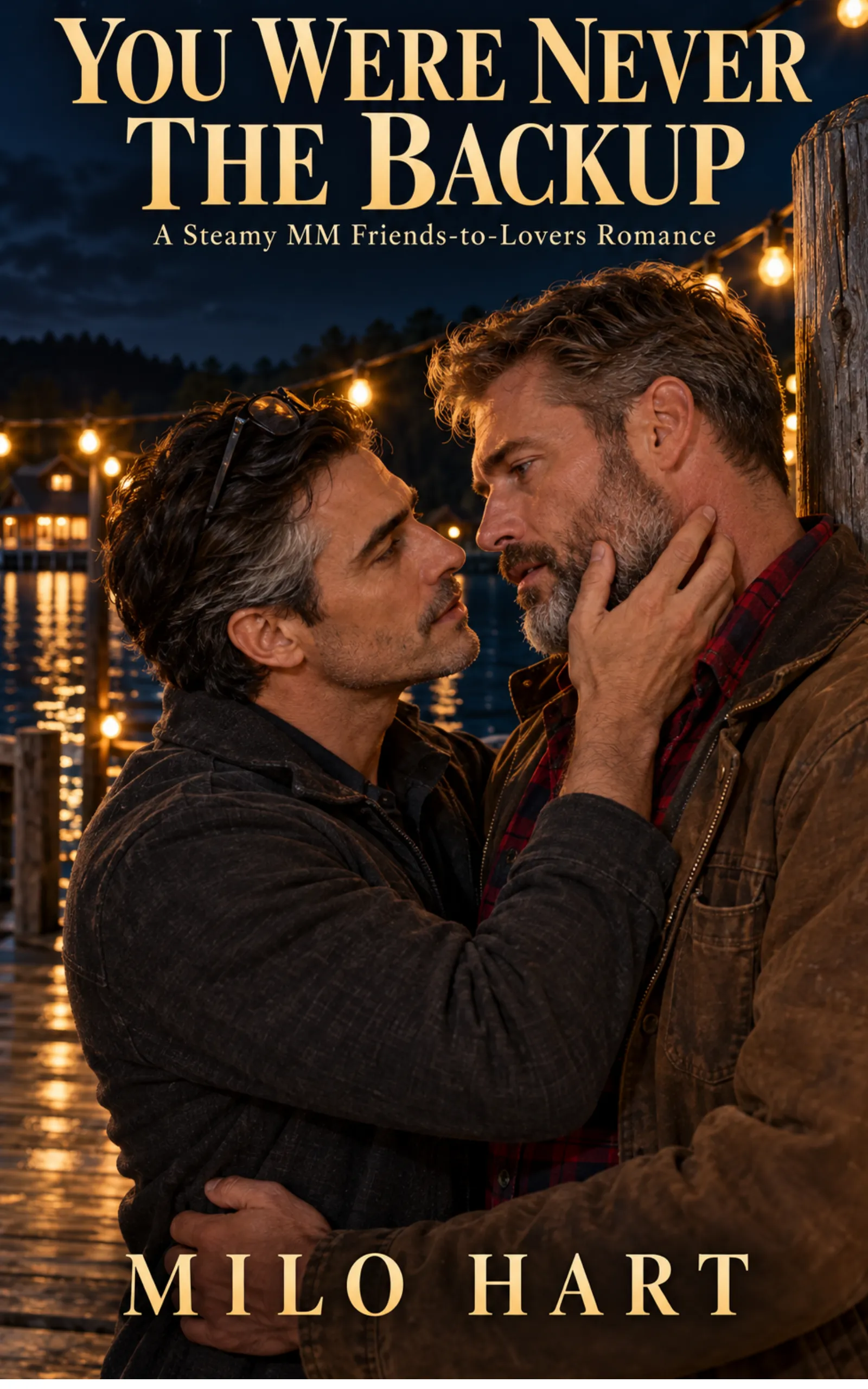
You Were Never the Backup
An MM Best Friends to Lovers Marriage Pact Romance
by Milo Hart
Shop the ebook · Shop the audiobook
Available at all major retailers
Pairing: MM
Heat: 🌶️🌶️🌶️🌶️🌶️ Inferno
Tropes: Marriage Pact, Best Friends to Lovers, Bisexual Awakening, First Time With a Man, Older MM (44 × 45), Long-Time Pining, He Falls First, Divorced Dad, Bartender × Estimator, Small Lake Town, Jealousy, Praise Kink, Dirty Talk, Switch, Holiday Romance, Grand Gesture, Proposal
He proposed out of convenience. Now he has to earn the yes.
Ten years ago, two freshly divorced best friends got drunk after close at The Lantern and wrote a pact on a bar coaster: if neither of us is married by the time I’m forty-five, we marry each other. One house. Nobody eats dinner alone.
Tonight is Graham Ellis’s forty-fifth birthday. In front of the whole bar, with three whiskeys in him and a cherry stem tied into a ring, he gets down on one knee and cashes it in.
I say no.
Because Graham wants a practical husband. A split mortgage and a cleared-out guest room down the hall. And I’ve spent twenty-three years in love with a straight man who has never once wanted to kiss me.
So kiss me, he says. Prove it’d be weird.
It isn’t weird.
It’s the end of everything Graham thought he knew about himself.
Now the man who has never looked twice at another man can’t stop thinking about my mouth, my hands, my voice telling him exactly what to do. He wants to court me properly. He wants to learn everything. He’s forty-five, and he’s never wanted anyone like this.
But wanting each other is the easy part. I’m about to bet every dollar I have on buying the bar. Graham has spent three years secretly planning to sell his house and sail away. And in twenty-three years, neither of us has ever learned how to ask the other for the one thing he really wants.
You Were Never the Backup is a high-heat MM best-friends-to-lovers romance with a marriage pact, a forty-five-year-old’s bisexual awakening, a lakeside small town that knows everybody’s business, two grown men finally done pretending, a lot of on-page spice, a switch dynamic, no cheating, and a guaranteed HEA. Dual POV. Complete standalone.
You’ll love this book if you enjoy:
✅ A drunk proposal with a cherry-stem ring, in front of the whole town
✅ A coaster kept in a junk drawer for ten years
✅ “So kiss me. Prove it’d be weird.” (It is not weird.)
✅ A forty-five-year-old divorced dad discovering, enthusiastically, that he’s bi
✅ A best friend who has been in love since the summer of the raccoon
✅ A stairwell, a steakhouse, a truck at the overlook, and a walk-in cooler
✅ Green sweaters, hand-painted roadside signs, and a guest room painted for the wrong reason
✅ A secret bar purchase, a secret boat deposit, and the fight that blows them both open
✅ A Christmas Eve grand gesture where he finally asks instead of tells
✅ Older MM, he falls first without knowing it, switch, no cheating, 🌶️🌶️🌶️🌶️🌶️ heat, HEA guaranteed
⚠️ Content Warning: This novel contains explicit sexual content (graphic MM scenes including oral sex, fingering, penetrative sex with both leads topping and bottoming, sex without condoms after testing and exclusivity, and one consensual rough encounter during an argument with an agreed stop word; all on-page sex is consensual), a character’s first sexual experiences with a man, alcohol use including drunkenness, references to past divorces, the past death of a parent from illness and hospice care, relationship conflict and a temporary breakup, family and small-town gossip, and strong language. No cheating, no third-party romance, no violence. Intended for readers 18+.
📖 Read Chapter One Free
Not sure yet? Read all of Chapter One right here.
Chapter One: Miles
The birthday boy is trying to order a drink that doesn’t exist.
“It’s like an old-fashioned,” Graham Ellis says, both forearms on my bar, leaning in like we’re negotiating a hostage release, “but with maple. And smoke. And it comes with one of those big ice cubes that makes you feel rich.”
“That’s an old-fashioned with maple syrup.”
“And smoke.”
“I’m not lighting a cinnamon stick on fire for you on a Saturday night, Graham. Look behind you.”
He looks. The Lantern is packed to the walls. Every stool taken, every booth full, a two-deep wall of flannel and fleece between me and the taps. Somebody’s kid is asleep under the dartboard on a pile of coats. The string lights out on the deck are swinging in the wind off the lake, and Friday’s trivia scores are still on the chalkboard because nobody’s had a free hand to wipe them off. Half of Briar Landing came out for his forty-fifth, and the other half came because they heard the first half would be here.
He turns back to me with the crooked smile. The one that goes up on the left and stays down on the right, like his face can only commit to being happy on one side at a time.
“It’s my birthday,” he says.
“It’s been your birthday for six hours. You’ve used that line nine times.”
“Is it working?”
I’m already reaching for the maple.
He laughs, low and pleased, and I keep my eyes on the jigger because I’ve learned that’s the safest place for them. Forty-five looks good on him. It looked good on him at forty, too, and at thirty-five, which is the problem I’ve been having since I was twenty-one. He’s big through the shoulders, thicker through the middle than he was in our twenties, and he has never once in his life apologized for it. The beard came in gray at the chin first, then crept up. He’s wearing the red flannel his daughter bought him three Christmases ago and the Carhartt jacket I have personally pulled out of his trash can twice, because it’s the only coat he’s ever owned that looks like it belongs to him.
I build the drink. Big cube. Orange peel. I don’t light anything on fire.
I slide it across and he takes a sip and closes his eyes and makes a sound I’m going to be thinking about at three in the morning.
“Avery,” he says. “Marry me.”
“Get off my bar.”
He grins and doesn’t move. Lena squeezes past me with four pints in two hands and bumps me with her hip, which means the end of the bar wants you and I’m not your mother. I go. When I come back, Graham’s still there, nursing the drink, watching the room with that loose, happy, proprietary look he gets when everyone he loves is in one place.
That’s his thing. Not parties, exactly. Headcounts. He likes knowing where everybody is.
Patrick, his brother, is holding court at the big table by the window with a pitcher and his wife and two guys from the volunteer fire department. Graham’s parents left at nine, his mother kissing my cheek on the way out and telling me to make sure he drinks water. Sophie FaceTimed from Boston at eight and made her father hold the phone up so she could sing to him in front of the whole bar, and he did, and he cried a little, and nobody said anything because this is Briar Landing and that’s just Graham.
His hand lands on the back of my neck when I come within reach.
It’s nothing. It’s a squeeze. Warm palm, rough fingers, thumb at the base of my skull, there and gone. He’s done it since Mercer Street. He does it to Patrick. He does it to his dad. He’s done it to me at weddings and funerals and hospital waiting rooms and once, memorably, in the middle of a Bills playoff game, when he forgot it was me and not the arm of the couch.
It means nothing to him.
I go back to pouring.
“You’re scowling,” he says.
“I’m concentrating.”
“You’re doing the thing with your mouth.”
“There’s no thing with my mouth.”
“There’s a thing.” He drags a finger in the air in front of his own lips like he’s diagramming it for a class. “It goes flat. Like you’re holding back an opinion about my shirt.”
“I have plenty of opinions about your shirt. I keep them to myself because I’m a professional.”
“See, that’s a lie.” He points at me with the glass. “Your glasses are on your head.”
I reach up. They are. I push them back into my hair and he looks so delighted with himself that I have to go deal with a guy who wants a Bud Light just to get out of range.
When I come back, he’s holding his phone up at me. On the screen is a photo of a hand-painted sign nailed to a fence post: LIVE BAIT • FUDGE • NOTARY.
“Route 9, outside Halston,” he says. “Took it Tuesday. Been saving it.”
“For your own birthday?”
“For an emergency. You looked like an emergency.” He tucks the phone away. “Tomorrow. My place. I’ve got Lethal Velocity Three and a family-size bag of those terrible cheese puffs.”
“There’s no way there are three of those.”
“There are four. The fourth one’s on a submarine.” He looks so genuinely thrilled about this that something in my chest goes tight and stupid. Every one of his birthdays since Mercer Street ends the same way: the worst action movie he can find, his feet on my side of the couch, both of us yelling at the screen.
“Fine,” I say. “I’m not sharing the puffs.”
At ten-thirty, Theo Marsh comes in from the deck with a drill holstered on his belt like a gunslinger.
“You’ve got a dead socket on the third post,” he says, sliding up to the service end. “I swapped the bulb. It’s the wiring. I’ll fix it Monday when I’ve got daylight.”
“You’re not on the clock.”
“I was out there anyway.” He shrugs. He’s thirty-seven, dark-blond, and built like he carries lumber for a living, which he does. He’s been rebuilding The Lantern’s deck for three weeks and he has a habit of showing up at closing to “check the joists” and leaving with a beer he refuses to let me comp. “You looked like you were drowning in here. Figured I’d help you keep the lights on.”
“That’s very civic of you.”
“I’m a civic guy.” He leans on the bar. Holds my eyes a beat longer than the conversation needs. “Ask me how civic sometime.”
I put a beer in front of him. On the house. He pushes a ten across anyway and I don’t fight it.
He’s flirting. He’s been flirting for three weeks, nice and easy and impossible to misread, the way men flirt when they’ve never once been told no by someone they actually wanted. It’s flattering. He’s good-looking. He’s kind to Lena and he picks up his own sawdust.
I glance down the bar.
Graham’s talking to Rob Dunleavy about gutters. Completely oblivious. He hasn’t looked over once.
Of course he hasn’t.
“I’ll keep that in mind,” I tell Theo, and his smile goes a little wider, and he takes his beer back out into the cold.
It’s Patrick who starts it. It’s always Patrick.
At a quarter to midnight, with the crowd thinned to the people who don’t have babysitters to get home to, he climbs up on a chair by the window. Not onto it carefully. Onto it like a man who has made his peace with the possibility of a broken hip.
“Ladies and gentlemen,” he booms. “Lantern regulars. Fire department. Rob.”
“Get down, Pat,” somebody yells.
“I will not get down. It is my baby brother’s forty-fifth birthday, and I have a public service announcement.” He lifts his glass toward the ceiling. “Ten years ago — ten years ago tonight, almost to the week — my brother Graham sat at that very bar, freshly divorced, crying into a Labatt’s—”
“I wasn’t crying,” Graham shouts.
“—crying into a Labatt’s, and he made a solemn vow with his best friend in the world, the man currently pouring your drinks. Miles Avery.”
Applause. Somebody whistles. I keep wiping down the bar like it’s an emergency.
Here’s what happened, since Patrick’s going to tell it wrong.
Ten years ago, Graham’s divorce was final on a Tuesday. On the Friday, he showed up here at ten p.m. in a suit he’d worn to the lawyer’s office and never taken off, and he sat at my bar, because I was a bartender then and not a manager, and he drank until I cut him off. My own divorce was eighteen months old. I was living in a studio over the hardware store with a futon and a cat that didn’t like me. At one in the morning, after close, we sat on the two stools at the end, and he said he didn’t think he could do it again. Marriage. All of it. He said the worst part wasn’t missing Natalie, it was the quiet. Coming home and there was no one to tell about his day.
And I said, half joking, because it was the only way I could say it, Well, if neither of us is married by the time you’re forty-five, we’ll just marry each other.
He laughed so hard he had to put his head on the bar.
Then he picked it up and said, One house.
And I said, Nobody eats dinner alone.
And he grabbed a coaster and the pen from behind my ear and wrote it down, and we both signed it, and he flipped it over and wrote something on the back that I didn’t read until I got home.
Patrick doesn’t know about the coaster. Nobody does.
“—and he said,” Patrick is hollering now, swinging his glass like a conductor, “and I quote, If neither of us is married by forty-five, we marry each other! And folks—” He spreads his arms. Beer sloshes. “Look at the calendar.”
The whole bar turns toward Graham.
Graham, who has had three whiskeys and a maple old-fashioned and has never in his life backed down from a dare, puts his glass down very slowly.
“Oh, no,” I say. “No. Absolutely not.”
“Pact! Pact! Pact!” Patrick starts it, and the fire department picks it up, and then Rob, and then Lena, who is supposed to be on my side, is pounding the bar top with her palm and grinning like the traitor she is.
Graham stands up off his stool.
He looks around for something. Anything. I watch him scan the bar, the bowls, my garnish tray. His face lights up.
He takes a maraschino cherry out of my garnish tray with his fingers, which is a health-code violation, and pops the cherry in his mouth, and holds up the stem.
“I’m going to tie it with my tongue,” he announces.
“You can’t tie it with your tongue,” I say.
“I’ve seen you do it.”
“I’ve been doing it since I was nineteen. You’ve never done it once in your life.”
“First time for everything.” He puts the stem in his mouth. The bar goes quiet, the kind of quiet you only get when a whole room of adults has decided to be stupid together. He works his jaw. His eyebrows go up. They go down. He rolls his eyes up toward the ceiling like there might be instructions written there. His face goes red.
It takes forty-five seconds, which somebody times out loud, and at the end of it he spits out a completely straight, completely chewed stem into his palm.
“Okay,” he says. “Plan B.”
He ties it with his fingers. Big, clumsy fingers that have built two decks and a treehouse and once replaced my entire kitchen faucet in a snowstorm. He makes a loop. Holds it up to the light. The bar applauds like he’s pulled a rabbit out of a hat.
Then he walks around the end of the bar, through the gap, onto my side, where nobody is allowed, and gets down on one knee on the rubber mat next to the ice well.
“Get up,” I say.
“Miles Avery.” He’s grinning up at me. His eyes are wet and bright and a little unfocused from the whiskey. He holds up the cherry-stem ring between his thumb and forefinger like it’s a diamond. “In accordance with the Ellis–Avery Retirement Scheme, which was signed into law at this very bar ten years ago—”
“There was no law.”
“—and which my brother has so kindly brought to the attention of the public—”
“I’m going to kill Patrick.”
“—will you do me the honor of splitting a house with me, and never letting me eat dinner alone again?” He clears his throat. Lifts the stem higher. “Marry me, Avery.”
The bar loses its mind.
Patrick is pounding the window. Lena has her phone out. The fire department is chanting SAY YES, and Rob Dunleavy is standing on the rung of his stool, and somebody in the back is doing the wedding march on a kazoo, and I have no idea where they got a kazoo.
And I laugh.
That’s what I do. It’s what I’ve always done. I laugh on cue, right when I’m supposed to, because that’s my job here. I’m the dry one. The one who rolls his eyes. I laugh and I take the stem out of his fingers and slide it onto my pinkie, where it fits about as well as you’d expect, and I say, loud enough for the room, “I’ll have my lawyer review the terms.”
The bar roars. Graham throws his head back and laughs that big, chest-deep laugh I would know anywhere, in any room, through any wall.
I help him up by the elbow. He’s heavy. He leans on me for a second longer than he needs to, warm and solid and smelling like smoke and orange peel, and his hand finds the back of my neck again and squeezes, and he says, right into my ear, “You’re the best, you know that?”
Then he lets go and goes back around the bar to take a bow.
I stand there by the ice well with a chewed cherry stem on my finger.
Inside, I am very quietly dying.
Not dramatically. Not like a movie. Just a small, specific death I’ve had a lot of practice at. The kind you have when you’ve loved somebody since you were twenty-one and you’ve watched him marry someone else, and have a daughter, and get divorced, and date a dental hygienist and a real estate agent and a woman named Carol who sold kombucha at the farmer’s market, and you’ve helped him move every single time. The kind where the man you’d crawl over glass for gets down on one knee in front of the whole town as a joke.
Because it is a joke. It’s the funniest thing in the world. Two divorced middle-aged men and a coaster.
I take the stem off my finger and put it in my shirt pocket.
Then I go pour Rob another beer.
Last call is one. By two, I’ve counted the drawer, Lena’s gone home, and the place is empty except for Graham, who is out on the dock in the Carhartt with his hands jammed in the pockets, watching the lake.
I lock the front. Kill the overheads. The string lights stay on, because they always stay on, because Ruth says a bar on the water should never look closed from the lake. I grab two bottles of water from the cooler and go out the side door.
It’s cold. October cold, the kind that gets in under your collar. The lake is black and choppy, slapping against the pilings. The far shore is a few porch lights and nothing else. Theo’s half-finished deck has a tarp over it that snaps every time the wind comes up.
Graham’s sitting on the edge of the dock with his boots hanging over the water. I hand him a bottle and sit next to him. Not too close.
“Drink that. Your mother made me promise.”
He drinks it. Half the bottle in one go. Wipes his mouth on his sleeve. Then he just sits there, holding it, quieter than he’s been all night.
The whiskey’s wearing off. I can tell by his shoulders. Graham drunk is loud and happy. Graham coming down is someone else.
“That was a good party,” I say.
“It was a great party.” He nods at the water. “Everybody came.”
“Everybody always comes for you.”
“Yeah.” He turns the bottle in his hands. Peels at the label. “Sophie’s not coming home till Thanksgiving. She’s got this job, and she loves it, and she’s got this apartment with two girls from work and a balcony the size of a dinner plate. She sent me a picture.” He laughs, but it doesn’t have much behind it. “She’s good. She’s so good, Miles. I did it. I got her all the way there.”
“You did.”
“And now she doesn’t need me to do anything.”
I don’t say anything. There’s nothing to say to that. He’s right. He did the hardest job in the world for twenty-two years, and he did it beautifully, and now it’s over and he’s sitting on a dock at two in the morning with nothing to fix.
He’s quiet for a long time. The tarp snaps.
“I cleared out the guest room,” he says.
I look at him.
“Last month.” He keeps his eyes on the water. “Took all of Sophie’s old stuff to Goodwill. The futon. The bins. Painted it. That gray you liked in Claire’s kitchen, I asked her what it was called. Got a real bed in there. A good one, not some — ” He waves a hand. “A real one.”
The cold goes all the way through my coat.
“Graham.”
“I meant it.” He finally turns his head. His face in the string lights is open and serious and a little scared, the way he looked in the hospital the night Sophie was born, the way he looked at his lawyer’s office ten years ago. “In there. I know Patrick made it a whole thing, and I made it a whole thing, and that’s fine, it was funny. But I meant it. I’ve been thinking about it for a while.”
“You’ve been thinking about marrying me.”
“I’ve been thinking about — ” He rubs his jaw, the beard rasping under his palm. “Look. We’d be good at it. You know we would. We already know how to live together, we did it for three years in that terrible house with the raccoon. We’ve never had a fight that lasted longer than a day. You’d stop paying rent on an apartment with no dishwasher. I’d stop talking to the TV.” He bumps my knee with his. “Split a house. Never eat dinner alone. Somebody to bitch to about your day. That’s what we said. That’s all I want.”
That’s all he wants.
There it is. Half my life, handed back to me in one sentence, gift-wrapped. A house. A dishwasher. A good bed in a gray room down the hall from his.
I could say yes. That’s the horrible part. I could say yes right now, on this dock, and he would be so happy. He’d hug me so hard my back cracked. We’d have breakfast together every day for the rest of our lives. He’d hold my hand at his father’s funeral and bring me soup when I was sick and call me his husband in front of his whole family, and every night he’d kiss my cheek in the hallway and go to his own room and close the door.
And I’d lie in my good bed in the gray room and listen to him snore through the wall for thirty years.
“No,” I say.
He blinks. “No?”
“No, Graham.”
“You don’t — ” He actually looks confused. Like he did the math and I’m telling him two and two is five. “Why not? Is it the house? We can sell mine. We can get something new, closer to the bar, I don’t — ”
“It’s not the house.”
“Then what?”
I look at the lake. I can feel the cherry stem in my shirt pocket like it’s burning a hole.
“I’m not marrying a man,” I say, very carefully, “who has never once in his life wanted to kiss me.”
It comes out quieter than I mean it to. And it sits there between us on the dock, in the cold, and I wish more than anything that I could take it back and laugh it off. Joke, Graham. I’m kidding. Get your coat.
But I don’t. Because it’s the truest thing I’ve said to him in twenty-three years, and I’m forty-four, and I’m tired.
Graham stares at me.
I watch it land. I watch him understand, maybe for the first time, that this isn’t a joke to me. Hasn’t been for a long time. Maybe ever. His mouth opens a little. His eyebrows pull together. He looks at me like I’ve just told him the lake was on fire.
And then, because he’s Graham Ellis, and he’s stubborn, and he’s still a little bit drunk, and he has never in forty-five years known when to quit, his chin comes up.
“Who says I haven’t?”
The dock tilts under me.
“Don’t,” I say.
“Who says I haven’t ever wanted to?” He’s warming up now, getting that stubborn set to his jaw, the one he gets right before he insists he can fix something himself and floods the basement. “You don’t know that. You don’t know everything I’ve ever thought about.”
“I know you’ve dated eleven women since your divorce. I helped you pick out the flowers for most of them.”
“That doesn’t mean — ”
“Graham. You’re straight.”
“I know I’m straight.” He says it like I’m being ridiculous. “I’m saying you can’t just decide it’d be — ” He waves his hand between us. “That it’d be some big terrible thing. Like I’d hate it. We’re adults. It’s a kiss.”
“It’s not a kiss. Not for me.” I stand up. My knees crack. “Go home. Drink the rest of the water. I’ll drive your truck over in the morning.”
He stands up too. He’s taller than me by two inches and he uses all of them, stepping into my space on the narrow dock until I can feel the heat coming off him through both our coats.
“So kiss me,” he says.
I stare at him.
“Go on.” His voice drops. Not drunk anymore. Something else. Something I don’t have a name for, because I’ve never heard it from him before. “If I’ve never wanted to, you’ll know in two seconds. Prove it’d be weird. Prove it, and I’ll drop it, and I’ll never bring it up again.”
He stands there with his hands still shoved in the pockets of the jacket I keep saving, chin up, waiting.
The lake slaps at the pilings. The tarp snaps. Every string light on the deck swings in the wind, and his face goes gold and shadow and gold again.
He thinks it’s a dare.
He thinks I’ll laugh.
Twenty-three years. Eleven women. One coaster in my kitchen drawer with his handwriting on the back.
I take his face in both hands.
Want to keep reading? The full novel is available now.
🔥 Want an EXCLUSIVE Bonus Chapter?
Day Two: Nothing — A scene TOO HOT for the bookstore
February. Three weeks on a catamaran out of Tortola, the captain gone ashore for the night, two thousand miles from the snow and the bar, and Miles’s feet burned red through the SPF 50. Then Graham asks for exactly what he’s wanted since the security line in Syracuse: to be bent over a trampoline net under a sky full of stars. Sound carries on water.
More from Milo Hart
Browse all Milo Hart books.
You Were Never the Backup
He proposed out of convenience. Now he has to earn the yes.
Every Other Week
Two divorced dads. One shared wall. Five rules they swear they'll never break.
After the Final Whistle
He laughed when his teammate got on his knees. Eight years later, he's not walking out.
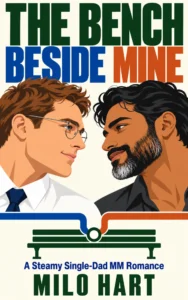
The Bench Beside Mine
He saved the seat. Then he saved a little more.

The Winter He Learned to Stay
Eighteen years ago he left without a goodbye. This winter, the storm won't let him leave.

The House We Left Behind
He left before morning. This time, he has to ask.
Never Miss a Release
Get new release alerts, exclusive bonus content, and reader-only giveaways.