
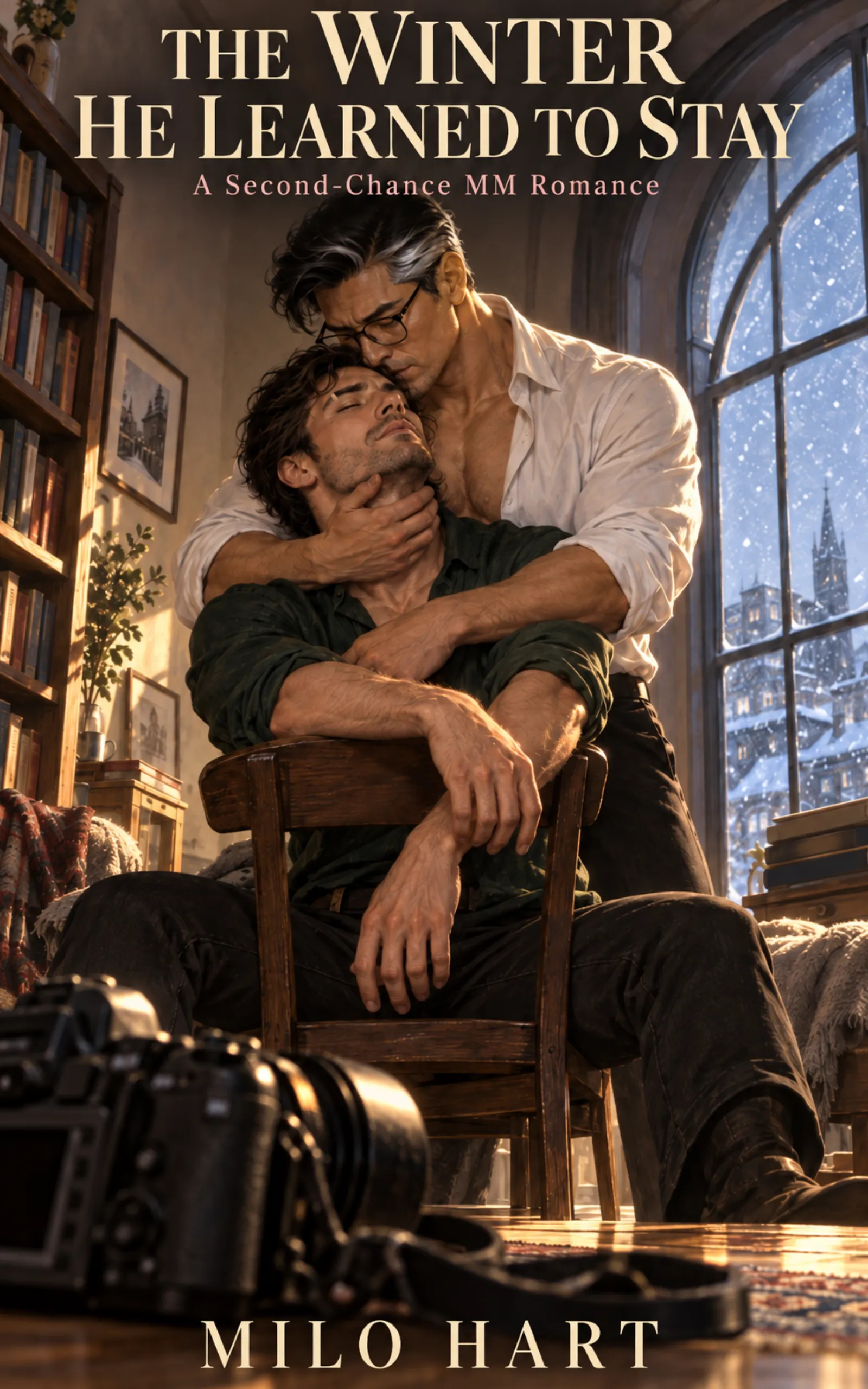
The Winter He Learned to Stay
A High-Heat MM Second-Chance Romance
by Milo Hart
Shop the ebook · Shop the audiobook · Shop the paperback
Available at all major retailers
Pairing: MM
Heat: 🌶️🌶️🌶️🌶️🌶️ Inferno
Tropes: Second Chance, Exes Reunited, Snowed In, Forced Proximity, One Bed, Small Town, Buttoned-Up Librarian, Photographer Who Never Stays, Switch Dynamic, Love Letters, Dirty Talk, Hurt/Comfort, Found Family, Holiday Romance
Eighteen years ago he left without a goodbye. This winter, the storm won’t let him leave.
Eli Mercer has spent eighteen years photographing other people’s kitchens in thirty countries, and he has never once unpacked his bag. Three nights in Briarwood, Pennsylvania. Twelve frames for a magazine. Then the next train out. That was the plan, right up until a blizzard closes the county, the inn’s boiler dies, and the only warm room left in town is the apartment over the library.
Jonah Kim has run that library for nine years. He has eleven unanswered letters to his name, two postcards with no return address, and a laptop folder of every photograph Eli has ever published. He is courteous, precise and very, very good at making it easy for people to leave. He offers Eli the guest room. It’s a room, Eli. It doesn’t mean anything.
Then the power goes out. The gas stove in the front room is the only heat for blocks, and the pull-out sofa drags two grown men into the middle every night. Jonah has one condition: Eli has to ask, out loud, for exactly what he wants. Eli has spent his whole life answering questions with a photograph.
The roads will open. The trains will run. Jonah has a county board to face and a four-hundred-thousand-dollar elevator to fight for. And Eli has a job offer on the other side of the world that he hasn’t mentioned yet. This time, if he goes, he’ll have to say so. And if he stays, he’ll have to mean it.
The Winter He Learned to Stay is a scorching, emotional small-town MM second-chance romance with two established men in their late thirties and forties, a snowed-in winter, a found family worth coming home to, and a hard-won HEA.
You’ll love this book if you enjoy:
✅ Second chance, eighteen years in the making
✅ Snowed in: one blizzard, one gas stove, one pull-out sofa
✅ A buttoned-up small-town librarian who says I’d like that as if it costs him
✅ A photographer who has never once unpacked his bag
✅ “Ask me.” Consent, praise and dirty talk, all said out loud (🌶️🌶️🌶️🌶️🌶️)
✅ A real switch dynamic: both men give, both men take
✅ Grown-up heroes with real jobs, real families and real history
✅ A small town that shows up when it counts
✅ Found family: a big brother, a formidable Korean mom, a knitting circle with a screwdriver
✅ Love letters, a library card, and a guaranteed HEA
⚠️ Content Warning: This novel contains explicit sexual content (graphic MM scenes including oral, anal, frotting, mutual masturbation, wrist-pinning and phone sex, with condomless sex only after both men test and agree to be exclusive), strong language, a childhood in foster care separated from a sibling (backstory), past abandonment and long estrangement, a blizzard and extended power outage, a deceased spouse (secondary character), disability access and a child who uses a wheelchair (handled with care), a temporary separation and a serious fight. Intended for readers 18+.
📖 Read Chapter One Free
Not sure yet? Read all of Chapter One right here.
Chapter One
ELI
Briarwood came at me sideways, the way it always had, through a train window that needed washing.
I had the camera up before I’d decided to lift it. Habit. Thirty-seven years old and I still couldn’t look at a thing that made me nervous without putting glass in front of it first.
Click. The water tower, repainted. It had been rust and a peeling high school mascot when I left. Now it was a clean municipal blue, which felt like being lied to politely.
Click. The foundry stacks, cold against a sky the color of dishwater. Those hadn’t changed. Nothing changes a dead smokestack.
Click. The back of Mill Street, the side nobody was meant to see from anywhere but the tracks. Fire escapes. Dumpsters. A gap between two brick buildings like a pulled tooth, where the shoe repair place used to lean.
And up the hill past the freight yard, the Dunmore house had its lights on.
I let that one go by without a frame. The Dunmore house had stood empty my entire adolescence with plywood over its eyes. I’d climbed in through the coal chute at sixteen to photograph the wallpaper. Now there was a wreath on the door and a yellow kitchen window, and somebody was in there making dinner like the place had never been anything but a home.
That’s the trouble with reading change for a living. You get good at it. I could stand in a town I’d never seen and tell you from the brickwork which decade the money left. Nobody warns you it works on places you already know, or that it’s a lot less fun when the thing that’s aged is your own absence.
“Briarwood,” the conductor said, swaying down the aisle. “Briarwood, next stop. Watch your step on the platform, folks, it’s slick.”
I capped the lens and went over the rules.
Three nights. Twelve frames. The bag stays zipped.
The first two were Marisol’s. She’d commissioned Cold Towns for Meridian back in August, over a bad phone line and worse coffee: six places where the industry had gone and the winter hadn’t, twelve finished images apiece. “Twelve, Eli. Not four hundred and a note that says you pick. I have a job. It isn’t yours.” I’d done a canal town in upstate New York and a glassworks town an hour south of it. Briarwood was third on the list.
I’d put it there myself. I’d told her it was a perfect specimen, which was true. I had not told her I was one of the things it manufactured.
The third rule was mine and older than the job. I’d had it since I was nine.
My phone buzzed against my thigh.
Owen: Dinner Wednesday. Adrian is cooking, do not bring anything.
Owen: Bring wine.
Owen: You on the train or did you bail
I looked at that last one for a second longer than it deserved. No question mark. My brother had never in his life accused me of anything. He just left the door open for the possibility, like putting out a saucer for a cat that might not come.
On the train, I typed. Pulling in now. Red or white?
Yes, he sent back.
The brakes caught. The platform slid up alongside, wet and empty, one sodium light already burning at four in the afternoon. I shouldered the camera bag, hauled the duffel down from the rack, and stood in the vestibule with my reflection in the door glass. Dark hair I’d cut myself in a motel mirror in Utica. Windburn. The scar through my left eyebrow that made me look like I’d been in more fights than I had.
I looked like a man passing through. I’d worked hard on that.
The doors opened and the cold walked in and put its hands down my collar.
Three nights.
The Carriage House Inn had been a livery, then a hardware wholesaler, then nothing, and was now eight rooms over a front parlor that smelled like woodsmoke and lemon oil. The woman at the desk had reading glasses pushed up into gray curls and a crossword she didn’t put down.
“You’re the photographer.”
“I’m a photographer,” I said. “I can’t speak for whether I’m the one you ordered.”
“Mercer. Three nights, room four, top of the stairs.” She slid a real key across the counter, brass, on a wooden fob. “Owen’s brother.”
That wasn’t a question either. Briarwood didn’t ask many. It told you what it already knew and watched to see if you’d argue.
“That’s me.”
“He fixed my porch. Good hands, your brother.” She finally looked at me over the paper, quick and thorough. I knew that look. I’d grown up under it. Which one are you, and how long are you staying. “Radiator in four knocks. It’s not dying, it’s just dramatic. They’re calling for snow tonight.”
“How much?”
“Six to ten. They always say six to ten.” She went back to her crossword. “Breakfast is at seven. If you’re not down by nine I give your bacon to the dog.”
Room four had a sleigh bed, a braided rug, a window over Main Street, and a radiator that greeted me like a man dropping a wrench down a well. I set the duffel on the luggage rack. I took out a clean shirt, my toothbrush, and the charger.
Then I zipped it shut again.
There’s a way to be in a room so that you could be out of it in ninety seconds with nothing left behind but a tip. I’ve had it down since before I could drive. Toiletries stay in the kit. Clothes stay in the bag. You never use the drawers, because drawers are a kind of promise, and you never, ever let anything of yours migrate to the back of a closet. People think it’s about traveling light. It isn’t, quite. It’s that if I’m the one who goes while everyone still likes me, I never have to stand there and find out what the day looks like when they stop.
I knew exactly how that sounded. I’d had it explained to me, kindly, by a woman in Montreal and less kindly by a man in Denver. Knowing a thing and unpacking a duffel are different skills.
I checked the light instead.
Four-twenty in late November, cloud cover like a lid. That gave me maybe forty minutes of blue hour, when the sky goes the color of a bruise and every lit window in a town turns to honey. It’s the cheapest trick in my bag and it never fails, and it was the whole thesis of the essay: the cold, and the people who keep a light on in it anyway.
I took one body and the thirty-five, left everything else locked in the room, and went down into Main Street.
It was good. God help me, it was good straight away.
Kessler’s Hardware had snow shovels standing in a barrel out front like umbrellas, and a kid in an apron wrestling a sandwich board that read ICE MELT. WE HAVE IT. DON’T PANIC. I waited until his breath clouded in the door light. Frame.
The Lyric still had its marquee, half the bulbs dead, promising a holiday double feature. A woman under it was trying to light a cigarette and hold a pizza box at the same time. Frame.
The diner. Two men at the counter in identical canvas coats, not talking, the way men who’ve known each other forty years don’t. Steam on the glass. I stood across the street for nine minutes with my fingers going numb until one of them laughed. Frame.
I was working. It’s the only time my head goes quiet. Everything narrows to an edge and a shadow and the half second before a stranger does something true, and there’s no room left in there for anything I might be feeling about the sidewalk under my boots.
Which is how it took me four frames to notice what I was doing.
I thumbed back through them on the screen. The hardware store, and in the far left of it, soft, a row of tall arched windows. The Lyric, and mirrored in the dark glass of the ticket booth, those windows again. The diner, shot from the east side of the street instead of the west, which was the wrong side, the worse angle, the one you’d only choose if you wanted the big brick building on the corner at your back where you couldn’t see it.
Or if you wanted it there.
I turned around.
The Briarwood Community Library took up the corner of Main and Alder the way it always had, three stories of red brick under a slate roof, with arched windows that ran nearly floor to ceiling on the ground level. Every one of them was lit. Not the flat white of an office. Lamps. Low and gold, the glow of a place that expects you to stay a while. Up under the eaves a smaller pair of windows burned too, and I didn’t let myself wonder who lived there now.
It was the light. I was a professional, that was the best light on the street, and any photographer alive would have kept drifting toward it.
I raised the camera.
Through the glass: shelves. A girl in a puffer jacket asleep on her backpack. An old man with a newspaper on a wooden rod. And crossing behind the long front desk, carrying a stack of books against his chest, a man.
Broad through the shoulders. Dark cardigan. He stopped, said something to someone I couldn’t see, and bent his head over whatever was in his hands, and the lamp behind him caught silver at his temple.
My finger went down on the shutter without me.
I stood on the corner with my pulse going in my throat like I’d sprinted there, staring at the back of the camera, at a picture of a stranger with a jaw I’d have known in the dark.
Eighteen years. The last time I’d seen that face, it had been asleep.
I could have gone back to the inn. I want that on the record. I had the frame. I had two more days, a brother who’d vouch for me, and a perfectly good coward’s route that involved emailing the library a permissions request from three blocks away.
I pushed the door open at 5:41.
The smell got me before anything else did. Paper and floor wax and radiator dust and wet wool, and under it something like pencil shavings, a smell I’d have sworn I’d forgotten. I was eighteen for a full second. Eighteen, with a library card that was the first thing in Briarwood with my name on it, and a guy pushing a shelving cart who stopped when I pulled down a book on Walker Evans and said, The one next to it is better.
He was at the front desk.
He had his back to me, sorting holds, and I got three steps of grace to take him in properly. He was bigger. That was the stupid, animal first thought. At twenty-two Jonah Kim had been long and a little underfed, all wrists. Somewhere in the years I hadn’t been watching he’d grown into the frame, heavy through the chest and back, the kind of solid you get from hauling boxes of books and shoveling your own steps, not from a gym. The cardigan was charcoal, sleeves shoved to the elbow. Forearms like that had no business under a cardigan. His hair was still black and still thick and had gone silver in two clean strokes above his ears.
Then he turned around, and he was wearing glasses.
Dark frames, square. He’d never needed them before. They sat on a face that had gotten harder in all the right places, and behind them his eyes went over me, once, and I watched him know me.
It took no time at all. No squint, no flicker of do I. He knew me the way you know your own handwriting.
And then, right in front of me, he put it away. Something behind the lenses folded shut like a book, and what was left was pleasant and attentive and went all the way to the back wall.
“Good evening,” Jonah said. “Can I help you find something?”
His voice had dropped. It used to crack when he laughed. This was low and level, with every consonant in place.
“Hi,” I said, like an idiot.
He waited. He was good at it. He set down the book he was holding and laced his fingers on the desk and gave me the full, courteous attention of a man who had all the time in the world and none of it for me in particular.
I’d pictured this. Of course I had, on planes, in the bad hours. I’d pictured him angry. I had speeches for angry. On my weaker nights I’d pictured him coming around the desk and getting a fistful of my jacket, and I’d had a response ready for that too, though not a verbal one.
I’d never once pictured a closed door with a welcome mat in front of it.
And I knew what I was looking at, which made it worse. Jonah went formal when he was hurt. He always had. The year I met him, a professor humiliated him in a seminar, and for the rest of that semester he addressed the man in complete sentences of such exquisite manners that it was like watching someone get slowly paper-cut to death.
I was getting the sentences.
“I’m in town on an assignment,” I said. My mouth found the patter on its own; it usually does. “Photo essay, a magazine called Meridian, winter in old mill towns. Very moody. Lots of steam coming off things. I was hoping to shoot the building. It’s the best-looking thing on the street, but you’d know that, you’re in it.”
Nothing. Not even the corner of his mouth, and I used to be able to get that corner with a lot less.
“The exterior is visible from a public sidewalk,” he said. “You don’t need permission for that.”
“And the interior?”
“For the interior there’s a form.”
Of course there was. He opened a drawer without looking down, second on the left, and drew out a single sheet and laid it on the desk between us and squared it with two fingers. Request to Photograph on Library Premises. I’d have bet the duffel he wrote it himself.
“Patrons may not be photographed without a signed release. Minors not at all. Staff at their own discretion. I’d ask you to keep clear of the computer stations entirely. People using them are frequently doing something private, like looking for work.”
“That’s fair.”
“It isn’t a negotiation. It’s the policy.”
“Then it’s a fair policy.” I tried the smile, the one that gets me onto fishing boats and into back kitchens and, on four continents, out of trouble. “Are you staff? For discretion purposes.”
“I’m the director.”
That landed somewhere under my ribs. He’d wanted it since he was twenty. He used to walk me through what he’d do with the place, the two of us in these stacks after close with his hands going: a children’s room that didn’t smell like a basement, evening hours, a real collection budget. I’d lain on that floor with my head on a dictionary and watched him want something out loud.
“Jonah,” I said. “That’s… congratulations.”
“It was nine years ago.”
“Then I’m late.”
“Yes,” he said, perfectly pleasantly, and let it sit there on the desk next to the form.
I looked down because I had to look somewhere. There was a pen in a brass holder by his hand. I reached for it at the same moment he moved to offer it, and our fingers met on the barrel.
It was nothing. Two knuckles and the side of his thumb. His skin was warm and dry, there was a paper cut healing on his index finger, and my whole body lit up like someone had thrown a breaker.
I knew what his throat smelled like. That was eighteen-year-old information, useless, and every nerve I owned handed it to me anyway, along with the weight of him and the exact low sound he made when he stopped being careful. I felt it in my stomach, and lower than my stomach. My ears went hot.
He didn’t snatch his hand back. That would have told me something. He simply let go of the pen, in his own time, and returned his hand to the desk. But his eyes had dropped to where we’d touched, and behind the glasses, for one unguarded beat, they were not polite at all.
Then they were again.
I bent over the form with my heart slamming. Name. ELI MERCER, in block capitals, like he might need the help. Purpose. Publication. Dates requested. My handwriting looked like it had been done on the train.
Address.
The pen stopped.
I’ve filled in that line in thirty countries. I have a system: Marisol’s office for anything official, a mail service in Tucson for anything that bills me. Neither one felt like something I could write down in front of this man. I skipped it and went on to the signature.
“The address line is required,” Jonah said.
“I don’t really have a… I move around. For work.”
“I’m aware of what you do for work.”
I looked up. He’d said it to the form.
So he’d seen the pictures. Somewhere in eighteen years he’d typed my name into a search bar, at least once, and looked. It shouldn’t have felt like a hand closing around the back of my neck.
“Where you’re staying will do,” he said.
“The Carriage House. Room four.”
“Then put that.”
I put that. 3 nights, I added in the margin, and couldn’t have said which of us I was telling.
He turned the sheet around with one finger and read it top to bottom, actually read it, while I stood there with melted frost running out of my hair and down my neck. Up close there were lines at the corners of his eyes. A small nick on his jaw where he’d shaved in a hurry. The top button of his shirt was undone under the cardigan, and I could see the hollow of his throat, and I made myself watch the date stamp instead.
He brought it down. The sound was very loud.
“I’ll review this tonight. You can collect the approved copy tomorrow after ten.”
“You have to review it? You just read it.”
“I review everything.” He slid the form into a tray. “If there’s nothing else.”
There was so much else that it was jammed in my chest like a crowd in a doorway. I’m sorry was in there, eighteen years stale and four lines too short. You look good was in there. I used to know how to make you laugh was in there, and under all of it something with no words at all, just the urge to put my palm flat on that desk and leave it there until he had to do something about it.
“No,” I said. “That’s everything.”
He inclined his head. Glanced, pointedly, at the clock over the door.
“We close at six.”
It was 5:52. Across the room a woman at a returns cart had stopped pretending to scan barcodes and was watching the pair of us like the last ten minutes of a movie.
I said thanks. I think I did. I got myself turned around and across the old oak floor, past the newspaper man and the sleeping girl, and out through the heavy door into the dark.
The cold was a relief. I stood on the top step and dragged it into my lungs, and something touched my cheek, light as a fingertip. Then my eyelashes. I tipped my head back. Under the streetlamp the air had come alive, small dry flakes sifting down out of nothing, the first of the six to ten.
I turned up my collar and started down the steps, and I was halfway to the sidewalk before it caught up with me and stopped me dead.
I’d said his name. I’d said it like I still had a right to it.
In ten minutes, Jonah Kim had not said mine once.
Want to keep reading? The full novel is available now.
🔥 Want an EXCLUSIVE Bonus Chapter?
Nine Days in Lisbon — A scene TOO HOT for the bookstore
April, and the library can spare him for four days. Eli meets the plane holding a sign. At the top of four flights of stone stairs there’s an iron bed, a pair of shutters open on the whole of the Alfama, a fado singer at the bottom of the lane, and one thing Jonah has never asked anyone for in his life: Get the camera out.
More from Milo Hart
Browse all Milo Hart books.
The Bench Beside Mine
He saved the seat. Then he saved a little more.
The Winter He Learned to Stay
Eighteen years ago he left without a goodbye. This winter, the storm won't let him leave.
The House We Left Behind
He left before morning. This time, he has to ask.
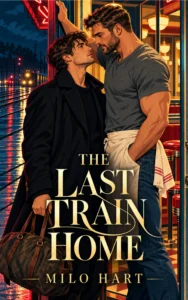
The Last Train Home
Six weeks. Four rules. One spare room over the diner he walked out on.
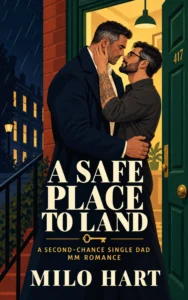
A Safe Place to Land
It isn't a second chance. It's a roof. For six weeks.
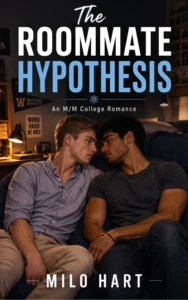
The Roommate Hypothesis
Two roommates. Six rules. One experiment that was never supposed to become everything.
Never Miss a Release
Get new release alerts, exclusive bonus content, and reader-only giveaways.