
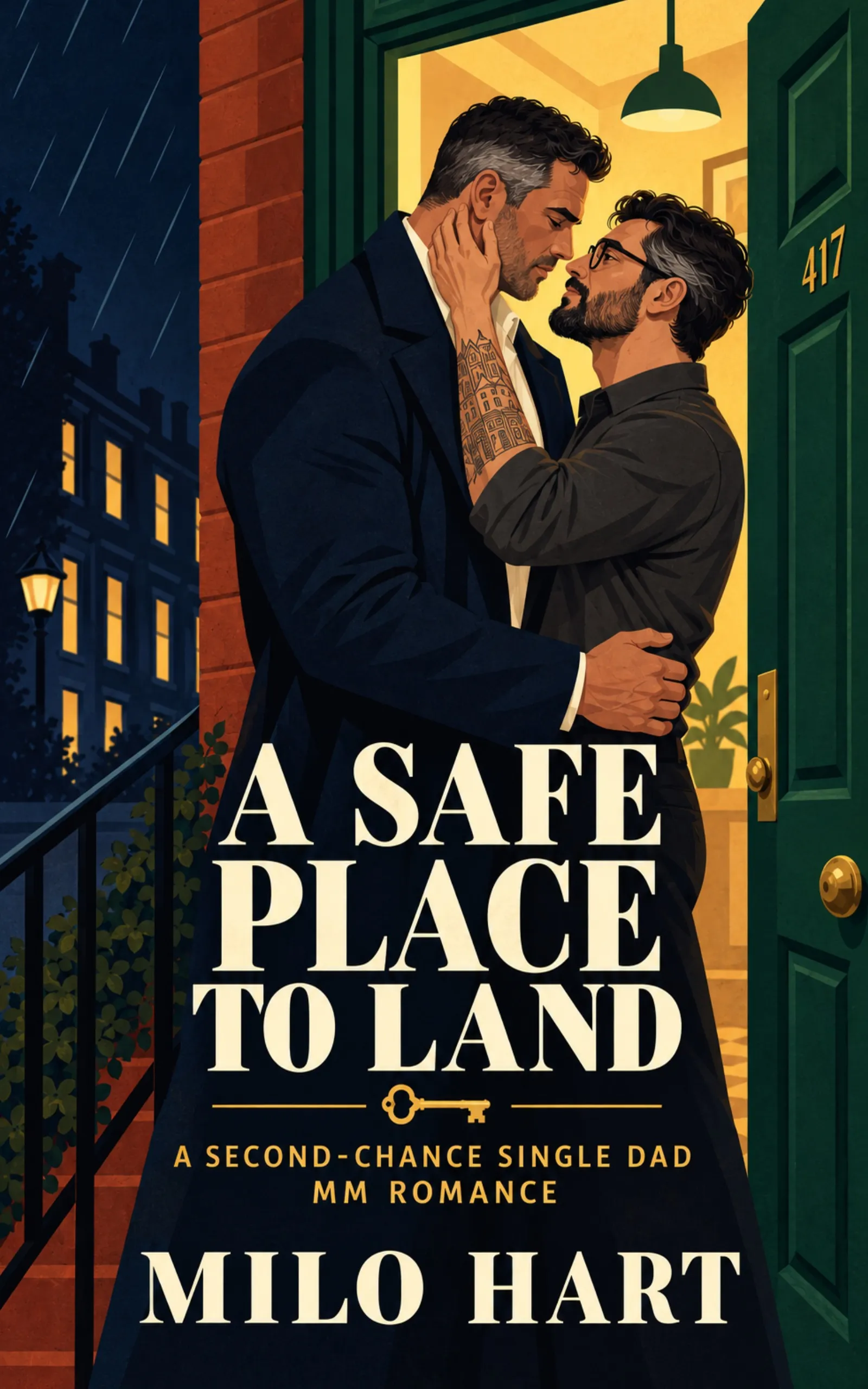
A Safe Place to Land
A High-Heat MM Second-Chance Romance
by Milo Hart
Shop the ebook · Shop the audiobook
Available at all major retailers
Pairing: MM
Heat: 🌶️🌶️🌶️🌶️🌶️ Inferno
Tropes: Second Chance, Newly Out Single Dad, Forced Proximity, Exes Reunited, Coming Out Later in Life, House Rules, Private Not Secret, Small Town, Love Letters, Dirty Talk, Hurt/Comfort, Found Family
It isn’t a second chance. It’s a roof. For six weeks.
Henry Cole has a duffel bag, a wedding ring in his coat pocket, a thirteen-year-old daughter who hasn’t answered his texts in six days, and, as of this afternoon, no house. Four months ago he finally told his wife the truth: he’s attracted to men, and he always has been. Tonight the apartment he rented has its ceiling on the floor, every hotel off the highway is full, and there is exactly one phone number left that his thumb still knows by heart.
Gabe Saunders hasn’t heard that voice in eighteen years. Not since a college stairwell, four words — I can’t do this — and a cold sheet. He’s forty now. He owns his building, restores old houses for a living, and is one of four architects bidding for the commission of his career. He makes up the guest room anyway. Then he writes the rules on a strip of tracing paper: You parent, I don’t. The past stays out of this house. Nobody plans past six weeks.
It’s a roof. That’s all. A galley kitchen thirty-eight inches wide. One plaster wall between two beds. A man who cooks by the gram and still can’t make a sound when he comes — and, lying awake on the other side of that wall, the man who taught him to be that quiet.
But Henry’s daughter is watching to find out who her father really is. His own father sits on the board that will decide Gabe’s future. And Gabe will not be anyone’s secret twice. If Henry wants more than six weeks, he’s going to have to say so out loud, with the lights on, in the one town where everybody knows his name.
A Safe Place to Land is a scorching, emotional MM second-chance romance with a newly out single dad, forced proximity, a found family worth fighting for, and a hard-won HEA.
You’ll love this book if you enjoy:
✅ Second-chance romance, eighteen years in the making
✅ A newly out single dad at thirty-eight
✅ Forced proximity: one guest room, one thin plaster wall
✅ Written house rules, broken one at a time
✅ “Private, not secret” — a hero who refuses to be hidden twice
✅ A sharp, funny thirteen-year-old who sees everything
✅ An ex-wife written as a person, not a villain
✅ Dirty talk, praise, and a man learning to be loud (🌶️🌶️🌶️🌶️🌶️)
✅ Small-town stakes and a very public declaration
✅ Found family and a guaranteed HEA
⚠️ Content Warning: This novel contains explicit sexual content (graphic MM scenes including oral, anal, rimming and mutual masturbation), strong language, a homophobic slur in an anonymous message, a parent’s past coercion over a character’s sexuality, closeting and coming out later in life, divorce and co-parenting, a child learning of her father’s relationship through a leaked photo, past infidelity (anonymous encounters during a prior marriage, disclosed on the page; there is no cheating between the leads), and a temporary breakup. Intended for readers 18+.
📖 Read Chapter One Free
Not sure yet? Read all of Chapter One right here.
Chapter One
HENRY
The pen was still in his hand.
Henry noticed it long after he’d stopped needing it. A cheap blue click pen with Lehigh Abstract & Title stamped in gold down the barrel. He had signed his name with it twenty-three times that afternoon. He’d counted, because counting was easier than reading what he was signing away: the house on Wexford Glen Drive. The maple he’d put in the front yard the week Lily came home from the hospital. The kitchen island where, four months ago, on a Tuesday, with the dishwasher running, he had finally said it.
I’m attracted to men, Claire. I always have been. I can’t keep doing this to you.
Three sentences. Fifteen years of marriage had come apart behind them like wet cardboard.
He clicked the pen. Clicked it again.
The lobby of the Kestrel Suites smelled like chlorine and waffle batter. Behind the breakfast bar a muted television showed a green smear of rain dragging itself across eastern Pennsylvania, and through the sliding doors the parking lot had already gone the color of dishwater. A youth lacrosse tournament was checking in. Boys in matching hoodies ricocheted between the luggage carts while their fathers stood at the desk with their wallets out, tired and uncomplicated, men who knew where they were sleeping tonight.
Henry had a duffel bag between his shoes, a garment bag over the arm of the chair, and a folder on his knee that said he no longer owned a home.
One of the fathers peeled away from the desk, did a double take, and came over with his hand out.
“Henry Cole. Keystone Valley. You did our refinance, what, two summers ago?”
“I did.” Henry was on his feet before he’d decided to stand, the smile already in place, the grip already the correct firmness. Eighteen years of practice. He could have done it under anesthesia. “The colonial on Birch. How’s the rate treating you?”
“Like a king. You here for the tournament?”
“Just passing through.”
“Well. Tell Claire we said hello.” The man clapped him on the shoulder and went back to his son.
Henry sat down again. The smile took a moment to come off, like tape.
Tell Claire. So it hadn’t gotten everywhere yet. Give it a week.
He set the pen on the side table and slid his hand into his coat pocket instead, which was worse.
The ring was in there. It had been in there for nineteen days, ever since the morning he’d checked into this hotel, stood at a bathroom sink the size of a mixing bowl, and worked it off over his knuckle. He hadn’t been able to put it back on. He also hadn’t been able to drop it into his shaving kit with the razor and the floss, like one more thing a man traveled with. So it rode in the right-hand pocket of his wool coat, and a dozen times a day his fingers found it and turned it, and turned it, the way a tongue goes to a missing tooth.
With his other hand he thumbed his phone awake.
Eleven texts. Six days. Every one of them marked Delivered, and under every one of them, nothing.
Good luck at the scrimmage, Lil.
How’d it go?
Mom says you scored twice. That’s my girl.
Sorry. I know you hate “that’s my girl.”
Friday at 6. Bring the Pentax. There’s a covered bridge out past the new place and the light’s good around 7.
He scrolled past the rest. They got shorter and sadder as they went, a grown man knocking on a door with less and less conviction.
She’d been told three weeks after her mother. The two of them on the couch, Henry in the armchair, a script the mediator had more or less written for them. Lily had listened to the whole thing with her knees pulled up to her chest. Then she’d said, So it was fake. The entire time, and gone upstairs, and that was the last complete sentence she had volunteered to him.
The eleventh text he’d sent at 4:52 this afternoon.
Change of plans about where we’re staying tonight. Still coming at 6. I’ll explain in the car.
Because at 3:40, while he was still in the title company’s parking lot with the ink drying, the property manager from Millrace Commons had called.
Unit 2C. Two bedrooms, second floor, inside the bus zone for Briarwood Middle. He’d put down first, last, and security three weeks ago and bought a bed frame for a room he had never seen with furniture in it. A pipe had let go in the apartment upstairs sometime Wednesday night. The ceiling had come down in the smaller bedroom. Lily’s bedroom.
Briarwood, of all places. He had left that town at eighteen on a baseball scholarship with a plan never to need it again, and here he was fighting for a two-bedroom there because it kept his daughter on the same school bus.
“We’re looking at six weeks, Mr. Cole, and that’s if the remediation people show up when they say,” the woman had told him, with the bright dread of someone who made this call for a living. “I can refund your deposit or I can hold the unit.”
“Hold it,” Henry had said.
He was a man who said hold it. He said it to nervous first-time borrowers and to loan officers who wanted to panic. He had built a career out of being the calmest person in any room with bad news in it.
Then he’d driven back to the hotel he had checked out of at noon, and the kid at the front desk, twenty-two at the outside with his name tag pinned on crooked, had looked at his screen and winced.
“We’re sold out through Sunday, sir. The tournament. I can call around, but honestly? Everything off the highway’s going to be the same.”
So Henry had sat down in the lobby and gone through it the way he would go through a file.
Claire’s sister’s townhouse: one bedroom and a pull-out sofa, already holding his wife and his daughter.
His parents’ house on Orchard Hill: four bedrooms, three of them empty, and a father who had said exactly one thing to him since the news reached him. You’ll fix this, Henry. Whatever this is, you will fix it before it gets around. Henry would sleep in the car before he carried a duffel bag up that driveway.
A motel in Harlow, twenty-five minutes out. Two double beds and a vending machine, on the first night in a month that Lily had agreed to stay under the same roof as him.
He had run every number. None of them worked.
And then, at ten past four, alone in the car with the first rain ticking on the windshield, he had done the thing he’d spent eighteen years not doing.
He hadn’t needed to look the number up. It wasn’t in his contacts. It had never been in any phone he’d owned; he had made sure of that, the way a drunk makes sure there’s nothing in the house. But his thumb knew it. His thumb knew it the way his hand still knew a four-seam grip, the way his feet knew the stairs of a house that now belonged to a couple from Allentown. Ten digits. He’d watched himself press them.
Four rings. A recording. You’ve reached Gabe Saunders at Saunders Studio.
And Henry had talked.
He honestly could not have said what came out. His name, probably. The apartment. Lily. He was fairly sure he’d said I know I have no right to ask you for anything. He had a sick suspicion he’d said it more than once. There might have been something about six weeks. There might, God help him, have been an apology, delivered to an answering service, for something he had done in a stairwell when he was twenty.
Then he’d hung up, walked in here, and sat down like a man waiting to be sentenced.
That was most of an hour ago. He had spent it not looking at his phone, with the fixed concentration of someone not looking at a wound.
The phone buzzed against his palm.
Not Lily.
Missed call. Voicemail (0:31). He had silenced the ringer for the closing and never switched it back on. Above the notification sat ten digits he would have known in the dark.
Thirty-one seconds.
Henry looked at the number for considerably longer than that. Thirty-one seconds was enough time to say no politely. It was enough time to say lose this number. It was, if he was being fair, about twenty-nine seconds more than he had ever given Gabe.
A lacrosse stick clattered across the tile. Somebody’s mother yelled a name. Henry pushed a finger into his left ear, put the phone to his right, and pressed play.
A breath first. Only that: one slow exhale, a man setting something heavy down.
“Henry.”
Everything in him stopped.
“It’s Gabe. I got your message. All four minutes of it.” The dryness in that was so familiar it hurt. “Fourteen Pruitt Street, in Briarwood. Brick duplex, two doors. You want the green one, upstairs bell. There’s a room for you and a smaller one for your daughter. It’s got a drafting table in it, so tell her to ignore the mess.” A pause. Something clinked, a glass or a set of keys. “I put sheets on. The room’s ready. Come when you can.”
Click.
No goodbye. No it’s been a long time. No how dare you.
Henry lowered the phone and found he couldn’t feel his feet.
It was the voice. He’d braced for the words, and the words had gone straight past him, because nobody had warned him about the voice. At twenty-two Gabe had talked fast, bright and quick and a little sharp, a mouth that ran three jokes ahead of the room. This was not that. This was lower. Slower. It had gravel in the bottom of it now, and patience, like something left out through eighteen winters that had come through better for it.
And it had said his name. Henry. The second syllable dropped low and unhurried, exactly, exactly the way it used to land against the back of his neck.
Heat went through him so fast it was almost funny. A hard, stupid pull behind his navel, and then his cock was thickening against his thigh, in gray chinos, in the lobby of a mid-priced hotel, while a nine-year-old in shin pads sprinted past his knees.
He was thirty-eight years old. He had a mortgage payoff statement in his lap.
He crossed an ankle over his knee, dragged the folder higher, and breathed through his nose.
It didn’t help. His body had already gone where it wanted to go: the second-floor stairwell of Fenner Hall at midnight, a flip phone hot against his ear, his back to the cinderblock and his own roommate asleep twenty feet away behind a fire door. And Gabe on the other end of the line, across campus, talking in a voice he never used in daylight.
Here’s what’s going to happen, Cole. You’re going to walk over here. I’m going to lock my door. And then I’m going to get you flat on your back and suck your cock until you can’t remember what your major is.
A door had opened somewhere above him on the stairs. Footsteps. Henry had turned his face to the wall.
And you’re going to have to be so fucking quiet about it, Gabe had said, low, laughing, because everybody’s home. Think you can do that for me?
Henry’s entire side of that conversation had been one word.
Okay.
That was all. That was all he had ever given back. A boy in a stairwell, so hard he could barely walk straight, saying okay into a telephone because anything more might be overheard.
He’d walked over there. And Gabe had been as good as his word.
Twenty minutes later Henry was flat on a mattress on Gabe’s floor with his jeans shoved down his thighs and a pillow crushed over his own face, biting cotton, while Gabe took him down his throat slowly enough to count as punishment. Every time Henry’s hips came up off the sheet, Gabe pinned them with a forearm and stopped. Waited. Looked up the length of him with those dark, amused eyes until Henry lay still again. That’s it, breathed wet against the inside of his thigh. Not a sound. God, look at you. When he came it had felt like something being pulled out of him by the root, his whole body bowing off the bed, his mouth wide open against the pillow, and no noise in that room at all except Gabe swallowing.
He’d been proud of that, at twenty. How quiet he could be.
He had been quiet for eighteen years.
Henry pressed the heels of his hands against his eyes until he saw colors. Then, because he had apparently learned nothing, he played the message again.
The second time through, he heard what wasn’t in it.
No warmth. Not one degree. The room’s ready. Not I’m glad you called, not I’d like to see you. A street, a bell, a set of sheets. Gabe had laid it out like a spec sheet.
But he had also listened to four minutes of a man falling apart on his voicemail, and then gone upstairs and made two beds.
And he had never changed his number.
Henry sat with that one. Eighteen years, three or four phones, a business with his name on the door, and the same ten digits the whole time. He didn’t let himself decide what it meant. Probably nothing. Probably it was a number a man had printed on his invoices and couldn’t be bothered to change.
Probably.
He didn’t even know what Gabe looked like now. He had searched exactly once, three winters ago at two in the morning with Claire asleep upstairs, and found a studio website: a restored staircase, a kitchen full of light, a contact form. No photograph of the man. Henry had shut the laptop, cleared the history, and unloaded the dishwasher in the dark, as though that were a normal thing to need to do afterward.
It was 5:21. Lily was expecting him at six, in the sense that she had been informed.
He could still take her to Harlow. Two double beds, a vending machine, a cheerful lie about how this was an adventure. He could delete the voicemail and the call log and go on being a man who had never once, in his adult life, been caught wanting something.
That man was safe. That man had a spotless credit history and a firm handshake and a daughter who looked straight through him. Henry knew every inch of him, because he had built him by hand, one swallowed word at a time, starting in a stairwell.
Come when you can, Gabe had said.
Not if.
He stood up. His knees held.
He took the folder and the garment bag and the duffel. He left the pen on the side table for the next person with something to sign away. In his pocket the ring tapped once against his knuckle, and he let it.
Outside, the rain had made up its mind.
Claire was waiting on her sister’s front step with her arms crossed, tucked back under the overhang where the gutter couldn’t reach her.
She wore the long gray cardigan she graded in. Her hair was up in the clip. For fifteen years that outfit had meant don’t talk to me until I’ve finished these, and Henry’s body still read it that way, still wanted to go put the kettle on.
“You’re four minutes early,” she said.
“I’m always four minutes early.”
“I know. I used to think that was a virtue.” It wasn’t cruel. It was only accurate, and she let it sit between them in the wet. “She’s getting her bag. She has packed a camera, a phone charger, and nothing I would describe as pajamas.”
“I’ve got a T-shirt she can sleep in.”
“I’m sure you do.” Claire’s eyes went to the car, to the garment bag hooked in the back window, then returned to him. “Your text said change of plans.”
So he told her. The pipe, the ceiling, six weeks. He kept it to four sentences. He watched her counselor’s face take it in and arrange itself, the same face she used on fifteen-year-olds explaining why they hadn’t technically been vaping.
“So where are you taking my daughter, Henry?”
“Our daughter.”
“Where.”
“Briarwood. Pruitt Street. A friend of mine has a duplex. There’s a room for her. A real one, with a door on it. It’s in the bus zone, so she can still get the 7:10.”
“Which friend?”
Rain ran off the edge of the overhang in a bright, steady rope. Henry made himself look at her instead of at it.
“Gabe Saunders. We were at Marwood together.”
Nothing moved in Claire’s face, which was how he knew something had moved behind it.
“You have never mentioned a Gabe.”
“No.”
The word hung there. She had spent four months finding out how much a man could keep in the things he didn’t mention. She could pick out one of his silences from across a room now.
“Is he…” She stopped. Glanced at the door behind her and dropped her voice. “No. I’m not asking you that on a doorstep. I’m asking you three other things. Is she safe there. Is it stable. And is this something I’m going to hear about from a parent in the pickup line before I hear it from you.”
“Yes. Yes.” He swallowed. “And no.”
He meant all three. He was sure of two.
“Text me the address.”
“I already did.”
“Of course you did.” For half a second she nearly smiled, and it was so much the old Claire, the one who stole his fries and called him Mr. Spreadsheet, that his chest went tight. Then it was gone, and she looked tired, and thirty-eight, and like someone he had done this to. “Henry. Don’t make her find things out the way I did.”
“I won’t.”
“That wasn’t a request.”
The door opened before he had to answer.
Lily came out sideways, the way she’d started doing everything lately, as if the world were a hallway she was trying to get down without touching the walls. Black hoodie, hood up. Soccer bag over one shoulder. The old Pentax hung around her neck, zipped inside the hoodie to keep the rain off, a square lump over her sternum like a second heart. One earbud in. One dangling.
She had grown again. He’d only been gone nineteen days.
“Hey, Lil.”
Her eyes passed over him the way they’d pass over a parked car.
She hugged her mother for a long time. Henry studied the gutter. He heard Claire say math test Monday and shin guards are in the side pocket and something lower that he wasn’t meant to catch. Then Lily walked past him down the steps, opened the rear door of the car, and got into the back seat.
The back. Behind the passenger side. As far from him as the vehicle allowed.
“She’ll tell you she’s eaten,” Claire said.
“Has she?”
“Half a quesadilla and a bag of those sour worms. Good luck.”
He drove.
The wipers kept time. For the first few miles the only sound from the back seat was the tinny leak of a podcast, two women with cheerful voices discussing where a body had been found. He caught her in the mirror once, the hood, the pale point of her chin, a strip of gummy candy disappearing between her teeth, and looked away before she could catch him at it.
“There’s a drafting table in your room,” he tried.
Nothing.
“Do you know what a drafting table is?”
“I have the internet, Dad.”
Four words. He took them like water. “Right. Sorry.”
Another mile. The road dropped toward the river and the first lights of town.
“Who is this guy?”
She’d pulled the earbud out to ask. He could see the white wire looped around her finger.
“An old friend,” Henry said.
He heard it as it left his mouth. Old. Friend. Two words, both of them defensible, both of them something he could have said under oath. And it was the first lie he had told his daughter since the afternoon he had sat in that armchair across from her and promised, with both hands flat on his knees, that he was finished lying.
Three months. He’d made it a little over three months.
“You don’t have old friends,” Lily said. “You have guys from the bank, and you have the man at Delancey’s who sells you screws.”
“I had a life before the bank.”
“Did you.”
It wasn’t a question. Henry’s hands shifted on the wheel.
“From college. His name’s Gabe. He designs houses. Fixes up old ones, mostly.”
“Does he have kids?”
“No.”
“A wife?”
The wipers went across. Came back.
“No.”
In the mirror, her eyes. His own eyes, that same gray-blue, in a face that was otherwise all Claire. They held on him for one long, level second, and he watched her do the arithmetic. She was thirteen. She listened to forty hours a week of women explaining how to tell when a man was leaving something out.
She put the earbud back in.
“Cool,” she said, in the voice of someone bagging evidence.
He could have fixed it right there. The light at the bottom of the hill was red; he had a full thirty seconds. He’s not just a friend, Lil. He’s someone I loved a long time ago, before your mom, and I treated him badly, and I’m scared out of my mind. It was all there, ready, a whole honest paragraph.
The light went green. Henry drove.
Briarwood came up around them the way it always did, all at once and unchanged. The depot first, dark behind its chain link, plywood over the arched windows. Delancey Hardware. The Keystone Valley branch on the corner of Main, his employer’s logo glowing blue in the rain. The street he’d walked to school on. The turn he would have taken for Orchard Hill, which he did not take.
Left on Pruitt.
Number fourteen was a tall brick house with a deep front porch and two doors, and one of the doors was green. A lamp burned in a downstairs window, shining on the tilted plane of a worktable, rolls of paper, a jar of pencils. Upstairs, every window was lit. Somebody had gone through and turned on all the lights, so that a person pulling up in the dark would know which house.
Henry put the car in park and didn’t move.
“Are we getting out,” Lily said, “or is this a stakeout?”
“We’re getting out.”
He got the duffel. She got her own bag and would not let him touch it. The rain came down on them like it had been waiting, and by the time they made the porch steps his coat was soaked through at the shoulders and her hood was plastered flat. Water ran off the end of his nose. He stood in front of two doorbells, one above the other, and his mind went perfectly, serenely blank.
Upstairs bell. Which one was upstairs? He lifted his hand.
The porch light came on before he’d found it.
Feet on a staircase inside. Unhurried. Coming down.
I’m not ready, Henry thought, and almost laughed, because he’d had eighteen years.
Beside him, Lily pulled out one earbud.
The green door opened.
Want to keep reading? The full novel is available now.
🔥 Want an EXCLUSIVE Bonus Chapter?
Nobody’s Home — A scene TOO HOT for the bookstore
Closing day on the house on Alder Street. The furniture comes Monday. Tonight there is one mattress, one work light and eleven empty rooms, and Gabe has just discovered that a house with nothing in it echoes.
More from Milo Hart
Browse all Milo Hart books.

The Bench Beside Mine
He saved the seat. Then he saved a little more.

The Winter He Learned to Stay
Eighteen years ago he left without a goodbye. This winter, the storm won't let him leave.

The House We Left Behind
He left before morning. This time, he has to ask.

The Last Train Home
Six weeks. Four rules. One spare room over the diner he walked out on.

A Safe Place to Land
It isn't a second chance. It's a roof. For six weeks.

The Roommate Hypothesis
Two roommates. Six rules. One experiment that was never supposed to become everything.
Never Miss a Release
Get new release alerts, exclusive bonus content, and reader-only giveaways.