
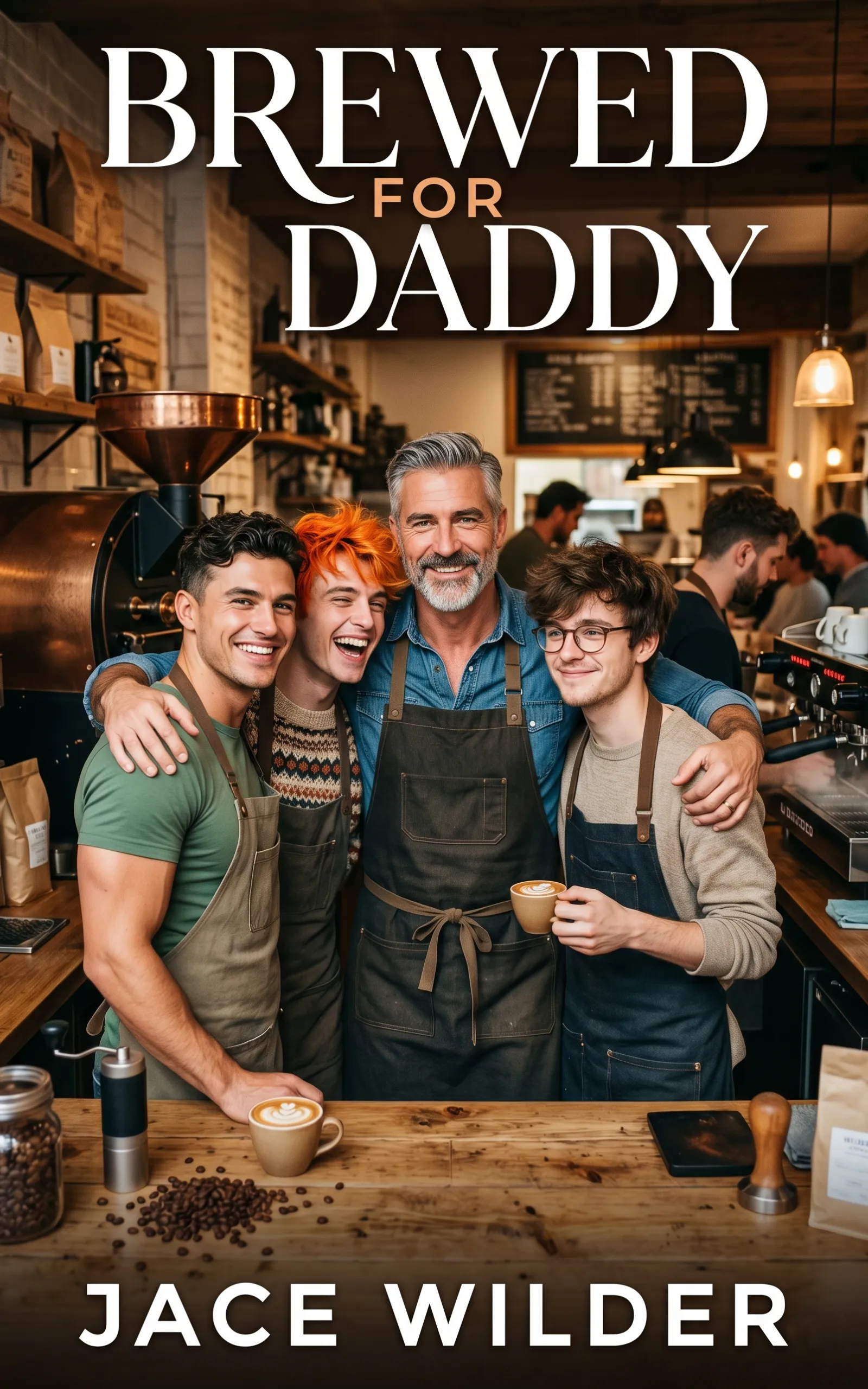
Brewed for Daddy
An MM Reverse Harem Café Romance by Jace Wilder
Available everywhere ebooks are sold
Pairing: MMMM (Daddy + Three Boys)
Heat: 🌶️🌶️🌶️🌶️🌶️ (Inferno)
Tropes: Reverse Harem · Age Gap · Why Choose · Praise Kink · Found Family · Grumpy-Sunshine × 3 · Workplace Romance · Small Town · Breeding Kink
Forty-six years of running my café alone. Three college boys in one Thursday morning. You do the math.
Malcolm Reyes has run Reyes Roastery for twelve years. He owns the building. His mother’s name is on the cornerstone. He’s been eating dinner alone for the last ten years and calling that a life. Then a corporate coffee chain with his former best friend as VP comes calling — and on the same Thursday morning, three college boys walk into his café within ten hours of each other, and Malcolm hires all three.
Finn is the twenty-one-year-old art major with pumpkin-orange hair who calls Malcolm “Daddy” by accident in the first thirty seconds and can’t take it back. Jude is the quiet business junior whose grandfather ran a café in Sacramento. Riley is the hospitality major who’s been coming to Reyes Roastery for four months because the place smells like his grandfather’s shop in Ashbury.
What starts as flirtation behind the espresso bar becomes a household contract, a whispered yes Daddy in the back room, and — when the corporate war comes for the café — a bed with four men in it and a very specific set of ground rules.
Malcolm built the café. The boys built the family. Together they’re going to defend both.
You’ll love this if you enjoy:
- ✓ Silver fox daddy with three eager twenty-one-year-old boys
- ✓ Why Choose / Reverse Harem MM (no one chooses, everyone stays)
- ✓ Specific, named, on-page praise kink and breeding kink
- ✓ Cozy café setting with found family regulars who cheer at the first public kiss
- ✓ Corporate-villain-with-a-past who gets a redemption arc
- ✓ One group scene that readers are going to scream about
- ✓ Explicit consent, named safewords, aftercare shown on-page
- ✓ HEA with all four men together, forever
⚠️ Content Warning
This is a scorching MM reverse-harem romance with very explicit sex scenes involving four consenting adult men. Contains: on-page oral, anal, group sex, praise kink, breeding kink, daddy kink, power exchange, light D/s, and one explicit double-penetration scene (bonus chapter). All dynamics are enthusiastically consensual, with named safewords, on-page negotiation, and shown aftercare. Plot elements include corporate harassment, fake online reviews, estranged parents (reconciliation-adjacent, never forced), and a brief discussion of sex work in an emotionally supportive context. No cheating. No dubious consent. HEA guaranteed — all four men are home by the end.
Intended for readers 18+.
📖 Read Chapter One Free
Not sure yet? Read the full first chapter right here.
Chapter One: Help Wanted
Malcolm
Four in the morning, the roaster running its slow burn, and I was already losing the day.
The email had come in at 11:47 the night before. I’d seen it on my phone in bed and made myself put the phone down without opening it. Then I’d lain there for three hours staring at the ceiling fan like it owed me money, and at 3:30 I gave up and came in early to roast.
Now the beans were doing their first crack in the drum behind me, that soft popcorn-pop sound, the smell going from grass to caramel to something darker, and I was sitting at the bar with my laptop open and my second espresso going cold in front of me. The subject line was in caps because Curtis had always typed in caps when he wanted you to know he meant it.
FW: REYES ROASTERY — REVISED OFFER (FRIENDLY)
Friendly. Christ.
I clicked it.
Mocha—
Good seeing you last month at the trade show. You looked well. Hope the back is holding up.
I want to keep this one between us before legal gets their hands on it. Corporate authorized me to come up another fifteen on the building plus a five-year consulting contract for you at a number you’ll like. I think you’ll find it more than fair, especially given the foot traffic projections for the campus expansion. We both know what’s coming for that block.
No pressure on timeline. Coffee soon?
— C.
I read it twice. Closed the laptop. Drank the cold espresso in one swallow.
Coffee soon. That was the part that pissed me off. Like we were going to sit across from each other at one of his BrewCorp prototypes and pretend it was 2002 and we were splitting a danish over the cooler in the food truck. Like he hadn’t been writing me checks with one hand and signing my eviction with the other for three years.
I got up, went to the roaster, pulled the trier, took a sniff. Another minute. I dropped the drum, hit the cooling tray, watched the beans tumble dark and oiled and almost there.
The thing about Curtis was, the offers had been getting bigger because the campus expansion was getting closer, and the campus expansion was getting closer because the regents had finally voted in March, and that meant I had — what — eight weeks? Ten? Before BrewCorp’s lawyers stopped being friendly and the city’s planning commission started being not-friendly in a way I’d be paying lawyers of my own to fight.
I’d bought the building in 2014 when this block was still half-vacant and the bank had laughed at me for offering. I’d put a roof on it the next spring. I’d put my mother’s name on the corner stone. I was not selling the building.
I was also, increasingly, not sleeping.
The bell over the front door went off and I about jumped out of my skin, because the front door was locked and it was four-thirty in the morning. Then I remembered I’d unlocked it when I came in to bring the milk crates up from the curb, and I’d forgotten to throw the deadbolt back.
“We’re not open,” I called.
“I know,” a voice called back. Young. Male. Cheerful in a way nobody should be cheerful at 4:30 a.m. “I’m so sorry. The sign on the door said the listing was up at five and I figured if I waited in line outside someone would beat me to it, so I just thought — hi.”
I came out of the back room wiping my hands on the towel hanging off my apron string. There was a kid standing in the middle of my café in a denim jacket two sizes too big for him, holding a folder against his chest like a shield. Pale. Freckled. Hair platinum on the sides and bright pumpkin orange on top, falling into one eye. A septum ring. Sky-blue eyes that had clocked me the second I came around the espresso bar and were now doing a slow, deliberate up-down that landed back on my face with no apology.
He smiled. The smile had teeth in it.
“Hi,” he said again. “I’m Finn.”
“You’re early,” I said.
“By about thirty minutes, yeah.”
“By about four hours.”
“I was very motivated.”
I looked at him. He looked at me. The orange hair bit was on purpose; I could tell from the way he tilted his head so it slid further into his eye, like a habit, a tic he’d weaponized.
“Resume’s in the folder?”
“Resume, two letters of reference, my food handler’s card, and a latte I made this morning at the place I’m currently working. Photo of the latte, I mean. I didn’t bring you a cold latte. That would be insane.”
“Mm.” I held out my hand. He gave me the folder. I flipped it open on the bar. Solid resume actually — three years at a third-wave place across town that I respected, art school enrollment up at the university, references from people whose names I knew. The latte photo was a tulip with seven layers. Showoff.
“How’d you hear we were hiring?”
“I follow your Instagram.” He paused. “That sounds bad. I mean, I follow a lot of cafés’ Instagrams. For research purposes.” Another pause. “Okay it sounds bad either way.”
“You currently employed?”
“Yes. But I want out. Owner’s a creep.”
“Define.”
“Asks the female baristas to wear shorter shorts in summer. Comments on my ass. He’s married.”
I made a note in my head. Wrote his name and phone number down on the back of the folder in pencil so I’d remember which one was which when the day was over.
“Why us?”
He blinked. Like he hadn’t been expecting an actual question.
“Honestly?”
“Honestly.”
“You’re the only café in this town that roasts your own and pays a living wage. I priced it out. Your starting hourly is forty-three percent over the metro average for food service and you offer health after ninety days. Nobody does that. Also—” he lifted his chin, “—your latte program is the best in the state and I want to learn from someone who actually gives a shit. I’m not going to sit here and tell you I want to be a lifer. I’m an art major. But I’d rather pull shots for you for two years than pull shots for any of these other clowns for one.”
I let that sit for a second.
“You always this prepared for interviews?”
“I made spreadsheets.”
“Show me a pour.”
He went bright pink, which I hadn’t expected, and which did something to me I told myself I’d think about later or, ideally, never.
“Right now?”
“Bar’s right there. Beans in the hopper. Pull me a double, steam me four ounces of whole, give me a heart. I don’t need a tulip; I need to know your hands.”
He set his folder down so carefully you’d have thought it was made of glass. Took off the denim jacket, hung it on the hook by the till like he’d worked here for a year. Underneath he was in a thin black t-shirt that did nothing to hide that he was built lean as a whippet, and a pair of jeans that did even less to hide the rest of him. I looked at the espresso machine and not at him.
He moved like he’d been making coffee his whole life. Tamped clean, locked the portafilter in with a wrist flick, set the cup, hit the button. While the shot pulled he steamed the milk — wand angled right, no screech, the pitcher tilting just-so as the foam built. I watched his hands. You can tell everything about a barista from the hands. His were quick and sure and the nails were chewed down to the quick.
He pulled the shot at exactly twenty-six seconds. Poured. The heart came out clean, centered, a little heavy on the lobes the way I liked them.
He slid the cup across the bar to me without breaking eye contact.
“For you, Daddy.”
There was a beat.
His face went the color of his hair.
“Oh my god,” he said. “I am so sorry. That is what I call my last boss because he’s a creep and I do it under my breath to make my coworkers laugh and it just — it came out, I am so sorry, that was so unprofessional, please don’t—”
“Finn.”
“Yes.”
“What time can you start.”
He stopped breathing for a second. I watched his throat work.
“Whenever you want.”
“Monday. Six a.m. Wear something you can move in. We’ll trial you for two weeks at training rate, then bump you to scale. Health kicks in at ninety days. You good?”
“Yes.”
“Go home and sleep. You look like hell.”
“Thank you so much, I won’t—” he was already grabbing his jacket, his folder, half-tripping over the leg of the bar stool, “—I won’t disappoint you, I swear, I’m going to be so professional, like aggressively professional, you won’t even know I—”
“Finn.”
“Yeah.”
“Take the latte. You earned it.”
He took the latte. He looked at me over the rim with those sky-blue eyes and I knew, with a small clear certainty I should have paid more attention to, that I had just made my life significantly more complicated.
The bell rang behind him on the way out.
I picked up the cup he hadn’t quite touched and turned it in my hand. The heart was already starting to sag at the edges, the way they do.
Daddy. Jesus Christ.
I went back to the roaster.
The second one came in at six.
By then I’d opened the front, flipped the chalkboard, started the regular drip, set out the pastry case with the bake from across the street, and put on the Sunday-morning playlist even though it was Thursday because the Sunday-morning playlist was the one that calmed me down. Maria from the bookstore came in for her cortado and didn’t say anything to me about my face, which meant my face must have looked rough. Pete from the city desk came in for a drip and a scone and asked if I’d seen the regents’ agenda for next month, and I said no and meant yes and don’t make me think about it.
The second applicant — Jude Kane, his email had said — came in at six on the dot, which I appreciated. He was tall, broad through the shoulders in that specific way that meant he’d played a sport that required running, tan in late August the way you got from being outdoors not from being on a tanning bed, and he had the kind of curly chestnut hair that he very clearly had not brushed since the previous morning. Hazel eyes. A coffee-cherry branch tattoo down one forearm, which I clocked because I knew what a coffee cherry actually looked like and most tattoo artists did not, and his was right.
He was in jeans and a faded green t-shirt with the university’s business school logo on the chest, and he stood in the middle of the floor with his hands in his pockets like he wasn’t sure he was supposed to walk to the counter.
“Jude?”
“Hey.” He came over. Easy walk. Looked me in the eye. Shook my hand once, firm, didn’t try to crush it. “Sorry, do you want me to stand somewhere specific, or—”
“Sit, sit. You want anything before we start?”
“A drip, if it’s not annoying.”
“Cream and sugar?”
“Black.”
“Smart man.”
I poured him one. He took it with both hands and held it for a second under his nose before he sipped it, which is the kind of thing only people who actually like coffee do. Most people pick up a cup and drink it. He smelled it first.
“That’s nice,” he said. “What is that, the Yirg?”
“Ethiopian. Natural process. You like it?”
“Tastes like blueberries.”
“It does.”
He sipped again. Looked down at his hands. Looked back up. “I should be honest with you about something before we get into it.”
I leaned against the back counter and crossed my arms.
“Okay.”
“I’m a business major. I’m a junior. My parents are paying for school but barely, and I picked up the FAFSA gap with work-study and now I’m out of work-study eligibility for the year, which is why I’m here. So I’m not going to lie to you and say I’m a coffee guy who’s been waiting to apply at Reyes Roastery his whole life. I’ve been a barista for two summers at a chain back home and I’m probably not as good as the last guy who walked in. But—” he held up the cup, “—I want to learn how to make this. And I’ll work hard, and I won’t call out, and I’ll close every Friday and Saturday if you need me to, because nobody else wants those shifts. I’m not the flashiest hire you’ll get this week. I’m just the most reliable. That’s the pitch.”
I let it sit. He let it sit too. He was good at silence in a way most twenty-one-year-olds aren’t.
“Why business?”
He made a face.
“My dad.”
“You like it?”
“I like the accounting part. I hate the marketing part. Mostly I just—” he shrugged, “—I want to be done with school. I’d rather be working with my hands.”
“Doing what.”
He hesitated. I waited him out. He glanced at the roaster behind me through the open back-room door.
“Doing that, probably,” he said. “I don’t know. I’ve never seen it done. I just like the smell.”
I held his eyes for a second longer than I meant to.
“You can start Monday,” I said. “Six a.m. Same trial rate as the kid I hired this morning. We’ll see how you do on bar; if you take to it, I’ll start showing you the roaster on Saturdays. I drop the drum at five a.m. on Saturdays. You’d have to be here at four-thirty.”
He sat up a little straighter.
“I can do four-thirty.”
“You sure.”
“Yes, sir.”
Sir. I told myself that one didn’t land. It landed. I let nothing show on my face.
“Good. Welcome aboard. Go fill out the W-9 with Marisol when she comes in at eight. Take a pastry on your way out.”
“Thank you.” He stood up. Hesitated. “Mr. Reyes—”
“Malcolm.”
“Malcolm. Thank you. Seriously. I — yeah. Thanks.”
He took an apple turnover and went out the door slower than Finn had, with more thought, with one look back over his shoulder at the roaster like he was filing it away. I watched the door swing shut behind him.
I had the distinct sensation, standing there with my second hire of the morning still warm in the room, that the universe was setting something up. I just couldn’t tell yet what the punchline was.
The third one I didn’t even remember scheduling.
He came in at four in the afternoon, during the lull, when I was reorganizing the syrup bottles because I needed something to do with my hands that wasn’t checking my phone for another email from Curtis. The bell rang and I looked up and there was a kid standing in the doorway with a backpack on one shoulder and an expression like he wasn’t sure he had the right address.
He was small. Compact, more accurately — five-eight maybe, broad through the shoulders the way a gymnast is broad through the shoulders, olive-skinned, a buzzed dark fade and big amber eyes that were currently doing their best to look at the floor.
“Um,” he said. “Hi. I had a — I think I had an interview at four? I’m Riley. Voss.”
I blinked. Pulled my phone out. Checked my calendar. There he was, four p.m., Riley Voss, hospitality management junior, scheduled by my sister-in-law Marisol last Tuesday because she’d gotten an email from a kid she said sounded “polite.” Marisol screened my hires when she had time; mostly she screened them based on whether they sounded polite.
“Riley. Yeah. Sorry, kid, long day, I forgot. Come on in. Sit anywhere.”
He sat at the bar. Set his backpack down very carefully between his feet. Folded his hands on the counter.
“You want a drink?”
“Um — water, please. If that’s okay.”
“Water’s free.”
I poured him a glass. He thanked me three times. He took a sip and then held the glass in both hands like Jude had held his coffee, and I noticed he had a small barbell through one nipple visible faintly under his white t-shirt, which I told myself I had not noticed and which I was going to forget about.
“So,” I said. “Hospitality management, Marisol said. Why coffee?”
“Um.” He looked at the espresso machine. Looked back at me. “I — okay, this is going to sound weird, but. I’ve been coming here. Since I moved here in August. Almost every day. And I — this is the only place in this town that feels like — okay this is going to sound really stupid—”
“Try me.”
“My grandpa had a café.” He said it fast, like he had to get it out before he lost the nerve. “In Sacramento. When I was a kid. He let me work the register on Saturdays. He died when I was twelve and they sold the building and it’s a check-cashing place now. And I came in here in August and it smelled the same. And I’ve been trying to work up the nerve to ask if you were hiring for like three weeks. And then I saw the sign last night.”
He stopped. He looked mortified.
“I’m sorry. That was a lot. I haven’t done a lot of interviews.”
I set the glass of water down very carefully on the bar between us.
“What was your grandpa’s name.”
“Tomás. Tomás Voss. His dad was — anyway. He taught me how to make café de olla. I make a really good café de olla. I don’t know if that’s relevant.”
“It’s relevant,” I said.
I don’t know why I said it. I think I said it because I’d heard him say café de olla with the right vowel on the last syllable, and because he was looking at me with these enormous amber eyes that were doing their best to hold my gaze and were not entirely succeeding, and because there was a small soft thing in my chest that was telling me that this kid had walked into the right café on the right day and that if I didn’t hire him I was going to think about it for a year.
“You ever pulled a shot?”
“No, sir.”
“You know how a steam wand works?”
“In theory.”
“You scared of customers?”
“A little.”
“Honest answer. You’ll get over it.”
He nodded.
“Riley, I’m going to hire you. I’m hiring two other guys this week. We’re going to be slammed when school starts, and I need a third on the floor. You’ll be slow at first. You’ll mess up drinks. Customers will be patient with you because my customers are good people, and the ones who aren’t I throw out. You’ll be on training rate for two weeks and then you’re at scale. Health at ninety days. Monday, six a.m., wear something you don’t mind getting milk on. We clear?”
He looked at me like I’d just handed him a kidney.
“You’re hiring me.”
“I’m hiring you.”
“You don’t even — I didn’t even — I didn’t bring a resume—”
“You told me about your grandpa. That’s the resume.”
His eyes went wet. Just for a second. He blinked it away.
“Thank you,” he said. Very quiet. “Thank you, Mr. Reyes.”
“Malcolm.”
“Malcolm. Thank you.”
He stood up. Picked up his backpack. Hesitated. Looked at the espresso machine like he was saying hello to it. Then walked out, very slowly, like he was afraid he’d wake up.
The door swung shut.
I stood there holding the half-empty glass of water, in the slanted yellow four-p.m. light, and I had the distinct and unmistakable feeling that I had just very calmly and very deliberately walked into the worst, best, most god-awful complication of my entire adult life, and that I’d done it three times before lunch.
I put the glass in the bus tub.
I went back to reorganizing the syrups.
Curtis came in at 8:14 p.m., fifteen minutes before close.
I knew it was him before I looked up because he wore the same goddamn cologne he’d worn in 2003 — sandalwood and something citrus and something else that I had spent a decade trying to identify and never had — and because my body still went tight across the shoulders the way it used to when I’d hear his footsteps coming up the alley to the truck.
He was in a charcoal suit, no tie, top button open. His hair was shorter than the last time. He’d lost a little weight. He looked good. He always looked good. Curtis Lansing had been the prettiest boy in our high school graduating class and he had aged the way pretty boys with money age, which is to say expensively.
He stood inside the door for a second and looked around the café like he was appraising it. He probably was.
Then he smiled. Big, easy, the same smile he’d given me the first time we’d met sophomore year of high school in the lunch line. The smile that meant I want something from you and you’re going to give it to me.
“Mocha.”
“Curtis.”
“Place looks great.”
“Place looks the same as it looked a month ago when you came by.”
“It does, doesn’t it.” He came over to the bar. He did not sit. He set his fingertips on the counter and leaned. “I was in the neighborhood.”
“Were you.”
“I’m always in the neighborhood. I was hoping you got my email.”
“I got it.”
“And.”
I took my time wiping down the steam wand. I set the rag down. I put my hands flat on the counter on my side, mirroring his.
“And the building’s not for sale, Curtis. The fifteen, the consulting, the projections, none of it. It’s not for sale at any number you’re authorized to write. You know it’s not. You’ve known it’s not for three years. You keep coming back because — I don’t actually know why you keep coming back. I used to think I knew. I’m not sure anymore.”
His smile didn’t move. His eyes did.
“Mocha.”
“Don’t.”
“I’m trying to help you.”
“You’re trying to buy the building under me before the campus expansion finalizes so BrewCorp can have the lease-free corner and you can walk into your fourth-quarter review with my front door in your pocket. I know what you’re doing. You know I know what you’re doing. We don’t have to do this part, the part where you act like you came in for old time’s sake. We had the friend version of this conversation already. We’re doing the business version now.”
He held my eyes.
“All right,” he said. “Business version.”
“Go.”
“You have eight months, maybe ten, before the planning commission rezones the block. When they do, your property tax goes up four hundred percent. Your insurance follows. The liquor license you don’t have but might want goes from doable to a hundred grand. The bank holding your commercial line is going to want a conversation with you the second the rezone hits, because the loan covenants get triggered. You are going to spend every dollar you have left fighting paperwork that I can make go away with a phone call. I am offering you, as a friend, a number that lets you walk away with your retirement intact, your name on a consulting contract you don’t have to show up for, and the satisfaction of knowing you sold to somebody who’ll keep the Reyes name on the awning for at least the first five years of operation. That is the offer. There won’t be a better one.”
I looked at him.
I thought about the three kids I’d hired today. About Finn calling me Daddy in front of his own face by accident. About Jude looking at the roaster. About Riley’s grandpa.
I thought about my mother’s name on the cornerstone.
I leaned a little further forward across the bar so that Curtis Lansing and I were eye to eye, six inches apart, and I dropped my voice down to where it goes when I want a man to listen to me.
“Curtis. Listen to me very carefully. I am not selling you the building. I am not selling anyone the building. If the rezone passes, I’ll fight it. If the bank calls the line, I’ll refinance. If the planning commission comes for me, I have a councilwoman who has been getting her oat-milk latte from me for nine years and I will call her on my cell phone. You are not the biggest threat I have faced in this neighborhood and you are not going to be the one who takes me out. Now drink the espresso I’m about to make you, because you came in here and I don’t turn customers away, and then go home.”
I turned around and pulled him a double. I tamped clean. I locked the portafilter. I hit the button. The shot ran twenty-five seconds. I set it on the bar in front of him without a saucer.
He looked at the cup.
He looked at me.
“You always did make a beautiful espresso,” he said.
“I know I did.”
“This isn’t over.”
“I know it isn’t.”
He drank the espresso in two swallows. Set the cup down. Reached into his inside jacket pocket, took out a business card I already had four of, slid it across the counter.
“In case you change your mind.”
“I won’t.”
“In case.”
He left a twenty on the counter for a three-dollar shot. He turned. He walked out. The bell rang.
I picked up the twenty. I picked up the card. I dropped both into the tip jar.
I stood there in the empty café with the late sun coming in low and orange through the front windows and the smell of his cologne still hanging in the air, and I let out a breath I had been holding since 4:30 a.m.
Then the bell rang again.
I closed my eyes.
“Curtis, I swear to God if you came back to—”
“Um.”
I opened my eyes.
Finn was standing in the doorway, the denim jacket back on, the orange hair freshly washed and falling into his eye, hands stuffed in his pockets and a small, careful, completely fake-casual smile on his face like he’d been rehearsing it on the walk over.
“Sorry. The door wasn’t locked yet. I — okay this is so weird, I’m sorry. I was walking home from a thing and I saw the lights on and I thought — you said Monday but I thought maybe if you needed help closing, I could—” he gestured vaguely at the dining room, “—learn the routine? Like, off the clock? Just to be ready Monday?”
I looked at him.
He looked at me.
The light in the café was orange and low and his hair was the exact same color as the light and he had walked across town at 8:30 p.m. on a Thursday night to ask me if he could learn the routine off the clock and we both knew that wasn’t what this was.
I should have said no. I should have said go home, kid, I’ll see you Monday at six. I should have done a lot of things that day that I did not do.
I reached behind me without breaking eye contact. I turned the deadbolt on the front door. The lock clicked.
I flipped the OPEN sign to CLOSED.
“Get back here,” I said. “I’ll show you how we wipe down the bar.”
He came around the counter so fast he almost tripped on the gate. The smile on his face had gone from rehearsed to real. His eyes were enormous.
“Yes, Daddy,” he said, very quietly, like he was testing whether it would survive a second time.
It did.
I didn’t say anything. I handed him the rag.
The bell over the door was still settling on its hook when he started wiping down the espresso bar with both hands, and I stood behind him in the warm orange light of a café that would not, if I had anything to say about it, ever belong to Curtis Lansing, and I watched the back of his neck where the platinum undercut faded into the orange and I thought:
You are in so much trouble, Mocha.
So much trouble.
I let myself look at him for one more second.
Then I went to get the broom.
end Chapter One
Want to keep reading? The full novel is available now at every major ebook retailer.
🔥 Bonus Chapter — Too Hot for Retailers
THE CABIN — Six weeks after the ceremony, Malcolm takes the boys to a cabin in the Cascades for a delayed honeymoon. It’s night two. Riley’s been planning for six weeks. All three boys take Malcolm, in order, and then all at once. Over 11,000 words of explicit full-cast heat, including the DP scene the retailers wouldn’t let us publish.
More from Jace Wilder
MM contemporary romance with heart and heat. See all of Jace’s books here.

Deposit Required
He paid for the hours. He never planned to pay with his heart.
No Straight Answers After Midnight
He called a stranger at midnight. The stranger already knew his name.

Best Friend’s Dad Bod
He calls it a dad bod. I call it exactly what I want.

His Ex-Husband’s Brother
Nine years of restraint. One dark kitchen. No going back.

The Straight Man’s Plus-One
The boyfriend was fake. The first kiss was not.
Eight Seconds, No Regrets
He only needs eight seconds on the bull. The man who saves him wants him alive for everything that comes after.
Never Miss a Release
Sign up for updates on new MM releases, bonus chapters, and the occasional very-specific opinion about coffee.