
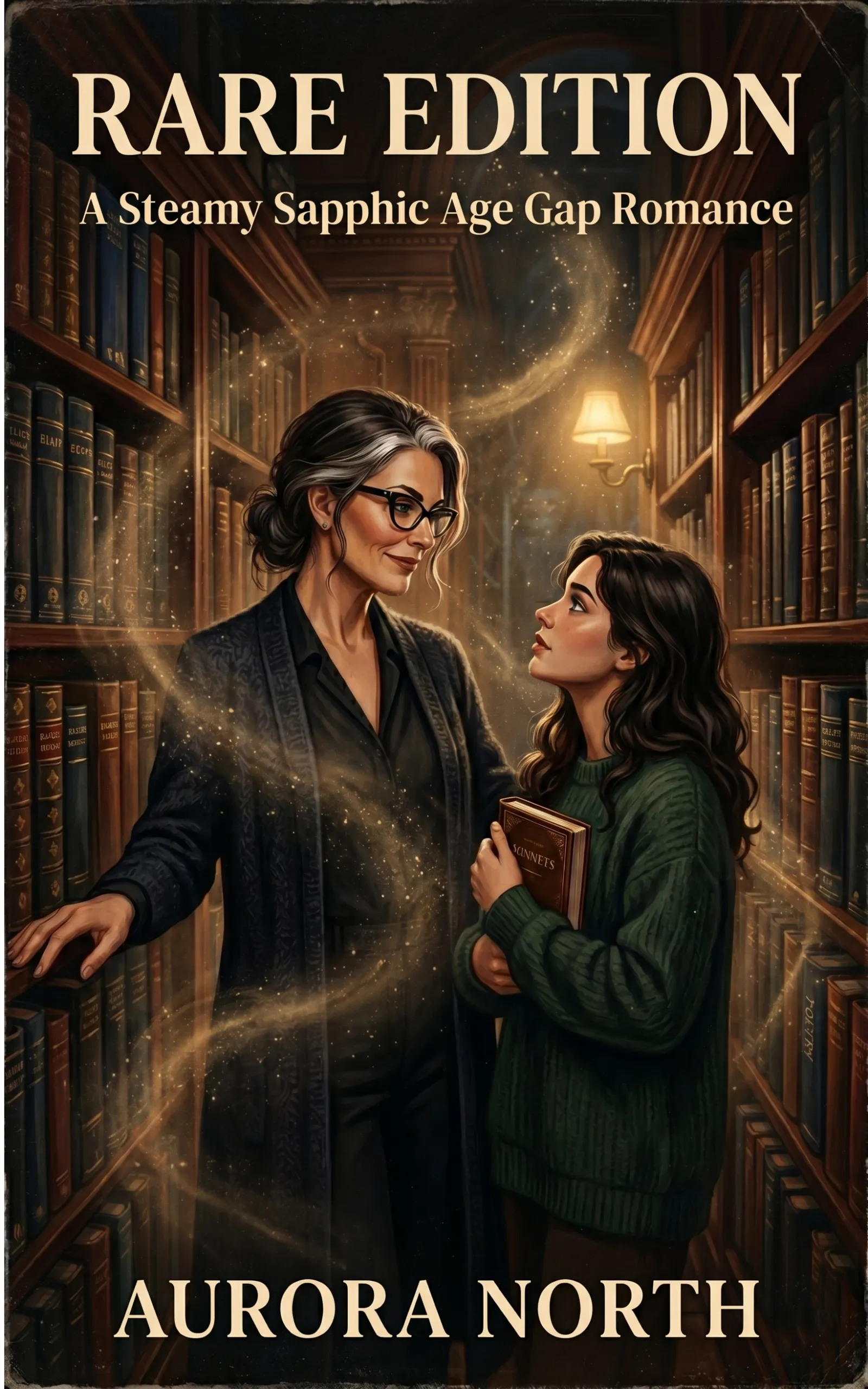
Free with Kindle Unlimited
Pairing: FF (Sapphic)
Heat: 🌶️🌶️🌶️🌶️🌶️ Inferno
Tropes: Age Gap, Praise Kink, Slow Burn, Workplace Romance, Forbidden Romance, Small Town, Found Family, Widower, Mentor/Protégée, Cozy Mystery, Bibliophile Romance
Length: 95,000 words
She came to volunteer. She stayed to solve a theft. She went home with the curator.
Dr. Evelyn Langford is fifty-one, widowed for four years, and the curator of the Harlow Memorial Library’s rare books collection. Her life is a closed system: the loft, the climate cases, the book club on Thursdays, the apartment upstairs that no one visits. She is, by every measurable standard, a success. She is also disappearing in plain sight.
Lila Harper is twenty-two. A new English-lit grad with a sapphic awakening she hasn’t fully cataloged, a mother who has plans for her, and a Tuesday-morning volunteer shift at the Harlow she has been showing up for, faithfully, for nine months. She has been carefully not looking at the curator. The curator has been carefully not looking back.
When the library’s 1855 first-edition Whitman — author-inscribed, $180,000, the centerpiece of forty years of Eve’s career — disappears from a locked case in a sealed loft, the world Eve has so carefully kept closed cracks open. The thief was inside the building. The thief knew the case. The thief was someone she once knew well. And the only person Eve trusts to help her recover the book — quietly, archivally, under the radar of a town council that wants her job — is the volunteer who has been waiting, all along, for Eve to look up.
What follows is two months of stolen evenings in the loft, a book club that turns into a war council, an investigation that reaches Pemberton’s in New York, and the slow careful unfolding of a curator who has not let herself want anything in years and a young woman who is finally being seen the way she has always wanted to be. Inferno heat. Fourteen on-page scenes. HEA, marriage, and a wedding-night bonus chapter waiting on the site.
You’ll love this if you enjoy:
✅ Age-gap sapphic romance with thirty years between them
✅ Praise kink, slow burn, and a curator who finally lets herself be wanted
✅ A forty-year-old book theft mystery solved by a found-family book club of brilliant older women
✅ Found family that includes a French widow, a retired judge, a Smith English professor, and a bakery owner with a fine-arts-investigator nephew
✅ Bibliophile romance, library setting, real archival research as foreplay
✅ A heroine who has been disappearing, and the woman who refuses to let her
✅ HEA guaranteed
⚠️ Content Warning: This novel contains explicit FF sexual content (graphic on-page scenes, including light bondage, marking, praise kink, and use of a strap-on); an age gap (51 / 22) between adult women in a fully consensual relationship; on-page theft and blackmail intimidation; depictions of anxiety, grief, and a dead spouse referenced throughout; brief depictions of homophobia from a parent character (resolved on-page); and use of the word “widow” many, many times. Intended for readers 18+.
📖 Read Chapter One Free
Not sure yet? Read the full first chapter right here.
Chapter One: Due Date
The humidity gauge in the rare books loft reads forty-seven percent, and I know before I look at it that I’m going to say nothing. Forty-seven is fine. Forty-seven is inside the range. The Harlow Collection has survived at forty-seven for a hundred and twenty years without my intervention. But the gauge was reading forty-three on Friday, and forty-three is where I set it, and there is no good reason for a climate-controlled case in a sealed loft to drift four points over a weekend when no one has opened the door.
I write it down in the inventory log. Then I write check tomorrow underneath, and then I close the log, because I have spent the last four years of my life writing check tomorrow in logs and tomorrow has always obliged.
The sun has not come up yet. I can see my own reflection in the loft window — silver at my temples catching the banker’s lamp, cat-eye glasses sliding down my nose, the collar of my cardigan turned up against a draft that shouldn’t exist in a building this well-insured. I push the glasses up. I turn sixty in nine years. I have been the curator of the Harlow Memorial Library for sixteen of them. I am, by every measurable standard, a success. I have a career that people in my field envy, an apartment that came with the job, a book club that loves me, and a husband who has been dead for four years come March.
I pick up my coffee. It’s cold. I drink it anyway. At six fifty-eight, I go downstairs to unlock the front doors, because the volunteer will be here in two hours and I like to have the day in order before anyone arrives.
The volunteer arrives at nine oh-four, which is four minutes late, and she arrives by knocking over the returns cart.
I hear it from the reference desk — the specific percussive disaster of thirty hardcovers hitting oak floorboards — and I am halfway out of my chair before the second crash follows. Someone is apologizing in a continuous, breathless, top-of-her-register stream.
“—so sorry, oh my god, I’m so sorry, I didn’t see the — is that a first edition, please tell me that’s not a first edition, I can’t believe I —”
I round the corner. Lila Harper is on her hands and knees on the library floor, pixie cut falling into her eyes, cardigan sleeve pushed up to the elbow, gathering books toward her chest with both arms. Her skirt is bunched around her knees. She’s wearing knee socks. There is a small freckle on the back of her left calf that I notice before I notice that the returns cart is, in fact, lying on its side, and that no, none of the books are a first edition, because I do not leave first editions on the returns cart, because I am not a fool.
I say, “Breathe.”
She looks up. Hazel eyes, mostly green in sunlight, mostly gold in lamplight. Wide. Ringed with panic. She has one of the books clutched to her chest — The Age of Innocence, library copy, mass market, worth approximately six dollars — and she is looking at me like I’m about to fire her.
I am not going to fire her. She has been here for nine months. She is the best volunteer I have ever had. I have not fired her. I have, however, spent nine months carefully not looking at her. I have looked at her hands and her work and the top of her head while she bends over a catalog card. I have not looked at her mouth. I have not looked at her legs. I have certainly not looked at the soft strip of skin above the waistband of her skirt that shows sometimes when she stretches to reach the top shelf of poetry.
I look, now, at her face only. “The books are fine,” I say. “Breathe.”
“Lila.” She stops. “Breathe,” I say again. “Once. All the way in. All the way out. Then stand up.” She breathes. She stands up.
I bend — carefully, because my knees are not what they were at thirty — and I right the cart. She is still holding The Age of Innocence against her chest like a shield. Her cardigan is buttoned wrong; the second button is in the third hole. I am not going to mention it. I am absolutely not going to reach over and fix it.
“Help me with these,” I say. I crouch. She crouches across from me. Our knees almost touch. She smells like drugstore vanilla shampoo and the cold outdoor air still coming off her cardigan, and somewhere under that, a little bit like old paper — the library’s smell, already on her, after nine months. I like that she smells like the library. I dislike how much I like it.
We work. Our hands brush on a picture book. The whole exchange takes maybe a second and a half, her fingers on the back of mine, warm, and then gone, and she does not look up, but I watch her watch the book travel from my hands to the cart, and her mouth does a small soft thing at the corner — a half-smile she doesn’t mean to give away.
On the next book I see it: the ink stain on the side of her right middle finger. Blue-black. Fresh-ish. She’s been writing something this morning with a fountain pen that leaked. I have the exact same stain in the exact same place. Have had it since college. Pen habit. Grip angle. I don’t point it out.
We finish. The cart is upright. Civilization is restored. “Eve,” I say. “We’ve been working together since February. You can call me Eve.”
“Eve,” she says, testing it, and she says it too softly, almost to herself, and then she turns very pink and shoves The Age of Innocence back onto the cart and walks out the front door to retrieve her coffee.
I stand in the reference area. The cart is upright. My coffee is still cold. My pulse is in my throat. I go back upstairs.
I sit in my car in the library parking lot for forty-three seconds before I go back inside. I know it’s forty-three seconds because I count them. I count them because counting is what I do when my body is doing something I don’t have permission for, and right now my body is doing several things I don’t have permission for, and all of them are caused by the fact that Eve Langford told me to breathe.
I am twenty-two years old. I have a bachelor’s degree in English literature from a respectable college. I have been out since I was nineteen. I know what I am.
What I am, apparently, is a person who almost came in a library parking lot because a woman nearly thirty years older than me told her to breathe.
I put my forehead on the steering wheel. “Get it together, Harper,” I say out loud. The car doesn’t answer. I lift my forehead. I get out. I walk back in.
I stop at the break room. I make a fresh cup of coffee — for her, not for me — because she takes hers black and the cup she was holding when I knocked over the cart was cold; I could tell by the way she was drinking it, like a chore. I hate that I notice things like that. I take the stairs two at a time and stop at the top to compose my face.
The loft is my favorite room in the world. Long oak reading table. Four green-glass banker’s lamps. Leather armchairs cracked at the seams from a hundred and twenty years of scholars sitting in them. Two sliding library ladders on brass tracks. Climate-controlled glass cases along the back wall, and in the middle case, lit from below like a relic, the Whitman.
Leaves of Grass. 1855 first edition. Author-inscribed. Insured for a hundred and eighty thousand dollars. The first time I saw it I cried a little, which I didn’t tell anyone about.
Eve is standing by the case with her back to me. She’s wearing the charcoal trousers, the high-waisted ones with the pleats, and the cream cashmere cardigan with the pearl buttons, and her mother’s gold pendant at her throat. Her hair is silver at the temples and dark chestnut everywhere else, cut in a chin-length bob.
“I brought you coffee,” I say, because not saying anything would be worse.
She turns. She looks at the mug. She looks at me. She says, “Oh.” “It was cold. The one you had. I — yours was cold.” “It was cold,” she agrees. Her mouth does a small thing at the corner. She takes the coffee from me. Our fingers do not touch this time. I think she’s being careful. I don’t know why I think that. I want it to be true.
She sips. Closes her eyes. Just for a second. “Thank you, Lila.” “You’re welcome, Ms. — Eve.” “Eve,” she says. “Get used to it.” I will never get used to it.
She sets the mug on the oak table, well away from the books, on a coaster — of course on a coaster — and she gestures for me to come over. She opens a pair of clean white cotton gloves and hands them to me.
“These are yours now,” she says. “Keep them at your station. Don’t touch anything from this collection without them. The skin oils on your hands are acidic enough to etch a fingerprint into rag paper in about forty years. A hundred people have touched the Whitman ungloved in a hundred and seventy years. Two of them were Walt Whitman.”
I put the gloves on. My fingers shake a little. I hope she doesn’t see. “Good,” she says. She lifts the Whitman out with both hands, sets it on the table on a padded cradle, and opens it to the flyleaf, where Walt Whitman, dead a hundred and thirty-four years, has signed his own book.
“Okay,” I say. My voice is embarrassing. She glances at me. Her eyes are gray. Sharp gray. Right now, warmer than usual — a little amused, maybe, at the fact that I am clearly experiencing what I can only describe as an emotional event in the presence of a piece of paper.
“Take your time,” she says. “Look at it. Then we’ll talk about what you can do with it. I have decided you are ready to handle the Harlow Collection. I would not be doing this if I had not made the decision. Take your time, Lila.” She steps back. She gives me space.
I look at the page. Walt Whitman’s handwriting. I think: I am going to come up here every day for the rest of my life if she lets me. I think: I will not let her see that. Then I look up because I want to see her face when I look up, and her face is — careful. Careful in a way I have not seen from her before. Her gray eyes are on my mouth and then on my hands and then back on my mouth, and the small soft thing has come back to the corner of her own mouth, and she catches herself, and she looks away.
I think: oh.
I think: oh, no.
I think: oh, yes.
“Good girl,” she says, and I almost drop the book.
She doesn’t catch what she’s said. Or maybe she does. Maybe she does and she has decided, in this specific moment, that she does not have to take it back. She turns to the case. She is making a small adjustment to the mounting. Her back is to me. The line of her shoulder is rigid.
I close the Whitman with hands that are now shaking openly. I put it back on the cradle. I take the gloves off, finger by finger, the way she has just shown me. I set them on the table. My pulse is so loud in my own ears I can’t tell whether the building is still doing its quiet morning sounds or whether the world has gone silent.
She turns back. Her face is, again, professional. Smooth. The small soft thing is gone from her mouth. The careful is back.
“Friday,” she says. “I want you here at four. We’ll start cataloging the Adams correspondence. It’s going to take us a few weeks. I’ll be staying late — if that’s all right with you.”
“Yes,” I say. Too fast. “Yes. That’s — yes.”
“Good,” she says. Then — carefully, deliberately, the way a curator handles an object she is about to put back in the case — she says, “Good girl.” And this time she means me to hear it. And this time she does not look away.
I take the stairs down two at a time. I do not know how I get to the parking lot. I sit in my car. I do not start the engine. I put both hands on the steering wheel. I make myself breathe. Once. All the way in. All the way out.
I think: Friday.
I close the library at six. I do not leave. I go up to my apartment — the private stairs, the third floor, the three rooms and the clawfoot tub and the brass bed — and I pour a glass of wine and I sit on the window seat with it.
The town green is full of dead leaves. The gazebo has Christmas lights already, even though it’s October. Harlow puts Christmas lights up on October first.
I have dinner alone. I have dinner alone most nights. It has been four years. Thomas has been dead for four years and I have been alone for — much longer than that, if I am being honest with myself, which I have spent most of those four years not being.
Today, in the loft, a twenty-two-year-old volunteer put her hand near mine over a cotton glove and I forgot what I was saying.
I am fifty-one years old. I have been performing a version of myself for twenty-five years. I am, perhaps, done performing.
I finish the wine. I wash the glass. I put it upside down on the dishrack. I look at the brass bed through the bedroom doorway. I look at the locked drawer in the nightstand.
I do not open it. Not yet.
I turn off the light. I go to bed. I sleep, badly, and I dream of a girl in knee socks standing at the top of a library ladder, and when she reaches for the book on the top shelf her sweater rides up, and I am at the bottom holding the ladder steady, and she looks down at me, and she says — not Eve, and not Ms. Langford, but the other thing, the thing I said to her this morning, in her voice, as a question — and I wake up with my hand pressed flat against my sternum and my mouth dry and the first gray light of Tuesday coming in through the curtains.
I do not check the humidity gauge that morning. I will check it on Wednesday. I will wish, for the rest of my life, that I had checked it on Tuesday.
Want to keep reading? The full novel is available now.
🔥 Want an EXCLUSIVE Bonus Chapter?
Overdue — The Wedding Night — A scene TOO HOT for Amazon
A year after the proposal, Eve and Lila get married in the loft. Six thousand words of explicit wedding-night bonus: candlelight, Delphine’s Parisian leather cuff and tether, the brass bed, four orgasms before midnight, Whitman read aloud at one a.m., and the morning after. The filthiest, most tender, most joyful chapter in the book.
More from Aurora North
Browse all Aurora North books →
The Cabin We Both Booked
Two reservations. One cabin. Six weeks. Seven rules.

The Second Apartment
She finally has a life that's all hers. The woman across the hall wants to be in it out loud.

Last Call for the Ice Queen
She runs the hotel like a Swiss watch. The new consultant just took it off her wrist.
The Woman Experiment
Three dates. One honest night. No way to keep it theoretical.


Night Shift, Door Locked
Calder Memorial After Dark
She has a rule for everything. Then she met the nurse who breaks them for fun.
Never Miss a Release
Get new release alerts, exclusive bonus content, and reader-only giveaways.