
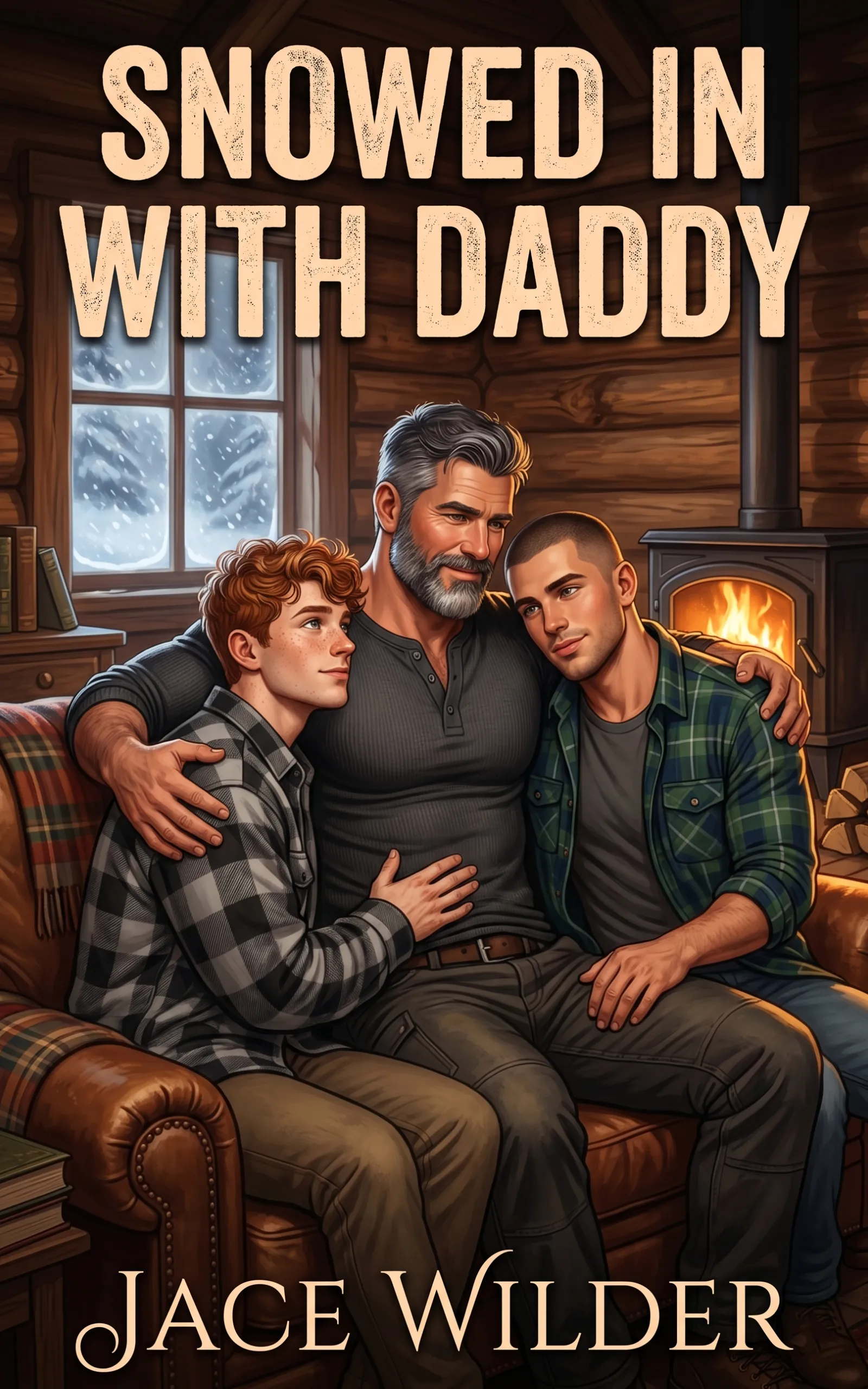
Snowed In With Daddy
MM Cabin Daddy Throuple Romance
by Jace Wilder
Available at your favorite retailer
Pairing: MM
Heat: 🌶️🌶️🌶️🌶️🌶️ Inferno
Tropes: Snowed In, Age Gap, Daddy Kink, Throuple Romance, Cabin Romance, Forced Proximity, Silver Fox, Hurt/Comfort, Praise Kink, Found Family, Caretaking, Polyamory, Grumpy/Sunshine
Length: ~96,000 words
Series: Standalone (Harlan Woods Book 1)
Two stranded hikers. One cabin daddy. A Nor’easter that changed all three of them.
Gideon Harlan has spent ten years alone in a cabin in the Adirondack High Peaks.
He buried his wife at forty. He led search-and-rescue out of Hollis Creek for eighteen years and stopped, in 2020, when a rope went slack with a man’s hand on it. He has not had anyone in his bed for more than three nights in a row in a decade. He has Ruth, his eleven-year-old shepherd. He has a stove that needs feeding. He has a list of things to do and the cold to do them in.
Then a Nor’easter rolls in two hours faster than the radio said, and at five p.m. on a Friday in February, two men come up his porch in the dark. One of them is unconscious. The other is holding him up.
Finn Reilly is twenty-five. A reckless content creator with a million-and-a-half followers and a panic disorder he hides from every single one of them. Jude Maddox is twenty-five. Ex-Navy corpsman. The quiet man who has been holding Finn together for two and a half years and is, on this hike, deciding whether to leave him.
Then the storm locks them in for a week.
Seven days in a hand-built log cabin in a blizzard. One woodstove. One loft bed. One very particular daddy who has not, in twenty-eight years, been a man in his own house for a man — let alone for two — and who has, in the dark of February, opened his door to two men who are, against every piece of math he can do in his head, going to change his life.
You will love this book if you enjoy:
- Snowed-in cabin daddy with a fifty-year-old beard, a dog named Ruth, and a fresh bandage in his medic kit before he asks your name
- Existing-couple-opens-up throuple where nobody is the third wheel and the brattier one stays a brat
- Praise kink that lands so hard it makes a Navy corpsman cry on a kitchen table
- Daddy directing his way through a spitroast, then making biscuits in the morning
- “You been carryin’ him a long time, son” delivered to a man who has not been seen in eighteen months
- A redwood hot tub on a back deck under the Milky Way
- Avoidant grumpy daddy attempting his classic last-day push-out and getting caught by his sailor before he finishes the sentence
- Three brushed-gold rings, on three left hands, by Christmas morning
- HEA guaranteed (and a Christmas bonus chapter that earns it)
⚠️ Content Warning: This novel contains explicit sexual content (graphic MM scenes including praise kink, age-gap dynamic, daddy kink, group/throuple sex, oral fixation, light bondage, and emotionally-charged first-time encounters), strong language, on-page references to widowhood and the death of a wife from cancer, on-page reference to a search-and-rescue death (a man dying on a rope), on-page combat trauma backstory (the death of fellow Navy servicemembers in Helmand and Syria), on-page panic attack (handled with care), an attempted arson confrontation involving a shotgun (no shots fired), and homophobic language used in passing context. Heat: 5/5. HEA. Intended for readers 18+.
📖 Read Chapter One Free
Not sure yet? Read the full first chapter right here.
Chapter One: Storm Coming
The weather radio’s been screaming Nor’easter for three days, and Ruth won’t settle.
She’s been up and down off the rug for an hour — lifts her head, listens to something I can’t hear, sighs, lays back down with her chin on my boot. She’s eleven. She doesn’t do this anymore. Hasn’t done this since the winter of ’23 when that fisher cat got into the shed and she went out the dog door at four in the morning and came back with blood on her muzzle that wasn’t hers.
“Alright, old girl.” I set down the stove poker. “I hear you.”
I don’t hear a damn thing, actually. But Ruth’s never been wrong about weather, and the sky over the ridge went the color of wet slate an hour before sunset. First flakes started around four. The porch thermometer read eighteen when I brought in the last armload of cordwood, and the bottom’s been falling out of it ever since. By the time I get back from checking the shed door it’s five degrees. The wind’s picking up in that low wet way that means the big stuff is twenty minutes out, not two hours like the radio said.
I pull on the old Carhartt and step out.
The porch boards are already dusted. Snow coming in sideways, hitting the glass of the kerosene lantern and melting with a sound like oil in a pan. Ruth follows me to the edge of the top step and stops, because she knows the rule. No porch in the dark. Not with bears down below and fishers in the pines and the occasional stupid thing I can’t name moving through the trees at dusk.
“Stay.”
She sits.
I walk the perimeter with the flashlight. Shed door latched. Generator tarped. Woodpile at the east wall still standing — I split a cord and a half last month and stacked it man-height under the overhang, and it’ll get me through most of what’s coming. Satellite dish has snow on it already. I knock it clean with the back of my glove. The south-facing stack where I keep the dry kindling is down to its last two bundles. Wasn’t paying attention. That’s fine. I can split more in the morning if the power goes, which it’s going to.
Standing there at the corner of the cabin I can’t see the treeline. Twenty feet and the world goes white. The wind sounds like something breathing against a wall.
Goes through me. That specific cold. Ten below is polite weather up here — you feel it, you respect it, you put on another layer. Minus twenty is weather. Minus thirty is the kind of cold that reaches up the sleeve of your jacket and through the hem of your thermals and finds the meat of you. This is going to be that, by midnight.
I hate how the air smells before a real storm. It doesn’t smell like anything. Just empty. Like the world pulled back.
Back on the porch I stomp my boots and Ruth stands for me. Inside, I lean the shotgun against the wall by the mudroom bench where it lives, hang the Carhartt on its peg, peel off the wool socks and put on the house pair. Cabin’s at sixty-eight because the woodstove’s been going since dawn. My fingers ache anyway. I’m fifty years old. My fingers ache when it’s going to rain.
Ruth goes back to the rug. Sighs again. Doesn’t lay her head down this time. Just watches the door.
Alright, I think. Alright, old girl. You and me, then.
The radio’s cycled back through. The National Weather Service has issued a winter storm warning for the following counties in upstate New York — Hamilton, Essex, Franklin, Clinton — expect snowfall totals between eighteen and twenty-six inches, winds gusting to fifty miles per hour, wind chill values to negative thirty-five. Travel is not advised. Travel is not advised. Travel is—
I turn it off.
Stew’s on the back burner. Venison I shot in October, potatoes from the root cellar, onions, thyme, bay. Been simmering since noon. I ladle myself a bowl, tear off a heel of the bread I baked yesterday, and sit at the table. Ruth doesn’t come over to beg. She’s still watching the door.
“Eat, Ruthie.”
She looks at me. Doesn’t move.
“Suit yourself.”
I eat.
It’s Marian’s anniversary week.
I don’t mark it. I used to — for the first few years, lit a candle, sat with a glass of bourbon, did the whole thing. The cemetery’s an hour’s drive when the roads are good and three when they’re not. I haven’t gone since the five-year. I don’t need to go. She’s not there. She’s in my left hand, which still has a callus from her wedding ring, even though I haven’t worn it in eight years. She’s in the upper shelf over the bookcase, where the Mason jar sits between a 1967 edition of A Sand County Almanac and a boot I’ve been meaning to re-sole. She’s in the creak of the fourth floorboard from the door, which she asked me to fix for twenty-two years, and which I never did, because I liked the sound of her feet coming home.
The anniversary’s Tuesday. It’s Sunday now.
I don’t mark it. I just — notice that the sky does a certain thing in the second week of February, a certain bone-colored thing, and I notice that Ruth is being weird, and I notice that when the storm radio went off the first thing my body remembered was her hand on the back of my neck the morning before she died, saying It’s alright, Gid. You’re alright.
I’m alright.
I finish the stew. Ruth finally comes over and puts her chin on my thigh, gray muzzle, one ear missing its top third from the bear in ’21. I feed her a crust of bread and the last potato and she takes them with the delicacy she’s had since she was a pup, like she’s pulling a bead off a thread. Good dog. Best one I’ll ever have.
I wash the bowl. Refill the stove. Check the oil level on the lantern. Set the kettle on the back edge of the woodstove where it’ll stay hot all night without boiling. Pour a bourbon — one, neat, small. I’ve got rules about when I drink. I follow them.
Then I sit in the chair by the stove with the Craig Johnson paperback I’ve been working through for a month — Any Other Name, the one with the dead cops and the Wyoming winter — and I read. Ruth puts her chin on my boot. The wind comes up harder. The cabin creaks around us. I can hear the spruce by the east window moving the way spruce move in forty-mile gusts, which is mostly not at all, a little at the top, a sound like a throat clearing.
Third page in, Ruth’s head comes up.
I don’t look at her right away. Could be nothing. Could be a branch coming down. Could be the fisher cat. Could be the wind hit the shed door latch wrong. I give it ten seconds.
She doesn’t lay her head back down.
Twenty seconds.
She stands.
“Ruthie.”
She walks to the door.
Now I look up.
She’s not hackling. She’s not growling. She’s standing with her nose half an inch from the crack under the door, and her tail is low but not tucked, and her ears are up and forward, and she’s — listening.
I set the book down, mark the page with a dog-eared corner because I’ve never owned a bookmark and never will, and stand up.
“What you got, girl?”
She whines. Just once. High and small. Not her alarm sound. Something else.
I walk to the door.
I’m getting ready to crack it and look out the stormlight when a sound comes through the wood that I am never prepared for, in this life or any other.
A fist.
On my door.
Not a knock. It’s not a knock, knocks have rhythm. This is the heel of a hand, hitting flat, once and then twice and then three times in a row, and then a voice — a man’s voice, muffled by the wind, shredded by something worse than wind —
“Please — please, please, please, please, somebody’s in there, please —”
Ruth barks. One sharp cut of sound, because that’s what she does when she wants my attention on her, not on the thing.
My hand is already on the shotgun before my brain has finished processing the voice. Twelve-gauge, one in the chamber, the rest in the sleeve on the stock. I don’t think about it, I don’t decide to — it’s the muscle of thirty years of opening doors after dark in the woods. Ninety-nine times out of a hundred you don’t need it. The hundredth time is how you get to the hundred-and-first.
I work the bolt on the door. Lift the latch. Open it two inches.
The wind takes it the rest of the way out of my hand and slams it back against the inside wall.
Two men on my porch.
For the rest of my life I am going to remember this the way you remember a car accident. Not in order. In pieces.
There is a man on his feet. Or close to it. Big-bodied, wide at the shoulder, jacket open at the throat, a cut on his forehead bleeding down into his eye, and he is using the last of himself to hold another man upright against his chest — arms around him from behind, one hand clamped flat across the smaller man’s collarbone, the other pinning him at the hip. He is looking at me. He has hazel eyes. The rest of his face is white. Not pale. White. Frostbite-white around the nose and mouth.
The smaller man is not conscious. Head lolled. A slip of coppery hair stuck to his forehead in a stripe of melted snow. His mouth is open. His lips are blue. I can see him breathing — shallow, fast, the bad kind — and I can see his legs not doing anything, just hanging.
The big one says, “Please.“
His voice is a wreck.
“Please. He’s —” He swallows. It costs him. “I’m — I’m a medic. I’m a medic, sir, I’m a medic, he’s going — he’s going hypothermic, he’s — please let us in, please —“
The word medic hits me in the chest.
I don’t have time for what it hits.
“In,” I say.
The shotgun’s already back against the wall. My hands are already moving. I get an arm under the smaller man’s knees and the other under the big one’s forearm, and between the two of us we half-drag and half-carry the boy across my threshold, and his weight is wrong — the weight of a person who has given up keeping his own bones in order — and his skin where my bare hand hits his bare wrist is the temperature of creek water in March, which is to say it’s the temperature of a thing that’s already most of the way to being done with being alive.
“Not again,” I hear myself say.
I don’t think the medic hears me. He’s breathing in that hitching way that means he’s about to go down himself. But I hear me. Clear as a bell in my own skull.
I put the thought in the drawer where I put things I’m going to have to deal with later.
“Kick the door.” The medic kicks the door. Misses. Kicks it again. Connects. The wind keeps trying to push it open. He gets it latched, falls against it, and slides down until he’s on his ass on the floorboards with his head tipped back against the wood, eyes closed.
“Don’t pass out on me,” I say.
“I’m not.” His voice is a rasp. “I’m not. I’m — I’m here. I’m here. What do you — what do you need.”
Ruth is right in my kitchen, nose to the boy’s hand, checking him.
“Rug,” I say. “By the stove. Now.”
I drag him. Not gently. Gentle is for people with time. I pull him by the hiking pack straps still on his shoulders, one long drag across the floorboards to the braided rug in front of the woodstove, and I get him on his back and I start going through him in the order you go through them in.
“Airway.” Tilted head. Clear. Breathing shallow and fast. Radial pulse — there, barely. A hundred and thirty beats, easy. That’s good. That’s good and bad. A hundred and thirty means his heart’s still trying. Below ninety means his heart’s giving up. Ninety is the cliff. A hundred and thirty is the edge.
“Sir.” The medic’s voice from the floor by the door. “Sir, he’s been out for — he’s been out maybe four minutes. He — we were — I don’t know how far we came, I’m sorry, I lost time —”
“Stay there,” I say. “You’re in shock. Stay on the floor till I get to you.”
“I’m fine —”
“Stay on the floor.“
He stays on the floor.
I turn back to the boy.
Pack off. I cut the strap with the knife from my belt because he’s zipped into the thing and the zipper’s iced. I get the pack clear. Jacket next. The zipper’s iced on that too. I get my fingers under the hem and just tear the fabric from the bottom to take pressure off the zipper, and the jacket peels off him like skin off a pear.
Hoodie under. Soaked through. Cut that, too.
The undershirt he’s wearing was a thermal when he put it on. It’s wet cloth now. It comes off in my hands, and so does the pair of tech pants he’s got on, which I work down over his hips while he’s limp on the rug. Boots. Socks. The socks are the worst of it. I peel one, and the big toe has that white waxy look at the tip I’ve seen too many times, and I put my thumb on it and it blanches to a dead yellow and stays that way for too many seconds.
Superficial frostnip. He’ll keep the toe. He’ll keep them all, probably. If we move fast.
Boxers, at the end. He’s in boxer briefs now. Black. Wet. I leave them on. Dignity is cheap and I can afford it.
“Sir —” The medic, trying to sit up.
“Don’t move. What’s his name.”
“Finn. Finn Reilly. I’m — I’m Jude, I’m —”
“Jude.” I’m working the wool blanket off the back of my reading chair. “How old is he.”
“Twenty-five.”
“How long’s he been wet.”
“Four hours, maybe. We — we were trying to get out. The storm — the storm came in early —”
“Medications?”
“Propranolol. Twenty milligrams as needed. He had — he took one this morning. For — he has panic —”
“Allergies.”
“Penicillin.”
“Core temp this low I need him skin to skin. You got any better ideas, you tell me.”
He doesn’t. He just closes his eyes and says, very quiet: “Okay. Okay. Thank you.”
I get the wool blanket around the boy, and then the duvet off my bed, and then the big Pendleton I keep over the back of the couch, and I layer them over him on the rug. I pull off my own flannel and my thermal undershirt and I lay down on my side against the rug and I get him against my chest the way you hold a child — one arm under his head, the other around his back — and I pull the blankets up over both of us.
He is cold.
Not cold like a day in the woods. Cold like the inside of the water. The inside of his mouth is cold — I can feel it on my collarbone where his open lips are pressed. The inside of his ribs is cold against my sternum. His hair against my neck is frozen in stiff curls that are already starting to melt and drip onto my shoulder.
“Easy,” I say. To him. To me. “Easy, son. I got you.”
He doesn’t answer. He wouldn’t. But I feel, against the skin of my chest, a minute shudder go through him. Not a shiver. He’s too far gone for shivering — shivering’s the body trying, and his body’s stopped trying — but a shudder. Something in the hindbrain registering warmth after four hours of no.
The pulse under my palm picks up. Small. But there.
I keep talking.
I’ve done this before. Not a lot, not this level, but twice from this level, two different people, and one of them made it and one of them didn’t, and the one who didn’t wasn’t because of the cold, so I don’t count it. I know the routine. Warm torso first, extremities second, no rubbing, no shoving a frozen limb toward the stove. Talk to them. Keep the mouth moving even if they can’t answer. The body on a hypothermic patient is a scared animal hiding in a hole. You don’t reach in and grab. You wait for it to come out.
“Hey. Hey, Finn. That’s a good name. Good Irish name. I got people up in Glens Falls named Reilly. Might be cousins of yours. Might not. Stew’s on the back of the stove, you smell that? Venison. Took her myself in October. Big cow elk, not a deer — you know I still call ’em deer when I bring ’em home, hard to stop after forty years — and she’s been simmering since before the weather radio went off, and you’re gonna have a bowl of her when you wake up. I’m gonna feed you myself if I have to. You hear me? Hey.”
His eyelid flickers.
I don’t believe it at first. I watch for it to do it again.
It does it again.
“There you are.”
Small sound out of him. A breath. A shape of a word that doesn’t reach sound.
“No no no, save it. Save it for when you’re warm. You’re gonna be warm. You’re at Gideon Harlan’s cabin on the back side of the ridge, you hear me? You walked into the right door. You walked into the right goddamn door on the right goddamn night. You hear me?”
He makes the breath-sound again.
I close my eyes for one second. Just one.
Thank you, I say, not to anyone in particular. Maybe to Marian. Maybe to the man ten years ago whose hand I felt let go of a rope. Maybe to Ruth. Maybe just to the air. Thank you.
Then I open them and I look across the rug to where Jude is sitting against the door.
He hasn’t moved. He told me he would stay, and he has stayed. He’s sitting with his legs straight out in front of him and his hands loose on his thighs and his head back against the door and his eyes closed, and his face — when I look at him with attention for the first time — is doing something very specific.
He’s holding it together.
He’s holding it together so tightly I can see the cost of it moving under his skin. Jaw locked. Breath slow, slower than it wants to be, controlled. The tremor in his hands is not cold. It’s adrenaline draining. I’ve had that tremor.
He is, I register, a medic. He was telling me the truth.
He has the look of someone who did his deployments. Buzzed hair on the sides, a little longer up top. A tattoo on his right forearm I can’t quite read from here. A jaw that someone put together with purpose. Broad, packed through the shoulders. Bleeding down his face from the cut over his eye. Boots still on. Pack still on. He came through my door carrying his boyfriend with a pack on his back, I am realizing now, and he has not yet let himself off the hook for having done it.
“Jude.”
His eyes open. He looks at me across the cabin. Focus comes to his face in stages. Like he forgot, for a second, where he was.
“Yes, sir.”
“You got frostbite on that nose.”
“Yes, sir.”
“You hurt anywhere else.”
“No, sir.”
“You lying to me.”
A pause. “My — my left foot’s wet, sir.”
“How long’s it been wet.”
“I stepped in the creek. Maybe — two hours ago, sir.”
“How long’s your boot been off since.”
“Hasn’t, sir.”
“Okay.”
I’d get up and go to him. I can’t. I have this kid against my chest and he is thirty seconds from being dead and thirty seconds from being fine and I cannot put thirty seconds between me and him right now.
“Jude, can you stand.”
“Yes, sir.”
“Slowly.”
He stands.
Slowly.
He gets to his feet in the old careful way, one knee and then the other, and when he’s up he leans against the door for a count of three before he trusts it. Good. He’s running the protocol on himself. That’ll save me time later.
“Kitchen,” I say. “Second cabinet from the sink. Top shelf. Electrolyte packets. Get one in a mug with hot water from the kettle on the stove — you can grab the handle with a towel, towel’s on the oven door. Put on one of my flannels from the peg by the mudroom. Any of ’em. Dry pair of socks in the basket under the bench. Boot off, sock on, sit the wet foot by the stove but not on the stove. You hearing me?”
“Yes, sir.”
“Do it.”
He does it.
I watch him do it, over Finn’s head. Each motion costs him. But he does each one correctly, and he does them in the order I gave them to him, and when he sits down at the kitchen table with the flannel on and the mug in his hands and the wet sock off the foot that is, yes, starting to go yellow-white at the heel, he puts his head down on the table with the mug in his two hands and he doesn’t cry, because men who’ve been deployed don’t cry the first time, but he does that thing deployed men do instead, which is go very still for a long time.
I let him have it.
Under the blankets, the kid against my chest makes another breath-shape.
Then — and I almost don’t catch it at first — his fingers twitch.
Right hand. Where it’s curled between my pecs. The fingers move half an inch.
“There you are,” I say again.
His eyes open.
He has green eyes. I register this without meaning to. The green of the moss on the north side of a hemlock in June. They are not focused. They are open, and they find the ceiling of the cabin, and then by stages they find my face, and there is nothing in them yet — no understanding, no fear, no relief. Just a boy coming back up from the bottom of a cold lake.
“Hey.”
He tries. I watch him try. His mouth opens.
“—uh.”
“I’m here. You’re safe. You’re at my cabin. Your boy’s over at the table. He got you home. You understand me?”
A long blink.
Then, so faint I have to feel it against my throat rather than hear it:
“…daddy.“
I think, for a second, that I have imagined it.
It happens sometimes in long jobs. Your brain gives you the sound it wants to hear, because it’s been fourteen hours and you’re fried and the body on the rug doesn’t look like anything yet and you need it to look like something. I’ve had hallucinations in the field. I had one in ’15 when I was twenty hours into a search and I was sure, dead sure, that I heard a child singing. It was a mourning dove.
He’s slurring. He’s hypothermic. His mother probably had just the one word left in his mouth, the safe one, the last one people have when the lights go out. Daddy. It doesn’t mean anything. He’s calling for whoever he used to call for. It’s a reflex. It’s a nothing.
I don’t look at Jude.
“That’s right,” I say. My voice is level and I am very glad of it. “I got you, son. You’re safe. Easy. Easy now.”
His eyes close.
His fingers stay curled against my chest.
At some point I lose the wind.
I don’t mean the wind stops. It doesn’t stop. It gets worse — the cabin groans once, hard, around ten-thirty, the way it does in a real gust, and Ruth looks up and then lays her head back down. I mean I stop hearing it. The cabin goes quiet inside my head the way it does when I’m running a job, and my whole attention narrows down to the kid against my chest. His breathing slowing from shallow-fast to shallow-even. His skin going from the temperature of the creek to the temperature of river stones in the sun. The small occasional shudder that means his hindbrain is finding the fire and dragging the rest of him toward it. My own heartbeat — which I can feel doing something I can’t read yet, something I’ll have to look at later when I have the time.
I keep talking to him. Low and steady. Nonsense, mostly. The kind of talk you use on a spooked horse. Names of the trees outside. The stew. The dog. Her age, her bad ear. The Pendleton over his shoulders, which my father bought in Bozeman in 1974. The shelf over his head, which holds a Leopold and a Bass and a boot. The stove, which is running so hot I can feel the heat of it on the soles of my feet. The weather, which I describe to him like I’m giving him a present. Twenty inches by morning, son. Thirty by Tuesday. You’re not going anywhere.
He doesn’t answer. But his body is answering. The temperature of his chest against mine is climbing, one degree and then another, and his pulse under my palm is slowing out of panic into work. Forty minutes in, he’s warm enough that I chance pulling him off my chest and laying him on his back on the rug and tucking him in properly, blankets to his chin, hot-water bottle — I get up, I get the one from the hook, I fill it from the kettle — against his ribs on the outside of the wool.
He makes a small noise when I lay back down next to him. Wordless. A noise that means come back.
I come back.
Jude has been sitting at the table the whole time, slowly drinking his electrolyte, watching us. I can feel him watching us. When I glance up, finally, his eyes are on my hand where it’s resting on Finn’s forehead.
He looks away fast.
“You want to trade,” I say, quiet. “Come over here, sit with him. I’ll check your foot.”
He comes over.
He kneels down on the other side of Finn and puts his hand on Finn’s cheek — gently, the way a man touches the thing that almost died — and he does not look at me at all. I can see his shoulders working. I can see the cost of the last four hours finally being asked for.
I let him have that too.
I check his foot. The heel’s going to blister. The toes are okay. I clean it, pack it in a dry towel, get his sock back on, get him settled cross-legged on the other side of his boyfriend.
Then I stand up. My knees complain. My back complains. I ignore them.
“Power’s going out inside the hour,” I say. “Kerosene’ll run me three, four days. Generator I save for the fridge. Satellite phone for emergencies only — and right now I’m telling you, neither of you is an emergency anymore, you understand me? He’s gonna make it. He’s gonna sleep rough tonight and he’s gonna feel like hell in the morning and by tomorrow evening he’s gonna eat a bowl of stew. That’s where we are. You with me.”
Jude looks up.
His eyes are wet. He doesn’t let anything come out of them. But they’re wet.
“Yes, sir.”
“Good.”
I get my shirt back on. Flannel over that. Pull one of the chairs in from the table so it’s facing the rug, and I sit in it, and I put my hands on my knees, and I look at these two boys on my floor.
The storm hits hard against the east wall. The cabin holds. Ruth comes over and lays down across Finn’s feet, because that is where she has decided Finn goes now. Her gray muzzle on his ankle, her bad ear twitching. She sighs, long and slow, the way she does when she’s finally satisfied.
I realize I haven’t breathed, really breathed, in about forty minutes.
I do, now.
I look at the kid. His mouth is closed. His color is coming back — pink in the lips, pink in the cheeks, the waxy cast gone from his nose. His hair in the firelight is the color of the inside of a maple log when you split it. The freckles across the bridge of his nose stand out against the returning flush. He is, under the sleep and the near-death and the borrowed flannel I’m going to put on him as soon as he can sit up, a pretty boy. It’s the first time I let myself register that sentence as a sentence.
I put it in the drawer.
The drawer with not again.
The drawer is getting full.
“Alright,” I say, to no one. To Ruth. To Marian. To the kid on the rug and his man next to him and the storm and the cabin and the boot that still needs resoling and the shelf above me and the jar on it. “Alright.”
I look at Jude. He’s got one hand flat on Finn’s chest. He’s feeling the breathing. He hasn’t taken his hand off him in ten minutes.
“Stew in twenty,” I say. “You eat. He sleeps. Then you sleep. We’ll figure out the rest in the morning.”
“Yes, sir.”
“And — Jude.“
He looks up.
“You did good tonight.”
His face does something I don’t have a name for.
He puts his head down again, forehead to his forearm across Finn’s chest, and he doesn’t move for a long time.
Outside, the storm comes on.
I get up to tend the fire.
Want to keep reading? The full novel is available now.
🔥 Want an EXCLUSIVE Bonus Chapter?
Christmas Morning — A scene too hot for retail
Six months past the end of the book. Christmas morning in the cabin. Snow on the porch, three men in flannel, two dogs on the rugs, one balsam tree in the corner — and three brushed-gold rings under the wrapping paper. The most joyful chapter Jace Wilder has ever written, and the spiciest gift exchange in the series.
More from Jace Wilder
Not Your Practice Husband
Fifteen years of being his practice husband. Six rules. One day he finally knows.

Still Here, Still Yours
He promised to call. Twenty-three years later, he's standing on my ball field.

Hands Full
One good hand. One thin wall. His best friend's little brother on the other side of it.

The Year We Stopped Pretending
They’ve been best friends for twenty-five years. It took one bed to ruin everything.
Two’s Company, Three’s Coming
A Steamy MMM Roommates-to-Lovers Romance

Spare Key After Midnight
The key was for emergencies. Wanting the man upstairs wasn't supposed to count.
Never Miss a Release
Get new release alerts, exclusive bonus content, and reader-only giveaways.