
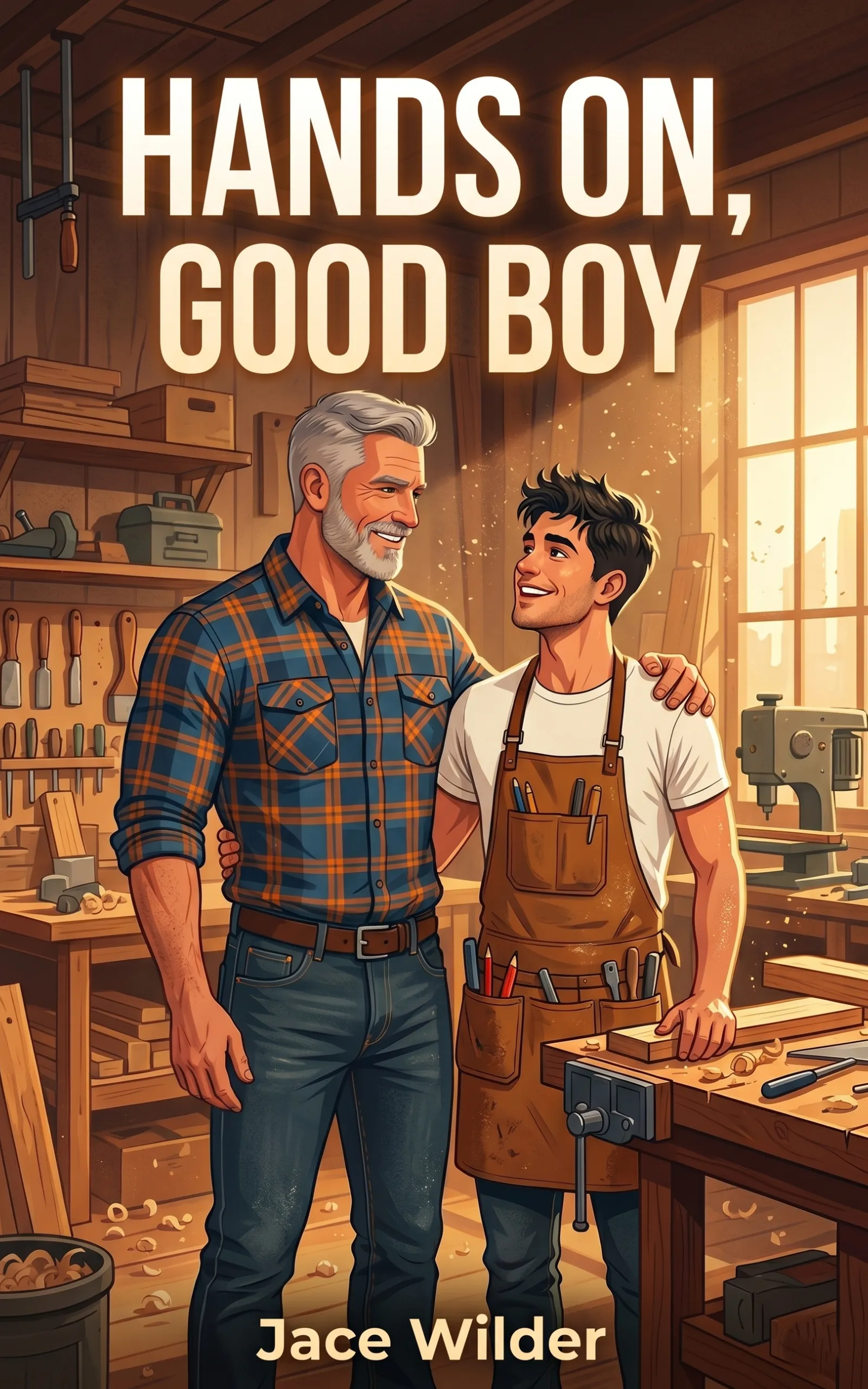
Free with Kindle Unlimited
Pairing: MM
Heat: 🌶️🌶️🌶️🌶️🌶️ Inferno
Length: 118,000 words
Tropes: Age Gap, Grumpy/Sunshine, Praise Kink, Daddy Kink, Widower, Mentor/Apprentice, Hurt/Comfort, Found Family, Small Town, Slow Burn, Blue Collar, Touch Starved, D/s Dynamic
Series: Cedar Hollow Craftsmen (#1)
The shop was the only home he had left. Until the apprentice walked up the gravel.
Declan Brody is fifty-three years old, a master woodworker, a widower, and a man who has built a shop out of silence. He has not been touched in three years. He does not intend to be touched again. Cedar Hollow, Vermont, a shop his grandfather built in 1962, and a cabin with his dead husband’s flannel still hanging on the door — it is enough. It has to be.
Rowan Ellis is twenty-six, a cut-off Boston heir with a trade school diploma, three weeks of diner shifts between schools, and a photograph of Declan Brody that he cut out of Fine Woodworking magazine when he was fourteen. His family stopped calling him by his name when he came out. The gravel drive of Brody Woodworks is the farthest he has ever driven from home. His truck dies at the end of it.
He walks up carrying a duffel and his grandfather’s toolroll.
Declan says good the first time Rowan does something right at the bench, and a thing in Rowan’s chest — a thing he has been carrying for a long time — cracks open.
The governor’s widow wants a patched mantel for Christmas. A $180,000 commission. Six weeks. A ghost of a different master’s predator circling the guild. A sabotage fire. A fake review. And slowly, in the dust of a cedar-pine Vermont shop, an old man learns to let somebody close again and a young man learns that the hands that know wood best know how to hold him, too.
You’ll love this book if you enjoy:
- ✅ Grumpy widower x sunshine apprentice MM romance
- ✅ 27-year age gap with massive praise kink payoff
- ✅ Slow burn that explodes (🌶️🌶️🌶️🌶️🌶️ — graphic, explicit, emotional)
- ✅ Vermont woodshop vibes, Carhartt flannel, cedar-pine cabin
- ✅ Daddy kink done right — competent, careful, devastatingly tender
- ✅ A found-family small town that shows up
- ✅ A hero who learns to love again and a boy who earns his place
- ✅ HEA with a May wedding and matching cherrywood-and-gold rings
⚠️ Content Warning: This novel contains explicit sexual content throughout, including graphic MM scenes, D/s dynamics (praise kink, Daddy kink, light restraint, safe-worded impact play with full aftercare), grief over a dead spouse, offscreen predatory antagonist behavior, mild workplace sabotage, and an age gap (53/26). Full aftercare is written into every scene. HEA guaranteed. Intended for readers 18+.
📖 Read Chapter One Free
Not sure yet? Read the full first chapter right here.
Chapter One: Rough Stock
— Rowan —
The truck died at the end of the gravel drive.
Of course it did.
I turned the key once more, got nothing but a sad click somewhere deep in the engine block, and sat there for a second with both hands on the wheel, staring up the long rise of the road toward the shop. Cedar pines closed in on either side like the nave of a church. A wooden sign at the mouth of the property told me, in letters that had been carved by a hand that knew how to carve:
BRODY WOODWORKS — EST. 1962 — BY APPOINTMENT.
By appointment.
Right. That was me. That was the appointment.
I grabbed the duffel out of the footwell and my grandfather’s toolroll off the passenger seat — real leather, brass buckles, three weeks of diner shifts between Portland trade school and here to pay for it — and I started walking.
The road up was maybe a quarter mile. Packed gravel, frost-cracked in places, the shoulders soft with a first fall of yellow birch leaves that hadn’t made up their mind about rotting yet. Vermont in October was doing its best impression of a postcard: red-orange hills, a sky sharp enough to cut you, a blue that tasted like iron at the back of my throat. I could smell woodsmoke from somewhere, and under it something else, something I’d been chasing the edge of since I was fourteen and cut a page out of Fine Woodworking magazine with a picture of a walnut lowboy on it.
Cedar. Fresh cedar. The shop smell.
I walked.
The shop itself sat on a rise in a clearing someone had cut sixty years ago and never let grow back. Converted carriage house, eight acres, a finishing barn off to the side with a sliding door rolled half open, a small clapboard apartment perched over the shop like a squared-off crow’s nest. Fifty yards back through the pines, a man’s cabin, chimney smoking in a way that said it had been lit before dawn. The cabin was where he lived. The apartment, I had been told in an email consisting of exactly eleven words — including the greeting — was where I would live.
The shop’s main door was rolled open.
I could hear the low whine of something being cut.
I stopped at the threshold.
I’d like to tell you I didn’t stop to look at him. I’d like to tell you I walked in professional and easy, the way a man with a Boston pedigree and a trade school diploma and half a lifetime of rowing-crew posture should walk into anywhere.
But that would be a lie, and I was running out of rooms to store lies in lately, so.
I stopped.
He had his back to me.
Broad back. Flannel rolled to his elbows. And those forearms — God — those forearms, corded and veined and white-scarred the way forty years of lumber did to a man, were doing something slow and deliberate with a hand plane along the face of a long piece of walnut. His shoulders were down. His feet were set. There was a rhythm to him I recognized, actually, from the old boathouse back home — a thing my crew coach used to call water, meaning a guy who rowed like he’d been born to it, who wasn’t fighting the stroke, who was just in it.
He was in the cut.
Silver at his temples. Hair dark on top, gone pepper at the back, rumpled like he’d shoved a hand through it an hour ago and hadn’t thought about it since. A beat-up Carhartt beanie above his ears. Reading glasses — I’d learn later — lived on a cord around his neck for when he needed them, pushed up on his forehead for when he didn’t know where they were, and tucked into the breast pocket of whatever flannel he’d grabbed that morning for emergencies.
A man with three pairs of glasses within arm’s reach at all times.
He didn’t turn around.
He said, “You the apprentice, or the UPS kid.”
“Apprentice,” I said, and hated how young my voice sounded against his. His was low, slow, Vermont. Mine was Boston trying very hard not to be Boston.
“You’re early.”
“The map app said it was thirty minutes longer than it takes.”
“Apps are for tourists.” He set the plane down. He turned.
The first thing I need you to understand about Declan Brody is that the photographs don’t do him.
I had one. The one from the magazine. In the photo he was maybe thirty-five, lean, laughing at something off-camera, and the caption underneath read TO WATCH: DECLAN BRODY, VERMONT, and so for twelve years that had been him to me: a young man laughing in black-and-white.
The man who turned around was fifty-three.
He was not laughing.
And he was not thirty-five in any way that mattered.
He was bigger than the photograph. Broader in the chest. Beard silver-shot, trimmed close, the kind of beard where you could tell a man had passed his hand down it that morning and paid attention. Blue eyes over the top of the reading glasses, which he had, at some point in the last hour, pushed up his nose to look at something fine. The glasses stayed. He looked at me over them.
I understood, standing there with my duffel and my toolroll and my traitor voice, that I had misjudged this entirely.
I had come here to learn from a master.
I had not come here prepared to be looked at.
“Rowan Ellis,” I said, and stuck my hand out.
“I know who you are,” he said.
But he took my hand.
His palm was warm and dry and rough in the exact way I had pictured, and he held my hand for about half a second longer than was professionally necessary, and I won’t swear he noticed my pulse in my wrist, and I won’t swear he didn’t.
He let go.
“Three questions,” he said. “Answer them or don’t. Either way I’ll know what I’m working with.”
“Okay.”
“Through mortise or stopped mortise for a trestle table.”
“Stopped.” I didn’t even pause. “If you want the end grain to stay clean.”
“Good. Second. Why shellac over polyurethane on an heirloom piece.”
“It’s reversible. Someone can restore it in a hundred years.”
“Good. Third.” He watched my face now, the way a man watches a board he is about to rip. “Why dovetails.”
It was the slowest question. The textbook answer — mechanical strength, tensile resistance, grain opposition — sat ready at the front of my mouth and, under his blue eyes over the reading glasses, felt, abruptly, a little like handing a poem a ruler.
I closed my mouth.
I opened it.
“Because they hold,” I said. “Without glue. Because wood wants to do two things at once — expand, shrink — and dovetails let it do both and still hold.”
He was quiet.
Something in his face did a thing I didn’t have a name for yet.
“Trade school makes you quick,” he said. “Doesn’t make you patient.”
That was the grade. I stood there and took it.
“Put your bag down,” he said, turning back to the bench. “We’ll see about the patient part.”
The tour took fourteen minutes.
I know because I was counting. The count was the only thing keeping my brain in my head.
Main bay. Finishing barn. A lumber rack that ran the entire back wall like the nave of a cathedral, air-dried stock stacked by species, each section labeled in the same hand that had carved the shop sign. Tools on pegboards arranged not by category but by size — smallest to largest, left to right — a system his grandfather had set up in 1962 and nobody had touched since. The Powermatic lathe, the one that had been on the cover of the magazine in my wallet, under a canvas throw like a horse covered for winter. A woodstove in the back corner with a kettle on it, ticking.
And at the center of the room, a workbench.
Twelve feet of maple, three inches thick, two generations of dings and scorches worn to butter. One single deep scar across the face. It had been sanded smooth but not removed. Someone had decided, at some point, that it stayed.
I stopped at it. “That scar —”
“Other time.”
I nodded. Moved on.
His rules, enumerated in that slow flat voice as we walked:
No phones past the shop threshold. No shortcuts on a client’s money. No working after nine p.m. unless he said so. No touching the Powermatic until he said so. No radio. No rings. Closed-toed shoes, always. No asking about the scar on the bench until a time that was not now.
“Understood,” I said, and then, because my mouth works faster than my brain when I’m nervous —
“Yes, sir.”
He stopped walking.
Half a second. Maybe three-quarters.
It was the longest half a second of my life.
He didn’t look at me. He didn’t correct it. He opened the side door into the finishing barn and said, “Mineral spirits, that shelf. Don’t mix them up with the lacquer thinner. Labels face front, always.”
We kept walking.
I kept breathing.
I kept my eyes on the back of his neck where it disappeared into the collar of his flannel and I kept telling myself that the heat crawling up my own neck was embarrassment and not — God help me — anything else.
The apartment was up a narrow set of stairs above the main shop.
He walked me up. He didn’t come inside. He stood in the doorway with one big hand flat on the jamb and pointed with the other.
“Kitchen. Bathroom. Bed. Desk. Wi-Fi password’s on the fridge. You get hot water if you don’t run the shop’s planer at the same time as the shower. Don’t run the shop’s planer at the same time as the shower.”
“Understood.”
“That’s your closet. Hangers in there.”
I looked.
The closet was not empty.
There was one flannel on a single wooden hanger. Green and black plaid, faded to something softer than plaid ought to be, the kind of cotton that had been through a washing machine two hundred times and kept coming out more itself. A man’s flannel.
A man’s flannel that was not his.
Too small in the shoulders for the man standing in the doorway.
I said nothing.
He said nothing.
After a second that stretched, he spoke without looking at the closet, the way a man speaks around something his eyes have already refused to go near.
“Dinner’s six. You eat, you eat with me. You’re not gonna eat, you tell me by four.”
“I’ll eat.”
“Good.”
He left.
I stood in the middle of the room with the duffel still on my shoulder and I looked at the flannel, and the flannel looked back, and I didn’t reach for it, and I didn’t touch it, and I didn’t ask.
Because I didn’t need to ask.
I put the duffel down on the floor.
I sat on the edge of the bed — which was stripped to fresh sheets, and which was tucked military-tight in the way a man makes a bed when he’s making a bed he doesn’t sleep in — and I put my head in my hands for a minute.
I had come to Vermont to be taken seriously. I had come to Vermont to learn. I had not come to Vermont to lose my mind in the first seven hours, but I was starting to have concerns.
At four fifty-eight I came back down to the shop.
He was at the bench. A chisel in his hand. Looking at something he’d pulled out of my toolroll without, I noticed, asking.
“This yours?” he said, not looking up.
It was the practice board I’d cut on my last day of trade school — a through-dovetail I’d been proud of, briefly, until I’d gotten on the bus out of Portland and started comparing it to pictures of work that didn’t live in student portfolios.
“Yeah,” I said.
“Looks like you were in a hurry.”
I had been. Ninety minutes till the bus.
“Sit,” he said, gesturing at a stool with the chisel.
I sat.
He slid the practice board across the bench to me.
“Recut it.”
“Now?”
“Now.”
So I set up at the bench. I pulled the lamp down. I got out my marking gauge and my fresh pencil and a bevel-edged chisel from my roll. He moved around the room like he wasn’t watching me. I knew he was. I marked the new cuts. Adjusted the gauge. Picked up the chisel.
And then — because this was what I had come here to learn, and because the man walking slowly past the bench behind me had written the article in my wallet — I did it the way I knew how to do it, and I did it a little too fast.
His voice came from just behind my right shoulder.
“Slow.”
I stopped.
“Again,” he said. “Slow.”
I started the cut again. I felt him move closer. I did not look up. I could smell him — cedar from the shop, wool, soap, the faintest under-note of bourbon from whatever he’d had at lunch. His hand did not touch mine. But he stepped in behind me and put his thumb, very lightly, against the inside of my right elbow.
Not my hand. My elbow.
“There,” he said.
I made the cut. I don’t know how I made the cut.
I know he was about four inches taller than me, and he was standing close enough that his breath was a slow warm thing on the back of my neck, and his thumb was on the inside of my elbow where a pulse lives, and I know the chisel moved clean through the grain like the wood wanted it to.
I know the word he said when I set the chisel down.
“Good.”
One word. Low. Flat. No inflection.
My whole body did something I was not prepared for my body to do.
He stepped back.
“Again. Other shoulder.”
“Yes, sir,” I said — before I could stop it, after I had meant to stop it, because at some point in the last two hours I had lost the veto on that particular phrase coming out of my mouth.
He did not correct it. He did not correct it the second time either.
…the dovetail cut, a courier at the door, a card from a man Declan hasn’t seen in ten years, and a dinner that tastes like his mother’s food — it’s all waiting inside the book.
Want to keep reading? The full novel is available now.
🔥 Want an EXCLUSIVE Bonus Chapter?
The Cabin at Christmas — A scene too hot for Amazon
Christmas Eve in the cabin. A silver ring Clem forged over six Wednesday nights. A bearskin rug by the hearth. A collar. Cuffs. A claim scene that lasts until sunrise.
More from Jace Wilder
Browse the full Jace Wilder catalog.

Deposit Required
He paid for the hours. He never planned to pay with his heart.

No Straight Answers After Midnight
He called a stranger at midnight. The stranger already knew his name.

Best Friend’s Dad Bod
He calls it a dad bod. I call it exactly what I want.

His Ex-Husband’s Brother
Nine years of restraint. One dark kitchen. No going back.

The Straight Man’s Plus-One
The boyfriend was fake. The first kiss was not.

Eight Seconds, No Regrets
He only needs eight seconds on the bull. The man who saves him wants him alive for everything that comes after.

Five-Star Anonymous
One storm. One hotel suite. One night without surnames — then he walks into my hotel with a critic's badge.

Bi the Time We Check Out
The rules end at checkout. Their feelings don't.
Never Miss a Release
Get new release alerts, exclusive bonus content, and reader-only giveaways.