
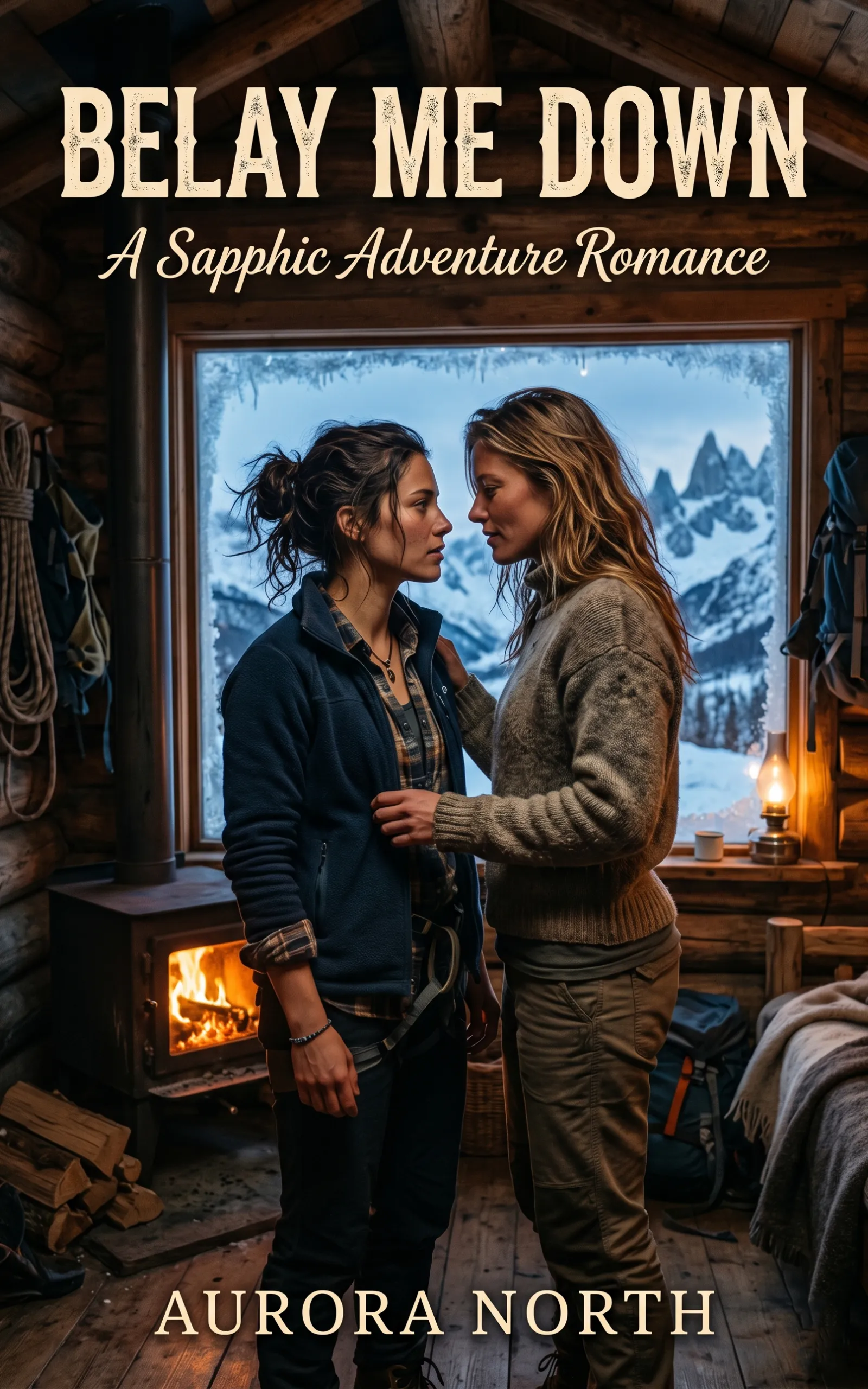
Belay Me Down
Sapphic Alpine Romance
by Aurora North
Free with Kindle Unlimited
Pairing: FF (Sapphic)
Heat: 🌶️🌶️🌶️🌶️🌶️ Inferno
Tropes: Forced Proximity, Only One Tent, Slow Burn, Praise Kink, Client/Professional, Grief Recovery, Touch Starved, Found Family, Hurt/Comfort, Grumpy/Sunshine, Survival Romance
A burned-out climber. A patient guide. A twenty-two-hundred-foot tower. And one rule built to be broken.
Nova Reyes is a legend and a mess. Famous in climbing circles. Free-soloing increasingly reckless routes since the day she watched her best friend and partner die on a wall three years ago. When she hires a guide in Patagonia for a first ascent of an unclimbed tower named after a dead woman, she tells herself it is a tribute. It is also the first time she has let another person belay her since the accident, and she is terrified of both the rope and the person holding it.
Serena “Sera” Hale is a third-generation Patagonian alpine guide with an IFMGA cert, a six-year rule about sleeping with clients, and a quiet, methodical authority that will not tolerate one ounce of Nova’s self-destruction. She is also, from the morning she picks Nova up at the gravel lot of El Chaltén, in more trouble than she has been in in four years.
Six weeks of training. A 30-kilometer approach. A 2,200-foot granite tower nobody has climbed. A thirty-six-hour storm that pins them on a portaledge eleven hundred meters off the deck. One sleeping bag. One rule. One dead woman on Nova’s chest in the form of a green-taped nut tool she is carrying to the summit.
They are going to climb this tower. They are going to do the job clean. And somewhere between pitch four of La Traviesa and the summit of Aguja Vera, they are going to stop pretending neither of them wants the other to break the rule first.
You’ll love this book if you enjoy:
✅ Slow-burn sapphic romance with six weeks of pining before the first kiss
✅ Gruff reckless climber x patient, competent guide
✅ “I am literally responsible for your life” energy
✅ Praise kink delivered in two languages, earned across 90,000 words
✅ Only one tent, only one portaledge, only one sleeping bag
✅ Grief recovery that is integrated, not erased — a dead first love who gets to come with them
✅ A Patagonian found family at the lodge who will break your heart in three directions at once
✅ Real climbing, real mountains, real technical texture
✅ HEA guaranteed — with a ring, a route named for the ghost, and a snowstorm coda
⚠️ Content Warning: Explicit sexual content (graphic FF scenes), on-page grief for a dead partner (climbing accident, discussed but not depicted in real time), a climbing injury and a short forced bivouac during a storm, alcohol use, adult language. HEA guaranteed. Intended for readers 18+.
📖 Read Chapter One Free
Not sure yet? Read the full first chapter right here.
Chapter One
The thing nobody tells you about free soloing is that it’s boring until it isn’t.
Six hundred feet up the east face of a nameless granite spur in the Tuolumne backcountry, at seven in the morning on a Tuesday in October, I was bored. My fingers were cold. The rock was dry. My breathing was metronome-even. I had climbed this pitch eleven times with a rope over the last two years, and I knew every hold by the feel of the callus it had worn into my skin.
Bored. Easy. Two more moves to a hands-in-pockets rest stance, then a mantle, then a walk-off.
That was when my right foot slipped.
Not much. A quarter inch, maybe. The kind of foot-slip you correct without thinking about. I corrected it without thinking about it. My hip dropped, my left foot bit harder into the smear, my right foot caught the edge it had missed, and I locked off on a finger jug the size of a quarter and held there for a second, waiting for my pulse to do the thing.
It didn’t do the thing.
It didn’t even spike.
I stood on the hold and thought, very clearly: that should have scared me.
And then, before I could decide whether it had scared me, I was moving again — mantle, rock-over, heel-hook, stand up. Walk-off. Boots on dirt. Sun on my face. Two mule deer watching me from a stand of lodgepole like I had walked out of a magic trick.
I sat down in the duff and put my head between my knees and waited to feel something.
I waited a long time.
The drive out of the park took three and a half hours. I stopped once, at a gas station in Groveland, to buy a Coke I didn’t drink and stand in the parking lot staring at a rack of postcards. The postcards were of Half Dome. I had been on top of Half Dome nine times. The postcards looked photoshopped.
A woman in a Subaru honked at me because I was standing in the spot where she wanted to park. I moved. She parked. She got out with two children and a golden retriever and a husband and a cooler, and they went into the gas station together like a single organism, and I got back in my truck and sat with my hands on the wheel and thought, I am going to die on a wall.
Not I might.
I am going to.
It was not a dramatic thought. It had the flat, reportable quality of weather. Tomorrow will be partly cloudy. Nova Reyes is going to die on a wall.
I drove to Boulder.
My apartment in Boulder was a one-bedroom above a bike shop on Pearl Street. It was extremely clean, because I was not in it often enough to make it dirty. The walls had nothing on them. The kitchen had three plates, two forks, a pan, and a French press. In the closet I had one duffel bag, two haul bags, six ropes coiled in the order I had retired them, and a cardboard box with Ellery’s name written on the side in Sharpie. The box had been in that closet for three years. I had not opened it.
I opened it.
Inside: a chalk bag with her initials stitched into the flap by her grandmother. A rack of nuts on a carabiner. A paperback copy of The Snow Leopard that she had loved and I had never read. Three photographs. A ratty red bandana that still smelled like her, and I hated that it still smelled like her, and I had to sit down on the closet floor for a minute because it still smelled like her.
And a nut tool. A nut tool, specifically — the small metal pick climbers use to pry stuck protection out of cracks. Hers was old-school, a BD from the early two thousands, the plastic handle wrapped in a strip of green athletic tape she’d put on it in Yosemite the summer before she died. Her thumbprint was still on the tape. You could see the whorl in the adhesive.
I held the nut tool in my hand for a long time.
Then I got up, went to the kitchen, opened my laptop, pulled up the inquiry form on halegoideservices.com, and started typing.
Contact inquiry — Hale Guide Services
Name: Nova Reyes
Objective: First ascent of the unclimbed south tower between Cerro Poincenot and Aguja Saint-Exupéry, sometimes called Vera on local maps. 2,200 ft, granite, ice mixed lower third.
Dates: Six-week window, starting whenever you can take me.
Experience: I assume you know.
Notes: I need a guide, not a partner. I need someone who will say no to me. The budget is not a problem. Please respond.
I read it three times. I deleted the line I assume you know. I put it back in. I deleted the line I need a guide, not a partner. I put that back in too. I hit send.
I closed the laptop.
I went out onto the fire escape and smoked a cigarette for the first time in eleven months, and I watched the sun set over the Flatirons, and I thought about the last thing Ellery had said to me, which was: dude, you’re runout, and I had said I’m fine, and she had said you’re runout, put something in, and I had said I’m almost at the belay, chill, and she had not said anything after that because she was checking the fixed line we had been told was safe, and the fixed line had not been safe, and ninety seconds later she was a hundred and fifty feet below me with her helmet split open and her neck in the wrong shape.
I put out the cigarette.
I went inside.
My phone buzzed on the counter.
From: [email protected]
Ms. Reyes —
I have the window. I can take you. Rates and terms attached. I will need a deposit and a conversation before I agree to anything further.
One condition up front, not negotiable: if I say we go down, we go down. If you cannot sign that, we cannot work together.
— S. Hale
I read it standing at the counter in my socks.
If I say we go down, we go down.
I read it again.
I wrote back:
Signed.
— N
I sent it before I could think about it.
I stood there for a minute waiting to feel like I had done something. I didn’t feel anything. I went to bed at nine-thirty. I did not sleep. At three in the morning I got up, packed the duffel and the two haul bags, put Ellery’s nut tool in the inside pocket of my jacket where it pressed against my ribs every time I breathed in, and sat on the edge of the bed in the dark watching the red numerals on the clock turn over one by one.
At five-thirty I called a cab to the airport.
At six-thirty I was on a plane to Santiago.
El Chaltén is eleven hundred miles south of Buenos Aires and three hours’ drive from the nearest airport, which is in El Calafate, which is itself the kind of town you reach by deciding, at some point in your life, that you would prefer not to be anywhere convenient. The bus from El Calafate to Chaltén runs twice a day in season and once a day off-season and I caught the afternoon one with a duffel and two haul bags and a stomach full of empanadas I had bought at a counter in the terminal from a woman who had looked at my face, said something quick in Spanish I could not follow, and put an extra one in the bag for free.
I sat at the back of the bus.
I watched Patagonia move past the window for four hours. Scrub and wind and a sky so big it felt rude. A guanaco standing in the road made the driver stop and honk, and the guanaco did not move, and eventually the driver got out and yelled at it, and the guanaco considered him at length and then walked, slowly, off the road. The bus clapped. The driver took a little bow. We kept going.
Patagonia, I thought. Okay. Okay, Patagonia.
I was trying not to look at the mountains.
The mountains were stupid. The mountains were wrong. Fitz Roy and Cerro Torre and the whole spine of them came up out of the steppe like teeth out of a jaw, and every time the bus crested a hill they were there again, and every time they were there again they were bigger and more terrible and more beautiful, and I put my forehead against the glass and I thought, oh, you absolute bitch, you are real.
I had seen pictures of Patagonia for fifteen years.
Pictures don’t cover it. Pictures can’t. Pictures compress the sky.
Somewhere around the last switchback, with the sun low and orange and the wind kicking the bus sideways in long, slow shoves, I saw the south tower for the first time. It was a small thing in profile, a hooked canine tooth tucked between two of the bigger towers, easy to miss if you didn’t know what you were looking at.
I knew what I was looking at.
The nut tool in my jacket pressed into my ribs.
Hi, I thought. Hi, Ellery. We’re here.
The bus pulled into Chaltén at twilight.
The town was one long gravel street, low buildings hunched against wind, a few lit windows, a dog sitting in the middle of the road who did not move for the bus and whom the bus went around. I hauled my bags off in a gravel lot that smelled like diesel and woodsmoke and frying onions. The other passengers melted into the dusk like people who had places to go. I did not, exactly, have a place to go. Sera had told me she would meet me. Sera had not told me how I would recognize her, which seemed, in retrospect, like the kind of detail a competent guide would have confirmed in advance, and I had been too chickenshit to ask.
I stood in the lot with my duffel at my feet and waited.
The wind came down off the glacier and went straight through my jacket like it had a grudge. I put my hands in my pockets. The nut tool was still in the left one. I touched the tape on the handle through the lining.
A dark blue Hilux pulled into the lot, headlights cutting the dust.
The door opened. A woman got out.
She was shorter than I expected. Compact. A long braid pulled forward over one shoulder of a battered Patagonia puffy that might have been navy once and was now approximately the color of wet stone. Jeans. Scarred approach shoes. She crossed the lot toward me in a way I recognized from across the gravel — not fast, not slow, but efficient, like every step was doing exactly the job it was hired for. A guide’s walk. You can spot it a hundred yards out.
She stopped in front of me. Looked up at me — only a few inches; I’m not that tall — and I got her face all at once in the blue of the dusk: golden skin, a jaw, a mouth that was not smiling, warm brown eyes that were doing me the specific courtesy of not being impressed.
“Nova Reyes,” she said.
It was not a question.
“Sera Hale,” I said.
It was also not a question.
She looked at me for another beat. Long enough that I started to feel it in my chest, which was stupid, which was embarrassing, which was the kind of thing I was going to need to get under control before the sun came up tomorrow.
“You’re thinner than the photos,” she said.
“You’re shorter.”
“I know,” she said. “You got everything?”
“Yeah.”
“Get in.”
She picked up one of my haul bags — the heavy one, the one I would have needed to brace for — and walked it to the back of the Hilux without making it look like anything. Tossed it in. Came back for the second one. I got the duffel myself. By the time I got to the truck she was already in the driver’s seat with the engine on and the heater cranking, and I had to hustle around to the passenger side because she did not wait.
I climbed in. Shut the door.
She put the truck in gear.
“Seatbelt,” she said, without looking at me.
I put on the seatbelt.
We pulled out of the lot.
The lodge was three kilometers out of town up a gravel road the Hilux took at a speed I would have called unwise in any vehicle I had ever owned. Sera drove it like she had driven it ten thousand times, which she had. She did not talk. I did not talk. The wipers worked once, twice, at a spatter of rain that came out of nothing and stopped. The headlights found the eyes of a fox on a fencepost. The fox blinked and was gone.
I looked at her hands on the wheel, because I had to look somewhere.
Her hands on the wheel were chalk-white at the knuckles, even though she was not gripping hard. Climber’s hands. The kind of hands that had held a rope through someone else’s fall so many times the rope had worn a permanent shallow groove into the webbing between thumb and forefinger. Short nails. A small white scar across the palm I could see when she reached down to shift.
I thought: those hands are going to hold my rope for six weeks.
I thought: I am going to watch those hands tie knots in front of me every morning for six weeks.
I thought: oh, no.
I had been sitting in her truck for four minutes.
“First time in Patagonia?” she said.
“Yeah.”
“It gets worse.”
“The wind?”
“Everything.”
She said it without looking at me. I watched her mouth when she said it, because I was looking at her face at the time, and her mouth did a thing at the corner that was almost but not actually a smile — a flicker, there-gone, the kind of thing you’d miss if you weren’t watching.
I was watching.
I made myself stop watching.
I looked out the windshield.
“Your email said you need a guide, not a partner,” she said.
“Yeah.”
“You want to tell me what that means?”
“It means I don’t want to have to ask nicely.”
“Okay.”
“Okay?”
“Okay,” she said. “I don’t ask nicely either.”
She downshifted into a switchback. The Hilux leaned. The headlights swept across a line of fenceposts and caught, for one second, the back half of a guanaco, which bolted. Sera made a sound that was not a laugh and not a word, just a small ha of acknowledgment, like she and the guanaco had an ongoing thing.
“One rule,” she said. “I want to say it to your face before we get to the lodge, so you can decide in the truck whether you’re staying.”
“Okay.”
“If I say we go down, we go down. I don’t care how close the summit is. I don’t care how much money you’ve paid me. I don’t care if you’ve waited your whole life for this tower. If I say down, we go down, and we don’t argue about it on the rope. You can argue about it in the bar after. Can you sign that with your mouth, not just your email?”
She still wasn’t looking at me.
“Yes,” I said.
“Say it the way you’ll remember it.”
“If you say down, we go down.”
“Good.”
She pulled up at the lodge.
The lodge was a long low building of dark wood and pale stone, windows throwing yellow rectangles of light onto the gravel, smoke from a chimney, a dog asleep on the porch who lifted its head at the truck and decided, visibly, that it did not care. Beyond the building, up the slope, the Fitz Roy massif was a black absence against a sky still holding the last stain of sunset. I got out and stood in the gravel with my duffel and looked up at that shape in the dark and I could not breathe for a second, a real second, lungs just not interested, and I had to put my hand against the side of the truck and wait for the air to come back.
Sera was watching me from across the hood.
I couldn’t see her face well enough to read it.
“Yeah,” she said quietly. “It does that.”
She came around the truck. She did not touch me. She stood about three feet away, in the gravel, with her hands in the pockets of her puffy and the braid over her shoulder, and she waited for me to get my breath back like it was a technical problem she had helped other people solve before and would help me solve now. Patient. Professional.
I got my breath back.
“Sorry,” I said.
“Don’t be. It’s worse in daylight.”
“Cool.”
“Come on. My mother’s made stew. She’ll be annoyed if it gets cold because I kept you in the truck.”
She picked up the heavy haul bag again. I got the duffel and the second bag.
We walked toward the yellow windows.
Halfway to the porch she said, without turning around, “Ms. Reyes.”
“Nova.”
“Nova,” she said, and she did not turn around when she said it, and the way she said it — the small soft vowels of the o and the a, the almost-Spanish shape of it in her mouth — went down the back of my neck like a finger.
“Yeah?”
“Sleep tonight.”
“I’ll try.”
“Don’t try. Sleep. You’re going to need it.”
She opened the door of the lodge, and the light came out around her, and she went inside without looking back to see if I was following.
I stood on the porch for one second longer than I needed to.
Then I followed her.
The nut tool in my jacket pressed, once, hard, against my ribs, and then I was inside, and the door closed behind me, and Patagonia kept happening on the other side of it without me, and I thought: okay. Okay. Here we go.
Want to keep reading? The full novel is available now.
🔥 Want an EXCLUSIVE Bonus Chapter?
Winter at the Lodge — A scene TOO HOT for Amazon
Fourteen months after the summit, Nova and Sera are married and alone at the lodge — Matías and Paloma stuck in El Calafate, the dog at the neighbor’s, a winter storm closing the valley for forty-eight hours, and a whole Saturday with nothing to do. A morning nap. A teasing bath. A long afternoon on a bed in a cabin in the snow. Praise kink, edge play, a cheese board, and one slow walk across fresh powder at twilight. Six thousand words. Nova’s POV. Unapologetically filthy.
More from Aurora North
Browse all Aurora North books.

The Last Credible Witness
Eight years ago she tore my testimony apart. Now she's my witness, and the one woman I can't touch.
What the River Kept
She took a stranger home from a bar. Four hours later, the stranger was standing over a body.
The Cabin We Both Booked
Two reservations. One cabin. Six weeks. Seven rules.

The Second Apartment
She finally has a life that's all hers. The woman across the hall wants to be in it out loud.

Last Call for the Ice Queen
She runs the hotel like a Swiss watch. The new consultant just took it off her wrist.

The Woman Experiment
Three dates. One honest night. No way to keep it theoretical.
Never Miss a Release
Get new release alerts, exclusive bonus content, and reader-only giveaways.