
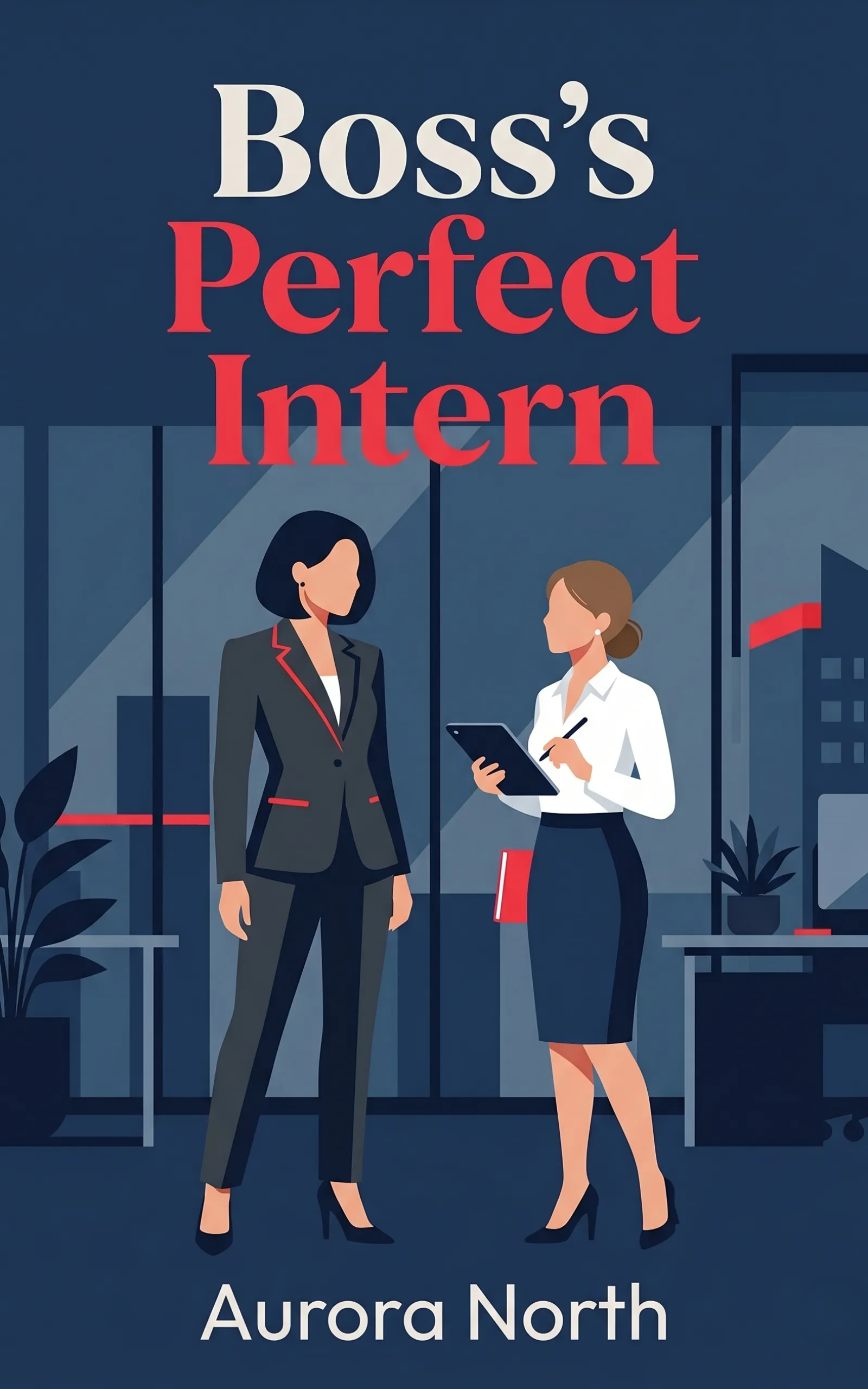
Boss’s Perfect Intern
Sapphic Boss/Intern BDSM Romance
by Aurora North
Free with Kindle Unlimited
Pairing: FF (Sapphic)
Heat: 🌶️🌶️🌶️🌶️🌶️ Inferno
Length: 155,000 words
Tropes: Boss/Intern, Age Gap (40/25), Praise Kink, Slow Burn, BDSM, D/s Dynamic, Forbidden Workplace Romance, Dominant Older Woman, Corporate Espionage, Grief Recovery, Hurt/Comfort
She was supposed to ruin me. She did. We got married anyway.
Tori Lang is forty years old, the CEO of a four-hundred-million-dollar Manhattan firm, and three years past the divorce that nearly ended her. She does not need an intern. She especially does not need the one in the wine-red dress with the dimple in only one cheek and the resume that should have been impossible.
Lena Voss is twenty-five, a Wharton finalist with a full-merit scholarship, an MBA from Columbia, and a mother dying at Montefiore from leukemia the family cannot afford to treat. She is also, as of forty-eight hours before the interview, a corporate spy — planted by Tori’s billionaire ex-wife, with a deadline and a price on her mother’s life.
The plan is simple. Get hired. Get close. Get the merger memo. Walk away with enough money to keep her mother alive.
The plan does not survive Tori Lang saying good girl with her hand at the back of Lena’s neck on a Wednesday evening in October.
What follows is the slow, scorching, devastating undoing of two women who should have known better — a contract at the Mandarin Oriental, rope on a hotel bed, a long counter in a Hamptons kitchen, two dead mothers, a hundred-and-two-year architecture of women in kitchens, and a wedding on the first of May. The lie is going to come out. It is going to break them both. And the only thing that survives the breaking — slow, slow, in pieces — is the architecture.
You’ll love this book if you enjoy:
✅ FF boss/intern with a 15-year age gap and devastating chemistry
✅ Praise kink as love language (good girl, sweet girl, my Lena, my Tori)
✅ Slow burn that DETONATES into Inferno-level BDSM (rope, contracts, strap-on play)
✅ Corporate espionage betrayal that becomes a love story
✅ Tender, devotional D/s dynamic with explicit consent and color-checks
✅ Two intertwined grief arcs that gut you and put you back together
✅ Multigenerational found family (mothers, daughters, the women in the kitchens)
✅ Latina rep, Jewish rep, queer rep written with care
✅ HEA absolutely guaranteed
⚠️ Content Warning: This novel contains extremely explicit sexual content (graphic FF scenes, BDSM, rope, strap-on play, praise kink, age gap, power exchange), strong language, on-page death of a parent (cancer), depictions of grief, manipulation/coercion (corporate espionage plot resolved on-page), workplace power dynamics, and a billionaire antagonist using a sick mother as leverage. Intended for readers 18+.
📖 Read Chapter One Free
Not sure yet? Read the full first chapter right here.
Chapter One: The Interview
Tori’s POV — Friday afternoon, October 2025, Lang & Ash, Manhattan
The girl was going to be a problem.
I knew it before she walked in. Knew it from the resume in front of me, the recommendation letters that ran two pages each, the GPA that should have been impossible. Knew it from the photograph the temp pool attached to every applicant file — small, professional, unremarkable, except for the mouth.
I closed the folder.
“Priya.” I didn’t raise my voice. The intercom didn’t need it.
“On her way up. Five minutes.”
“Coffee.”
“Already on it.”
I leaned back in the chair Richard had bought me the day we incorporated — oxblood leather, obscenely expensive, the only piece of furniture in the building older than the company itself. Beyond the floor-to-ceiling glass, Manhattan was doing the thing it did at four in the afternoon in October, going gold around the edges, the Hudson catching fire two blocks west. I dictated a note into my phone for the merger memo, deleted it, dictated it again.
I did not need an intern. I needed a defense analyst, a forensic accountant, and roughly four more hours in every day. What I had instead was a Wharton finalist named Elena Voss, twenty-five, full-merit scholarship, the kind of resume people built around her in textbooks ten years from now.
I had turned down six candidates this week. I had cut the last one off in under three minutes.
I pulled the folder back open and looked at the photograph again.
The mouth. Soft, full, painted a shade of red that no woman wore to a final-round interview unless she meant something by it. A small dimple in only one cheek. Hazel eyes the camera couldn’t quite catch — they read brown in the photo, and something else in person, I would have bet a quarter of my net worth.
I closed the folder. Again.
“Stop it, Lang,” I said, to the empty office.
The elevator chimed.
Mariah brought her up.
I heard them before I saw them — Mariah’s laugh, real and unguarded, which Mariah saved for people she had already decided she liked. That was the first warning. Mariah did not like anyone before noon and barely tolerated humanity by close of business. I made a mental note to ask her about it later and forgot it the moment my office door opened.
The girl walked in.
She was wearing a dress.
Not a suit, not a blazer-and-pencil-skirt combination, not anything the career counselors at Columbia would have signed off on for a final round at a firm like mine. A dress. Wine red. Knee-length, sleeveless, fitted at the waist in a way that suggested the seamstress had taken her measurements personally, with a neckline that sat exactly where a neckline had no business sitting in a CEO’s office on a Friday afternoon. Black pumps, modest heel. A leather portfolio tucked under one arm. A small gold cross at her throat that she touched, once, when she saw me.
I stood. I always stood for candidates. It was a tell I had cultivated — putting them at ease while I took their measure top to bottom in the time it took to round the desk.
I took her measure now.
She was smaller than I had pictured. Five-seven, maybe, in the heels. The brown of her shoulders against the wine of the dress made my mouth go briefly dry. Her hair was down, a riot of dark honey curls she had clearly tried and failed to tame, and there was a single curl at her temple that had escaped the rest and lay against the line of her jaw, and I would think about that one curl for the next twelve hours.
“Miss Voss.”
“Ms. Lang. Thank you for the time.”
Her voice was lower than I had expected. There was a softness at the edges of it, a Bronx cadence she hadn’t bothered to scrub out, and underneath the softness something deliberate. Sultry was the wrong word. Sultry was for women who needed it. This was a woman who had been told what her voice did to people and had decided to use it.
I gestured to the chair across from mine. She sat. Crossed one leg over the other. The dress did what a dress like that was designed to do — rode an inch up her thigh and stopped just short of the place where my eye wanted to follow.
I sat down very carefully.
“Coffee?” I asked.
“Black, please.”
“That’s the right answer.”
“I know.”
I let that sit between us for a beat. She held my eyes.
The first warning had been Mariah’s laugh. The second was the photograph. The third was the dress. The fourth, and the worst, was that she did not look away. Most candidates looked away. Most candidates spent the first ninety seconds of an interview with me apologizing with their body language for being in the room. This one looked at me like she was deciding whether to hire me.
I was forty years old. I ran a four-hundred-million-dollar firm. I had stared down hostile boards, hostile press, and one extraordinarily hostile ex-wife. A twenty-five-year-old in a red dress should not have been able to shift the weight in my own chair.
“Let’s begin,” I said.
The first question was the one I asked everyone. I had been asking it for eleven years and I had never had a candidate I respected give me the same answer twice.
“Tell me a time you were wrong about something important. Not something professional. Something that mattered to you personally. And tell me how you knew.”
She didn’t blink.
“I was wrong about my mother.”
I waited.
“I was eighteen,” she said. “I got into Columbia. Full ride. And I told my mother — I sat at the kitchen table and I told her — that the reason she’d never gone to college was because she’d been afraid. I said it like that. I said the word afraid. I told her I wasn’t going to be afraid the way she’d been afraid.”
She took a breath.
“My mother had been working two jobs since I was four. My father left when I was two. She didn’t go to college because she had a child to feed, and the year she would have started she lost her own mother and had to put her on a payment plan with the funeral home. She had been more brave by twenty-three than I will be in my entire life.”
A pause. Steady eyes.
“I knew I was wrong because she didn’t get angry. She just looked at me like I was very young. And I have been very careful, since, about the difference between a thing I haven’t done and a thing somebody else couldn’t do.”
I didn’t respond for a moment.
“Did you apologize?”
“For three years. She told me to stop. She said apology was a tax I was paying so I’d feel better, and she didn’t want my money.”
I made a note in the margin of her resume. I did not look up while I made it. If I looked up too quickly she would know what I’d written.
“Question two.”
The second question was the trap.
“You’re three months into your internship. You discover that one of our senior vice presidents has been steering contract awards to a vendor in which her brother holds a thirty-percent equity stake. The contracts are within market rate. The work is competent. Nobody is being demonstrably harmed, and the VP has been instrumental in three of our largest wins this year. You have proof. What do you do?”
Most candidates went one of two ways. The bootlickers reported it immediately, citing fiduciary duty in a tone that made me want to throw them out of the window. The cowards rationalized — no one’s being harmed, market rate, instrumental — and lost the job in the same sentence.
She thought about it.
“I’d want to know two things first,” she said. “Has she disclosed the relationship in writing anywhere — board minutes, conflict-of-interest filing, anywhere — even if no one’s reading it. And do the contracts pre-date her tenure as a VP, or did the spend go up after she got the title.”
That was not an answer. It was a reframing of the question, and it was a better question than the one I had asked.
“Assume she has not disclosed. Assume the spend tripled the quarter she was promoted.”
“Then I’d take it to you.”
“Why me. Why not legal. Why not the chair of the audit committee.”
She tilted her head a quarter inch. “Because if I take it to legal, in three months I’m an intern who got a senior VP fired. If I take it to the audit chair, I’m an intern who went over the CEO’s head in her first quarter. If I take it to you, I’m an analyst you trust.”
She held my eyes.
“And because you’d want to be the one who decided what to do with it. Ms. Lang.”
I set my pen down.
“That was very calculated, Miss Voss.”
“You asked a calculated question.”
“I asked an ethics question.”
“You asked a power question dressed as an ethics question. I answered the question you asked.”
The silence in the office was not the kind I was used to. It was thicker. It pressed on the skin under my collar.
I picked the pen back up.
“Question three.”
The third question was personal.
I didn’t ask it of everyone. I asked it of the ones I was already considering.
“Why do you want this job.”
Most candidates had a script ready for this. Mission, growth, leadership, mentorship. I had heard every variation. I was bored of all of them.
She was quiet for a long time.
“My mother is sick,” she said.
I waited.
“Pancreatic. Stage three. She started treatment in August and the bills are — they are what they are. I have a brother in his second year at SUNY Albany. He doesn’t know how bad it is. I haven’t told him.”
She was not looking at me anymore. She was looking at a point just past my left shoulder, at the photograph of Richard and me on the day we rang the opening bell.
“I want this job because it pays more than any other internship in the city, and because if I do it well it leads to a job that pays a great deal more than that. I don’t want to lie to you about it. I could tell you I admire what you’ve built. I do admire what you’ve built. But if you offered me half the money I’d take a different offer, and I’d be a worse employee for the resentment.”
She looked back at me.
“I want this job because I need it. And I’m telling you that because I’d rather lose the offer than start a job by lying to the person I’d be working for.”
I am very good at not reacting. I have spent two decades cultivating it. There was a thing happening behind my sternum that I did not have time for and would deal with later, alone, with vodka.
“That’s an unusual thing to say in an interview.”
“I’m aware.”
“Most candidates would be afraid I’d think they were unprofessional.”
“Most candidates haven’t watched their mother lose nine pounds in three weeks.”
I closed the folder.
“Miss Voss.”
“Ms. Lang.”
“Do you have a question for me.”
This was not part of the interview. This was the moment I usually wrapped up — thank you for your time, we’ll be in touch by Tuesday. I had never, in eleven years, opened the floor at the end. I was not sure why I had just done it.
She didn’t hesitate.
“Why are you hiring an intern at all.”
I almost laughed. “Excuse me?”
“You haven’t taken an intern in four years. The last one you hired left after six weeks and gave a quote to Business Insider calling you, I believe the phrase was, the most exquisitely demanding human being she had ever met. Your COO does the kind of work an intern does. Your assistant does the kind of work two interns do. You don’t have a training program. You don’t have a mentorship structure. You don’t have time.”
She set her portfolio down in her lap. Folded her hands on top of it.
“So I’d like to know why I’m here. Because it’s not because you need an intern. And if I take this job, I’d like to know what I’m walking into.”
The light through the windows had gone from gold to bronze. The Hudson, beyond her shoulder, was doing the thing it did when the sun got low. I felt her watching me.
I had three answers.
The first was the truth, which was because Richard is dying and I am going to be alone in this company in eight months and I need to start trusting somebody now or I will not survive it.
The second was the strategic answer, which involved succession planning and bench depth and a six-page memo I had written to myself in July.
The third was the answer I gave.
“Because I read your application,” I said, “and I had a feeling about you.”
She did not blink.
“What kind of feeling.”
“The kind I usually ignore.”
“And you’re not ignoring it now.”
“No, Miss Voss. I am not.”
She smiled then.
It was a small smile. It pulled the dimple in her left cheek. It did not reach her eyes, which stayed steady on mine, and it was the worst thing I had seen all week. There was a heat under my collar. There was a heat lower than that. I kept my face still and my hands flat on the desk and I let her look at me.
I stood up.
“Be here Monday. Seven sharp. Mariah will send the paperwork tonight. The first ninety days are a probation. If you survive them you have a real job.”
She rose. The dress did the thing again. I did not look.
I looked.
“Thank you, Ms. Lang.”
“Don’t thank me yet.”
She extended her hand. I took it. Her palm was warm and dry. Her grip was firm — and her thumb pressed, just barely, against the soft inside of my wrist, against the place where my pulse had been doing something it had no business doing for the last eleven minutes. She held it there for the space of two heartbeats. Then she let go.
It might have been an accident.
I had not, in the last eleven years, met a woman who did things like that by accident.
“Welcome to Lang and Ash, Miss Voss.”
“Lena,” she said.
“I’ll call you Miss Voss.”
The smile pulled deeper. The dimple, again.
“Yes, ma’am.”
She turned. She walked to the door. She did not look back, which was somehow worse than if she had. The door closed behind her with a soft, expensive sound.
I sat down. I put both hands flat on the desk. I waited for my pulse to come down.
It did not come down.
I picked up the phone and pressed the intercom.
“Priya.”
“Hired her?”
“Yes.”
“Knew it.”
“Priya.”
“Yes.”
“I am going home early.”
“Tori — “
“Cancel my five. Cancel my seven. I am going home.”
There was a small silence.
“Are you all right.”
“I am fine.”
“Tori. Are you all right.”
I looked at the chair across from mine. The leather was still warm. There was the faintest impression of where she had sat, the faintest indentation in the cushion, and I was forty years old and the CEO of a four-hundred-million-dollar firm and I was looking at the imprint of a girl’s body on my furniture and thinking about her thumb on my wrist.
“I am fine, Priya. Cancel the meetings.”
I hung up.
I sat there for a long time.
When I finally stood, the sun was gone. The city had come on, all of it at once, a thousand windows lighting up across the river. I took my coat off the hook and shrugged into it. I picked up the folder.
I almost left it on the desk.
I didn’t.
I tucked it under my arm and rode the elevator down forty-seven floors and got into the back of the town car. The driver pulled away from the curb. I leaned my head against the cool of the window and I closed my eyes, and I saw the curl at her temple, and the line of her thigh, and the slow press of her thumb against the soft place on my wrist, and the dimple, and the yes, ma’am.
I read her resume three more times on the way home.
The girl was going to be a problem.
I had known it from the start.
Want to keep reading? The full novel is available now.
🔥 Want an EXCLUSIVE Bonus Chapter?
The Long Counter — A scene TOO HOT for Amazon
Three years after the wedding. Sunday morning at the Hamptons. Tori is forty-three. Lena is twenty-nine. The long counter Margaret cooked at is still where the architecture moves. Lena wakes Tori with her mouth, then puts Tori on the counter — slow, naked, with the wedding strap and the small old gold band and the slip on the cabinet watching. The hottest scene Aurora North has ever written.
More from Aurora North
Browse all Aurora North books.
The Cabin We Both Booked
Two reservations. One cabin. Six weeks. Seven rules.

The Second Apartment
She finally has a life that's all hers. The woman across the hall wants to be in it out loud.

Last Call for the Ice Queen
She runs the hotel like a Swiss watch. The new consultant just took it off her wrist.
The Woman Experiment
Three dates. One honest night. No way to keep it theoretical.


Night Shift, Door Locked
Calder Memorial After Dark
She has a rule for everything. Then she met the nurse who breaks them for fun.
Never Miss a Release
Get new release alerts, exclusive bonus content, and reader-only giveaways.