
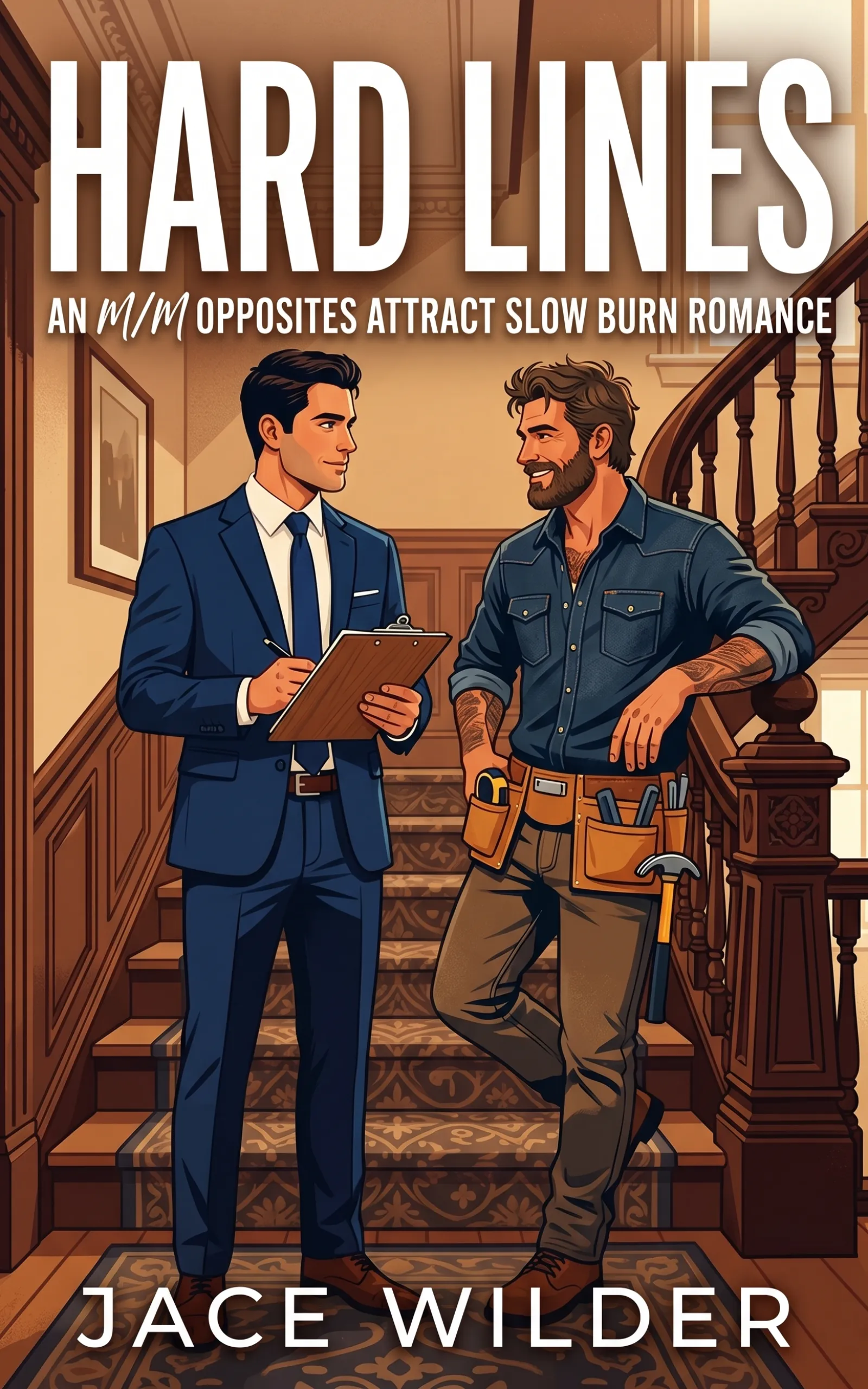
Hard Lines
An MM Contemporary Romance — by Jace Wilder
Available at all major retailers
The Details
Pairing: MM
Heat: 🌶️🌶️🌶️🌶️🌶️ Inferno
Length: ~135,000 words
Distribution: Wide — All Major Retailers
Tropes
• Blue Collar / White Collar
• Closeted MMC
• Class Difference
• Forced Proximity
• Slow Burn
• Age Gap
• Control vs. Surrender
• Found Family
• Renovation Romance
He came to fix the brownstone. He stayed to break the man inside it.
Evan Hale is six months away from making partner at a white-shoe Manhattan firm. He has the spreadsheet, the schedule, the Tom Ford navy. He has the 1898 Park Slope brownstone he bought at auction in May. He has — most importantly — fifteen years of practice at being the man the firm wants him to be.
What he doesn’t have is a contractor. Not yet.
Rafael Moreno is a Marine vet, a brownstone restoration specialist, and the kind of man who notices the way another man holds a fork. He took the job for the building. The 1898 plaster ceilings. The original parquet under three layers of bad paint. He didn’t take it to break a senior associate at a white-shoe firm. He didn’t take it because the man who hired him was, on the inside of his body, the most carefully constructed lie Rafe had ever stood next to.
He didn’t take it for any of those reasons.
He took it.
What follows is six months on a job site. A staircase that comes apart at the second-floor landing. A drop cloth on the parlor floor. A bay window with a man and a dog passing on the other side of the street. A kitchen island. A cast-iron tub. A Christmas Eve dinner above a bakery in Sunset Park where Evan finally — for the first time in fifteen years — tells his mother on the phone the name of the man he is building something with. A partnership vote that will, on December fifteenth, decide one version of his life — and on December twenty-fourth, decide the other.
This is a 135,000-word slow-burn MM contemporary about the man who walks into a foyer in a Tom Ford navy with a printed timeline in his hand and the man who, with his hands in his back pockets and his weight on his back foot, looks at him and says, very quietly, yeah.
HEA. Bonus epilogue included. Free wedding-night bonus chapter on the website.
You’ll love this if you enjoy:
- ✓ Slow burn that earns every inch — first sex doesn’t arrive until you’ve felt them not-touching for a hundred pages
- ✓ Blue-collar/white-collar dynamics with real class tension, not aesthetic
- ✓ A closeted MMC who gets unmade and remade, not “fixed” by his partner
- ✓ A contractor MMC who is patient on purpose — until he isn’t
- ✓ Found family with full Spanish-speaking household, a four-year-old in a cape, and a sister-in-law who has had your number since college
- ✓ Heat 5/5 — staircase, drop cloth, butcher block, bay window, cast-iron tub, bear-skin rug
- ✓ HEA with a wedding, a brass plate, and a mother-in-law who grows bay-laurel cuttings on a windowsill in Schenectady for one full year before bringing them down
Content Notes
Adult MM romance, 18+. Explicit on-page sexual content (heat 5/5, multiple positions and dynamics including topping/bottoming both ways, dominance/surrender, semi-public). Closeted main character on-page coming-out arc with workplace homophobia (an antagonist outs the MMC at a work event in Act 3). References to a previous unhealthy relationship (cheating, controlling behavior — fully off-page, in backstory). Brief mention of family estrangement following an absent/cold father. Discussion of a parent’s death from cancer (off-page, years prior). HEA guaranteed with bonus epilogue.
📖 Read Chapter One Free
Not sure yet? Read the full first chapter right here.
Chapter One
— Evan —
The alarm went at five because that was when I’d set it, and because I had not slept past five since I was twenty-three, and because I had a partnership decision in six months and a brownstone full of broken plaster and a contractor I had not yet hired and twelve emails I needed to answer before sunrise.
I sat up. I did not check my phone.
There were rules.
Run first. Coffee second. Phone third. Anything else was the kind of life I’d already worked too hard to outgrow, and I was not interested in finding out who I’d be if I let the order slip.
I dressed in the dark. The Lululemons that fit like a second skin, the long-sleeve base layer because September in Brooklyn was going cold mornings and warm afternoons and I refused to be the man who’d dressed wrong for the day. Hat. Watch. Keys. Out the door of the rental on 7th by five-twenty and into the blue dark of the avenue with my breath fogging in front of me and the city not yet awake enough to be loud.
Prospect Park at five-thirty was the only version of New York I actually liked. Empty. Honest. The loop unspooled the same way every morning — past the bandshell, past the dog beach, up the hill that had stopped feeling like a hill three years ago, down the back stretch where the light changed first. I ran a six-thirty mile and I did not look at my watch. My body knew. That was what I’d built it for.
By the third mile I had drafted four paragraphs of the deal memo I owed Gerald by noon. By the fourth I had answered, in my head, the question Coughlin would ask in the eleven o’clock and the follow-up he’d ask after I shut him down. By the fifth I was thinking about the brownstone.
I was always thinking about the brownstone.
I’d bought it at auction in May. Two-point-three million for four stories of 1898 limestone with original woodwork under three layers of bad paint and a parlor floor that had been sliced into a two-bedroom rental in 1974 by a man who should not have been allowed near a load-bearing wall. The inspector had used the word gut eleven times in his report. I had counted.
I had also bought it knowing exactly what it would cost to fix, because I had spent the entire spring building a spreadsheet, and because I do not buy things I cannot afford. The number wasn’t the problem. The number was, in fact, the cleanest part of the whole transaction.
The problem was the calendar.
The firm’s holiday open house was December eighth. Gerald had mentioned it twice in the last month, both times with the kind of casual lift in his voice that was never casual. We thought we’d do it at your new place this year, Evan, if you’re settled. Translation: Show me what you’ve made of yourself and we’ll see if you get the office on the corner. The partnership vote was December fifteenth. Anyone who could not host a hundred lawyers and their wives in a finished brownstone in Park Slope was not someone Crane Whitfield made partner.
So.
Six months. House done. Vote won. Life proceeding according to the plan I had been running on since I was nineteen years old.
I came out of the park at six-fifteen, stripped my shirt off in the lobby of the rental because I hated tracking sweat across the floor, and stood in the shower for exactly four minutes. By six-thirty I was dressed — Tom Ford navy, white shirt, the watch my mother did not know I owned — and on the train to midtown with a coffee from the place on Union and a clean head.
Run first. Coffee second. Phone third.
The phone, when I finally let myself look at it on the F train, had thirty-eight emails and one text from Mira that just said did you call him yet.
I had not called him yet.
I typed this morning and put the phone face-down on my thigh.
Mira’s wife’s cousin. That was the chain. He’s the only contractor I would let near a 19th-century brownstone, Diane had said over dinner three weeks ago, and the only reason he’s available in your timeline is that the last guy he was supposed to work for turned out to be a piece of shit, so call him before he books out the rest of the year. Diane was an architect. Diane did not throw around recommendations.
I had the man’s number in my phone for nineteen days before I made myself dial it. He had picked up on the second ring. He had a voice like someone who’d just woken up at noon, even though it was four in the afternoon. He had said yeah, Diane mentioned you, send me the address and the inspector’s report and we’ll walk it Thursday at nine.
He had not said please. He had not said thank you. He had said yeah.
It was Thursday.
It was eight-fifty-two when I left the F train at Bryant Park and eight-fifty-eight when the elevator at the firm opened on fifty-two, and Gerald was already in the corridor with his hand on the conference room door, and he turned when he heard me coming and gave me the smile that meant he wanted something.
“Evan.”
“Gerald.”
“You free for ten minutes?”
I was not free for ten minutes. I had a nine o’clock walk-through in Park Slope with a contractor whose voice was still doing something to the back of my neck that I had not yet examined in the light. I said, “Of course.”
He took me into his office. He did not sit. He stood with his hands in his pockets and looked out the window at the building across the avenue, and he said the thing about the open house again — we’re really hoping, he said, like the firm was a person — and I made the right noises and the right gestures and he said good man, Evan, good man, and I was out the door at nine-eleven with my pulse in my throat.
I had not been late for a meeting in four years.
I texted the contractor from the back of the cab. Running ten minutes behind. Apologies.
He did not text back.
By the time I got to 8th Avenue, it was nine-thirty-two. The street was awake — strollers and two old men outside the bodega and a woman walking three Pomeranians on a single braided leash — and the brownstone stood in the middle of the block with its scaffolding still tarped from the last owner’s failed attempt at a roof patch and its stoop chipped and its parlor windows blank. I had a key in my pocket. I let myself in.
The smell hit first. Dust, old plaster, the ghost of a hundred years of cooking. The hall ran straight back to the garden — original parquet under three layers of crud, original moldings under three layers of paint, original everything under everything. I stood in the foyer with my Tom Ford pants and my four-hundred-dollar shoes and breathed in the smell of a building older than my country, and for one second, before I caught myself, I felt something close to peace.
Then I checked my watch.
Nine-thirty-six.
He was not here.
I texted again. I’m on site. Sent it. Put the phone away. Walked the parlor floor with my hands behind my back the way I’d learned to do at depositions, which was a stupid way to walk through your own house, and which I did anyway.
The list. I knew the list. I had memorized it the way I’d memorized everything else that mattered. Strip the parlor walls. Refinish the parquet. Open up the kitchen wall on the garden level. Three new bathrooms. Replaster everything. Mechanicals — full rip and replace, electrical to code, plumbing because the cast iron was on borrowed time. Stoop repointing. Roof. Restore the bay window in the front parlor. Strip and refinish the staircase, all four stories of it, original walnut.
Six months. I had six months.
I had spent two and a half weeks rehearsing what I was going to say to this man, and the rehearsal had gotten more elaborate every time. I had a printed timeline in my bag. I had a phased payment schedule. I had three contingencies if he balked at the deadline. I had a folder of inspiration shots from Architectural Digest with the page numbers marked.
I had, I realized, become a man preparing to give a presentation in his own house.
Nine-forty-eight.
The door opened.
I felt it before I heard it — the pressure-change of the front door on its old hinges, the brief crack of light off the avenue, the boots on the foyer tile — and I turned around with my mouth already open to say you’re late, and then I stopped, because the man in my hallway was not what I had been expecting.
I’m not sure what I had been expecting. Someone who said yeah on the phone. Someone Diane respected. Some construction guy.
I had not been expecting that.
He filled the doorway. Six-two, maybe, but the kind of six-two that took up more room than the measurement should have allowed — broad through the chest, heavy in the arms, a t-shirt that had been washed enough times to go soft and was now stretched across him like it had given up arguing. Thick. Solid in a way that made me, for a second, painfully aware of every meal I’d skipped that week. Tan. Dark hair shoved back from his face by what looked like nothing more than the press of his own forearm. Permanent scruff. A tattoo running down the inside of his right arm that disappeared under the sleeve. A scar through his right eyebrow that bisected it into two unequal halves.
He was forty-one. I knew because Diane had told me. He looked like every guarantee my body had ever made me on a Friday night and never delivered on.
He was also not wearing a coat.
In September. At nine-fifty in the morning. With his sleeves not even rolled because they didn’t need to be rolled because the t-shirt didn’t have any.
He set a battered canvas bag down on the foyer floor like he’d been here before. He took me in the way a contractor takes in a building — top to bottom, no comment — and he said, “You Evan?”
“Yes.” Said too fast. I said it again, slower. “Yes. Rafe?”
“Yeah.”
He didn’t apologize for being late. He didn’t even acknowledge it. He just stood there in my foyer with his hands loose at his sides and looked at me, and waited, and I felt my shoulders square the way they did when a witness was being difficult, and I said —
I said, “I appreciate you making the time. I have a number of things I’d like to walk you through this morning regarding scope, timeline, and budget, and I’d —”
“Sure,” he said. “Walk me through them.”
He didn’t smile. He didn’t sit down. He just put his weight on his back foot and tilted his head about half an inch, and the tilt was patient in a way that made me feel, instantly, like I was about to make a fool of myself.
I made a fool of myself anyway.
I had the speech. I gave it. I had the timeline — I unfolded it on the staircase newel post because there was no kitchen island yet and no parlor table and no surface in the entire house that wasn’t powdered with a hundred years of someone else’s life — and I walked him through the phases. Demo by the end of the month. Mechanicals by mid-October. Drywall by Halloween. Finish carpentry through November. Punch list by December first. Final walk-through December seventh. Open house December eighth.
I was articulate. I was precise. I had cost estimates per phase. I had budgeted a fifteen percent contingency. I had written down, in a sub-bullet, flexibility on aesthetic details, NO flexibility on timeline.
He let me get all the way through it.
He let me get all the way through it without saying a single word, which I should have noticed was a kind of mercy and didn’t notice at the time.
When I finished, I folded the timeline back along its creases and looked up at him, and I said, “What questions do you have?”
He looked at me.
He looked at the timeline in my hand.
He looked at the parlor doorway behind me.
He said, “Do you know what the floor’s sitting on?”
“I’m sorry?”
“The floor.” He nodded at the parquet under our feet. “Parlor floor. Do you know what’s underneath it.”
“I — the inspection report mentioned —”
“The inspection report is a starting point.” He stepped past me. He did not ask permission. He moved with the unhurried center of gravity of a man who knew exactly where his weight was at all times, and he crouched down next to the wall in the parlor and pressed two fingers into the seam where the parquet met the baseboard, and he frowned at it.
“It’s a sleeper system over a subfloor that was not put down by anybody who liked the people who’d be walking on it,” he said, “and depending on how bad it is, you’ve got either three weeks of work or two months of work, and you don’t know which yet, and your timeline doesn’t know either.”
He stood up. He turned around. He looked at me the way I had, ten minutes earlier, looked at the smell of the foyer.
“Same goes for the back wall of the kitchen on the garden level,” he said. “Same goes for the joists under the second-floor bath. Same goes for the chimney flue in the parlor, which I’m going to bet you a hundred bucks has not been swept since Eisenhower. Same goes for whatever’s behind the plaster in this hallway, which has a soft spot you didn’t notice on your way in.” He nodded at the wall behind my left shoulder. “Right there. Tap it.”
I did not tap it.
He watched me not tap it.
He said, “What I’m telling you is that the timeline you wrote on that piece of paper is the timeline for a house you have not actually met yet. You bought a hundred-and-twenty-six-year-old building. It’s going to tell us what it needs when we open it up. And what I’m going to need from you, if I take this job, is for you to understand that before I sign anything, because I’m not in the business of telling clients what they want to hear in September and apologizing in December.”
He said it without heat. That was the thing. He said it the way he’d said yeah on the phone. Like it was a fact, and he was telling me, and he didn’t care very much whether I liked it.
I felt the heat hit my throat.
I felt it climb. The flush. The tell I’d been trying to stamp out of my body since I was fourteen years old and which had outlasted every other piece of training I’d done on myself, because the body is honest in ways the mind never agrees to be. It went up the side of my neck and into my jaw and I knew, without a mirror, that I was the color of someone who had just been told something he could not argue with by a man who had not raised his voice.
I cleared my throat.
I said, “Right.”
He looked at me for one second longer than he needed to.
I would think about that one second for a long time afterward.
“I’ll walk it,” he said. “Front to back. You can come or you can stand here. Up to you.”
“I’ll come.”
“Yeah.”
He picked up his bag and slung it over his shoulder, and he walked through the parlor like he already lived there. Hand on the wall every few feet — flat-palmed, listening — pressing into the plaster the way a doctor presses into a stomach. Down the hall. Into the back room that someone had called a kitchen in 1974 and that nobody should have called a kitchen since. Up the stairs to the second floor — slow, deliberate, his weight rocking each tread to feel which ones moved. Up to the third. Up to the fourth. Out onto the small flat roof access at the back of the top floor. Down again. Down past me. Down to the garden level.
I followed him for forty minutes. I did not say a word for thirty-eight of them.
I watched his hands. I tried not to.
He had hands like a man who had used them. Not just the calluses — though there were calluses, ridges along the pad below the thumb, the heel of the palm — but the way he held them. Loose. Ready. He pressed the back of his knuckles against a wall to test for cold spots. He spread one open palm flat against a windowsill and stood there for ten seconds with his eyes half-closed like he was listening to something I couldn’t hear. He hooked one finger under the lip of a baseboard and pulled, gently, just enough to test the tension. He never grabbed anything roughly. He never had to.
By the time we got back to the foyer, the September sun had climbed enough that the dust in the air looked like it was lit from inside, and my shirt was sticking to my lower back, and Rafe Moreno had not asked me a single additional question, and I was furious with him in a way I could not justify and could not get rid of.
He set his bag down again. He pulled a small black notebook out of his back pocket and flipped through three pages and folded it shut and put it back.
He said, “Okay.”
I waited.
He said, “I’m going to think about it.”
“You’re —”
“Yeah.”
“What does that mean.”
He looked at me. He had brown eyes and his eyelashes were too long for his face and there was sawdust on the inside of his wrist that I had no idea where he’d picked up and he was, I realized, only barely amused.
“It means I’m going to think about it,” he said. “I’ll call you tomorrow.”
“Mr. Moreno —”
“Rafe.”
“Rafe.” I made myself slow down. I made my voice the voice I used in conference rooms, the voice that had won me four cases on tone alone. “I’d like to be very clear about something. I have a deadline. I am prepared to pay above market for that deadline. I have a contract drafted. I would like, if at all possible, for you to commit before you leave this house, because if you walk out that door without committing, I am going to spend the next forty-eight hours interviewing other contractors, and I would prefer not to.”
He listened to all of it.
He waited until I was done.
Then he picked up his bag, and he settled it on his shoulder, and he said —
His voice low, no edge to it, only that flat patience I was starting to recognize and starting to hate — “Counselor. I’m going to think about it.”
He had not asked me what I did for a living.
He’d known. From the suit. From the speech. From the way I held a clipboard.
He pulled the front door open. He stepped through it. He turned, half-back, with one hand on the jamb, and he looked at me one more time, head to foot, slow, in a way that was not — I was telling myself — not a way that meant anything, not a way I had any business reading anything into, not anything but a contractor sizing up a client he wasn’t sure he wanted.
He said, “You should eat something. You look thin.”
He pulled the door shut behind him.
I stood in the foyer of my two-point-three-million-dollar brownstone with the dust coming down through the September light, with my timeline crumpled in one fist, with my shirt stuck to my back and my throat still red and my hands, I noticed for the first time, shaking, very faintly, the way they had not shaken in fifteen years.
I waited until I heard his truck start.
I waited until I heard it pull away.
I waited until the block was quiet again.
Then I walked into the front parlor, and I sat down on the floor in the middle of the room, in my Tom Ford pants, in the dust, and I pressed both hands flat against the parquet.
He was right.
The floor was soft.
I had stood on it for ninety minutes that morning and I had not noticed.
I sat on the floor for a long time. The dust settled on my shoulders. My phone buzzed twice in my pocket and I did not look at it. I kept my palms flat against the wood and I felt, through the parquet and through the sleeper system and through the subfloor that some terrible man had put down in 1974, the very faint give of a building that had been waiting a hundred and twenty-six years to be touched by someone who knew what it actually needed.
It was, I thought, the first thing I’d been wrong about in a long time.
I did not yet know — could not have known, sitting there with the sun moving across my shoulders and Rafe Moreno’s counselor still sitting in my chest like a coin dropped down a well — that it was not going to be the last.
But I was about to find out.
I stood up. I brushed the dust off my pants. I walked out of the brownstone, locked the door, and got back in a cab to the firm.
My phone, when I finally checked it on the way uptown, had two new texts.
The first was from Mira: well???
The second was from a number I did not have saved.
It said, I’ll do it. Send me the contract. — R.
I read it three times.
I put the phone in my lap. I looked out the cab window at the city moving past me, at the river coming up on the left, at the bridge, at the towers where I worked, at the entire careful machinery of the life I had built for myself; and I felt, very clearly, the first hairline crack open across all of it.
I told myself I didn’t.
I texted Mira: He took the job.
I did not text him back.
Not yet.
Want to keep reading? The full novel is available now.
🔥 Free Bonus Chapter
“The Long Way Home” — Wedding Night at the Cabin
A 6,000-word bonus chapter set on Evan and Rafe’s wedding night at the cabin upstate. Both rings on. The brass plate freshly re-cast. The version of them that has been being good to each other for eight months — finally allowed to stop. Heat 5/5. Read it free on the website. (Spoilers — read the novel first.)
More from Jace Wilder
If Hard Lines wrecked you, the rest of Jace’s catalog is going to do the same job in different rooms.


Room for One More
Two roommates. One gym crush. Zero chance of staying casual.

Curved Grade
He said 'good' like it was a door opening. I walked through it.

Kept on Campus
He said there were no strings. He lied.

Good Boy Clause
He needed a rent discount. He got a landlord who calls him good boy.
Curfew & Chains
He enforced the rules. I broke every one. Then he made me beg to follow them.
Never Miss a Release
Get notified when the next Jace Wilder MM romance lands.