
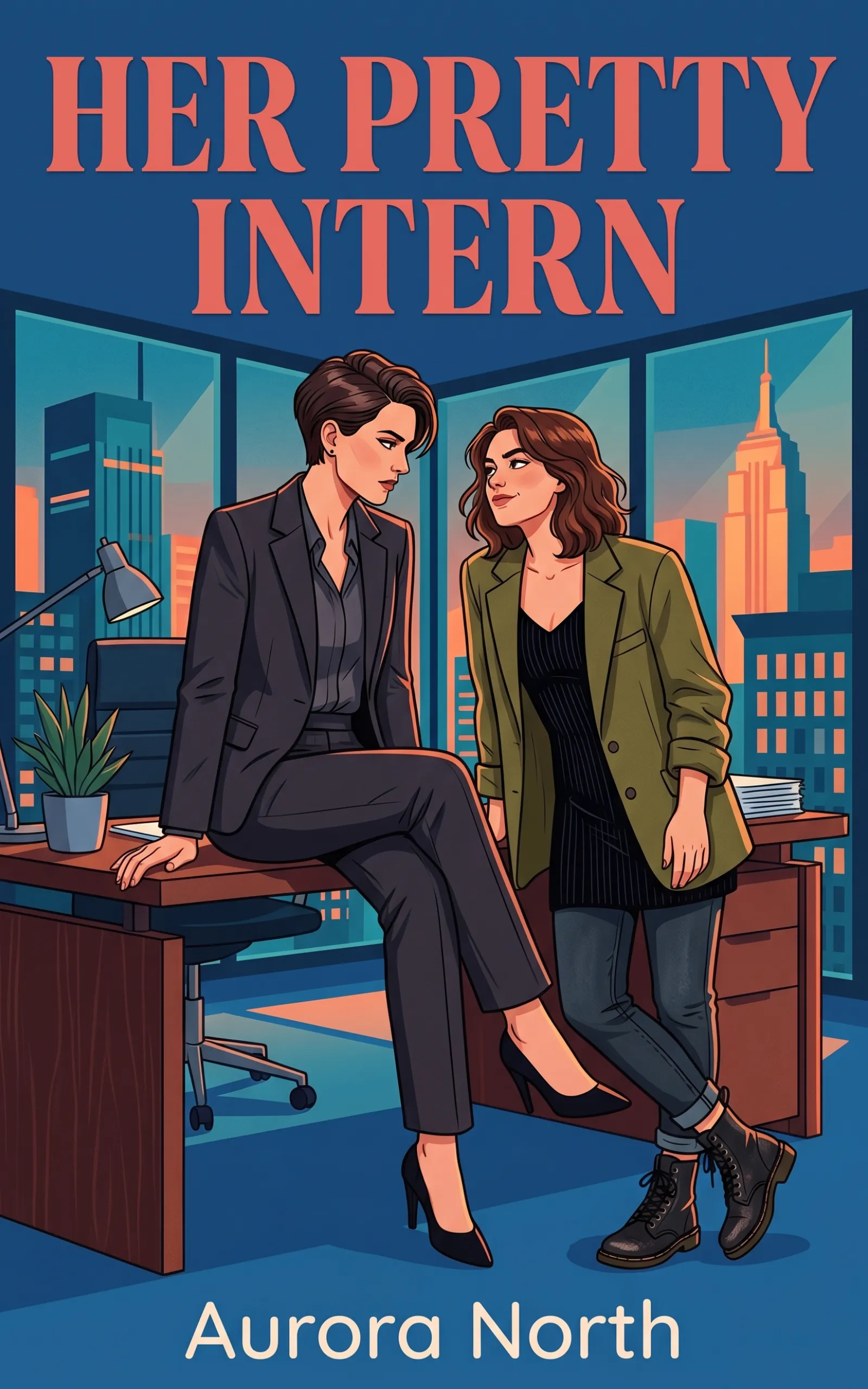
Her Pretty Intern
FF Sapphic Romance · Age Gap · Boss/Intern · Forbidden Workplace
by Aurora North
Free with Kindle Unlimited
Tropes & Details
Pairing: FF
Heat: 🌶️🌶️🌶️🌶️🌶️ Inferno
Length: 132,000 words · Standalone · HEA
Tropes: Age Gap · Boss/Intern · Forbidden · Slow Burn · Workplace Romance · Praise Kink · Ice Queen · D/s Dynamic · Power Exchange · Secret Relationship · Touch Starved · Sapphic Awakening · Mentor/Protégée · Suit Kink · Dominant Woman · Competence Kink
She built an empire on control. Riley Parker is here for a paycheck and the slow, smiling destruction of every rule her boss has ever lived by.
Twenty-two-year-old Riley Parker has one summer to prove she belongs at the most discreet crisis-PR firm in Manhattan. She arrives on the seventh of June in the wrong dress, the wrong borrowed blazer, and the right pair of scuffed boots. By 4:45 p.m. she’s standing in a corridor on the eighteenth floor when a woman in a charcoal suit walks past without looking — and Riley’s career, her summer, and every careful operational decision she has ever made about her own life are, on inspection, over.
Thirty-nine-year-old Victoria Hale built her firm on iron control after walking out of a hotel hallway in Geneva at four a.m. nine years ago. She has not, in nine years, broken a rule. She has not, in nine years, looked at a person in a corridor on the eighteenth floor of her own building. She has not, in nine years, smiled where anyone could see her. Riley Parker, on inspection, lasts six minutes.
What follows is eleven weeks of stolen kisses against bathroom counters, hotel suite walls in Boston, glass desks at seven p.m., kitchen islands at 8:43 a.m., the south wing of a beach house at one minute to two in the morning — and one explosive corporate scandal that puts Victoria’s firm, her career, and the small clean private thing she has, in eleven weeks, finally allowed herself to want, on inspection, on the front page of every paper on the island.
Riley Parker, on inspection, is twenty-two. She’s from Astoria. She has a Queens paralegal mother, a best friend named Cass, a wine red dress, and exactly one careful operational plan for what she wants the rest of her life to look like.
She is, on inspection, going to win.
You’ll love this if you live for…
- Ice queen CEOs who only ever smile for one girl
- Twenty-two-year-old summer interns in the wrong dress
- Slow burns that detonate against bathroom counters at 3:04 p.m.
- Praise kink, suit kink, and a small dried-blood lipstick that means I want a thing
- Forbidden workplace romance that runs head-on into a corporate scandal
- A girl from Queens whose mother lets nobody else pay for lunch
- Off-the-charts heat and a guaranteed HEA at a small clean private courthouse on Worth Street
Content Warnings
This book is intended for readers 18+. Heat level: 5/5 Inferno. Contains: explicit on-page F/F sex (multiple scenes including strap-on use), age-gap dynamic (39/22, both fully adult), boss/intern power imbalance addressed openly on-page, brief on-page mention of a past affair with a married woman (handled with full closure), one explosive corporate scandal involving leaked photographs and tabloid threat, references to the protagonist’s absent father, and a brief on-page panic episode in chapter eighteen. HEA guaranteed. No cheating between leads. No third-act breakup that lasts more than 24 hours.
📖 Read Chapter One Free
Not sure yet? Read the full first chapter right here.
Chapter One
Riley
The first time I see Victoria Hale, I’m wearing the wrong dress.
It’s the dress I ironed twice last night and once again this morning at 5:42 a.m. like I was going into combat instead of an internship. The dress my mother said made me look professional but pretty. The dress Cass took one look at on FaceTime and said made me look like you’re trying to suck off the corner office. Standing now in the seventh-floor reception of Hale Strategic at 7:51 in the morning, watching the elevator doors slide open and shut without releasing me, I am increasingly afraid Cass was right.
The dress is black. Slip silhouette. Ribbed knit. Somewhere between a midi and a too-short. The blazer over it is borrowed — vintage Theory I lifted from my mom’s closet because she said it was lucky. The boots are mine. The boots are the only honest thing I’m wearing. The boots are scuffed leather, three years old, and they cost me half a paycheck when I was nineteen and stupid.
I am twenty-two now. Older. Wiser. About to spend twelve weeks at the most prestigious crisis-PR firm in Manhattan in a borrowed blazer and a slip dress that says fuck me, fire me, or promote me depending on the lighting.
The receptionist’s nameplate says HARLOW. Harlow does not look up when I approach.
“Riley Parker,” I say. “Summer intern.”
Harlow types something. The keyboard sounds expensive. Everything in this lobby sounds expensive — the elevator, the air conditioning, the silence. Hale Strategic occupies floors fourteen through twenty-two of a tower in Tribeca that has no signage on the street and no logo in the lobby and a private elevator bank you can’t access without a biometric scan. I read about it in a New Yorker profile in March, the kind of profile that uses phrases like the most discreet woman in Manhattan and the firm you call when nothing has happened yet but you’re afraid it might.
The piece had a single photograph. Black-and-white. Victoria Hale in profile, looking out a window, jaw cut like she’d machined it herself.
I cut it out.
I’m not going to think about that right now.
“ID,” Harlow says.
I hand her my driver’s license. She slides a tablet across the marble. “Sign in. Read the NDA. Initial each page. There are nine.”
“Nine NDAs?”
“One NDA. Nine pages.”
I sit on the edge of a leather couch that costs more than my mom’s car, and I read every word, because I’m a Parker and Parkers don’t sign things without reading them. By page four I am parsing clauses about non-disparagement in perpetuity and liquidated damages in excess of one million dollars. By page seven I am reading about what Hale Strategic considers a Confidential Communication, and the answer is literally everything I say or hear or see or touch for the next twelve weeks.
I initial. I sign. I hand the tablet back.
Harlow finally looks at me. Her eyes flick from my boots to my hairline in a way I felt before she did it. Her mouth doesn’t move.
“Eighteenth floor,” she says. “Patricia is expecting you. Don’t be late.”
I am not late. I am eight minutes early. I do not say this.
In the elevator the doors close, and I see myself reflected in the mirrored panel, and I think oh, you stupid little thing, you have no idea what you’re walking into.
The thought is not unpleasant.
The thought is, in fact, the second-most-honest thing about me today.
Patricia is waiting at the elevators on eighteen.
She is a small woman with iron-gray hair and a tablet and pearl earrings of the kind that say I have been doing this longer than you have been alive. She does not smile. She does not extend a hand.
“Parker,” she says. “Walk with me.”
The eighteenth floor is open-plan, which I did not expect. I expected oak and shadow. I get instead a cold pale gold — sand-colored carpet, white walls, glass-fronted offices along the perimeter. The light is northern, gray-blue, soft. Everyone is at their desks already at 8:03, and nobody looks up. Nobody is on a phone. The whole floor sounds like a library that has just realized it might be on fire.
“Hale Strategic,” Patricia says, walking, “is a crisis communications firm. You know what that means.”
“Yes.”
“Tell me what you think it means.”
“You make problems disappear before they’re problems.”
She makes a noise that is not exactly approval but isn’t disapproval either. “We make problems disappear before the public knows they’re problems. There is a difference. You will learn it.”
She does not slow down. We pass a coffee bar. We pass a glass conference room with eleven people in it and a whiteboard with someone’s name on it and a circle around it and three exclamation points. Two of those exclamation points are red.
We pass a corner office. The door is closed. The blinds are down. I do not need to ask whose office it is.
I look anyway. I am twenty-two and stupid.
Patricia keeps walking.
“Phone,” she says.
“Excuse me?”
“Your phone. Hand it over.”
I hand it over. Patricia drops it into a small leather pouch with a magnetic seal. The phone is gone. I will get the phone back at six o’clock. I will not get it back during the day.
“You’ll be issued a firm device,” Patricia says. “Email and Slack only. No personal use. No social. No photographs, ever, of anything inside this building. Do you understand?”
“Yes.”
“If you violate that, you will be terminated and sued. The NDA you signed makes both of those processes very fast. Do you understand?”
“Yes.”
“Good.” We are at a desk now — small, clean, with a closed laptop and a single yellow legal pad and a pen. “This is yours for now. You are assigned to David Rhee. Senior associate. He will tell you what to do. Do what he tells you. Do not improvise. Do not have opinions. Do not speak unless spoken to in a client meeting. Do you understand?”
“Yes.”
She finally — finally — looks at me. Up close she has wonderful skin and very tired eyes.
“Parker,” she says. “I have read your file. Columbia, full scholarship, comms and poli sci, two languages. You wrote a thesis on disinformation in the 2020 election that I personally found impressive. You are here on merit. You should know that. Everyone on this floor knows that. You will be the only intern on this floor this summer.”
I am not expecting this. My voice catches.
“Why are you telling me?”
“Because David Rhee will be condescending to you for two weeks before he realizes he shouldn’t be. I am giving you that information so you can survive those two weeks.” She turns. “Do not embarrass me. Welcome to Hale Strategic.”
She is gone before I sit down.
David Rhee is condescending to me for forty-five minutes.
David Rhee — late thirties, Princeton tie, kind of handsome in the way of men who were told they were handsome at sixteen and never recovered — hands me a binder labeled HOLLOWAY and explains crisis communications to me as if I have not just signed nine pages of NDA about it.
“Senator Holloway,” he says, “is one of our priority accounts. Tech entrepreneur, sold his company to Google in 2019, ran for Senate in 2022, currently being investigated by the SEC for a transaction that did not technically violate the law. Are you with me?”
“He used a shell company in Delaware to short his own stock the week before he announced poor earnings, and the SEC can’t prove intent.”
David Rhee looks at me for a long moment.
“You read the news,” he says.
“I read the news.”
“That’s good.”
“Thank you, David.”
“You can call me Mr. Rhee.”
“Sure.”
He gives me three documents and tells me to summarize them into a single page by noon. The documents are forty-five pages each. They are written in legal English by a man who I suspect was paid by the word.
I sit down at my new desk with my new firm laptop and I begin.
By 9:15 I have outlined all three. By 9:40 I have a draft. By 9:58 I have a clean version that fits on one page with eleven-point font and proper margins. I send it to David Rhee at 10:01 with the subject line HOLLOWAY SUMMARY — RP, because nobody has ever made it in this industry by waiting for a deadline.
I do not get a response.
I get up. I get coffee.
I get lost.
The eighteenth floor is bigger than I thought. I take a wrong turn out of the kitchenette and find myself in a corridor I have not seen before, narrower, lined with closed doors, the carpet here not sand but a dark slate gray. I am about to turn around when I realize the corridor ends in a half-open door, and the half-open door is a corner office, and the corner office is —
I stop.
My heart does not stop.
I cannot see her, but I can see her desk. The desk is glass and steel and approximately the size of my mother’s living room. There is a single closed laptop on it. There is a single porcelain cup on a saucer. There is a fountain pen, uncapped, lying across an open leather portfolio.
There is a coat over the back of the chair. Camel. Wool. Long.
The office smells like something. Bergamot. Black tea. Something underneath that is just expensive and clean and could rip me in half.
A voice behind me says, “Can I help you find something?”
I turn around so fast I nearly fall.
The woman in the corridor is not Victoria Hale. She is taller than me, mid-forties maybe, Asian, dressed in a navy suit with no shirt under the jacket — just skin and one gold chain. Her hair is cropped short. Her smile is not warm.
“I — I’m sorry,” I say. “I was looking for the kitchen.”
“You’re walking away from the kitchen.”
“I noticed.”
“You’re the intern.”
“Riley Parker.”
“Margaux Chen. I’m the COO.” She tips her head sideways at the corner office. “Not what you came to look at.”
“I wasn’t —”
“Riley Parker,” she says, gently, “everyone wants to look. The kitchen is that way. Don’t make me a problem on your first day.”
I go.
I go fast.
I do not look back. I am almost certain Margaux Chen is still standing at the end of the corridor watching me go, and I am completely certain that if I look back I will trip over my own boots.
I get to the kitchen. I make coffee I do not need. I stand by the window for a full minute and stare at the side of a building across the street and think oh god, oh god, what is wrong with you, it has been three hours, get a grip.
I get a grip.
I go back to my desk.
David Rhee has emailed me back. The email says: Good. Do it again with this. There is a forty-page attachment. The attachment is in French.
I crack my knuckles. I get to work.
At 12:45 David Rhee comes by my desk and tells me I have an hour for lunch. He says it like he is doing me a favor. He looks at the French summary I have left in his inbox and does not say anything about it. I will later learn that this is the only compliment David Rhee is capable of.
I take my phone back from Patricia’s assistant — a sweet boy named Theo who looks fifteen — and I get in the elevator and I do not breathe properly until I am on the street.
The street is hot. New York in June. The kind of heat that makes the pavement shimmer above the subway grates. I walk a block and a half to a bodega and I get an iced coffee and a turkey sandwich, and I find a bench in the little pocket park behind the building, and I call Cass.
She picks up on the first ring. “Parker.”
“Mendoza.”
“How’s the prison?”
“It’s fine.”
“You sound weird.”
“I sound fine.”
“Riley.”
“Cass.”
“You sound weird.“
I take a long pull of iced coffee. I look at the pigeon on the bench across from me. The pigeon looks back. The pigeon, also, is unimpressed with me.
“It’s a lot,” I say. “The NDAs. The phone thing. They take your phone.”
“They take your phone?“
“They take your phone.”
“That’s insane.“
“It’s actually kind of hot.”
“What is wrong with you.”
“A lot of things, traditionally.”
Cass laughs. I love her. Cass is doing her summer at a midtown agency that lets her wear sneakers and post on TikTok during lunch. Cass is, by all reasonable metrics, the smarter of the two of us.
“What’s actually going on,” Cass says.
“Nothing.”
“Riley.”
“Nothing has happened.”
“Has nothing happened in a way that you want to tell me about?”
I do not answer immediately. I look at the pigeon. The pigeon walks away.
“I haven’t even met her yet,” I say.
“Met who?”
“…The CEO.”
There is a silence on the line. Cass is doing the thing where she puts pieces together very fast and gets somewhere ahead of me.
“Riley.”
“What.”
“The CEO. The CEO whose corner office I have heard about for six weeks. The CEO whose New Yorker profile you cut out and put on your fridge. That CEO.”
“I didn’t put it on my fridge.”
“It’s on your fridge.”
“It’s on my fridge incidentally.”
“Riley Parker.”
“Cass Mendoza.”
“Do not.”
“I’m not.”
“Do not make this that.“
“It’s not that. I haven’t even seen her in person. I just got a glimpse of her office and her coat and I felt —”
“You felt what.“
“It smelled like bergamot.”
Cass makes a noise on the line that is fifty percent laugh and fifty percent the sound of a woman watching her best friend walk into traffic.
“Eat your sandwich,” Cass says. “Go back to work. Do not, under any circumstances, sleep with the CEO.”
“I’m not going to sleep with the CEO.”
“You say that like it’s a sentence you have permission to say.”
“I’m not going to sleep with the CEO, Cass.”
“Eat your sandwich.”
I eat my sandwich.
The afternoon is quieter than the morning. I do not yet know that this is the way it works at Hale Strategic — mornings are war, afternoons are paperwork, evenings are war again. I just know that at three o’clock the floor goes hushed, and David Rhee disappears into a meeting I am not invited to, and I am left with three more documents and instructions to make them less stupid.
I make them less stupid. It is not hard. They were very stupid.
At 4:45 I have nothing left to do, and I am too proud to ask for more, and I am too scared to leave my desk, and I have gotten up to walk to the kitchen for the third time this hour because my legs have started doing a thing where they jiggle if I sit too long.
I have the empty coffee cup in my hand. I am walking back from the kitchen. I am taking the long way — the way that goes past the corner office — because I am twenty-two and stupid and I have already established this about myself.
The corridor is empty.
The corridor is quiet.
The light at this end of the floor at 4:45 in June is — I want to say cinematic but the word is too small. The light is amber, low, slanting in through a window at the corridor’s far end, hitting the gray carpet and the white walls and turning everything the color of a held breath.
The corner office door is open.
I do not look in. I have learned at least that much in eight hours.
I keep walking.
I am four steps from the corridor’s mouth — four steps from rounding the corner back into the main floor — when I hear heels.
I know, instantly, before any rational part of my brain has caught up, that the heels are hers.
I do not know how I know. I have never heard her walk before. But the rhythm of them is wrong for everyone else on this floor. Margaux walks fast. Patricia walks faster. The associates clip. This is measured. Two beats. Two beats. Two beats. Like a metronome someone sat down with a long time ago and decided was going to be the rhythm of their life.
I should keep walking.
I keep walking. Slower.
She comes around the corner.
I have time, in the half-second before she sees me, to take her in. Cream silk shirt. Charcoal trousers. The camel coat from the chair, now over one arm. A leather folio under the other. Hair pulled back. No jewelry I can see except the pearl studs. Lipstick the color of dried blood. Tall — taller than I expected, even in lower heels than I expected. She is reading something on her phone. She is walking and reading and her stride does not change.
She does not see me.
She passes me.
She is six inches from my left shoulder and she does not look up.
I should let her go.
I am twenty-two. I am stupid. I am wearing the wrong dress.
“Good morning, Ms. Hale.”
The words leave my mouth before I have decided to say them. They are also wrong — it is not morning, it is 4:45 in the afternoon, it is the end of the day, good morning is the kind of thing you say to a woman like Victoria Hale only if you are an idiot or you are doing it on purpose.
I am, possibly, doing it on purpose.
She stops.
She stops the way a clock stops. Whole-body. One breath, then nothing. The phone goes very slowly to her side.
She turns.
She turns, and she looks at me, and —
I have prepared, in the eleven hours since I woke up this morning, for a lot of things. I prepared for the NDAs. I prepared for the elevator. I prepared for Patricia and David Rhee and the floor and the coat and the office. I prepared, on the bench, eating my sandwich, for the moment I might see her in passing in a meeting and have to keep my face still.
I did not prepare for her looking at me.
Her eyes are gray-blue. They are not warm. They are not cold either. They are the color of weather that has not decided yet what it is going to do, and they go from my face to my throat to the line of my shoulder under the borrowed blazer to the hem of the slip dress and back to my face in the time it takes me to finish exhaling.
She sees the dress.
She sees the dress, and she sees that I know she is seeing it, and her mouth — her dark, dark mouth — does something at the very corner. Not a smile. Less than a smile. A reaction so small I would not have caught it if I were not staring.
It is 4:45 in the afternoon. I have known this woman exists for six weeks. I have been in her building for nine hours. I have, on the basis of one half-second look in a corridor, just understood something about myself I did not know this morning when I left my apartment in Morningside Heights.
“Good afternoon, Ms. Parker,” she says.
Her voice is what I read it would be. Low. Deliberate. The kind of voice you would build a religion around. She does not raise it. She does not need to. The two words land somewhere under my ribs and stay there.
She knows my name.
I do not know how she knows my name. She has been in the corridor ten seconds. She has not been on the floor all day. She is reading something on her phone that is presumably more important than the existence of a summer intern, and she has said my name like she has known it for a week.
“You have something on your blazer,” she says.
I look down. There is a small dark spot on the lapel of the borrowed blazer. Coffee. From the kitchen. From the cup in my hand, which I have apparently been gesturing with. It is the size of a dime. I would not have noticed it for another hour.
“Oh,” I say. “Thank you.”
“Don’t let David work you past six on your first day.”
“Okay.”
“Welcome to Hale Strategic, Ms. Parker.”
She does not say it warmly. She does not say it coldly. She says it like a fact she has decided to inform me of. Then she turns, and she walks the rest of the way down the corridor, and her heels make their measured two-beat sound, and she disappears around the corner, and the corner office door — which she did not enter, which I now realize was not her destination — clicks softly shut on a draft.
I stand there.
I stand there with the empty cup in my hand and the spot on my borrowed blazer and the late-June light at 4:46 in the afternoon making the whole corridor look like the inside of a held breath, and I think —
I think, oh.
I think, oh, this is going to be a problem.
I think it three times. Each time with a different inflection. The third time I think it I am also already turning around, walking back to my desk, putting the coffee cup down, sitting in the chair, opening the laptop, and pretending — to David Rhee, to Margaux Chen, to Patricia, to the seventeen senior associates I have not yet been introduced to, to the entire eighteenth floor of Hale Strategic, and to myself — that nothing has happened.
Nothing has happened.
Nothing has happened, except that for the first time in my life I have understood what people mean when they say I knew the second I saw her, and I have understood it not in a romantic way but in the way you understand a fault line: as a fact about the ground you are standing on, a fact that was true before you arrived and will be true after you leave.
Nothing has happened.
I get through the next seventy-five minutes.
I leave at six on the dot.
I do not text Cass on the elevator.
I do not text Cass on the walk to the train.
I do not text Cass on the train.
I get all the way to the apartment in Morningside Heights, and I take off the boots, and I take off the blazer with the spot on it, and I take off the wrong dress, and I put on a t-shirt and the sweatpants I have owned since freshman year, and I sit on the couch with a glass of cheap pinot grigio I poured before I sat down.
Then I text Cass.
I think my boss is going to be a problem.
I watch the typing dots come up. They go away. They come back.
Problem how
I think about it.
I drink half the wine.
Problem like I’m going to do something stupid.
The dots come up faster this time.
Define stupid
I do not answer.
I lie down on the couch. I close my eyes. I see — uninvited, unwelcome, very clearly — Victoria Hale’s mouth doing the thing it did at the corner. The almost-smile. The thing that was less than a smile.
I see her eyes going from my face to my throat.
I see the cream of the silk shirt and the camel of the coat and the dark line of the lipstick, and I think about her saying Welcome to Hale Strategic, Ms. Parker in the voice I am going to hear in my head for the rest of the summer.
My phone buzzes. Cass again.
Riley Parker if you do not text me back I am coming to your apartment.
I text her back.
She doesn’t even know my name yet.
I send it.
I lie there, on the couch, in the sweatpants, in the dark, with my eyes closed, with the wine going warm in my hand.
She knew my name.
She knew my name and she knew about the blazer and she knew when David Rhee was going to try to keep me past six and she knew what I was wearing and she knew I was going to say something to her in that corridor before I knew it.
Victoria Hale knew my name. And she said Don’t let David work you past six on your first day, and she said Welcome to Hale Strategic, Ms. Parker, and she walked away.
And she was, I am almost completely certain, also lying.
I open my eyes. I sit up. I drink the rest of the wine.
I think — for the first time today, and not, I am beginning to understand, the last — oh god, what have I done.
I have not done anything.
Not yet.
Want to keep reading? The full novel is available now.
🔥 Want More Riley & Victoria?
A free, exclusive, extra-explicit bonus chapter — set seven months and three weeks after the courthouse, on the small clean private morning of Saturday, the twenty-first of November, in the carriage house behind Jonathan’s lodge in Aspen. Six inches of fresh snow. The harness. Brunch at 10:30. Take a long time about it.
More from Aurora North
Sapphic romance with off-the-charts heat, ironclad heroines, and HEAs that don’t flinch.

The Cabin We Both Booked
Two reservations. One cabin. Six weeks. Seven rules.

The Second Apartment
She finally has a life that's all hers. The woman across the hall wants to be in it out loud.

Last Call for the Ice Queen
She runs the hotel like a Swiss watch. The new consultant just took it off her wrist.

The Woman Experiment
Three dates. One honest night. No way to keep it theoretical.


Night Shift, Door Locked
Calder Memorial After Dark
She has a rule for everything. Then she met the nurse who breaks them for fun.

Hit It Like You Mean It
The hit was legal. Everything after it is against the rules.

One Kiss Past Straight
She asked her lesbian best friend for one kiss. Her best friend wanted three dates.
Never Miss an Aurora North Release
Get new release alerts, exclusive bonus content, and reader-only giveaways straight from Aurora.