
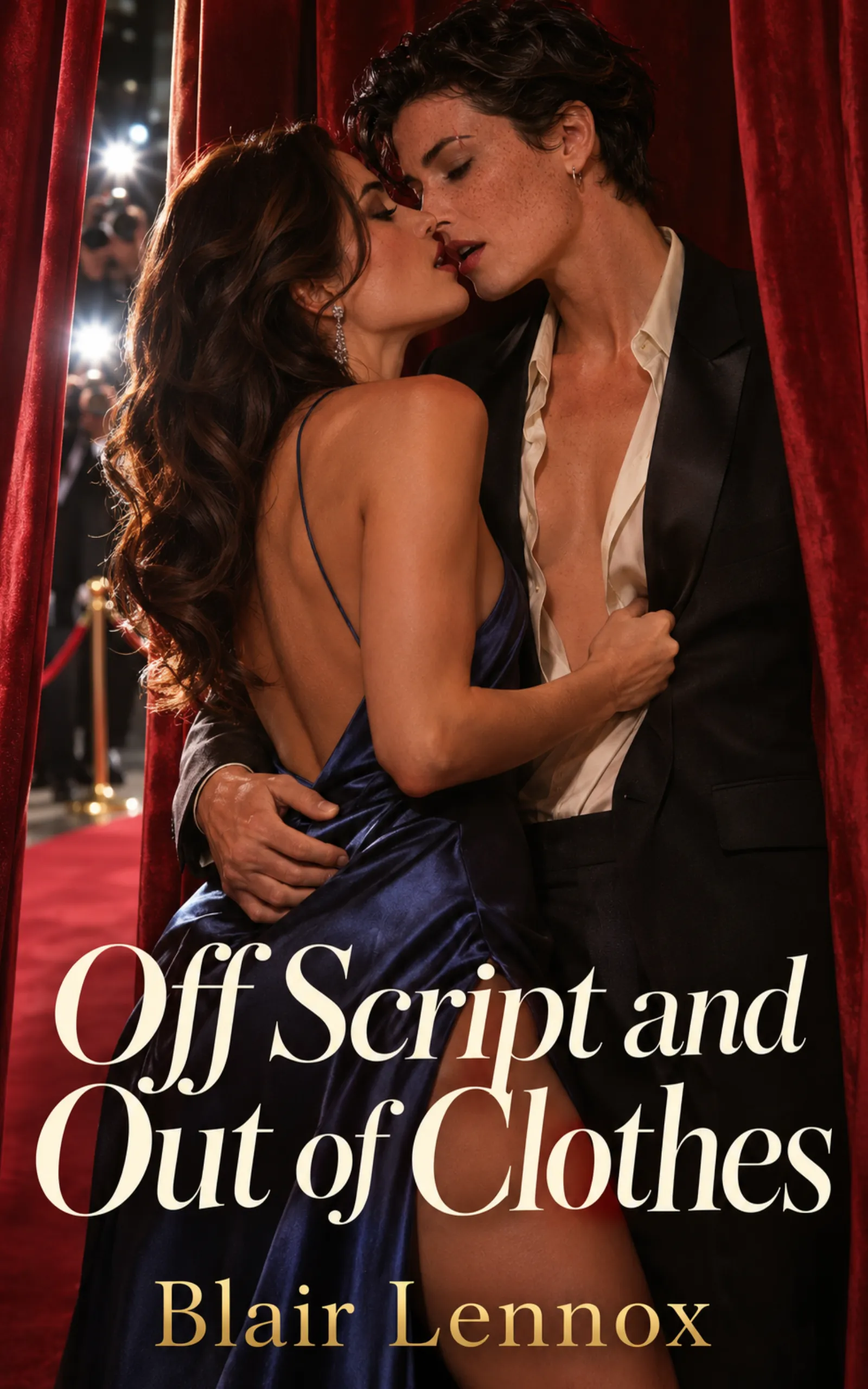
Off Script and Out of Clothes
A Sapphic Celebrity Co-Star Romance
by Blair Lennox
Available at all major retailers
Pairing: FF (Sapphic)
Heat: 🌶️🌶️🌶️🌶️🌶️ Inferno
Tropes: Celebrity Co-Stars, Closeted × Out, Fake PR Relationship, Secret Relationship, Forbidden Workplace Romance, On-Screen Kiss Turns Real, Sapphic Awakening, Coming Out, Intimacy Coordinator, Irish Heroine, Found Family, Grand Gesture, Public Declaration, Dirty Talk, Strap-On, Switch Dynamic, Off-Book Proposal, HEA
America fell in love with them on screen. Off camera, it’s forbidden.
Laney Lowry has been America’s sweetheart for a decade, and she has never once gone off script.
Her lines, her boyfriends and her denials have all been written by someone else. Her publicist approves her quotes three days before she’s asked the question. Her pop-star boyfriend is renewed every award season like a lease.
Bridie Ashworth came out at twenty-four and paid for it with a “difficult” reputation and a decade of lost roles. She lives by one rule: never again be anyone’s secret.
Then their characters on television’s biggest show finally kiss, and the fandom loses its mind. The network sells the chemistry. The intimacy coordinator brings a clipboard. And the late-night line readings in Bridie’s trailer stop being rehearsals.
Now the most-shipped couple on television is falling in love for real, in front of millions of people who already believe it. Only one of them has ever told the truth. And when a live talk-show host asks Laney the question the whole world wants answered, the correct answer and the true one have never been further apart.
Off Script and Out of Clothes is a scorching ~78,500-word sapphic celebrity co-star romance with dual POV, a closeted leading lady, an out-and-proud Irish co-star, a fake PR boyfriend who knows exactly what he is, and an HEA guaranteed.
You’ll love this book if you enjoy:
✅ A closeted America’s sweetheart and an out Irish stage actor whose characters just went canon on TV’s biggest show
✅ A table-read kiss in front of forty people that Bridie calls “Irish marking”
✅ An intimacy coordinator with a sticker-covered clipboard, twelve takes in a lighthouse set, and the take the network uses
✅ A gay pop-star fake boyfriend who’s in on it, very funny, and absolutely refuses to propose
✅ Late-night line readings in a trailer, a soaked 4 a.m. knock on a hotel door in Tofino, and a kitchen counter that settles nothing
✅ A talk-show answer that breaks her heart, an essay with a typo in it, and a one-way flight to a Galway pub
✅ A red-carpet answer nobody wrote for her: “It’s not chemistry. It’s her.”
✅ No cheating, 🌶️🌶️🌶️🌶️🌶️ heat and an HEA guaranteed
⚠️ Content Warning: This novel contains extremely explicit sexual content (graphic FF scenes throughout, including oral, fingering, tribbing, a strap-on, mirror play, edging, phone sex, dirty talk, angry sex, and sex in semi-public places: a film-set trailer, a hotel elevator, a hotel door), strong language, and alcohol. Also includes a closeted lead and her coming out on her own terms, a past affair with a married woman (backstory, off-page), a staged PR relationship, paparazzi and a leaked video, a public talk-show answer that wounds her partner, a period of separation, and an absent father (past). No cheating. Intended for readers 18+.
📖 Read Chapter One Free
Not sure yet? Read all of Chapter One right here.
Chapter One
LANEY
The first thing I say every morning is a line somebody else wrote.
Today it’s I’m so grateful for the fans, they’re the heart of this show, and I say it into my phone at 5:41 a.m., barefoot on cold kitchen tile, while my publicist listens from Los Angeles with the focus of a woman timing a soufflé.
“Again,” Simone says. “You put an honestly in there.”
“Did I?”
“You said, ‘I’m so grateful for the fans, honestly.’ Honestly makes people think you’re usually lying.”
“I’m so grateful for the fans. They’re the heart of this show.”
“Warmer on heart.”
“They’re the heart of this show.”
“Don’t lean on it. You sound like a greeting card with a gun to its head.” Keys clatter on her end. Simone types the way other people fire staple guns. “Fine. That one’s approved. Next. ‘What’s the hardest part of playing Margot?'”
I already know the answer. I learned it on Sunday, when it arrived in my inbox inside a document called LL_VF_Talking_Points_v4_FINAL_final. The Vanity Fair interview is on Thursday. The quotes are approved on Monday. That’s the order things happen in my life. People find out what I think about three days before I’m asked.
“The hardest part,” I say, “is leaving her at work. Margot carries the whole town on her back. Some nights I go home and I can still feel the weight.”
“Good. Do the little laugh after weight.”
I do the little laugh after weight.
My brain does this sometimes. It formats things. INT. LOWRY APARTMENT – YALETOWN – PREDAWN. A WOMAN, thirty, rehearses gratitude in her underwear. It’s been doing it since I was nineteen and somebody handed me my first set of sides. I’ve never told anyone. It isn’t the kind of thing you put in a talking-points document.
The lock clicks. Pilar lets herself in with two coffees, one iPad, and the face she wears when she’s been awake since four and has decided to be cheerful about it as an act of aggression.
“Morning, superstar.” She sets an oat latte in front of me and points at the phone. “Is that Simone? Hi, Simone.”
“Hello, Pilar,” says Simone, who is very fond of Pilar the way you’re fond of a dog that bites your enemies.
“Last one,” Simone says to me. “‘Is there anyone special in your life?'”
Here it comes. The script for this one never changes. It just gets a new coat of paint every year.
“I’m focused on the work right now,” I say, “but I’ve never been closed off to love. Eventually I’d love the whole thing. Partner, kids, a dog that sheds on everything.”
My fingers are on my left earlobe. I notice them there, the way you notice you’ve been humming. I take them away.
“Perfect,” Simone says. “Table read at seven. Don’t be late. And smile, the network is coming.”
She hangs up. Simone never says goodbye. She considers it a wasted line.
Pilar is looking at me over the rim of her cup.
“What,” I say.
“You did the ear.”
“I did not do the ear.”
“There’s a thread, Laney. Forty-seven posts. ‘Laney Lowry touches her earlobe when she’s lying, a deep dive.’ Someone made a supercut. It’s set to Fleetwood Mac.”
“I don’t lie.”
“No,” Pilar agrees, and sips. “You’ve never lied once in your entire life. You just say a lot of things.”
I grew up two houses down from Pilar Reyes in Fresno. She taught me to ride a bike, and I taught her the difference between a matte and a satin lip. When I got cast in my first movie at nineteen she drove me to LAX in her mom’s Corolla and cried at the curb, and when I got cast in my third she quit her job at a dental office and came to work for me. She is the only person in my life who isn’t paid to agree with me. Technically she is paid. She just doesn’t let it affect her.
“Schedule,” I say.
She swipes. “Seven, table read, episodes 201 through 205. Network’s sending Garrett Hollis, so wear the face. Twelve-thirty, wardrobe fitting for Margot’s new coat, which I’m told is very sad and very expensive. Three, call with Simone about award season. Six, trainer. Nine, you’re asleep, because you’re a professional and because I said so.”
“What’s the award-season call about?”
Pilar’s thumb pauses over the screen for half a second. In anyone else I wouldn’t notice. In Pilar it’s practically a confession.
“She didn’t say,” she says.
You have to understand what Saltmarsh is now, because a year ago it was nothing.
A year ago it was a mid-budget mystery on Harbor Network about a disgraced Portland detective named Margot Quill, exiled to a fog-drowned fishing town on the Oregon coast to investigate the death of a girl the ocean gave back. Atmospheric. Prestige-adjacent. The kind of show the trades call “moody” when they mean nobody will watch it. I took it because my agent said I needed “texture” after three romantic comedies in a row, and because the pilot script made me cry on an airplane.
Then it aired. The premiere did fine. Episode three did better. By the finale, twenty-six million people across every platform were watching a detective and a lighthouse keeper’s daughter stand two feet apart in the rain and not touch each other.
The mystery was good. That isn’t why it exploded. It exploded because of Wren Byrne, the lighthouse keeper’s daughter with the rough-cropped hair and the knife-edge mouth who knew every secret in Saltmarsh and wouldn’t give Margot any of them. It exploded because of the way the two of them looked at each other across crime scenes, kitchen tables and the black water under the pier. The fans named it before the writers did. #Quillwren trended for nine straight weeks. There are tattoos. There’s an entire genre of fan edit set to Hozier. I have been handed, at airports, by crying women, framed drawings of my character kissing a woman she has never once kissed on screen.
Bridie Ashworth plays Wren.
I’ve worked beside her for one full season, sixty-one shooting days, and I have filed her where I file everything: neatly, under the correct heading. The heading is Professional Respect. Under it are the facts. She’s the best scene partner I’ve ever had. She doesn’t do the thing actors do, where they act at you; she listens so hard it feels like being undressed. She’s dry, she’s punctual to the minute, she brings her own tea bags from Galway because she says Canadian tea “tastes of apology,” and she’s been out since she was twenty-four, which the trades still mention in the second paragraph of every profile as if it’s her middle name.
Under the same heading, filed for completeness: the shape of her wrists when she rolls her sleeves. The low gravel of her voice at the end of a long day. The time in episode 108 when she said a line to me in the rain, You’re not the first person who came here to be forgiven, Detective, and I forgot my next line for the first time in eleven years.
Professional respect. It’s a very large file.
Harbor’s Vancouver stages are in Burnaby, three gray hangars and a parking lot full of trucks, and the boardroom on the second floor has been set for forty. Name cards. Water bottles sweating on coasters. Scripts with our names on the covers and the word CONFIDENTIAL stamped across every page in red, as though anybody in this room could be trusted with a secret.
I’m early. I’m always early. Being early is the cheapest way to make people think you’re kind.
I do the room. Hugs for the writers, who look like they slept under their desks. A hand on the arm for Felix Brandt, our director, a soft-spoken German who says we have it, let’s go again so often that the crew printed it on a hoodie. A nod for the network contingent at the far end: three men and a woman in Patagonia vests, led by Garrett Hollis, Senior Vice President of something with the word Strategy in it. Garrett has very white teeth and the gaze of a man who sees everything in a room as a number.
“Laney.” He takes my hand in both of his. “Big season. Big, big season.”
“I’ve heard.”
“You haven’t heard anything yet.” He winks. Men like Garrett think winking is a personality.
I take my seat, two chairs from the head of the table where Dot will sit. Across from me, a name card reads BRIDIE ASHWORTH. The chair behind it is empty.
At 6:59, the door opens and the room changes temperature.
She comes in with rain on her shoulders. Of course she does. It’s February in Vancouver; it’s been raining since the Bronze Age. She’s wearing a charcoal suit with the jacket open, a white shirt, boots that have seen weather, and her dark hair is cropped short and pushed back like she did it with her hand in the elevator, which she probably did. There’s a dusting of freckles across her nose that no makeup department on earth has managed to defeat. Five foot nine and built like someone who used to carry scenery for a living, because she did.
“Sorry,” she says to the room in general. “Ferry.”
“You don’t take a ferry,” Dot says from the doorway behind her. “You live in Kitsilano.”
“I took a ferry recreationally. It was lovely until it was late.” Bridie drops into the chair across from me and shakes the rain off her hands. Her eyes land on me and stay there, gray-green, amused. “Lowry.”
“Ashworth.”
That’s our thing. It’s been our thing since the first day of season one, when she walked onto set, shook my hand, and said I’m told you’ve never been late in your life, so I’ll be the other one, and then wasn’t late again for sixty-one days.
She tips her head and studies me. “You’ve had your coffee.”
“How can you tell?”
“You’ve the look of a woman who’s already apologized to someone this morning.”
“Simone.”
“Ah. Morning confession.” She uncaps a pen with her teeth. “What did you confess?”
“That I’m grateful for the fans.”
“Are you?”
“Warmly,” I say. “On heart.”
Her mouth twitches. She has a mouth that does most of its work in the corners. It’s a terrible thing to notice about a colleague at seven in the morning, and I file it immediately.
Dot Ferreira takes the head of the table. She’s in her fifties, silver bob, reading glasses on a beaded chain, the posture of someone who’s run three hit shows and buried two networks. She doesn’t sit so much as convene.
“Before we start,” she says, “I’m going to say something, and I need every person in this room to not tweet it for sixty days. Garrett, that includes your nephew.”
Polite laughter. Garrett holds up his hands.
Dot takes her glasses off. That’s how you know she’s serious. Dot only takes her glasses off for deaths and renewals.
“Season one, the audience told us what this show is about,” she says. “We were very clever and very dark and we wrote a lot of drowned people, and what twenty-six million people actually tuned in for was two women not saying something. So this season, we say it.” She looks down the table at me, then across at Bridie. “Season two, Margot and Wren happen. On screen. All of it.”
There’s a half-second of silence, the kind that comes before applause when nobody’s sure whether they’re allowed.
Then the writers’ end of the table erupts. Someone actually whoops. Hana, the writers’ assistant, puts both hands over her mouth. The network vests clap the way people clap when their stock just vested, and Garrett Hollis leans back in his chair and smiles at the ceiling like God just sent him a spreadsheet.
I clap. My hands know how. I smile, and that’s the dimple, and the dimple is load-bearing; it’s paid for my apartment.
Inside, something has come unscrewed.
All of it. I’m doing math I don’t have the formula for. Margot and Wren. Margot and Wren happen. A kiss, obviously. More than a kiss, if Dot is saying all of it with her glasses off. Scenes with closed sets. Scenes with an intimacy coordinator. Scenes where I’m going to have to look at Bridie Ashworth from six inches away and want her, on cue, for twelve hours a day, while a boom operator eats a granola bar over my head.
I’ve done love scenes. I’ve done eleven of them, if you count the one in the elevator in Second Chances where I mostly kissed a stunt double’s ear. I’m good at them. They’re choreography. You hit your marks, you angle your jaw, you think about your grocery list.
I don’t think I’m going to be able to think about my grocery list.
I look across the table.
Bridie isn’t clapping. She’s sitting very still with her pen against her lower lip, and she isn’t surprised. Not even a little. Her eyes are on me, steady, reading me the way she reads a scene, all the way to the bottom of the page.
My hand goes to my ear.
I watch her see it.
I put my hand flat on the table.
“You knew,” I say, under the noise.
“Dot asked me in January.”
“Dot asked you.”
“I told her I’d want it done right, or I’d want it not done at all.” She says it quietly, without apology. “I’ve played the lesbian who dies in act three. I’ve played the lesbian who goes back to her husband. I’ve played the lesbian who exists for two scenes so the straight girl can feel brave about it. I wasn’t going to play Wren as a plot device.”
“She didn’t ask me.”
Dot, who hears everything, says from the head of the table without looking up from her notes, “I asked Bridie because she’d have walked if I wrote it badly. I didn’t ask you, Laney, because you’d have said yes to anything.”
The table laughs. It’s meant as a compliment. Dot doesn’t do compliments; she does true things and lets you sort them out later. I laugh too, the little laugh, the one that goes after weight.
Bridie doesn’t laugh. Bridie looks at me like she’s just watched someone take a hit.
“Shall we read?” Dot says.
We read.
Episodes 201 through 203 go the way table reads go. Murders, mostly. A new body in the cannery. A creepy pastor with a speaking part. Margot gets shot in the shoulder in 202 and spends 203 bleeding in Wren’s kitchen while Wren stitches her up with a fishing needle and says, Hold still, Detective, or I’ll sew your mouth shut and do us both a favor. Bridie delivers the line so dry the writers groan with pleasure.
I’m good. I’m always good at table reads. I find Margot’s voice, the clipped Portland cop with the cigarette rasp she quit three years ago, and I hold it. My body keeps doing the job while my mind runs ahead through the script in my lap, flipping pages I’m not supposed to be on yet, looking for it.
I find it on page forty-one of episode 204.
THE LAMP ROOM.
At the bottom of the page there’s a stage direction nine words long. I read it four times.
The read reaches 204 after a ten-minute break, during which I drink a water I don’t want and Bridie stands at the window with her hands in her pockets watching the rain. When we sit back down, Hana reads the slug line in her bright, careful voice.
“Interior, lighthouse, lamp room, night. The storm is hitting the glass. Margot climbs the last stairs, soaked. Wren is already there, waiting, like she knew.”
I lift my script. “You weren’t at the house.“
“No.” Bridie, as Wren, doesn’t lift hers. She doesn’t need to. She learned the whole season in three weeks; she’s the only actor I know who comes to table reads off book. “I come up here when the weather’s bad. Someone has to keep the light on.“
“The light’s automatic. It’s been automatic since 1987.“
“I know.” A beat. “I come up anyway.“
The room has gone quiet. It’s an actor’s quiet, the kind that happens when forty people stop rustling because they don’t want to miss something.
“You could have told me,” I read. My voice has changed. I can hear it. Margot’s rasp has thinned out, and what’s underneath it is me. “About your father. About the boat. You let me spend six weeks chasing a—“
“You’d have left.“
“I’m not leaving.“
“You always say that,” Bridie says, quietly, “right before the ferry.“
Hana reads, “Margot crosses to her. She stops close enough to touch. She doesn’t.”
I don’t look up from the page. I can’t.
“Wren,” I read. “Tell me to go.“
And Bridie, who knows every word of this scene by heart, who has every line of the season in her head, says, “No.“
Hana’s voice: “Wren closes the distance. They kiss.”
Nine words. I counted them on page forty-one. Wren closes the distance. They kiss. The light turns.
“Let’s just mark it,” Felix says gently. “We’ll do it properly with Juno in rehearsal—”
Bridie stands up.
Not all the way. She rises just enough to lean, one hand flat on the table between the water bottles, and she reaches across with the other and lays her palm along my jaw. Her thumb settles under my cheekbone, exactly where a camera would want it. Her hand is warm. There’s still a little cold from the rain in the tips of her fingers.
She looks at me for one second and waits. It’s a question. It’s so plainly a question that I think the whole table can see it.
I don’t think about the answer. I nod, very slightly, into her palm, and tip my face up the last inch to meet her.
She kisses me.
It’s chaste. Closed mouth, nothing a network would blur. Her lips are soft and a little dry and they press against mine with a deliberate, patient weight, as if she has all the time in the world and wants me to know it. She smells like rain and black coffee and something green, a soap, a shampoo, I don’t know. I’ve been kissed on camera more than a hundred times. I know where to put my hands and how to angle my head and how long to hold before the director calls it.
I don’t know any of that now.
I count, because counting is what you do on a mark. One. Her thumb moves a quarter inch against my jaw. Two. My mouth softens under hers without asking me first. Three. Something low in my stomach turns over, slow and heavy, like a key in a lock, and my thighs press together under the boardroom table hard enough to hurt. Four.
She lets go.
She sits back down. She picks up her pen. She turns the page.
“Sorry,” she says to Felix, perfectly mild. “Thought we were marking it.”
Nobody says anything.
Forty people, and not one of them says anything. Hana’s hand is frozen over her script. One of the writers has his mouth slightly open. Even the network vests have gone still, the way animals go still when they sense weather coming.
My lips are buzzing. I can feel my pulse in them, and in my throat, and in places nobody has ever written stage directions for. I’m aware of my own face with total, horrible precision. It’s blank. Thank God. Eleven years of training, and the one thing it has given me is a face that stays blank while my body does whatever this is.
Felix clears his throat. “That was,” he says carefully, “marking it?”
“Irish marking,” Bridie says.
The room breaks. Laughter rolls down the table from the writers’ end, too loud and too relieved. Someone says oh my God at a volume they think is private. Dot, at the head of the table, puts her glasses back on, which in Dot is the equivalent of a standing ovation.
My next line is Margot’s. It’s one word. The script says Margot, after, barely: Okay.
I look at the page. The word is right there.
“Okay,” I say. It comes out of me rough and real, and it isn’t Margot’s voice at all.
Garrett Hollis lets out a long breath at the end of the table and taps his pen twice against his legal pad, the way a man taps a calculator.
“Well,” he says, to nobody and everybody. “That’s chemistry.”
He says chemistry the way other men say dividend.
We finish the read. I don’t remember 205. I’m told I was very good in it.
Afterward the room dissolves into the usual: writers swarming Dot, the network vests swarming Garrett, the assistant directors swarming the schedule. I gather my script and my water and my coat and I keep my body moving, because a body in motion doesn’t have to answer any questions.
Bridie is at the coffee urn by the door. She’s stirring a tea bag around a paper cup with a plastic stick, slowly, like it owes her money.
I stop beside her because there’s no route to the door that doesn’t go past her, and because I’m a professional, and because I’ve filed her under Professional Respect and professionals say things to each other.
“You could have warned me,” I say.
She doesn’t look up from the tea. “Wren wouldn’t have.”
“I’m not Wren.”
“No.” She lifts her eyes. Up close they’re grayer than I thought, with a ring of green near the pupil, like sea glass. She looks at me for a long moment, and I have the feeling, again, of being read all the way to the bottom of the page. “You’re not, are you.”
It isn’t a question. I don’t know what it is.
“I did ask,” she says, quieter. “If you’d not nodded, I’d have sat back down and let Felix mark it, and nobody would’ve known the difference.”
“I know.” I did nod. That’s the part I can’t file.
“It was good,” I say. “For the scene. It’ll help, having found it early. We’ll know what we’re working with when we get to Juno.”
“That’s what it was,” Bridie says. “Research.”
“Exactly.”
“Grand.” She drops the stirrer in the bin. “Glad to be of service, Lowry.”
She walks out with her tea. She doesn’t look back. She has a way of leaving a room as if the door was put there for her personally.
I stand by the coffee urn for a while, holding a script with my name on it and the word CONFIDENTIAL stamped across every page in red.
The car is waiting downstairs, a black SUV with Benji at the wheel, the driver the studio gives me in Vancouver because Simone believes a woman with my face shouldn’t be seen operating a vehicle. Pilar is in the back already, on her phone. She looks up as I slide in, takes one look at me, and puts the phone face down on her thigh.
“Oh,” she says.
“Don’t.”
“I didn’t say anything.”
“You said oh.”
“Oh isn’t anything. Oh is a vowel.” She studies me. “The table read went well, I take it.”
“It was fine.”
“Hana texted me.”
“Why does Hana have your number?”
“Everybody has my number. I’m the friendly one.” Pilar’s voice softens, which is somehow worse. “Hana said, and I’m quoting, your girl and the Irish one just melted forty people in a conference room. With a fire emoji. Three fire emojis.”
“It was a choice Bridie made for the scene.”
“Mm-hm.”
“It’s a love story now. Dot announced it. It’s going to be the whole season. So we’ll be doing a lot of—” I make a gesture that I hope means professional choreographed intimacy and suspect means something else. “That.”
“Mm-hm.”
“Stop mm-hm-ing me.”
“I’ll stop mm-hm-ing you,” Pilar says, “when you stop touching your mouth.”
I take my fingers off my lips. I hadn’t known they were there.
Benji pulls out into the rain. Burnaby slides past the window in gray and green, the trucks and the hangars and a crew guy in a yellow slicker running across the lot with a coffee tray over his head. I watch it go by and I think about nothing, very hard, for a long time.
INT. SUV – MOVING – DAY. A WOMAN, thirty, sits very still and does not think about a kiss.
The thing nobody tells you about having your life written for you is that it’s restful. Other people choose the boyfriends. Other people choose the quotes. You show up on time and hit your marks and say your lines warmly, on heart, and nothing is ever your fault, because nothing was ever your idea. I’ve lived like that for eleven years. I’ve been engaged to a man I didn’t love because it tested well. I’ve been photographed holding hands with four different actors on four different red carpets, and if you’d asked me at any point what I wanted, I’d have said I’m focused on the work right now, and I would have meant it, because no one had ever handed me a script where the answer was anything else.
Four seconds.
It doesn’t mean anything. It was a choice made by a gifted actor in service of a scene. I’ve been kissed by plenty of gifted actors.
None of them made my thighs clench under a table. None of them made me forget a word I’d read four times. None of them stood up in a boardroom and looked at me for one second first, as if they were asking.
My phone buzzes in my lap.
Simone. Of course it’s Simone. Simone has a sixth sense for the exact moment I start to feel something. She swoops in like a lifeguard.
I turn the screen over.
Great read, I hear. Network’s thrilled. Award season: Sonny Vale renewal. Same terms as last year, January through March, three carpets, two dinners, one “leaked” vacation. Locking it in. Smile. — S
Want to keep reading? The full novel is available now at all major retailers and direct from our store.
🔥 Want an EXCLUSIVE Bonus Chapter?
The Light Turns — A scene TOO HOT for the bookstore
The last night of season three. Stage B is dark, the lighthouse set goes into storage at dawn, and somebody has left the lamp room on and the rain running. Laney is waiting at the top of the stairs in Margot’s soaked oilskin and nothing else, and this time nobody is going to call cut.
More from Blair Lennox
Browse all Blair Lennox books.

Off Script and Out of Clothes
America fell in love with them on screen. Off camera, it's forbidden.

Per My Last Orgasm
Her boss has broken five assistants. Assistant number six just emailed her a sex fantasy by mistake.

The Maid of Honor Clause
She asked her best friend to teach her how to finally come before the wedding. Falling in love wasn't in the contract.

My Best Friend’s Older Sister
She came to help clear her best friend's family home. She didn't plan on wanting the sister nobody forgave.

No Longer Her Assistant
For five years she ran the CEO's life. Now the CEO has to ask.

Who’s a Good Girl
She's never obeyed anyone in her life. Then the dog trainer said two words.
Never Miss a Release
Get new release alerts, exclusive bonus content, and reader-only giveaways.