
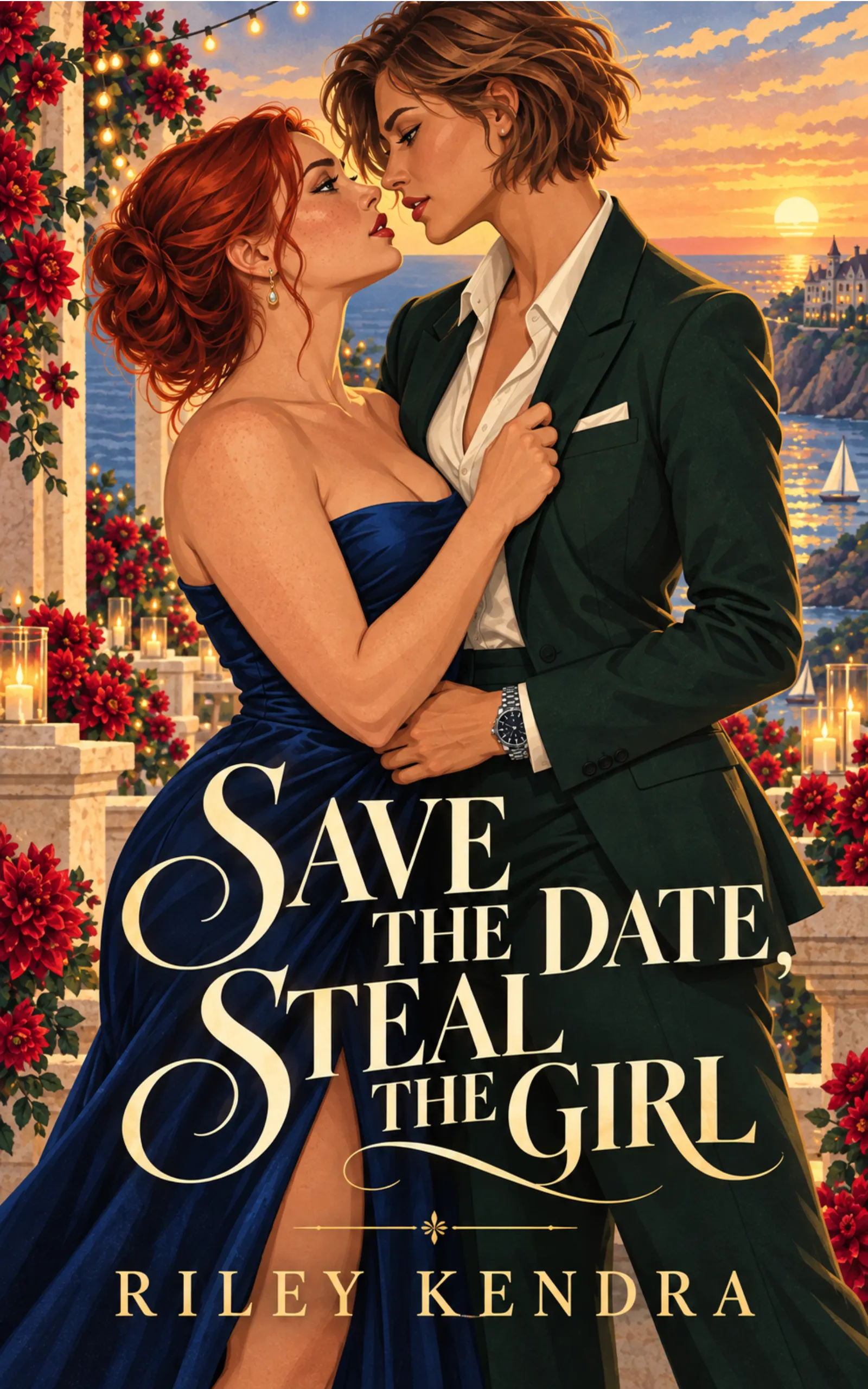
Save the Date, Steal the Girl
A Sapphic Hired-Date Wedding Romance
by Riley Kendra
Shop the ebook · Shop the audiobook · Shop the paperback
Available at all major retailers
Pairing: FF (Sapphic)
Heat: 🌶️🌶️🌶️🌶️🌶️ Inferno
Tropes: Hired Wedding Date, Fake Dating, Ex’s Wedding, Bi Awakening, First Time With a Woman, Forced Proximity, Professional Boundaries, Transactional to Real, Switch Dynamic, Romantic Comedy
She hired a fake girlfriend for her ex’s wedding. Falling for her wasn’t in the contract.
Rachel Porter can handle her ex-boyfriend’s wedding.
What she can’t handle is one more person asking if she can handle it.
So when the groom kindly offers to move her seat, in case coming alone might be difficult, Rachel tells him she’s bringing her girlfriend.
She doesn’t have one. So she hires one.
Kim Ellis is a professional event companion: charming, discreet, and very clear about her rules. She’ll hold Rachel’s hand. She’ll handle the nosy aunts. She’ll make four days at a seaside estate in Newport look like love.
Nothing else is for sale.
Which is a problem, because Rachel has never kissed a woman and can’t stop thinking about this one. And Kim has never once wanted a client, until a dry-witted English teacher with a red pen starts looking at her like she’s the only interesting person at the wedding.
So they keep to the rule. On the clock, it’s business. Off the clock is nobody’s business but theirs.
But the booking ends at Sunday brunch. And neither of them knows what’s left when nobody’s paying.
Save the Date, Steal the Girl is a high-heat sapphic romantic comedy with a hired wedding date, a bi awakening, one cottage with a door that won’t latch, an ex who is maddeningly nice about all of it, dual first-person POV, and an HEA guaranteed.
You’ll love this book if you enjoy:
✅ A fake girlfriend invented by text, to an ex who only wants her name for the place cards
✅ A professional companion with three rules, a hand-ruled ledger, and a watch that chimes on the hour
✅ “Out loud’s good. I like out loud.” Consent that gets spoken, every single time
✅ A teacher voice that can put a woman in a chair and keep her there with one sentence
✅ One cottage, one four-poster, one sofa bed, and a painted door that doesn’t quite latch
✅ Bi awakening at thirty-five, and a first time with a woman that’s worth the wait
✅ A refund at 12:40 a.m. that changes everything
✅ No cheating, no wedding sabotage, 🌶️🌶️🌶️🌶️🌶️ heat and an HEA guaranteed
⚠️ Content Warning: This novel contains extremely explicit sexual content (graphic FF scenes throughout, including oral, fingering, mutual masturbation and watching, semi-public scenes, light restraint with a safeword, and a strap-on), strong language, and alcohol. Also includes an ex’s wedding, a lie told to family and its fallout, a professional boundary crossed and then addressed on page, a teenage student’s harsh treatment by his father (off page), and a funeral and grieving widow (off page). No cheating. Intended for readers 18+.
📖 Read Chapter One Free
Not sure yet? Read all of Chapter One right here.
Chapter One: Rachel
The text arrived while I was writing vague in a margin for the fourth time that afternoon, which I would later recognize as foreshadowing and at the time recognized only as a Monday.
Room 214 was empty the way a classroom only gets after four o’clock: chairs up, radiator ticking, the whiteboard still ghosted with third period’s attempt to diagram a sentence that hadn’t deserved it. I had twenty-six sophomore essays on The Great Gatsby, a red pen, and a cup of coffee that had gone cold around the time Devon Marsh’s thesis statement informed me that Gatsby “wants a lot of things in the book.”
Vague, I wrote. What does he actually want? Be specific.
My phone buzzed against the desk.
I should say that I knew who it was before I looked. Not through any mystical residue of six years together. Adam was simply the only person in my life who texted in complete paragraphs and signed them.
Hi Rach. Hope the new school year is treating you well! Celia and I are finalizing the seating chart this week and I wanted to check in. Right now we have you at Table 6 with Anna and some of the wedding party’s plus-ones, but if coming alone might feel difficult, we’re very happy to move you somewhere quieter. Totally your call, no pressure either way. — A
I read it once, the way a normal person would.
Then I read it the way I read everything, which is the problem with me.
Somewhere quieter. As though I were a guest with a sensory condition. Or a widow. Somewhere near the kitchen doors, presumably, with somebody’s great-aunt and a clear line to the exit, where I could be sad without getting any on the centerpieces.
Might feel difficult. The conditional of pity. He hadn’t written if you’d rather. He hadn’t written if it’s easier. He had reached, with real care, for the gentlest available way to say we’ve discussed you.
And that was the part that sat on my chest. Not Adam. Adam was a decent man who returned shopping carts and had once driven forty minutes to bring my mother a casserole dish she’d left at our apartment. He had ended six years with me fourteen months ago by saying, with tears in his eyes, that he couldn’t keep building a future out of habit, and then he had gone out and built one out of something else in what I considered an insultingly efficient amount of time.
I didn’t want him back. I’d checked. I had checked the way you press on a bruise, regularly and with scientific interest, and somewhere around last spring it had stopped hurting and started just being a place on me that used to.
What I minded was the picture. Adam and Celia at a kitchen table with a seating chart between them—poster board, probably; Celia was a landscape architect, she’d have done it to scale—and one of them touching a little paper circle with my name on it and saying, What do we do about Rachel?
I was a logistical tenderness. I was a thing to be handled kindly.
I had already said yes to this wedding. My sister was a bridesmaid. Anna and Celia had been close since a college summer I’d spent mostly not being invited to things, and when the invitation came Anna had sat on my couch and said, I need you there, and I need it to be fine, and I had said, It will be fine, because I am excellent at fine. I am, professionally and temperamentally, the person who makes it fine. I’d checked one on the reply card and salmon beneath it and mailed it the same day, so no one could say I’d hesitated.
I picked up the phone.
That’s so thoughtful, but Table 6 is perfect, I typed. Deleted it. It sounded like a woman gripping the edge of a sink.
No need! I’m great. Deleted. I had never been great with an exclamation point in my life, and he knew it.
Thanks, Adam. I’m fine where I am. True. Dignified. Also precisely what a person would say from somewhere quieter.
Down the hall, a custodian’s cart rattled over the seam in the linoleum. I looked at the cursor. I looked at Devon Marsh’s essay and my own handwriting in the margin of it, demanding specifics from a fifteen-year-old.
What I meant to type was Actually, I’m bringing someone.
That was the sentence I had composed. It was a perfectly good lie. It was beige. It committed me to nothing more than a warm body in a rented suit, and for about a second and a half I even had a candidate: a cousin of Leah’s, an orthodontist named Greg who owed her a favor.
What my thumbs typed was: That’s kind of you, but I won’t be alone. I’m bringing my girlfriend.
And then, before the part of me that grades things could get its pen out, I hit send.
The message sat there in its blue bubble, small and clean and impossible.
I waited to feel sick.
I’d like to report that I did. A sensible woman, having just invented a human being and a sexual orientation in a single text to her ex, would feel something in the neighborhood of nausea. What I felt instead started low in my stomach and moved up, warm, like the first swallow of something stronger than I usually ordered.
My girlfriend.
I said it aloud to the empty chairs. Quietly, with the door open, like a word I was testing for a student before I let them use it in a sentence.
I said it once more, a shade louder, and my face went hot to the hairline—alone, in front of thirty upturned chairs.
It didn’t sound like a lie. That was the unsettling thing. It sounded like a word I had been walking around for a long time, the way you walk around a piece of furniture in the dark in your own house—no need to look, you simply know where not to put your foot.
Three dots appeared. Vanished. Appeared.
Oh! Adam wrote. Then, separately, because he was regrouping: Rach, that’s great. Really. I’m happy for you.
I waited for the turn. The since when? The strangled pause of a man recalculating six years of evidence.
What’s her name? he wrote. Celia wants to hand-letter the place cards and she’ll kill me if I get a plus-one wrong.
So that was Adam. Not threatened, not wounded, not even particularly curious—just dutifully collecting data for his fiancée’s calligraphy. I had detonated my entire self-concept at 4:46 on a Monday and he needed it for stationery.
Her name.
I looked around my classroom as though one might be written somewhere. A poster of Toni Morrison regarded me from beside the window with what I chose to interpret as professional sympathy. Toni was out. So, for different reasons, were Daisy, Zelda, and the Emily on the back wall, who had famously declined most invitations.
I’ll get you all the details this week! I typed, and sent it, exclamation point and all, and then I turned the phone face-down on Devon Marsh’s essay and put both hands flat on the desk on either side of it, like a woman steadying a table during a séance.
Ten days. The wedding was a four-day production at a seaside estate outside Newport, Thursday dinner through Sunday brunch, because Celia’s family did nothing by halves and apparently neither did love, when it was done correctly. In ten days I needed to produce a woman who would hold my hand in front of everyone I had known in my thirties.
I should have been drafting the retraction.
Instead I sat there with my pulse going in my throat, looking at the back of my phone, thinking about the word.
“You invented a lesbian,” Leah said.
“I invented a girlfriend.” I held out my glass. “Her orientation is her own business.”
Leah Grant had been my best friend for eleven years and a reference librarian for fourteen, and she brought to both roles the same expression: a kind of patient, delighted alarm, as if you had just asked her where to find books on a subject that was going to get you in trouble. She poured. Her kitchen was the size of a generous closet, painted a yellow she had chosen and regretted, and I was sitting on the counter beside the stove because both chairs were occupied by library discards she was “rehoming.”
“Walk me through it,” she said. “Slowly. You were going to say someone.“
“I was going to say someone.“
“And you had Greg.”
“I had Greg in mind. Briefly.”
“Greg would’ve done it. Greg has a navy suit and no inner life.” She leaned back against the refrigerator and looked at me over her glasses. “But that’s not what came out.”
“No.”
“What came out was a woman.”
“What came out was a noun, Leah.”
“Mm.” She drank. “Interesting noun, though. Out of all the nouns.”
I had known she’d do this, which was why I had driven straight to her apartment instead of my own, and also why I had sat in the car outside for six minutes first, rehearsing. In the rehearsal I’d been breezy. In the rehearsal I’d said it just seemed like the kind of thing that would end the conversation, and Leah had laughed, and we’d moved on to logistics.
“It just seemed like the kind of thing that would end the conversation,” I said.
Leah did not laugh. Leah waited, which is a thing librarians can do for an extremely long time.
Here is what I didn’t say, perched on her counter with my boot heels knocking the cabinet. That my sophomore-year roommate was a girl named Dana Kessler, and that for two years I had introduced her to people as my favorite person and watched her brush her hair at night with an attention I’d assumed everyone paid their roommates. That four years ago the art teacher down the hall had told me I had beautiful handwriting, and I’d carried the compliment around for most of a school year like something breakable. That I noticed women’s forearms. Their voices. The backs of their necks when their hair was up. I had a word for all of it and the word was admiration, and I’d kept it filed there so long the folder had gone soft at the edges.
“Rachel.”
“It’s possible,” I said carefully, “that the noun wasn’t entirely arbitrary.”
Leah set her glass down on a stack of withdrawn Agatha Christies. She did it gently, the way you’d set down anything with a skittish animal in the room.
“Okay,” she said.
“That’s all I’ve got. That’s the whole thesis. I don’t have supporting paragraphs.”
“I’m not grading you.”
“I’m grading me.”
“I know, honey. You always are.” She crossed the two steps of her kitchen and knocked her shoulder against my knee, and that was the entirety of the fuss she made, which is why she was my best friend and not merely someone I knew. “So. Not arbitrary. Noted, shelved, we can pull it from the stacks whenever you like. In the meantime you have a much more urgent problem, which is that you owe Celia Ward a name for a place card.”
“I could say we broke up.”
“In ten days? After announcing her on a Monday?”
“People break up.”
“People do. And then they go to the wedding alone, and they get moved to the quiet table, with a fresh breakup, in front of his mother.” She let me have a moment with that image. “Or you tell him the truth, and you’re the ex who made up a girlfriend.”
I put my face in my free hand.
“Or,” Leah said, in a tone I recognized, the tone of a woman who had located the microfiche, “you get one.”
“I can’t get a girlfriend in ten days. I haven’t gotten one in thirty-five years.”
“Not a real one.” She was already dragging her laptop out from under a tote bag. “Greg’s ex-wife—”
“Greg’s ex-wife is not coming to this wedding.”
“—Greg’s ex-wife hired someone to take to her firm’s holiday party the year of the divorce. A professional. He was apparently wonderful. He knew which fork, he talked to the managing partner about sailing for forty-five minutes, he got her out the door before the karaoke. It’s a real thing. People do it for galas, reunions, work dinners.” She opened the laptop on the stove, between the burners, and started typing with the terrifying speed of someone who did it for a living. “And when she was asking around, the name everybody gave her first was a woman here in Providence. She only went elsewhere because she wanted a man on her arm.”
“A woman.”
“A woman.” Leah turned the screen toward me. “Ellis and Company.”
The site was clean. That was my first impression, and I registered a faint surprise at my own relief; I had braced for red velvet, for euphemism. This was cream and charcoal and one line of text set in a serif that somebody had chosen on purpose.
Ellis & Company. Event hosting and platonic companionship, for the occasions you’d rather not walk into alone.
“‘Company,'” I said. “She made a pun.”
“She made a good pun. Keep reading.”
There was a short list titled What I Do. Weddings, galas, reunions, family functions, work events. Introductions and conversation. Difficult relatives. Knowing you want to leave before you’ve admitted it.
There was a shorter list titled What I Don’t. It ran three lines, and I gave it the attention I usually reserved for contracts and poetry.
I don’t help anyone hurt anyone.
I don’t do anything you and I haven’t agreed to.
I don’t offer intimate services. Please don’t ask. I’m very good company. That’s the whole job.
No hedging. No unfortunately, no at this time. A woman who knew exactly where her fences were and had painted them a visible color. Something in my shoulders came down an inch.
“She can write,” I said.
“I knew that would get you. She’s also not cheap. Multi-day rates are on request, which in my experience means sit down first.”
“Good. I’ve been economical for six years. Look where it got me.”
“That’s the spirit.” Leah scrolled. “And that’s her.”
I’d like to describe the photograph the way I would for a class—composition, light, what the subject’s posture tells us—because that would suggest I looked at it analytically.
She was standing in a doorway. Charcoal suit, cut close, the jacket open over a white shirt with the top two buttons undone and nothing at her throat but skin. One hand in her trouser pocket. A watch on the other wrist, the cuff pushed back just far enough to show it, and below the watch a hand that was—I didn’t have the vocabulary. Capable. Long through the fingers. The kind of hand you would notice pouring wine, or resting on the back of someone’s chair.
Light-brown hair in a bob that had been cut well and then deliberately argued with. A jaw. And she was laughing—not at the camera, at something off to the left of it, her head turned a few degrees so that the smile was caught in the act of happening. It was a quick smile, crooked on one side. It looked like the smile of a person who had just been told a secret and fully intended to do something with it.
Kim Ellis, said the caption. Owner.
The warmth from the classroom came back. It did not stay in my stomach this time.
“Hm,” I said.
“Hm,” Leah agreed.
I read the three-sentence bio. Hospitality training, nine years in event coordination, a specialty in “rooms with history.” I retained none of it, because my eyes kept returning to the place where her collar lay open against her neck, and then to her mouth, and I was aware of the kitchen being very small and the wine being very red and my own knees pressed together on the counter for no reason I could have defended in writing.
Leah, who had no mercy, clicked the arrow at the edge of the picture.
The second photograph had been taken at an event: candlelight, a blur of black tie, the corner of a string quartet. Kim Ellis was in profile this time, in a dinner jacket, bending to say something into the ear of a woman of about seventy in emerald silk. One hand rested between the woman’s shoulder blades. Not gripping. Not even pressing. Simply there, the way you’d touch something you had been trusted with, and the woman’s whole face had gone soft and wicked around whatever she was being told.
It was an advertisement. I understood that I was looking at a professional doing her job extremely well.
I also understood, with a clarity that made the backs of my thighs prickle against the laminate, that I wanted to know what she’d said. I wanted to know what that voice did at that distance, pitched low, for one person. I wanted, specifically and indefensibly, to be the ear.
“She puts clients on her website?”
“Only the ones who ask.” Leah tapped the fine print beneath it. “Shared at the request of the guest pictured. Apparently people like it known that they had her for the evening.”
Had her. I took a larger swallow of wine than the sentence warranted.
“Rach.”
“I’m assessing her credibility.”
“You’ve been assessing it for a full minute. I timed you. You’ve read The Waste Land faster.”
“It’s a significant decision. I would be introducing this person to my mother.“
“Uh-huh.” Leah’s voice was soft and unbearable. “And how’s her credibility?”
Leah clicked back to the doorway, and I looked. At the forearm, the watch, the easy slouch of someone who had never once checked whether she was taking up too much room. I thought about that hand at the small of my back while I said hello to Adam’s parents—steering me, light and certain, the heat of a palm through a dress—and something low in my body clenched so abruptly that I had to take a drink to cover it.
“She seems,” I said, “qualified.”
Leah had the decency to turn around and refill her own glass so she could smile at the refrigerator.
“Before you fill out the form,” she said, with her back to me, “I’m going to ask one annoying question and then I’ll never ask it again. What do you want out of this? Because if it’s the look on Adam’s face—”
“It isn’t.”
“—because he’s not going to give you one. He’s a golden retriever. He’ll say that’s great, Rach, and mean it, and you’ll want to drown him in the raw bar.”
“He already said it.” I turned my glass by the stem. “Nearly word for word.”
“So what’s it for?”
I had the breezy answer. I want to eat my salmon in peace. It was loaded and ready. But Leah had asked it kindly, with her back turned, and in any case the real answer was nowhere I could reach it yet. It was down under the soft folder, under admiration, under a text message I had liked the look of far too much.
“I don’t know,” I said. “I want to walk in and have it not be a question. That’s as far as I’ve gotten.”
“That’s a start.” She came back and pulled the laptop to the edge of the stove where I could reach the keys. “Type.”
The inquiry form asked for the kind of event, the dates, the location. Easy. Then it asked, in that same unfussy serif: What do you need from the day?
I wrote: A companion for my ex-boyfriend’s wedding weekend. Deleted ex-boyfriend’s. Restored it. Leah breathed over my shoulder like a proctor.
“You don’t have to tell her everything.”
“If I’m vague, I deserve whatever I get,” I said, and wrote the rest in one go, before I could mark it up.
My ex-boyfriend is getting married the third weekend of September at Seabrook House, outside Newport, Thursday through Sunday. This afternoon I told him I was bringing my girlfriend. I don’t have one. In the interest of full disclosure, I have never had one. I would like to discuss your availability and your rates, and I would be grateful for your discretion. — Rachel Porter
I proofread it. I changed would be grateful for to would appreciate, then changed it back. I checked the punctuation on sentences that didn’t have any.
“That’s three times,” Leah said.
“Four.”
“Send it, or I’m calling Greg.”
I sent it.
A small gray line appeared at the bottom of the screen—Thank you. Kim reads every inquiry herself—and then there was nothing to do but sit in a yellow kitchen with the consequences.
Leah made pasta. I told her I wasn’t telling Anna, not before the wedding, and she told me that was a mistake with my signature on it, and I said I would tell Anna I was seeing someone, which would be true in the narrow sense that I’d be looking directly at her. We ate standing up. Leah raised her fork and proposed a toast to Dana Kessler, wherever she was, and her hair, and I informed her that this was the last time I confided anything in a public employee.
I was drying the colander when my phone went off on the counter.
Unknown number. Providence area code.
Leah’s eyebrows climbed. It had been forty minutes. I had assumed a form like that went into a queue—an assistant, an auto-reply, three to five business days in which I could lose my nerve in an orderly fashion.
I dried my hands, thoroughly, one finger at a time. Then I picked it up.
Ms. Porter — I have that weekend open. Thursday, four o’clock, the café at Wickenden and Brook. I’ll be the one in the window. Bring the invitation.
And tell me what you actually want.
— K.
Want to keep reading? The full novel is available now.
🔥 Want an EXCLUSIVE Bonus Chapter?
Plus One — A scene TOO HOT for the bookstore
December, a lake cabin in New Hampshire, and Kim’s brother Ben on the other side of a one-inch pine wall. Rachel has never once been quiet in bed. Kim makes her a deal: every sound, she stops.
More from Riley Kendra
Browse all Riley Kendra books.

The Girls’ Trip Clause
A dare made it real. The rules were supposed to keep it fake.

Save the Date, Steal the Girl
She hired a fake girlfriend for her ex's wedding. Falling for her wasn't in the contract.

The Resort Rebound
She asked her wingwoman to find her a woman. The only one she wanted was next door.
Wrapped Around Her Finger
She made up a fiancée. Then the fiancée showed up in a suit.

The Plus-One Problem
She invented a girlfriend to survive one wedding. Then she said a real name.

The Honeymoon Upgrade
She came to photograph a wedding. She got the honeymoon instead.
Never Miss a Release
Get new release alerts, exclusive bonus content, and reader-only giveaways.