
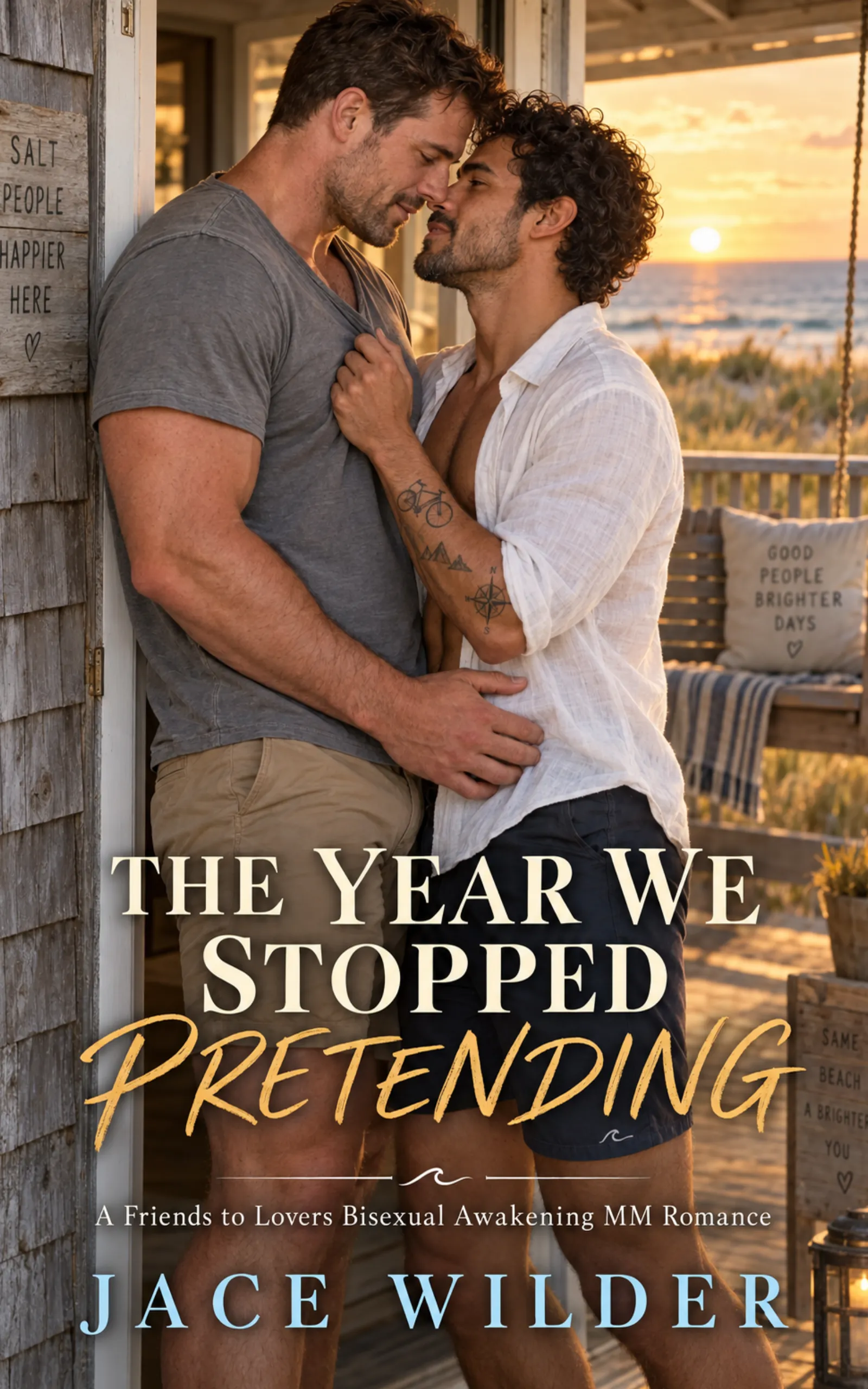
The Year We Stopped Pretending
A Friends to Lovers Bisexual Awakening MM Romance
by Jace Wilder
Shop the ebook · Shop the audiobook
Available at all major retailers
Pairing: MM
Heat: 🌶️🌶️🌶️🌶️🌶️ Inferno
Tropes: Best Friends to Lovers, Divorced Dads, Bi Awakening, Only One Bed, Road Trip, Forced Proximity, Mutual Pining, Praise Kink, Late Bloomer, Small Town, Found Family
They’ve been best friends for twenty-five years. It took one bed to ruin everything.
Colin Ward and Mateo Silva have done it all side by side. High school football. Each other’s weddings. Raising sons across the street from each other. Getting divorced in the same miserable year.
So when their teenage boys guilt them into one last road trip to the Outer Banks, Colin figures he can survive nine days in a car with the man he’s spent his whole life not looking at.
Then a booking error puts them in one room.
A storm puts them in one bed.
And one kiss in the dark puts an end to twenty-five years of pretending.
Mateo’s been in love with his best friend for as long as he can remember, and he’s done settling for whatever’s left over. If Colin wants him, he can say it sober, in daylight, out loud.
Colin wants him. God, does he want him. But wanting Mateo at a beach house is one thing. Wanting him at home — in front of an ex-wife, a son, and a whole small town — is another.
The road back is nine hours long. And only one of them is done hiding.
The Year We Stopped Pretending is a high-heat MM romance with lifelong best friends to lovers, divorced dads, bisexual awakening, only one bed, a road trip that goes very wrong and very right, and a hard-won, out-loud HEA.
You’ll love this book if you enjoy:
✅ Lifelong best friends to lovers, twenty-five years in the making
✅ Two divorced dads and the teenage sons who set them up
✅ Bisexual awakening at thirty-eight
✅ One car, one motel room, then only one bed
✅ A boundary worth swooning over: sober, daylight, out loud
✅ Praise kink, dirty talk, and a history teacher who turns out to be very loud
✅ Small-town coming out and a found family at one long table
✅ Dual POV, ten explicit scenes, and a hard-won HEA
⚠️ Content Warning: This novel contains explicit sexual content (graphic MM scenes including oral, anal, rimming, mutual masturbation and a solo scene), strong language, alcohol use, divorce and co-parenting, bisexual awakening and coming out later in life, a teenager seeing his father kiss a man before he has been told, a parent lying to his son about a relationship (and repairing it on the page), references to a disapproving late father, and a temporary breakup. There is no cheating between the leads. Intended for readers 18+.
📖 Read Chapter One Free
Not sure yet? Read all of Chapter One right here.
Chapter One
COLIN
The sign had been on Colin Ward’s lawn for six weeks, and he still flinched at it every morning the way you’d flinch at a stranger standing in your yard.
FOR SALE, it said, in the cheerful red of a stop sign. Below that, since the Fourth of July, hung a smaller rider somebody had bolted on crooked: SALE PENDING.
Pending. He taught tenth-grade history; he knew what the word was worth. It meant the treaty was signed and nobody had told the soldiers yet.
“Dad. You’re doing the thing.”
“I’m not doing a thing.”
“You’re staring at the sign.” Theo came down the porch steps sideways with his camera bag hugged to his chest like something that could bruise. Fifteen, all wrists and shins this summer, his mother’s fine brown hair hanging in his eyes. He set the bag in the back of the Highlander, considered it, and moved it six inches clear of where the cooler would go. “It’s not going to say anything different.”
“I was checking the lawn.”
“The lawn’s dead.”
“So now it’s checked.” Colin hefted the cooler off the driveway. “Did you pack sunscreen?”
“Yes.”
“Actual sunscreen. Not the spray. The spray is a lie they tell children.”
“Dad.”
“Sorry. You packed it. Sorry.”
Theo gave him the look. It had shown up around March, about when the lawyers finished, and it was a hell of a look to see on your own kid: patient, measuring, a photographer checking the light before deciding whether the subject was worth the exposure. Then he went back in for his duffel, and Colin stood in his driveway at seven-forty on a Friday morning in late July, holding forty pounds of ice and string cheese, with no one left to act fine at.
Six days in Cape May. That was the plan. A two-bedroom condo three blocks from the water, one father, one son, mini golf. He’d printed the confirmation. He’d made a list. He intended to be so relentlessly okay at this vacation that Theo would quit reading him like a thermometer.
Across the street, metal hit concrete, and somebody swore in two languages.
Colin’s head turned. It always did. Twenty-five years, and it still swung toward that voice like a needle finding north.
Mateo Silva was in his own driveway, losing a fight with a bike rack.
He’d already given up on his shirt. It hung off the side mirror of the Tacoma like a surrender flag, and the rest of him was bent over the trailer hitch with a wrench in one fist and the early sun lying across his bare back like a palm. He wasn’t a big man. Never had been—five-eleven if he bothered to stand straight, built close to the frame, nothing on him that wasn’t there for a reason. The shoulders. The two long ropes of muscle down either side of his spine, shifting when he threw his weight on the wrench. The thighs—Christ, the thighs—fifteen years off the race circuit and still straining the legs of his cutoff work shorts like the denim had been asked a rude question. Sweat had turned the curls at his nape to black commas. A stripe of chain grease crossed his ribs where he’d wiped a hand without thinking, and Colin’s eyes followed it down, around, to the place it vanished under a waistband riding low on one hip, lower than—
A bike rack. He was looking at a bike rack.
“La otra, Nico. The fourteen. I said the fourteen.”
“You said the big one!”
“The fourteen is the big one!”
“Then how come there’s three bigger ones in the box?” Nico came around the tailgate holding a socket up to the light like a jeweler with bad news. Sixteen, as tall as his father already and twice as loud, same curls, same mouth. “Mira. Seventeen. Nineteen. Whatever this is. You own, like, a store of these.”
“I own a shop of these. A store is where people buy things. A shop is where I fix what they did to them.” Mateo straightened, dragged a tattooed forearm across his forehead, and laughed—head back, the whole brown length of his throat in it.
Colin felt that laugh land where it always landed. Low. Under the ribs. A spot he had spent most of his life declining to name.
It was nothing. That was the drawer it went in, and the drawer was deep. Nothing, 2001–present. Mateo climbing out of a lake. Mateo asleep on the couch with one arm flung over his eyes and his shirt rucked up. Mateo in a rented tux, re-tying Colin’s bow tie with those blunt, quick fingers ten minutes before Colin married somebody else—breathe, Ward, she’s the one who has to walk, all you gotta do is stand there. A man noticed his best friend. That was allowed. You knew somebody since you were thirteen, you were permitted to know what his back looked like.
You were possibly not supposed to know it with your mouth gone dry.
Mateo turned, caught him, and raised the wrench like a toast.
“Ward! You loading that cooler or taking it to prom?”
Colin looked down. Still holding it. He’d been holding it, by rough estimate, for the entirety of Reconstruction.
“It’s heavy. I’m pacing myself.”
“You’re thirty-eight, not eighty.”
“Tell my back.”
“I’d have to find it first, under all that—” Mateo waved the wrench at the general length of him, grinning, teeth very white in the dark beard. “—teacher.”
“That’s not the insult you think it is.”
“Wasn’t insulting. I like it.” And he bent to the hitch again as if he’d said nothing, because he had. It was just how Mateo talked. He’d said filthier things in a best-man toast.
Colin put the cooler in the car and breathed out through his nose.
His decree had come through in March. Mateo’s had beaten it by five months. The same miserable year, start to finish—the two of them getting divorced in tandem the way they’d done everything since eighth grade, as though somebody had offered a group rate. Brooke had the townhouse on Wicker now. Elena had a condo near the college. Two boys rotated between four addresses on a color-coded calendar, and for the second summer running nobody was driving to the Outer Banks. Colin was taking Theo to Cape May. Mateo was taking Nico to a cabin outside Jim Thorpe with bike trails and no cell signal. Two small, brave, separate vacations, leaving the same morning from opposite sides of Alder Street, and nobody had been rude enough to mention it.
He had the hatch halfway closed before the part of his brain that graded papers caught what his eyes had been too busy to read.
That was the four-bike rack.
Mateo owned three. Colin knew, because he’d helped hang the pegboard they lived on. A two-bike for quick trips. A three for race weekends. And the big steel bastard he only dug out when—
“Dad?” Theo, from the front door, in the voice of a kid being extremely casual. “Can you come in for a sec? Nico and Mateo are coming over. We have to, um. We need to show you guys something.”
The kitchen was two-thirds boxes. Colin had labeled each one in block capitals—PLATES, EVERYDAY; PLATES, WEDDING; MISC. DRAWER (WHY)—and the island stood stranded among them like the last dry deck on a sinking ship. The boys had taken the far side of it. Theo had the laptop. Nico had the floor, obviously.
Mateo came in through the side door without knocking, the way he had for fifteen years. He’d found his shirt, a faded gray SILVA CYCLES tee, and put it on in a hurry; it clung dark between his shoulder blades. He went straight to the cabinet over the coffee maker, opened it, regarded the bare shelf, and without a word crouched to the box marked MUGS and dug until he came up with the chipped Phillies one. His. It had lived here since 2014.
“You packed my mug.”
“I packed all the mugs.”
“You packed my mug, in a box, going to an apartment I haven’t seen.” He filled it from the pot and leaned his hips against Colin’s counter. “That’s a little bit of a kidnapping, Ward.”
“Okay,” Nico said. “So. First of all, nobody yell.”
“Strong open,” said Mateo.
“Theo.”
Theo turned the laptop around.
It was a listing photo. Gray cedar shingles gone silver with salt, two decks stacked like drawers left open, a run of stairs down to the dune. Over the carport, a hand-routed sign hanging from one good chain and one bad one.
SECOND WIND.
Something in the middle of Colin’s chest did a slow, complete rotation.
“You booked the house,” he said.
“We booked the house,” Nico agreed.
“With what?”
“Dad’s card’s saved on the site. From two years ago.”
Mateo lowered the mug. “My card.”
“We’re gonna pay you back. In chores.”
“In chores. You know what a week in Avon runs in July, in chores? You’re mowing my lawn at forty. You’re doing my gutters with your own kids watching.”
“I have a condo,” Colin heard himself say. “In Cape May. I have a confirmation number. I printed it.”
“Had,” Theo said, to the laptop.
“Theodore.”
“You never changed your email password.” His son’s ears had gone pink. “It’s still my birthday.”
“That is—buddy, that’s a crime. That’s two or three crimes, I’d have to look it up.”
“Full refunds, though,” Nico said. “Both places. We read the cancellation policies. We’re not animals.”
“And the cabin?” Mateo asked.
“Gone since Tuesday.”
“Tuesday.” Mateo looked at the ceiling. “I bought bear spray on Wednesday.”
“There’s a thirty-day return on that.”
Colin opened his mouth to deliver a speech. He had one. It had sections. Trust, and boundaries, and you cannot commit light wire fraud because you’re sad. He gave that speech for a living, to rooms of thirty.
Then Theo closed the laptop halfway and said, “Cape May was going to be you and me being weird in a condo.”
“We weren’t going to be weird.”
“You made a list, Dad. It had unstructured fun on it. With a start time.”
Mateo made a sound into his coffee.
“And ours was gonna be two guys in the woods with no bars,” Nico said, “and him going you good, mijo? every forty minutes like I’m on a watch list. No offense.”
“Little bit taken.”
“We’ve gone eleven years.” Theo wasn’t talking to the laptop anymore. He was looking right at Colin, and the measuring look was gone; what was under it was worse. Hope, folded up small, the way he folded everything now so nobody would have to carry it for him. “Last time was two summers ago and nobody knew it was the last time. I just don’t want that to be how it ends. One more. A normal one. Then you guys can go back to being depressed in separate zip codes.”
“Same zip code,” Mateo said. “He’s moving nine blocks.”
“Papi.”
“I’m just saying. Accuracy.”
“One car,” Nico pushed on. “The Highlander’s got the third row, the four-rack’s already out. We stop at the Starlite tonight, like always, we’re at the house tomorrow by lunch. Nine days. That’s it. That’s the whole ask.”
Nine days.
Colin did the arithmetic the way he did all arithmetic, by looking for the exits. Three bedrooms: the boys in the bunk room like always, a room apiece for the dads, a staircase and a whole floor between. That was fine. That was architecture. But no Brooke at the stove this time, no Elena in the porch rocker with her red pen and her stack of freshman comp, no wives to make it two families at a beach house instead of—
Instead of what, exactly?
Instead of nine days of Mateo coming up the dune path wet to the waist. Mateo at the deck rail at dusk with a beer bottle hanging from two fingers. Mateo’s laugh through a bedroom wall. A week and a half without one single other adult to stand behind.
The no was right there. He had it loaded. It’s a lot of money, guys. It’s not a good year. Your mothers and I agreed on a schedule. Every piece of it reasonable, and every piece of it a coat thrown over the real thing, which was that he was afraid of a house.
And Theo was watching him with that small folded hope.
Colin did what he always did. He turned to Mateo. “What do you think?”
“Uh-uh.” Mateo didn’t even set the mug down. Brown eyes, level, a little tired around the edges, seeing all the way to the back of him the way they had since they were kids. “Don’t do that. Don’t pass it to me so you don’t have to hold it.”
“I’m asking your opinion.”
“You’re asking me to be the reason. I’ve been the reason since ninth grade. I’m why you took shop, I’m why you didn’t take the Maryland job, I’m why we got the big TV.” He tipped his head. His voice came down, quieter, pitched to cross the island and go no farther. “Say no if you want to say no, Ward.”
The kitchen held still. The refrigerator hummed in a house already promised to a couple from Harrisburg.
He didn’t want to say no. That was the whole rotten root of it. He wanted that silvered house so badly his teeth hurt.
“We’d have to stop for more ice,” Colin said.
Nico whooped and slapped the granite. Theo’s entire face came open like a shutter—there and gone, but Colin saw it, and would have taken out a second mortgage on a house he barely still owned to see it again.
Mateo kept looking at him one beat past comfortable.
“That’s not a yes. That’s a grocery list.”
“It’s a yes.”
“So say it.”
“Yes. God. Yes, okay? We’re going.” His neck was hot. “Sorry about your card.”
“That’s three.”
“Three what?”
“Sorries. It’s not even eight o’clock.” Mateo drained the Phillies mug, rinsed it, and, holding Colin’s eye the entire time, walked it past the box marked MUGS and out the side door with him. “I keep a count. You’re in the low six figures.”
It took Mateo four minutes to mount the rack on the Highlander once he had nobody to argue with about sockets.
Colin watched that too, a little. The economy of it. Mateo’s hands were the truest thing about him: scarred across the knuckles, black in the nail beds no matter what he scrubbed with, and so sure of themselves that bolts seemed to want to go in for him. He seated the hitch pin by feel, without looking, while telling Nico which bike went on which tray and why. Inked into the forearm that worked the ratchet, a swallow flexed its wings.
Then it was the old dance. Eleven summers had worn the choreography into both of them. Colin built the cargo the way he built a lesson plan, heavy and structural on the bottom, anything you’d want before Virginia up top. Mateo undid a third of it to wedge in what Mateo considered essential: the dented cast-iron griddle, two bags of masarepa, a tool roll, and a speaker the size of a toaster.
“We have a stereo. In the car. It came with the car.”
“That’s for driving. This is for the deck.”
“The griddle weighs more than Theo.”
“The griddle is the reason your son has eaten breakfast on vacation since he was four. Respect the griddle.”
The boys had gone back inside to litigate a missing phone charger. Their voices carried through the screen door, faint and bitter. Mateo hauled his duffel off the driveway.
“Scoot. I’m coming through.”
There was no through. There was a foot and a half between Colin’s hip and the garage door track, and Colin was leaning into the cargo hold with both arms full of beach chair.
Mateo came anyway.
His hand landed in the small of Colin’s back. Flat, warm, spread wide—and a little low, right where Colin’s T-shirt had ridden up from reaching, so that what it found wasn’t cotton. It was skin. Callused palm, the heat of a man who’d been working in the sun, four fingertips resting just above the waistband of his shorts and a thumb fitted into the groove of his spine as though it had been measured for the spot.
“Behind you,” Mateo said, close, easy, on his way past.
It was nothing. It was how you moved somebody in a tight space. He’d done it in dugouts, in kitchens, in the vestibule of a church.
Every nerve Colin owned stood up and faced that hand.
Heat went through him in one long downward pour, back to belly to the root of him, so fast and so stupidly total that he locked his knees against the bumper. His cock gave a slow, heavy, unmistakable pulse against his thigh. He stared into the cargo hold at a bag of charcoal and did not breathe, because if he breathed he’d lean back, an inch, only an inch, just to feel that palm press—
Seventeen. Lake Arden, the swim dock, past midnight. Mateo hauling himself up out of the black water and landing on his elbows over him, streaming, laughing—and then not laughing. Six inches. Lake water running off the end of his nose onto Colin’s mouth. Ward, he’d said, like a question. And Colin had barked out a laugh, rolled from under him, and cannonballed off the end.
The hand slid away. Mateo shoved the duffel in beside the griddle and thumped it twice.
“There. Perfect. Don’t touch anything.”
“It was perfect before,” Colin said, to the charcoal, in something close to his own voice.
“It was tidy before. Different thing.”
He’d never brought it up, the dock. Not once in twenty-one years. Mateo never had either, which meant Mateo had forgotten it by breakfast, the way you’d forget any dumb half-second at a lake party. Only one of them had kept it. Only one of them had it filed, with a tab.
Nothing.
Colin shut the hatch harder than the hatch required and stood behind it a moment longer than loading a car called for, thinking about the War of 1812 until his body agreed to be a history teacher’s again.
By the time the boys came banging out of the house, he had his face back. They belted into the second row with their earbuds dangling and resumed a border dispute over the center armrest that had been running since they were in boosters. Brooke had been texted; Elena had been texted; both had sent a thumbs-up within ninety seconds of each other, which was its own kind of information Colin chose not to grade.
“Can I drive?” Nico called. “I have a permit.”
“No,” said two fathers, in one voice.
“First leg! It’s all highway!”
“It’s all highway with my son in the car,” Colin said.
“And mine,” Mateo said, “who I’ve seen parallel park.”
He came around the front bumper spinning the key ring on one finger. He’d backed the Highlander down to line up the hitch, so he had them, and for a second Colin thought he’d keep them—just walk to the driver’s side, rack the seat back for those ridiculous legs, and take it out of Colin’s hands. The whole day. The whole nine.
Some craven part of him wanted exactly that.
Mateo tossed the keys over the hood instead. A lazy underhand arc, glinting. Colin caught them against his chest.
“You drive,” Mateo said. “I run everything else. Like always.”
“Everything else.”
“Music. Food. Route. Morale. General vibe.” He ticked them off on grease-stained fingers. “You keep it between the lines. I make it worth going.”
“I have thoughts about the route.”
“You have feelings about the route. I have a route.” He opened the passenger door and grinned at Colin across the hot roof, squinting into the sun, curls drying wild, so entirely himself it was hard to look at straight on. “Come on, Ward. Take me to the beach.”
Colin got in.
The car closed around the four of them and promptly got smaller. Mateo dropped into the passenger seat smelling of sweat and citrus hand cleaner and chain lube, shoved the seat back as far as it went, and spread out the way he did everywhere—knee angled wide, bare forearm claiming the entire center console, swallow and chainring and a line of small black numbers that were Nico’s birthday. Four inches from Colin’s hand on the gearshift. Close enough that the hair on his arm lifted toward it like grass toward weather.
His lower back was still warm in the shape of a palm.
He started the engine. Mateo was already thumbing through his phone; a second later the speakers coughed up the opening riff of the same song that had opened every road trip the two of them had taken since 2009, and both boys groaned on cue, delighted.
Colin put the car in reverse and checked his mirror. The house slid backward through it—porch, dead lawn, the bedroom window he hadn’t slept well behind in two years. Then the sign, red and white, swinging a little as they passed.
SALE PENDING.
He looked away from it, at the road, at his own knuckles, anywhere but at the man beside him singing the wrong words on purpose.
Nine days. He could be normal for nine days.
Want to keep reading? The full novel is available now.
🔥 Want an EXCLUSIVE Bonus Chapter?
The Dock, Take Two — A scene TOO HOT for the bookstore
The first full summer at the cabin. The boys are at their mothers’ till Sunday, there’s no moon, and the dock where it all nearly didn’t happen is twenty feet long. Mateo asks the same one-word question he’s been asking for twenty-two years. This time Colin has a much better answer — and sound carries on a lake.
More from Jace Wilder
Browse all Jace Wilder books.

Still Here, Still Yours
He promised to call. Twenty-three years later, he's standing on my ball field.

Hands Full
One good hand. One thin wall. His best friend's little brother on the other side of it.
The Year We Stopped Pretending
They’ve been best friends for twenty-five years. It took one bed to ruin everything.
Two’s Company, Three’s Coming
A Steamy MMM Roommates-to-Lovers Romance
Spare Key After Midnight
The key was for emergencies. Wanting the man upstairs wasn't supposed to count.

His First Man at Forty
Bluebird Lanes
He asked the brewery owner to be his first. The answer was three dates — and nothing comes off until the third.
Never Miss a Release
Get new release alerts, exclusive bonus content, and reader-only giveaways.