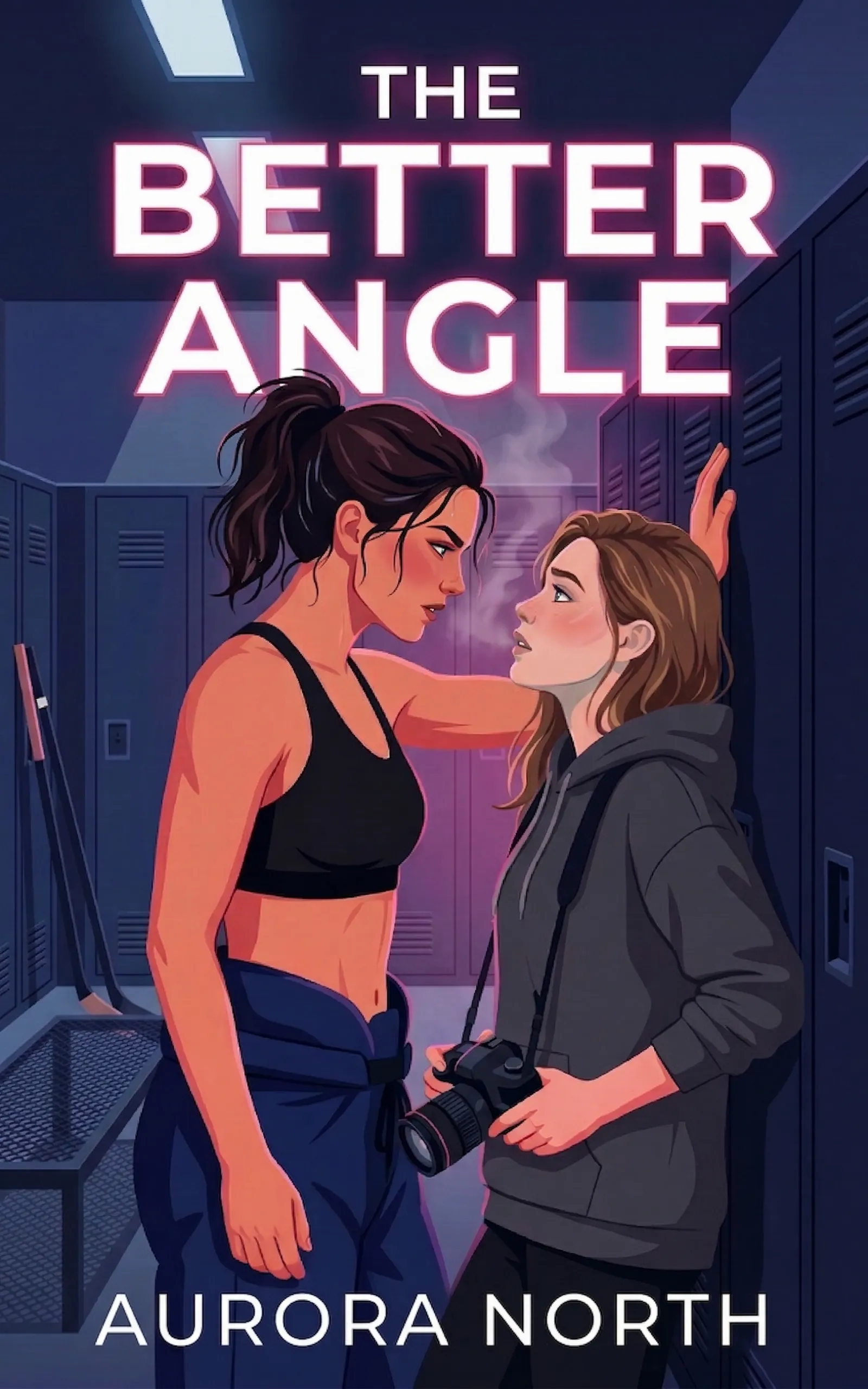
The Better Angle by Aurora North — She Pointed a Camera at the Quietest Player on the Ice. The Player Looked Back and Forgot How to Be Anyone Except Herself.
She’s been shooting hockey for seven years. She knows the angles, the light, the exact millisecond when a player’s face reveals something the game tape won’t catch. She’s invisible — that’s the job, and she’s made it her life. Stay behind the glass. Stay behind the lens. See everything. Be seen by no one.
Then the quiet forward sits in her chair at media day and looks at her — not at the camera, at her — and the photographer’s hands go still on the shutter for the first time in ten years.
The Better Angle is Aurora North’s 80,000-word slow-burn sapphic hockey romance about Riley Keane, a sports photographer who hides behind her camera because being visible is too dangerous, and Eve Marchetti, a fiercely talented PWHL forward who’s spent seven years sealing herself off from everyone because the last time she let someone close, the grief nearly destroyed her. It is a forbidden workplace romance. It is a secret relationship story. It is a book about photography and hockey and darkrooms and hotel hallways and the terrifying, life-altering risk of being truly seen by someone who won’t look away. It is the best thing the Aurora North catalog has produced, and it is not close.
The Setup: What You’re Walking Into
Riley Keane is twenty-nine, bisexual, and living in a third-floor walkup in Somerville with slanted ceilings, a bathroom the size of a closet, and a converted second bedroom that she uses as a darkroom. She’s just landed the biggest contract of her career — full-season embedded photographer with the Boston Falcons, a PWHL expansion team — and she is going to be professional and invisible and excellent and she is absolutely, under no circumstances, going to develop feelings for a player on day one.
She develops feelings for a player on day one.
Eve Marchetti is twenty-five, a second-year forward, and the kind of hockey player that coaches call “the engine” — she’s never the flashiest skater on the ice, but every line she’s on produces. She reads the game two moves ahead. She wins faceoffs at a rate that makes opposing coaches redesign their neutral-zone strategy. She’s Italian-American, close with her big loud family back in Duluth, and she hasn’t slept through the night since her father died when she was nineteen.
Eve doesn’t perform for the camera. She doesn’t smile on command. She doesn’t do the media-day thing where you tilt your head and look approachable. She just sits in the chair and looks at Riley Keane with brown eyes that are steady and warm and utterly, unnervingly direct, and Riley takes six frames and forgets she’s working.
That’s the setup. A photographer who can see everyone except herself, and a player who can read the ice like poetry but hasn’t let another human being close in seven years. A camera between them. A contract that explicitly forbids what’s about to happen. And the slow, devastating, inevitable collapse of every wall they’ve ever built.
The Architecture: How This Slow Burn Works
The Better Angle is patient in a way that most contemporary romance isn’t. North doesn’t rush the connection — she builds it the way Riley builds a photograph: exposure by exposure, layer by layer, each frame adding density to the image until the accumulated weight becomes undeniable.
The first six chapters are pure tension. Riley embeds with the team. She rides the bus. She sits in hotel bars. She shoots practice from ice level and game action through the glass. And she keeps catching Eve — in unguarded moments, in quiet corridors, in the specific, devastating way that Eve’s face changes when she doesn’t know she’s being watched. Riley puts these photos in a private folder on her laptop. The folder grows. Fourteen images. Twenty. Fifty. Each one a confession she didn’t mean to write.
Meanwhile, Eve is orbiting. She doesn’t mean to — she just keeps ending up near Riley. Stretching at her end of the rink. Taking the bus seat beside her. Lingering after practice to ask questions about photography that are really questions about Riley. It’s gravitational. Neither of them chose it. Both of them feel it. And the reader, watching from the outside, is going slowly, methodically insane.
The hotel hallway scene in Chapter 5 is the moment the book announces what it is. They’ve been up talking for two hours — about Eve’s brother Marco, about Riley’s mother Diane, about everything except hockey and everything except the thing that’s building between them. They walk to their rooms. Same floor. Neighboring doors. They stand in the hallway, too close, not touching, and Eve says: “If I don’t walk away right now, I’m going to do something I can’t undo.” And Riley, with the steady precision of a woman who composes images for a living, says: “If it happens in a hotel hallway at midnight after two whiskeys, I’m going to spend the rest of my life wishing it had happened somewhere that mattered more.”
Reader, I screamed.
The first kiss doesn’t happen until Chapter 8 — in Riley’s darkroom, in red light, while Eve watches a photograph of herself emerge from a developer tray and says “You see me like this?” and the answer is yes, the answer has always been yes, and the kiss is slow and deliberate and tastes like developer and mint and eight weeks of wanting. Riley overexposes the print because she forgets about the chemistry, and the ruined image becomes the most important photograph in the book.
The Darkroom as Love Language
The thing that makes The Better Angle different from every other sports romance on the shelf is the photography. Not as set dressing — as structure. As metaphor. As the fundamental grammar of the story.
Riley shoots film. She develops in a darkroom. And the process — expose the paper, put it in the tray, wait for the image to appear — mirrors the emotional arc of the entire book. You can’t rush development. You can’t force the image. You show up, you trust the chemistry, and you wait.
North uses this at every level. The private folder of Eve’s photographs is a visual love diary that Riley doesn’t consciously understand she’s keeping. The overexposed print from the first kiss is a metaphor for what happens when you forget to be careful. The Sunday roll — thirty-six frames of Eve in her apartment, unposed, unperformed — is the physical evidence of Riley stepping out from behind the camera and into the frame of her own life.
There’s a scene where Riley’s mother, Diane — an artist, a painter, a woman who raised her daughter alone and recognizes hiding because she does it too — looks at the Sunday roll and says: “There’s no barrier here. You’re not behind the camera in these photos. You’re in the room.” And the reader understands, in a flash of clarity, that the entire book has been about this: a woman learning to stop observing her life and start living inside it.
It’s one of the best uses of a non-romantic element as emotional architecture that I’ve seen in the genre. The darkroom isn’t a setting — it’s a thesis.
The Tropes: Your Shopping List
Sports Photographer x Player — Through the Glass
Not just proximity — structural intimacy. Riley’s job requires her to look at Eve for hours every day and capture what she sees. Eve’s job requires her to perform in front of Riley’s lens. The camera becomes a confessional, a love letter, and eventually a barrier that has to be set down. The glass between photographer and player is literal and metaphorical and the book uses both.
Forbidden Workplace Romance — With Real Consequences
This isn’t a hand-wavy “oh no, HR might find out” situation. Riley’s contract has a morality clause. Her boss, Jordan, issues an ultimatum: end the relationship or resign. The professional consequences are real and specific and they drive the book’s central crisis. The forbidden element has teeth.
Secret Relationship — Weaponized Proximity
The hidden-relationship phase is some of the hottest material in the book, and not because of the sex scenes. It’s the stolen glances across the locker room. The fingertips brushing during equipment handoffs. The neck-touch in a darkened film session that makes Eve wet for twenty minutes during a tactical briefing. The hiding itself becomes erotic — every moment of restraint is a pressure valve, and the reader is right there in the compression chamber.
Slow Burn That DETONATES
Eight chapters before the first kiss. Eleven chapters before the first full explicit scene. And when it arrives — in Riley’s bedroom, after a fight, after a reconciliation, after three months of pining — it’s earned so thoroughly that the release feels tectonic. The anticipation isn’t just foreplay for the reader — it’s foreplay for the characters. They’ve been edged by their own lives.
“She Sees the Real Me” — Mutual and Devastating
Both characters are hiding. Riley behind the camera. Eve behind the game face. The book’s central engine is mutual recognition — two women who are experts at being invisible finding the one person who makes them visible. The vulnerability isn’t one-directional. They take turns being seen, and each act of seeing costs something.
Only Soft For You
Eve Marchetti has four publicly visible emotions: focus, mild irritation, severe irritation, and the face she makes when Tessa makes a good save. She does not smile. She does not emote. She is the Ice Queen of the PWHL — except with Riley, where she laughs, cries, shakes, loses control, and reveals a dimple in her left cheek that only exists when the smile is real. The contrast between Eve-in-public and Eve-with-Riley is devastating.
The Heat: Talking About the Spice 🔥
🌶️🌶️🌶️🌶️🌶️ Inferno. This book does not fade to black. It stays in the room. And what happens in the room is graphic, emotional, and earned by the chapters of tension that precede it.
The explicit scenes are distributed across the second and third acts, each one escalating in intimacy and intensity. North understands that the best spice is architectural — each scene builds on what the characters have learned about each other, so the sex at the end of the book is not just hotter than the sex at the beginning but different. More trusting. More surrendered. More willing to ask for the terrifying thing.
The Scenes, Ranked by Reader Devastation:
#5: The Kitchen Counter (Chapter 13). Tuesday morning, seven-thirty. Riley wearing Eve’s crewneck and nothing else. Eve on her knees on the kitchen tile. Twenty minutes until practice. The crewneck stays on. The coffee gets cold. The efficiency of it — two athletes on a schedule, maximizing the available window — is wildly hot and unexpectedly funny.
#4: The Hotel Wall (Chapter 13). Post-game, road trip, adrenaline still buzzing. Eve pins Riley face-first against the hotel room wall and takes her from behind — fast, hard, nothing like their usual dynamic. Riley braces against the wallpaper and makes a sound that is audible through the hotel walls. The urgency is the point. Eve is burning off a two-goal game, and Riley is the surface she burns against.
#3: The First Time (Chapter 11). After the fight. After the reconciliation. After three months of looking and wanting and not touching. Eve goes down on Riley for the first time in Riley’s bed, and the scene is written with the slow, meticulous attention of a woman who reads bodies for a living and a photographer who reads light. Riley comes saying Eve’s name “like a prayer.” Eve returns the favor with “photographer’s hands — precise, controlled, missing nothing.” Both women cry afterward. Not from sadness. From the shock of being that thoroughly known.
#2: The Reconciliation (Chapter 18). They’ve been apart for two weeks. Riley shows up at Eve’s apartment with a portfolio of prints and a three-minute speech about love letters and being in the frame. They come back together slowly — intentional, nothing like their first time. Eve undresses Riley and whispers everything she couldn’t say when they were apart. The scene is emotional and intense and unhurried and the eyes-open mandate — “stay with me, don’t close your eyes” — is the most intimate direction in the book.
#1: The Season-End (Chapter 23). No clock. No schedule. No practice in the morning. For the first time, they have actual time, and they use every second of it. Eve goes slow — devastatingly, excruciatingly slow — and Riley retaliates by spending an obscene amount of time between Eve’s thighs, working with the patience of a woman developing a print in the dark. Eve comes with a sound that “wasn’t controlled, wasn’t efficient — just Eve, without the game face, without the mask, without anything.” It’s the culminating explicit scene, and it only works because twenty-two chapters of trust-building made it possible for both women to stop holding back.
The Conflict: Why This Book Has Weight
The Better Angle runs on two engines of conflict, and both of them are character-driven rather than plot-imposed.
The first is professional: Riley’s contract prohibits relationships with players. Her media director, Jordan Park, discovers the relationship via a blurry fan photo and issues an ultimatum — end it or resign. Riley, in a misguided act of protection, chooses to end the relationship without telling Eve about the ultimatum. She does the thing she’s always done — retreats behind the camera, becomes the observer instead of the participant, chooses safety over closeness. And Eve, who recognizes the pattern because it mirrors her own seven-year rule about not letting anyone close, calls it exactly what it is: cowardice dressed up as nobility.
“Safe is not the same as alive.” That’s the line. That’s the thesis of the entire book, delivered by Eve Marchetti in a Brighton apartment while the woman she loves tries to leave. It’s the best single line Aurora North has ever written.
The second engine is internal: both women are expert hiders. Riley hides behind the camera. Eve hides behind the game face. They’ve built entire identities around not being seen, and the book asks them — forces them — to dismantle those identities in order to have each other. The emotional arc isn’t “will they get together” (they will, it’s romance, we know) — it’s “can two people who’ve spent their entire lives being invisible survive the exposure of being loved?”
The answer, arrived at through 80,000 words of exquisite tension and tenderness, is yes. But it costs them. It costs them their comfortable hiding places. Their professional armor. Their carefully maintained distance from the world. And the cost is the point — because the thing they get in return is a life that’s actually lived, not just observed.
The Supporting Cast: Why the Falcons Feel Real
Shay Novak — The captain. Loud, blonde, chaotic, married to a pediatrician named Jenn. She clocks the Eve-Riley tension in October and spends the rest of the season being aggressively supportive. She mimes hearts on the team bus. She yells “HELL YEAH, MARCHETTI” during a post-game scrum. She buys a game-show buzzer to prevent hockey talk at dinner parties. She is the best friend character the genre deserves.
Tessa Park — The goalie. Communicates primarily through pad saves and meaningful silences. She confronts Eve in the weight room during the breakup fallout and delivers the book’s most precise emotional diagnosis: “You’re playing like someone who’s trying to outrun something.” She sees the whole ice. She always has.
Marco Marchetti — Eve’s older brother. Six-two, two-twenty, cries at golden retriever videos. Calls Eve every Sunday without fail. His phone call scene — “When you find the person who makes you brave, you hold on” — is the moment the third act locks into gear. He will cry when he meets Riley. He will cry at the Sunday gravy. It will be very wet and very Italian.
Diane Keane — Riley’s mother. An artist. A painter. The woman who raised Riley alone and recognizes hiding because she does it too. Her scene with the prints — “You were in the frame” — is the emotional turning point of the entire book. She develops the negatives, literally and metaphorically.
Jordan Park — The media director. Not a villain — a woman doing a difficult job who made a bad call under pressure. Eve’s confrontation with Jordan in Chapter 19 — strategic, not scorched-earth, the power play of a woman who war-games everything — is one of the most satisfying scenes in the book.
The Photograph That Defines the Season
There’s a moment in Chapter 21 where everything the book has been building converges into a single image. Eve dives for a rebound in an elimination game — full extension, horizontal, stick outstretched — and tips the puck into the top corner. Riley, behind the glass, gets the shot.
The photograph becomes the cover of the league’s mid-season feature. It’s the image that defines the Falcons’ inaugural season. And what makes it extraordinary isn’t the athleticism or the timing — it’s Eve’s face. In the frame, frozen at one-eight-thousandth of a second, Eve’s expression is not effort. It’s joy. Pure, incandescent, unguarded joy — the face of a woman who forgot to be afraid.
Riley says: “It’s the best photograph I’ve ever taken.” Eve says: “It’s the one you were always trying to take — the one without the barrier.”
The photograph is the book. The book is the photograph. A woman who learned to stop hiding, captured by a woman who learned to stop looking from a distance. The better angle isn’t a composition technique — it’s a way of seeing. A way of being seen.
Who This Book Is For
You’ll love The Better Angle if you enjoy:
✅ Sports photographer x hockey player — the most original sapphic sports romance setup in years
✅ Forbidden workplace romance with a real contract, a real ultimatum, and real consequences
✅ A slow burn that takes eight chapters to reach the first kiss and earns every single second
✅ Explicit FF scenes that are graphic, emotional, and architecturally integrated into the character arcs
✅ Photography as love language — darkroom scenes that will rewire your understanding of what intimacy can look like
✅ “She sees the real me” with devastating mutual vulnerability
✅ A secret relationship where the hiding itself becomes the heat
✅ Only Soft For You energy from a woman who has four public emotions and a secret dimple
✅ Found family hockey team with the best captain in the genre
✅ A post-game interview coming-out scene that will make you scream
✅ Dual first-person POV (alternating) that gives you full access to both sides of the pining
✅ An HEA earned through courage, honesty, and the willingness to step out from behind the glass
If you loved: the pining of One Last Stop but wanted more heat. The sports-world texture of Power Play but wanted it sapphic. Any FF romance where the tension between being hidden and being seen is the engine that drives everything. Any book where you finished it at 3 AM and immediately started it again because you weren’t ready to leave.
Content Notes
This novel contains explicit sexual content (graphic FF scenes including oral sex, penetrative sex with fingers, mutual masturbation, and multiple explicit scenes of escalating intensity), strong language throughout, depictions of grief and parental death (off-page, referenced), anxiety and emotional avoidance as coping mechanisms, a controlling workplace authority figure (not romanticized, resolved with agency), sports-related injuries, and one fan-photo privacy violation. All characters are consenting adults (25+). Heat level: 🌶️🌶️🌶️🌶️🌶️. Intended for readers 18+ only.
Get the Book
Free with Kindle Unlimited — read The Better Angle right now. Standalone. No cliffhanger. HEA guaranteed.
Get the Bonus Chapter
Already finished? Still thinking about the crewneck on the pillow and the ruined darkroom print? “The Sunday Roll” is waiting — set after the epilogue, Eve’s POV. Riley hands Eve the Leica and lies back on the bed. For the first time, the photographer becomes the subject. What starts as vulnerability becomes the hottest, most intimate night of their lives — role reversal, explicit direction, and the scene that proves the glass is gone for good. Too explicit for Amazon, free for readers.
As an Amazon Associate, Fractal Enigma LLC earns from qualifying purchases at no extra cost to you. Each Fractal Enigma title links to the book page on this site where you can read more and access exclusive bonus content.
Never miss a release — the newsletter sends new Aurora North titles, bonus chapters too hot for Amazon, and reader-only giveaways straight to your inbox. 🔥