
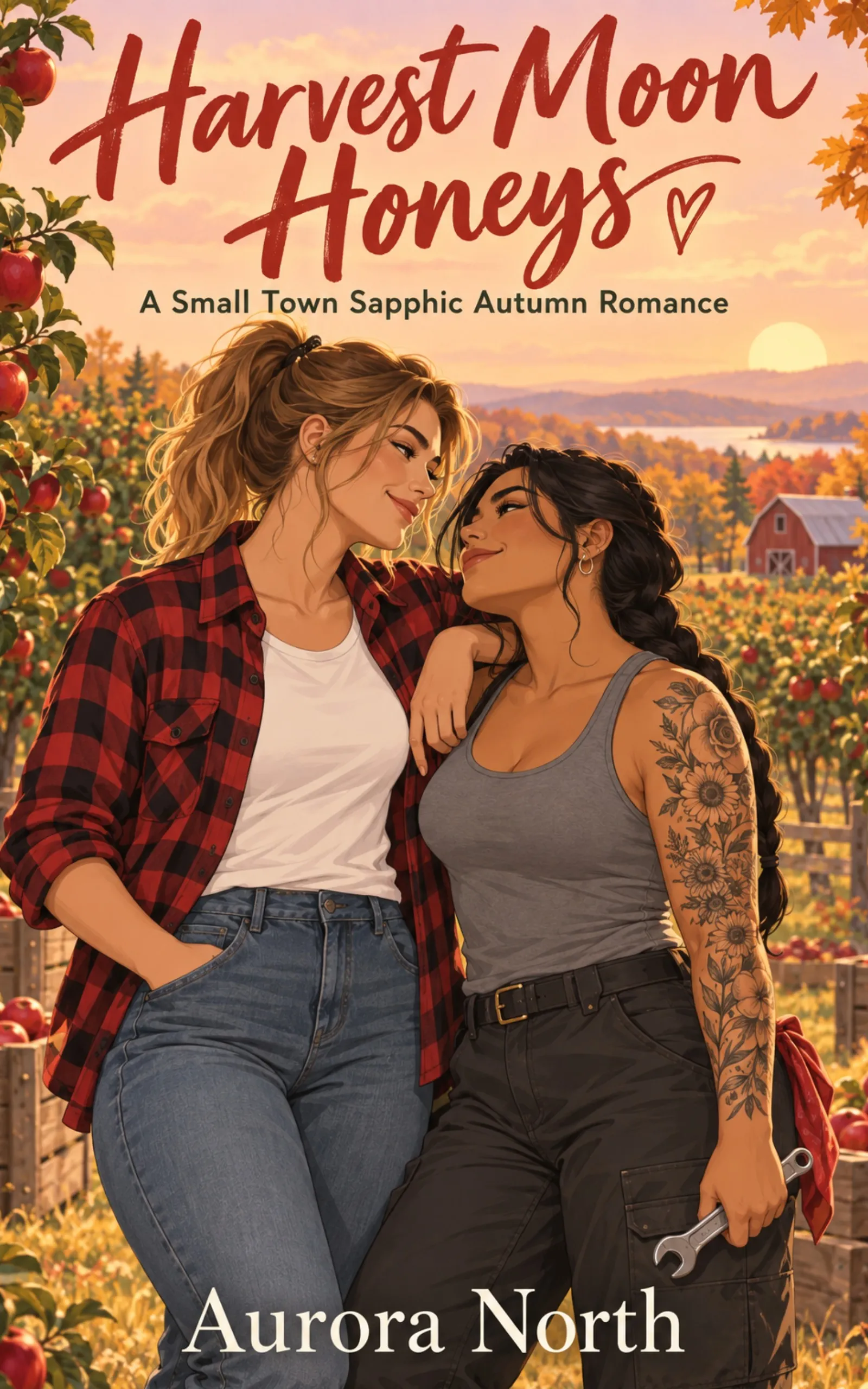
Harvest Moon Honeys
Sapphic Small-Town Fall Romance
by Aurora North
Choose an ebook retailer · Shop the audiobook
See available purchase options
Pairing: FF (Sapphic)
Heat: 🌶️🌶️🌶️🌶️🌶️ Inferno
Tropes: Enemies to Lovers, Forced Proximity, Small Town, Praise Kink, Blue Collar, Class Difference
The city fixer. The grease-stained mechanic. The fall neither of them planned.
Morgan Vale hasn’t set foot in Bellwether, New York in fifteen years — not since a public humiliation taught her that needing a place gives it power to break you. She’s built a career turning chaos into spreadsheets and has never looked back. But when her grandmother shatters her ankle and the family orchard faces collapse weeks before the town’s biggest festival, Morgan’s the only one with the skills to save it.
June Alvarez is the town’s blunt, tattooed, broad-shouldered mechanic who’s kept the orchard’s ancient equipment alive for a decade with duct tape, stubbornness, and hands that can fix anything. She fully expects Morgan to sell the place out from under her — another polished outsider cashing in on something she doesn’t understand.
Their fights are loud. Their chemistry is louder. Somewhere between a busted cider press and a borrowed flannel, Morgan stops running — and June stops bracing for the person she wants most to leave.
You’ll love this book if you enjoy:
✅ Enemies-to-lovers with real friction (not manufactured misunderstandings)
✅ Grumpy mechanic × polished city fixer — blue collar meets white collar
✅ Forced proximity in a shared farmhouse with one working bathroom
✅ A fall festival countdown that doubles as a ticking clock
✅ Slow burn that EXPLODES (🌶️🌶️🌶️🌶️🌶️ — graphic, explicit, emotional)
✅ Found family, queer community, and a grandmother who sees everything
✅ HEA guaranteed
⚠️ Content Warning: This novel contains explicit sexual content (graphic FF scenes), strong language, and depictions of anxiety, self-doubt, and past emotional harm. Intended for readers 18+.
📖 Read Chapter One Free
Not sure yet? Read the opening of Chapter One right here.
Chapter One: The Broken Ankle and the Broken Books
Morgan Vale was halfway through explaining why a fourteen-percent margin on artisanal crackers was a fantasy when her phone lit up with a 607 area code she hadn’t seen in three years.
She silenced it. Kept talking. The quarterly review had six more slides, and the regional buyers across the conference table were already losing patience with the numbers she’d spent two weeks making palatable. She was good at this — translating ugly realities into language that made people feel like tough decisions were smart ones instead of desperate ones. Her boss, David, called it her superpower. Morgan called it knowing how to read a room.
The phone buzzed again. Same number.
“—so if we shift the distribution window to bi-weekly and renegotiate the cold-chain contract, we recover about sixty thousand annually without cutting a single SKU.” She advanced the slide. “Questions?”
The phone buzzed a third time. Then a fourth, in rapid succession — texts now, not calls.
David glanced at her pocket. She ignored him.
“The implementation timeline is aggressive but realistic. I’ve built in a two-week buffer for supplier onboarding, and I’ll personally manage the—”
Her phone rang again. Loud enough this time that the buyer from Whole Foods raised an eyebrow.
“Excuse me.” Morgan pulled it out, intending to decline the call and deal with whoever was having a meltdown later. But the texts were from Owen Park, and Owen didn’t text unless something was actually wrong.
Your grandmother fell off a ladder.
She’s at the hospital. Broken ankle, maybe worse.
She won’t let anyone call you but I’m calling you.
Morgan. Pick up.
The room went sideways for half a second. Just a tilt — the conference table, the overhead lights, the PowerPoint slide with its clean bar graph — and then she was back, steady, her face doing the thing it always did when something inside her cracked: absolutely nothing.
“I need to step out,” she said. “David, can you take the distribution slide?”
She was in the hallway before he answered.
Owen picked up on the first ring.
“Before you spiral,” he said, “she’s fine. Cranky, mean to the nurses, and refusing painkillers because she says they make her boring. Classic Edith.”
Morgan leaned against the hallway wall, her hand pressed flat to the drywall like she needed to confirm that solid surfaces still existed. “What happened?”
“She was on a ladder in the equipment shed trying to fix a light fixture because she doesn’t believe in asking for help. Sound familiar?” Owen’s voice carried the specific gentleness of someone who’d known Morgan since she was nine and barefoot in an orchard. “She fell. Broken ankle — clean break, not surgical. But she’s in a boot cast and she can’t walk on it for six weeks.”
“Six weeks.” Morgan did the math before she could stop herself. It was September fourth. Six weeks put them past the Harvest Moon Festival. Past the entire fall revenue window. “Owen, the festival—”
“I know.”
“The press was already having problems. She told me last month the motor was—”
“I know, Morgan.”
She pressed her fingers against her eyes. The fluorescent hallway light was suddenly unbearable. “How bad is it? The business side, not the ankle.”
The pause told her everything. Owen was not a man who paused for dramatic effect.
“Bad,” he said. “She’s been holding it together with duct tape and denial for about two years. The press is dying. We’re short-staffed because she can’t afford to hire the seasonal crew she needs. Revenue’s been dropping, and the festival is the only thing that keeps the doors open through winter. Without her running it—” Another pause. “She needs you.”
Morgan stared at the ceiling tile directly above her head. It had a water stain in the shape of a kidney. She’d walked this hallway four hundred times and never noticed.
“I’ll be there tonight,” she said.
“Morgan—”
“Tell her I’m coming. Don’t let her argue.”
She hung up, went back into the conference room, and finished the presentation. Every slide. Every question. She smiled at the buyer from Whole Foods and shook his hand and walked David through the follow-up action items. Then she went to her office, closed the door, and sat in her ergonomic desk chair staring at the Boston skyline for eleven minutes.
She counted. It was easier than feeling anything.
Then she pulled up Hertz, booked a midsize sedan, and started packing her laptop bag.
David appeared in her doorway. “Everything okay?”
“Family emergency. I need to take some time.”
“How much time?”
“A week.” She said it automatically, the way she said everything — with certainty she didn’t feel. A week was manageable. A week was a discrete unit of crisis, containable, schedulable. “Maybe two.”
“The VP candidate list finalizes end of next month. You know that.”
“I know.”
“Don’t disappear on me, Morgan.”
She gave him the smile she’d perfected over a decade of corporate survival — warm enough to reassure, cool enough to establish that she didn’t need reassurance back. “I never disappear. I relocate temporarily.”
He laughed. She didn’t.
The drive from Boston to Bellwether, New York, took four hours and twelve minutes, and every mile of it felt like traveling backward through a life she’d spent fifteen years outrunning.
Morgan drove with both hands on the wheel because she was a person who drove with both hands on the wheel. The rental smelled like synthetic pine and someone else’s fast food. The GPS pronounced Bellwether wrong — Bell-weather, two distinct words, when anyone who’d grown up within fifty miles of it knew it was Bellwether, one word, the stress on the first syllable, the rest of it swallowed like the town itself tried to disappear into its own name.
The interstate gave way to a state highway. The state highway gave way to a county road. The county road gave way to Route 14, which wound along the western shore of Seneca Lake before cutting inland through vineyard country and dropping, eventually, into the shallow valley where Bellwether sat like a town that had been put down gently and forgotten.
Morgan’s hands tightened on the wheel.
She hadn’t been back in fifteen years. She’d had reasons — graduate school in Chicago, the first job in New York, the move to Boston, the promotions that came like clockwork because she was very good at turning chaos into spreadsheets and very bad at sitting still long enough to miss anything. Edith visited her instead. Twice a year, a seventy-something woman with opinions about everything would appear in Morgan’s apartment, rearrange her kitchen, declare her furniture “aggressively temporary,” and leave behind a jar of apple butter that Morgan would ration for months.
They didn’t talk about why Morgan never came home. It lived between them the way certain things lived between family members — acknowledged in the negative space, never named, shaped by its absence like a tree growing around a fence post.
The exits got smaller. The gas stations got older. The sky opened up the way it only did in this part of New York, wide and unsettled, the clouds moving fast over hills that looked like they’d been sleeping since the last ice age.
Morgan turned off Route 14 onto Orchard Road and felt something clench in her chest that she chose to classify as anxiety about the financial situation.
Vale Orchard appeared on the left, and her foot eased off the gas before her brain caught up.
It was still beautiful. That was the first thing — the gut-punch recognition that the place she’d run from was still, objectively, one of the most beautiful pieces of land she’d ever seen. Eighty acres of apple trees in early September, the branches heavy with fruit just starting to turn, the rows running in clean lines up a gentle slope toward the tree line. The farmhouse at the top of the drive, white clapboard, wraparound porch, the kind of house that looked like it had been painted by someone who believed in the concept of home with a sincerity that bordered on religious.
The second thing was that it was falling apart.
The fence along the road had two sections down and a third leaning at an angle that suggested it was negotiating with gravity. The equipment shed’s paint was peeling in sheets, exposing weathered gray wood underneath. The cider production barn — the big stone-and-timber building that housed the press, the bottling line, and the tasting room — had a blue tarp patched over a section of the roof. The gravel drive needed regrading. The sign at the entrance — VALE ORCHARD & CIDER MILL, EST. 1952 — was faded almost past reading.
Morgan pulled in and parked. She sat in the rental car for a full minute, her hands still on the wheel, looking at the farmhouse where she’d spent every summer from age six to eighteen.
Then she got out, pulled her roller bag from the trunk, and walked up the porch steps with the posture of a woman entering a quarterly review.
The front door was unlocked. It had always been unlocked.
“Gran?”
“Kitchen.”
Morgan followed the voice through the hallway — same wallpaper, same creaky third floorboard, same framed photo of her grandfather holding a bushel of Cortlands in 1974 — and found Edith Vale sitting at the kitchen table with her left ankle in a medical boot, a laptop open to what appeared to be a spreadsheet made by someone who fundamentally did not understand spreadsheets, and a phone pressed between her shoulder and her ear.
“Owen, I already told you — the conveyor belt is fine, it just needs the tension adjusted, and if you’d stop babying it and actually — oh, she’s here. I’ll call you back.” Edith hung up and looked at Morgan over the top of her reading glasses. “You drove.”
“I drove.”
“You look thin.”
“You fell off a ladder.”
“It was a short ladder.”
“All ladders are short until you break your ankle on one.”
Edith’s mouth twitched. She had the kind of face that stored everything — seventy-eight years of weather and grief and stubbornness carved into lines that somehow still looked more alive than most people’s faces at thirty. Her white hair was pulled back in a practical bun. Her eyes, the same gray as Morgan’s, were sharp and unapologetic and, underneath the performance of annoyance, unmistakably relieved.
“Well,” Edith said. “Come here.”
Morgan crossed the kitchen and hugged her grandmother carefully, mindful of the boot, and Edith held on for exactly two seconds longer than casual, and neither of them mentioned it.
“You didn’t have to come,” Edith said when Morgan pulled back.
“Owen said you needed me.”
“Owen has a flair for the dramatic.”
“Owen said you’ve been holding this place together with duct tape and denial for two years.”
Edith’s jaw tightened. “Owen talks too much.”
Morgan sat down across from her and opened her own laptop. “Show me.”
The books were worse than Owen had warned her.
Revenue had dropped twenty-two percent over three years. Not a cliff — a slow erosion, the kind that didn’t look catastrophic in any single quarter but added up to a business that was bleeding out one paper cut at a time. The cider press had needed a major overhaul eighteen months ago; Edith had patched it instead. The seasonal crew was down to four. The equipment was aging past the point where maintenance could keep up with entropy.
And then there was the Harvest Moon Festival.
The festival accounted for forty-one percent of the orchard’s annual revenue. Two days in October — vendor fees, cider sales, tasting-room traffic, hayrides, merchandise — generated enough cash to carry the operation through winter and into spring. Without it, Vale Orchard didn’t make it to Christmas.
The festival was twenty-six days away. The cider press was failing. The staff was exhausted. And the woman who’d run this operation for fifty-three years was sitting across the table with a broken ankle, pretending she could still do it.
“I’m staying,” Morgan said. “Four weeks. I’ll build a plan, stabilize operations, get the press running, restructure the festival budget. I’m not asking, Gran. I’m telling you.”
Edith studied her for a long moment. “You always were bossy.”
“I prefer ‘strategically directive.’”
“Your grandfather called it ‘being a pain in the ass.’”
“He would know.”
Edith laughed — a real laugh, startled out of her. Morgan’s throat went tight. She looked back at the spreadsheet. Safer territory.
“I need to understand the full picture,” Morgan said. “Every vendor contract, every maintenance log, every outstanding invoice. And I need to talk to whoever’s been keeping the equipment alive, because based on what I’m seeing here, that person is either a miracle worker or a masochist.”
Edith smiled. Not her usual sharp smile — this one was slower, edged with something Morgan couldn’t read.
“That would be June,” Edith said.
“June Alvarez. She owns the repair shop in town — Juniper Garage. She’s been maintaining the press, the tractors, the generators, the whole operation for about ten years. She knows this equipment better than anyone alive, including me.” Edith paused. “She’s also the reason the press is still running at all, so when you meet her, try to remember that before you start asking her to justify her invoices.”
“You walk into a room, find the budget line that doesn’t make sense, and interrogate it. It’s why you’re good at your job and terrible at first impressions.” Edith held up a hand. “I say that with love.”
Morgan closed her mouth. Her grandmother was not wrong.
She was deep in a red-flagged line item about the cold-storage compressor when the crunch of tires on gravel pulled her attention to the window.
A truck had pulled into the drive — not a new truck, but a work truck, the kind that looked like it had earned every dent and scratch through honest labor. Dark paint, toolbox mounted in the bed, mud on the wheel wells. It parked beside Morgan’s rental sedan and the engine cut.
A figure climbed out. From the kitchen window, Morgan could see broad shoulders, work boots, and a braid of dark hair tucked under a ball cap.
“That’ll be June,” Edith said, reaching for her reading glasses. “She keeps the machines alive.” She glanced at Morgan over the frames. “Try not to fight with her before you’ve unpacked.”
Morgan looked back at the window. The woman was pulling a heavy tool bag from the truck bed, one-handed, like it weighed nothing.
“Why would I fight with her?”
Edith just smiled and went back to her crossword.
Want to keep reading? The full novel is available now.
🔥 Want an EXCLUSIVE Bonus Chapter?
The New Bed — A scene TOO HOT for the bookstore
The bed arrived on a Tuesday. June built it by hand — walnut, iron bolts, steel gussets. No squeaking. When Morgan grips the headboard for the first time, the stress test begins. Counter-grade joinery meets quality-control enthusiasm in the filthiest, funniest, most joyful bonus chapter in the series.
More from Aurora North
Browse all Aurora North books.
The Cabin We Both Booked
Two reservations. One cabin. Six weeks. Seven rules.

The Second Apartment
She finally has a life that's all hers. The woman across the hall wants to be in it out loud.

Last Call for the Ice Queen
She runs the hotel like a Swiss watch. The new consultant just took it off her wrist.
The Woman Experiment
Three dates. One honest night. No way to keep it theoretical.

Night Shift, Door Locked
Calder Memorial After Dark
She has a rule for everything. Then she met the nurse who breaks them for fun.
Never Miss a Release
Get new release alerts, exclusive bonus content, and reader-only giveaways.