
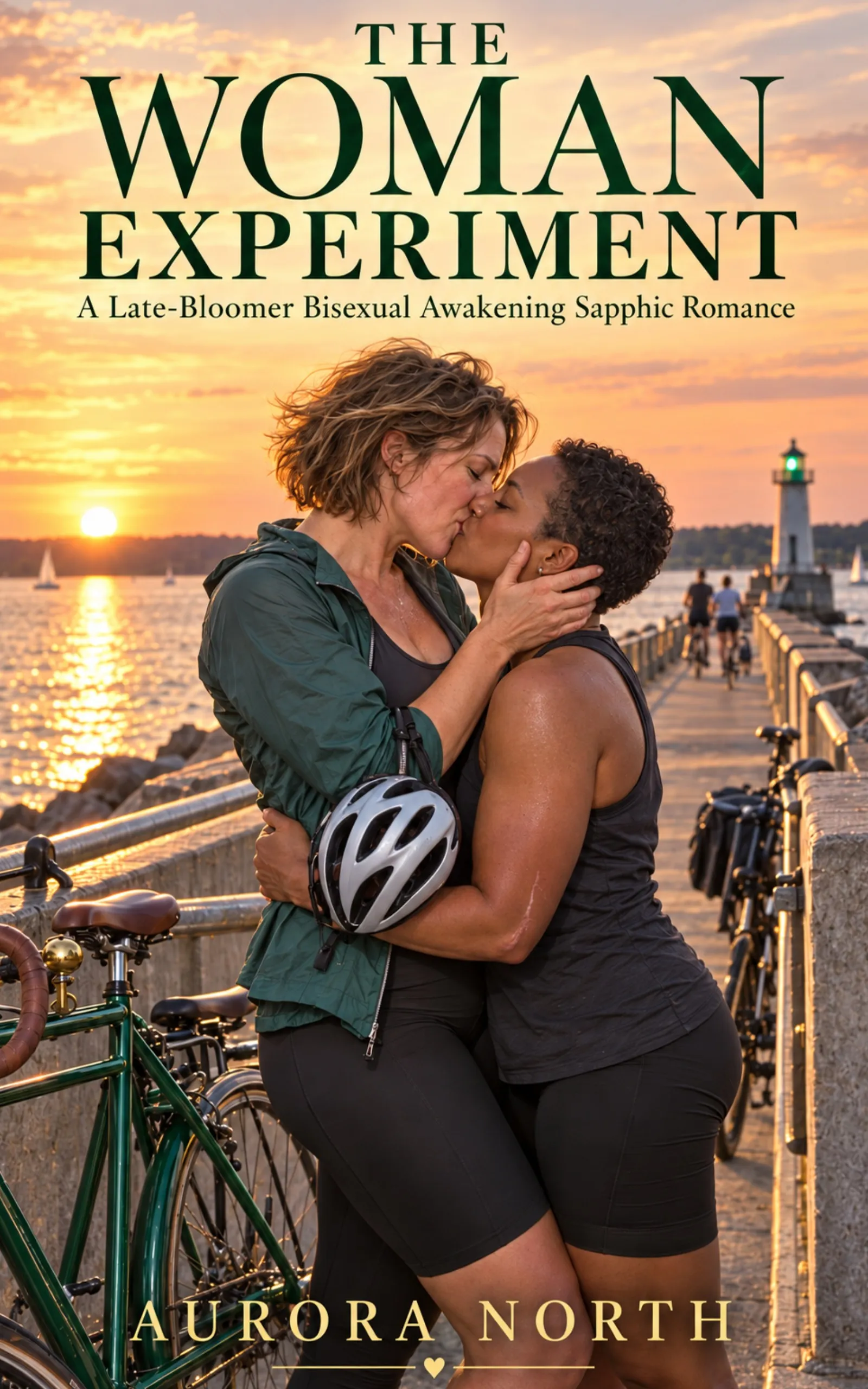
The Woman Experiment
A Late-Bloomer Sapphic Romance
by Aurora North
Shop the ebook · Shop the audiobook
Available at all major retailers
Pairing: FF (Sapphic)
Heat: 🌶️🌶️🌶️🌶️🌶️ Inferno
Tropes: Late Bloomer, Bi Awakening, First Time with a Woman, Three-Date Deal, Experienced × Curious, Praise Kink, Heroine Over 40, Found Family
Three dates. One honest night. No way to keep it theoretical.
At forty-two, Beth Morrow finally has room to ask the question she’s been avoiding for twenty years.
What if she wants women?
Her divorce is final. Her kids are grown. Her color-coded life is suddenly all hers, and row fourteen of her post-divorce to-do list says date a woman.
Then a dead bicycle brings her to Nia Hollis.
Nia is confident, gorgeous, very much a lesbian, and completely unwilling to be some newly single woman’s field trip. So Beth makes an offer written on the back of a repair ticket: three real dates, total honesty, nothing promised. And one correction. She doesn’t want a woman. She wants Nia.
By the end of date three, Beth has her answer. By morning she has a much bigger problem.
Because spectacular firsts are easy. Telling the people who still see her as Brian’s wife is not. And Nia has been someone’s secret before. She’s not doing it twice.
The Woman Experiment is a high-heat sapphic romance with a late-blooming bisexual heroine, a bike-shop owner who knows exactly what she’s doing, three dates, one very honest night, a lot of on-page spice, no cheating, and a guaranteed HEA.
You’ll love this book if you enjoy:
✅ A late-bloomer bi awakening at forty-two, written with respect and a lot of heat
✅ Experienced × curious — a bike-shop owner who knows exactly what she’s doing
✅ A three-date deal with one rule: total honesty
✅ First time with a woman, on the page, with nothing skipped
✅ Praise that lands like a hand on the back of the neck
✅ A spreadsheet heroine and the woman who won’t be a row on it
✅ Grown kids, a decent ex-husband, and a found queer community
✅ No cheating, 🌶️🌶️🌶️🌶️🌶️ heat, HEA guaranteed
⚠️ Content Warning: This novel contains explicit sexual content (graphic FF scenes, including toys and a strap-on), strong language, divorce, coming out later in life to adult children and family, a cycling accident with a minor injury, and references to a past secret relationship. Intended for readers 18+.
📖 Read Chapter One Free
Not sure yet? Read all of Chapter One right here.
Chapter One: After
The divorce takes eleven minutes.
I know because I check my watch when the clerk calls Morrow and Morrow, and again when the judge, a woman with reading glasses on a beaded chain, wishes us both well and reaches for the next file. Eleven minutes to end twenty-one years. I have sat through longer meetings about the font on a pay stub.
At one point she asks whether the marriage is irretrievably broken. Brian and I answer “Yes, Your Honor” in perfect unison, like a couple who has rehearsed, and the court reporter glances up as if we might be the first people that day who actually like each other.
Brian holds the courtroom door for me. I hold the outer one for him. To the very end, we are excellent at doors.
“Coffee?” he says on the courthouse steps, hands shoved in the pockets of the only suit he owns. “Feels like there should be coffee. Or a cake. Do people get a cake for this?”
“I believe the cake is for the beginning.”
“That’s backwards. You need the cake way more now.”
The café across the street has a window table and a chalkboard pushing something called a lavender fog. Brian orders black coffee and a cinnamon roll the size of a hubcap. I order tea, then change it to a latte with an extra shot, because nobody is going to require me to be sensible today.
He tears the roll in two and slides the half with more icing across the table without looking. Two decades of muscle memory. I take it. There’s a pale band on my finger where the ring sat until last spring, and a matching one on his, and we both pretend not to check.
I was nineteen when the test came back positive, a sophomore with a color-coded planner and a boyfriend who could fix anything with an engine and made me laugh until I got hiccups. We married when I was twenty, in his mother’s backyard, me five months along in a dress with a forgiving waistline. Nobody forced anybody. We were in love and we were terrified, and those two facts held the roof up for a long time.
Then came Lila, and three years later Sam, and somewhere in the blur of daycare invoices and furnace repairs I turned into the person who knew where everything was. The insurance cards. The permission slips. Everyone’s feelings, including several that were never mine to manage. Brian stayed fun. I got reliable. Fourteen months ago a counselor with very kind eyes asked when we had last wanted each other instead of simply needing each other, and neither of us could name the year.
“We should tell them it’s official,” Brian says, pulling out his phone.
We write it together. He types with one thumb; I edit over his shoulder. Paperwork’s final. We’re both okay. We love you two and nothing about that changes. He adds a thumbs-up. I make him delete the thumbs-up.
Sam answers inside a minute. ok. are you guys getting lunch or is that weird
Lila takes four. I know. I checked the court website this morning. Love you both. Mom, call me later.
“She checked the court website,” Brian says.
“She’s mine.”
“She is so completely yours.” He laughs, and then the laugh runs out. He turns his cup a quarter turn on its saucer. “Can I say a thing?”
“For accuracy, is it a thing I’ll need a napkin for?”
“Probably.” He looks at me properly, which he has not always remembered to do. “You were the infrastructure, Beth. The whole time. The bills, the kids, my mom’s birthday, whatever was wrong with the gutters. I just got to live in the building. I’m sorry I let you be that. I should’ve noticed it wasn’t the same thing as you being happy.”
I do need the napkin.
“You were a good husband,” I tell him, once my voice can be trusted. “It was a real marriage. I’d like that entered into the record.”
“So entered.” He wipes icing off his thumb. “What are you going to do now? With all the…” He waves at the air around me. “Room.”
“I have a list.”
“Of course you have a list.”
“It’s a spreadsheet.”
“Of course it’s a spreadsheet.” His grin is the one from our wedding photos. “Anything good on it?”
Row fourteen arrives in my mind fully formatted, and heat climbs the back of my neck.
“Paint,” I say. “I’m repainting the bedroom.”
He gives me the look of a man who has been watching me change the subject since we were both teenagers. Then he lets it go. This may be the finest feature of being divorced from Brian Morrow: he is no longer entitled to the follow-up question.
On the sidewalk he hugs me hard, the same soap, the same shoulder, and climbs into a city parks truck he is absolutely not authorized to use for personal errands.
“Hey,” he calls through the window. “Go do something that isn’t on the spreadsheet.”
“Everything is on the spreadsheet.”
“Then go do the weird row.”
He drives away. I stand there holding half a cinnamon roll in a napkin, and nothing in me breaks. I am surprised by how much room that leaves.
I took the whole day off, which means I am home at one o’clock on a Monday, a time and place I have never previously occupied.
The house has opinions about it. The refrigerator hums. The hall clock, a wedding gift, ticks as though it is billing me. Family photographs climb the stairwell in the order I hung them: Lila missing her front teeth, Sam in a dinosaur costume he wore for most of a year, Brian and me squinting on a beach. I left every one of them up. They are accurate.
I trade the courthouse blazer for a cardigan, make a sandwich I do not eat, and open my laptop on the dining table Brian built from a walnut slab the winter Sam was born.
The file is called After. I created it at two in the morning on the night Brian moved into his apartment, because I couldn’t sleep and I do not know how to be sad without column headers.
Row 3: Repaint the bedroom. Not beige.
Row 6: Ride a bike again.
Row 9: Learn to sleep in the middle of the bed. Status: complete. I sleep diagonally now. I have overachieved.
Row 15: Take a trip alone.
And directly above that, in the same eleven-point font as everything else, as though it were a dental cleaning:
Row 14: Date a woman.
Row fourteen has its own tab. I named the tab Woman Experiment because at two in the morning it sounded rigorous, and it contains exactly two entries. Step 1: Download app. Complete. Step 2: Finish profile. Stalled, eleven days.
I open the app on my phone. My profile is done through the photograph (Sam’s graduation, me squinting again, Brian cropped out at the shoulder) and the occupation field, where payroll compliance manager sits like a warning label. Then comes the screen that has beaten me eleven days running.
I’m interested in:
Men. Women. Everyone.
Three options. I process garnishment orders across four states. I can reconcile a quarter-end in my head. I cannot press a button.
I close the app.
What I do instead is put in my earbuds, the way I have most nights for three weeks.
The audiobook is called Salt Water Season. It concerns a marine biologist and the woman who captains her research boat, and I maintain that I purchased it by accident, a position weakened by the fact that one cannot accidentally enter a credit card security code. I am on chapter nineteen. I have been on chapter nineteen three times.
I carry the laundry basket upstairs so that I have a reason to be in the bedroom.
The narrator has a low, unhurried voice, an alto with a little grain in it. In chapter nineteen, the captain backs the biologist against the wheelhouse door while rain hammers the deck. “Tell me what you want,” the captain says. “All of it. Out loud, Doc.”
I fold one towel.
“Your hands,” the biologist says. “Your mouth. I want you to quit being so goddamn careful with me.”
I set the towel on the dresser. I lie back across my diagonal bed in my good navy slacks. I stop pretending about the laundry.
It starts the way it always starts, with my palm flat on my stomach as if I’m checking for a fever. The captain is opening the biologist’s shirt, and the narrator lingers over every button, and my fingers slip under my waistband and over cotton, and I am already wet. Not a little. Soaked through, from a sandwich I didn’t eat and eight sentences in a stranger’s voice.
That’s data. I have been ignoring data for a long time.
I get the slacks off, and the underwear, and fold neither. My blouse I unbutton to the waist. In the nightstand there’s a small teal vibrator I ordered in the third month of the separation and entered in the household budget under Miscellaneous. I set it on the quilt beside my hip and use my fingers first, because I want to know exactly how bad this is.
It’s bad. I’m slick and swollen, hot to my own touch, and when I draw two fingertips up through myself and across my clit my hips leave the mattress.
“Look at you,” the captain says in my ears. “Look how wet this pretty cunt is for me.”
I don’t own a word for that part of myself that I like. The narrator owns several and deploys each one with total confidence, and every time she does, something low in my belly pulls tight like a drawstring.
Here is the trouble with chapter nineteen. Somewhere around the wheelhouse door, I lose the plot. The biologist goes first; she blurs out and it’s me with my shoulders against the wood. Then the captain blurs too, and what’s left is not a character. It’s a woman. She has no face yet. She has only the parts I apparently hold strong views about.
Her hands. Strong ones, short-nailed and sure, hands that have done this before, with tendons that shift in her forearms when she takes hold of my hips. The weight of her pressing me down. Her breasts soft against mine, which is the detail that undoes me, the simple shocking softness of it. And a voice at my ear, lower than the narrator’s and nowhere near as polite.
Slower, she says. I didn’t tell you to rush.
I slow down. Dear God, I slow down, in my own bedroom, for a woman I invented.
That’s it. Now open your legs for me. Wider. I want to see all of you.
My knees fall apart. The afternoon comes in flat and gold through the blinds, striping my bare thighs, and I have never in forty-two years done this in daylight with my eyes open.
I look, too. That’s new. The soft slope of my stomach that I hold in during meetings. The silver stretch marks at my hips, two babies’ worth. The dark hair between my legs gone wet and flattened, my own fingers shining. In my head her hand spreads wide and possessive over all that softness, and she does not politely overlook any of it. She likes it. She wants a handful.
I pull the earbuds out and drop them on the quilt. The narrator shrinks to a tinny murmur near my elbow.
The woman in my head doesn’t stop talking.
So that settles that. The book was never the engine. It was the permission slip.
I cup my own breast through my bra, then shove the cup down and roll my nipple between my fingers, harder than I ever let anyone else, and pretend it’s her mouth. Her teeth, careful. Her tongue, not careful at all. With my other hand I push two fingers inside myself and tell myself they’re hers, thicker than mine, working me open with no hurry whatsoever while her thumb circles my clit.
You’ve wanted this for a long time, haven’t you.
“Yes,” I say, out loud, to the ceiling fan.
Say it properly.
“Yes. I have. I want it.”
I imagine her moving down my body. Her shoulders nudging my thighs wider, broad and warm. Her breath first. Then her tongue, flat and slow, then pointed and exact, licking into me as though she has cleared her entire afternoon and I am the only item on the agenda. I have never had a woman’s mouth on me. I can feel it anyway. I can feel the wet heat of it so precisely that I make a sound I don’t recognize, high and cracked.
I grab the vibrator, thumb it on, and press it to my clit.
After that nothing about it is tidy. My heels dig into the quilt. I’m riding my own hand, three fingers now, graceless and loud, the slick noise of it obscene in my quiet house, the buzz held tight exactly where I need it. In my head she has my wrists pinned over my head, which is anatomically inconsistent with everything else she is doing to me, and I do not care, I want all of it at once, her hands and her mouth and her weight and that voice.
Not yet, she says, and I pull the vibrator away, panting, shaking, my whole body clenched around my fingers on the very edge of it. Hold it. Hold it for me. You can.
I can. I didn’t know that about myself. I hold there for three breaths, four, sweat prickling under my breasts, thighs trembling, until I’m whimpering through my teeth.
Now, sweetheart. Give it to me.
I put the vibrator back.
“Oh, fuck.”
I say it at full volume to an empty house.
It tears through me in long, hard pulses, my back bowing off the bed, my thighs clamping shut around my wrist, my cunt squeezing my own fingers so tightly I can count each wave. It keeps going well past the point where it is usually polite enough to end. I hear myself say it again, smaller, into the crook of my arm. Fuck. Fuck.
I have used that word aloud perhaps twice in my adult life. Once while Sam was crowning. Once when I hit a deer.
I should be finished. I always stop at one; one is efficient. But my fingers are still inside me, and when I shift them I’m so sensitive that I gasp, and the voice in my head says, amused and merciless, Did I say we were done?
I don’t use the vibrator this time. Only the slippery heel of my hand grinding against my clit, and my fingers curling, and the thought of her watching me do it with her chin on my knee. The second one is quicker and deeper, a slow hard clench that rolls up from the soles of my feet and leaves me shuddering on my side with my wet hand trapped between my thighs.
Then quiet. The fan turns. The vibrator buzzes against the quilt like a trapped wasp until I find the button. From the dropped earbuds the narrator carries on, tiny and oblivious, describing rain.
I lie there with my blouse hanging open and my pulse knocking in my throat, and I make myself look at it squarely, the way I would look at a ledger that refuses to balance.
For years I have told myself, about a number of women, that what I felt was admiration.
Admiration has never made me come hard enough to see spots. Admiration does not require a change of bedding.
It was never admiration.
A sensible woman would nap. I shower, pull on jeans, and walk into the garage with the scrubbed, faintly manic energy of someone who has just been proven right about something enormous and would now like to be proven right about something small.
Row six. Ride a bike again.
The bike hangs on two hooks behind the Christmas bins. It is a forest-green steel hybrid I bought with waitressing money the summer before I got pregnant, back when I rode it everywhere, in sundresses, with no helmet and no plan. It has not left this wall since Lila was in a car seat.
I used to know things on that bike. I knew the hill behind the community college took exactly eleven hard pedal strokes. I knew how to ride no-handed while eating a peach. Then I knew how to install a car seat, and the bike went up on the hooks, and each year it became a little more like furniture.
I wrestle it down. It weighs approximately what Sam weighs. Both tires are flat as place mats and cracked along the sidewalls. The chain has gone the orange of a traffic cone. When I squeeze the left brake lever it travels all the way to the grip without consulting the wheel, and the right one does not travel at all.
I am not a stupid woman. I can see this is a bad idea.
I also had the best orgasm of my life forty minutes ago, on a weekday, on purpose, and it has left me with poor impulse control and a strong suspicion that the rules are negotiable.
In a bin of soccer cones I find Sam’s old hand pump and a skateboard helmet covered in stickers. The helmet perches on my head like a bottle cap. The pump takes ten minutes and most of my upper-body strength to put a questionable amount of air into each tire. Then I wheel the bike to the top of the driveway, swing a leg over, and discover that the seat was set by a far more optimistic person.
“Twenty-three years,” I tell the bike. “You’d think one of us would remember.”
I push off.
For about four seconds it is glorious. Wind lifts the damp hair off my neck. My body does remember: the lean, the balance, the small swoop in the stomach. I am nineteen and nobody’s infrastructure.
Then the driveway tilts toward the street, as it always has, and I squeeze the brakes.
Nothing happens on the left. Nothing happens on the right. The chain makes a noise like a drawer full of silverware and locks solid, the front tire sighs flat, and the handlebars wrench sideways out of my grip.
I get one foot down. It isn’t enough. The bike goes one direction and I go the other, and I meet my own driveway palm-first.
Silence. A sprinkler ticking next door. The back wheel turning lazily beside my head. Across the street a curtain twitches and falls still, which means the whole cul-de-sac will know by dinner that the Morrow woman has finally cracked.
I take inventory, because that is what I do. Knees: functional. Jeans: intact. Dignity: under review. The heel of my right hand is scraped raw and full of grit, already stinging, bright beads of blood coming up through the gray.
I start laughing. It comes from the same place the swearing did. I sit in my driveway at half past two on the day of my divorce, bleeding lightly and laughing like a lunatic in a child’s helmet, with a dead bicycle lying across my shins.
Eventually I haul us both back into the garage. I rinse my hand at the utility sink, hissing, and watch a thin pink thread circle the drain. The bike leans against the workbench where Brian’s tools used to hang, front wheel turned away from me like a dog that has been shouted at.
“That was my fault,” I tell it. “I should have requested documentation.”
I sit down on the step and pick the last of the gravel out of my palm with my phone balanced on my knee.
Bike repair Lakemont, I type with my good thumb. Then, after a moment, more honestly: adults who forgot how to ride a bike.
The third result is Switchback Cycles, in an old hardware store on the east side.
The website has no photographs of men in Lycra, which I count in its favor. There’s a long, narrow shop with bikes hanging down one wall. There’s a close-up of somebody’s hands truing a wheel: brown forearms, sleeves shoved up, grease in the creases of the knuckles, a pale scar slanting across one elbow.
I look at those hands for longer than the hands strictly require.
Beneath them, a banner.
RIDE AGAIN. Ten weeks for adults who used to ride, never learned, or are a little scared. No Lycra. Nobody gets dropped. We finish together on the Breakwater Loop.
And in smaller type: 35 miles.
There is a list of frequently asked questions, and whoever wrote it has met me.
Do I need to be in shape? No. That’s what the ten weeks are for.
Do I need an expensive bike? No. Bring what you’ve got. We’ll tell you the truth about it.
What if I fall? Then you’ll have fallen, and we’ll help you up, and you’ll have a story.
I already have the story. I would like the help.
Thirty-five miles. I have just failed to complete thirty-five feet.
But I know something about myself that I did not know this morning. Or rather, I have lost the ability to not know it. I am a person who can be wrong about what she wants for twenty years and survive finding out. Set beside that, thirty-five miles is only arithmetic. Three and a half miles a week.
I fill in the form. Name. Phone. Under Tell us about your bike, I write: Steel hybrid, older than my adult daughter. The brakes are decorative.
Emergency contact. My thumb has typed Bri before I catch it. Twenty-one years of forms, and his name has been the answer on every one. I hold down the delete key. I type Lila Morrow, daughter, and sit for a second with how strange and how ordinary that looks.
Under What’s bringing you back? I type A list. I delete it. I type Unfinished business, leave it, and pay the fee before I can convene a committee.
You’re in! the screen says. Class starts in two weeks. Bring your bike by the shop before then and we’ll make it safe. We’re open Saturdays.
Saturday. I can do Saturday.
My palm throbs. My thighs still feel borrowed. The garage smells of cold concrete and old rubber, and for the first time in longer than I can calculate, I am behind schedule on absolutely nothing.
Two rows in one afternoon. One of them drew blood and the other made me swear, and I honestly could not say which frightened me more. What I can say is that neither one killed me, and that I am sitting on a garage step with my heart going like I have somewhere to be.
Brian said to do the weird row.
The app is still on my phone. I open it.
I’m interested in:
My thumb leaves a faint smear of blood on the glass.
Women.
Save.
Want to keep reading? The full novel is available now.
🔥 Want an EXCLUSIVE Bonus Chapter?
Row Fifteen — A scene TOO HOT for the bookstore
Beth’s week alone by the ocean, night three. Nia flies in for exactly one night with the harness in her carry-on. A glass door, a dark beach, two gas-station sandwiches, and the first time Beth says Nia’s two favorite words back to her.
More from Aurora North
Browse all Aurora North books.
The Cabin We Both Booked
Two reservations. One cabin. Six weeks. Seven rules.

The Second Apartment
She finally has a life that's all hers. The woman across the hall wants to be in it out loud.

Last Call for the Ice Queen
She runs the hotel like a Swiss watch. The new consultant just took it off her wrist.
The Woman Experiment
Three dates. One honest night. No way to keep it theoretical.


Night Shift, Door Locked
Calder Memorial After Dark
She has a rule for everything. Then she met the nurse who breaks them for fun.
Never Miss a Release
Get new release alerts, exclusive bonus content, and reader-only giveaways.