

Don’t Tell My Brother
Sapphic Romance
by Aurora North
Pairing: FF (Sapphic)
Heat: 🌶️🌶️🌶️🌶️🌶️ Inferno
Tropes: Brother’s Best Friend, Age Gap, Forced Proximity, Secret Relationship, Mutual Pining, Slow Burn, Small Town, Renovation Romance
She came home to start over. She didn’t expect her brother’s best friend to be sleeping down the hall.
Katie Miller is twenty-nine, recently single, recently unemployed, and moving back into her parents’ farmhouse in Ridgewood, New York. It’s not a crisis — it’s a reset. At least that’s what she keeps telling everyone.
Lauren Davis is thirty-eight, her brother’s best friend, and the woman Katie has been hopelessly, secretly attracted to since she was twenty-one. She’s also living in the guest room — twenty feet down the hall — while renovating a barn into a wedding venue.
When Katie signs on to help with the renovation, what starts as a practical arrangement becomes something neither of them can control. Late nights in the barn, accidental touches, and one devastating moment on the lake unravel fifteen years of careful distance.
But Lauren has spent a decade drawing lines she doesn’t cross. Katie is Matt’s little sister. Matt is Lauren’s best friend. And the closer they get, the more they risk — not just their secret, but the family that holds them together.
You’ll love this book if you enjoy:
✅ Brother’s best friend sapphic romance with a nine-year age gap
✅ “She’s been off limits for fifteen years” tension
✅ Forced proximity in a family farmhouse (twenty feet of hallway)
✅ Slow burn that detonates (🌶️🌶️🌶️🌶️🌶️ — graphic, explicit, emotional)
✅ Working-together renovation project with competence kink
✅ A heroine who finds her spine and a love interest who stops holding back
✅ HEA guaranteed
⚠️ Content Warning: This novel contains explicit sexual content (graphic FF scenes), strong language, age-gap dynamics, family conflict, and depictions of a secret relationship. Intended for readers 18+.
📖 Read Chapter One Free
Not sure yet? Read the full first chapter right here.
Chapter One: Home Again
Everything I owned fit in the back of a Subaru, which was either a testament to minimalist living or proof that I’d spent six years in New York accumulating nothing of value. I was going with minimalist. It sounded more intentional than pathetic.
The Hudson Valley opened up on either side of the highway like it always did — stone walls cutting through fields, old barns leaning against hills, the river winking through the trees whenever the road curved east. I’d driven this route a hundred times. Home for Thanksgiving, home for Christmas, home for Matt’s engagement party, home for the Fourth of July because Dad grilled like a man with something to prove and Mom bought enough wine to outfit a small vineyard. Every trip had been temporary. A weekend, a holiday, a brief dip into the life I’d outgrown.
This one wasn’t temporary.
I turned off the highway at the Ridgewood exit and felt the specific dread of a woman who was about to become her mother’s project. Not because Allison Miller was overbearing — she wasn’t, mostly — but because she had the emotional radar of a Cold War surveillance satellite, and there was no version of this conversation where I walked in looking like a success story.
Twenty-nine. Recently single. Recently unemployed. Recently unable to afford the apartment I’d shared with a man who was already in Chicago pretending our breakup was mutual.
Daniel had been the plan. Not a passionate, all-consuming, sweep-me-off-my-feet plan — the sensible kind. The kind where you split groceries and coordinated calendars and told yourself that stability was the mature version of happiness. When his firm offered him the transfer, he’d packed his half of the apartment in two days. He’d assumed I’d follow. When I said I wasn’t sure, he’d looked at me like I’d proposed something genuinely insane — a woman who didn’t want to orbit her boyfriend’s career being roughly equivalent to a woman who wanted to set the apartment on fire.
I didn’t follow. I also couldn’t afford the rent alone. And because the universe has a vicious sense of timing, the lifestyle agency where I’d spent three years building someone else’s brand decided to restructure my position into oblivion the same week I needed to find a new apartment.
So. Ridgewood. The farmhouse. My old bedroom, which had been converted into a sewing room and then a home office and was now, apparently, available as a holding cell for adult children with bad luck and no lease.
The house appeared around the last bend of Miller Road — a white clapboard farmhouse that my parents had bought as a wreck when I was fourteen and slowly, obsessively restored into something that looked like it belonged in a magazine about people with better taste and more patience than me. Stone foundation, wraparound porch, black shutters, a garden that Mom maintained with a discipline usually reserved for military operations.
It was beautiful. It also felt like driving backward through my own life.
Dad was on the porch before I had the engine off, which meant Mom had been watching from the window and texted him. He came down the steps in his calm, unhurried way — David Miller did everything at the speed of a man who had retired from contracting and now had nowhere to be. He opened my car door, looked at the backseat full of garbage bags and suitcases, and said, “You pack like your mother.”
“That’s the nicest thing anyone’s said to me in a month.”
He pulled me into a hug that lasted three seconds longer than usual, which was his way of saying he was worried without saying he was worried. “We’ve got the small bedroom set up for you. Your mother bought new sheets.”
“The small bedroom?”
“Guest room’s occupied.”
I didn’t have time to ask before Mom appeared on the porch, drying her hands on a towel, her face arranged in the careful expression of a woman who had prepared herself not to make this weird. Allison Miller was fifty-nine, silver-haired, beautiful in the angular, no-nonsense way of women who have spent their careers running things and had no intention of stopping. She directed the county museum the way other people directed wars — with strategy, delegation, and a zero-tolerance policy for incompetence.
“Katie-bug.” She held my face in her hands and looked at me the way only mothers can — like she could see every bad decision I’d made in the last six months tattooed across my forehead. “Are you hungry?”
“Starving.”
“Good. I made too much food. Your father thinks I’m overreacting.”
“You bought new sheets, Mom.”
“They were on sale.”
Dad carried the heavy bags. I carried the garbage bags full of clothes. We processed through the house — the kitchen that smelled like roasted garlic and something baking, the living room with its wide-plank floors and the bookshelves Mom had been filling since I was born, the stairs with the banister I’d slid down until I was twelve and cracked my chin on the newel post.
The small bedroom was exactly what it sounded like — a narrow room at the end of the hall with a single bed, a dresser that had been in the family since approximately the Civil War, and a window that looked out at the side yard. The new sheets were a soft blue. Mom had put a vase of wildflowers on the nightstand, which was either thoughtful or funereal depending on your perspective.
“It’s great, Mom. Thank you.”
She lingered in the doorway. “How are you doing? Really.”
“I’m fine. It’s not a crisis, it’s a reset.”
“That sounds like something your brother would say.”
“God, don’t tell him I’m quoting him. He’ll be insufferable.”
She smiled but didn’t leave. “Daniel called last week. He wanted to know if you were coming home.”
“This is home. That’s the whole point.”
“I meant to New York.”
“I know what you meant.” I put a garbage bag on the bed and started pulling out shoes I hadn’t worn in a year. “We’re done, Mom. It wasn’t dramatic. It was just done.”
She watched me for a beat longer than comfortable, decided not to push, and went back downstairs. I sat on the bed and looked at the ceiling and counted to thirty, which was the amount of time I’d estimated I could go between interactions without someone asking me a gentle, caring question that made me want to scream.
I made it to twelve before I went to check the guest room.
Not because I was nosy. Because Dad had said it was occupied, and the guest room was the good room — the one with the queen bed and the attached bathroom and the view of the mountains — and I was curious about what visiting aunt or family friend had claimed it before I could.
The door was open. The bed was made. And the room was clearly, unmistakably lived in — not by a weekend guest but by someone who’d been here long enough to settle.
Work boots by the door, caked with dried mud. A flannel shirt draped over the desk chair. A stack of rolled construction plans on the dresser. A laptop charger snaking across the nightstand. And on the bed, sprawled across the quilt like he owned the place, a golden retriever with his head on the pillow and his tail thumping against the mattress.
I knew the dog before I knew the boots.
Max.
Which meant the boots were Lauren’s.
The realization moved through me the way a wave does — you see it coming, you know it’s going to hit, and it still knocks the breath out of you.
Lauren Davis. Matt’s best friend. The woman who’d been coming to Miller family dinners since I was fifteen years old. The woman who’d taught me to drive stick when I was seventeen because Matt didn’t have the patience and Dad was too nervous. The woman I’d watched walk out of a lake in a black swimsuit when I was twenty-one and felt something shift in my chest that I spent the next eight years pretending was sunstroke.
Lauren was staying here. In the room twenty feet from mine. In my parents’ house. Where I now also lived.
I backed out of the doorway slowly, as if the dog might report me.
Mom was in the kitchen. I leaned against the counter and arranged my face into something casual. “So who’s in the guest room?”
“Lauren. Didn’t your brother tell you?”
“Matt tells me a lot of things. I tune out roughly sixty percent.”
Mom laughed. “She bought the old Hendricks barn on Route 9. She’s converting it into an event venue — weddings, private parties, that kind of thing. The farmhouse is closer to the site than her place in town, so she’s been staying here during the heavy renovation phase. About three weeks now.”
“That’s great.” My voice sounded normal. I was almost sure my voice sounded normal. “Good for her.”
“She’s been wonderful. Cooks more than your father, cleans up after herself, keeps that dog out of the garden. I told her she could stay as long as she needs.”
“Awesome. That’s really awesome.”
Mom gave me a look that suggested she’d detected something in my response that exceeded the normal human threshold for calling things awesome, but Max chose that moment to come barreling down the stairs and shove his head into my lap, and the moment passed.
I scratched Max behind the ears and told myself that this was fine. Lauren had been around my family for fifteen years. She was Matt’s friend. She was practically furniture. The fact that I’d spent a non-trivial portion of my twenties constructing elaborate fantasies about a woman who thought of me as her best friend’s kid sister was my problem, not a situation.
The back door opened at four-thirty, and every rational thought I’d assembled in the previous two hours evaporated like water on a hot engine.
Lauren came in from the mudroom pulling off her work gloves, hair in a messy braid, a streak of sawdust across her jaw, wearing a faded henley with the sleeves pushed to her elbows. She was taller than I remembered — five-ten, maybe more in the boots — and the years since I’d seen her had done nothing but make her more unfairly, aggressively beautiful. Not magazine beautiful. The other kind. The kind that comes from a woman who can frame a wall and fell a dead tree and carry a sixty-pound dog up a flight of stairs without breaking stride. Brown eyes, sharp jaw, the kind of forearms that made me lose track of sentences.
She saw me and stopped.
For exactly one second, her face was unguarded. I saw surprise, something warm, something that moved too fast for me to name — and then the mask clicked into place and she was just Lauren, Matt’s Lauren, smiling at me with the easy, familiar warmth of a woman who’d watched me grow up.
“Katie Miller.” She crossed the kitchen and pulled me into a hug that smelled like cedar and engine oil and something faintly sweet — sunscreen, maybe, or sawdust. “What are you doing here?”
“Living here, apparently.” My voice came out steadier than my heartbeat. “Surprise.”
She pulled back, her hands still on my shoulders, and looked at me with the same assessing attention she probably gave a load-bearing wall. “Your mom said you might be coming back for a bit. I didn’t think she meant tomorrow.”
“Neither did I. And yet.”
Max was losing his mind between us, tail going like a metronome, shoving his nose into every hand he could reach. Lauren laughed and pushed him gently toward his water bowl. “Down, idiot. She’s not going anywhere.”
She turned back to me and the kitchen felt smaller. “I’m sorry about Daniel.”
“Don’t be.”
“Okay.”
That was one of the things about Lauren that had always wrecked me — she didn’t push. She didn’t ask follow-up questions designed to extract emotion like some well-meaning interrogator. She said something direct, accepted the answer, and moved on. It made me want to tell her everything, which was exactly why I couldn’t.
“Mom says you bought a barn.”
“I bought a disaster that used to be a barn. I’m trying to make it a venue before I run out of money or sanity, whichever comes first.”
“That’s ambitious.”
“That’s one word for it.”
She leaned against the counter across from me, arms crossed, and I watched her forearms flex because I am a person with a problem and no self-control. The henley was tight enough to see the shape of her shoulders, the line of her collarbone, the suggestion of the body underneath that I’d been imagining with increasingly specific detail since I was old enough to know what I was imagining.
This was going to be a disaster.
Matt arrived at six, breezing through the front door with the energy of a man who believed every room improved with his presence. My brother was thirty-five, broad-shouldered, good-looking in the clean-cut, trust-me-with-your-retirement-fund way that served him well as a financial adviser and poorly as a human being who needed to learn that not every conversation required his input.
“Katie!” He picked me up, because he always picked me up, because acknowledging that his sister was a fully grown adult woman would require recalibrating an identity he’d been building since I was born. “You look great. Are you okay? You’re okay, right?”
“I’m fantastic, Matt. Put me down.”
He did, and immediately launched into the part of the evening I’d been dreading — the help portion. Over dinner (Mom’s roasted chicken, Dad’s garlic bread, Lauren’s salad that was somehow better than any salad had a right to be), Matt offered advice with the generosity of a man who genuinely could not conceive that his perspective might not be the most valuable thing in the room.
“There’s an agency in Albany that does brand work for the tourism bureau. I could make an introduction.”
“That’s okay, I’m—”
“And Jake Turner — remember Jake? — he’s running that brewery in town now. He might need marketing help. I’ll text him.”
“Matt, I just got here. I haven’t even unpacked.”
“I know, I know. I just want you to have options. You don’t want to sit around the house getting stuck in your head.”
“I appreciate that.”
“And maybe set up a budget for the next few months? I can help you look at your savings, figure out a runway.”
“Matt.”
“I’m just saying, the freelance thing can be unpredictable, and if you’re not careful—”
“Matthew.” Mom’s voice, quiet and precise. “She drove five hours to get here. Let her eat.”
Matt raised his hands. “I’m helping.”
“You’re managing. There’s a difference.”
He looked wounded in the specific way of people who genuinely believe their unsolicited advice is a public service. I gave him a conciliatory smile because I always gave him a conciliatory smile, because that was what I did — I smoothed, I softened, I let Matt be Matt so that nobody had to have the argument about whether Matt’s version of concern was actually Matt’s version of control.
Lauren watched me do it. I could feel her watching. She sat across the table with her water glass and her perfect posture and her expression that gave away absolutely nothing, and I knew — the way you know things you’ve spent years learning to read — that she saw exactly what I was doing.
She didn’t say anything. She didn’t need to. The look was enough.
After dinner, Matt and Dad watched a game. Mom cleaned the kitchen with the ruthless efficiency of a museum director who considered disorder a personal insult. I took Max for a walk around the property because the alternative was sitting in the living room with my brother’s concern and my mother’s radar and Lauren’s presence, and I needed to breathe air that didn’t smell like cedar and sawdust.
The evening was warm and gold, the kind of Hudson Valley summer that makes you understand why people paint this place. I walked Max to the edge of the property where the yard met the tree line and stood there looking at the mountains going purple in the distance.
I’d left New York because staying felt like dying slowly in a nice apartment. I’d come home because I didn’t have anywhere else to go. And now I was standing in my parents’ yard at twenty-nine, single, broke, directionless, and sharing a hallway with the woman I’d been pointlessly, hopelessly attracted to since I was old enough to understand what the feeling in my stomach meant when she looked at me.
This wasn’t a reset. This was a detonation.
Max leaned against my leg and looked up at me with the uncomplicated devotion of a creature who had never once made a bad decision about who to love. I scratched his ears. He groaned with satisfaction. At least someone in this house was easy to please.
I went to bed at ten because the drive had been long and my emotional reserves were approximately at zero. The small bedroom was quiet, the new sheets were soft, and I could hear the house settling the way old houses do — the creak of beams, the hum of the refrigerator, the distant murmur of Dad’s TV.
And then, just after eleven, footsteps in the hall.
Not heavy, not hurried. The soft, deliberate steps of a woman trying not to wake anyone. They passed my door and I held my breath like an idiot, like a teenager, like the twenty-one-year-old who’d lain in this same house listening for Lauren’s voice downstairs and feeling her pulse in her throat.
The guest room door opened. Closed. The house went quiet.
Twenty feet of hallway. That was the distance. One bathroom, two closed doors, and fifteen years of pretending this wasn’t what it was.
I stared at the ceiling for a long time.
I’d been home six hours, and the worst part wasn’t the failure. It wasn’t the small bedroom or the new sheets or my brother’s advice or my mother’s careful eyes. The worst part was that Lauren Davis still smelled like cedar and engine oil. Her forearms still looked like that. Her voice still did that thing — low and even, like she was always slightly amused by something she’d never explain.
And I still couldn’t stop noticing.
Want to keep reading? The full novel is available now.
🔥 Want an EXCLUSIVE Bonus Chapter?
After the Barn — What Happens When the Door Closes — A scene TOO HOT for Amazon
The venue launch is over. The guests are gone. And Lauren finally has Katie alone in the barn they built together. No brother. No borrowed time. No more pretending this is just a renovation project. What follows is the slowest, filthiest, most possessive night of their lives — and the moment Lauren stops holding anything back.
More from Aurora North
Browse all Aurora North books.
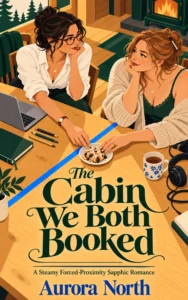
The Cabin We Both Booked
Two reservations. One cabin. Six weeks. Seven rules.

The Second Apartment
She finally has a life that's all hers. The woman across the hall wants to be in it out loud.

Last Call for the Ice Queen
She runs the hotel like a Swiss watch. The new consultant just took it off her wrist.

The Woman Experiment
Three dates. One honest night. No way to keep it theoretical.


Night Shift, Door Locked
Calder Memorial After Dark
She has a rule for everything. Then she met the nurse who breaks them for fun.
Never Miss a Release
Get new release alerts, exclusive bonus content, and reader-only giveaways.