

The Dollar Princess’s Revenge
A Gilded Age Historical Romance
by Evelyn Ashcombe
Shop the ebook · Shop the audiobook
Available at all major retailers
Pairing: MF
Heat: 🌶️🌶️🌶️🌶️🌶️ Inferno
Series: Standalone
Tropes: Revenge Romance, Second Chance, American Heiress, Penniless Earl, Written Terms, Femdom Power Exchange, Orgasm Control, Switch Dynamic, Public Courtship, Grovel, He Falls First, Class Difference, Wealth Gap, Dirty Talk, Betting Book, Wedding
Six years ago he denied her before three hundred people. Now she holds every note on his estate.
London, 1895. Six years ago, in Lady Vane’s ballroom, Charles Tremaine courted Florence Bennett for an entire Season, put his hands on her behind an orange tree in the conservatory, and ten minutes later told three hundred people she had misunderstood his attentions. Then he stood there and let them laugh.
Now the Pittsburgh steel heiress is back: twenty-nine, six million dollars in her own name, and wearing a red Worth gown that makes every dowager in Mayfair start counting. Charles is the seventh Earl of Ravensmere, with turned cuffs, a leaking roof, and eighty-four thousand pounds of his late father’s mortgages falling due on Midsummer Day.
What he doesn’t know: Florence bought every one of those notes in March.
She offers him Terms. Six weeks of conspicuous courtship, by daylight, where all of London can watch. He corrects the old story every time it’s told. And at midnight at Lady Vane’s Midsummer Ball, six years to the night, he asks her on his knee, before everyone. She answers before everyone.
Behind a closed door the terms are simpler. He does as he’s told. He doesn’t touch her until she says. He doesn’t spend until she says.
He signs. He kneels. He obeys. And somewhere between a hired carriage on the Embankment and a state bed in Wiltshire, Florence starts to forget she came to collect.
But Charles has found out who holds his notes.
And he has decided to let her win.
The Dollar Princess’s Revenge is a standalone Gilded Age historical romance with an American heiress, a penniless earl, a revenge plot, six clauses on a sheet of Savoy notepaper, a heroine who holds the pen, a hero who learns to stand up in a room, explicit on-page heat, no cheating, and a guaranteed HEA. Dual POV. Approx. 78,000 words.
You’ll love this book if you enjoy:
✅ An American heiress who buys the earl’s debts before she buys her steamer ticket
✅ Six written clauses, a ballroom, a date, and an answer given at midnight before everyone
✅ “Is the door shut, my lord?” and a hero who does exactly as he’s told
✅ A hired brougham on the Embankment, a watch in her hand, and the words You may
✅ A conservatory, an orange tree, and a man finishing what he started six years ago, on his knees
✅ An earl who sells his house rather than take a shilling of her money
✅ A grovel done in empty drawing rooms, with nobody there to see it
✅ Gilded Age MF historical romance, 🌶️🌶️🌶️🌶️🌶️ heat, no cheating, HEA guaranteed
⚠️ Content Warning: This novel contains explicit sexual content (graphic MF scenes, including oral sex, manual sex, a negotiated femdom power exchange with orgasm denial and control, a safeword (“enough”) honoured on the page, sex in a moving carriage, in a conservatory with people passing, in a boathouse, on a desk, and switching; all on-page sex is consensual), a past public humiliation, a deliberate financial and social revenge scheme, an emotionally cold late father and a controlling aunt, references to past lovers, a painful public refusal, period attitudes toward women, class and money, and strong language. No cheating, no sexual violence, no dub-con. Intended for readers 18+.
📖 Read Chapter One Free
Not sure yet? Read all of Chapter One right here.
Chapter One: Florence
They had put electricity into the chandelier.
It was the first thing Florence noticed from the top of Lady Vane’s staircase, and she was grateful to have something to notice. Six years ago it had burned three hundred wax candles and dripped on the dancers. Now every crystal was lit from the inside, hard and white and modern, and it hung over the ballroom like a verdict.
Nothing else had changed. The same gilt chairs lined the same silk walls. The same palms sulked in the same Chinese pots. The same people turned toward the door with the same expression of polite appetite.
“Mrs. March,” the footman announced. “Miss Bennett.”
The room went quiet.
Not silent. English rooms never did anything so honest as fall silent. The talk only thinned, sentence by sentence, until she could hear individual fans clicking shut. She knew this quiet. She had heard it once before, in this room, in the two seconds after a man with grey eyes said, I fear Miss Bennett has misunderstood my attentions. Then the laughing had started.
Florence laid her gloved hand on the banister and walked down into it.
She had dressed with some care. Unmarried girls wore white in London. She had worn white the last time, twenty-three years old and trussed up in tulle like a christening cake. Tonight she wore Worth’s red, the red of a good Bordeaux, cut so low and fitted so close that the fitter in the rue de la Paix had asked whether mademoiselle intended to breathe. Mademoiselle had said breathing was not the object. Her grandmother’s diamonds lay cold against her throat, forty carats that had started life as Pittsburgh steel.
“They’re staring,” Lydia murmured at her shoulder, sounding pleased about it.
“They’re counting.” Florence smiled at nobody in particular. “Give them a moment. It’s a large sum.”
The whispers reached her in pieces, the way they were meant to. The Bennett girl. Six million. Dollars, my dear, but even so. Wasn’t she the one who—? Yes. That one. And under it, hissed with relish, the name the newspapers had hung on her before her trunks were off the boat. The Dollar Princess.
She found she didn’t mind it. A princess was at least assumed to own things.
The air at the bottom of the stairs was exactly as she remembered: hothouse lilies, hair oil, warm champagne, and the faint animal note of three hundred well-bred people sweating discreetly into silk. At twenty-three it had gone to her head like ether. At twenty-nine it smelled like a market, and she had always been good in markets.
A very young man with a very new moustache stared at her bosom until Lydia asked him, kindly, whether he had lost something down there.
“Miss Bennett!” Lady Vane bore down on them in lilac satin and a great many pearls, both hands out. “How brave. How delightful, I mean to say. We had quite decided America meant to keep you.”
“America tried. I’m difficult to keep.”
“And not married yet! With all your advantages.”
“I’ve been careful with my advantages, Lady Vane. It’s how one comes to have them.”
Her hostess laughed a beat late, not sure whether she had been insulted. “You’ll come to my Midsummer ball, of course. The twenty-second of June. I always give it on the twenty-second.”
“I remember the date.”
Lady Vane’s smile held, but something behind it ducked. It ought to. It had been Lady Vane who asked the question that night, archly, tapping his sleeve with her fan. And when are we to wish you joy, the pair of you?
“I wouldn’t miss it,” Florence said, and meant it more than the woman would ever know.
She had taken four more steps into the room when a voice like a paper knife stopped her.
“And here is our persistent Miss Bennett.”
Lady Honoria Tremaine was sixty-three, upholstered in grey silk, with a face like a closed door that someone had pinned a cameo to. She had pitched the remark to carry, and it did. Heads turned with a rustle.
Florence turned too, smiling. “Persistent, Lady Honoria? I’ve been gone six years. In Pittsburgh we call that taking a hint.”
Someone tittered and smothered it.
“And yet you have come back to us.”
“I heard you had all put in electric light. I wanted to see whether anything else had improved.” Florence let her gaze travel from the cameo to the hem of the grey silk and back up, without hurry. “I’ll keep looking.”
Lydia coughed violently into her glove.
Lady Honoria’s mouth shrank to a seam. She was drawing breath for a reply when her eyes moved past Florence’s shoulder, and the reply died, and Florence knew.
She knew before she turned. She had been knowing it for some minutes, if she was truthful, as a prickle between her shoulder blades: the particular sensation of being looked at by one person in a room full of people looking.
She turned.
He was standing by the far pillar with a glass in his hand and he had gone completely still. Not the stillness of good manners. The stillness of a man who has been struck somewhere soft and is waiting to learn how badly. Across the whole glittering width of the room his eyes were fixed on her, and for one stripped second there was nothing in his face that an earl ought to show in public.
Then he set the glass down on a passing tray without looking at it, and started to walk.
The crowd did what crowds do around a title, which is rearrange. A corridor opened across sixty feet of parquet. The orchestra was between dances, and in the hush he came straight down the middle of the floor toward her.
Charles Tremaine. He had been only the heir, the last time, with a father to be afraid of. The father had been dead fourteen months. Florence knew it to the week. She knew a number of things about the seventh Earl of Ravensmere to the week, and to the shilling.
He was taller than she had allowed herself to remember. Leaner. The brown hair was cut closer and there was a line beside his mouth that hadn’t been there at twenty-eight, the kind a man gets from saying no to himself. His evening clothes were faultless and, to an eye that knew cloth, four years old. The cuffs had been turned.
He did not hurry. He stopped at exactly the correct distance and bowed.
“Miss Bennett.”
His voice had dropped a little with the years. It still did what it had always done, which was arrive somewhere under her ribs before her ears had finished with it.
“Lord Ravensmere.” She gave him two fingers, as one would to a curate. “I’d offer condolences on the title, but I’m told that in England one congratulates.”
“One does both. Usually in a single sentence, to get it over with.”
“How economical.”
“We have had to become so.”
It was said drily, without self-pity, and it was not what she’d expected. She filed it where she filed everything.
“So I had heard. All New York has heard. You would be astonished how far the news of an English mortgage will travel.”
“I shouldn’t be astonished in the least. It has generally arrived everywhere before I have.”
A joke, at his own expense, in front of his aunt. The Charles Tremaine she remembered would sooner have swallowed his studs.
“You look well,” he said. He wasn’t looking at the diamonds. Everybody else in the room was looking at the diamonds. He was looking at her face, and then, for half a second too long, at her mouth.
“I’m extremely well. I recommend being rich in one’s own name. It does wonders for the complexion.”
Something moved at the corner of his mouth and he held it down. Then he said, low, for her alone, “Will you dance with me?”
Quietly. Privately. The way he had asked her everything six years ago: in corners, behind ferns, in the dark of a carriage, where it could all be denied afterwards.
Florence tipped her head. “Forgive me. The room is so loud. What did you say?”
The room was not loud. The room had not drawn a full breath since he started across it.
She watched him understand. It went through the grey eyes like a shadow over water, and a small muscle jumped in his jaw. For a moment she thought he would refuse. The boy she had known would have smiled, murmured something graceful and slid out from under it.
The man lifted his voice until it reached the palms.
“I asked, Miss Bennett, whether you would do me the honour of the waltz. I should be very grateful. I have crossed the room to ask it.”
A fan snapped shut somewhere to her left. Lady Honoria’s cameo trembled.
“Now that,” said Florence, “I heard.”
She laid her hand on his sleeve and let him lead her out under the light.
The orchestra, which had been watching like everyone else, fell hastily into a waltz. He turned to face her. His left hand took her right. His other hand settled at the small of her back.
Kid glove, satin, whalebone, linen. Four layers lay between his palm and her skin, and her skin knew him anyway.
Her body had no pride. It never had. The last time that hand was on her it had been under eleven yards of white tulle in the conservatory forty feet from where they stood, two fingers deep inside her, while she bit the shoulder of his coat to keep quiet and came so hard her knees went. Ten minutes later he had stood beneath this chandelier and told the room she was imagining things.
He swept her into the first turn and her nipples drew tight against the edge of her corset. By the second, the heat had dropped lower, a slow thick pulse between her legs, and she was wet. Wet, at a reception, in front of three hundred people, for a man she despised.
It was almost funny. She kept her face perfectly pleasant and made a note to be furious later.
He was holding her an inch nearer than the dowagers would care for. Not enough to be remarked on. Enough that on every turn the hard length of his thigh pressed the silk between hers, and she was obliged to decide, each time, not to press back.
“You’re holding me as though I might break,” she said.
“I’m holding you as though you might leave.”
“I shall. Directly after this. I only came for the one.”
“The one dance?”
“The one look at the room.” She let her eyes go up to the blazing crystal as he turned her beneath it. “It’s smaller than I remembered. Most things here are.”
“Not everything, I hope.”
She brought her gaze back down, slowly, and let it rest on him. “I’ll reserve judgment.”
That reached him. She felt it in the hand at her back, a flex of the fingers, quickly mastered. He danced the way he had always danced, without flourish and without a single mistake, and he smelled of starch and cold air and something darker under it that her memory supplied before she could stop it. His throat. Just under the jaw. You had your mouth there.
“You look—” he began.
“Expensive. Thank you. It’s deliberate.”
“I was going to say dangerous.”
“That’s deliberate too.”
They turned past Lady Vane, past a row of dowagers with their lorgnettes up like opera glasses, past Lydia, who was eating an ice and enjoying herself enormously.
“Your hand isn’t steady, my lord.”
“No.”
“Is it the dancing? You were always so reliable at it.”
“It is not the dancing.”
He said it without gallantry, as a plain report of fact, and it went through her like a swallow of the brandy she intended to have the moment she got home. She looked at his neckcloth until the feeling passed.
“They’re all watching us,” he said.
“Of course they are. It’s what they’re for.”
“You used to mind.”
“I used to be twenty-three and under the impression that it mattered what they thought of me.” She let him take her through another turn. “Now I’m only interested in what they think of you.”
His eyes came down to hers, sharp, searching. He was not a stupid man. He had never been stupid, only weak, which was worse, because a stupid man could not have known what he was doing to her.
“Why have you come back?” he asked.
“For the Season. I’m told it’s the thing to do with a fortune.”
“You loathed the Season.”
“I loathed being new at it.” She smiled. “I’m not new at anything now.”
She watched that one land, and watched him work out precisely what she meant by it, and watched the colour come up along his cheekbones. Six years ago he had been the first man to put a hand on her. She wanted him to understand, in the plainest terms a ballroom allowed, that he had not been the last, and that the others had finished what they started.
“No,” he said quietly. “I don’t suppose you are.”
There was no judgment in it. There was something a good deal more inconvenient, which was heat.
“Florence.” It came out rough, as though he had been carrying it a long way.
“Miss Bennett,” she corrected pleasantly.
His jaw worked. “Miss Bennett. What I said to you in this room—”
“Not here.”
“I have waited six years to say this to you.”
“Then you’ve had a great deal of practice at waiting. Not here, Lord Ravensmere. You’ve said quite enough in this room.”
He took it the way a man takes a blow he has been braced for: a breath, no flinch. He did not lose the time. She would give him that. “Where, then?”
“The Savoy. Friday. Eleven o’clock.”
A pause, one bar long. “At night?”
“In the morning.” She smiled up at him as though he had said something charming, for the benefit of the lorgnettes, and dropped her voice until it was only breath. “I’m granting you an appointment, my lord. I’m not inviting you into my bed.”
His step never faltered. But under her left hand the muscle of his shoulder turned to stone, and for one unguarded instant the grey of his eyes was swallowed nearly whole by black.
Good, she thought, with her pulse going like a hammer in three separate places. Good. You too.
“I’ll be there,” he said.
“Yes. I know you will.”
The waltz ended. He did not let go at once. For the length of a breath after the last note his hand stayed where it was, warm and heavy at the base of her spine, and she allowed it, and all of London watched her allow it.
Then she stepped back. She gave him the curtsy owed to an earl, not a quarter inch more, and said, “Good night, Lord Ravensmere,” in a voice that carried quite as well as his had.
She walked off the floor without looking back. She had no need to look. She could feel him standing there alone in the middle of the parquet under all that pitiless light, with every eye in Mayfair on him and nothing to do with his hands.
She knew exactly how that felt.
Lydia fell in beside her at the foot of the stairs. “You’ve left him standing,” she said out of the corner of her mouth.
“I’ve left him the floor. He’s an earl. He will think of something to do with it.”
Behind them the noise came back all at once, a hundred conversations starting on the same breath, like a flock going up off a field. Florence climbed toward the door with her spine straight and her skirts in one hand, and every step of the way she could feel the wet silk of her drawers.
The Savoy had a lift, a bathroom to every suite and electric light at the turn of a switch, and Florence loved it the way she loved anything that did what it was built to do.
Her sitting room hung over the river. Beyond the glass the Embankment lamps ran away in a long curve toward Westminster and the Thames slid by underneath, black and oily and getting on with its business. She had sent the maid to bed. Lydia had kicked off her slippers, found the brandy and poured two glasses of a size no English hostess would have countenanced.
Lydia March was thirty-three, the widow of a Philadelphia man who had left her comfortable and, by her own account, a great deal better rested. She was officially Florence’s chaperone. It was the most successful joke either of them had ever told.
“Well,” she said, folding herself into the corner of the sofa. “That was better than the opera and considerably shorter.”
“Eleven minutes.” Florence stripped off her gloves finger by finger. “I timed it by the clock over the door.”
“Naturally you did. He looked at you the way my late husband used to look at a hand of cards he couldn’t afford to play.”
“He can’t afford it. That’s rather the point.”
“And you, my girl, went pink to the diamonds.”
“I do not blush.”
“No, you flush. It starts about here,” Lydia tapped her own breastbone, “and I would lay money on where it finishes.”
Florence took the brandy and drank a third of it standing. “My body has appalling judgment. It always did. That’s why I never let it sign anything.”
“Were you wet?”
“Lydia.”
“I’m a widow, not a nun. Were you?”
There was no point lying to a woman who had known her since she was nineteen. “By the second turn.”
Lydia’s laugh rang off the ceiling.
“It signifies nothing,” Florence said. “One can want a thing and know to the penny what it’s worth. I want oysters. I don’t marry them.”
“Nobody ever fingered you in a conservatory with an oyster.”
“That you know of.”
She set down her glass. A cable had come while they were out. It lay on the writing table in its buff envelope, squared to the blotter by some careful hotel hand, and she had been aware of it since she walked in, the way one is aware of a loaded gun in a drawer. She slit it with the paper knife.
ALLEGHENY TRUST NEW YORK TO BENNETT SAVOY LONDON. PURCHASE COMPLETED. ALL RAVENSMERE NOTES NOW HELD YOUR ACCOUNT. FACE VALUE EIGHTY FOUR THOUSAND STERLING. FALL DUE MIDSUMMER DAY. AWAIT YOUR INSTRUCTIONS.
She read it twice, once for the sense and once for the pleasure. Then she walked it across the room and held it out.
Lydia read it. She stopped looking amused about halfway down.
“Florence. What have you bought?”
“A private bank in Lombard Street got itself into difficulties over the winter and had to sell its paper cheap. Among that paper was every mortgage note the late Lord Ravensmere ever put his name to. My people in New York took the lot in March.”
“In March. Before we sailed.”
“Three weeks before I booked the cabins.”
Lydia lowered the cable to her lap. “Does he know?”
“He knows an American trust holds his debts. He doesn’t know the trust has a face.” Florence turned to the window. Her reflection floated on the dark, a red dress and a rope of cold fire. “He certainly doesn’t know he waltzed with it tonight.”
“Eighty-four thousand pounds.”
“I paid a good deal less. The bank was in a hurry.”
“And it all comes due—”
“Midsummer Day. The twenty-fourth of June. A Monday.”
For a moment there was only the faint hum of the electric lamps and a tug hooting somewhere down by Waterloo Bridge.
“What do you mean to do with him until then?”
“Let him court me.” It came out flat and clear. She had been saying it in her head since the Hudson. “Loudly. By daylight. In every drawing room where they laughed. I want his flowers arriving where the hall porter can count them, his horse at my carriage wheel in the Park, and his name beside mine in every newspaper they read over their kidneys. He kept me in corners for an entire Season, Lyd. This time he may do his wanting where it can be seen.”
“He’ll do it. The man hasn’t a choice. He needs an heiress and you’re the largest one in the shop.”
“Yes.”
“And when he’s done all this courting? What then?”
Florence did not answer.
On the mantel, propped against the clock, stood a square of pasteboard that had not been there this morning. Lady Vane wasted no time. Viscountess Vane, At Home, Saturday the twenty-second of June. Dancing. Six weeks from this coming Saturday. Six years to the night.
He would ask her there. She would see to it that he asked, on his knee, before everyone, under that chandelier. And she would look into those grey eyes and hand him back his own sentence, word for word, in the same sweet reasonable tone, and listen to the room go quiet for him.
Two days after that the notes fell due. She would call every one.
It was not a complicated plan. The good ones never were. One bought low, one waited, and one collected.
“You have the look,” Lydia observed, “that you get before you buy a railroad.”
“It’s a far smaller acquisition.”
“Is it?” Lydia finished her brandy and stood, gathering her slippers in one hand. At the bedroom door she stopped. “I’ll say one thing and then I’ll hold my tongue until you’re sorry. Eleven minutes, four layers of clothing, and you were soaked through. Six weeks is a long while to stand that close to a fire and call it bookkeeping.”
“I have held worse paper.”
“Mm. Good night, Princess.”
The door closed. Florence stood on at the window with the cable in her fingers.
The small of her back was still warm. That was the indignity of it. A quarter of an hour in a carriage, a lift, two rooms and a glass of brandy later, the exact print of his hand still sat at the base of her spine as though he’d left it there on purpose, and lower down she ached, sullenly, like a tooth.
She pressed her thighs together and looked at her own face in the glass until it looked like a woman who kept accounts.
Let them say she had come back for a coronet. Let Lady Honoria count the diamonds and Lady Vane count the invitations and the whole of Mayfair lay bets on how soon the American would have him. They would all know the truth by Midsummer.
She had not come back to marry the Earl of Ravensmere.
She had come back owning him.
Want to keep reading? The full novel is available now.
🔥 Want an EXCLUSIVE Bonus Chapter?
Nothing to Declare — A scene TOO HOT for the bookstore
August 1895. The Rome Express to Venice, a sleeping compartment her father bought both neighbours of, and one request from Charles: he wants to make Florence lose count. She counts through Burgundy. She counts through a customs officer at the frontier. Then the train goes into the Mont Cenis tunnel for twenty-five minutes of total dark.
More from Evelyn Ashcombe
Browse all Evelyn Ashcombe books.

The Dollar Princess’s Revenge
Six years ago he denied her before three hundred people. Now she holds every note on his estate.
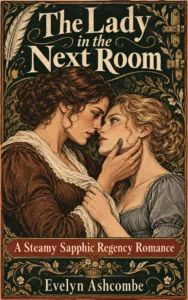
The Lady in the Next Room
A widow with a locked drawer. A runaway with a borrowed name. And a door with two bolts between them.

Her Ladyship’s American Wife
A countess with a leaking house. An American heiress who pays for everything. And the one thing that cannot be bought.
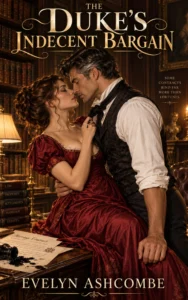
The Duke’s Indecent Bargain
He named his price on a terrace. She answered with six articles and a lawyer.
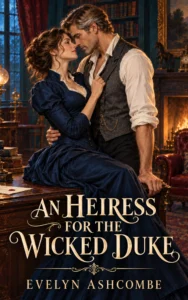
An Heiress for the Wicked Duke
She doesn't sign for goods unseen. He hasn't let anyone see him in seven years.
Never Miss a Release
Get new release alerts, exclusive bonus content, and reader-only giveaways.