
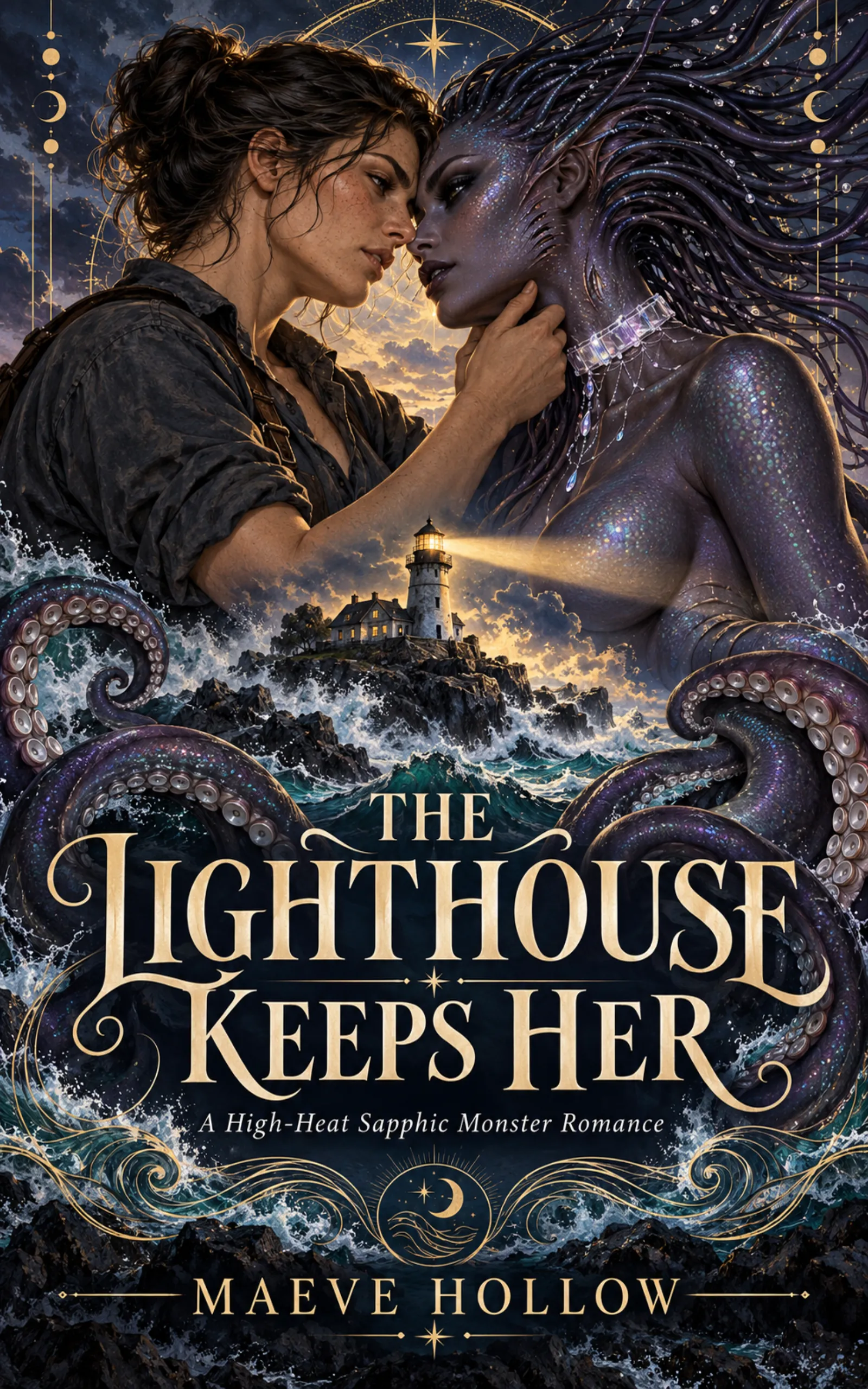
The Lighthouse Keeps Her
A High-Heat Sapphic Monster Romance
by Maeve Hollow
Shop the ebook · Shop the audiobook
Available at all major retailers
Pairing: FF (Sapphic)
Heat: 🌶️🌶️🌶️🌶️🌶️ Inferno
Tropes: Human × Sea-Creature Heroine, Monster Romance, Tentacles, Hurt/Comfort, Forced Proximity, Strangers to Lovers, Touch Starved, Size Difference, Light Bondage & Edging, Stop Words That Are Honored, Competence Kink, Lighthouse Romance, Corporate Villain, Rescue Mission, Found Family, Grovel, Standalone
She found an eight-armed woman bleeding in the channel below her lighthouse. She opened the gate and walked to the far wall.
Mara Venn is a state lighthouse engineer with a clamp meter, a bad attitude and a three-month contract to automate Bellwether Light and get out before the town learns her middle name.
Then she kills the main breaker at midnight to trace a mystery load, and the basement starts to sing.
In the tidal channel below the tower she finds Ilyr — a two-hundred-and-thirty-year-old Routewarden of the deep, bleeding blue from a torn net, eight arms spread across the rocks, a cracked crystal collar at her throat and the channel draining around her. Mara opens the old iron sea-gate, props it with a breaker bar, and walks to the far wall to let her choose.
She chooses. And it turns out she speaks English. Fluently. She has been listening to everything Mara said all night, including the part about her mouth.
Ilyr escaped a steel box two miles offshore where Lumen Reach Coastal Systems is farming her people for their light, using a corrupted distress call to lure rescuers into its nets. Eleven are still inside. One of them is her apprentice. And the call is ramping toward the night every family on the coast swims south.
Mara has engineering, a chain-smoking harbor electrician and a Coast Guard captain who knew her father. Ilyr has a breath-pearl, a council that wants every road to land closed forever, and a secret folded inside her regulator that she has not told anyone.
Mara has one rule she learned the hard way: never let anybody go back in one more time. Ilyr has only ever asked for one thing: the door goes both ways.
The Lighthouse Keeps Her is a high-heat FF sapphic monster romance with a fully nonhuman, eight-armed sea-creature heroine who never becomes human, explicit and inventive human × cephalopod spice (suckers, ink, a long tongue and a whole lot of arms), stop words honored every time, a grovel on both sides, a daring rescue under a platform at sea, and a guaranteed HEA. Standalone.
You’ll love this book if you enjoy:
✅ A fully nonhuman heroine — eight arms, gills, light-speech, no human form ever
✅ A grumpy lighthouse engineer who makes forty-item lists and has never once let anyone take over
✅ Every sucker is a tongue, and she tells you what you taste like
✅ “Surface” and two taps — consent asked for, answered, and honored
✅ A sea-gate that only opens from the inside, and a keeper who builds it that way on purpose
✅ Popcorn “dead clouds,” Patsy Cline versus Pearl Jam, and a deeply unimpressed harbor seal
✅ A ninety-year-old keeper’s logbook and a love story under the light that came first
✅ Ink. Yes, that kind. Don’t say squid.
✅ 🌶️🌶️🌶️🌶️🌶️ heat, HEA guaranteed
⚠️ Content Warning: This novel contains explicit sexual content between a human woman and a fully nonhuman, eight-armed sea creature (graphic FF scenes including oral sex, penetration with tentacle-arms, multiple arms at once, consensual restraint and edging with stop words, inking, and nonhuman anatomy), captivity and exploitation of sentient beings by a corporation, physical injury and blood, a panic attack in an enclosed space, a parent’s death at sea (past, discussed), a violent confrontation and use of a shock weapon, a home break-in, a betrayal of trust between the leads, and strong language. Intended for readers 18+.
📖 Read Chapter One Free
Not sure yet? Read all of Chapter One right here.
Chapter One: Mara
The ferry captain promised Mara Venn three times that the fog would burn off by noon, and three times the fog made a liar of him.
She stood at the rail anyway, coffee going cold in her fist, and watched the coast of Maine assemble itself out of gray one piece at a time. A granite shoulder. A row of lobster boats nodding on their moorings. A church steeple floating with no church under it yet. Then the light — white tower, red iron gallery, planted on a tidal headland like a woman who’d been told to wait and had outlasted everybody who told her.
Bellwether Light. Ninety-one feet. Built 1891. Third-order Fresnel lens, automated in ’87, and maintained ever since by whoever the state could guilt into it. The spec sheet in Mara’s bag listed fourteen deferred repairs and said nothing at all about what the tower looked like stepping out of the fog, which was exactly the right amount for a spec sheet to say.
“She’s a pretty one,” the captain said, coming to stand beside her.
“She’s a load-bearing cylinder,” Mara said. “With a lamp on top.”
He gave her the look she’d been getting from men in rubber boots her whole working life — the one that said a girl, and a mean one — and went back to his wheelhouse. Mara finished her coffee. It tasted like the bottom of a thermos, which was what it was.
Three months. Assess the tower, write the automation plan, sign it over to the state, and get gone before the town learned her middle name. She’d done it at Pemaquid and Owl’s Head and that miserable rock off Cutler where the keeper’s house had a dead seal in the cistern. She could do it here.
The ferry bumped the pilings. Gulls screamed about it.
A woman was waiting at the head of the dock with a cigarette in one hand and a ring of keys in the other big enough to belong to a jailer. Sixty, maybe a little past it. Canvas jacket gone soft at the elbows, gray hair chopped short like she’d done it herself with tin snips, a face that had been out in the weather so long it had stopped arguing with it.
“You’re the engineer,” the woman said.
“Mara Venn.”
“I know who you are, honey. You’ve got Danny’s jaw.” She tossed the keys. Mara caught them on reflex. “Dot Kearney. Harbor electrician, harbormaster when Lyle’s drunk, which is Tuesdays. Truck’s this way.”
Mara did not ask how Dot knew her father. She’d been on the dock for nine seconds.
The truck was a Ford that predated several of Mara’s own fillings, and it smelled like menthols and wire insulation. Dot drove the way she apparently did everything else, with one hand and total confidence, out along the harbor road past a diner with a hand-lettered PIE sign, a lobster co-op with its doors rolled up and a radio inside playing classic rock, and a row of shingled houses whose windows all seemed to have someone standing behind them.
“Lantern House is stocked,” Dot said. “Milk, eggs, coffee, bread, a bottle of something that’ll strip paint. Co-op’ll sell you lobster off the boat if you tell them I sent you. Diner closes at two. Don’t eat the chowder on Mondays.”
“Why not Mondays?”
“Because it’s the weekend’s chowder.” Dot flicked ash out the window. “Lumen Reach was out here in the spring.”
Mara looked over.
“Coastal Systems. The modernization outfit. They had a crew in your lower level for two weeks in April. Installed what they called monitoring gear. Harbor Authority signed off on it.”
“Monitoring what?”
“Didn’t say. Didn’t ask me to wire it, which is how I knew it was stupid.” Dot’s mouth went flat. “I’ve done every circuit on that headland for thirty years. Then a company from Portland shows up with its own electricians and its own conduit and a guy in a vest who calls me ma’am like it’s a diagnosis.”
“It’s not in my contract docs.”
“Wouldn’t be.” Dot let that sit. Then, too casually: “The old-timers say she sings some nights.”
“The light.”
“Since about August. Fella named Orrin swears you can feel it in your teeth out past the ledges. Says it hums.”
“Does Orrin drink?”
“Everybody drinks, honey. It’s Maine.” The truck lurched onto the gravel spit that ran out to the headland. The tide was halfway out, the causeway shining wet on both sides. “Your dad pulled my brother off the Saddleback ledge in ninety-six. Middle of February. Went in on a line with forty knots blowing.”
Mara looked straight out the windshield. The tower grew in it, white and enormous.
“I’m here for three months,” she said. “Assessment, automation plan, out.”
Dot was quiet for a beat. “Sure.”
“I mean it.”
“I heard you.” Dot parked in front of a low gray cottage with a red door and a porch that leaned like it was trying to hear something. “Nobody leaves in three months, Mara. That’s not a threat. It’s just tides.”
Lantern House smelled like mildew and Pine-Sol and the ghost of a century of woodsmoke. There was a woodstove, a kitchen table with one short leg, a bed with a quilt someone’s grandmother had made out of someone else’s grandfather’s shirts, and on the wall a framed postcard of Bellwether Light from 1952 that looked exactly like Bellwether Light now, minus the rust.
Mara unpacked the way she always did. Power meter. Clamp-on ammeter. Laptop and drive. Headlamp, flashlight, spare batteries in a Ziploc. Multitool. Torque wrench. Then, eventually, toothbrush.
Jen used to stand in the doorway of every rental and watch her do it. Tools first, she’d say, not unkindly the first year, less kindly the fifth. Then the toothbrush. Then, if there’s room, me.
Mara put the bourbon in the cabinet over the sink and shut the door on it and on that.
At four she walked the headland in the thinning fog, counting spalled granite and rusted gallery bolts and writing them down. At six she ate scrambled eggs standing up. At eight she found Dot’s paint-stripper in the cabinet was a decent rye and had one finger of it, which was the number of fingers she allowed herself on a site.
At nine she went up the tower.
One hundred and fourteen iron steps spiraled up the inside of the brick like the inside of a seashell. Her boots rang on every one. At the top, the lens room — the great glass beehive of the Fresnel, prisms stacked in brass rings, the lamp turning slow at its heart. Every twelve seconds the beam swept the water. Every twelve seconds the whole room filled with white and emptied again.
Mara loved it. She’d have died before saying so.
She clipped her headlamp on and went back down to the panel room at the base of the tower, a cramped space walled with mismatched equipment from five decades of budgets. Main service. The lamp circuit. Fog signal. The rotation motor. Controller, heater, dehumidifier, the radio beacon. She added them up on a legal pad, the way her father had taught her to add tide tables — longhand, because a calculator could lie to you and your own handwriting couldn’t.
Then she clamped the meter on the main feed and read it.
She read it again.
“No,” Mara said to the empty room.
The meter didn’t care. It sat there, glowing, two point three kilowatts heavier than every load on her list combined.
Two point three. Steady. Not a motor kicking on and off, not a heater cycling. Something drawing hard and constant, around the clock, off the same service that fed the light.
She checked the schematic. Nothing. She checked the 1994 as-built, the 2009 upgrade, the stack of Coast Guard maintenance cards rubber-banded together in a coffee can. Nothing.
Then she put her headlamp on the panel and saw it — a new armored cable, gray, clean, coming off the main through a hole somebody had drilled sometime this year. The hole wasn’t sealed. The cable wasn’t labeled. It ran down the wall in a line of shiny new straps and disappeared through the floor grating into the dark of the lower level.
“Monitoring gear,” Mara said. “Monitoring gear, my ass.”
She stood there with her hands on her hips and her pulse doing something she didn’t love.
Two point three kilowatts was a lot for a sensor package. Two point three kilowatts was a space heater and a hair dryer running all night, every night, forever. Two point three kilowatts was the kind of number that meant somebody had put something in her lighthouse that wanted feeding.
The sane move was to email the state, flag it, wait for Lumen Reach to send an explanation on letterhead, and get on with her fourteen deferred repairs.
Mara had never in her life made the sane move when a load didn’t balance.
She checked her watch. 11:41. She’d filed a ten-minute outage window with the Coast Guard that afternoon for exactly this kind of thing — scheduled maintenance, Bellwether Light, 2350 to 0000 — because she was not an animal. The sea out there was empty, the forecast flat. She could kill main power, watch what died, and find out what the gray cable was feeding.
At 11:50 she put on gloves, put her hand on the main breaker, and said, “Okay. Let’s see who you are.”
She threw it.
The tower went black.
Not dark — black. The rotation motor groaned down to silence. The fridge-hum of the controller stopped. Somewhere above her, the lamp went out, and for the first time in a hundred and thirty-five years Bellwether Head was a rock in the night with nothing on it.
The quiet was enormous. Mara heard the sea breathing against the headland. She heard her own heartbeat. She heard —
A hum.
Low. So low it wasn’t in her ears so much as in her back teeth, her sternum, the steel fillings from a dentist in Bangor who’d been dead ten years. It pulsed. Slow and even. Like something breathing.
And light came up through the floor.
Violet. Not the cheap purple of an LED strip — deep, rich, wet, the color of a bruise in the moment before it turns. It came up through the iron grating in slats, beat by beat, throwing bars across her boots and up the brick walls. Pulse. Fade. Pulse.
“Battery bank,” Mara said, mostly to hear her own voice. “Somebody put a battery bank on it. That’s all. That’s all that is.”
Her voice sounded like someone who didn’t believe her.
She took the flashlight off her belt and went down the stone stairs to the lower level.
The stairs were wet and cut into bedrock, worn into shallow bowls in the middle by a century of keepers’ boots. Thirty-one of them. Then the chamber.
She’d seen it on the drawings: the old seawater intake that once fed the boilers for the steam fog whistle, decommissioned in 1938, left to flood. On paper it was a rectangle. In person it was a cathedral someone had sunk. A long stone room, ceiling vaulted and dripping, a ledge running along three walls around a pool of black seawater maybe forty feet long. On the seaward end, a massive iron sea-gate — a grille of crossbars as thick as her wrist, hinged at the top, rusted red, holding back the open water outside. Through its bars she could see the night and the rocks and the white seethe of the tide going out.
The violet light was coming from the wall to her left.
There was a brass housing set into the stone there, the size of a dinner plate, green with age, its rim stamped with a spiral — a single line curling inward on itself, old, careful, hand-cut. Behind a window in its center sat something that wasn’t glass. It looked like quartz that had grown instead of been mined, milky and veined, and light moved inside it like it had a circulation.
Bolted directly over the old brass, ugly as a tumor, was a gray steel box. Lumen Reach’s logo on a sticker. An armored cable running into it. A battery bank on a shelf below with its charge lights green. The box had clamped itself onto the old brass the way a lamprey clamps onto a fish and was pushing power into whatever lived in the crystal.
The crystal sang. That was the word. Mara had no better one and she hated it. The hum came out of it and went into the water and through the stone and into her body, and every pulse of violet went out through the sea-gate and across the rocks and away, out to sea, like a voice calling someone’s name.
“Okay,” Mara breathed. “Okay, that’s — what are you.”
She reached out a gloved hand. Stopped an inch short of it.
Something outside answered.
Light. Out past the sea-gate, down on the rocks. Blue-violet, faint, flickering — an answering pulse, but wrong. Ragged. Stuttering. Like a signal from equipment that was failing. It flared once, weak, and went almost dark, and flared again.
Mara stood there with her flashlight pointed at nothing.
Then she looked at her watch. 11:57.
“God damn it,” she said, and ran up thirty-one stairs, and threw the main breaker back on, because there were rules, and one of them was that you did not leave a lighthouse dark past the window you’d filed no matter what was singing in your basement. Above her the motor groaned awake. The lamp caught. The beam swept out across the water, white and ordinary, and the world went back to being a place that made sense.
The violet pulse under the grating didn’t stop.
Of course it didn’t. It was on its own battery.
Mara stood in the doorway of the tower with the wind pulling her hair loose from its clip. Down on the rocks, past the corner of the headland where the sea-gate opened onto the tidal channel, the other light flickered again. Weaker.
She grabbed the big flashlight and went outside.
The keeper’s path down the seaward side of the headland was a set of iron rungs set into the rock and a rope rail someone had replaced with braided nylon in the last decade, God bless them. Mara went down it with the flashlight in her teeth. The rocks at the bottom were black and slick and furred with weed, cut through with channels the tide left behind. The channel nearest the chamber ran straight up to the sea-gate, deep enough at high water for a skiff.
It was emptying. She could hear it, the sucking gurgle of water leaving.
She took the flashlight out of her mouth and swept it across the rocks.
Weed. Barnacles. A lobster buoy somebody had lost. Blood.
She stopped.
It was on the rock in long smears, and it was blue. Not a bruised blue, not dark. Blue like antifreeze, like the inside of a mussel shell, catching the beam and shining. A wide trail of it, dragged, going down into the channel.
Mara followed the light down.
There was a woman in the channel.
That was the first thing her brain gave her, because it was the only frame it had. A woman — slumped against a shelf of rock with her shoulders hunched and her back to the cliff, the low water pooled around her waist. Bare shoulders. Long arms braced on the rock on either side of her, fingers spread. A curtain of something dark and fine falling down her back like hair, but not hair — filaments, hundreds of them, thin as fishing line and tipped with points of failing light.
Then the woman lifted her head and Mara’s brain gave up on frames entirely.
Her eyes were huge. Twice the size of human eyes and black as the water, black all the way across, with a thin ring of silver around each like a coin’s edge. No ears. Smooth curve of skull where the ears would be, the filaments sweeping back from it. Along both sides of her throat, a row of fine slits opened and closed, opened and closed, fluttering — gasping. Her skin was dark violet-charcoal, flecked with pearl, and it was shifting as Mara watched. Ripples of color moving under the surface, gray to bruise-purple to an ugly mottled green.
Below the waterline, where a woman’s hips should have become legs, they didn’t.
They became arms.
Eight of them. Long and thick at the root, tapering, spilling out across the bottom of the channel and up onto the rocks, curled and sprawled, each one lined underneath with rows of suckers rimmed in silver. One of them was moving slowly across the weed like it was feeling for something. Two lay limp. And along the place where her hips flowed into them — the thick muscle of her, the base — a gash ran the length of Mara’s forearm, torn wide, and that was where the blue was coming from.
There was a band around her throat. Something like a collar, the same milky, veined crystal as the thing in the brass housing, set close against the gill slits. It was cracked straight through. Light leaked out of the crack in weak, uneven spurts.
That was the light. That was what had answered.
Mara stood on the rock with her flashlight shaking very slightly and her mouth open.
The woman stared back. Her chest was rising and falling fast — and Mara’s eyes, God help her, went where any eyes would have gone, to small, high breasts with nipples dark as plums, bare and wet and heaving with every desperate breath — and Mara jerked her gaze back up to that face so fast she nearly gave herself whiplash.
Christ, Venn. She’s bleeding to death.
The thing about the face was that it was not human and it was beautiful, and both of those were true at the same time, and Mara didn’t know where to put them. The mouth was full and dark and pulled back in a grimace that showed blunt white teeth. The cheekbones were high and sharp under that shifting skin. It was a face like a storm through a window — alien, and furious, and impossible to look away from.
The woman’s lips parted.
Then the whole world went white.
It was like staring into a welding arc. Light exploded out of the creature’s body, out of every inch of that dark skin at once, a flash so total that it didn’t seem to come from anywhere — it just was, everywhere, inside Mara’s skull. She yelled. Her boot went out from under her on the weed and she landed hard on her ass on the wet rock with the flashlight skittering away somewhere and her eyes full of nothing but white, white, white.
She lay there. Blinking. Cold water soaking through the seat of her Carhartts.
Slowly the white broke up into purple blotches. The blotches broke up into dark. The dark had a shape in it, low and hunched in the channel, maybe ten feet away.
It hadn’t come closer. It hadn’t gone anywhere either. Mara could hear it breathing — a wet, rasping catch, a sound with no lungs in it, a sound like a fish on a deck.
Every instinct she had said get up, get up, back up the rungs, call someone.
She thought of the gray box clamped on the brass. Of Lumen Reach and a guy in a vest who called Dot ma’am like it was a diagnosis. Of who exactly she’d be calling.
She didn’t get up.
She sat. Pulled her knees up. Put her hands open on her knees where they could be seen, palms out, the way her father had taught her to approach a panicked swimmer: Slow. Low. Let ’em see your hands. Don’t ever grab first.
“Okay,” Mara said. Her voice came out rough. She cleared her throat and tried again, low and even. “Okay. Okay. I’m not going to touch you.”
The breathing in the dark hitched.
“You don’t understand a word of this. That’s fine. I’m going to talk anyway. I talk. It’s a whole problem.” Her vision was coming back in patches. The flashlight had landed in a crack in the rock, pointing sideways, throwing a long fan of light across the channel. In its edge she could see the shape again: the slumped shoulders, the big black eyes fixed on her, the arms coiled in close now, tight, protective. The light under the skin had gone dim and tight-knit, a gray-violet crawl. “That was — wow. That was a hell of a flash. Respect. I’m going to see spots until Thanksgiving.”
Nothing.
“I’m going to stay right here. Right on my butt. Not moving.”
The channel gurgled. Mara looked at it, really looked, and her stomach dropped. The water was down to the creature’s ribs now. A minute ago it had been at her waist. The arms spread across the bottom were half out of it, the suckers on the exposed ones puckering in the air, and the skin over them looked dull. Matte. Drying.
She did the math the way she did all math, fast and ugly.
Low tide was at 1:20. That was ninety minutes. At this rate the channel would be a puddle in forty. The creature had gills. Gills needed water. The gash was bleeding into a pool that was getting smaller every minute, and the crystal at her throat was flickering like a bulb on a bad ballast, and she was hurt too badly to drag herself forty yards across the rocks to open water. Mara had seen how much blood was on the rocks. She’d already tried.
“You’re stranded,” Mara said quietly. “Aren’t you. You came in on the high and you couldn’t make it back out.”
The black eyes didn’t blink. Maybe they couldn’t.
Behind the creature, thirty feet up the channel, was the sea-gate.
Mara stared at it. The iron grille set in the headland like a portcullis. Behind it, the chamber. A forty-foot pool of seawater that never drained, because it was cut below the low-tide line — that was the entire point of an intake. Six feet deep at dead low. Dark. Out of the wind. Out of sight of the harbor and every window in it.
“There’s a door,” Mara said. “Right there behind you. There’s water on the other side of it that doesn’t go anywhere. You could—” She stopped. Shook her head at herself. “You can’t understand this.”
But the creature’s head turned. Just slightly. Just enough that one black eye slid toward the sea-gate and back to Mara.
Mara’s skin went tight all over.
“Okay,” she said. “Okay. I’m going to go open it. That means I’m going to stand up, and I’m going to back up those rungs, and you’re going to let me do that without blinding me again, because I’ll fall off a ladder and die and then you’ll be stuck out here with a dead lady. Deal?”
Silence. The rasp of that breathing.
Mara stood up slowly, one hand on the rock, the other out and open. She left the flashlight where it was so the creature would have light. She backed to the rungs without turning around. She climbed by feel, her heart going like a jackhammer the whole way, every second expecting the white to slam into her again.
It didn’t.
At the top she ran.
The sea-gate winch was in a niche at the seaward end of the chamber, a big iron wheel geared down to a chain, and nobody had turned it since Eisenhower.
Mara put her whole weight on it. It didn’t move. She swore at it. She got the breaker bar off the tool wall in the panel room and came back down and jammed it through the spokes and hung off it like a kid on a jungle gym, swearing in a steady, creative stream that would have made Dot proud.
The wheel shrieked. Gave a quarter-turn. The chain jumped and bit.
“Come on. Come on, you rusted son of a bitch, come on—“
Another quarter-turn. Another. Down at the waterline the sea-gate groaned awake and began to lift, the bottom crossbar dragging up out of the black water and streaming, the whole iron grille swinging outward and up on its top hinges like an eyelid opening. Cold air rushed in. The sound of the sea doubled.
She cranked until her shoulders burned and the gate stood open at its full height, a gaping mouth of night. Then she took the breaker bar out and jammed it through the chain links against the wall so the gate couldn’t drop — so nothing could drop it, not the gearing, not gravity, not her. She checked it twice. She leaned on it. It held.
Then Mara walked away from it.
She walked the length of the ledge, all forty feet of it, to the landward end of the chamber where the stairs came down. She put her back against the cold wet stone of the far wall, as far from the open gate and the water as the room would let her get, and she stayed there.
The violet pulse from the brass housing kept beating against the ceiling. The battery lantern she’d brought down sat on the ledge beside her throwing a warm yellow circle. Past the open gate, the channel. Past the channel, the dark.
Mara waited.
Her heart slowed by degrees. Her ass was soaking wet and her eyes still had a lavender blot in the middle of everything, and she was a thirty-seven-year-old professional engineer with a state contract and a pension plan, standing against a wall in a flooded basement at midnight waiting for something out of a fever dream to decide whether to trust her.
“This is fine,” she whispered. “This is a normal Tuesday.”
It was Thursday.
The sea breathed. The crystal sang. Nothing came.
Maybe it was dead. Maybe it had dragged itself back to the open water after all, or bled out in the dark while she wrestled with a winch. Maybe she’d made the whole thing up — a gas leak, a stroke, one finger of Dot’s rye on an empty stomach. Mara found she’d balled her fists and made herself open them again.
Then, out in the channel, the water moved.
A sound came with it. Wet. Heavy. A thick slap of muscle against rock, and then a long drag. And another slap. And another drag.
Mara stopped breathing.
At the mouth of the open sea-gate, something reached up out of the dark and curled over the bottom crossbar. Long. Dark. Silver-rimmed suckers gripping the iron. It flexed and pulled, and another arm came up beside it, and another, and the creature hauled herself into the gap — slumped, shaking, the cracked collar at her throat spitting weak light, the gash along her hip streaming blue down the stone.
She paused there in the open gate with the sea at her back. Her huge black eyes found Mara across the length of the chamber.
Then, arm over arm, slow and terrible and deliberate, she dragged herself forward — toward the black water of the pool. Toward the light of the lantern.
Toward Mara.
Want to keep reading? The full novel is available now.
🔥 Want an EXCLUSIVE Bonus Chapter?
Both Ways, All Night — A scene TOO HOT for the bookstore
A year after the gate. A nor’easter is screaming through the channel, and for the first time in her life Mara doesn’t check the light. She walks naked to the open sea-gate and asks Ilyr to take her out into the storm — and then into the one room in the lighthouse that has no door.
More from Maeve Hollow
Browse all Maeve Hollow books.

The Vampire’s Daylight Alibi
Rook & Venn Investigations
She has seven nights to prove a vampire didn't kill in the sun. The only evidence is the blood she has to taste.
The Lighthouse Keeps Her
She found an eight-armed woman bleeding in the channel below her lighthouse. She opened the gate and walked to the far wall.

The Shadow in Her Spare Room
She moved into a dead woman's sewing room to hide. The only thing she asked was not to be seen.

Signed, Sealed, Scorched
A dragon kept the one letter that could have sent her away. She kept it out of love. That was the problem.

The Seventh Daughter’s Bodyguard
She was hired to keep the witch alive. Nobody said she’d have to share her with six dead women.

A Curse Made for Two
Her touch has burned everyone for a hundred years. The appraiser who grabbed her hand didn't even blister.
Never Miss a Release
Get new release alerts, exclusive bonus content, and reader-only giveaways.