
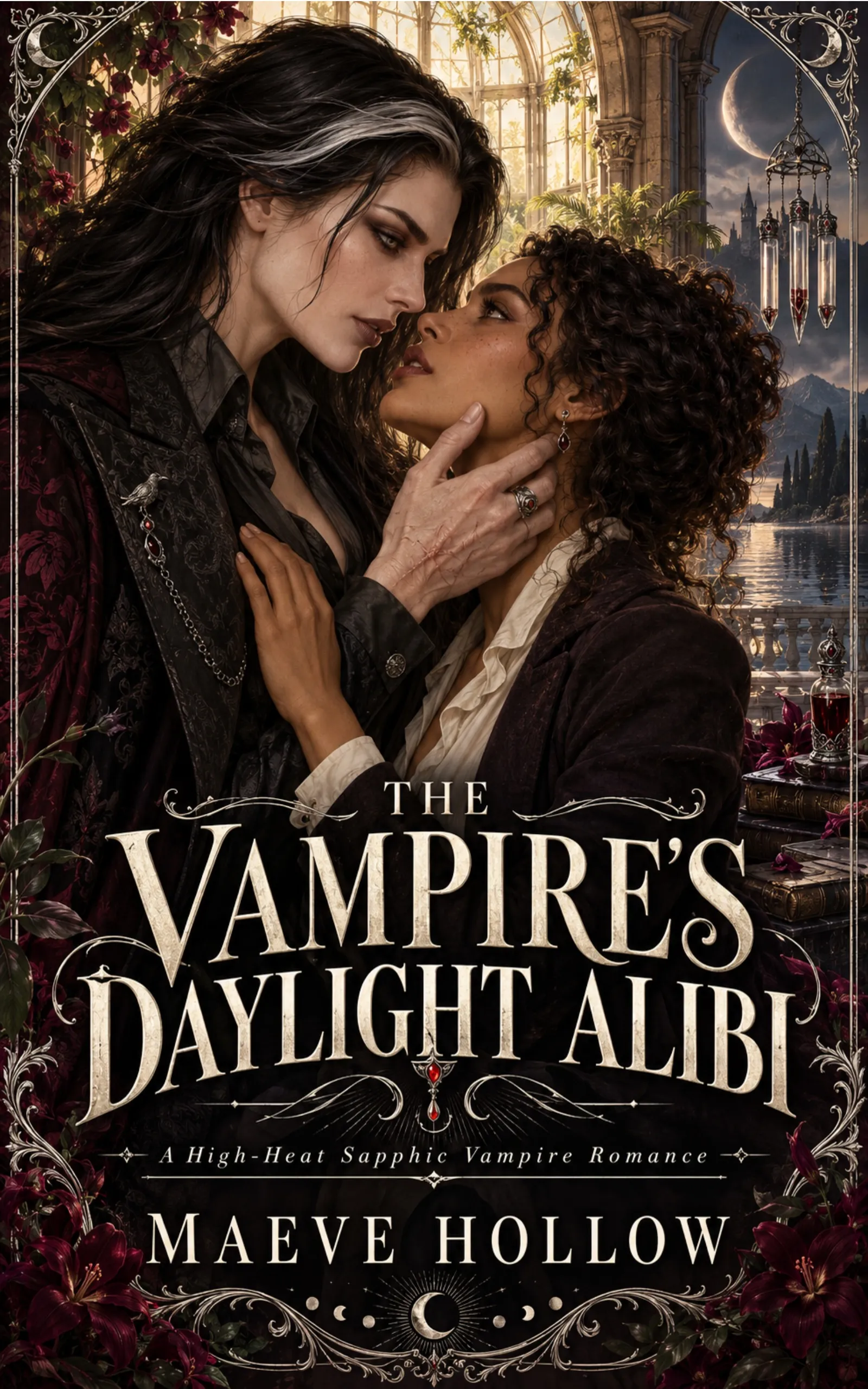
The Vampire’s Daylight Alibi
A Sapphic Vampire Mystery Romance · Rook & Venn Investigations, Book 1
by Maeve Hollow
Shop the ebook · Shop the audiobook
Available at all major retailers
Pairing: FF (Sapphic)
Heat: 🌶️🌶️🌶️🌶️🌶️ Inferno
Tropes: Vampire × Human, Enemies to Lovers, Forced Proximity, Age Gap, Ice Queen Magistrate, Blood Bond & Feeding, Murder Mystery, Ticking Clock, Wrongful Conviction, Mentor Betrayal, Hurt/Comfort, Touch Starved, Touch Her and Die, Book 1 of Rook & Venn Investigations
She has seven nights to prove a vampire didn’t kill in the sun. The only evidence is the blood she has to taste.
Dr. Thea Venn is the only hematologist in three states who ever stood up in open court and said I was wrong, and it cost a man four years. It ended her career. It also makes her the one human the Night Tribunal can’t buy.
Magistrate Severine Rook has sat on the vampire bench for seventy-one years and kept to the dark for two hundred and forty-three. Now a human woman lies drained on the white stone of the Dayglass Conservatory at noon, and the vial of blood in her pocket shows Severine’s hands around her throat.
In this city, a vampire’s blood remembers. Put one drop under your tongue and you feel the last seventy-two hours of her body. Every touch. Every hunger. Everything.
Thea has seven nights to read the evidence before Severine is chained under the glass and given to the Dawn. The first sample shows a murder. The second, drawn fresh by the accused herself, shows an alibi in perfect darkness, and the last hour Severine spent alone on dark silk with the scarf Thea left behind.
Tell her I’m sorry about the last hour.
She isn’t.
Now a furious scientist and an ancient, unblinking judge are trapped together in a lakefront house under ward, hunting a killer who can make blood lie, while the oldest secret in Severine’s sealed records waits to be read.
The Vampire’s Daylight Alibi is a high-heat sapphic vampire mystery romance with a fair-play murder plot, a ticking clock to noon, blood-reading that is as explicit as it is dangerous, a heroine who refuses to let anyone decide for her, a vampire who learns to say please, and a guaranteed HEA. Book 1 of Rook & Venn Investigations.
You’ll love this book if you enjoy:
✅ A 286-year-old ice-queen magistrate who has never once been told no
✅ A human scientist who tells her she’s rude for not blinking
✅ Blood that lets you feel everything her body felt, including the parts she’d rather you didn’t
✅ Feeding scenes, throat bites, inner-thigh bites, and a vampire who always stops when she says she will
✅ A headboard torn in half, an iron bed bent into a U, and a strap-on rule: if you move, I stop
✅ A locked-house mystery with a seven-night countdown and a killer hiding in plain sight
✅ A clerk with no patience, a lawyer who chews nicotine gum, and a toaster read cover to cover
✅ A hero who walks straight into the sun for the woman she loves
✅ 🌶️🌶️🌶️🌶️🌶️ heat, HEA guaranteed
⚠️ Content Warning: This novel contains explicit sexual content between two women (graphic FF scenes including biting and blood-drinking during sex, oral sex, fingering, mutual masturbation, strap-on play, light restraint, and sexual sensations experienced through blood-reading), blood and feeding, murders by strangulation and drowning experienced in sensory detail, severe sunlight burns, drugging and abduction, a threatened public execution by sunlight, the past execution of an innocent woman, a murder staged as a suicide, vomiting, nosebleeds, and strong language. Intended for readers 18+.
📖 Read Chapter One Free
Not sure yet? Read all of Chapter One right here.
Chapter One: Thea
The elevator under City Hall didn’t have buttons. It had a brass key, a woman holding it, and the smell of a church that had been locked for a hundred years.
“Four sentences,” Tamsin Shaw said, and thumbed a fresh square of nicotine gum past her lipstick. “Then you can call me insane for the rest of the ride.”
“I’m already there. You picked me up at eleven-forty at night and told me to bring my good gloves.”
“Sentence one.” The car dropped. Not lowered. Dropped, a long greased fall that left Thea Venn’s stomach somewhere around the lobby. “Vampires exist, and about forty people in this city who aren’t vampires know it.”
Thea looked at her.
“Sentence two. One of them is Magistrate Severine Rook, the most senior judge on the court that polices them, and since sundown she’s been sitting in a cell accused of murder.” Chew. Chew. “Sentence three. The victim is a human woman named Nessa Holt, found dead at twelve-fourteen this afternoon inside the Dayglass Conservatory, and the evidence is a vial of the magistrate’s blood that, when read, shows the magistrate killing her.”
“Read,” Thea said.
“Sentence four. Under the Compact, any capital case with a human victim requires an independent human expert to examine the blood, and every expert the Tribunal has ever used is on somebody’s payroll, and you”—Tamsin finally turned her head—”are the only hematologist in three states who ever stood up in open court and said I was wrong, and it cost a man four years.“
The car hummed. Somewhere below them, water moved through stone.
Thea tugged her scarf higher on her throat, mostly to have something to do with her hands. “Okay. So the actual pitch is: the woman with the famous conscience puts her name on whatever your court already decided. Human signature, clean hands, case closed. That’s a rubber stamp with a tragic backstory, Tamsin.”
“I want someone who’ll tell the truth.”
“Everybody says that until they hear it.”
Tamsin’s mouth twitched. “And the vampire thing? You’re very calm about the vampire thing.”
“I’m choosing to process the vampire thing later. Possibly with wine. Possibly screaming into a towel.” Thea pushed a curl off her forehead. It sprang right back. “What’s the rate?”
“Twelve hundred a day.”
“My centrifuge sounds like a dying goose and my rent is due Thursday. Fifteen.”
“Fourteen, and you don’t throw up on anyone important.”
“I make no promises about the vomit.”
The doors opened onto a corridor of dark wood and lamplight the color of weak tea. No windows. Of course no windows. The air was cool and still and very clean, and the people in it moved wrong — too smooth, no wasted motion, like a film with half the frames cut out. A man in a charcoal suit stopped mid-sentence as Thea passed and turned his whole head to follow her, slow, the way a dog tracks a sandwich someone has dropped.
“Don’t bleed down here,” Tamsin said pleasantly.
“Wasn’t on my list.”
“Paper cuts. Nosebleeds. Biting your cheek because you’re nervous. Don’t.”
“I’m not nervous.”
“Your hands are in fists.”
Thea unclenched them. She hated that she had to.
At a desk outside a heavy door, Tamsin signed something in a ledger with a fountain pen and handed Thea a folder. The first photograph was Nessa Holt on her back on white stone, citrus trees above her, sunlight pouring through a glass roof so bright the image had flared at the edges. Thirties. Fair hair. Throat bruised black in the shape of two hands. A neat double wound under the jaw, and skin the color of paper. Drained.
The second photograph was a close-up of the stone beside her open fingers: a mourning brooch, crushed. A jet oval, its glass face cracked into a starburst, a curl of pale hair coiled behind it.
“Hers?”
“Nobody’s claimed it.” Tamsin tapped the third photo — a small sealed vial, dark red, labeled in neat archive script. “That was zipped into the inside pocket of her coat. Severine’s signature, authenticated by the Sable Archive at three p.m. Read at four. The reader quit at four-oh-six and went home to throw up.”
“You said read. Twice. I need you to tell me what that means, because in my world you read blood with a hemocytometer and a lot of coffee.”
“In this world,” said Tamsin, “a vampire’s blood remembers the last seventy-two hours of what her body felt. You put a drop under your tongue and you feel it, too.” She opened the heavy door. “Come meet the defendant.”
The cell was a stone room with one bench outside it and a line of faint silver set into the floor, running up the walls and across the ceiling like frost on a window. Past the line, the air wavered, a heat shimmer without heat.
Past the shimmer sat Severine Rook.
She was in a straight-backed chair in the middle of the cell as if she’d had it brought in specifically to be seen in, and maybe she had. Black trousers, black shirt buttoned to the collarbone, a charcoal coat that fit across her shoulders like it had been cut onto her. Tall even seated. Strong through the neck and arms in a way that wasn’t decorative. Black hair pulled back hard, one streak of silver running through it from the left temple. Her left hand rested on her knee, and the back of it was rippled with old scar tissue, shiny and pale, like wax that had run and set.
Her eyes were gray. Not pretty gray. Courtroom gray, overcast-on-a-weekday gray, and they settled on Thea the way a verdict settles on a defendant: completely, and without hurry.
“Dr. Venn,” she said. Her voice was low and dry and precise, every consonant finished. “You came.”
“I was paid to come. Those aren’t the same thing.”
“No. Most people who are paid to come still manage to be frightened of me.”
“Give me a second. I’m a slow starter.”
Something moved at the corner of the magistrate’s mouth. Not a smile. The rumor of a smile, filed and dismissed.
Thea sat on the bench outside the silver line, pulled out her notebook, and uncapped a pen. Her hands were steady. Her heart was not. It was doing something fast and showy that she could feel in her teeth, and she had the distinct, unpleasant sense that the woman across the ward could hear every beat of it.
“You’ve read the summary,” Severine said. “You think I did it.”
“I think I’ve got four photographs and a story. I don’t think anything until I’ve seen data.”
“How novel. My colleagues think things constantly. They find it saves time.”
“Your colleagues sound like prosecutors.”
“Several of them were. Before they died.” She tilted her head a fraction. “Ask me, Doctor. You want to.”
“Did you kill Nessa Holt?”
“No.”
“Did you know her?”
“By name. She audited the archive. She was thorough and unpopular, which in my experience is the same thing.”
“Where were you at noon today?”
“Forty feet under my house, in a room with no windows, in the dark. Which is where I have been at noon every day for two hundred and forty-three years, because the alternative is that I catch fire.” Even, patient, the voice of someone reading a statute aloud to a child. “Before you ask, there are no witnesses. The ward on my sleeping chamber records every entry and exit. It was down this week for maintenance. There is no record that I was in that room.”
“Convenient.”
“Inconvenient. Someone arranged it very well.” Gray eyes, steady. “You haven’t written anything down.”
“I’m listening first.”
“And?”
“And you haven’t blinked since I walked in.”
A pause. The shimmer at the ward line seemed to hold still with her.
“I don’t need to,” Severine said.
“It’s rude.”
For a moment nothing happened. Then the magistrate closed her eyes — slowly, deliberately, the lids coming down and lifting like a curtain at the end of an act — and looked at Thea again with an expression of perfect, sardonic courtesy.
Thea’s whole body went hot.
Not a blush. Worse than a blush. A low, heavy, traitorous heat that started under her sternum and slid straight down, the kind of thing her body hadn’t bothered to do in two years and had apparently decided to do now, here, forty feet under City Hall, for a woman who was very possibly a murderer and certainly not human. She pressed her knees together under the notebook and was furious about it.
“Better?” Severine asked.
“Marginally.”
“You’re angry.”
“I’m tired. It’s after midnight and a lawyer just told me in an elevator that the monsters are real and I’m supposed to taste one.”
“You’re angry,” Severine said again, very quietly, “and not afraid. I find I don’t know what to do with that.”
“Try saying thank you.”
“For what?”
“For the first person in this building who isn’t treating you like you’re already dead.”
The magistrate went still. Not the stillness she’d been holding all along — a different one, as if something underneath had stopped moving for a second to listen.
“Venn,” Tamsin called from the doorway. “Archive’s ready for you.”
Thea stood. Her scarf, loose from her fidgeting, slid off her shoulder and onto the bench behind her. She didn’t feel it go.
Severine’s gaze dropped, briefly, to the bench.
Thea assumed she was trying to read the notes upside down. She would revisit that assumption later, with considerably more profanity.
The reading theater was a round room the size of a large closet, lined in black felt, with a single padded chair in the center like a dentist’s throne and a window of smoked glass along one curve where someone could watch. The only light was a red bulb low on the wall. It smelled faintly of cloves and old paper.
“Odelia Vale,” said the woman waiting in it, and held out a gloved hand. “I run the Sable Archive. You must be the woman who said no to the State of New York.”
“Most people lead with the four years.”
“Most people are boring.” Odelia’s smile was warm and creased at the eyes. She looked mid-forties — brown hair threaded with silver and pinned up loosely, a moss-green cardigan over a silk blouse, reading glasses hooked in her collar. She was the first person all night who looked at Thea the way colleagues used to: interested, unhurried, as if Thea might say something worth hearing. Thea liked her immediately and was suspicious of that, too, on principle.
“You’re one of them,” Thea said.
“I am. Two hundred and nineteen, if you’re counting, and everyone always is.” Odelia drew a slim glass slide from a lacquered box. A single bead of blood sat on it, gone amber at the edges where something had been mixed in. “Here’s everything you need, because the Tribunal will expect you to be an expert in about four minutes. A vampire’s blood keeps the body, not the mind. Touch, temperature, smell, sound, pain, pleasure. Not thoughts. Not motive. Not who she was thinking about. The Tribunal forgets that constantly, and it is the most important thing anyone will ever tell you about this work.”
“Noted. Limits of the finding.”
Odelia’s eyebrows rose with pleasure. “Oh, you’ll do. Reagent’s already in. Under the tongue. Don’t swallow. It will feel like remembering something that never happened to you. First readings are usually fog — a temperature, a sound, thirty seconds if you’re lucky. Don’t be disappointed.”
“And if it isn’t fog?”
“Then squeeze my hand, and I’ll bring you out.”
Thea sat in the chair. The felt walls swallowed every sound. Through the smoked glass she could make out Tamsin’s outline, arms crossed, jaw working on her gum.
Odelia tipped the slide. The bead slid onto Thea’s tongue, and she tucked it under, and it tasted of iron and cloves and something faintly sweet, like a bruised plum—
—and her hands were not her hands.
They were bigger. Longer in the fingers, harder across the palms, and they were wrapped around a throat, and they were squeezing.
Thea didn’t decide to squeeze. She was simply doing it, the way you’re simply breathing, with a strength that came up from somewhere so deep and so easy it was obscene. The throat was soft and warm. A woman’s pulse slammed against the pads of her thumbs, frantic, a trapped bird. Under her, a body bucked and twisted, and the heels of two shoes kicked and scraped against stone — she could feel the shudder of each kick come up through her own knees where she knelt — white stone, cold and smooth and grit-dusted, and the woman’s nails raked her forearms and it didn’t hurt, it didn’t hurt at all, it was like being scratched by a kitten.
And light. Light everywhere. Pouring down from above, white and total, so bright it erased the edges of everything, so bright she should have been squinting, burning—
But she wasn’t.
The light lay on the back of her neck and her hands like a sheet of paper. No weight. No warmth. A hospital light. A refrigerator light. Some animal part of Thea’s own body, buried under the borrowed one, registered that and flagged it and had nowhere to put the flag.
Squeeze.
A small, sour ache bloomed in her left wrist each time the grip tightened — down in the joint, under the bone, an old complaint flaring on every hard clench. It didn’t stop her. It was just there, the way a bad tooth is there.
And under everything, so faint she almost lost it under the woman’s choking, a sound. Glass touching glass. One high, clear note. Then, a long breath later, another. Like a bell for something very small.
The body under her went slack.
Then her mouth opened, and something in her upper jaw gave — a pressure and a sliding and a sweet, hot release, like cracking a knuckle she’d needed to crack for a week — and she bent, and bit.
Blood flooded her mouth.
Thea had spent fourteen years of her life around blood. She had pipetted it, spun it, stained it, smeared it, sequenced it, and once, in a teaching lab, accidentally aspirated it into her own mouth and spat for ten minutes. She knew its taste the way a baker knows burned sugar.
She had never tasted it like this. Like the first cold water after a fever. Like coming. Heat poured down her throat and spread through a body that had been cold for centuries, filling it, lighting it up limb by limb, and it was so good her borrowed spine bowed with it, and she drank, and drank, and the woman under her was getting lighter, emptier, and Thea couldn’t stop because she didn’t want to stop because it was so fucking good—
A hand was crushing hers.
Not borrowed. Real. A gloved hand, and a voice, and something sharp and acrid under her nose, ammonia — and the felt room slammed back around her, red bulb, the creak of the chair, her own heart going like a hammer, and Thea jackknifed forward and grabbed for the edge of a metal bowl Odelia was already holding under her chin.
She didn’t throw up. Close. Very close. She breathed through it in hard, ugly gulps while something warm ran over her upper lip and dripped onto her jeans.
“Nosebleed,” Odelia said, very calmly, and pressed a cloth into her hand. “Tilt forward, not back. Pinch. Good. You’re all right. You’re all right, Thea.”
“Don’t,” Thea said thickly, through the cloth, “tell me I’m all right. I just murdered somebody.”
“You felt somebody murder somebody.”
“It was good.” Her voice cracked on it. She hated that it cracked. “Drinking her. It was — it felt good, and I couldn’t—”
“I know.” Odelia’s gloved hand was flat between her shoulder blades, steady and impersonal and kind. “It always does. That’s the worst part of this work, and nobody warns you. You were under for three minutes and forty seconds.”
“Is that bad?”
“It’s extraordinary. Most readers need a year of training to hold thirty.” Odelia crouched in front of her so they were eye to eye. Hers were brown and bright and, for a second, something close to awed. “You’re a natural, Dr. Venn.”
“I’m a natural at being sick in a closet.”
“That too.”
Thea laughed, which was a mistake, because it sent a fresh trickle of blood down the back of her throat. When the bleeding slowed she dug out her notebook with fingers that wouldn’t quite close and wrote, in handwriting that looked like someone else’s:
Strangulation, manual, kneeling posture. Then bite. Victim conscious throughout initial assault. Light extremely bright, overhead, total. Stone surface. Duration of experience ~3 min.
She stared at the word bright for a long moment. Something about it itched, the way a misplaced decimal itches before you’ve found it. She couldn’t get her hand around it. Her brain felt bruised.
Under the last line, out of habit, she wrote: Limits of this finding: and then nothing, because she didn’t know them yet.
Her left wrist ached. She rubbed it absently against her thigh and didn’t notice she was doing it.
The Tribunal sat in a long room with no windows and black wood benches rising in tiers, like a lecture hall built for people who’d stopped needing lectures. A dozen figures in dark robes. A gallery of maybe thirty more, very quiet. A dais at the front with a slab of polished stone set into it, and to one side, a dock enclosed in that same frosty silver line.
Severine stood in the dock with her hands loose at her sides as if she were the one presiding.
Thea had been inside that body for three minutes and forty seconds. She was finding, as she walked down the center aisle beside Tamsin with a bloodstain drying on her jeans, that her own body hadn’t fully gotten the memo that it was over. She could still feel the ghost of those hands — that strength, so deep and so lazy it hadn’t even had to try. The hot pour of blood down a throat that wasn’t hers. She looked at Severine Rook’s long fingers and her own fingers curled.
She’d felt that woman kill. She’d felt how good it was.
And the treacherous, low heat from the cell was back, worse now, tangled up with horror in a way that made her want to scrub herself raw and also, distantly, somewhere she was not going to examine tonight, made her want to see that cold mouth open on a sound.
You’re sick, Thea told herself. You’re sleep-deprived and traumatized and sick. Get it together.
Severine’s gray eyes found her across the room and stayed.
“Magistrate Calder presiding,” murmured Tamsin. “Rook’s rival for about two centuries. She’s wanted this for a long time. Don’t give her anything she can quote.”
Elspeth Calder looked fifty, with a long pale face, red-gold hair coiled at the nape of her neck, and the expression of a woman who had been waiting a very long time for a waiter to bring the correct wine. She looked at Thea’s jeans, then at Thea’s face, and visibly found both wanting.
“The human expert,” Calder said. “You have read the sample.”
“I have.”
“And?”
“And it’s consistent with a manual strangulation followed by a bite. Under very bright light. I’m not prepared to say more tonight.”
“Is it Magistrate Rook’s blood?”
“That’s not my determination—”
“The signature is authentic,” Odelia said from the side of the room, quietly, clearly sorry to be saying it. “The archive is certain of that. I’m afraid it’s hers.”
Calder turned back to Thea. “Then it is her blood, and in her blood she kills a woman under the sun. Is that a fair summary, Doctor?”
Thea thought of the light lying on her skin like a sheet of paper. Of an itch she couldn’t scratch. “It’s her blood,” she said carefully. “I don’t know yet what that means.”
“How refreshing. A scientist with no conclusions.” A thin ripple of amusement through the benches. “The Tribunal does not share your difficulty. A human woman is dead. The evidence names the accused in her own blood. How the accused walked in daylight is a question we will answer at our leisure, and, I suspect, with great interest.”
“Seven nights,” Tamsin said, standing. “Under the Compact, the defense is entitled to seven nights to answer blood evidence in a capital matter. Seven nights and house arrest under ward. Magistrate Rook has sat on this bench for seventy-one years. She’s not going to run.”
Calder’s long fingers drummed once on the stone. Thea had the sense of a cat deciding that the mouse would be more fun if it was allowed to run a little.
“Seven nights,” Calder said. “Counting this one. House arrest at Rook House, under Tribunal ward. And if at the end of the seventh night the evidence stands, Severine Rook will be given to the Dawn at noon on the eighth day, in the Dayglass Conservatory, where she was so careless as to leave the body.” She smiled for the first time. It was not an improvement. “It seems only fitting.”
The gallery didn’t gasp. These weren’t people who gasped. But the silence changed texture, the way a room does when someone has said a thing nobody can take back.
“The Dawn?” Thea whispered.
“They chain you under the glass roof at noon,” Tamsin said, without moving her lips, “and they watch.”
Thea looked at the dock.
Severine hadn’t moved. Her face hadn’t changed. She looked at Calder as if Calder had read out a weather report, and then she turned her head and looked straight at Thea, and the gray of her eyes had gone strange — lighter, silvered at the edges, like frost forming on a window in fast motion.
“Dr. Venn,” she said. Her voice carried without being raised. Every head in the room turned toward Thea. “You read the evidence against me. Now read the evidence for me.”
“I—”
“My blood. Fresh. I will draw it myself at dawn and send it to you sealed, and it will hold every hour between now and then, and every hour before. Seventy-two of them. All of it.” A pause, small and precise, like a blade being turned in the light. “I’ll warn you now, Doctor. You won’t like everything you find.”
Want to keep reading? The full novel is available now.
🔥 Want an EXCLUSIVE Bonus Chapter?
Sorry About the Last Hour — A scene TOO HOT for the bookstore
A rainy night at the new Rook & Venn office on Mercer Street. Severine walks in with a sealed vial and a card: Drawn at 8:40. Read the last hour. This time she asked first. This time she’s in the room while Thea reads it, and every single thing Thea feels in that blood, Severine is about to do to her for real.
More from Maeve Hollow
Browse all Maeve Hollow books.

The Vampire’s Daylight Alibi
Rook & Venn Investigations
She has seven nights to prove a vampire didn't kill in the sun. The only evidence is the blood she has to taste.
The Lighthouse Keeps Her
She found an eight-armed woman bleeding in the channel below her lighthouse. She opened the gate and walked to the far wall.
The Shadow in Her Spare Room
She moved into a dead woman's sewing room to hide. The only thing she asked was not to be seen.

Signed, Sealed, Scorched
A dragon kept the one letter that could have sent her away. She kept it out of love. That was the problem.
The Seventh Daughter’s Bodyguard
She was hired to keep the witch alive. Nobody said she’d have to share her with six dead women.

A Curse Made for Two
Her touch has burned everyone for a hundred years. The appraiser who grabbed her hand didn't even blister.
Never Miss a Release
Get new release alerts, exclusive bonus content, and reader-only giveaways.