
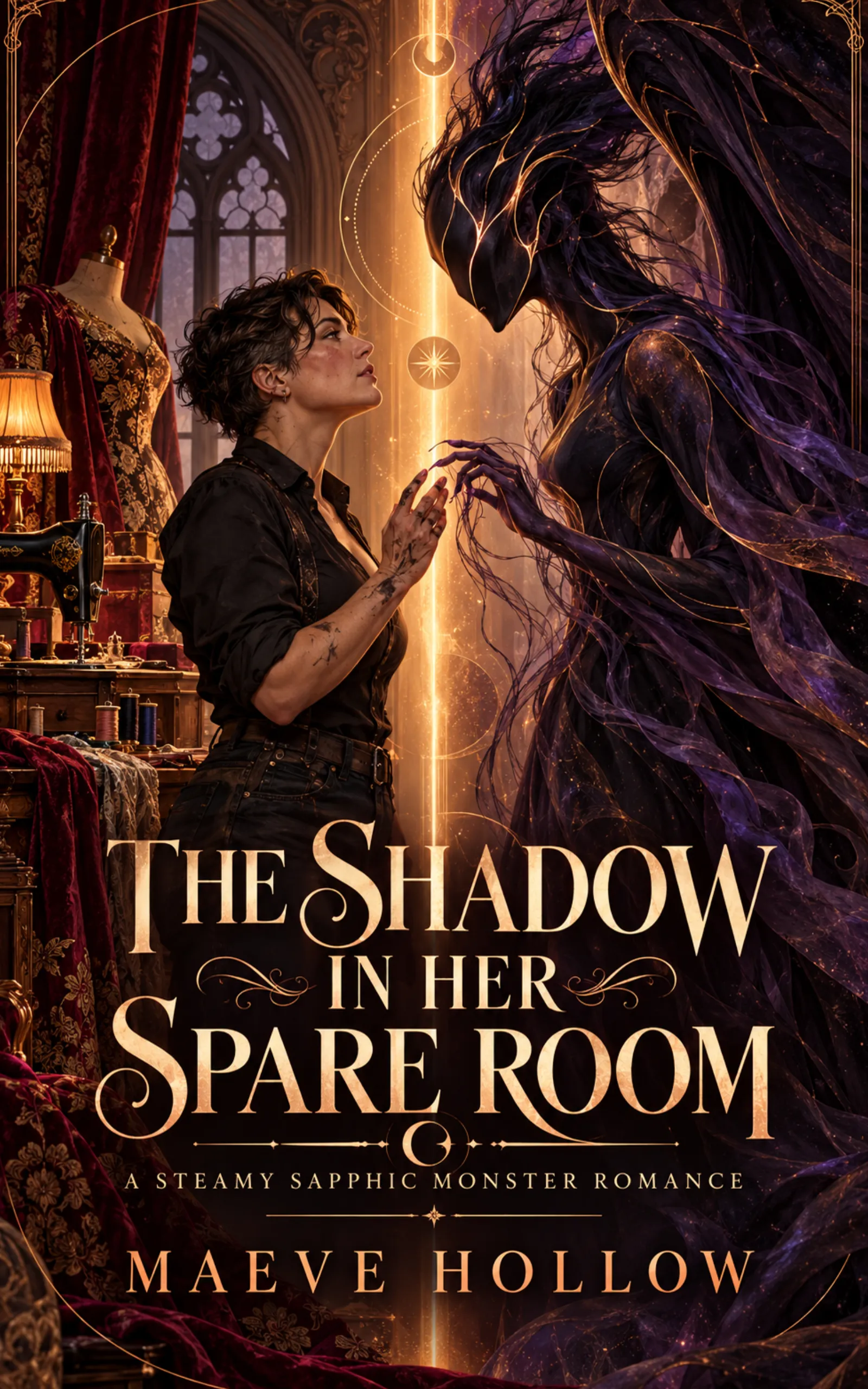
The Shadow in Her Spare Room
A Sapphic Paranormal Monster Romance
by Maeve Hollow
Shop the ebook · Shop the audiobook
Available at all major retailers
Pairing: FF (Sapphic)
Heat: 🌶️🌶️🌶️🌶️🌶️ Inferno
Tropes: Human × Shadow-Born Heroine, Monster Romance, Fugitive in the Spare Room, Forced Proximity, Hurt/Comfort, Touch Starved, Size Difference, Light Play, Consensual Restraint & Safewords, Grief, Found Family, Artist Romance, Corporate Villain, Grovel, Standalone
She moved into a dead woman’s sewing room to hide. The only thing she asked was not to be seen.
June Marlow lights theaters for a living. She has spent twenty years making three hundred strangers look exactly where she wants them to look.
Then she comes home to her dead mother’s house on Ash Row and finds a shadow on the sewing-room wall that doesn’t move when she moves the lamp.
Selyth is Vey — shadow-born, a hundred and seventy years old, torn ragged down her left side, and on the run from Aurelian Civic Light, the company flooding the Old Quarter with flat white Dayline that erases bodies like hers. She needs contrast. Warmth. No flicker. She needs a room. She absolutely does not need the loud, ink-stained human who sits on the floor in the doorway and talks to a wall.
June builds her a room out of amber and gradient. Then a bed. Then a whole new language for what a body made of edges wants, and how to give it to her.
But June is designing Aurelian’s launch show. Sel has a stolen key sewn into Rosalind Marlow’s dress form. And on Lantern Night, in front of the whole city, Aurelian means to switch on the full grid with Sel’s best friend standing on the stage.
Sel asked June for one thing: don’t record this, don’t draw it, just see it. June said I promise.
The Shadow in Her Spare Room is a high-heat FF paranormal monster romance with a fully nonhuman shadow heroine who never becomes human, a lighting designer who has to learn to ask, explicit and inventive human × shadow spice, safewords that are honored every time, a grovel on both sides, a city-wide rescue built out of light, and a guaranteed HEA. Standalone.
You’ll love this book if you enjoy:
✅ A fully nonhuman heroine — living shadow, no human form, ever
✅ A lighting designer who builds her lover a room, then a bed, then a road through the city
✅ Filaments, a mantle, braided lengths, and a body that blooms across every wall when she comes
✅ “Ember” and two taps — consent that is asked for and answered
✅ A dead mother’s sewing room, burgundy velvet, and a dress form that keeps a secret
✅ Bad melodrama, a hundred-and-seventy-year-old theater snob, and a soap opera with four sets of twins
✅ A grumpy Vey healer who calls everything “adequate” and a best friend who is late for everything, including her own rescue
✅ A betrayal on both sides and a grovel that doesn’t pretend it was small
✅ 🌶️🌶️🌶️🌶️🌶️ heat, HEA guaranteed
⚠️ Content Warning: This novel contains explicit sexual content between a human woman and a fully nonhuman shadow being (graphic FF scenes including oral sex, fingering, penetration with braided filaments, a hand-in-body “core” act, consensual restraint and edging with safewords, and nonhuman anatomy), grief for a dead parent, captivity and experimentation by a corporation, the deaths of eleven people in a medical-style trial (discussed, offscreen), a violent home raid, a privacy betrayal by a love interest, a cruel argument between the leads, and strong language. Intended for readers 18+.
📖 Read Chapter One Free
Not sure yet? Read all of Chapter One right here.
Chapter One: June
The road case weighed eighty-one pounds empty, and June Marlow had never once in eleven years of touring managed to get it up a flight of front steps with dignity.
“You need a hand with that?” the cab driver asked, in the tone of a man who very much hoped she didn’t.
“I’m good.” She wedged her hip under the case, got the casters onto the first step, and lost them again. Something inside rattled — a C-clamp, a roll of gaff, the cheap Bluetooth dimmer she’d bought in an airport in Tulsa and never returned. “I’m great. This is how I relax.”
He was already pulling away. His taillights slid down Ash Row and turned the corner, and then the street was empty and very, very bright.
June stopped with one boot on the second step and looked at it properly.
When she’d left fourteen months ago, Ash Row had been lit the way the Old Quarter had always been lit: badly, beautifully, by accident. Sodium lamps that buzzed orange and threw long hard shadows down the cobbles. A porch light here, a lit window there, the warm spill from the bakery on the corner that kept its ovens on all night. You could walk the length of the street and pass through twenty different moods.
Now there were poles.
Slim, white, every thirty feet on both sides, tall as the rooflines. Each one ended in a flat rectangular head that pointed straight down and poured out light like milk out of a carton. Not bright, exactly. Worse than bright. Even. It hit every brick at the same angle and the same intensity, filled every doorway, crawled under every parked car. There wasn’t a single shadow on the street longer than her own shoe.
She turned in a slow circle. Her own body cast almost nothing. A faint smudge around her boots, already being eaten from three sides.
A small plaque on the nearest pole said DAYLINE PILOT ZONE — A PUBLIC SAFETY INITIATIVE OF AURELIAN CIVIC LIGHT. Eliminating uncontrolled shadow for a brighter Vesper.
“Oh, fuck you,” June told the pole, with feeling.
It was the kind of light she’d spent her whole career fighting. Light with no point of view. Light with no opinion. A hospital corridor at four in the morning, stretched over an entire neighborhood. Every instinct she had as a designer wanted to climb the thing with a wrench and give it something to say.
Instead she got the case up the steps, one bump at a time, and let herself into her mother’s house.
It still smelled like her.
That was the first thing, and the worst. Two years, a property manager, three rounds of cleaners, and the front hall of Marlow House still smelled like starch and cedar and the particular burnt-sugar perfume Rosalind Marlow had worn every day of her life because a lover in 1987 had told her it made her smell like a crème brûlée.
June stood on the mat with her keys in her hand and let it hit her. Then she shut the door on the white street, leaned her back against it, and said, out loud, “Okay. Okay. You knew it would do that.”
The house didn’t answer. It creaked, settling around the sudden warmth of the furnace she’d had the manager switch on that morning. Narrow and tall, three floors stacked like books on a shelf, every board in it older than the city’s electrical grid. Her grandmother had bought it. Her mother had filled it — with fabric and friends and arguments and actors who needed somewhere to sleep after closing night. June had grown up doing homework on a cutting table while a drag queen got pinned into a ballgown six inches from her elbow.
She’d been gone, really gone, since the funeral. One contract after another. A regional Macbeth, a cruise-ship revue she still didn’t talk about, then the big one — fourteen months lighting the national tour of Ironclad, a steampunk musical about a lighthouse keeper and a sentient submarine that was exactly as stupid as it sounded and had made grown men sob in thirty-one cities. She’d built the lighthouse beam that swept the house at the end of act one. People had proposed during it. She had a folder of videos.
Every time the tour hit a city, she’d told herself she’d figure out the house next time.
The tour had ended four days ago in Halvard. The cast had cried at the closing party and the stage manager had cried and June had stood at the back of the bar with a warm beer and realized that for the first time in two years, there was no next city.
So. Here she was.
She hit the hall switch. The old brass sconces came up yellow and a little uneven, one bulb slightly cooler than the other, and something in her chest unclenched. Better. Light with a history. Light with flaws.
The photos started at the bottom of the stairs.
Rosalind had hung them herself, crooked on purpose, climbing the wall in a ragged line that followed the banister to the second floor. Rosalind at twenty-five in a cloud of tulle. Rosalind with a mouthful of pins, glaring at the camera. Rosalind and a baby June asleep in a basket of offcuts. June at fourteen with braces and a borrowed follow-spot, so proud of herself she looked deranged. June at thirty, her arm around her mother’s shoulders, both of them squinting into the sun on the steps of the Lantern Theatre the night June’s first mainstage season opened there.
That one she touched. She didn’t mean to. Her fingertips were already on the glass, smudging it, her ink-stained knuckles reflected over her mother’s face.
“Hi, Mom,” she said. “Sorry I’m late.”
Then she went to find something to drink.
The kitchen was at the back of the ground floor, long and low, with a scarred butcher-block island and a window over the sink that looked out onto the tiny walled yard. Above the island hung the pendant — a dented copper dome her mother had salvaged from a demolished pub, wired with a bulb so old and warm it was practically orange. June found the dimmer by feel and brought it up to about a third.
The kitchen came back to her in pieces. The chipped blue tiles. The hooks where Rosalind’s pans had hung. The calendar on the fridge, still on the month she’d died, a dentist appointment circled in red that her mother hadn’t lived to keep.
June took the calendar down and put it face-first in a drawer. That was enough for one night.
There was a bottle of bourbon in the cupboard above the fridge, a quarter full, exactly where it had always been. She poured two fingers into a jam jar, then a third finger because she’d earned it, and leaned against the island and drank and listened to the house.
Furnace ticking. Pipes knocking. The low hum of the fridge.
Her phone buzzed against the butcher block.
Ada: ARE YOU HOME. Tell me you’re home. I need you on Thursday. I need you so badly it’s embarrassing.
June: Home. Drinking my mother’s bourbon in the dark like a Victorian widow.
Ada: Good. Iconic. Come to the Lantern Thursday, I have NEWS. Big news. Money news.
June: Ada, you’ve never had money news in your life.
Ada: I KNOW. That’s why I need you sober and in a chair. Thursday!! Love you. Welcome home. Sorry about the poles.
June looked at that last line for a while.
June: What the hell are the poles.
Ada: Thursday!!!!
She snorted and put the phone face-down. Ada Mercer had been running the Lantern on fumes, grant applications, and sheer volume for fifteen years. She’d hired June for her first real show when June was twenty-four and terrified, and she’d cried at Rosalind’s funeral harder than June had. If Ada had money news, June would sit in a chair for it.
She finished the bourbon. She was rinsing the jar when she noticed the cold.
It was faint. A thread of chill along the back of her neck, like someone had cracked a window somewhere upstairs. June glanced at the furnace vent by the door — still breathing warm air — and then up at the ceiling.
The spare room was directly above the kitchen.
She stood very still with the water running.
That room had been her mother’s studio for thirty years. Shutters on the windows because sunlight faded the silks. Walls Rosalind had plastered herself, rough and swirled, because she said flat walls made fabric look dead. Bolts of cloth stacked to the ceiling. The cutting table. The industrial sewing machine. And in the corner, the dress form — headless, armless, padded and patched and older than June — that her mother had talked to while she worked the way other people talked to dogs.
June had closed that door the day after the funeral, and she had not opened it since. She’d told the property manager not to either. Just leave it. Leave that one room.
The draft came again. Colder.
“It’s an old house,” June said to the kitchen. “Old houses have drafts. This is not a horror movie. You are not a girl in a nightgown. You are a thirty-six-year-old woman with a union card.”
She shut off the tap, dried her hands on her jeans, and went upstairs anyway.
Her bedroom was at the front of the second floor, overlooking the street. She’d planned to drop into bed fully clothed and deal with sheets tomorrow. Instead she stopped on the landing with her hand on the banister and stared down the hall.
The spare room door was open.
Not wide. A few inches. Enough for a slice of darkness between the door and the frame.
The property manager, June thought. The cleaners. Someone came in to check the radiator. Someone ignored a very specific instruction and is going to get a very specific email.
She walked down the hall. The boards announced every step. At the door she stopped, put two fingers on the old wood, and pushed.
The hinge gave its familiar long complaint. The room opened up in front of her.
It was darker than the hall, but not dark. The shutters were closed, but whoever had come in had left the little brass lamp on the cutting table plugged in and switched on, its fringed shade throwing a low warm pool across the tabletop and scattering everywhere else. The light caught the edges of things. The stacked bolts of fabric made a ridged wall along one side — burgundy, emerald, a bolt of gold brocade her mother had been saving for something important. The sewing machine crouched under its cover. The dress form stood in the corner under a white sheet, the shape beneath it soft and armless and so familiar June’s throat closed.
And on the far wall, between the window and the corner, there was a shadow.
June’s first thought was professional, and it arrived fully formed, the way they always did: That’s wrong.
Not that’s scary. Not that’s a person. Just — wrong. The way a follow-spot is wrong when the operator misses his mark and the actor’s three feet to the left of the light. The way a shadow is wrong when it falls toward the source instead of away.
The lamp was on the cutting table, low and to the right. Anything between it and the far wall should have cast a shadow up and to the left, stretched and tilted. The bolts of fabric did exactly that, a long ridged shape climbing the plaster. The sewing machine did. Even the dress form under its sheet did — a soft gray lump leaning toward the ceiling.
This one didn’t.
This one stood straight up. Tall, much taller than June, the top of it nearly brushing the crown molding. Clean-edged against the swirled plaster. Darker than the shadows around it, a dense, layered dark that seemed to have depth, the way deep water does. It had a shape. There was no other word for it. Long legs. A narrow waist. The suggestion of hips. Shoulders that spread out into something broad and draped, like a cloak hanging from them, or folded wings. Arms held close to the body. A head, tilted very slightly to one side.
It was a woman. A shadow of a woman. Standing on the wall of her mother’s studio, cast by nothing at all.
June didn’t breathe. The fabric shadows and the machine shadow and the dress-form shadow all leaned one way, obedient, and this one stood among them like a person standing in a crowd of mannequins.
“Okay,” June whispered. Her voice came out thin. “Okay. That’s — huh.”
Nothing moved.
The cold was coming from that wall. She could feel it now on her face and her bare forearms, a steady chill radiating off the plaster like the room was a refrigerator and someone had left the door open.
Everybody in Vesper has a cousin who’s seen one. That was how her mother had always put it. Shadow-born. The city had known about them for decades — nonhuman residents, some kind of civic recognition, a line in the census. You heard about them the way you heard about wolves in the hills outside town. Rare. Real, technically. Somebody else’s story. June had grown up in the Old Quarter and the closest she’d ever come was a kid at school swearing he’d seen a shadow cross the canal bridge against the wind.
She’d assumed, like most people, that they were — she didn’t know. Weather. Phenomena. Things that happened to a place rather than things that lived there.
The thing on her wall did not look like weather.
June made herself take one step into the room. Then another. The boards creaked. The shadow didn’t flinch or shift. It just stood there in its impossible straight line, and the longer she looked, the more detail she saw. Its edges weren’t sharp exactly — they were fine, a soft feathering of darker lines all along the outline, like fringe, like the barbs on a feather. Where the lamplight brushed the right side of it, those fine edges caught a faint sheen. Not black at all, up close. A deep bruised violet. A seam of bronze, there and gone.
The left side was different. Ragged. The fine edges there were frayed and uneven, some of them drifting loose from the outline like threads pulled from a hem, and the darkness itself looked thinner, patchier, as if it were struggling to hold.
It’s hurt, June thought, and didn’t know where the thought came from.
Then, because she was who she was, she did the only thing her brain knew how to do with a lighting problem.
She tested it.
The brass lamp sat on the far end of the cutting table. June crossed to it slowly, keeping her eyes on the wall. Her hands were shaking. She wrapped them around the lamp’s cold base, lifted it, and walked it a full four feet to the left, to the other end of the table, the cord dragging behind it.
Every shadow in the room swung. The fabric bolts flattened and slid right. The sewing machine’s shadow wheeled across the floor. The dress form’s soft lump drifted along the wall like a boat changing course.
The woman-shape didn’t move an inch.
She stood exactly where she’d been. If anything she looked darker now, denser, the fine edges along her outline lifting slightly, like hair in a static charge.
June set the lamp down very carefully, because otherwise she was going to drop it.
“That’s not a shadow,” she said, mostly to herself. “You’re not a shadow. Shadows have to obey the light. That’s the only thing they’re for.”
The cold deepened. The fine edges along the shape’s right side rippled, a slow wave traveling from shoulder to hip.
Something in June’s belly turned over, low and hot, and it was not entirely fear.
That startled her more than the shadow had. She stood there with her heart going like a kick drum and realized she was being — looked at. There was no face. No eyes. Just a head-shaped dark, tilted toward her. But she’d spent her whole adult life in rooms full of people watching, and she knew the weight of attention when it landed on her. This had weight. It settled across her face and slid down her throat and rested, cool and patient, somewhere around her collarbone.
She’d been looked at like that maybe three times in her life. Usually by a woman across a bar, right before June made a bad decision.
“Jesus Christ, Marlow,” she breathed. “Not the time.”
The shape tilted its head a fraction further. Like it had heard her. Like it was amused.
June’s hand was already in her back pocket.
She knew it was a bad idea while she was doing it. Some part of her said leave, close the door, call someone, but the louder part said you need to know what it does. That was the part that had gotten her through two hundred tech rehearsals. Every fixture, every gel, every surface: you didn’t know what it was until you knew what it did when light hit it.
She thumbed on her phone flashlight and swung the beam at the wall.
The shadow flinched.
There was no other word. The whole tall shape jerked back as if struck — but back into what? Into the wall? It seemed to compress, to pull in on itself, and where the hard white beam touched it, the edge didn’t just retreat, it fractured. The fine feathered outline along its left side broke apart into a spray of dark splinters that scattered across the plaster like cracks running through ice. For a fraction of a second June could see the swirls of her mother’s plaster through it.
A sound came out of the dark. Not a voice. A low, resonant thrum, felt more than heard, the kind of frequency that came through the soles of your feet when the subwoofers kicked in. It hit June in the sternum and made her teeth ache.
The shape slid. Fast and smooth, sideways along the wall and down, pouring around the corner of the window frame and away from the beam, hugging the rough plaster, its outline stretching long and thin as it went. June’s flashlight chased it on pure reflex. The shadow ducked behind the stacked bolts of fabric, then along the floor beneath the cutting table, then up — up the corner behind the dress form, into the deep fold where the sheet hung against the wall and the brass lamp couldn’t reach.
It folded itself into that dark and was gone.
The fractured pieces on the wall — the splinters — June swung the light back and they weren’t scattered anymore. They’d been pulled along with it. Drawn in like a net being hauled. Nothing left behind. The plaster was just plaster.
She stood in the middle of her mother’s studio with her phone held out in front of her like a crucifix and her pulse slamming in her ears.
“Shit,” she whispered. “Shit. Shit, I’m sorry—”
She didn’t know who she was apologizing to. She didn’t know why. She only knew that she’d seen something hurt, and that she was the one who’d done it, and that her phone light was still blazing a hard white circle on the wall like an accusation.
She killed it.
The room dropped back into lamplight, the brass lamp now sitting crooked at the wrong end of the table, throwing everything at a slant.
And it was cold. God, it was cold. The chill had gone from a draft to a presence, pouring out of the corner behind the dress form, raising goosebumps on her arms and tightening her nipples under her T-shirt so hard it almost hurt. Her breath fogged. Actually fogged, a faint pale ghost of it hanging in the lamplight.
Silence.
June listened to it. The furnace had stopped ticking. The pipes had gone quiet. She could hear her own heart and the faint electrical whine of the old lamp bulb and nothing else at all. Not a creak, not a breath. The kind of silence that only happens in a theater in the half-second after the last line, before the house decides what it feels.
She should leave. She knew that. She should back out of the room, close the door, go downstairs, and call — who? The police? Hi, there’s a shadow in my dead mother’s sewing room and I think I hurt its feelings. Ada? Ada would come over in her pajamas with a bat and a bottle of wine and make it worse.
The cousin, June thought wildly. Somebody’s cousin who’d seen one.
She didn’t leave.
Instead she stood there in the cold with her phone clutched against her chest and looked at the corner behind the dress form. The sheet hung soft and white over the familiar shape. Behind it, where the wall met the other wall, the shadow was very deep. Deeper than a corner should be. She could see, if she let her eyes go soft the way she did when she was reading a stage from the back of the house, a faint violet sheen in it. A slow, uneven movement, like breathing. The left side of the dark was rougher than the right. Still frayed. Maybe worse.
It’s hurt, she thought again. And it came here to hide.
The image came to her unbidden: those white poles marching down Ash Row, pouring flat light into every doorway and under every car. Eliminating uncontrolled shadow. Not one place on that whole street for something like this to stand.
Except here. Her mother’s room. The shutters. The rough plaster. The lamp no one had been in to turn off.
June swallowed. Her throat clicked.
“Hey,” she said. It came out a croak. She cleared her throat and tried again, softer, the voice she used on nervous actors the night before opening. “Hey. I’m — I’m not going to do that again. Okay? That was stupid. I didn’t know. I’m sorry.”
Nothing.
“This is my house,” she went on, because she couldn’t seem to stop talking. She always talked when she was scared. She talked through blackouts and blown dimmers and the time a moving light had dropped twelve feet and missed a dancer’s head by inches. “Well. It was my mother’s. Now it’s mine, I guess. I’ve been gone a long time. I didn’t know anyone was — I didn’t know.”
The cold pulsed. It was the only word for it. A slow wave of chill rolled out from the corner, washed over her, and drew back.
June’s whole body prickled in its wake. Her skin felt too tight, too warm under the cold, every nerve awake. She was aware, suddenly and stupidly, of everything: the damp at the small of her back, the seam of her jeans, the hard points of her nipples against cotton, the way her heartbeat had moved down from her ears to somewhere much lower and much more inconvenient.
Absolutely not, she told her body. You do not get to have opinions about this.
Her body did not care. Her body had been touched by exactly no one in fourteen months except a lighting programmer named Dev who hugged everyone after every show, and her body had decided that being looked at this hard by something this tall was the most interesting thing that had happened to it in a year.
She needed to see it again. That was the problem. That was the whole stupid problem. The artist in her was standing there in the cold, practically vibrating, demanding a second look. Better light. A side angle. Something warm and low that would rake across those fine edges and show her what color they really were.
Instead her hand drifted to the wall beside the door, the way it had a thousand times as a kid. Her fingers found the old toggle switch for the overhead fixture. One bare bulb in a frosted glass shade, flat and white and ugly. Her mother had never used it. Kills the color, Rosalind used to say. Makes everything look like a bus station.
June didn’t decide to flip it. She’d just — been doing this all her life. You come into a dark room, you hit the switch.
The toggle snapped up.
The bulb overhead flared white, flat, merciless — and in the corner behind the dress form, the deep dark didn’t retreat this time. It crumpled. June saw it happen. The whole shape went thin and gray and pressed against the plaster like something pinned under glass, its fine edges shredding loose along the left side, the violet sheen gone dead.
From that corner, low and resonant and impossibly close — close enough that she felt it in her own chest, under her breastbone, like a second heartbeat — a voice spoke.
It was a woman’s voice. Deep. Strained. Very, very tired.
“Please. Turn that off.”
Want to keep reading? The full novel is available now.
🔥 Want an EXCLUSIVE Bonus Chapter?
Asked For and Answered — A scene TOO HOT for the bookstore
Closing night of The Drowned Bride of Harrow Hall. The Lantern is empty, the rain curtain is still rigged, and June asks Sel a plain question: may she light her on that stage, for no one, and save nothing? Sel says yes. Then she asks for channel forty-two, and for the rain.
More from Maeve Hollow
Browse all Maeve Hollow books.

The Vampire’s Daylight Alibi
Rook & Venn Investigations
She has seven nights to prove a vampire didn't kill in the sun. The only evidence is the blood she has to taste.

The Lighthouse Keeps Her
She found an eight-armed woman bleeding in the channel below her lighthouse. She opened the gate and walked to the far wall.

The Shadow in Her Spare Room
She moved into a dead woman's sewing room to hide. The only thing she asked was not to be seen.

Signed, Sealed, Scorched
A dragon kept the one letter that could have sent her away. She kept it out of love. That was the problem.

The Seventh Daughter’s Bodyguard
She was hired to keep the witch alive. Nobody said she’d have to share her with six dead women.

A Curse Made for Two
Her touch has burned everyone for a hundred years. The appraiser who grabbed her hand didn't even blister.
Never Miss a Release
Get new release alerts, exclusive bonus content, and reader-only giveaways.