
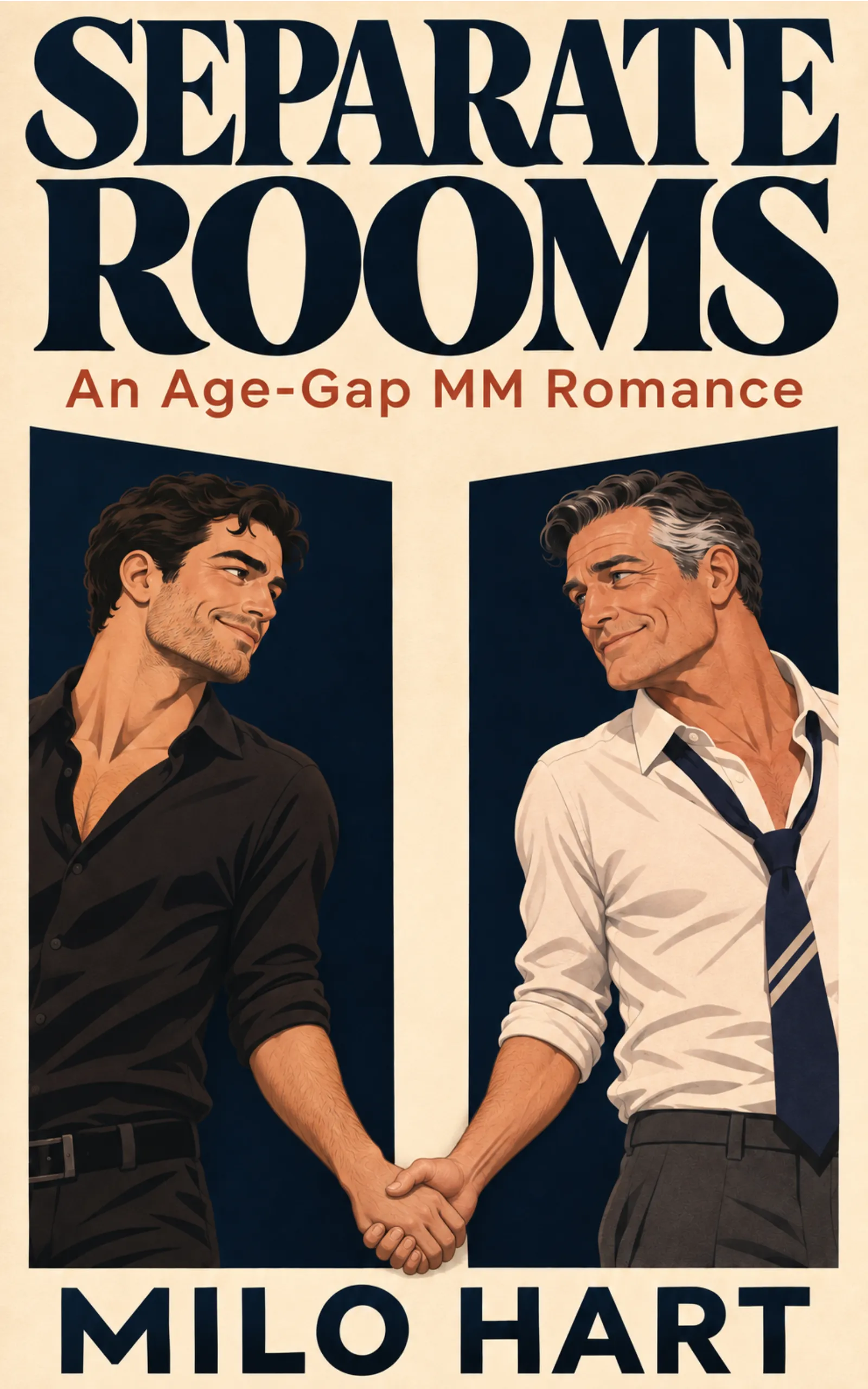
Separate Rooms
An MM Age Gap Romance
by Milo Hart
Shop the ebook · Shop the audiobook
Available at all major retailers
Pairing: MM
Heat: 🌶️🌶️🌶️🌶️🌶️ Inferno
Length: ~80,000 words
Tropes: Age Gap, Bisexual Awakening, Silver Fox, Closeted Hero, Widower, Forbidden Workplace Romance, Secret Relationship, Coming Out, Light Bondage, Praise Kink, Power Exchange, Switch, Phone Sex, Earned Grovel, Second Chance
He signed my invoices. Then he signed them away.
Owen Brooks runs the part of a conference nobody sees: the forty minutes before the keynote, the cable kicked loose under the stage, the change order that lands at noon. He spent eleven months as one man’s secret once. He swore he’d never be anyone’s secret again.
Stephen Grant is fifty-three, a widower, acting chief executive of a national trade association, and the board’s favorite for the permanent job. For seven years his life has had exactly one room in it.
Then, on the last night of a Nashville conference, the man who signs Owen’s invoices asks him to dinner. Owen tells him no. Stephen files a governance memo by Monday morning.
What follows is hotel corridors and separate rooms, a list of questions on hotel notepaper, a navy silk tie, and a man who has never let go of the wheel finding out how good it feels to hand it over. But Stephen’s campaign is selling the devoted widower who gave everything to the job, and that story doesn’t have room for Owen in it.
Owen never asked him to come out. He only asked not to be erased. Now Stephen has to choose between the bigger room and the man.
Separate Rooms is a scorching, emotional MM age-gap romance with a bisexual awakening at fifty-three, a closeted executive and the event producer he can’t stop watching, forbidden workplace tension handled by the book, very explicit scenes, both men switching, a real grovel, and a guaranteed HEA. Dual POV. Complete standalone.
You’ll love this book if you enjoy:
✅ Thirty years of separate rooms and one man who won’t be hidden in any of them
✅ A silver-fox widower at fifty-three and the thirty-five-year-old production director who calls his shows
✅ A bisexual awakening that starts on the edge of a stage in Nashville
✅ “You sign my invoices, Stephen.” “Then I’ll stop signing them.”
✅ A list of questions on hotel notepaper, a ceramic frog, and a shirt button kept for eight weeks
✅ A navy silk tie that ends up somewhere far more interesting than a board meeting
✅ Yellow, red, and a man who has never once let anyone take the wheel
✅ Closeted executive, age gap, forbidden workplace romance, switching, 🌶️🌶️🌶️🌶️🌶️ heat, HEA guaranteed
⚠️ Content Warning: This novel contains explicit sexual content (graphic MM scenes including oral sex, rimming, fingering and prostate play, anal sex, phone sex, light bondage with a necktie, sex without condoms after both men disclose negative test results, and both leads topping and bottoming; all on-page sex is consensual), a closeted main character, the past sudden death of a spouse (recalled), grief, a public campaign that erases a partner, a relationship breakup, alcohol use, and strong language. No cheating, no violence, no sexual violence. Intended for readers 18+.
📖 Read Chapter One Free
Not sure yet? Read all of Chapter One right here.
Chapter One: Owen
At 12:04 p.m. on the last day of the National Building Services Association’s Southeast Regional Member Conference, Stephen Grant ruined my afternoon in eleven words.
“We need to move the closing keynote forty minutes earlier. Sorry.”
He said it from the doorway of my production office, which was a converted coat check behind the Cumberland Grand’s main ballroom, furnished with a folding table, two laptops, a box of zip ties, and a bowl of hotel mints I’d been living on since Wednesday. He was wearing the charcoal suit. He was always wearing the charcoal suit. Four months of conferences, planning calls and venue walkthroughs, and I could count on one hand the times I’d seen Stephen Grant in anything else, and still have fingers left over to hold my coffee.
I didn’t look up right away. You learn that in this job. The first thing out of your mouth after a change order is the thing people remember, so you make sure it isn’t a swear word.
“Forty minutes,” I said.
“Dr. Okafor’s flight was moved. She can’t stay past three-fifteen.” He paused. “I’ve already told her yes.”
Of course he had.
The keynote was set for 3:40 in the main ballroom. At 12:04, the main ballroom held four hundred and twenty facilities managers eating chicken in cream sauce at sixty-two round tables. To get from rounds to theater-style, re-check stage audio, swap the lectern mic for a lav, run her slides through confidence monitors I hadn’t tested with her laptop, and reset the room, I’d built in ninety minutes. Now I had fifty, and my lunch crew was due on break.
“Okay,” I said.
Stephen’s eyebrows rose a quarter inch. On anyone else, that’s nothing. On him it’s a standing ovation.
“Okay?”
“Okay, it’ll happen. Okay, it’s going to cost you overtime for six people. Okay, I’m going to say some things about you on channel two that I’ll deny later.” I looked up. “Go eat your chicken, Stephen. I’ve got it.”
He didn’t go right away. He stood in the doorway a beat longer than people usually do, a big man filling a small frame, six-foot-two and built like the kind of load-bearing wall you’re not allowed to knock out during a renovation. Silver all through his dark hair, heavier at the temples. Blue-gray eyes set deep under a lined forehead. He had the kind of face that looked stern at rest and had probably looked stern at rest since he was nine.
His staff called him the Monument. Not to his face. I’d heard it from a junior coordinator in Atlanta who’d had two glasses of rosé and no sense of self-preservation.
“Thank you,” he said, and went.
I grabbed a cocktail napkin off the stack by the mints, because my laptop was busy running the afternoon breakout feed and there’s no faster interface than a pen. I wrote the new run of show in block capitals. I keyed my headset.
“Joel. Channel two.”
“Go for Joel.” His voice crackled in my ear, Tennessee-thick even though he’d grown up in Skokie. He put it on for the southern shows. Bought him ten extra minutes on everything, he claimed.
“Keynote’s moving up forty.”
Silence. Then, very calmly: “I’m going to need you to say that again so I can be sure it’s a war crime.”
“Okafor walks on at three. Doors at two-fifty. Lunch clears by one-thirty.”
“Lunch doesn’t clear by one-thirty, Owen. Lunch has dessert.”
“Then dessert gets fast.” I was already moving, napkin in my teeth while I rolled my sleeves. Twice, precise, just below the elbow. Tessa says I do it like a surgeon scrubbing in. “I’ll talk to banquets. Get your guys on stage audio at one-thirty-five. I want a lav check with Okafor by two-twenty, not two-forty-five.”
“She’s at lunch.”
“So we go to her.”
Here’s what nobody tells you about events: the show isn’t the work. The show is the easy part. The work is the forty minutes nobody sees.
I found the banquet captain, a woman named Deloris who’d been running ballrooms at the Cumberland Grand since before I could legally drink, and I begged. Not literally. Mostly literally. I promised her my undying devotion and a glowing email to her GM, and she sent servers in with dessert at twelve-forty instead of one and started pulling plates at one-fifteen with the brisk, maternal violence of a woman who has cleared a thousand tables and will clear a thousand more.
I fixed a confidence monitor with a firmware update and a prayer. I pulled Dr. Okafor’s slides off a thumb drive, because her laptop was eleven years old and had opinions about HDMI. I found her at table nineteen, explained her mic in the time it took her to finish her coffee, and clipped the lav to her lapel myself. She was sixty, wiry, a retired Army Corps of Engineers colonel who had literally written the book on flood resilience in commercial buildings. She watched me tuck the cable down the back of her jacket and said, “You’re very calm.”
“I’m paid to look calm.”
“Are you calm?”
“No, ma’am.”
She laughed, a big crack of a laugh, and I liked her immediately.
At 1:32, thirty people in black flipped sixty-two rounds into four hundred and twenty theater seats in nineteen minutes. I stood at the back of the house and called it.
“Rows A through F, center, go. Kenny, you’re crooked. Kenny. Look at me. There you go. Stage left, I need that aisle at five feet, not four. The fire marshal walks at two and I don’t want to explain narrow egress to a man who already hates me.”
“He doesn’t hate you,” Joel said in my ear.
“He will at two.”
Sound check at 2:05. Lav check at 2:20. The confidence monitors lagged and I spent four minutes on my back under the stage apron with a flashlight in my mouth before I found a cable kicked half out by a server’s heel. Doors at 2:50. The room filled. The lights went down.
At 3:00:00, Dr. Okafor walked on to applause, the slides came up clean, the audio was so good you could hear her breathe between sentences, and four hundred and twenty people who would never know what it cost settled back to listen.
That’s the high. People ask why I do this, and that’s the answer: the moment the thing you held together with zip ties and swearing and other people’s goodwill lands so smoothly nobody knows you were ever close to losing it.
I let myself have three seconds of it. Then I scanned the room the way I always do. Exits. Sightlines. Camera riser. Tech table. Back wall.
Stephen was standing at the back wall.
Not unusual. He always stood at the back during keynotes, arms folded, like a man supervising a demolition. He could stand there an hour without shifting his weight. What was unusual was where he was looking.
Not at the stage.
At me.
I was thirty feet away, in the shadow by the tech table, headset on, sleeves rolled. He wasn’t looking at the headset, and he wasn’t looking past me to the stage. He was looking at my forearms, and then up at my face, and when I caught him he didn’t do what people do when you catch them. He didn’t jump. He didn’t glance away.
He held it for one long, level second. Then he turned his eyes to the stage as if he’d been watching it all along.
I felt it in my stomach. Low. Warm.
I told myself it was adrenaline.
By eleven, the main ballroom looked like the morning after a very respectable party. Four hundred and twenty chairs in stacks of ten lined the north wall like they were waiting for a bus. The stage was still up, the truss still flown, the drape pulled back so the room’s ugly bones showed: carpet patterned to hide stains, gold-painted pillars, chandeliers that lit everything a little too yellow. Load-out was at seven. Most of my crew had gone to the bar at nine-thirty, and I’d sent the rest to bed.
I was doing the walk.
Every show, I do the walk. Alone, last, slow. Under the stage skirt for forgotten cases. Under the tech table for forgotten phones. Green room for the presenter’s reading glasses, which are always there. Tonight I found a lanyard, a single shoe, and a pack of gum. Nobody ever comes back for the shoe. I’ve never understood it.
I’d just tossed the shoe onto the lost-and-found pile when someone cleared his throat at the back of the room.
“You missed one,” Stephen said.
He was standing by the double doors, holding up a lanyard.
He’d lost the jacket. That was the first thing. It hung over the back of a stacked chair, a charcoal shadow in the dim. His shirt was white, crisp even at the end of a day like this one, cuffs still buttoned. And his tie—
His tie was loose.
Not off. Loose. The knot pulled down two inches, the top button open beneath it, a dark wedge of throat and the first edge of silver chest hair.
I’d spent four months with this man. Planning calls, site visits, two conferences before this one, a board dinner in Atlanta where he sat at the head of a table for six hours and never touched the knot. I’d seen Stephen Grant get rained on. I’d seen him eat ribs. I had never, not one time, seen his tie loose.
It shouldn’t have done anything to me. It was a tie.
It did something to me.
“Thanks,” I said, and took the lanyard when he walked it over. Our fingers didn’t touch. I made sure of that. “What are you doing down here? The board’s in the bar.”
“The board’s in the bar,” he agreed. “Malcolm is telling the story about the Hoover Dam.”
“What’s the story about the Hoover Dam?”
“There isn’t one. It’s eleven minutes long and there’s no dam in it.”
I laughed. It came out of me before I could stop it, a surprised bark that bounced off the empty ceiling. Stephen’s mouth did something. Not quite a smile. The corner of one.
“That’s new,” I said.
“What is?”
“You being funny.”
“I’m frequently funny.” He put his hands in his pockets. “It’s just not in the job description.”
I picked up my clipboard so I’d have something to do with my hands and walked toward the stage, and he walked with me. The deck was three and a half feet high. I sat on the edge, and after a second so did he, carefully, like a man lowering himself into cold water, his big frame folding until our legs hung side by side over the carpet. He left a foot of space between us. I noticed the foot.
“I wanted to apologize,” he said. “For today.”
“You don’t have to apologize. You have to approve the overtime.”
“Denise will approve it.”
“Then you’ve done everything you need to do.”
“No.” He looked out at the stacked chairs. “I watched you. From noon on. I watched you take a decision I made in thirty seconds and spend three hours making sure it didn’t cost anybody anything they’d notice. That’s what I’m apologizing for. Not that you did it. That I never think about the fact that someone has to.”
I didn’t say anything for a minute. Clients don’t notice the forty minutes. Clients see the show. That’s the whole point.
“It’s the job,” I said.
“Is it the job you wanted?”
I looked at him. He was already looking at me. In the half light, with his tie loose and no table between us, he looked younger than fifty-three. Not young. Just less carved.
“I started hauling staging when I was nineteen,” I said. “Summer job. Rented trucks, stood up risers for corporate retreats, got screamed at for putting things where the drawings said to. The first time a show I’d worked went off clean, I sat in the truck afterward and shook for ten minutes. Thought something was wrong with me.” I shrugged. “Nothing was wrong with me. I was hooked. Fifteen years later I’ve got my name on half a company and a bad back, and I still shake sometimes.”
“Today?”
“Little bit. Under the stage, with the flashlight.”
“I saw you go under.”
“I know,” I said. “I saw you see me.”
The air changed. Just slightly. I know it from a thousand rooms: the half-second before a cue, when everybody in the booth inhales. He didn’t look away. Neither did I.
Then he did the thing that wrecked me.
“What do you do,” Stephen asked, “when nobody needs you?”
It wasn’t a line. If it had been a line, I’d have known what to do with it. I’ve been hit on by clients before, by married men at open bars, by a regional VP in Phoenix who put his hand on my ass in a service elevator and learned something about my reflexes. This wasn’t that. He asked it like a question he’d been carrying around a long time and had no one to hand it to.
“Sleep badly,” I said. “Watch cooking shows I’m never going to cook from. Forget to water my plants.” I tilted my head. “You?”
He opened his mouth.
He closed it.
He sat on the edge of the stage with his loosened tie and his folded hands, and I watched Stephen Grant, acting chief executive of a national trade association, a man who had answered every question I’d ever asked him in under five seconds with a complete sentence and an action item, try to answer that one and fail.
“I don’t know,” he said finally, quietly. “I don’t think there’s been a when.”
“Since—” I stopped.
Everybody knew. It had been in the member magazine profile when he was named acting chief: widowed seven years, one daughter, the Association has become his family. I’d read it in a dentist’s waiting room and remembered thinking it was a strange thing to print about a man.
“Since Claire,” he said. “Yes. Before that too, maybe. I don’t know.” He breathed out through his nose, something close to a laugh. “I’m sorry. That’s not a conference-wrap conversation.”
“The conference is wrapped.”
“So it is.”
He turned his head, and his eyes dropped.
To my mouth.
It wasn’t a flick. It was a long, slow slide, the kind of look that has weight, the kind you feel land. His gaze rested on my lips and stayed there one second, two, long enough that I felt my pulse in the skin of them.
I’ve been watching men look at me since I was fifteen. I know the difference between curiosity and want.
That wasn’t curiosity.
Then he blinked and looked back up, and something closed in his face like a door on a pneumatic hinge. Not slammed. Eased, very firmly, into its frame.
“It’s late,” he said. “We should both go sleep badly.”
“Yeah.” My voice came out rough. I cleared it. “Yeah. We should.”
We ended up in the same elevator because only one bank serves the tower floors at the Cumberland Grand, and because I’m not the kind of man who pretends he forgot something to avoid another man.
He pressed fourteen. I didn’t need to.
“You’re on fourteen?” he said.
“Fourteen-twelve.”
“Fourteen-nineteen.”
“Lot of fourteens.”
“Denise books the block.”
The doors closed. Mirrored walls, brass rail, the ghost of someone else’s perfume and carpet shampoo. I could see both of us from three angles, which is two more angles than you want when you’re trying not to look at a man.
He’d put the jacket back on. He hadn’t fixed the tie.
In the mirror, his hand came up and rested on the back of his neck. I’d seen him do that exactly twice before—once in Atlanta when Malcolm asked about the budget shortfall, once on a call when the Denver venue tried to downgrade our ballroom. His tell. The Monument, unsure.
Fourteen.
The corridor was long and hushed and lit in that amber hotel glow that makes everybody look like they’re in a whiskey commercial. My room was halfway down on the left. His was further, on the right. Four doors down and across the hall. I counted later, so I know.
Our footsteps made no sound on the carpet. I had my keycard out before I needed it, a stupid little act of self-protection. Something to hold.
At 1412 I stopped and turned to say good night, the kind you say to a client. Warm. Professional. Closed.
He was standing closer than he had on the stage. Not crowding. Just closer. The foot of space was gone.
“Owen,” he said.
He’d never said my first name out loud. In emails, yes—Owen, see attached. Never out loud. His voice did something to it. Made it heavier. Made it sound like something he’d been keeping in his mouth.
“Stephen.”
“I’d like to take you to dinner.” He said it the way he said everything, clean and precise, the sentence fully built before it left him. Then he added, lower and a little less built, “Not about work.”
I stared at him.
My heart did something I’m not proud of. It leapt like a kid who just heard the ice cream truck. And right behind that, slower and older and heavier, came everything else.
“You sign my invoices, Stephen.”
It came out quieter than I meant. Not a rebuke. A fact, laid on the carpet between us where neither of us could step around it.
He didn’t flinch. He didn’t do the thing men do—oh, I didn’t mean it like that. He looked at me with those blue-gray eyes, steady as a load calculation.
“Then I’ll stop signing them,” he said.
It knocked the air out of me.
I don’t know what I’d expected. A retreat. An apology. A careful laugh to turn it into a joke so we could both pretend tomorrow. I had not expected a fifty-three-year-old man in a charcoal suit to stand in a hotel corridor and tell me, without blinking, that he would rearrange his professional life to buy me dinner.
“Good night, Stephen,” I said, and my voice was steady, and I hated how hard I had to work for it.
He nodded once. “Good night, Owen.”
He didn’t move until I’d opened my door. I know because I felt him there. I stepped inside, the door swung shut behind me on its slow hotel closer, the latch clicked, and I put my back against it.
And I stood there in the dark with my keycard in my hand and my cock so hard it hurt.
I’m not being poetic. It hurt. It was shoved up thick and aching against the inside of my fly, straining at the denim like it had been waiting all night for permission and had just decided it didn’t need any. My pulse beat in it. I could feel every heartbeat there, and in my throat, and in my lips where he’d looked at them.
I pressed the heel of my hand against it through my jeans. Hard. Not stroking. Just pressure, the way you press a bruise, and a breath shuddered out of me into the dark, louder than I wanted.
Then I’ll stop signing them.
God, that voice. That low, careful, exact voice that ran board meetings and budget reviews and told four hundred people where the exits were, saying that to me at eleven-forty at night with his tie undone.
I thought about it undone the rest of the way. I thought about hooking one finger in that knot and pulling it free and watching his throat move when he swallowed. I thought about his hands, big and deliberate, the plain steel watch on one thick wrist, and what they’d feel like gripping my hips. I thought about that mouth, which I’d watched say action item a hundred times, opening under mine. I thought about how much of him there was, and how badly I wanted to find out what he sounded like when he stopped being careful.
My hips pushed into my own palm before I told them to.
I took my hand away.
Not tonight. Not to this. That felt like a line worth having.
I flicked on the lamp and the room jumped into existence: king bed, desk, a framed print of a horse that someone had paid actual money for. I dropped my keycard on the dresser, sat on the edge of the bed, and did what I do with every change order.
I counted.
One. He’s the client. Managing director and acting chief executive of the National Building Services Association, and Brooks & Lane had a six-month production contract with his signature at the bottom. Tessa would kill me. Tessa would be right to kill me. We had seven people on payroll, three of them with kids, and the NBSA account wasn’t the whole company, but it was a big enough piece that losing it meant conversations I didn’t want to have with people I loved.
Two. He’s straight. Or he had been, as far as the world knew, for fifty-three years. I’d been a curious straight guy’s first experiment exactly once, at twenty-four, and it ended with him crying in my bathroom and me wondering why I’d ever thought I was strong enough to be anybody’s first anything.
Three. He’s a widower. Seven years. Her name was Claire, and he’d said it tonight like a word from a language he didn’t speak much anymore. Whatever this was for him, it was knotted up with grief and loneliness and a question he couldn’t answer on the edge of a stage. And I’d done knotted. I’d done eleven months of it with a man named Graham who held me in the dark and promised after the partnership vote, and after the merger, and after, until I figured out that after was a place you could live forever if someone let you.
Client. Straight. Widower.
Three no’s.
I said them out loud, to the horse.
Then I brushed my teeth, stripped, and lay down under the hotel duvet in the dark with my cock still half hard against my stomach, and did exactly what I’d told him I’d do.
I slept badly.
My phone buzzed at 1:12 a.m.
I was awake, of course. Staring at the red eye of the smoke detector, listening to the ice machine at the end of the hall grind and settle. I grabbed the phone off the nightstand thinking Joel, load-out, something broke.
It wasn’t Joel.
It was a contact saved as Stephen Grant – NBSA, a number I’d used maybe forty times in four months for confirmations and run-of-show attachments and one memorable call about a fire alarm in Atlanta. I had never once gotten a text from it after nine p.m.
Three words.
I meant it.
I read it four times. I turned the phone face down on my chest and lay there with my heart going like a kick drum under it, and four doors down and across the hall, on the same floor, under the same amber light, a man I absolutely could not have was lying awake too.
I didn’t answer.
I didn’t sleep, either.
Want to keep reading? The full novel is available now.
🔥 Want an EXCLUSIVE Bonus Chapter?
Coat Check — A scene TOO HOT for the bookstore
The NBSA holiday party at the University Club. Stephen wears the ruined tie in public for the first time. A coat check with three hundred coats and no attendant. And back in Lincoln Park, the tie goes around a different pair of wrists.
More from Milo Hart
Browse all Milo Hart books.
The Married Man Upstairs
The man upstairs is separated. He's just very bad at saying so.

Never His Son-in-Law
He almost married her. Now he can't stop thinking about her father.

My Ex-Husband’s Brother
I was married to his brother. Now I can't stop looking at him.
Separate Rooms
He signed my invoices. Then he signed them away.
Not Your Replacement
He made me come in his truck. Monday, he walked into my archive with my ex's last name.
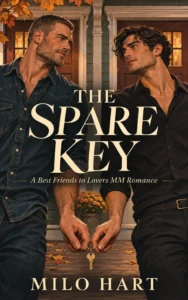
The Spare Key
Twelve years. One spare key. And the friend he never let himself want.
Never Miss a Release
Get new release alerts, exclusive bonus content, and reader-only giveaways.