

Not Your Replacement
An Age-Gap Forbidden MM Romance
by Milo Hart
Shop the ebook · Shop the audiobook
Available at all major retailers
Pairing: MM
Heat: 🌶️🌶️🌶️🌶️🌶️ Inferno
Length: ~84,000 words
Tropes: Ex’s Dad, Age Gap, Silver Fox, Forbidden Romance, Secret Relationship, One Night Stand, Strangers to Lovers, Workplace Romance, Photographer Romance, Praise Kink, Dirty Talk, Light Bondage, Safe Word, Size Difference, Switch, Earned Grovel
The last man I should want is the one who already made me come.
Museum registrar Daniel Reed has ten weeks to save what’s left of a dead glass factory, and zero interest in complications. Then a broad-shouldered, gray-eyed stranger at the factory’s farewell party tells him there are ten replacement blocks in the bar’s glass wall, not nine, walks him out to a frozen parking lot, and takes him apart with one hand.
Monday morning, the museum’s photographer comes down the archive stairs.
Graham Foster. Fifty-five. Steady, quiet, impossible to rush. Father of Oliver Foster, the man Daniel loved for eighteen months and lost two years ago.
Everything Daniel has ever heard about Graham Foster says cold, absent, selfish. Nothing about the man waiting for the light across the drafting table says any of that.
They agree to keep it professional. They last about a week.
Then Oliver comes home to run the museum’s fundraising campaign, and he has no idea his father is sleeping with his ex. Every day they don’t tell him, the lie gets heavier. Every night together, it gets harder to remember why they should stop.
Not Your Replacement is a high-heat, emotional MM age-gap forbidden romance with an ex’s dad, a twenty-two-year age gap, a man who labels everything and a man who keeps everything, a secret that detonates in a darkroom, a real reckoning between a father and son, and a guaranteed HEA. Dual POV. Complete standalone. No cheating.
You’ll love this book if you enjoy:
✅ A one-night stand in a fogged-up pickup that turns out to be your ex’s father
✅ A museum registrar who labels everything and a silver-fox photographer who keeps everything
✅ “Let me watch you.”
✅ A black leather glove that never gets returned
✅ A red-lit darkroom, a print rising out of the developer, and one inch neither man crosses (yet)
✅ A camera strap, an iron bed, a safeword, and a frozen lake that groans like whales in March
✅ A father finally telling his son the worst version of the truth, with no edits
✅ A seventy-four-year-old glass designer who wants her name on her lamp and will swear in front of anybody
✅ Ex’s dad, age gap, secret relationship, workplace romance, praise kink, both men switch, 🌶️🌶️🌶️🌶️🌶️ heat, HEA guaranteed
⚠️ Content Warning: This novel contains explicit sexual content (graphic MM scenes including hand jobs, oral sex, deep throating, rimming, fingering, edging and orgasm denial, light bondage with a camera strap and a safeword, a hand over the mouth, a hand resting on the throat with no pressure, phone sex, sex in a vehicle and other semi-public places, sex without condoms after both men disclose testing, and both leads topping and bottoming; all on-page sex is consensual), a twenty-two-year age gap, a relationship with an ex-partner’s father, a secret relationship and lies to family members, a parent’s past emotional neglect and a cruel, long-unacknowledged betrayal of an adult child, a parent’s late coming out and divorce, a family member’s thyroid biopsy (benign), workplace disclosure, the past loss of fingers in an industrial accident (mentioned), alcohol use, and strong language. No cheating, no violence, no sexual violence. Intended for readers 18+.
📖 Read Chapter One Free
Not sure yet? Read all of Chapter One right here.
Chapter One: Daniel
The Last Shift had been a bar for sixty-one years, and for sixty-one years it had smelled exactly like this: fryer oil, wet wool, beer gone tacky in the floorboards, and under all of it a faint mineral bite the regulars swore was glass dust blown across Furnace Street from the plant.
Tonight the plant was dark.
I could see it through the front wall, which wasn’t a window so much as a grid of old glass block somebody had mortared in during the Eisenhower administration. Every square was thick and greenish and slightly warped, so the Ellis Glassworks across the street came through in pieces. A smokestack broken into six. A loading dock folded in on itself. The sodium lamp over the gate smeared orange through each block like something trapped in honey.
Someone had taped a hand-lettered sign over the bar mirror: THANK YOU ELLIS, 1921–2026. Under it, in a different marker and a much angrier hand, someone had added: NOW WHAT.
The place was packed with people who’d made glass for a living. You could tell by the burn scars, pale and shiny on the backs of hands wrapped around cans of Genesee. Two men in their seventies were crying openly at the end of the bar, and nobody was embarrassed for them.
I was the only person in the room wearing a sweater that cost more than forty dollars, and everybody knew it.
“You’re the museum boy,” said Nora Bell.
She’d found me first, which I should have expected. Seventy-four, five feet nothing, white hair cropped short, and a gaze that could have stripped paint. She set a can in front of me without asking what I drank.
“Daniel Reed,” I said, and held out my hand. “I’m the registrar at the Northbridge Museum of Design. Thank you for meeting me.”
She looked at my hand for long enough that I nearly took it back. Then she shook it, hard, with fingers that felt like they’d been carved from a fence post.
“Registrar,” she said. “I don’t know what that is, and I’m too old to pretend.”
“I keep track of things. Where every object is, what condition it’s in, where it came from, who made it.”
“Who made it.” She laughed. It was not a happy sound. “Then you’re about forty-seven years late, sweetheart.”
I’d spent twenty minutes in my car rehearsing a pitch while my phone ran its battery down to nothing. I had release forms in a folder and a whole paragraph about first-person testimony.
I said, “Tell me.”
Nora’s eyes narrowed. She was deciding whether I meant it.
“Nineteen seventy-nine,” she said finally. “I drew a lamp. Teardrop shade, ribbed, amber cased over white so it glowed like a peach when you turned it on. Took me four months to get the ribbing right. The mold guys hated me.” Something in her face softened for half a second and then set again. “We sold eleven thousand of those damn things the first year. You know whose name went in the catalog?”
“Ellis?”
“Walter Ellis. Simon’s father. Walter Ellis couldn’t draw a bath.” She drank. “Designed by Walter J. Ellis for Ellis Glassworks. Like he’d been up nights. He was in Boca half that year.”
My tongue went into my cheek before I could stop it. It’s a thing I do. My mother says I’ve done it since I was four, right before I’d tell a teacher she’d spelled something wrong.
“Is there a drawing?” I asked. “A pattern book, anything with your name on it?”
“There was. Ask Walter where it went.” She tipped her can toward the ceiling. “Oh, wait. He was a prick, by the way.” She looked past me at the glass block, at the dark plant beyond it, and for a moment she was somewhere else entirely. “They’re clearing it in ten weeks. Simon’s got a buyer for the land. Whatever your museum doesn’t take goes in a dumpster.”
“I know,” I said. “That’s why I’m here.”
“You going to save my lamp, museum boy?”
The honest answer was I don’t know if we have room. I’d seen the inventory estimate and our storage numbers. I’d done the math twice, because I always do it twice.
“I’m going to try to find it,” I said. “And if I find it, I’m going to try to get your name on it.”
She studied me for a long time.
“Tuesday,” she said. “My kitchen, ten a.m. Bring a real recorder, not your phone. And bring donuts. Not the chain ones. Hoffman’s on Ninth.”
“Hoffman’s on Ninth.”
“Don’t be late. I don’t like late.” She slid off the stool, collected a coat from a great-nephew who’d been hovering by the door, and pointed one gnarled finger back at me. “And get a haircut. You look like a sheepdog.”
Then she was gone, and I was alone at the bar with an unopened beer and the release forms she hadn’t signed and the strange, buzzing lightness I always get when something lost turns out to have a name.
I stayed because I didn’t want to go home yet.
Home was a two-bedroom on the east side and a baking show I’d watched every Friday for two years. Home was fine. So I drank Nora’s beer and looked at the glass block.
The orange broke differently through every square—amber in one, almost olive in the next, a cold bottle-green near the bottom where some had been replaced with newer stock. I started counting the replaced ones. Nine.
“It’s better at four in the afternoon.”
The voice came from my left. Low. Unhurried. The voice of a man who didn’t need to be heard to know he’d been listening.
I turned.
He was big. The bar stool looked like a child’s chair under him. Broad through the shoulders, heavy through the chest and thighs, a canvas work jacket washed into softness. Hair cropped close, dark blond gone almost entirely gray. Gray stubble along a hard jaw. A nose that had been broken once and set by someone in a hurry. Mid-fifties, maybe.
And eyes. Deep-set and steady, a color between gray and green that I had seen somewhere before and couldn’t place. Lake water in March.
“Sorry?” I said.
He nodded at the glass. “The sun comes in low off the lake around four. Hits that wall straight on. Every block lights up a different color for about ten minutes, and then it’s gone.” He lifted his glass—something brown, neat. “The night version’s all right. But you’re looking at it like it’s the real thing.”
“I wasn’t aware there was a test.”
The corner of his mouth moved. Not a smile. The rumor of one.
“There isn’t,” he said. “You just looked like the kind of man who’d want to know.”
I should have been annoyed. But there was nothing smug in it. It sounded like an observation he’d filed and handed over because it might be useful.
“How do you know about four o’clock?” I asked.
“I’ve sat here at four o’clock.”
“Waiting for the light?”
“Mostly.” He considered his glass. “Sometimes waiting for the nerve to go home.”
That landed somewhere under my ribs. I let it sit there.
“There are nine replacement blocks,” I said, because apparently that was who I was going to be tonight. “Bottom row and two up in the right-hand corner. The tint’s wrong. Too blue. Somebody broke the originals and couldn’t match them.”
He turned his whole body on the stool to look. He took his time doing it. Then he looked back at me, and something in his face had shifted—interested now, really interested, the way a man looks at something he didn’t expect to find in a junk drawer.
“Ten,” he said.
“Nine.”
“There’s one behind the Christmas lights. Top left.”
I leaned. Behind a strand of dead colored bulbs left over from some long-ago December, one block glowed the wrong cool blue.
“Ten,” I conceded.
“You count things.”
“I label things. Counting’s part of it.”
“What do you label?”
“Everything, if you let me.” I turned my can a quarter-turn on its ring of condensation. “I look at the label first. Before the object. Who made it, when, what it’s made of, where it’s been. Then I know what I’m looking at.”
“And then you look.”
“Then I look.”
“Most people do that the other way around.”
“Most people are wrong a lot.”
He laughed. It came out of him short and low and startled, like he hadn’t planned on it, and it did something to the back of my neck I wasn’t prepared for.
“Graham,” he said, and held out his hand.
“Daniel.”
His palm was broad and warm and his fingertips were rough—calloused in a specific way, along the pads, like he spent his days turning small hard things with precision. He didn’t do the squeeze-for-dominance thing men do. He just held on for one beat longer than he needed to, and let go.
We talked for an hour and a half. I know because I checked the clock over the register when he ordered the second round, and again when he didn’t order a third.
Things I knew about Graham by the end of it:
One. He did not tell you what he did for a living. When I asked, he said, “I look at buildings,” and when I said that wasn’t a job, he said, “It’s been mine for thirty years,” and that was as far as that went.
Two. He’d known some of the men crying at the end of the bar. Around nine he went over, put a hand on each of their shoulders, and said something I couldn’t hear. One of them grabbed his wrist and held on.
Three. He listened like it was a physical activity. He took in what you said and let it sit before he answered.
Four. He did not perform. Not once. I’d been on eleven dates in two years—I’d counted, obviously—and every one of those men had performed. I’d forgotten that sitting across from someone could feel like this: like being in a quiet room with the door shut.
Five. He was watching my mouth when I talked. He was very good at hiding it. He was not quite good enough.
“What are you doing here tonight?” he asked, near the end. “You’re not a glass man. Your hands are wrong.”
“What’s wrong with my hands?”
“Nothing.” He looked at them. He didn’t say anything else for a moment. “No burns.”
“I’m here for work. Sort of.” I folded the coaster in half, then in half again. “They’re clearing the plant. I’m trying to keep pieces of it.”
“Which pieces?”
“As many as they’ll let me.”
He was looking at the coaster. I’d folded it into a perfect rectangle without noticing.
“And you?” I said. “You’re not crying into a Genesee.”
“I’m saying goodbye to a building.” He looked through the glass at the dark shape of the plant, broken into its pieces. “I knew it a long time.”
There was something with weight under that. I didn’t ask. I’d already decided what I was going to do next, and I didn’t want any heaviness in the room when I did it.
I finished my beer.
“Walk me to my car?” I said.
He didn’t answer right away. He looked at me—a long, deliberate pass from my face to my hands to my mouth and back up, and I felt every inch of it like a palm. Somebody put Springsteen on the jukebox. Somebody else booed.
“Where are you parked?” he asked.
“Far.”
“Good,” said Graham, and stood up.
It was eleven degrees, according to the bank sign across the street. The snow had started again—fat, slow flakes through the streetlights—and the cars in the lot were humped under it like sleeping animals. My Subaru was at the far end, past a plow pile taller than I was.
We made it about forty feet.
“This is me,” Graham said, at a dark pickup with a rack on the back. He pulled out his keys. “You’ll freeze before you get your scraper out.”
“I’m from here. I’m used to it.”
“I know.” He opened the passenger door. “Get in anyway.”
I got in.
He came around the front, big and unhurried in the snow, and climbed in and started the engine, and the heater came on with a roar. The cab smelled like coffee and cold air and something sharp and chemical I couldn’t identify. A bag by my feet. Reading glasses folded on the dash.
Neither of us said anything.
The windshield started to fog from the bottom up.
“Daniel,” he said quietly.
“Yeah.”
“You can get out. I’ll walk you the rest of the way.”
“I know.”
“I want to be sure you know.”
I turned in the seat to face him. In the green dashboard light his face was all planes and shadows, and he was looking at me with an expression I couldn’t read except that it was serious, and patient, and very, very focused.
“I know,” I said, and leaned across the bench seat, and kissed him.
He let me. For one long second he let me—let me press my mouth to his, let me find out that his lips were softer than the rest of him and that his stubble scraped—and then his hand came up and settled along my jaw, broad and warm, thumb at the corner of my mouth, and he took over.
Jesus.
He kissed like he talked. Slow. Deliberate. Like he had nowhere else to be until spring. He opened my mouth with the pressure of his thumb and licked into it, unhurried, thorough, tasting whiskey and something underneath it that was just him, and every time I tried to speed it up he slowed it back down. His other hand found the back of my neck. Held me there. Not hard. Just there, so I knew exactly where his hand was and exactly how easily he could keep me.
I made a sound I’ll deny until I die.
“Come here,” he said against my mouth.
“I am here.”
“Closer.”
I got a knee up on the seat and he pulled, and then I was half across the console in a way that would hurt tomorrow, my hands in his jacket, his heat soaking through two layers of wool. The windows were fully white. A plow scraped down Furnace Street, and its orange light swept through the fog on the glass and was gone.
His hand slid down my chest. Stopped at my belt.
He pulled back enough to see my face.
“Yes?” he said.
“God. Yes. Yes. Are you seriously asking—”
“I’m seriously asking.”
“Then I’m seriously answering. Please.”
He undid my belt with one hand. One hand, without looking, like he’d been doing it his whole life—the buckle, the button, the zipper, and then his palm was flat against my stomach above the waistband of my briefs, and he stopped again, and I nearly bit him.
“Graham.”
“I like how you say that.”
“I’ll say it louder if you move.”
That rumor of a smile again. Then his hand slid under the elastic and wrapped around my cock, and every thought I had went white.
He was big all over. His hand was big. He could close his fingers around me with room to spare, and he did, warm and dry and rough, and stroked once, slow, from the base to the head. I was already hard. I’d been hard since closer. He felt how hard and made a low sound in his chest that I felt more than heard.
“There you are,” he murmured.
He stroked me again. Slower. Twisted his wrist at the top so the callus of his palm dragged over the head, and my hips came up off the seat like he’d plugged me into the truck battery.
“Fuck—”
“Shh. I’ve got you.”
“I know you’ve got me, that’s the problem—”
He worked his other hand down and shoved my jeans and briefs lower, past my hips, so he had room, and then he looked down at what he was doing. Openly. In the dashboard light. My cock in his fist, flushed dark and wet at the tip, and the slow drag of his big hand along it, and he watched it the way he’d watched the glass block. Like it was worth the time.
“Look at that,” he said, very quietly. Almost to himself.
My face went hot. My cock jerked in his hand. He felt that too.
“You like being looked at,” he said.
It wasn’t a question, so I didn’t answer it. I put my forehead down on his shoulder instead and breathed into the canvas of his jacket and let him stroke me, slow and steady and maddening, his thumb sweeping through the slick at the head on every upstroke and spreading it down. He wasn’t trying to get me off. Not yet. He was learning me. Which spot made me shake, how much pressure made me swear, how I sounded when he squeezed at the base and held it.
“Faster,” I said into his shoulder.
“No.”
“Graham.“
“Lift your head.”
I did, eventually. His face was very close. His pupils had swallowed most of the gray-green.
“Let me watch you,” he said.
That was it. That was the thing that did it. Not the hand—though God, the hand—but the way he said it, low and plain and certain, like watching me was something he’d decided he was owed and was going to collect.
He sped up.
Not a lot. Just enough. A rhythm now instead of an exploration, tight and twisting and steady, and my hips started moving into it whether I told them to or not, fucking up into his fist while he held my neck with his other hand and kept my face where he could see it. I was making noises. I was saying things. I think I said please. I think I said right there, don’t you dare stop. I know I said fuck more than any adult should in a parked vehicle.
“That’s it,” he said. “That’s it. Don’t hide it from me.”
“I’m not—”
“You were going to. Don’t.”
The heat started at the base of my spine and pulled tight, tighter, and he felt it happen, felt my thighs lock, and he didn’t slow down and he didn’t speed up, he just kept going exactly the same, steady as a metronome, like a man who’d decided where this ended and wasn’t interested in discussing it.
“Graham—I’m going to—”
“I know. Go on.”
I came so hard my vision whited out at the edges. It tore out of me in long pulses, across his knuckles and my stomach and the hem of my sweater, and he stroked me through every one of them, slower and slower, watching my face the entire time. I could feel him watching. I could feel it on my skin like light.
When it was over I was shaking. Actually shaking, a fine tremor through my thighs, my forehead dropped back to his shoulder and my breath sawing in and out against his collar.
He kept his hand on me, loose, until I stopped.
“Okay?” he said.
“I don’t know yet. Ask me in a minute.”
That startled laugh again, low against my temple.
He reached across me into the glove compartment—I felt the stretch of him, all that weight shifting—and came back with a fistful of fast-food napkins.
“Romantic,” I said.
“I’m a practical man.”
He cleaned me up with more care than the napkins deserved, then tucked me back into my jeans, and I let him, boneless, and some distant part of my brain filed that under things nobody has done for me in a very long time.
I came back to myself in stages. The heater. The fog. The very obvious, very substantial ridge of him under my hand where I’d braced on his thigh.
I slid my hand up.
His hand caught my wrist.
Not hard. Just certain. The way he’d held my neck.
“Next time,” he said.
I stared at him. “You’re joking.”
“I’m not.”
“You just—and you’re not going to let me—”
“No.”
“Why?”
He thought about it. He actually stopped and thought about it, his thumb moving slowly over the inside of my wrist, right over the pulse.
“Because I’d like to want something for a while,” he said. “It’s been a long time.”
I didn’t have anything to say to that. I’m a man who always has something to say, and I didn’t.
So I went with: “You’re very sure there’s a next time.”
He looked at me in the green light. Let it sit, the way he did.
“No,” he said. “But I’d like one.”
My phone was dead, of course.
“I’d give you my number,” I said at the door of my Subaru, scraping the windshield with my library card because I’d lost the actual scraper in November. “But I’d have to write it on your hand with a pen I don’t have.”
Graham stood a few feet back in the snow with his hands in his pockets. The flakes were landing on his shoulders and not melting.
“Northbridge isn’t that big,” he said.
“That’s either very romantic or a little bit of a threat.”
“Could be both.” He took the library card out of my hand, cleared the whole driver’s side in forty seconds of big, efficient strokes, and handed it back. “Drive safe, Daniel.”
“That’s it?”
“That’s it for tonight.”
He walked back toward his truck without looking back. I didn’t get in the car until his taillights had turned onto Furnace Street.
I was halfway home, fingers aching on the frozen steering wheel, before I realized I was only wearing one glove.
I did not go back to the Last Shift on Saturday at four o’clock.
I want that on the record. I sat in my study at three-fifteen with my coat on, which is a sentence I’m not proud of, and then I took it off. I told myself it had been one night. I told myself a man who doesn’t give you his last name is giving you an answer.
On Sunday I bought a new glove. On Sunday night I lay in bed and thought about a rough palm and a low voice saying let me watch you, and I jerked off like a teenager, fast and furious and a little ashamed, and fell asleep immediately afterward, which is the closest thing to a full night I’d had in a month.
On Monday I went to work.
The inside of a dead glass factory is the coldest place on earth.
The furnace hall was the size of an aircraft hangar, three stories of brick and iron and filthy clerestory windows, and the furnaces had been cold since November. Every breath came out white. Pigeons muttered up in the rafters, where the light came down in long, dusty columns.
“Two pairs of socks tomorrow,” said Leah Morgan. Our chief curator was wearing a parka so large it appeared to be wearing her. “And don’t touch metal with bare skin. I am not filling out that incident report.”
“I’ve read the safety memo.”
“You’ve memorized the safety memo.” She led me past a row of rusting annealing ovens toward a set of iron stairs. “Prototype room’s on the mezzanine. Simon Ellis says ten weeks, and I believe him, because Simon Ellis has never said a number that wasn’t money. We’ll talk about the campaign next week.” She stopped at the foot of the stairs. “And our photographer. He’s been out here three weeks already. He’s shot half of what you’re about to catalog. Be nice to him. He’s the best we could afford, and he’s better than we deserve.”
“I’m always nice.”
“You’re always correct, Daniel. That’s a different thing.” She tipped her head back and raised her voice. “Graham? Have you got a minute?”
The world did a small, strange skip.
There was a man up on the mezzanine, on a stepladder by the tall windows, a camera raised to his eye. Light came through the dirty glass in a long gold blade, and he was waiting for it, perfectly still. Then the shutter clicked, and he lowered the camera, and turned.
Gray hair. Broad shoulders under a canvas jacket. A worn leather strap around his neck.
He saw me.
He didn’t go still. That came later. What he did first was smile—a real one, this time, small and private and surprised, the smile of a man finding something he’d been told he wouldn’t—and it went straight through me like the light through that window.
He came down the stairs. Unhurried. The iron rang under his boots.
“Daniel,” he said.
“You two know each other?” said Leah.
“We met on Friday,” Graham said. He hadn’t stopped looking at me. “At the Last Shift. The farewell.”
“Small world,” said Leah, already pulling out her buzzing phone. “Daniel, Graham Foster. Graham, Daniel’s our registrar—you’ll be in each other’s way constantly, I apologize in advance. Excuse me, it’s the board—” She walked off with the phone pressed to her ear.
Foster.
My brain did the thing it does. A name comes in, the files open, and it cross-references against everything I have.
Foster.
Oliver Foster. Eighteen months. A ring I’d looked at in a jeweler’s window and never bought. Oliver at two in the morning on my kitchen floor, saying, My dad photographs buildings. That’s what he does instead of showing up.
Oliver’s eyes. That was where I’d seen the color. Gray and green. Lake water in March.
Every bit of warmth that had been rising in me since that smile turned to ice.
I watched Graham’s gaze drop—an ordinary, polite glance, the kind you give a new colleague—to the lanyard around my neck. To the white plastic badge clipped on it. NORTHBRIDGE MUSEUM OF DESIGN. DANIEL REED. REGISTRAR.
And then he went still.
Not paused. Not hesitant. Still, all the way down, the way a man goes still when he’s stepped onto ice and heard it crack. The smile didn’t fade so much as stop existing. His hand closed slowly around the camera strap.
“Daniel Reed,” he said. Very quietly.
A pigeon took off somewhere above us. The light slid off the window and the hall went gray.
“The museum,” said Graham Foster. He lifted his eyes back to mine, and they were Oliver’s eyes, and they weren’t, and I had come in his hand in a parked truck three nights ago.
“You’re Oliver’s Daniel.”
Want to keep reading? The full novel is available now.
🔥 Want an EXCLUSIVE Bonus Chapter?
Somewhere With a Lock — A scene TOO HOT for the bookstore
One year to the night after the Last Shift. Graham has finally put a lock on the darkroom door, and Daniel has finally stopped saying not yet. A red safelight, a Leica, a roll of film nobody else will ever see, and a promise from the worst night of the book, kept in full.
More from Milo Hart
Browse all Milo Hart books.
The Married Man Upstairs
The man upstairs is separated. He's just very bad at saying so.

Never His Son-in-Law
He almost married her. Now he can't stop thinking about her father.

My Ex-Husband’s Brother
I was married to his brother. Now I can't stop looking at him.
Separate Rooms
He signed my invoices. Then he signed them away.
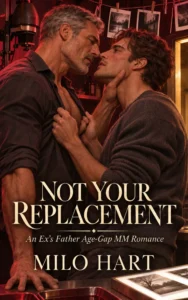
Not Your Replacement
He made me come in his truck. Monday, he walked into my archive with my ex's last name.

The Spare Key
Twelve years. One spare key. And the friend he never let himself want.
Never Miss a Release
Get new release alerts, exclusive bonus content, and reader-only giveaways.