
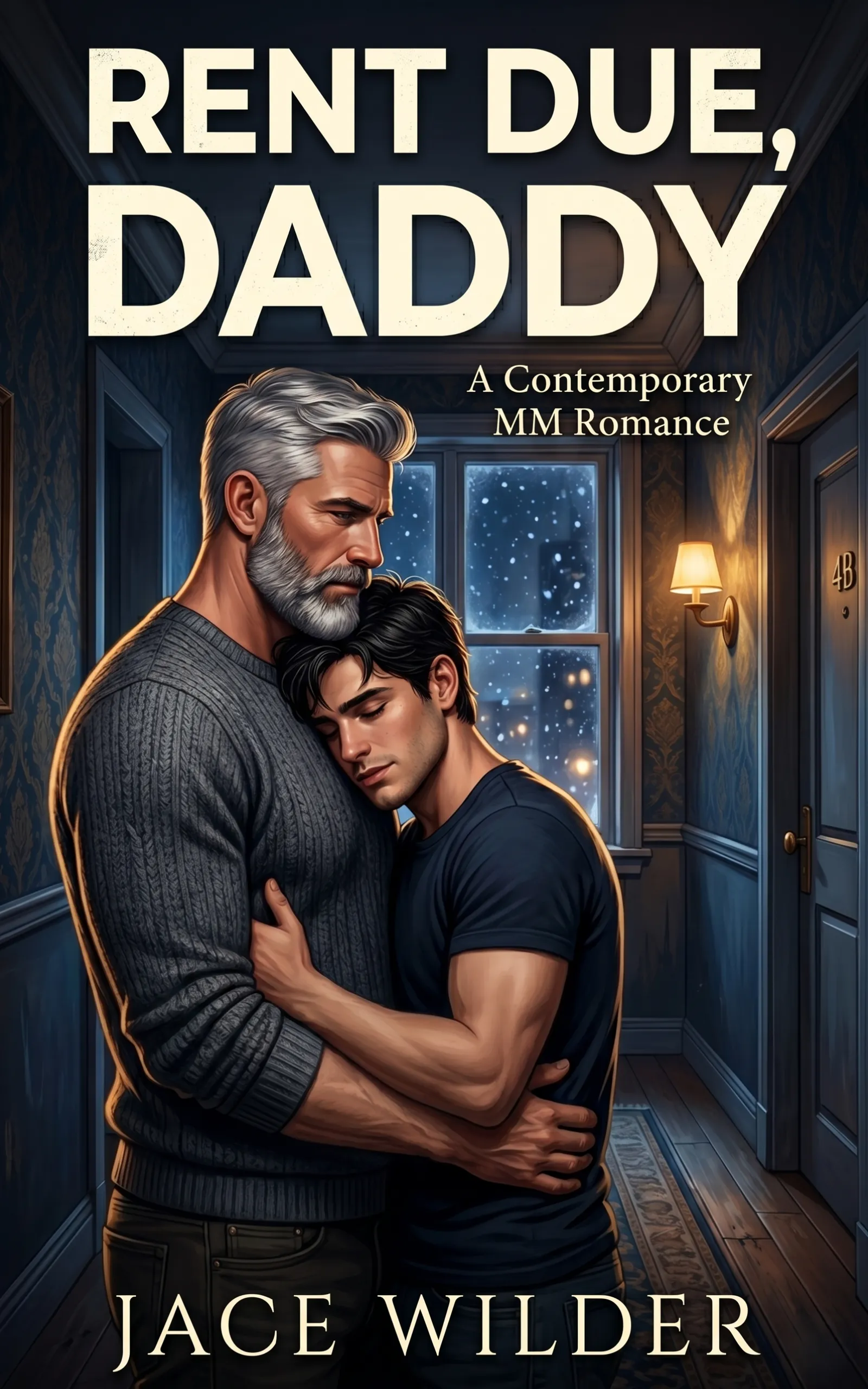
Rent Due, Daddy
A Grumpy Silver Fox MM Romance
by Jace Wilder
See available purchase options
Pairing: MM
Heat: 🌶️🌶️🌶️🌶️🌶️ Inferno
Tropes: Age Gap, Grumpy/Sunshine, Silver Fox Daddy, Praise Kink, D/s Dynamic, Forced Proximity, Hurt/Comfort, Found Family, Slow Burn, He Falls First, Touch Starved, Brat/Tamer
Three months late on rent. One very particular silver-fox landlord. One good boy who finally gets told no — and said yes to everything after.
Eli Carver is twenty-four, three months behind on rent, and tattooing illegally out of the kitchen of his fourth-floor walk-up. He’s aged out of foster care, been blacklisted by an abusive ex, and learned to pay for everything the hard way. When he slides a dollar-store envelope with $412 under his landlord’s door at five in the morning, he has four hundred dollars and a death wish — and he offers to work the rest off.
Ronan Hale is forty-eight, recently divorced, bought the four-story walk-up with his settlement money and hasn’t touched anyone in six years. He came out to himself at forty-two. He says “boy” like a policy. And the last thing he is going to do is take a scared twenty-four-year-old’s body for rent money.
What starts as a payment plan becomes a slow-burning obsession — Eli over his knee for being late, the whole building watching them fall, a predatory developer circling Eli as the “weak link tenant,” and an abusive ex crawling back out of the dark at the worst possible time. Ronan has spent six years telling himself this boy is not for you. He’s done telling himself that.
Eli came here to hide. He’s staying because Ronan built him a home.
You’ll love this book if you enjoy:
✅ Grumpy silver fox daddy x sweet bratty power-bottom artist
✅ 24-year age gap, praise kink, D/s dynamic, HEA
✅ “That’s mine now” possessive-but-tender energy
✅ Nosy found-family neighbors (Mrs. Adler will adopt you)
✅ A landlord who pays his tenant’s gas bill anonymously
✅ Hurt/comfort that actually earns the comfort
✅ The villain defeated by paperwork, not fists
✅ An ending where the broke kid ends up co-owner of the building
✅ 🌶️🌶️🌶️🌶️🌶️ — graphic, explicit, emotional
⚠️ Content Warning: This novel contains explicit MM sexual content, age-gap dynamics (24/48), D/s and praise-kink elements including negotiated OTK spanking and belt discipline in an explicitly consensual romantic relationship, references to past emotional and verbal abuse by a former partner, on-page recovery from past intimate-partner trauma, a minor attempted arson subplot, and frank references to foster-care aging-out. No on-page violence against the main characters. HEA guaranteed. Intended for readers 18+.
📖 Read Chapter One Free
Not sure yet? Read the full first chapter right here.
Chapter One: Three Months Late
Eli
The envelope was too thin and I knew it.
I stood at the top of the third-floor landing at four forty-seven in the morning, holding four hundred and twelve dollars in cash inside a greeting-card envelope I’d stolen from the dollar store because I didn’t own a real one, and I counted the steps down to Ronan Hale’s door one more time.
Twelve steps. Left at the bottom. Third door.
The hallway smelled like old radiator and somebody on the second floor had been cooking garlic at one in the morning again. The bulb outside Mrs. Adler’s door buzzed in that sad, dying way it had been buzzing since I moved in, and the floorboards were cold through my socks because I hadn’t wanted my boots to make noise on the stairs.
You’re a grown man, I told myself. You are a grown man sliding a partial rent payment under your landlord’s door like a raccoon.
Yes, I answered myself. That’s correct. Keep going.
I took the stairs one at a time, the envelope sweating against my palm. Four-twelve was all I had. Rent was nineteen hundred. I was three months behind. The math was not mathing and I had stopped letting myself look at it directly, the way you stop looking at a bad bruise, the way you stop looking at a text from your ex.
I just needed to get the envelope under his door and get back upstairs before he heard me.
Ronan Hale got up at five. I knew this because Ronan Hale got up at five every single day of his goddamn life and the man lived directly under my bedroom and the floors in this building were a hundred and twenty years old and honest. I heard his coffee grinder at five-oh-two. I heard his boots at five-oh-nine. I heard his front door at five-fifteen when he went down to check the boiler, because that was the kind of man he was — a man who checked the boiler at five-fifteen in the morning like it might have feelings about being neglected.
It was four-forty-nine now. I had time.
I made it down the stairs. I made it to the door. I crouched — carefully, slowly, like I was defusing something — and slid the envelope under the crack.
It went three-quarters of the way.
It stopped.
I nudged it with my fingertip. It didn’t move. Something on the other side of the door — a rug, the threshold, God’s sense of humor — had caught the corner, and the envelope was now sticking out of Ronan Hale’s apartment like a little white tongue.
“No,” I whispered. “No no no no no—”
I got down on my stomach. On the hallway floor. In my pajama pants and a hoodie I’d had since I was nineteen. I pressed my cheek to the cold wood and I tried to poke the envelope the rest of the way through with one finger and I was so focused on this, so deeply focused on the envelope and the shame and the specific cosmic unfairness of being me at four-fifty in the morning, that I did not hear the footsteps behind me.
I heard the voice.
“Carver.”
Low. Gravel. Directly above me.
Every muscle in my body tried to leave through my feet at the same time.
I lifted my head slowly, like a dog caught on the counter, and there were boots. Work boots. Scuffed brown leather with the laces double-knotted. My eyes traveled up from there — jeans worn soft at the knees, a dark flannel with the sleeves pushed to the elbows even though the building was freezing, a mug of black coffee held in one enormous hand — and landed on Ronan Hale’s face.
He was looking down at me.
He was not smiling.
His hair was wet at the temples like he’d just splashed water on his face, silver all through the black, and his jaw had that salt-and-pepper scruff he never fully shaved, and his gray eyes were doing the thing they did where they looked at you like they’d already read the last page of your book and were waiting to see if you’d figure it out too.
“Mr. Hale,” I said, from the floor. “Hi.”
He took a slow sip of his coffee.
“Get up,” he said.
I got up. I got up so fast I cracked my elbow on the wall and I didn’t even flinch, because flinching would have required brain cells I did not currently possess. I stood in front of him in my pajama pants and the envelope was still poking out from under his door, visible between us like a piece of evidence at a trial.
“I was just—” I started.
“I can see what you were just,” he said.
“It’s rent,” I said. Stupidly. Like he couldn’t tell.
“I can see that too.”
“It’s — okay, it’s not all of it.”
“I figured.”
He crouched. Just — right there in the hallway, he bent down in one smooth motion that his knees should not have been capable of at forty-eight, and he picked the envelope up off the floor. He held it for a second in his big calloused hand, weighing it, and I watched his thumb drag across the front of it where I had written RENT – CARVER 2C in Sharpie, and I swear to God my stomach turned over.
He straightened up.
“Come on,” he said.
“What?”
“Inside.”
“I — I don’t have to come inside, I can just—”
“Eli.”
He said my first name.
He had never said my first name before. Not once in six months. It had always been Carver or kid or 2C or, one memorable time when I’d locked myself out, you. And now he was standing in his own doorway with my sad envelope in his hand, saying Eli in that voice like gravel under a tire, and my feet just — went.
I followed him in.
I had never been inside Ronan Hale’s apartment.
I had imagined it. Not in a weird way. In a — okay, in kind of a weird way, but in the way you imagine your landlord’s apartment when you live directly above it and you hear him walking around at night and sometimes, when you can’t sleep, you try to map the footsteps to furniture. Couch here. Bed there. That’s the kitchen, where the faucet runs.
I had been close, actually. The couch was where I thought it was — a deep brown leather thing with a wool blanket folded over the back — and the kitchen was to the right, separated from the living room by a butcher-block island with two stools tucked under it. But the parts I hadn’t been able to imagine were the parts that hit me.
The books. A whole wall of them, floor to ceiling, built-ins that he had obviously made himself because the wood didn’t match anything you could buy and the joins were too clean. Westerns, mostly. McCarthy, McMurtry, a beat-up copy of Blood Meridian with the spine held together by tape.
The plants. So many plants. A monstera by the window that looked like it paid its own rent. A row of little succulents on the sill in mismatched ceramic pots that I would bet my life he had not bought himself — somebody had given them to him, probably Mrs. Adler, and he had kept them alive out of stubbornness.
The smell. Cedar and coffee and something warmer underneath, something like whatever aftershave he used, which I had caught whiffs of before in the hallway and had a whole complicated private feeling about. In his apartment it was — it was everywhere. It was the air.
He set my envelope on the butcher block. Slid it about two inches, lined it up parallel with the edge. Then he set his coffee mug down next to it. Carefully. Like the mug was breakable, which it wasn’t — it was one of those thick diner mugs, white, chipped at the rim.
“Sit,” he said, nodding at one of the stools.
I sat.
He leaned against the counter on the other side of the island, folded his arms, and looked at me. Just looked. It was the longest anyone had looked at me without talking in — I couldn’t remember. Jordan used to look at me while he was talking. Jordan looked at me like I was a problem he was in the middle of solving. Ronan was looking at me like I was a weather pattern he was trying to decide how to dress for.
“How much is in there,” he said finally. Not a question. A request.
“Four twelve.”
“Out of nineteen.”
“Yeah.”
“For this month.”
“Yeah.”
“Plus the two behind.”
“Yeah.”
He nodded once, slowly, like I’d confirmed something he already knew and did not particularly enjoy knowing.
“Eli,” he said — my name again, and I was going to have to get used to the way it landed in my chest when he did that or I was going to die in this kitchen. “What’s going on.”
“Nothing,” I said immediately.
His eyebrows moved. Not up. Just — inward. A single millimeter of disappointment.
“Try again,” he said.
“I had a slow month.”
“You had a slow three months.”
“I — yeah.”
“You working?”
“Yeah.”
“Where.”
“Around.”
“Eli.”
“I tattoo, okay? I’m a tattoo artist. I’m working on getting set up and it’s — the getting-set-up part is the part I’m currently in, and it’s not — it’s not the paying part yet, it’s the — the building-up part, and I just need—”
“You tattooing out of your kitchen.”
I opened my mouth to lie. I looked at his face. I closed my mouth.
“Yeah,” I said.
“In my building.”
“Yeah.”
“You know that’s not legal.”
“Yeah.”
“You know that could lose me my certificate of occupancy.”
“I didn’t know that part specifically, no.”
He exhaled through his nose. Not angry. Tired, almost. He picked up his coffee and took a long drink and set it back down in exactly the same place, and then he just stood there for a second looking at the envelope on his butcher block like it had personally wronged him.
“How long you been here,” he said.
“Six months.”
“How long you been behind.”
“Three.”
“How long you been telling yourself you were gonna catch up next week.”
I didn’t answer that one.
He didn’t make me.
“Okay,” he said. He reached into his back pocket and took out the little black notebook I had seen him carrying since the day I’d signed my lease — the rent ledger, I’d figured out eventually, a paper one, because of course Ronan Hale kept a paper ledger. He flipped it open to a page, tapped it twice with the end of his pen. “Here’s how this is gonna go. I’m applying the four-twelve to September. That brings September current to fifteen-oh-eight short. August and July are still out. You owe me forty-eight-twenty all in.”
“Oh my God.”
“I know.”
“Oh my God.”
“You want some water.”
“No — yeah. Yes. Please.”
He poured me a glass of water from a pitcher in the fridge and slid it across the island and I drank the whole thing in one pull and set the empty glass down and he refilled it without saying anything and I drank that one too.
“Friday,” he said.
“What?”
“You got till Friday. Not for all of it. For a plan. I want to sit down with you Friday and hear a real plan — numbers, dates, what you’re gonna pay and when. Not a promise. A plan.”
“Friday.”
“Friday.”
“That’s four days.”
“That’s four days.”
“Okay.”
“And you’re gonna stop tattooing out of that apartment.”
“Mr. Hale—”
“Today.”
“Mr. Hale.”
“Today, Eli.”
“Okay.”
“I mean it.”
“I know. Okay. Today. I’ll — I’ll tell my two clients this week to reschedule, I’ll—”
“Reschedule where.”
“I’ll figure it out.”
He looked at me. Longer this time. The kind of look where I could feel him clocking things — the hoodie, the pajama pants, the dark under my eyes, the sleeve of florals crawling up my forearm, the cover-up on my left wrist that was visible where my sleeve had ridden up when I’d put the glass down. I watched his eyes catch on the cover-up. I watched him not say anything about it.
“Okay,” he said.
And that should have been the end of it.
That should have been it, right? That should have been the whole conversation, the whole scene, me walking out of his apartment with four days to figure out my life and a stern talking-to ringing in my ears, and I should have gone back upstairs and cried into my mattress and started calling people.
But I was tired. I was so tired. I had been tired for a year. I had been tired since Jordan and I had been tired since the drive east and I had been tired since the first night in the shelter before I’d found this place and I had been tired at three in the morning when I’d counted the bills in the envelope for the fourth time hoping the number had changed, and something in Ronan Hale’s kitchen, in the cedar smell and the quiet and the way he had refilled my water glass without being asked, something in all of it knocked loose a piece of me I hadn’t known was about to fall.
I opened my mouth.
I said the thing.
I said, “I could work it off.”
He went still.
I kept going. Of course I kept going. I was a runaway train at this point, I was a Jenga tower, I was a man who had just put his hand in a wood chipper and was explaining why.
“I mean it,” I said. “I — I’ve done — I’ll do anything, I’ll clean the building, I’ll paint, I’ll — whatever you need, I’m good with my hands, I can — or — or anything else, you know, whatever you — I could — anything you want, I mean it, I’ll—”
“Eli.”
“—I’ll work it off, I’m serious, I—”
“Eli.”
His voice did something.
It didn’t get louder. It got lower. It dropped into his chest and came out at a register I had not heard him use before, and the kitchen got very, very quiet around it.
I stopped talking.
He was looking at me. Both hands flat on the butcher block now, on either side of his coffee mug, and his shoulders had gone tight under the flannel and his jaw was doing something complicated, and his gray eyes were on mine and they were not cold, they were not angry, they were burning, they were burning low and careful and furious, and not furious at me — that was the thing, that was the thing that undid me, he was not furious at me —
He reached out.
He picked up the coffee mug.
He set it down.
He set it down so softly it didn’t make a sound, not a clink, not a tap, he set a ceramic mug down on a butcher-block counter and it made no noise, and the care of it, the deliberate care of the way he set that mug down when I could see in his shoulders that he wanted to throw it, that undid something in me I am not going to recover from.
“Don’t,” he said.
“I—”
“Don’t you ever.” He paused. His jaw worked. “Don’t you ever offer me that again. Not to me. Not to anyone. You hear me.”
“I didn’t—”
“Not anyone, Eli.”
“I—”
“You think that’s how this works?” He wasn’t moving. He hadn’t moved. Both hands still flat on the counter, his voice still low, and somehow that was worse than if he had shouted, somehow the stillness of him was a thing I could feel in my ribs. “You think you come down to my door at five in the morning with four hundred dollars and I’m the kind of man who — what. Takes the rest out in trade? That’s what you think of me?”
“No. No, I — I didn’t mean—”
“Or is it you think that’s what you’re worth.”
Oh.
Oh no.
The kitchen tilted a little bit. I put my hand on the butcher block to steady myself and I realized I had stopped breathing somewhere in the last sentence, and I tried to take a breath and it came in shaky, and his eyes tracked the shake and something in his face — shifted. Softened, almost. Not all the way. A millimeter.
“I just,” I said. My voice had gone small. I hated it when my voice went small. “I just wanted to — I didn’t know what else to—”
“I know,” he said.
“I’m sorry.”
“I know you are.”
“I wasn’t — it wasn’t a — I wasn’t trying to—”
“I know, boy.”
Boy.
He said it like it was nothing. Like it was a word he’d used a thousand times for a thousand tenants, and maybe it was, maybe he called everyone in the building boy and kid and son and I had never noticed, but I had noticed now. I had noticed now because he said it low and careful and it walked down my spine like a hand.
My face went hot.
He saw it.
I watched him see it.
For one second — one single second, shorter than a blink — his eyes dropped. They dropped from my eyes to my mouth and back, one clean movement, and then they were on my eyes again and his jaw had set and he had straightened up off the counter and he was putting distance between us like a man stepping back from a ledge.
“Friday,” he said.
His voice was normal again. Almost.
“Friday,” I repeated.
“Ten in the morning. Right here.”
“Okay.”
“Bring a plan.”
“Okay.”
“And Eli.”
“Yeah.”
He looked at me. Held my eyes. I could not tell you what was in his face. I have a whole tattoo portfolio of faces and I could not have drawn what was in his face in that second if you held a gun to my head.
“You’re worth more than four hundred dollars,” he said. “Don’t forget that on your way upstairs.”
I don’t remember the walk back up to 2C.
I remember the door closing behind me — his door, three, quiet, the lock sliding — and I remember my hand on the banister and I remember being on the third-floor landing and then I was inside my own apartment with my back against my own door and I slid down it until I was sitting on the floor in my pajama pants and the cold hallway was suddenly my cold kitchen floor and I put my hands over my face.
I wasn’t crying.
I wasn’t.
I was, a little.
It wasn’t because he’d said no. I had been told no before. I had been told no in a lot of worse ways. Jordan had told me no with his hands, once, and with his voice plenty of other times, and I had taken every no like a dog takes a folded newspaper, and I had learned to flinch and move on and find the next thing to try.
It was because Ronan Hale had said no and then he had said you’re worth more than four hundred dollars and he had said it like it was a fact, like it was on the ledger, like he had written it down in the little black book in pen and he was just reading it to me, and nobody in my entire life had ever told me no like that.
Nobody had ever told me no like it was a kindness.
I sat on my kitchen floor and I pressed the heels of my hands into my eyes and I breathed through my mouth until my chest stopped doing the thing it was doing, and then I got up and I went to the window.
The sun was starting to come up over the roof of the building across the street. That specific gray-pink light that only happens for about nine minutes in October. I pressed my forehead against the cold glass and I watched it and I thought about the way he had set down the mug.
Then I went to the kitchen table and I got my sketchbook and I opened it to a fresh page and I drew him from memory.
Not his face. I didn’t trust myself with his face yet.
His hands.
His hands flat on the butcher block. The veins on the backs of them, the calluses at the base of his fingers, the way one thumb had been pressed down harder than the other like he was bracing for something. I drew the mug between them. I drew it small and chipped and white.
I drew until my fingers cramped and the light changed and the radiator started clanking and somewhere three floors below me I heard a door open and close and I heard his boots on the stairs going out, and I sat at the kitchen table with a graphite smudge on my cheek and a four-day deadline and no plan at all, and I thought:
Oh no.
Oh no, Eli.
You are in so much more trouble than rent.
Want to keep reading? The full novel is available now.
🔥 Want an EXCLUSIVE Bonus Chapter?
First Winter — a scene TOO HOT for the book.
The first snow of December. A fire in the hearth. A collar Ronan’s been oiling for six weeks. An afternoon off-leash with no agenda except Eli, on his knees, wearing the only thing he’s allowed to wear. Edging, kneeling, aftercare on the couch with the snow coming down past the window. Set between Chapters Thirteen and Fourteen — and Eli wears it to Mrs. Adler’s Christmas lunch on Sunday.
More from Jace Wilder
Browse all Jace Wilder books.

Before You Ask Him
He wrote the proposal for his best friend. Every word was about the man holding the ring.
Not Your Practice Husband
Fifteen years of being his practice husband. Six rules. One day he finally knows.

Still Here, Still Yours
He promised to call. Twenty-three years later, he's standing on my ball field.

Hands Full
One good hand. One thin wall. His best friend's little brother on the other side of it.

The Year We Stopped Pretending
They’ve been best friends for twenty-five years. It took one bed to ruin everything.

Two’s Company, Three’s Coming
A Steamy MMM Roommates-to-Lovers Romance
Never Miss a Release
Get new release alerts, exclusive bonus content, and reader-only giveaways.