
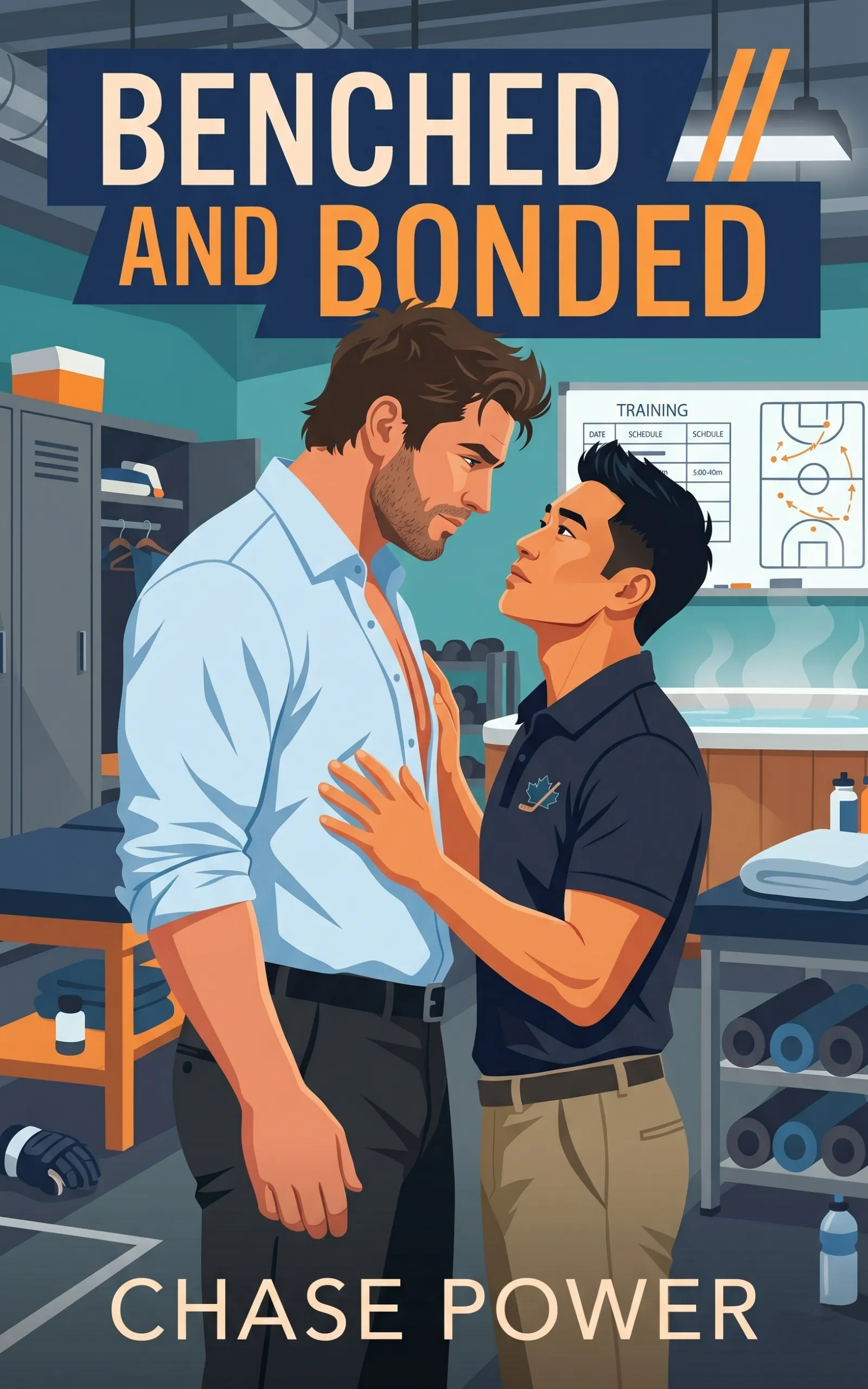
Free with Kindle Unlimited
Pairing: MM
Heat: 🌶️🌶️🌶️🌶️🌶️ Inferno
Tropes: Forbidden Trainer/Patient, Hurt/Comfort, Praise Kink, Grumpy/Sunshine, Forced Proximity, Size Difference, Found Family, Slow Burn
He blew out his knee in front of eighteen thousand people. His trainer rebuilt everything else.
Dylan Mercer hits people for a living. He’s the Portland Riptide’s enforcer — the six-three, two-twenty-five shadow that makes pretty little skill guys hear footsteps every time they touch the puck. When a freak angle on a clean hit blows out his knee, every coach and every critic confirms what Dylan has always secretly believed: without his body, he’s nothing.
Evan Li is the youngest head athletic trainer in the NHL — meticulous, relentless, stubborn enough to hold the line against management when they want to rush Dylan’s timeline. He’s also the first person in Dylan’s life who looks at the wreckage of his knee and sees a whole human being underneath.
What starts as clinical — quad sets, goniometer readings, a red marker circling “GREAT PROGRESS” like a valentine — becomes something neither of them can name and neither of them can stop. Evan’s hands on Dylan’s body. Dylan’s voice saying yes, sir without sarcasm for the first time. A kiss in an empty gym that a janitor interrupts and twenty-four weeks of rehab that neither of them survives unchanged.
But Evan is the man who has to clear Dylan to play again. Management is pressuring him to rush the timeline. Dylan is falling harder every week. And the line between clinical care and love is getting thinner every time Evan walks through the door with an oat milk latte Dylan brought him.
Some ligaments heal in twelve weeks. Some take twenty-four. And some take a man who refuses to quit, a trainer who refuses to leave, and one very patient cat named Hendrix.
You’ll love this book if you enjoy:
- ✅ MM hockey romance with a praise-kink dynamic and explicit D/s undercurrent
- ✅ Forbidden trainer/patient tension handled with real ethical stakes
- ✅ Slow burn that EXPLODES (🌶️🌶️🌶️🌶️🌶️ — graphic, explicit, emotional)
- ✅ Enforcer hero who learns his worth isn’t measured in punches
- ✅ Found family, Hurt/Comfort, and a cat who judges everyone equally
- ✅ HEA guaranteed — and one reader-exclusive bonus chapter too hot for Amazon
⚠️ Content Warning: This novel contains explicit sexual content (graphic MM scenes, D/s dynamic, praise kink), strong language, depictions of traumatic sports injury and surgical recovery, discussions of identity loss and mental health, and professional-boundary negotiation. Intended for readers 18+.
📖 Read Chapter One Free
Not sure yet? Read the full first chapter right here.
Chapter One
Dylan
The hit was clean.
I want the record to show that. Whatever happened after—the stretcher, the silence, the MRI that rearranged my entire fucking life—the hit itself was textbook. Shoulder through the chest, feet planted, head up. I’d thrown ten thousand just like it since I was fourteen years old and some peach-fuzzed bantam coach pointed at the biggest kid on the opposing bench and said, “Make him afraid to touch the puck.”
So yeah. Clean hit.
It was the landing that ruined everything.
Third period, tied 2-2 against Seattle. Our building, eighteen thousand screaming, the kind of Friday night game where the energy in the arena feels like a living thing—this rolling, electric pulse that crawls under your pads and gets your blood up. I’d already dropped the gloves once in the first, a quick scrap with their enforcer after he boarded Nick into next Tuesday. Standard stuff. My knuckles were still singing, the good kind of ache, the kind that reminded me I was useful.
Because that’s what I was. Useful. I hit things, and people cheered, and my teammates slept a little easier knowing nobody was going to run them without answering to me first.
Coach sent me over the boards with forty seconds left in a TV timeout. “Mercer, their top line is out. Make it uncomfortable.”
I loved that word. Uncomfortable. It meant I got to be the thing that went bump in the night, the six-three, two-twenty-five shadow that made pretty little skill guys hear footsteps every time they touched the puck.
I picked up their center at the red line. Mikhailov—quick hands, soft around the edges, the kind of guy who flinched if you breathed on him too hard. He caught a pass at the top of the circle and turned up ice, head down, and I had him lined up like a deer in headlights.
I closed the gap in three strides. Dropped my shoulder. Drove through his chest with everything I had, and the sound was beautiful—that thick, meaty thud of a body-on-body collision that you feel in your molars. Mikhailov went sideways. The puck squirted free. The crowd erupted, eighteen thousand people screaming my name, and for exactly one-point-three seconds, I was invincible.
Then my right skate caught a rut in the ice.
It was small—a divot, a chip, the kind of imperfection that exists on every sheet of ice in every arena in the world and doesn’t matter ninety-nine-point-nine percent of the time. But my weight was wrong. I was still carrying the momentum of the hit, leaning forward, and when my blade caught, my body kept going while my right leg stayed planted.
I felt the pop before the pain.
It was wet. Internal. Like something tearing loose from its moorings deep inside my knee—a sound that wasn’t really a sound, more like a vibration that traveled up through bone and cartilage and every nerve ending I had. My brain cataloged it with a clarity that felt almost clinical: that’s your ACL.
Then the pain showed up.
It came in a white-hot wave that started in my knee and detonated outward—thigh, hip, spine, skull. My leg buckled. I went down on the ice face-first, and the cold burned against my cheek, and I was screaming before I made a conscious decision to scream. Just this animal sound ripping out of my throat, my fingers clawing at the ice like I could dig my way out of my own body.
The crowd noise cut in half. Then in half again. Eighteen thousand people going from roar to murmur to that specific, awful hush that means someone’s really hurt. Not hockey-hurt, not shake-it-off hurt. Hurt hurt.
I rolled onto my back. The arena lights were blinding—those massive overhead rigs that turn everything white and shadowless, like operating room lights, like God leaving the flashlight on. I squeezed my eyes shut and tried to breathe and couldn’t because every inhale sent a fresh spike of agony through my knee, and all I could think was no no no no no—
“Dylan.”
The voice cut through the static in my head like a blade through tape. Calm. Clear. Close.
“Dylan, I need you to stop moving. Can you hear me?”
I opened my eyes. Everything was blurry—tears, or shock, or both—but I could make out a shape kneeling beside me on the ice. Dark hair. Team polo under an open jacket. Brown eyes locked onto mine with an intensity that felt almost physical, like hands gripping my face and holding me still.
The new trainer. Li. I’d seen him around the facility—young, lean, always smiling at something, always carrying a tablet and a coffee. I hadn’t paid him much attention. Trainers were background noise. They taped your wrists and told you to stretch and occasionally frowned at X-rays. I’d never needed one for anything that mattered.
I needed one now.
“Focus on my voice,” he said. His hands were on my leg—one above the knee, one below, stabilizing without moving. They were warm. Steady. Not a single tremor. “Don’t try to move your right leg. I’ve got it. You’re okay.”
“I felt it pop,” I gritted out. The words came through clenched teeth. “My knee—I felt—”
“I know. We’re going to get you off the ice, and we’re going to figure out exactly what happened. But right now, I need you to breathe. In through your nose, out through your mouth. Can you do that for me?”
Something about the way he said it—can you do that for me—cut through the panic. Not a command. A request. Like he was asking for a favor, like my breathing mattered to him personally.
I breathed. In through the nose. Out through the mouth. The pain didn’t get better, but the spiral slowed.
The medical team arrived with a stretcher. I’d seen guys get stretchered off a hundred times and always thought the same thing: rather die than leave the ice like that. But when they lifted me, I didn’t have the luxury of pride. My knee was a white-hot star of agony, and every micro-movement sent lightning bolts up my leg, and I bit down on my mouthguard so hard I thought my teeth would crack.
Li walked beside the stretcher the whole way. One hand on the rail, the other on my shoulder. He was talking—I caught fragments through the pain haze. Vitals, stabilization, something about imaging. But his hand didn’t leave my shoulder, and his voice didn’t waver, and when we got to the tunnel and the arena lights gave way to fluorescent hallway glare, I looked up at him and his expression was the same as it had been on the ice: steady, focused, not afraid.
Everyone else looked afraid. The team doctor, the assistant trainers, the equipment guys lining the hallway—they all had that look, the one that said this is bad without anyone needing to say the words. But Li just kept his hand on my shoulder and his eyes on mine and said, “You’re doing great. Almost there.”
They got me into the medical room. Someone cut my skate off—the right one, careful, Li supervising with that same preternatural calm—and the relief of pressure on my swollen knee made me groan loud enough that the room went quiet.
“Pain scale,” Li said. He was crouched beside the table now, eye level with me, those brown eyes searching my face. “One to ten.”
“Seven.” It was a nine. Maybe a ten. But I was a hockey player, and hockey players lied about pain the way other people lied about their weight.
He didn’t call me on it. Just made a note on his tablet and said to the team doctor, “Let’s get him comfortable and call imaging. I want an MRI tonight if we can get the slot.”
Then he looked back at me. “We’re going to give you something for the pain. The doctor’s going to examine you. I’ll be right here.”
I wanted to say something. I don’t know what. Thank you seemed too small. I’m scared seemed too honest. So I just nodded, and they pushed something into my IV that softened the edges of the world, and the last thing I registered before the drugs pulled me under was Li’s hand, still on my shoulder, and his voice—low, meant only for me—saying, “You’re going to be okay, Dylan.”
He didn’t know that. Nobody did.
But the way he said it, I almost believed him.
I woke up in a hospital bed at eleven-thirty at night, and for three perfect seconds, I didn’t remember.
The room was dark except for the blue glow of monitors and a thin strip of light under the door. The sheets were scratchy. Something beeped in a slow, steady rhythm that matched my heartbeat. I blinked at the ceiling and thought, Did we win?
Then I tried to move my right leg, and the memory came back like a freight train.
The pop. The ice. The scream.
I looked down. My knee was immobilized in a massive brace, packed with ice, elevated on a foam wedge. Even through the drugs, I could feel it—this deep, structural wrongness, like the architecture of my body had been fundamentally rearranged. My knee didn’t feel like a knee anymore. It felt like a bag of loose parts held together by swelling and medical tape.
My phone was on the bedside table. I reached for it, wincing at the pull in my hip, and thumbed it open.
Forty-seven text messages. Twelve missed calls. Nick had sent a voice memo that was just him saying “Dyl, bro, call me, I’m freaking out” on a loop for thirty seconds. Holloway, our captain, had texted a simple Thinking of you. Whatever it is, we deal with it. Half the team had sent some version of get well soon, big man.
I scrolled through them and felt nothing. Not gratitude, not comfort. Just a hollow buzzing in my chest, like someone had scooped out my insides and left the shell running on autopilot.
Then I got to the bottom of the thread and saw one I didn’t recognize. A number not saved in my contacts.
Hi Dylan — this is Evan Li, head AT. Wanted to let you know your MRI is scheduled for 7am tomorrow. The imaging will give us the full picture. Whatever it shows, we’ll have a plan. Try to sleep if you can.
Evan Li. The trainer. The calm voice, the steady hands.
I stared at the message for a long time. Whatever it shows, we’ll have a plan. Not it’ll be fine. Not don’t worry. A plan. Like he was already two steps ahead, already building something, already working.
I didn’t respond. I put the phone down and stared at the ceiling and tried to imagine a version of my life where I didn’t play hockey.
The ceiling had no answers.
My phone buzzed again. Marcus.
I picked it up before I could stop myself.
Saw the game. That sucks. Hope you’re ok.
Four months since he’d texted me. Four months since he’d sent I don’t think I can do the whole caretaker thing and vanished like I was a subscription he’d decided to cancel. And now this—eight words of nothing, sent from a safe distance, just enough to technically qualify as giving a shit.
I deleted the message. Put the phone facedown on the table.
The monitors beeped. The ice machine hummed. Somewhere down the hall, a nurse laughed at something, and the sound was so normal, so fine, that it made me want to put my fist through the wall.
Instead, I closed my eyes and tried to sleep, and when I finally drifted off, the last thought in my head wasn’t the injury or Marcus or the eighteen thousand people who’d gone quiet.
It was a pair of steady brown eyes and a voice that said you’re doing great like it was the truest thing in the world.
The MRI was at seven. The results came at nine-fifteen.
I knew before anyone said a word.
You learn to read faces when your job is reading the intent of two-hundred-pound men skating at thirty miles an hour. The team doctor—Harding, a silver-haired guy who’d seen everything twice—walked into my room with his tablet and a careful expression that was trying very hard to look neutral. Behind him was Li—Evan—in a fresh team polo, tablet in hand, coffee nowhere in sight. His face was harder to read. Not neutral. Something else. Something I’d later learn was the expression of a man who had bad news and had already started building the bridge over it.
“Dylan,” Harding said. He sat down. Bad sign. Doctors who sit down are about to ruin your day. “Let me walk you through what the MRI showed.”
He pulled up the images on his tablet and turned them toward me. I’d seen MRIs before—every hockey player has—but I’d never seen my own knee look like that. Even to my untrained eye, the image was wrong. Shadows where there should have been clean lines. A gap where something should have been connected.
“Complete tear of the anterior cruciate ligament,” Harding said. “Partial tear of the medial collateral. Significant bone bruising across the tibial plateau.”
The words landed one at a time, like stones dropping into still water.
“Surgical reconstruction is recommended. We’d use a patellar tendon autograft—your own tissue, gold standard for athletes. Recovery timeline is nine to twelve months for full return to play.”
Nine to twelve months. The season would be over in five. The math was simple and devastating.
“So I’m done,” I said. My voice sounded weird. Flat.
“For this season, yes.” Harding was gentle about it, the way you’re gentle with someone who’s about to break. “But the surgery has an excellent success rate, and with proper rehabilitation—”
“Proper rehabilitation,” I repeated.
Evan spoke for the first time. He’d been standing by the window, backlit by the grey Portland morning, and when he stepped forward, there was something in his posture that was different from Harding’s careful sympathy. He looked like a man with a blueprint.
“I’ve already drafted a preliminary rehab protocol,” he said. He tapped his tablet and a timeline appeared—color-coded, week-by-week, with milestones and targets stretching out across the better part of a year. “Post-surgical, we start with basic range-of-motion and quad activation within the first week. Progressive weight-bearing by week three. Pool therapy by week five. Strength building through weeks seven to twelve. Sport-specific training after that, building to return-to-play testing around month eight or nine.”
I stared at the timeline. It was meticulous. Obsessively detailed. Every week had specific goals, specific exercises, specific benchmarks. He’d built it overnight, I realized. Between the arena and right now, this guy had gone home and built a nine-month roadmap for putting me back together.
“The knee is reconstructable,” Evan said, and the word he emphasized wasn’t knee but reconstructable—like that was the part that mattered, the possibility, not the damage. “The MCL partial should heal conservatively alongside the ACL graft. The bone bruising resolves on its own. What matters is the rehab, and the rehab is something we can control.”
We. Not you.
“I won’t sugarcoat it,” he continued. “It’s going to be the hardest physical work you’ve ever done, and some days it’s going to feel like you’re going backward. But if you commit to the protocol—fully commit, no shortcuts—you have a legitimate path back to the ice.”
I should have felt something. Hope, maybe, or determination, or at least the grim satisfaction of having a plan. But all I heard was nine to twelve months and this season is over, and all I could see was my own knee on that MRI, torn apart, useless.
I made myself smile. The kind of smile I’d perfected over years of post-fight interviews, the one that said I’m fine when my hands were broken and my face was split and everything hurt.
“Guess I’ve got time to learn guitar,” I said.
It didn’t land. Harding gave a polite exhale. Evan just looked at me, those brown eyes steady and unimpressed, like he’d heard the joke for what it was—a wall going up—and had already decided he was going to climb it.
“Surgery’s scheduled for Thursday,” Harding said. “I’ll have the surgical team come talk you through the procedure this afternoon. In the meantime, rest. Ice. Keep the brace on.”
He stood up, squeezed my shoulder in that doctorly way, and left.
Evan didn’t leave.
He stood by my bed with his tablet against his chest, looking at me like he was running calculations. Not cold—there was warmth in it, the kind of warmth that came from competence and purpose rather than pity. He wasn’t sorry for me. He was already working.
“You’ll get the protocol in your email tonight,” he said. “Read it when you’re ready. Don’t Google your injury—every horror story online is someone who didn’t do the rehab right. You’re going to do the rehab right.”
Not a question. A statement. Like it was already decided.
“And Dylan?”
I looked up.
“Whatever you’re feeling right now—the anger, the fear, the ‘I’m fine’ thing you’re doing—that’s normal. All of it. Don’t fight it. Just don’t let it make your decisions.”
He held my gaze for one more second, then turned and walked out, and I was alone with the beeping monitors and the MRI images still glowing on Harding’s abandoned tablet.
I stared at the screen. At the torn-apart architecture of my knee. At the gap where something essential used to be.
Then I picked up the water pitcher from the bedside table and hurled it at the far wall.
It hit with a deeply unsatisfying plastic thud, water splashing across the floor, ice cubes skittering under the guest chair. Not even a real break. Not even a proper destruction. I couldn’t even throw something right with my whole body screaming at me.
I sat there in the aftermath—wet floor, scattered ice, chest heaving—and felt the full weight of it settle onto my shoulders like a physical thing.
I was twenty-seven years old. I’d built my entire life around being the guy who hit hard, fought harder, and never stayed down. Every coach I’d ever had told me the same thing: You’re not a skill guy, Mercer. You’re not a playmaker. You’re the muscle. You’re the fear. That’s your value.
And now the muscle was torn. The fear was mine. And the value—the only value I’d ever been taught to believe in—was lying in pieces on an MRI, color-coded in shades of damage.
I didn’t cry. Enforcers don’t cry.
But I sat in that hospital bed with water dripping down the wall and ice melting on the floor, and I thought: If I can’t fight, what am I?
Nobody answered.
They discharged me the next afternoon with a brace, crutches, a pharmacy bag full of meds, and a follow-up schedule that read like a second job. Nick drove me home because Nick was twenty-three and incapable of leaving anyone alone, and he chattered the entire way about the game (we lost in OT), the team’s road trip next week, a new restaurant in the Pearl District, anything except the thing we were both thinking about.
I let him talk. It was easier than silence.
My apartment was exactly the way I’d left it—clean enough, bare enough, the kind of place that looked expensive and felt empty. Two-bedroom condo in the Pearl, floor-to-ceiling windows overlooking the river, a kitchen I used exclusively for coffee and reheating takeout. I’d lived there for three years and it still looked like a hotel room. No art on the walls. No photos on the fridge. The only sign that a human being occupied the space was a stack of history books on the nightstand and a gaming setup in the living room that could’ve powered a small spacecraft.
Nick helped me onto the couch, propped my leg on the coffee table with approximately nine pillows, and stood in my kitchen looking lost.
“You need anything? Food? I can order something. Or I can cook—I mean, I can’t really cook, but I can make, like, pasta. Everybody can make pasta.”
“I’m good, Nick.”
“You sure? Because I can stay. I don’t have anywhere to be. I mean, I have film review at six, but I can skip it, Coach won’t—”
“Nick.” I looked at him. He was hovering in that way people do when they want to help but don’t know how, his big frame taking up too much space in my kitchen, his face doing a terrible job of hiding the worry. “Go to film review. I’m fine.”
He didn’t believe me. I didn’t believe me either. But he nodded, squeezed my shoulder way too hard (I didn’t flinch, because enforcers don’t flinch), and left with three separate promises to check in later.
The door closed. The apartment went quiet.
I sat on the couch with my knee throbbing under the brace and my crutches leaning against the wall and the entire evening stretching out in front of me like a sentence I didn’t know how to finish. Normally at this hour I’d be at the rink—practice, workout, film, whatever. The rhythm of a hockey season is relentless and all-consuming, and I’d spent my entire adult life inside it, letting it carry me from one day to the next without ever having to think about what I wanted, who I was, what any of it meant beyond the next shift, the next hit, the next fight.
Now the rhythm was gone. And the silence it left behind was louder than any arena I’d ever played in.
I picked up my phone. Scrolled through the messages again. Responded to Holloway (Thanks, Cap. I’ll be alright), to my mom (I’m home, knee’s messed up, surgery Thursday, don’t worry—she’d worry anyway, she always did), to Chloe (I’m fine, stop calling, I’ll FaceTime you tomorrow).
Then I opened Evan Li’s message again.
Whatever it shows, we’ll have a plan.
I thought about the timeline he’d built. The color-coded weeks. The way he’d said reconstructable like it was a promise and not a diagnosis.
I thought about his hands on my knee on the ice—warm, steady, sure. The way his voice had cut through the panic like a scalpel, precise and clean. The way he’d stood in my hospital room this morning and looked at me, not with pity, not with careful distance, but with something that looked a lot like I see you and I’m not going anywhere.
My phone buzzed. Email notification.
From: Evan Li, MS, DPT, ATC Subject: Your Rehab Protocol — Read When Ready
I opened it. The attachment was a forty-seven-page PDF. Forty-seven pages. For a knee.
At the top, he’d written a note:
Dylan — This is your roadmap. It’s not a suggestion. It’s a commitment, from both of us. Every exercise, every milestone, every timeline is based on the best available evidence and tailored specifically to your injury, your body, and your goals. We start the day after surgery. I’ll be there. — Evan
I read it twice. Then I put the phone down, leaned my head back against the couch, and stared at the ceiling of my expensive, empty apartment.
Nine months. Maybe twelve. An entire year of my life spent trying to rebuild the one thing that made me worth anything.
And somewhere in this city, a trainer I barely knew had already stayed up all night building the blueprint.
I didn’t know what to do with that.
So I closed my eyes, and I let the pain meds drag me under, and I slept without dreaming.
Want to keep reading? The full novel is available now.
🔥 Want an EXCLUSIVE Bonus Chapter?
Held — A scene TOO HOT for Amazon
One year later. Dylan and Evan are running their first community injury-prevention workshop. Evan’s been watching Dylan all afternoon. The drive home is twenty-five minutes of Evan’s voice telling Dylan exactly what’s going to happen when they get there. What follows is soft cuffs, a silk blindfold, extended denial, full aftercare — and a question Dylan has been carrying in his nightstand for three weeks.
7,700+ words. Explicit throughout. Reader-exclusive. Free.
More from Chase Power
Browse all Chase Power books.
Firehouse Heat
He trained me to follow orders. Then he gave me one I couldn't resist.

Off-Ice Husband Material
He married his best friend in Vegas. Now he has to survive living with him.
Rookie Roommates
The walls were thin. So were his defenses.
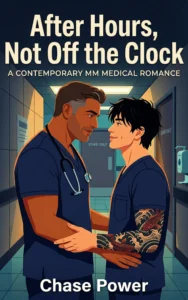
After Hours, Not Off-the-Clock
Two exhausted men. One rule: only after hours. The hospital never prepared them for this.
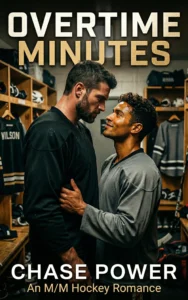
Overtime Minutes
"No more overtime" becomes "no more holding back."
Never Miss a Release
Get new release alerts, exclusive bonus content, and reader-only giveaways.